 CN Sweaters
An argyle sweater vest can fail even when every diamond looks correct in the artwork. The knitted panel may change width after finishing, the centre line may move off the garment centre, a diagonal may break at the neckline, or long floats may snag during wear. Enlarging the same chart for every size can create another problem: the motif grows with the body until the upper sizes look like a different design.
The production brief therefore needs two connected systems. One controls the garment block, including shoulder, chest, armhole and length. The other controls the pattern in wales and courses, including repeat size, colour fields, diagonal lines and placement landmarks. The buyer must decide where these systems stay fixed and where they are allowed to change.
This guide focuses on that decision. It explains how to choose a knitting route, grade the motif across sizes, build a useful sample matrix, price the real chart architecture and inspect bulk without relying on a visual “looks close” approval.
What Must the Argyle Pattern Brief Freeze?
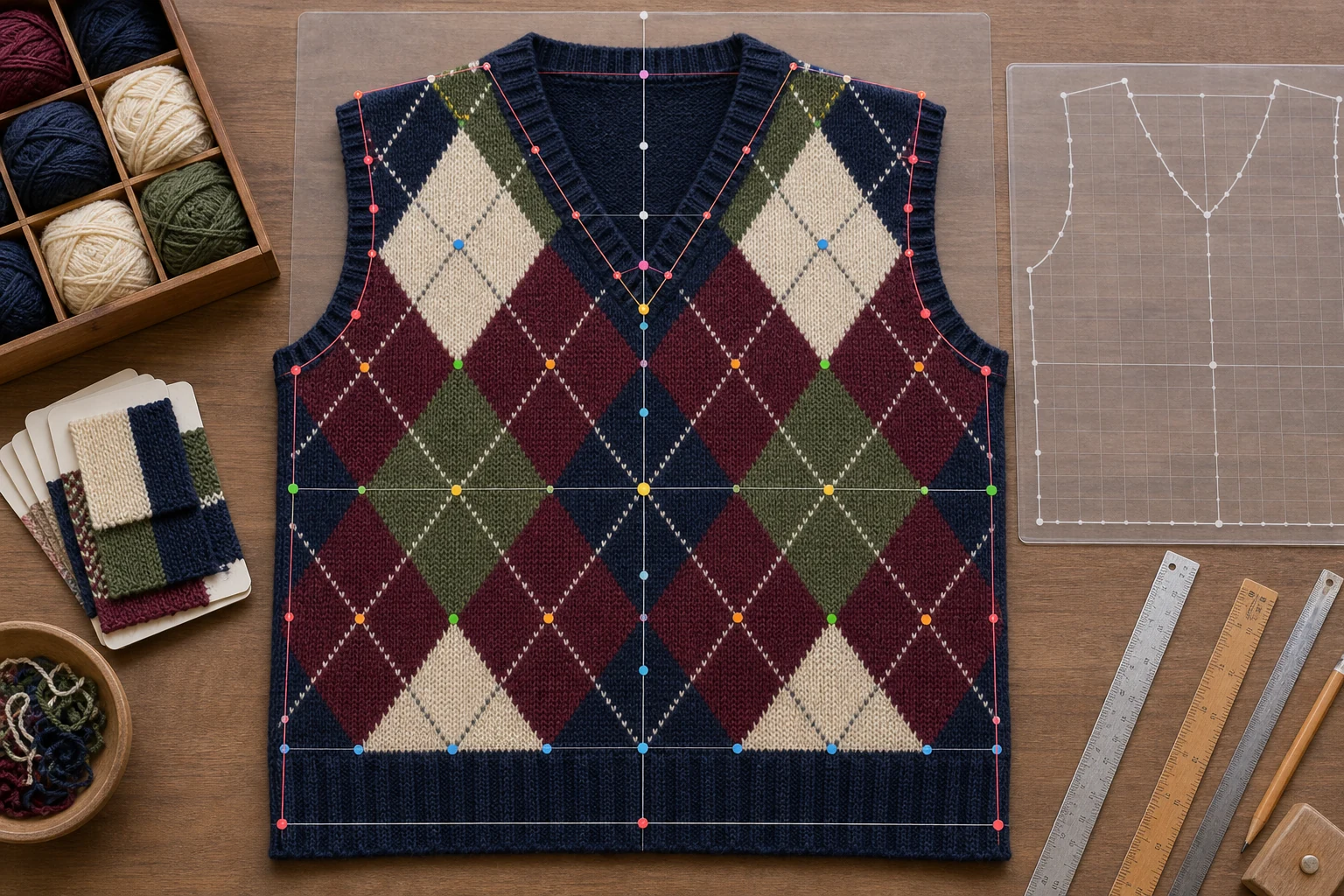
The artwork file should begin with the intended garment, not a cropped image of diamonds. State whether the vest is fitted, classic or oversized; what it layers over; the gauge and yarn family; and the approved base-size measurements. Shoulder coverage, V depth, armhole shape and body length decide how much usable pattern area remains after shaping.
Separate design landmarks from repeat data
Create a front-panel drawing with a true centre line, shoulder endpoints, neckline point, armhole start, hem seam and side seams. Then place the argyle landmarks on that panel. Useful landmarks include the centre of the dominant diamond, the first full diamond below the V point, the height where diagonals cross, and the distance from the lowest motif row to the hem.
Record the chart in stitches and rows as well as centimetres. ISO 23606:2009, confirmed current in 2025, covers systems of symbolic notation and pattern design for knitted fabrics. A buyer does not need to impose one software format, but the approved package must show how colour and stitch information is represented. A screenshot alone cannot tell the next technician whether a line occupies one stitch, two stitches or a plated structure.
Use the knitwear tech-pack checklist to connect the chart version to the garment sketch, size table and bill of materials. Put a revision code on every chart. “Final argyle” is not a revision system.
Define what may move
Some motifs should remain centred even if a partial diamond becomes narrower near the side seam. Other programs need a fixed diamond width but allow the number of repeats to change by size. Write that rule before grading. Also state whether the front and back share the same pattern, whether the side seams must match, and how much interruption is acceptable at the neckline and armhole.
The brief should include an exclusion list. For example: no clipped diagonal at the V point, no full diamond cut in half at centre front, no unplanned colour join within a visible field, and no loose float crossing the armhole edge. These are release conditions, not styling comments.
Which Knitting Route Fits the Design?
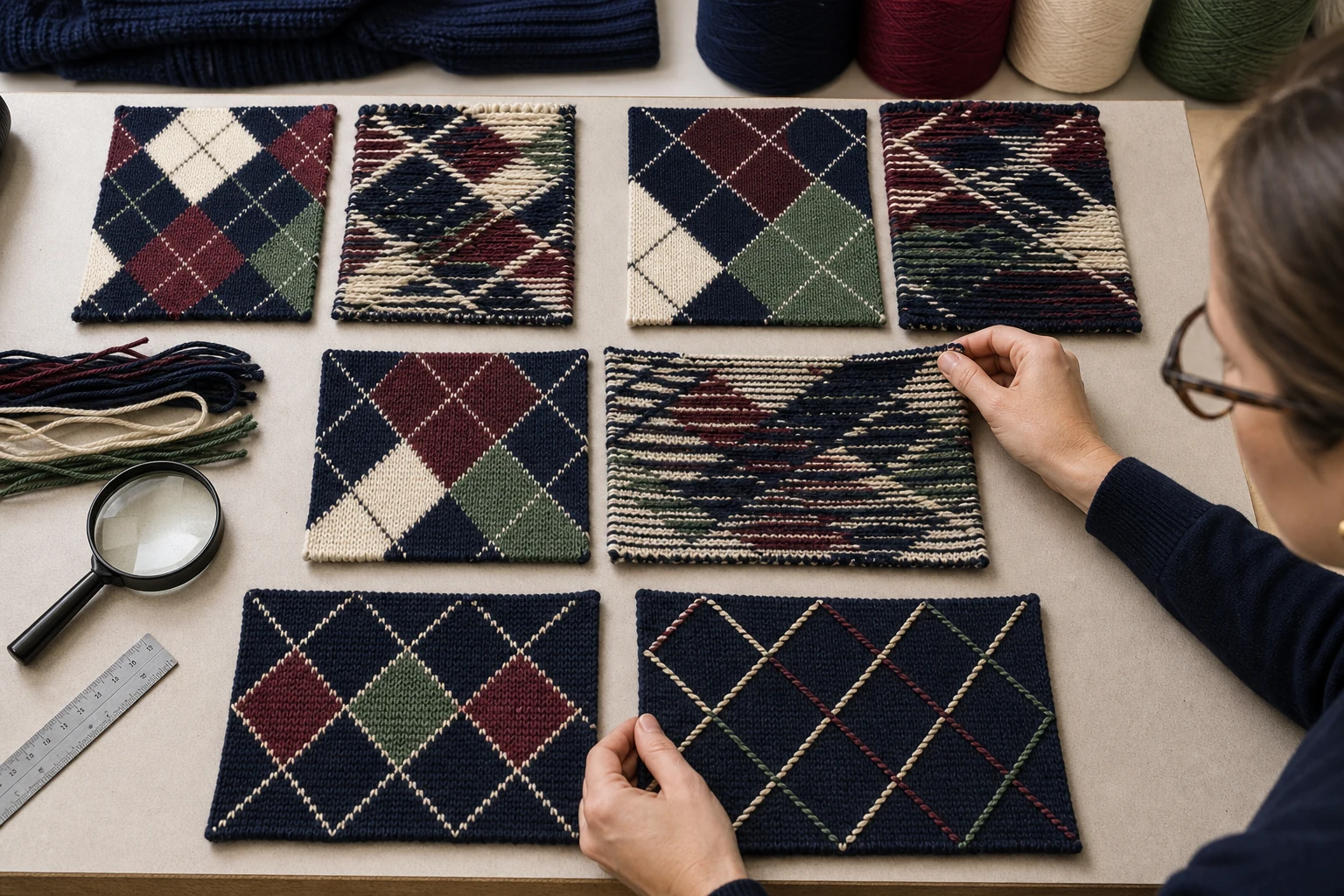
Argyle can be produced through intarsia, jacquard, plating, embroidery or a mixed route. The visual reference does not select the method. Route choice changes the back appearance, yarn travel, weight, stretch, programming time and risk at colour boundaries.
Compare the back as carefully as the face
Dedicated flat-knitting equipment can use intarsia carriers. A STOLL machine guide specifically lists classic argyle among intarsia applications in its Performer machine documentation. That example shows that intarsia is a real production route, but it does not prove that every factory, machine or argyle chart is suitable. The supplier must demonstrate the proposed chart on the intended machine and yarn.
Use the following comparison to structure the route trial:
| Route | Best use in an argyle vest | Evidence required before approval |
|---|---|---|
| Intarsia | Large colour blocks with limited yarn carried behind | Face and back knit-down, boundary security, carrier plan and yarn-tail control |
| Jacquard | Repeated pattern needing stable colour distribution | Backing structure, weight, stretch, float length and colour separation |
| Embroidered diagonal | A clean knitted diamond base with a separate crossing line | Thread route, penetration, stretch compatibility, end security and wash result |
| Mixed route | Design that needs large fields plus a fine accent line | Component sequence, colour registration, repair method and capacity proof |
Ask for face and back photographs under the same light, then retain the physical knit-down. If the vest is meant to sit over a white shirt, inspect the reverse through the armhole and neckline. A technically acceptable back can still look untidy in use.
Control colour boundaries and diagonals
Approve the diagonal thickness in stitches, not as a vague “fine line.” Check every crossing point and every direction change. At a colour boundary, review holes, tight columns, yarn tails and local stiffness. A correction that closes a hole can also shorten the panel or pull the diagonal out of line.
The trial should use the proposed production yarns. A smoother substitute may hide carrier drag or boundary bulk. Compare colour under daylight and store lighting, and use the colour-shade control guide to connect each colourway to approved yarn and lot references.
How Should Diamond Geometry Survive Size Grading?
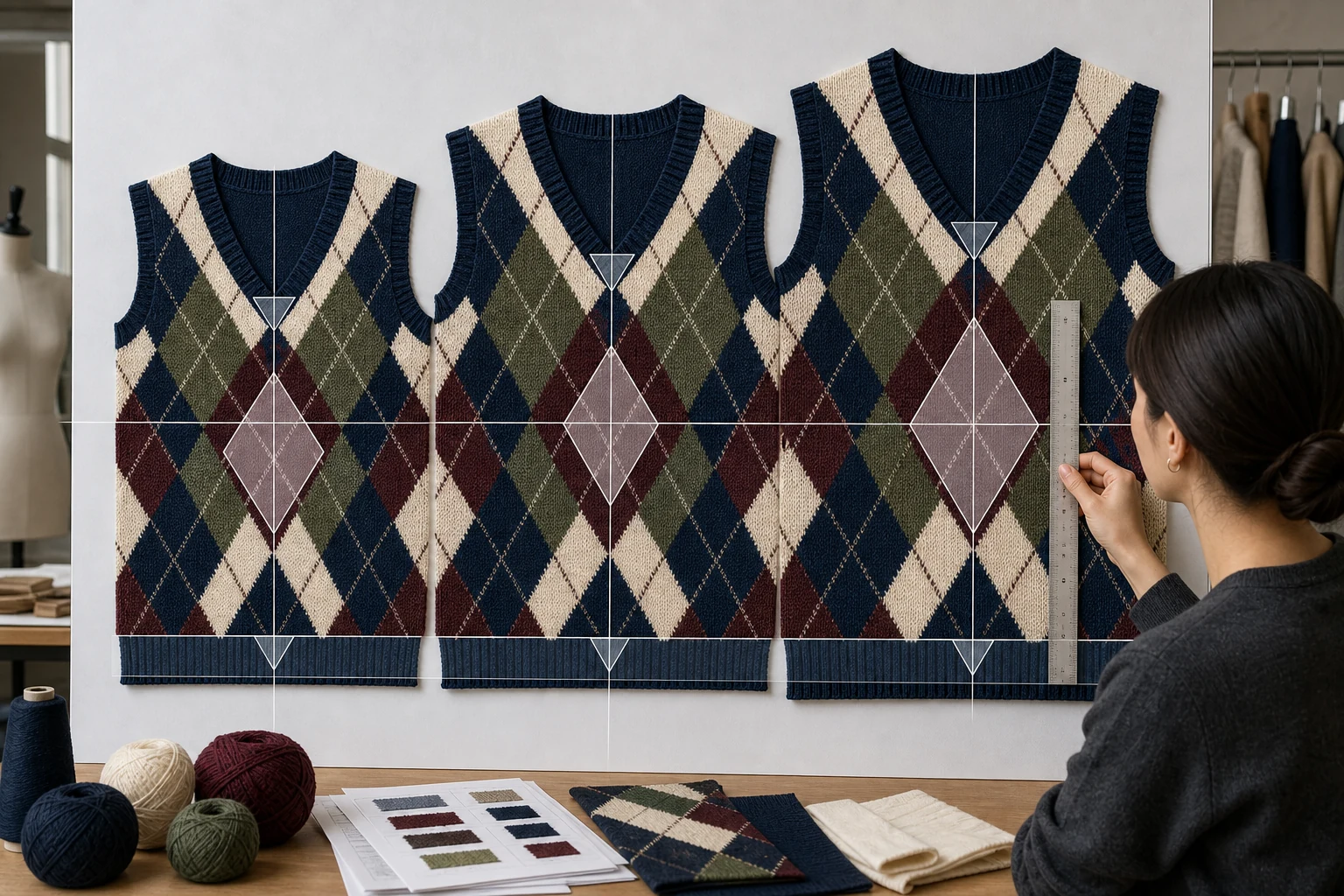
The garment and motif should be graded as separate maps, then reconciled. Body width is measured in centimetres; the chart is built in wales and courses. Finishing changes the conversion between them. If the team scales a bitmap to the new chest width, it loses control over stitch count, line thickness and the centre landmark.
Choose one of three size architectures
A fixed-repeat architecture keeps diamond width and height constant. Larger sizes gain complete or partial repeats toward the side seams. This protects motif character, but the technician must decide where added repeats enter and how they meet the armhole.
A fixed-count architecture keeps the same number of major diamonds across sizes. Diamond width changes by size, so separate charts or controlled stitch reallocations are needed. This route can preserve a clean centred layout, but upper and lower sizes must be compared because the motif character may change.
A hybrid architecture holds the centre module and diagonal thickness while adjusting the outer fields. This is often useful when the centre-front diamond is the design identity and side-seam matching is secondary. It still requires size-specific rules; “centre it” is not enough.
The buyer should select an architecture based on the range. A narrow XS to L range may tolerate one shared chart with controlled side adjustments. A broad unisex or plus range may need chart families. Review the custom sweater vest MOQ and size planning guide before adding size families, because each family can add programming, sample and approval work.
Grade vertical placement separately
Width changes do not answer where the motif sits vertically. Decide whether the first complete diamond is referenced from the shoulder, V point, underarm or hem. A hem reference protects the lower border; a neckline reference protects the visible relationship at the chest. When body length changes, one cannot automatically preserve both.
Mark the intended compromise by size. Check the V point against the nearest crossing line, the underarm against the nearest diamond apex and the hem against the final motif row. Use lower, base and upper sizes to expose a bad rule. The size-grading guide is useful for garment dimensions, but the argyle chart still needs its own landmarks and transition rules.
What Should the Sample Matrix Prove?
One attractive base-size sample proves very little about a multi-size argyle order. Sampling should remove route, chart, fit and colour risks in an economical sequence.
Start with route knit-downs
First compare the viable knitting routes on a panel large enough to include a full diamond, a diagonal crossing and at least one colour boundary. Record yarn identity, machine, gauge, loop length or density setting, chart version and finishing route. Measure the rested panel before and after finishing.
ASTM D8007-24 covers separate wale and course counts for weft-knitted fabrics. Those counts can help the team describe density consistently and diagnose why a motif became wider or taller. They do not replace the approved garment measurement method, and the buyer should agree the applicable procedure with the testing party.
Select the route only after looking at the face, back, stretch, local thickness and correction risk. Then produce a base-size garment to settle block balance and motif position. Use the pre-production sample review to document what that garment is allowed to release.
Add sizes and colourways by risk
The size set should include the sizes where the chart rule changes, not just a habitual middle trio. If the upper size adds a repeat, sample that size. If the smallest size compresses outer diamonds, sample it. If two body blocks share the same commercial size label, treat them as separate cases.
Do not sample every colourway automatically, but identify which one exposes each risk. High contrast makes broken diagonals and boundary gaps easier to see. A pale colourway may reveal reverse-side show-through. A dark saturated combination may create greater staining concern.
For a washable product, ISO 105-C06:2010 is a current reference for colour fastness to domestic or commercial laundering. Dimensional change also needs a specified washing and drying procedure. The order file must state the exact procedure, specimen, acceptance grade, cycle count and rest condition. Naming a standard without those choices is incomplete.
How Do Route and Chart Count Change Cost?
The quote should identify the approved production architecture. “Four-colour argyle vest” is too broad because two four-colour designs can require different carrier movement, backing, chart count and handling.
Ask for the cost basis
Request the machine class, gauge, number of active colours in one knitting zone, intarsia carrier or jacquard requirement, estimated knitting time, yarn consumption, waste allowance and finishing route. Add programming by chart family, size-set samples and any manual work for yarn tails or embroidered lines.
The custom knitwear cost-driver guide helps separate material, setup and process costs. For this style, the most useful scenario comparison is:
- one shared chart with fixed repeats;
- separate charts for lower, base and upper size groups;
- a simpler knitted field with a secondary applied diagonal.
Compare the finished result and reject exposure as well as the quoted unit price. A cheaper route that creates frequent holes or motif misplacement can consume the saving in sorting and rework.
Keep yarn and garment minimums visible
Each colour may have a yarn purchase or dye minimum even when it occupies a small area. Several low-volume colourways can leave residual yarn without producing enough garments to recover programming and sample work. Review the yarn-planning guide and decide which colours are shared across the range, which are exclusive, and who owns usable balance stock.
The purchase order should name approved chart families and colourways. If the buyer later moves a diagonal colour, changes the diamond scale or widens the size range, the supplier must recheck programming, yarn allocation, samples and delivery. Treat that as a controlled change rather than a free artwork edit.
How Should Bulk Inspection Measure Motif Drift?
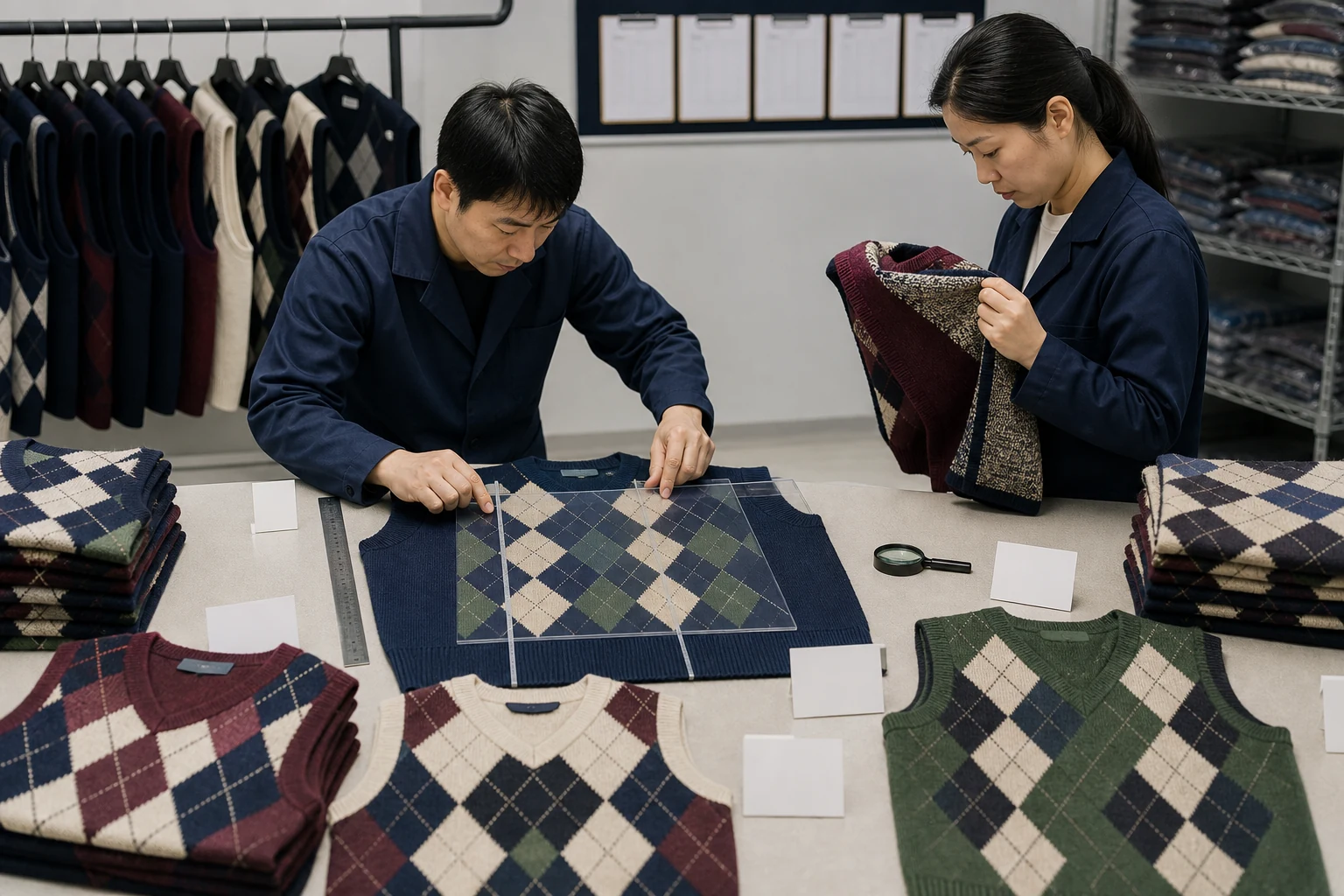
Bulk inspection needs a first-off from each chart family and colourway risk group. Check it after the production finishing route and a stated rest period. An unwashed panel cannot release a finished vest.
Use pattern-specific points
Measure garment chest, length, shoulder, V depth and armhole first. Then check:
- centre-front offset of the approved dominant diamond;
- diamond width in wales and height in courses;
- diagonal thickness and continuity at crossings;
- distance from the V point and hem to named motif landmarks;
- side-seam relationship and visible partial diamonds;
- reverse-side floats, joins, tails and local stiffness.
Overlay the first-off against a full-size approved chart or use a transparent landmark template. Do not stretch one garment to make the motif fit the template. If density is wrong, the garment and motif measurements should reveal the same process change.
Long floats or applied threads may need snag assessment. ASTM D3939/D3939M-26 is the current Mace method for snagging resistance of fabrics. Its applicability and acceptance level should be set with the laboratory because a test result is useful only when the specimen and end use match the method. Also conduct a garment wear check over the intended shirt, including dressing, reaching, sitting and bag contact.
Trend by source of variation
Record results by size, colourway, yarn lot, machine or machine group, chart version and finishing batch. A motif that shifts only in one size suggests a chart or shaping rule. A motif that grows across several sizes in one finishing batch suggests a density or process change. Mixing those units into one average hides the diagnosis.
Use the size-drift production guide to set warning and hold rules. Inspect the first pieces after a yarn-lot, machine, chart or finishing change. Reworked garments must return to the same rest and measurement condition before release.
What Must Be Archived for a Reorder?
The reorder file should identify the product without relying on the old sample room’s memory. Keep the approved front and back chart, chart-family map, software export or machine-readable file where contractually available, colour references, yarn articles, gauge, density record, finishing route and garment size table.
Preserve evidence and change history
Retain one approved first-off or panel for each chart family, plus clear face and reverse photographs. Store the measurement and motif-landmark results with the item’s yarn lot, machine and finishing identity. The physical sample should have a date and condition note, especially if it has been washed or used for display.
At reorder, request a change declaration for yarn source, colour route, machine class, chart, knitting method, finishing and subcontracted operations. Reopen only the affected gates. A new yarn lot may require colour and density checks; a new machine route may require a route knit-down and first-off; a new size may require a chart-family decision and size sample.
The bulk consistency guide can hold the broader approval trail. For argyle, add the pattern files and landmark records. The retained standard then becomes a usable comparison rather than a photograph labelled “same as last order.”
Conclusion
Argyle production should begin with a chart architecture, not a decorative reference. Freeze the garment block, pattern landmarks, route, colour boundaries and size rule before asking the factory to quote or sample. Select intarsia, jacquard, embroidery or a mixed route from physical evidence on the intended yarn and machine.
Release bulk through chart-family first-offs, garment measurements, wale-and-course landmarks and reverse-side inspection. Keep source identities in every result so the team can separate a grading error from yarn, machine or finishing drift. For reorders, preserve the chart family, density, colour references and first-off evidence, then reopen the exact gates affected by a declared change.
This leaves the buyer with a repeatable design record and gives the factory a measurable basis for correction before defects spread across sizes or colourways.
Frequently Asked Questions
Should every size use the same argyle chart?
Only when the approved architecture supports it. A narrow range may share a fixed repeat with controlled side adjustments. A broad range may need chart families so the centre motif, diagonal thickness and partial diamonds remain intentional.
Is intarsia always the best route for argyle?
No. Intarsia can suit large colour fields, but the decision depends on machine capability, yarn, chart complexity, reverse appearance, stretch and cost. Compare physical knit-downs from the routes that the supplier can actually run.
Which measurements should be added to the garment spec?
Add centre-front motif offset, diamond width and height, diagonal thickness, distances from the V point and hem to named landmarks, and side-seam pattern relationships. Record the relevant items in stitches or rows as well as centimetres.
How many samples are needed before bulk?
Use route knit-downs, one base-size garment and the sizes where the chart rule changes. Add colourway samples when contrast, staining or reverse show-through creates a separate risk. The sample count should follow the decision matrix rather than a fixed habit.
What should trigger a new first-off on a reorder?
A changed yarn lot, machine route, chart version, knitting method, size family, colour process or finishing route should trigger the checks affected by that change. Keep the previous first-off and chart records so the comparison is explicit.