 CN Sweaters
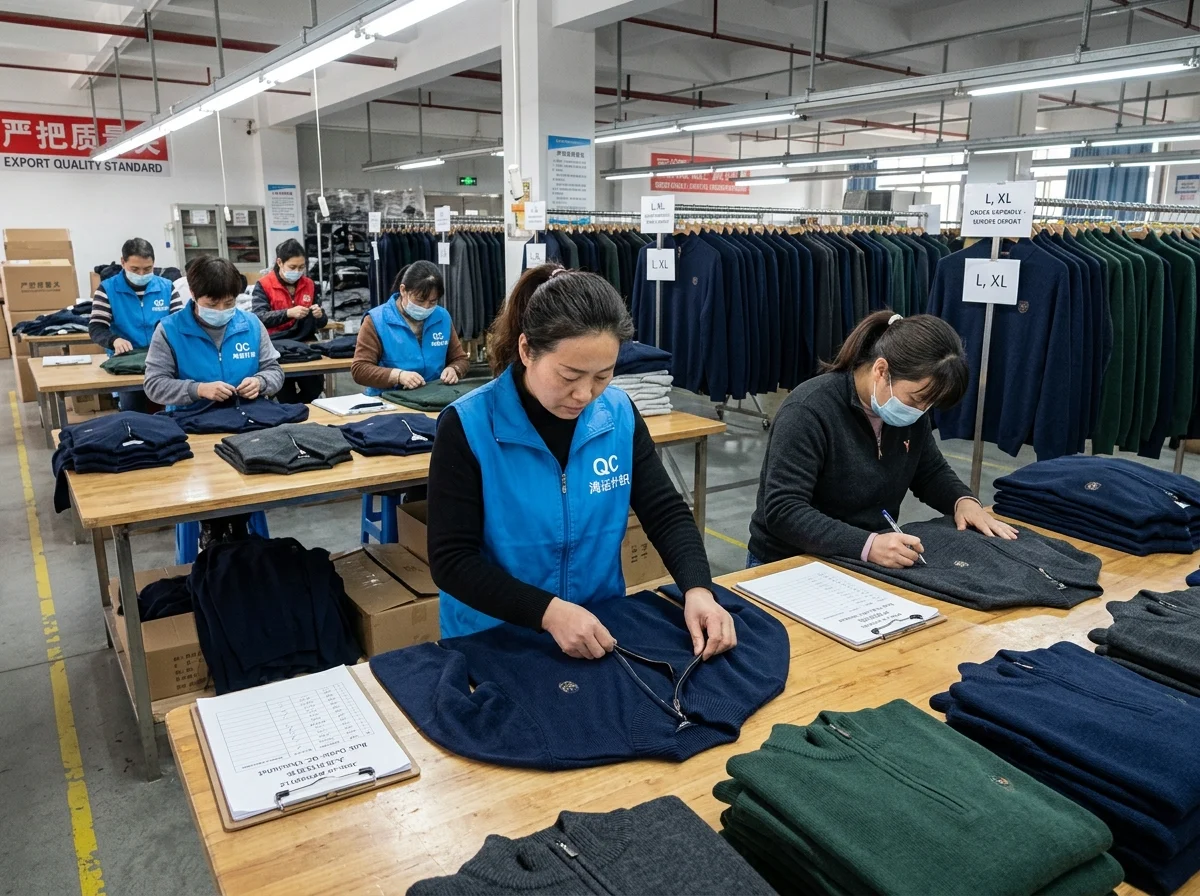
Sample approval is not the finish line. From a factory perspective, the real risk window for bulk knit sweaters opens the moment the gold seal is signed off, because dye lots shift, yarn tension drifts, and washing conditions vary across thousands of pieces. If buyers want bulk goods that match the approved sample in color, measurement, hand feel, and shrinkage, the controls must be built into PP sampling, inline checks and pre-shipment inspection instead of leaving every decision to final QC.
The cost of getting this wrong is concrete. A 3 cm chest deviation on a fitted pullover can trigger size-curve rejection at retail. A half-grade drop in colorfastness can mean a chargeback. A yarn lot with 2% higher shrinkage than the approved sample can turn a Medium into a Small after the first wash. These are not rare events; they are the standard failure modes wholesale buyers face when sample-stage discipline does not carry into bulk production. Below we break down where consistency is actually won or lost, and what buyers should ask their sweater factory to commit to before issuing the PO.
Why Does Approved Sample Quality Drift in Bulk Production?
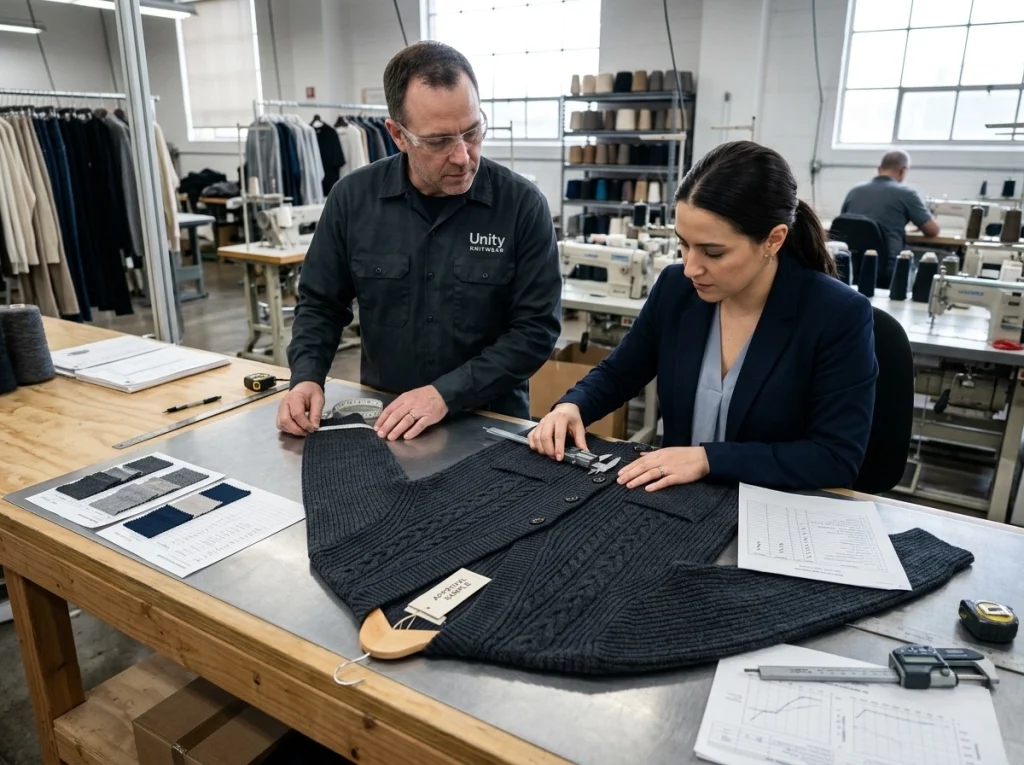
The short answer: sample-room conditions are not production-floor conditions. A PP sample is typically knitted, linked, and washed under tight supervision with selected yarn cones and a single operator. Bulk production runs across multiple machines, multiple shifts, several yarn lots, and a wider washing batch size. Even when the factory follows the same tech pack, the variables multiply, and small drifts compound into visible inconsistency.
Yarn lot variation and dye batch differences
Yarn dyed in separate lots almost never matches exactly. Even with the same dye recipe, a difference of half a grade on the grey scale is common between lots. For solid-color knitwear, factories should commit to one continuous dye lot per color per PO whenever the quantity allows it, or clearly mark cut-offs where lot changes occur so buyers can decide whether to accept the variation or split the shipment by lot.
Machine tension and operator differences
Stitch density depends on machine gauge, yarn tension setting, and ambient humidity. Two machines running the same program can produce panels that differ by 1–2% in width. Multiplied across a 50 cm body width, that is up to 1 cm of variation before linking even begins. A first-piece-off check per machine gives the buyer a chance to identify variation before the run proceeds.
Washing, steaming, and finishing inconsistency
Finishing is where many sweaters gain or lose their final dimensions. Wash temperature, softener dosage, drying time, and steam pressure all influence the final hand feel and measurements. If the PP sample was hand-washed but bulk goes through a 50 kg drum, the outcome will not match unless the factory pre-tests the finishing recipe on bulk-scale equipment before mass washing begins.
What Is the Real Role of a PP Sample in Bulk Control?
A PP sample is the contract, not a courtesy. It locks the construction, measurements, color standard, trims, and labeling that bulk must match. From a factory perspective, the PP sample should be produced using the exact bulk yarn lot, bulk trims, and the same machine type that will run mass production. If any of those change later, the PP sample is no longer a valid reference, and a new round of approval is needed.
PP sample versus gold seal sample
The PP sample is what the factory submits. Once the buyer signs and seals it (often with a tamper-evident tag), it becomes the gold seal sample, the unalterable benchmark for bulk. The factory keeps a counter-sealed copy. Every inline and final inspection compares production output against this sealed reference, not against the original photo proto or fit sample. Skipping the sealing step is a common cause of disputes when bulk goods arrive slightly different and there is no agreed physical standard to compare against.
What a PP sample must lock down
A useful PP sample confirms: yarn count and composition, gauge, stitch pattern, all measurements at the points of measure (POM) listed in the tech pack, color against the approved lab dip, trims (labels, hangtags, zippers, buttons), packing method, and finishing hand feel. If any of these are still “to be decided” at PP stage, bulk consistency cannot be guaranteed.
TOP samples and inline checks during bulk
Once bulk starts, Top of Production (TOP) samples are pulled from the line, typically after the first 5–10% of output. These are compared against the gold seal sample for measurement, color, and workmanship. If a TOP sample fails, the line stops and the issue is corrected before the rest of the order is produced. This is the single most effective tool for catching drift early, and buyers should explicitly request TOP sample sign-off in their PO terms.
How Should Buyers Read AQL Inspection Reports for Knitwear?
AQL is a sampling math, not a quality guarantee. The Acceptance Quality Limit defines the maximum percentage of defective units a lot can contain and still pass. For knitwear, the industry-standard AQL levels referenced by third-party inspectors such as Intertek’s textile and apparel inspection services are 4.0 for minor defects, 2.5 for major defects, and 0 for critical defects. Buyers should confirm these levels in writing with the factory before booking inspection.
Defining minor, major, and critical for sweaters
Minor defects in knitwear typically include loose threads, slight stitch irregularities outside high-visibility zones, and minor shading not visible at arm’s length. Major defects cover open seams, broken stitches, holes, misaligned linking, wrong size labels, and color shading beyond grade 4 on the grey scale. Critical defects include broken needles left in the garment, banned chemical residues, or mislabeling that breaches import regulations. A single critical defect can reject the entire lot.
Sample size and decision rules
For a typical bulk knit order of 1,200–3,200 pieces under General Inspection Level II, the inspector pulls roughly 125–200 pieces at random. The acceptance/rejection numbers come from the standard AQL tables and must be agreed in the PO. Buyers who do not specify the inspection level often discover too late that the factory defaulted to a looser level than expected.
What AQL does not cover
AQL inspection is visual and dimensional. It does not, on its own, verify shrinkage, colorfastness, or fiber composition. Those require lab testing, which we cover in the next section. Treating an AQL pass as a complete quality clearance is one of the most common procurement mistakes in knitwear sourcing.
Which Lab Tests Actually Protect Bulk Knit Sweaters?
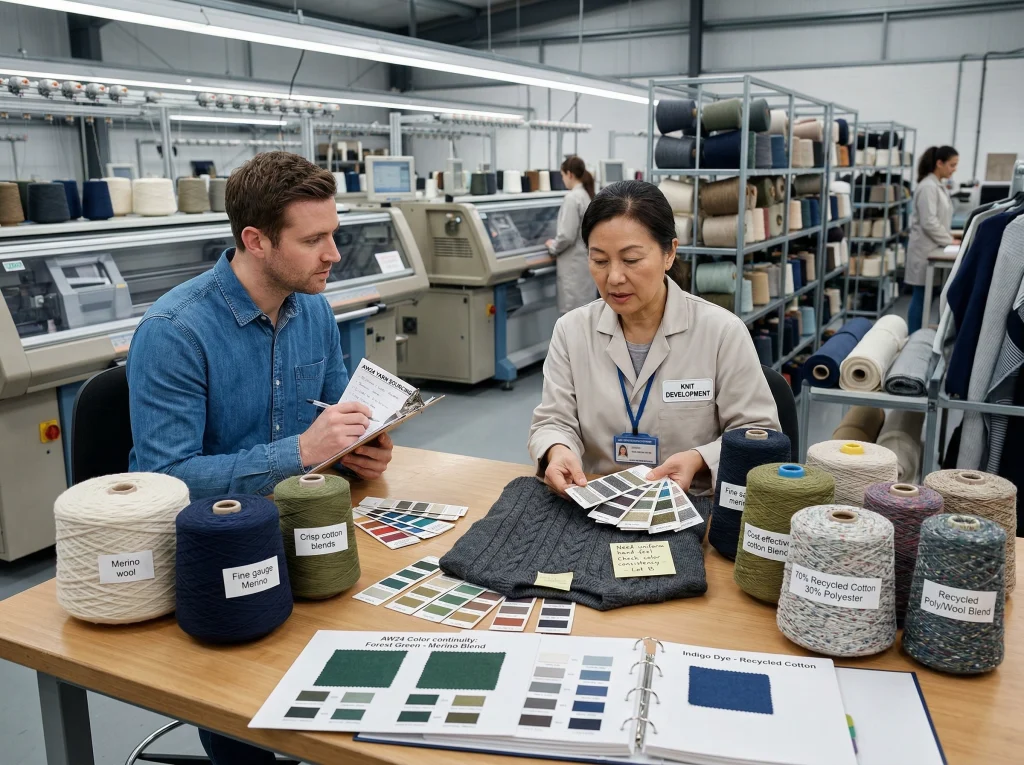
Visual inspection alone misses the failures that show up after the first wash. For bulk knit sweaters, the testing protocols that matter most are dimensional stability, colorfastness, and fiber composition verification. Intertek’s apparel testing program runs these protocols against internationally accepted methods, and serious buyers build them into their PO conditions.
Shrinkage and dimensional stability
The two reference methods in active use are AATCC 135 for dimensional change after home laundering, dominant in US programs, and ISO 6330 for domestic washing and drying procedures, common in EU programs. Acceptable shrinkage for knit sweaters typically sits within ±5% length and ±3% width, but the actual tolerance must be agreed per fiber and construction. Wool-rich and cashmere blends require tighter control because they felt more aggressively under heat and agitation.
Colorfastness across the relevant exposures
For knitwear, the colorfastness tests that matter most are AATCC 61 or ISO 105-C06 for laundering, AATCC 8 or ISO 105-X12 for crocking (rubbing), and AATCC 16 or ISO 105-B02 for light. A grade of 4 or higher on the grey scale is the working benchmark for premium programs. Dark and saturated colors, especially red, navy, and black, deserve closer scrutiny because crocking failures are common and visible.
Fiber composition verification
Labeling regulations in the EU (Regulation 1007/2011) and the US (FTC Care Labeling Rule) require accurate fiber percentages on permanent labels. Quantitative analysis catches yarn substitution, where a supplier swaps a portion of cashmere for wool, or merino for a coarser grade, without disclosure. When fibre content is material to the product claim or cost, the buyer can request third-party test results for the bulk yarn lot as well as the development material.
What Size Tolerances Are Realistic for Wholesale Knitted Sweaters?
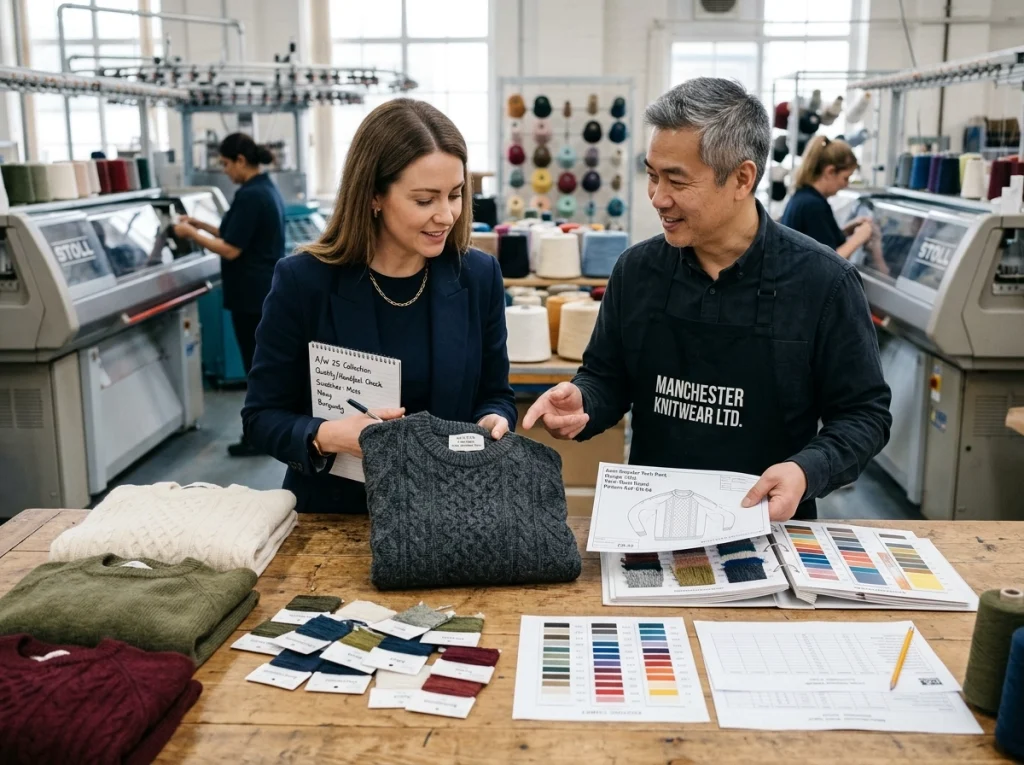
Knit fabric stretches, recovers, and breathes. Demanding woven-level tolerances on a chunky cardigan is unrealistic and pushes the factory toward unsustainable rework. From a factory perspective, the workable industry range for wholesale knitted sweaters is roughly ±1 cm to ±2 cm on most POMs, with tighter control on critical fit points and looser allowance on areas that the body does not perceive.
Which measurement records should match before bulk release?
Do not import a generic tolerance chart into a purchase order. The buyer should define the measurement points, method, garment state, sampling stage and treatment of out-of-tolerance pieces for this style. The PP sample and the signed measurement sheet are the reference; any bulk allowance must be agreed before knitting starts.
Record
Approved PP sample and measurement sheet
Buyer check
Point of measure, method, state and tolerance
Release condition
Factory records variance, corrective action and recheck result
How Do MOQ, Lead Time, and Reorders Affect Consistency?
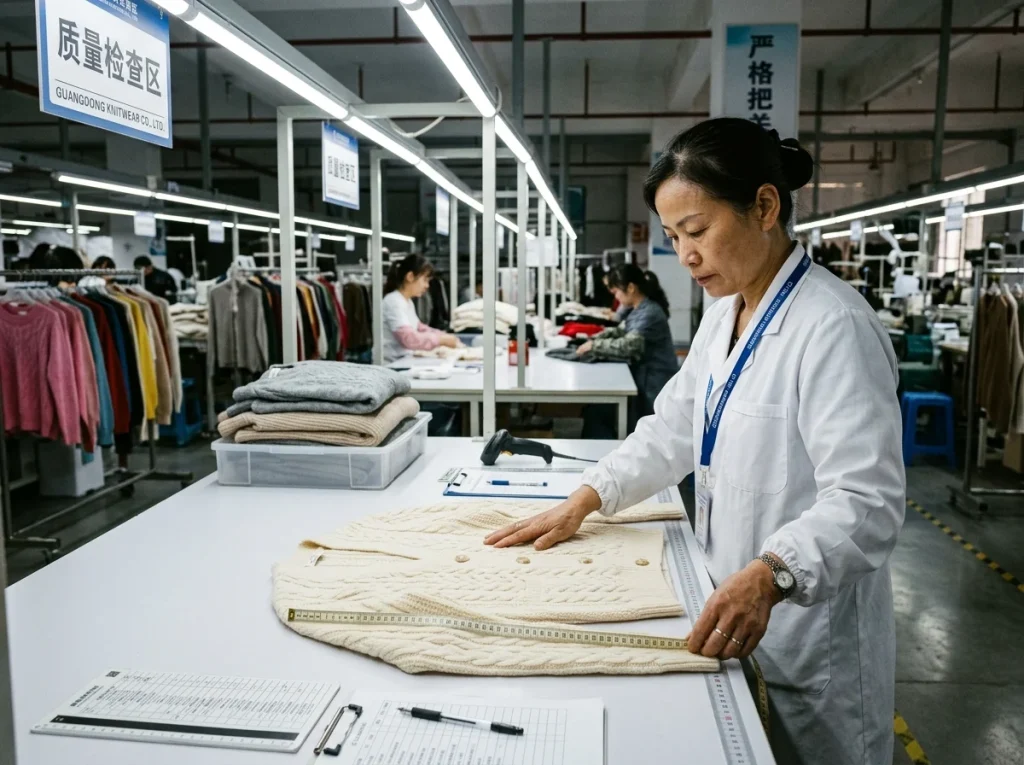
Larger runs are easier to keep consistent than small ones. Counterintuitive but true: a 3,000-piece order in one color allows the factory to dedicate machines, lock a single yarn lot, and stabilize the finishing recipe. A 300-piece order in six colors fragments the production, multiplies lot changes, and increases the risk of drift. Understanding the trade-offs around MOQ & Lead Time is essential for buyers planning consistent assortments.
Reorder consistency challenges
Reorders rarely match the original lot exactly. Yarn supplied months apart comes from different dye batches, and base stock may have shifted. For reorders, factories should provide an updated lab dip against the original gold seal sample, and buyers should approve the new color standard before bulk dyeing begins. Treating a reorder as automatic continuation of the first PO is the most common source of post-shipment disputes.
What Pre-Shipment Steps Reduce Risk Before Goods Leave the Factory?
Which records must agree before the buyer releases the order?
Put the technical file, PP sample, yarn and colour reference, measurement sheet, inspection plan and packing specification under the same revision control. The buyer can use the knitwear tech-pack checklist to identify the locked inputs, the fit-sample and size-set comparison to define the sample decision, and the knitwear production sequence to locate the approval handovers. For a first supplier relationship, apply the remote factory-audit questions; for a controlled pilot, compare the release steps in this small-batch pilot guide.
The window between final inspection and container loading is where remaining risk should be eliminated, not discovered. From a factory perspective, a structured pre-shipment routine prevents the most expensive failures: wrong assortments, missing labels, damp cartons, and undetected shading. A robust Quality Control & Compliance protocol covers all of the following before the shipping mark goes on the carton.
Final random inspection scope
Final inspection should verify quantity, assortment by size and color, measurement on a random sample, workmanship against AQL levels, packing method, polybag and carton marking, and shipping documents. The inspector compares pulled pieces against the gold seal sample, not against memory or photos. A signed inspection report with photographs becomes part of the shipping file.
Shading and lot management
Even with single-lot dyeing, slight shading bands can appear. The factory should grade cartons by shade band (typically A, B, C) and label them so the buyer can manage retail allocation. Mixing shade bands inside one carton is a major defect under most buyer protocols and should be caught at final inspection.
Due diligence and compliance documentation
Beyond product quality, responsible buyers verify supply chain compliance. The OECD due diligence guidance for responsible garment and footwear supply chains sets out a six-step framework covering risk identification, mitigation, tracking, and remediation. For brands selling into the EU and increasingly the US, documented due diligence on labor, chemicals, and traceability is no longer optional. Factories should provide signed compliance declarations, test reports for restricted substances, and traceability records for the yarn supply on request.
What Must Buyers Confirm Before Bulk Knitwear Release?
Sample approval and bulk consistency are two separate disciplines. The first proves the factory can make the sweater once; the second proves it can make it three thousand times. Buyers who treat the gold seal as the start of QC, not the end, get bulk that matches expectations. Those who assume approval equals delivery quality usually find out at the warehouse what they should have specified in the PO.
Before issuing the PO, require the supplier to return the controlled technical file, PP-sample reference, inspection plan, measurement and appearance criteria, final-pack specification and a named release owner. The buyer should accept or hold the order against those records, rather than against a verbal assurance that bulk will match the sample.
Frequently Asked Questions
What MOQ should I expect for custom bulk knit sweaters in one color?
For custom-developed knit sweaters using bulk-dyed yarn, MOQ typically starts around 300–500 pieces per color per style. ODM programs using stock yarn can sometimes accept lower quantities, while fully custom yarn programs with specialty fibers may require 800 pieces or more per color. The MOQ exists to allow stable yarn dyeing, machine setup, and consistent finishing; pushing below it often means wider tolerances or higher unit cost.
How long does bulk production take after PP sample approval?
Standard lead time is 45–75 days from PP approval to ex-factory, depending on yarn lead time, finishing complexity, embroidery or print decoration, and order size. Compressed timelines under 40 days are possible for simpler styles using stock yarn but typically reduce inline inspection rhythm and finishing pre-tests, which increases the risk of variation across the bulk.
Can a reorder match the original shipment exactly?
Reorders rarely match perfectly because yarn supplied months apart comes from different dye batches. We recommend treating each reorder as a fresh color approval cycle: new lab dip against the original gold seal sample, written sign-off on any acceptable variation, and a TOP sample check once bulk starts. Buyers who plan reorders in advance can sometimes reserve yarn from the original lot if quantity allows.
What happens if the pre-shipment inspection fails AQL?
The factory typically reworks, replaces defective pieces, or sorts the lot to remove failing units, then requests re-inspection. Cost of rework and re-inspection sits with the party responsible for the defect under the agreed contract. Buyers should clarify rework, re-inspection, and shipping delay terms in the PO so that an inspection failure does not trigger a separate commercial dispute on top of the quality issue.
Which shipping method works best for bulk knit sweater orders?
For typical bulk orders, sea freight remains the cost-efficient default, with 25–40 days transit to major US and EU ports depending on routing and current schedules. Air freight is reserved for replenishment, fashion-sensitive launches, or recovery from delays, and adds 3–5 times the freight cost. Buyers planning seasonal launches should align the factory ex-factory date with sea freight transit to avoid air freight as a contingency.