 CN Sweaters
Long cardigan sizing fails when one standard block is enlarged in every direction. Adding the same amount of length and width may produce a larger garment, but it does not address the different body relationships behind tall and plus ranges. The error becomes more visible in a long knitted style because fabric weight, an open front and loaded pockets pull on the block during wear.
A buyer needs two declared size architectures. The tall block controls where added vertical length is placed. The plus block controls girth, front length, projection, openings and movement. Both still need a common design language, but their grade rules and sample evidence should remain traceable.
The following workflow covers block selection, garment measurements, pocket reach, wearer trials, size-set planning, cost, bulk control and repeat-order records for a long cardigan program.
Why Does One Grade Table Fail?
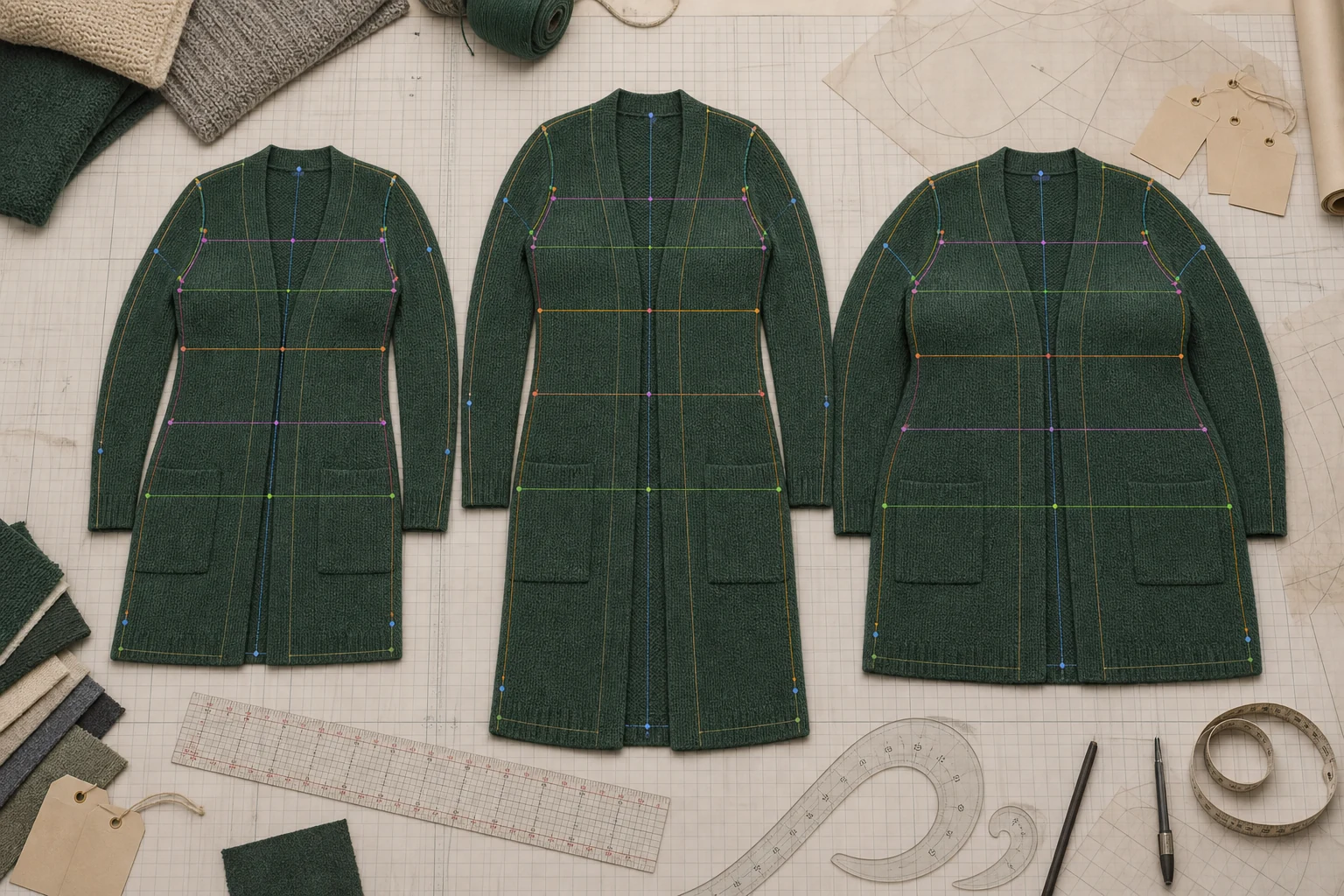
Tall and plus are different fit problems. Height does not predict girth distribution, and a larger bust or chest does not predict stature. Combining both into a broad tolerance hides which relationship has changed.
Define the target bodies before the garment
Start with the population, sales market, intended underlayers and desired fit. Record the body dimensions used to select each base block. Include stature, bust or chest, waist, hip, back-waist length, arm length and any additional dimension needed to explain the target customer.
ISO 8559-1:2017 describes anthropometric measurements that can support body databases and size-and-shape profiles. It is a reference for defining how body dimensions are taken. It does not supply a finished cardigan specification or decide the brand's customer profile.
Keep the body table separate from the garment table. The first describes the intended wearer; the second adds ease, design proportion, knit stretch and construction allowances. Assign a block code to every sample and carry it through the tech pack, fit report and inspection record.
Keep size labels separate from fit engineering
ISO 8559-2:2025 specifies primary and secondary dimension indicators for clothing size designation based on body measurements. Use that distinction when planning consumer-facing size information. Do not copy a body dimension onto the garment table as though it were a finished measurement.
Connect the size label, body range and garment specification through a controlled map. Show which body interval each size serves, which block supplies the shape and which garment measurements create the approved ease.
ISO 8559-3:2018 describes a methodology for body-measurement tables and intervals using population data; garment dimensions are outside its scope. This is useful discipline for a brand building a size range. The range should come from declared body evidence and commercial coverage, while garment dimensions are developed and fitted separately.
The custom knitwear size-grading guide helps document grade increments. For this program, add a column showing whether each point follows the standard, tall or plus rule. Transition sizes where the rule changes require their own sample evidence.
What Must Change in a Tall Block?
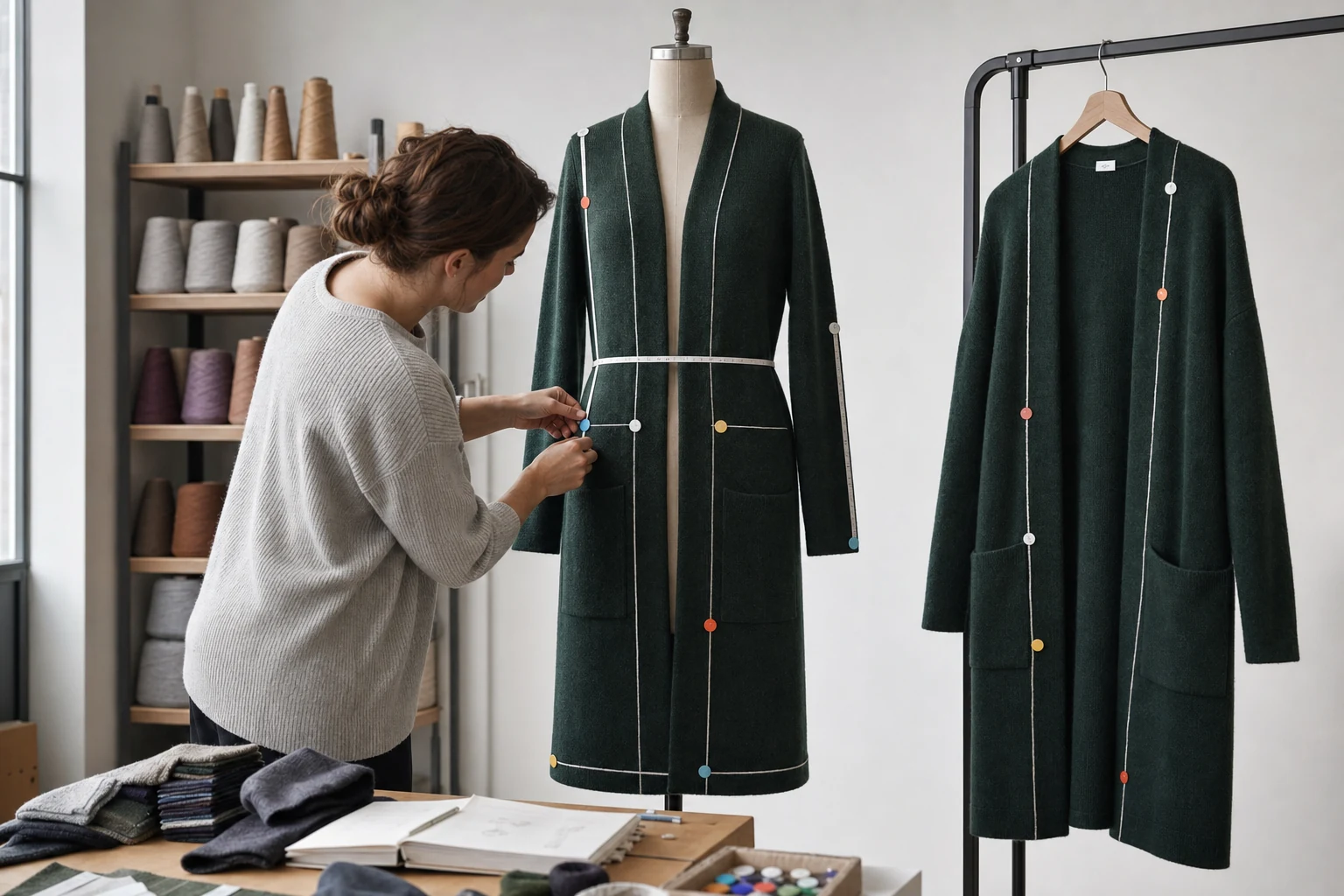
A tall cardigan needs vertical landmarks in the correct places. Extending the hem alone lowers the total length but leaves the waist, pocket, armhole and sleeve relationships unchanged.
Distribute added length by landmark
List the vertical points from high shoulder to armhole, bust or chest level, natural waist, pocket opening, hip, hem and sleeve end. Decide how much additional length belongs between each pair. The answer depends on the target body data and the design, not a single percentage.
For example, a tall block may need more back-waist length, a lower waist position, a revised armhole depth and additional sleeve length. If all added body length is placed below the pocket, the opening can sit too high for the wearer even though the hem reaches the intended level. If sleeve length is added only at the cuff, elbow shaping and any sleeve detail stay in the wrong place.
Record shoulder-to-waist, shoulder-to-pocket, shoulder-to-hem, underarm-to-hem and sleeve landmarks. ISO 18890:2018 defines main garment measurement points and allows interested parties to agree additional points. Use the standard as a method reference, then illustrate the long-cardigan points needed for this order.
The knit maxi dress guide addresses another long knitted product where weight and length interact. Apply the same diagnostic habit here: separate initial dimensions, finishing change and later hanging movement.
Preserve balance through the long front
Check the tall sample buttoned or closed if the style has a closure, hanging open, walking and seated. A long front can swing outward when the shoulder, neckline edge or front length is wrong. Side seams can move forward or backward when length is added without correcting block balance.
Measure front and back length from defined shoulder points, then record side-seam hang and hem level. Photograph the garment from front, side and back after a stated rest. Repeat the view with the pockets empty and carrying the intended trial load.
Use the custom cardigan construction guide as background for gauge and cardigan fit, then keep the tall block's vertical map in the order file. A photograph cannot preserve the placement decisions by itself.
What Must Change in a Plus Block?
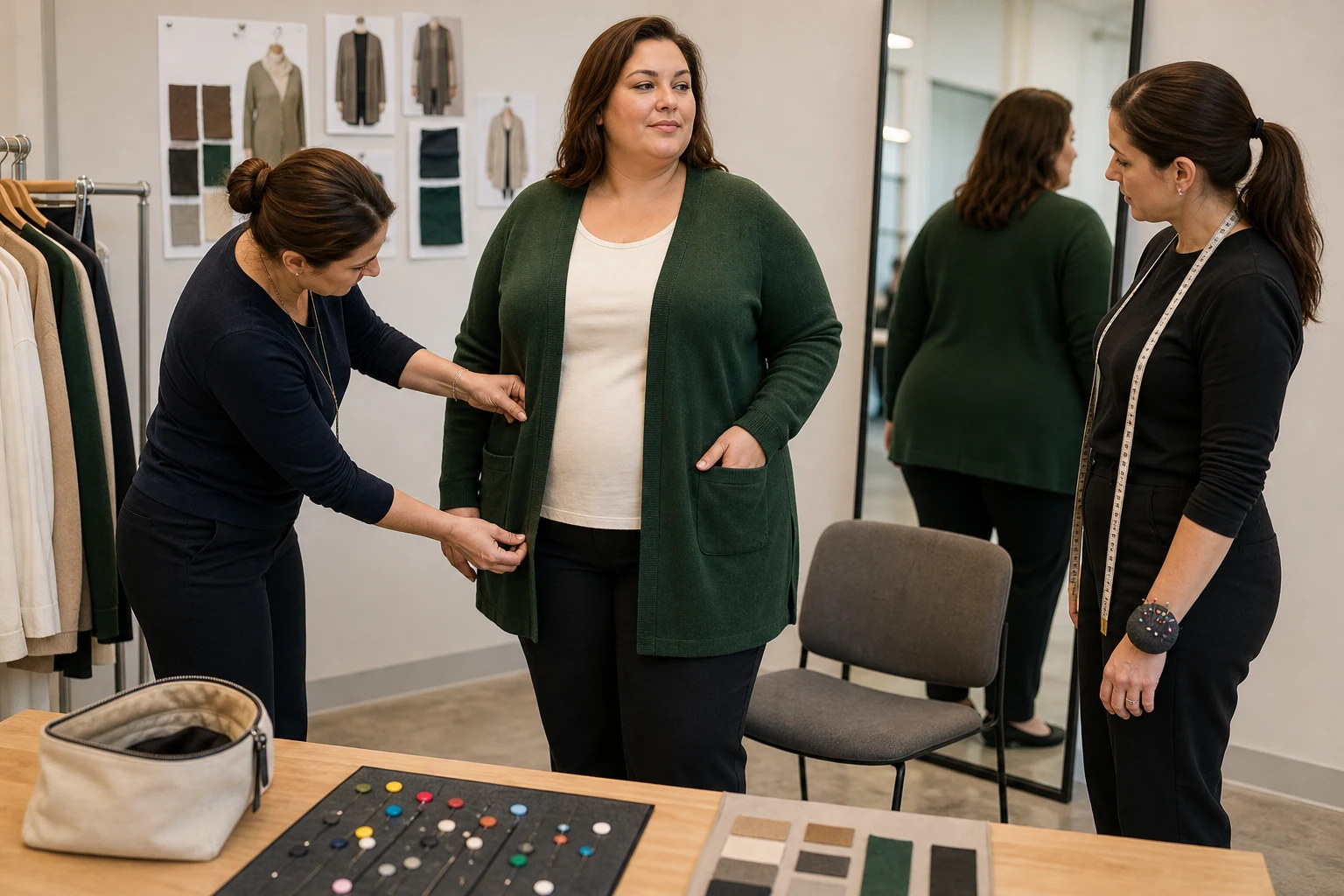
The plus block needs a shape strategy for girth and front projection. Increasing half-chest, waist and hip by equal amounts can create excess at the back, insufficient front length and tight openings.
Allocate girth and front length deliberately
Start with the target bust or chest, waist and hip intervals. Decide how circumference is divided across front and back and how side seams should hang. Add front length where body projection requires it, while keeping the hem and pocket line controlled.
Record cross-front, cross-back, front width at key levels, back width, front length, back length and side-seam position. For a buttoned design, include overlap and gap checks. For an open design, include the natural front opening at several levels. These points reveal whether added width is serving the wearer or simply spreading the garment.
Assess ease on the intended underlayer and photograph the garment at rest, reaching, walking and sitting. A blouse layer and a heavy outer layer create different movement needs.
Do not use a wide tolerance to join two block shapes. The measurement-tolerance guide can help set functional limits after the intended shape is approved. Tolerance controls manufacturing variation around a target; it does not repair an unsuitable target.
Check armholes, sleeves and openings as a system
Upper-body girth affects armhole shape, bicep room, shoulder balance and sleeve mobility. Widening the body without changing the sleeve can restrict reaching. Dropping the armhole without checking the sleeve head can add bulk and pull the front edge.
Measure armhole depth, straight and curved armhole where used, bicep, elbow, cuff opening and sleeve length. Add a dressing test with the intended underlayer. Observe whether the wearer can put on the cardigan without overstretching the cuff, placket or shoulder seam.
The custom sweater sampling checklist is useful for assigning these questions. Settle the base plus shape in a fit sample, then use the size set to prove the grade and any construction transitions.
How Should the Sample Matrix Be Built?
Sampling should expose the differences between block families and the sizes where a rule changes. A single middle size cannot prove tall length distribution or plus front balance across the range.
Select samples by risk
Use a matrix with block, size, target wearer, question and release evidence:
| Sample decision | Evidence to collect | Release consequence |
|---|---|---|
| Standard base | Design proportion and common construction | Reference for shared styling |
| Tall lower and upper | Vertical landmarks, sleeve position and open-front balance | Tall grade approval |
| Plus lower and upper | Girth allocation, front length, openings and movement | Plus grade approval |
| Rule-transition size | Pocket, slit, trim or program change | Construction-map approval |
| Conditioned duplicate | Dimensional and hanging repeatability | Bulk-process approval |
Select lower, base and upper sizes from the offered range. Add a transition size whenever button count, pocket dimensions, slit length, panel count, machine program or packing changes.
Use representative fit forms or wearers for both families. Record the relevant body dimensions, underlayer and fit comments without storing unnecessary personal information. The sample feedback guide can help convert each comment into a measurement, pattern, construction or approved visual change.
Run movement and pocket-reach trials
Check standing, walking, sitting, reaching forward, raising the arms and placing a hand in each pocket. For a long cardigan, note front swing, side-seam movement, hem contact and whether the wearer pulls the garment to reach the pocket.
Define pocket opening length, depth, bag construction, top position and distance from centre front or side seam. Measure the position from a stable shoulder point as well as from the hem. A hem-only reference moves the pocket when total length changes.
Load the pocket with a declared object or mass that represents the use case. Photograph and measure before loading, immediately after, after a hold period and after rest. Check local growth, edge distortion and left-right balance. A pocket test without a stated load cannot be repeated.
Keep each sample's yarn lot, finished weight, gauge, machine program, finishing route and conditioning time in the pre-production sample review.
What Should Testing Prove?
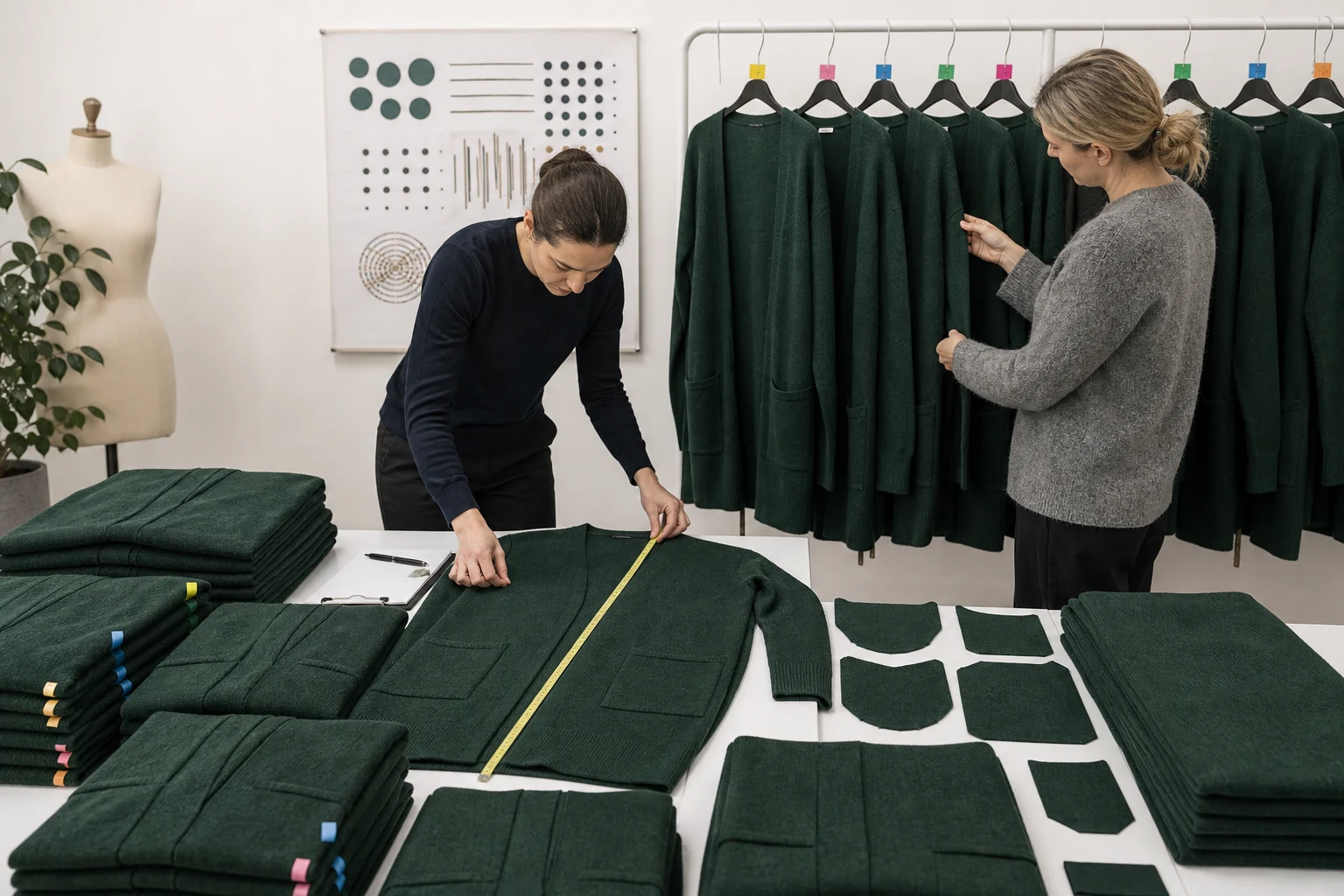
Long knitted garments can change after washing, drying, hanging and wear. The test plan needs time and condition, not just an initial table measurement.
Separate care change from hanging growth
For washable styles, ISO 5077:2007 specifies a method for determining dimensional change after appropriate specified washing and drying procedures. The order file still needs the chosen procedure, number of cycles, preparation, measurement points, rest time and acceptance limits.
Measure body length, front length, back length, sleeve length, pocket level and width points before care and after the stated conditioning period. Keep tall and plus results separate. A combined average can hide a failing upper size or one block moving in the opposite direction.
Run a separate hanging assessment using the intended hanger and a defined duration. Record measurements immediately after hanging and again after flat rest. Add the pocket load where it reflects likely use. Care change, temporary hanging extension and residual growth answer different questions.
The knitwear testing guide can connect laboratory results to garment wear review. Agree methods and limits before testing so a failed result triggers a defined decision.
Diagnose failures by block and process
A block fault tends to repeat by size relationship. A process fault may follow yarn lot, machine group, operator, finishing batch or conditioning state. Preserve these identities on every report.
If tall shoulder-to-pocket distance grows correctly but shoulder-to-waist does not, inspect the grade distribution. If one colour hangs longer across both blocks, inspect yarn or finishing. If upper plus sizes show front hem lift while back length is stable, revisit front projection and front-length allocation.
Set warning limits inside the final tolerances. Use the size-drift production guide to group results by likely source instead of correcting every unit through pressing.
How Do Cost and Inventory Change?
Two block families add development and control work. The commercial decision should show where that cost occurs and which sizes justify separate inventory.
Price the size architecture
Ask the supplier to identify pattern or program work, size-set garments, fit sessions, testing, pocket changes, consumption by size, linking or assembly time and packing differences. Finished weight should be recorded by sampled size because a long upper size may change yarn cost and machine time materially.
Use the custom knitwear cost-driver guide to separate fixed development from variable production. Compare a shared visual design with separate blocks against the risk and rework of forcing one block across the range.
Plan depth and packed weight
Keep sales depth by block and size. A total order quantity can conceal weak coverage in tall or plus sizes while leaving excess in the standard range. Use the wholesale sweater SKU planning guide to connect size depth with colour and channel decisions.
Weigh and measure packed units from representative lower and upper sizes. Confirm fold method, bag size, units per carton and carton mass. Long garments may require an extra fold or support to keep the front edge and pockets from creasing. Upper sizes can reduce carton count even when unit volume appears close.
How Should Bulk and Reorders Be Controlled?
Bulk evidence must preserve the block identity. A first-off from the standard block cannot release tall and plus production.
Release first-offs by block
Approve conditioned first-offs from each production block and any size where the construction changes. Confirm block code, body and sleeve landmarks, front and back balance, pocket level, opening, side-seam hang and packed identity. Check the intended yarn lot, machine route and finishing batch.
Set in-line checks by block, size, colour, yarn lot, machine group and finishing batch. Trend shoulder-to-waist, shoulder-to-pocket, front length, back length, side-seam position and pocket level. Inspect garments standing or hanging as well as flat where balance is the decision.
The bulk consistency guide can hold the wider trail. Add the tall and plus block fields so an inspector can separate a grade error from a finishing subgroup.
Hold damp, reworked or unconditioned units until they can be measured under the approved method. If a warning limit is crossed, identify the affected subgroup and investigate before blending it with accepted units.
Preserve the repeat-order map
Archive the body-range definition, block codes, grade tables, transition rules, wearer evidence, garment measurement methods, approved samples, test results, pocket-load record, packed dimensions and bulk trends. State which file controls each field and mark superseded revisions.
Before a repeat order, request declarations for yarn, gauge, program, machine route, finishing, pocket construction, trims, size range and packing. Reopen the tall landmarks when stature coverage or vertical distribution changes. Reopen plus balance when body intervals, front allocation or openings change.
Use the bulk planning guide to assign owners and decision dates. The retained first-offs and measurement history should show whether a repeat unit is genuinely comparable.
Conclusion
Long cardigan sizing needs separate tall and plus block logic. The tall file should distribute added length across armhole, torso, sleeve, pocket and hem landmarks. The plus file should allocate girth, front length, projection, armhole, sleeve and lower-opening room. Both need a declared body range, garment measurement method and block code.
Approve lower, upper and transition sizes through fit, movement, pocket reach, care and hanging checks. In bulk, release first-offs by block and trend vertical landmarks, front balance, pocket level and side-seam hang by production subgroup.
For a repeat order, retain the body-to-block map, grade rules, test conditions, pocket-load evidence, conditioned samples and packed-weight assumptions. Reopen the specific gate affected by a new body range, yarn, program, construction or size curve.
Frequently Asked Questions
Can a tall size be made by adding hem and sleeve length?
That shortcut leaves waist, pocket, armhole and elbow landmarks in the standard positions. Distribute added vertical length from body data and confirm the result on representative wearers.
Can plus sizes use the same grade increment as standard sizes?
Use the same rule only when fit evidence supports it. Plus blocks often need different front allocation, front length, armhole, bicep and opening rules. Sample the sizes where those relationships change.
Which long cardigan sizes belong in the size set?
Include lower and upper sizes from each block family, plus any size where pocket, slit, button, panel, program or packing rules change. Select by risk and transition rather than a fixed number of garments.
How should pocket position be measured?
Measure it from a stable shoulder landmark and from centre front or side seam. Keep the hem reference as a secondary check. Test reach and a declared pocket load on the intended wearer.
What should be checked again on a repeat order?
Verify body-range assumptions, block codes, yarn, gauge, program, finishing, pocket construction, size curve and packing. Compare conditioned first-offs from each affected block with the retained records.