 CN Sweaters
An organic cotton cardigan reorder is easy to misread as a buying decision: last spring's colour sold, the factory still has the pattern, and the team would like more units. In practice, it is a chain-of-evidence decision. The repeat only remains the same product if the yarn, claim documents, shade, construction, care result and retained reference still agree.
Spring makes those gaps visible. A cardigan that feels right in an autumn showroom may grow at the placket after a humid delivery, look thinner in a pale colour, or land in a different dye lot after the best-selling size has already been replenished. The buyer needs a controlled route for those questions before committing yarn or promising a customer the same item.
Are You Reordering a Garment or an Evidence Chain?

The SKU name, a previous purchase order and a factory's assurance are useful references, but none proves continuity. A repeat order should begin with a one-page identity record that names what must stay the same and what may change.
Define the product promise in buyer terms
Write the commercial job in plain language. For example: a breathable, machine-washable spring layer with an organic-content claim, stable button front and a soft but not transparent body. Then split that sentence into checks: customer-facing claim, yarn article, stitch and gauge, finished weight range, colour, fit block, buttons, care route and packing.
Use the custom knit sweaters tech-pack checklist to assign a document, owner and approval date to each controlled item. Leave genuinely open choices visibly open. An empty field is not a factory option, and a commercial comment is not a knitting instruction.
Set the reorder decision date early
The date matters because yarn reservation, dyeing, testing, capacity and delivery do not move together. Work backwards from the required inbound date to a point where the buyer must either release a yarn lot or select a smaller, lower-risk replenishment. Give the team a named fallback: use a retained shade, offer fewer colours, defer the repeat, or run a new sample.
The custom sweater sampling checklist is useful here because it separates decisions. A knit-down can settle yarn and shade. A finished garment can settle fit and handling. A pre-production unit can settle the actual bulk route. Calling all three “the sample” hides what has and has not been approved.
Which Organic Claim Can This Specific Lot Support?
“Organic cotton” should be treated as a claim that needs a lot-specific documentary path, not as a feel or a general supplier attribute. Before the buyer repeats marketing language, the team should determine which standard is being used, who is certified in the route, and which documents relate to the yarn intended for this order.
Match the claimed standard to the order record
GOTS describes a system that covers textile processing and requires traceability through the supply chain; it also states that businesses involved in a GOTS-certified product’s production need certification by approved bodies. OCS focuses on third-party certification of organic materials and chain of custody. Those descriptions do not make either label interchangeable, and they do not decide the claim wording for every market.
Ask the supplier to identify the proposed standard, certificate holder, certificate scope, transaction or chain document where applicable, yarn article, lot, colour and quantity. Check that the document period and named company are relevant to the order. The purchaser should then have destination-specific claims and labelling reviewed by the appropriate compliance owner rather than borrowing wording from a previous season.
Keep claim evidence separate from performance approval
A credible document file does not prove that the cardigan has the right handle, cover or recovery. Keep the claim register beside, but separate from, the product test and sample record. The first answers “what material may be represented.” The second answers “does this particular cardigan meet its product brief?”
Link the yarn article to a sealed knit-down and a finished reference. Record count, ply or ends, stitch construction, machine gauge, loop length where controlled, washing or finishing route, and the date the reference was accepted. The private-label knitwear yarn planning guide gives the buyer a practical place to capture yarn identity instead of relying on a trade name.
For a blended programme, list every fibre and trim separately. A later change to sewing thread, button backing or stabiliser can alter care behaviour even if the cotton yarn is unchanged. The care-label and fiber-content guide can help the team assemble the product facts, but the final label needs to match the tested item and the sales destination.
How Should Yarn and Shade Be Carried Across Spring Sales?

The most commercial reorder error is committing to a forecast without knowing the yarn's controlling minimum. A unit forecast may call for 600 more cardigans, while the spinner's minimum, dye lot or certification paperwork makes the real decision closer to 1,200 units or a mixed residual position.
Calculate demand, yield and residuals together
Start from confirmed sales by colour and size, not one total quantity. Add approved production consumption by size, a documented allowance for knitting and finishing loss, expected test or sample use, and the residual yarn already under the brand's control. Do not insert a generic loss percentage without asking the maker how it was observed on the prior run.
Keep three scenarios: a conservative refill, the expected repeat and an upside case. For each, show yarn kilograms, colour minimum, number of garment units, residual kilograms, value at risk and the last practical release date. That lets a buyer decide whether colour depth, size availability or lower residual exposure matters most.
| Reorder choice | Evidence needed before release | Commercial consequence |
|---|---|---|
| Use current residual yarn | lot balance, shade condition and retained-standard comparison | quickest route, but limited size or colour depth |
| Reserve a new dye lot | confirmed yarn article, colour reference, minimum and document path | broader availability, with shade and minimum exposure |
| Split the order by colour | sales mix, per-colour consumption and capacity plan | protects best sellers, but may raise unit cost |
| Delay and develop again | current material availability and revised calendar | avoids an unsupported repeat, but loses spring selling time |
Treat dye-lot acceptance as a physical decision
Paper shade approval is insufficient for a cardigan. Review the proposed lot in the actual structure, at the planned finished state, beside the approved reference and any adjacent components. Photographing both is useful for the file, but the physical check should decide whether a customer would see the lot as the same offer.
Record the observation conditions: light source, sample state, background, number of swatches or panels, people present and acceptance decision. If the new lot is acceptable only for a separate online colour name or a different delivery, make that a merchandising decision before the purchase order is issued.
The measurement tolerance guide offers a useful discipline for the rest of the approval: define method and functional limit. The same approach applies to shade review. “Close enough” is not a limit; the buyer needs a named retained reference and authority to accept, reject or route the lot differently.
What Must the First Reorder Sample Prove?
The first reorder sample should answer the questions created by the proposed change. If only capacity moved and all materials remain controlled, a first-off may be enough. If the yarn lot, finish, button supply, fit block or care instruction changed, the sample plan needs to reopen the affected evidence rather than repeat every old test by habit.
Compare against the retained standard
Condition both the retained piece and the candidate sample before comparing them. Inspect body length, chest or bust, shoulder, sleeve, placket width, button spacing, hem and cuff recovery. For an open-front cardigan, also hang it on the intended hanger and observe the front edge after a defined rest. Cotton growth may appear there before it becomes obvious on a flat measurement table.
Use a comparison sheet with actual readings, not just approval marks. Where a point differs, say whether the change comes from grading, yarn, construction, finishing or an unresolved cause. This makes later conversations with the factory much faster and prevents the team from treating two unrelated deviations as one cosmetic issue.
Prove the stated care route
Care copy should follow evidence, especially when a spring line is marketed as easy to wear. The US FTC Care Labeling Rule requires covered manufacturers and importers to provide regular care information and to have a reasonable basis for it before sale. Other markets may impose different requirements, so the buyer should route final instructions through the responsible compliance review.
Test the garment, trims and any stabilising parts through the proposed care method. Recheck dimensions, pilling, twist, placket shape, buttons, rib recovery, colour change and surface feel after the specified cycle and rest. The important output is not a collection of lab PDFs; it is a pass limit tied to the commercial promise. If the cardigan is sold as easy-care but needs a special recovery step to look acceptable, that difference belongs in the product decision.
How Should Price, MOQ and Calendar Be Controlled?

A reorder quote should allow a buyer to see which portion is actually repeatable. Ask for a quote that keeps material, claim administration, development, testing, production, packing and freight assumptions distinct. A lower unit price gained by merging lots or dropping a test can be a different programme rather than a saving on the same one.
Ask for a quote that exposes dependencies
Request the yarn basis, quantity break, exchange or validity assumption if relevant, dye route, claim-document handling, knitting and linking route, finishing, test allowance, packing configuration and lead-time milestones. Tie every quote line to a released technical file. The custom sweater cost guide helps separate variable garment cost from one-time or threshold costs.
Reserve only after the evidence is ready
Create a short release gate before yarn is committed: approved claim file, accepted shade route, completed consumption calculation, confirmed sample scope, care-plan owner, production slot and written escalation for late or failed results. Put the owner and deadline beside each gate.
The bulk knit sweaters planning guide can organise that handoff. It is especially useful when the commercial team wants to reserve capacity before every document is complete. A provisional hold can protect a calendar; it should not silently become approval to use an unverified lot.
When Is Bulk Ready to Release?
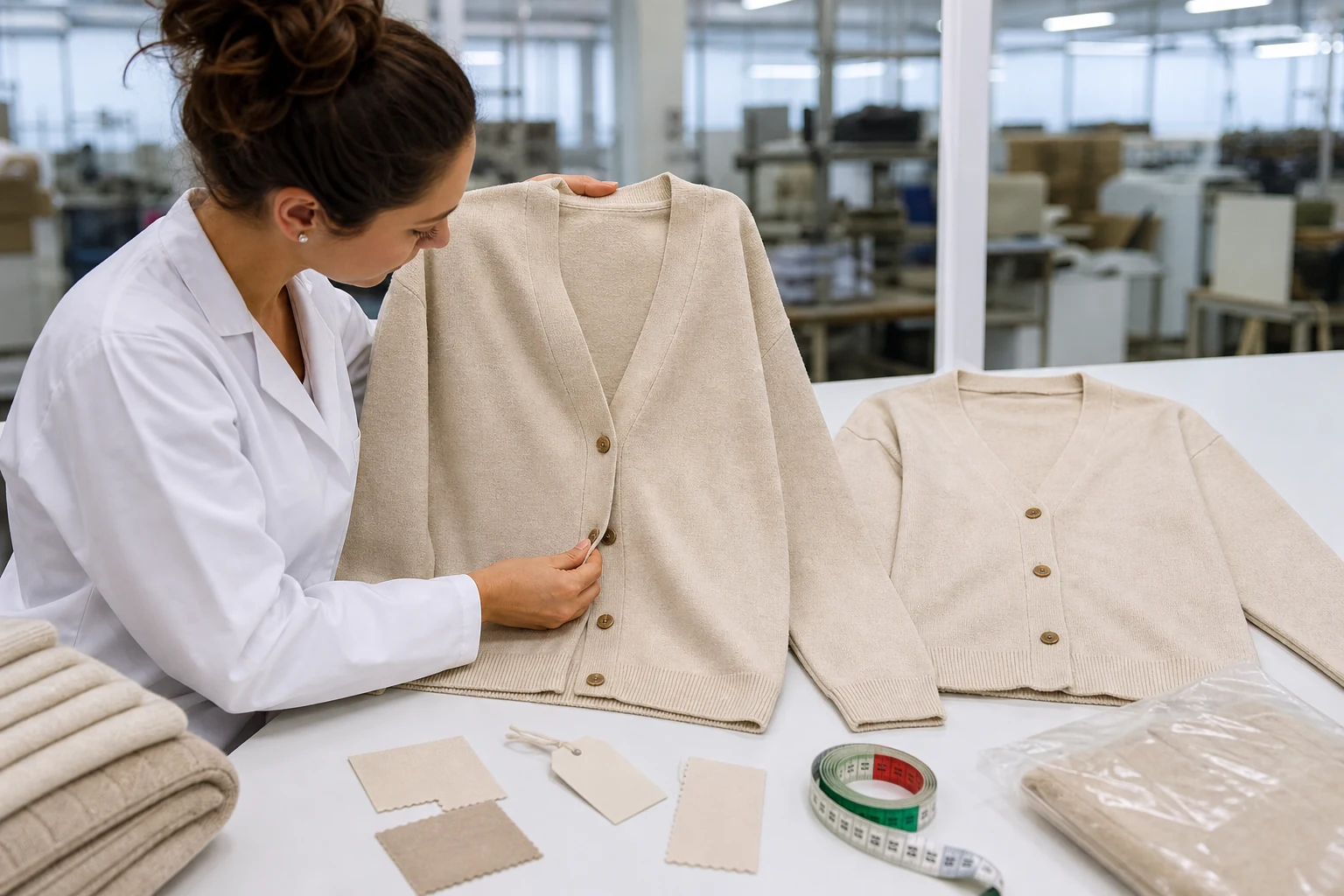
Bulk is ready when the factory can show that the chosen lot and route reproduce the accepted product, and when the buyer has a way to stop an affected batch. An attractive pre-production sample is not enough if its yarn, machine, finishing batch or document file is different from the planned run.
Approve a traceable first-off
The first-off record should identify yarn lot, cone or issue record, colour, size, machine group, production date, finishing batch, measurement condition, care label version and packing version. Compare it to the retained standard and the current technical pack. Keep photographs, but record measurements and the physical location of the retained item as well.
Release authority should be explicit. If shade, placket growth, finished size or paperwork falls outside the agreed condition, define who can hold the lot, what gets rechecked, and whether rework could affect the claim or care result. This is the practical difference between inspection and control.
Sample lots according to the risk
Inspect early production more closely when the lot, colour or route changed. Record which units were sampled, the method, result, repair action and recheck. Avoid averaging away problems: a batch can have an acceptable mean body length while the upper sizes or one finishing shift have moved outside the functional limit.
Check carton labels, size stickers, fibre or care labels and colour identity before sealing final packing. The retail packaging and barcode guide helps connect physical units to the order record. A correct garment in the wrong carton can still create a customer complaint and damage the audit trail.
What Should Survive Into the Next Reorder?
The goal of the first repeat is not simply to finish it. It is to leave the next buyer with enough evidence to decide whether the following order can use the same controls. Store the physical and digital record so it can be located by style, colour, season and lot without interpreting someone else's old email thread.
Archive the decision, not just the files
Retain the approved garment, yarn or knit-down reference, lot and shade information, chain-of-custody or transaction records where used, test results, measurements, accepted exceptions, label artwork, packing proof, production dates and final quantities. Add a short end-of-order note: what changed, what failed, what was reworked, what was absorbed as residual, and what should be checked first next time.
The how to prepare before contacting a sweater manufacturer resource is a helpful standard for keeping those inputs usable across handoffs. Files should carry a style and revision identifier, not a vague label such as “final approved.”
Reopen the right gate when something changes
At the next reorder request, ask the maker for a declared-change list covering supplier, yarn article, lot, colour, gauge, machine group, construction, trim, finish, test route, labels and packing. Compare it to the archived release sheet. A declared change does not automatically cancel the programme; it tells the buyer which proof needs to be repeated.
For example, a new dye lot calls for shade and possibly care confirmation. A revised button may reopen placket and wash checks. A new factory location can require the claim path, first-off and capacity record to be reviewed again. This is more useful than calling every change “the same quality,” because it gives the team a limited, evidence-based acceptance plan.
Conclusion
An organic cotton cardigan reorder is reliable when it preserves more than the sketch and the last unit price. The buyer should identify the product promise, connect the specific yarn lot to its permitted claim, compare shade and construction against a retained standard, and calculate the residual position before yarn is committed.
The first-off then has to prove the route that will actually make bulk: material record, finish, measurements, care result, labels and packing. When a lot or process changes, reopen the affected gate instead of assuming the old approval travels with the style name. That record makes a spring replenishment easier to defend commercially and easier to repeat without quietly changing the product.
Frequently Asked Questions
Does a previous organic certificate cover every reorder?
No. The buyer should confirm which document, certificate holder, yarn lot and route apply to the proposed order, then have the claim and label wording reviewed for the sales destination.
Can a new dye lot use the previous garment approval?
It can be compared to the retained standard, but it still needs an explicit shade decision in the intended knit structure and finished state. The order should identify whether it is the same offer or a separate colour route.
What is the first number to check before reordering?
Check usable residual yarn by colour and size demand, then compare it with the controlling yarn or dye minimum. That exposes whether the proposed unit quantity can genuinely use the current material position.
When should care testing be repeated?
Repeat the evidence affected by changes to yarn, finishes, trims, construction or the stated care route. The responsible compliance owner should decide the final test and label requirements for each market.
What should make a buyer stop a “repeat” order?
Stop and re-scope when the claim documents, yarn identity, shade acceptance, first-off result or care evidence no longer supports the product promise. A new development route is safer than forcing an unsupported match.