 CN Sweaters
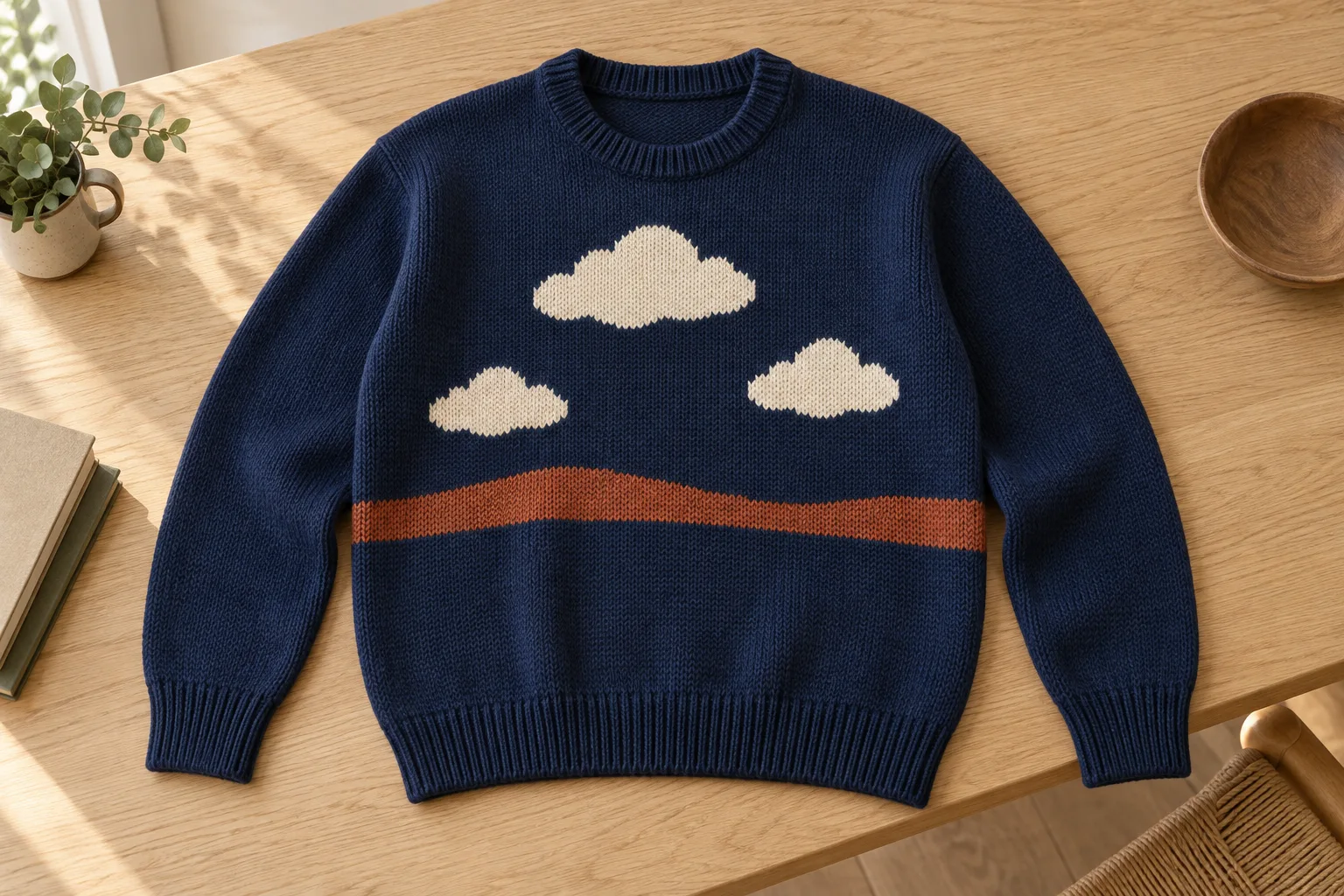
An intarsia knit sweater should move into bulk only when its difficult colour boundaries work on the proposed production route. An attractive front photograph is not enough. The buyer needs to know whether isolated colour areas can be repeated without unresolved openings, tight joins or an unpriced repair operation. If that evidence is missing, the practical choice is another controlled trial, a design change or a different route.
This guide addresses that route decision for an original or authorised graphic with separate colour islands. It does not teach diamond placement or size grading. The argyle pattern-control guide already covers those geometric decisions. Here, the working document is a boundary map showing where the proposed intarsia route succeeds, where it fails and what change would justify another trial.
No artwork, machine allocation or test results for a specific CNSweaters order are assumed. The examples are hypothetical. Use them to ask for evidence from the supplier responsible for the actual yarn, program and finishing route, not as proof that any factory can reproduce the design.
What makes an intarsia knit sweater route uncertain?
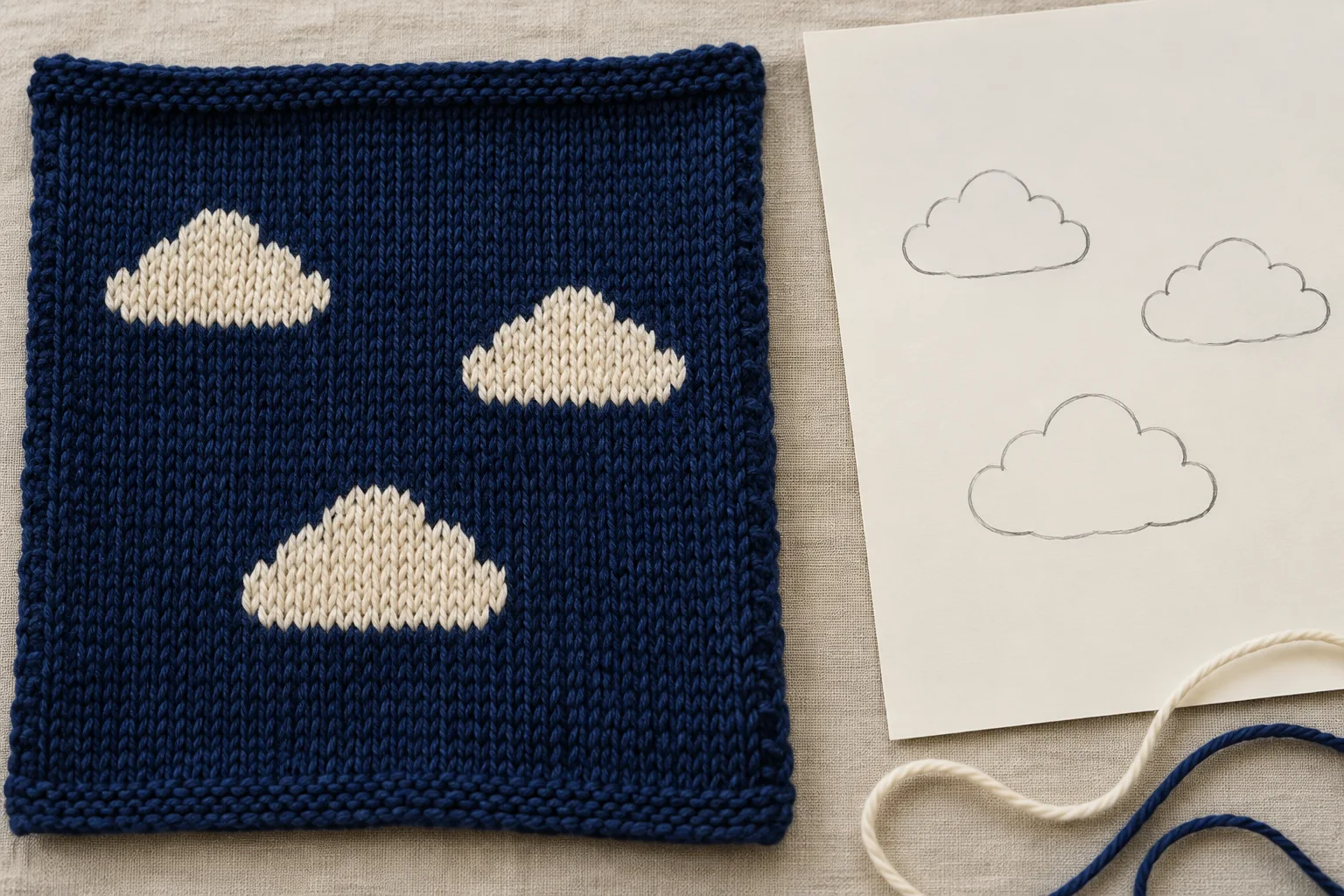
Count separate areas rather than colour names
A drawing with three colours may contain many separate islands of one colour. A different three-colour drawing may use three broad connected fields. The colour count alone does not describe the work the knitting route must perform. Give each isolated area a reference and show the courses where it begins, divides, joins another area or ends.
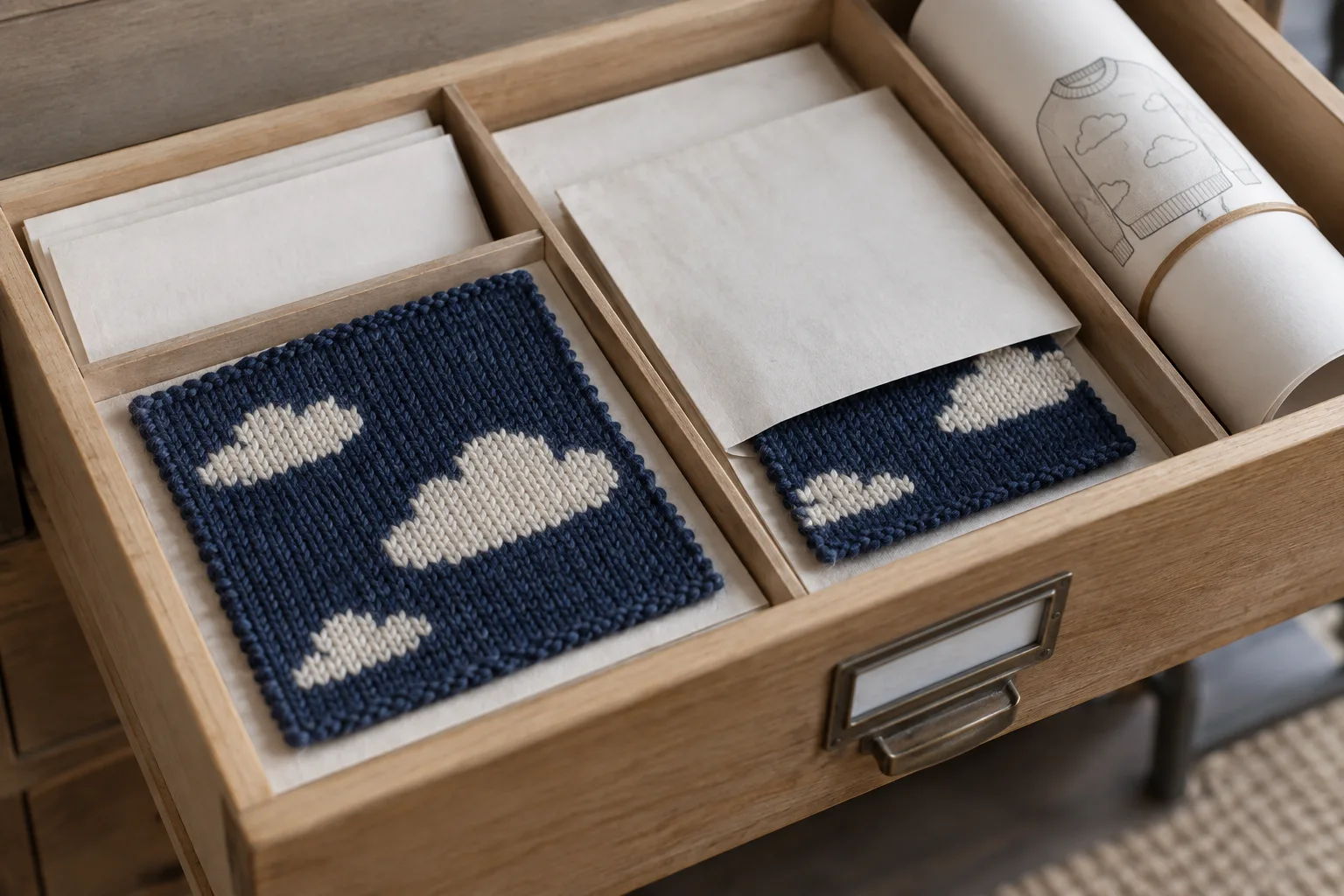
Consider an invented graphic of three pale clouds over a dark ground, with a narrow contrasting path below them. Call the clouds A, B and C and the path D. This map lets the technician explain whether the separated areas create distinct yarn-handling demands. Do not translate four labelled areas directly into four required carriers; the actual routing and machine arrangement determine that relationship.
SHIMA SEIKI’s N.SIR machine information lists intarsia carriers among the relevant features. This establishes that equipment configuration matters. It does not establish which options a supplier has installed or whether its proposed setup can run this drawing. Request confirmation of the actual route, not a machine-brand logo on a capability sheet.
Locate the boundaries that deserve a trial
Mark narrow tips, short isolated areas and transitions close to shaping or an opening. Give each boundary a code that can appear on a sample photograph. State whether it will sit on a relatively quiet part of the body or a location that moves during dressing and wear. The purpose is to choose useful trial specimens, not to declare every boundary equally difficult.
Also identify what the design cannot change. A buyer who would accept a broader cloud tip should say so before a technician spends time preserving it. A protected brand symbol may have less room for revision. Use the knitwear tech-pack checklist to place those permissions beside the graphic and garment drawing rather than leaving them in a separate conversation.
What should the supplier demonstrate first?
Request a route explanation tied to the artwork
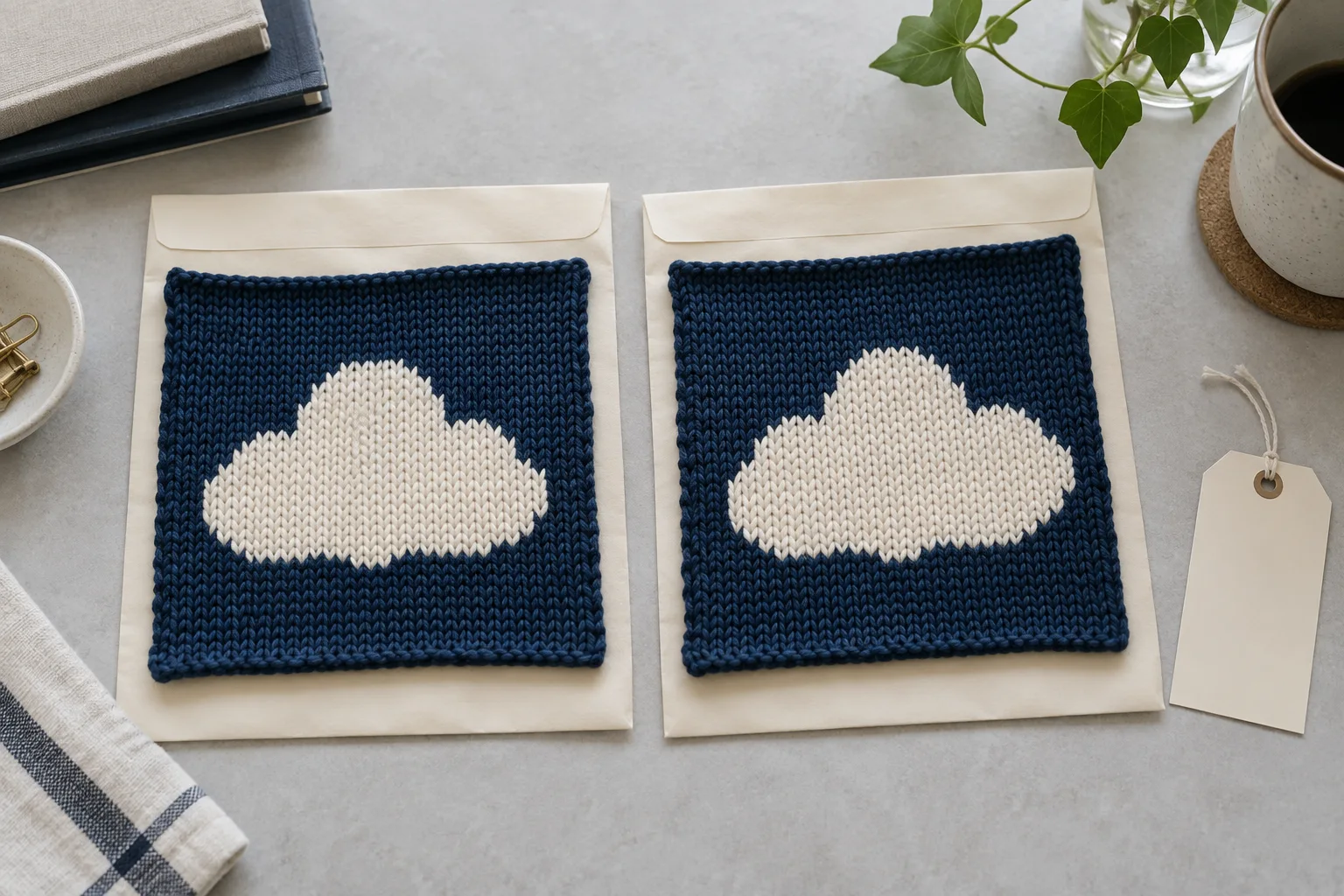
Ask the technician to identify the proposed machine configuration, chart reference, yarn assignments and handling of the marked transitions. The explanation need not disclose proprietary programming that the contract does not require. It must still be specific enough to show that the actual drawing, rather than a generic intarsia example, has been assessed.
SHIMA SEIKI’s knitting-feature explanation describes dedicated intarsia carriers as supporting colour changes within a knitting width. Do not turn that description into a universal maximum for colours or islands. Available configuration, the drawing and the intended production process still need to be considered together by the responsible technician.
Ask what would change if the drawing were moved, widened or simplified. A useful answer identifies the affected areas and the next evidence required. “No problem” and “too complicated” are equally weak if neither is connected to a boundary code. If the supplier cannot yet explain the route, agree a feasibility stage instead of pretending that the unit quote is a confirmed production offer.
Sample the difficult transition, not an easy substitute
The first trial should contain the critical beginning, ending or meeting of colour areas. A rectangle with the same yarn colours does not answer whether the narrow path in the actual artwork works. Keep enough surrounding fabric to observe distortion, and specify the intended finishing condition before comparing the result.
Request face and reverse views and retain the physical piece. Record any manual correction before photography. A repaired specimen may be valuable evidence, but it must be labelled as repaired; otherwise the buyer may approve a route that relies on work absent from the price and production plan.
The sample-fee and development-fee guide helps distinguish a feasibility trial from a finished sales sample. State the trial’s decision in the request: determine whether boundary B can be produced without the listed unresolved defect. This gives both sides a clear stopping point and prevents polishing an entire garment before the route question is answered.
How should a failed boundary be investigated?
Describe the observation before choosing a correction
Record where the problem appears, under what condition and whether it recurs on comparable pieces. An opening visible only during an agreed extension check is a different observation from a gap in the relaxed panel. A tight vertical join is not the same as a colour area knitted in the wrong location. Avoid collapsing them into a single “intarsia defect” category.
The following table is a hypothetical diagnostic worksheet. It suggests evidence to request, not proven causes or universal defect limits.
| Observation | First comparison | Controlled next trial | Release remains open until |
|---|---|---|---|
| Opening at cloud tip B | Chart reference and actual tip construction | One documented tip revision | Revised tip meets agreed appearance and use checks |
| Tight line beside path D | Relaxed dimensions on both sides | Technician-selected joining adjustment | Local improvement does not distort the panel |
| Loose reverse end at C | Finishing and securing record | Declared securing method | Repeatable result and labour basis are demonstrated |
| Problem only after finishing | Same identified piece before and after | One controlled process comparison | Intended production finish gives acceptable evidence |
Keep the original failed piece. If every unsuccessful panel is discarded, later discussion depends on photographs with different lighting and tension. Mark the relevant boundary, sample version and condition before sending it back. The sample-feedback guide provides a useful discipline for recording one observation and one requested response at a time.
Separate the location of the defect from its extent. One identified cloud tip failing on several pieces suggests a different trial from unrelated openings scattered across the panel. Ask the supplier to plot observations on the same boundary drawing rather than attaching an unlabelled stack of close-ups. Include pieces without the problem when making the comparison; their recorded inputs may help the technician distinguish a consistent design constraint from a variable production condition. Absence of a visible gap in a photograph is not a substitute for the agreed physical assessment.
Avoid changing several variables at once
If the supplier changes yarn, chart and finishing together, the result may improve without revealing which change mattered. That can be acceptable as a new route proposal, but it is not evidence that a single adjustment solved the original problem. Give the combined proposal a new identity and assess the consequences for the garment brief.
For a diagnostic trial, ask the technician which variable is being isolated and why. Buyers should not dictate machine settings from a photograph. They should require a traceable explanation of the trial and a comparison that can support the next commercial decision. If the supplier cannot isolate the cause economically, choosing a simpler graphic may be more sensible than continuing an open-ended investigation.
Which revision is worth testing again?
Separate changing the graphic from changing the product
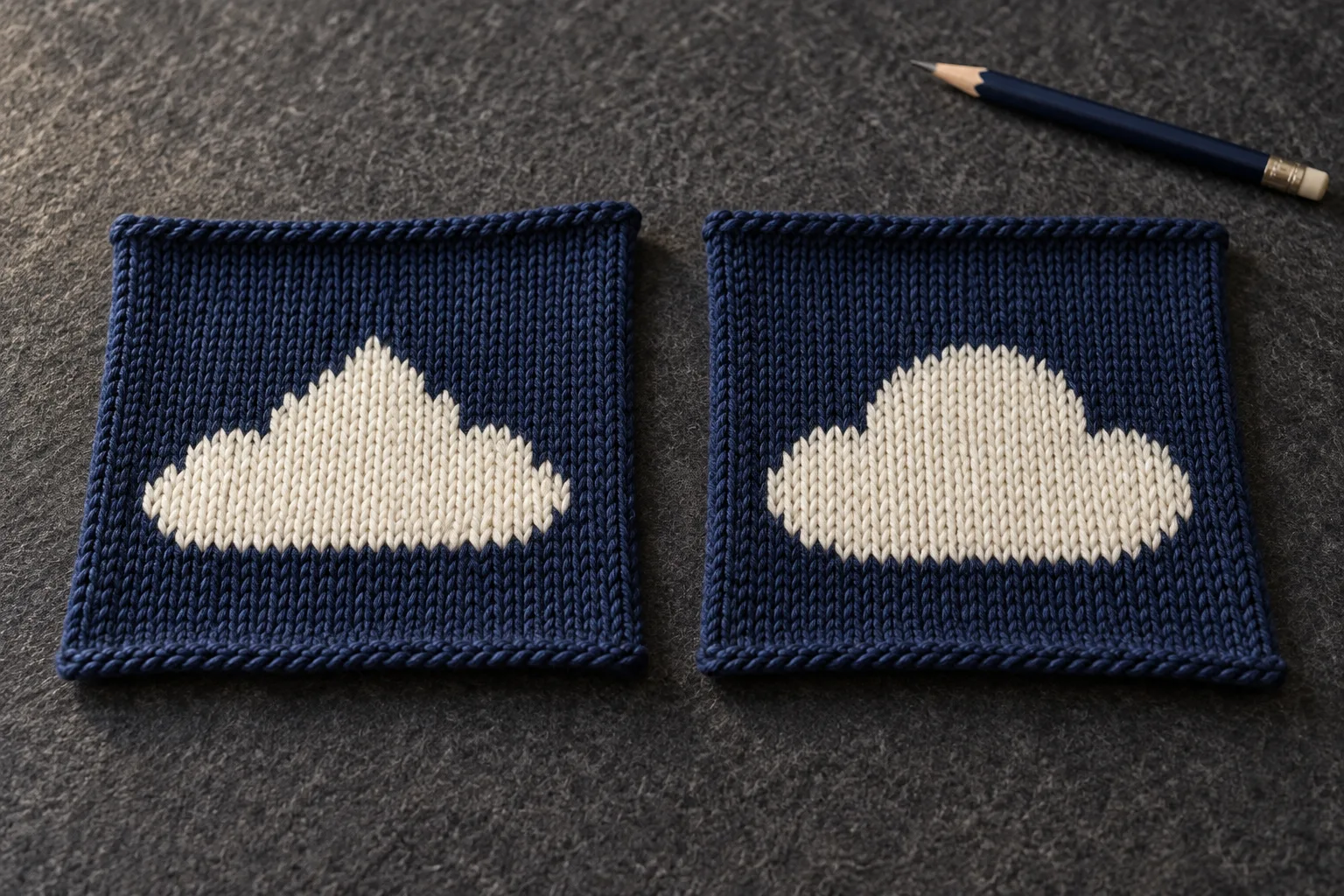
Broadening an optional tip changes artwork. Changing the yarn may alter the whole garment. Switching to another knitting route can alter the reverse, handle and development work. Adding manual repair changes the production process. These are different proposals and should not share one approval box labelled “sample revised.”
Use the yarn-planning guide when a proposed yarn change affects purchasing or colour availability. Use the argyle cardigan route discussion only for broader construction comparisons. Neither page approves the new boundary on this graphic; the revised route still needs its own specimen.
Ask what the revision protects and what it gives up. Removing one isolated cloud may reduce the graphic’s intended balance. A broader path may be visually acceptable but too prominent on a small front. A route that produces a cleaner reverse may change fabric weight. The buyer should decide whether the resulting product is still the one the order intends to buy.
Compare total correction exposure
Suppose a hypothetical trial of twenty identified pieces contains four pieces needing manual attention. That observation is not a reliable forecast of the final defect rate. It is enough to ask what caused the interventions, whether their method is repeatable and how the supplier will show that the underlying process is controlled before bulk.
Do not simply add an assumed repair percentage to the quote and call the issue solved. Ask for the intervention record: boundary, work performed, operator route, result and remaining consequence. If the proposal relies on ongoing manual work, include that work in the agreed production sequence and verify the repaired result under the same assessment conditions.
The custom knitwear cost-driver guide can help organise programming, material and handling costs. For this decision, compare the cost of another meaningful trial with the exposure created by releasing an unresolved route. Neither a low unit price nor money already spent on development proves that proceeding is the better choice.
What evidence is needed before bulk release?
Approve the intended condition and repeatability
Agree the appearance and use checks with the technical team before reviewing the final specimen. Record how the piece is rested, handled and assessed. If extension is part of the review, define how it will be performed and judged. Do not invent a universal gap size, pull force or cycle count from a general manufacturing article.
ISO 23606 addresses notation and pattern design for knitted fabrics. Its scope supports keeping the pattern representation intelligible; it does not specify an acceptable hole at an intarsia join. The order therefore needs both a controlled chart reference and separate product acceptance conditions.
Ask for evidence from more than one conveniently selected specimen where repeatability is the open question. Choose the sample plan with the responsible quality team according to the actual route and risks. The goal is to determine whether the approved construction can be repeated, not to obtain an attractive replacement photograph for the failed one.
Connect the trial to the production route
Confirm that bulk will use the route represented by the release sample, including any declared manual operation. Where the proposed machine group, material or finishing process differs, ask what bridging evidence is needed. A successful sample made under another arrangement cannot silently authorise the planned route.
The pre-production sample review should name the approved boundary map and list unresolved exceptions. Keep the broader knitwear testing plan separate from the route trial. Passing the local boundary review does not establish every performance or market requirement for the finished garment.
Write the release in terms of the exact graphic revision and order scope. “Intarsia approved” is too broad. A statement identifying the route, sample and permitted variants gives production a usable reference and gives the buyer a clear reason to reopen review if one of those inputs changes.
When should the buyer stop this route?
Define a useful final trial
Before authorising another round, name the unresolved question and the evidence that would change the decision. If the next sample repeats the same drawing and process without a reason to expect a different result, it is not a useful trial. Ask for a revised hypothesis or stop spending on that route.
A practical stop condition might be inability to demonstrate the protected boundary without an unapproved graphic change. Another might be a proposed repair operation that the supplier cannot document or repeat. These are order-specific decisions, not blanket claims that intarsia is unsuitable for complex work.
Keep design and procurement involved in the choice. The technician can explain a viable alternative, but the buyer must decide whether its appearance, hand and cost still fit the planned product. If no acceptable revision remains, hold the style rather than releasing it under an ambiguous concession that quality staff cannot inspect.
Preserve the decision for a later order
Archive the original boundary map, failed specimens, successful revision if any, and the reason for the final decision. Record whether the outcome was route accepted, graphic revised, route replaced or style held. These labels are more useful than marking the project “sample complete,” which says nothing about manufacturing readiness.
On a repeat, ask what has changed in the relevant materials, equipment arrangement, program and finishing route. Reopen only the affected boundary evidence, but do not assume that a different production setup inherits the old result. The reference-sample guide helps preserve comparison pieces with enough identity to make that review possible.
Keep commercial changes attached to the technical decision. If a simplified graphic was accepted only to meet a particular price, record it as the purchased revision. Otherwise a future team may request the original artwork at the simplified price and unknowingly restart the same feasibility problem.
Conclusion
The bulk decision for intarsia belongs at the difficult colour boundary, not at the front photograph. Map the separate areas, identify the transitions that need proof and ask the supplier to demonstrate the actual proposed route. Keep failed pieces and describe their condition before approving a correction.
Another trial is worthwhile when it answers a specific unresolved question. A changed graphic, yarn, construction or manual operation must be assessed for what it changes in the product and the commercial plan. None should disappear inside a vague sample approval.
Release only when the identified route has adequate evidence against the agreed boundary requirements, with broader garment checks handled separately. If the necessary evidence cannot be produced, simplify the authorised artwork, assess another route or hold the style. That decision is more useful than carrying an unexplained defect into bulk.
Discuss your intarsia development brief
Frequently Asked Questions
Do fewer colours always make intarsia easier?
Not necessarily. Separate islands, their position and their transitions matter as well as colour count. Ask the technician to assess the actual map rather than quoting feasibility from the number of yarn shades alone.
Can a repaired sample still be used for approval?
It can provide evidence if the repair is disclosed and the buyer assesses the resulting route. It cannot prove that the piece was produced without that operation. Record the method, repeatability and commercial responsibility before release.
Should the buyer prescribe carrier settings?
Normally the responsible technician should select machine settings. The buyer should define product requirements, require a traceable route explanation and evaluate the resulting evidence. A photograph does not provide enough information to dictate a safe technical adjustment.
Does a successful boundary panel approve every size?
No. It answers the boundary question represented by that panel. If placement, shaping or another relevant condition changes in a garment variant, assess what additional evidence is required before extending the route approval.