 CN Sweaters
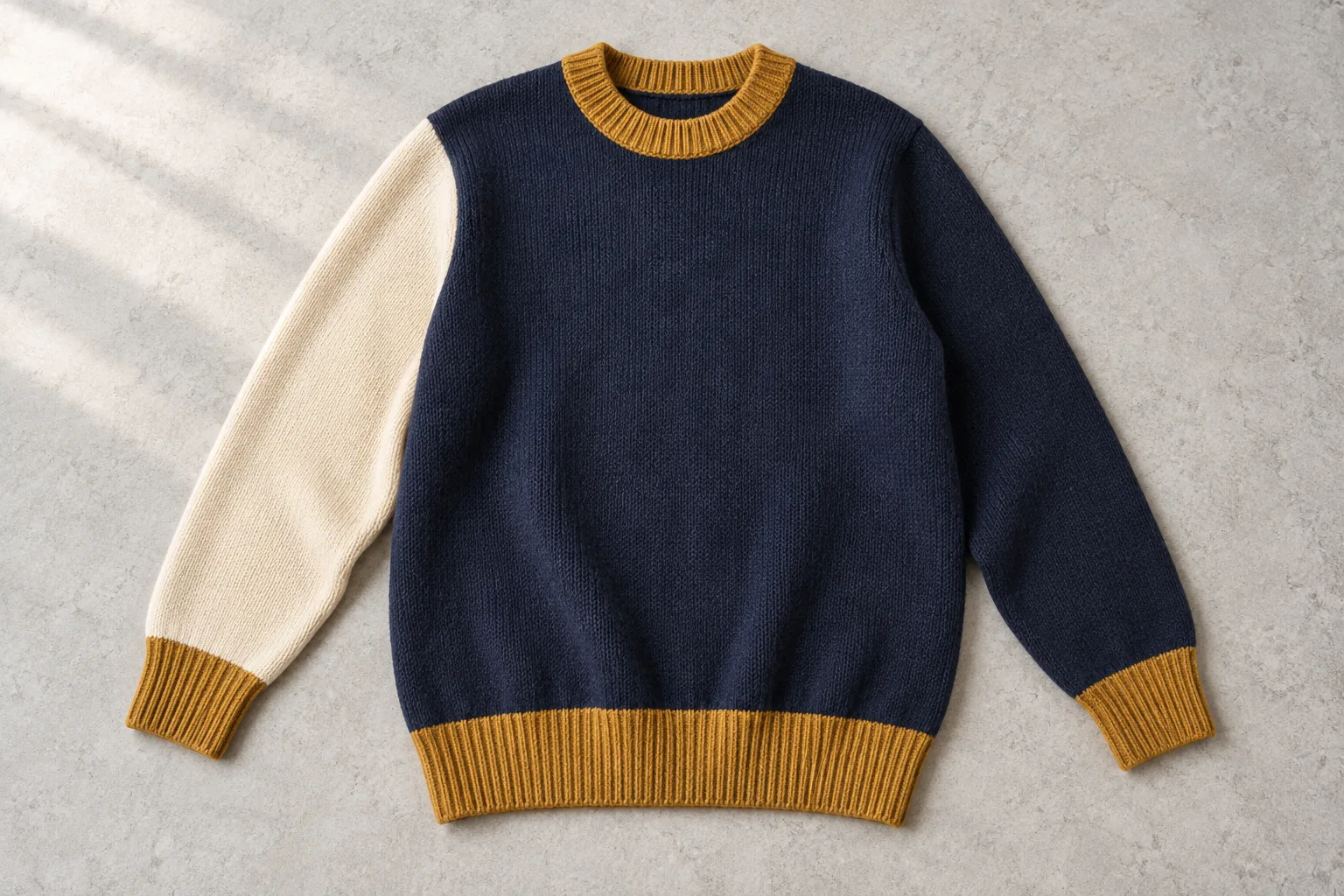
Colorblock sweater compatibility must be assessed on one interacting garment, not several attractive yarn colours. Before committing a fall retail drop, ask whether its contrasting areas can tolerate the same finishing and care route without unacceptable staining, distortion or changes at their boundaries. If they cannot, the useful decision is whether to change a material, reduce the contrast, revise the construction or stop that version.
This guide addresses compatibility between areas within one adult sweater. It does not replace a dye-lot approval system, prescribe a universal test grade or establish CNSweaters manufacturing capability. The examples are hypothetical development decisions. Actual methods, sample selection, acceptance limits and care wording need agreement with the supplier, qualified testing provider and responsible market reviewer before bulk approval.
What does colorblock sweater compatibility require?
Map the regions that will be treated together
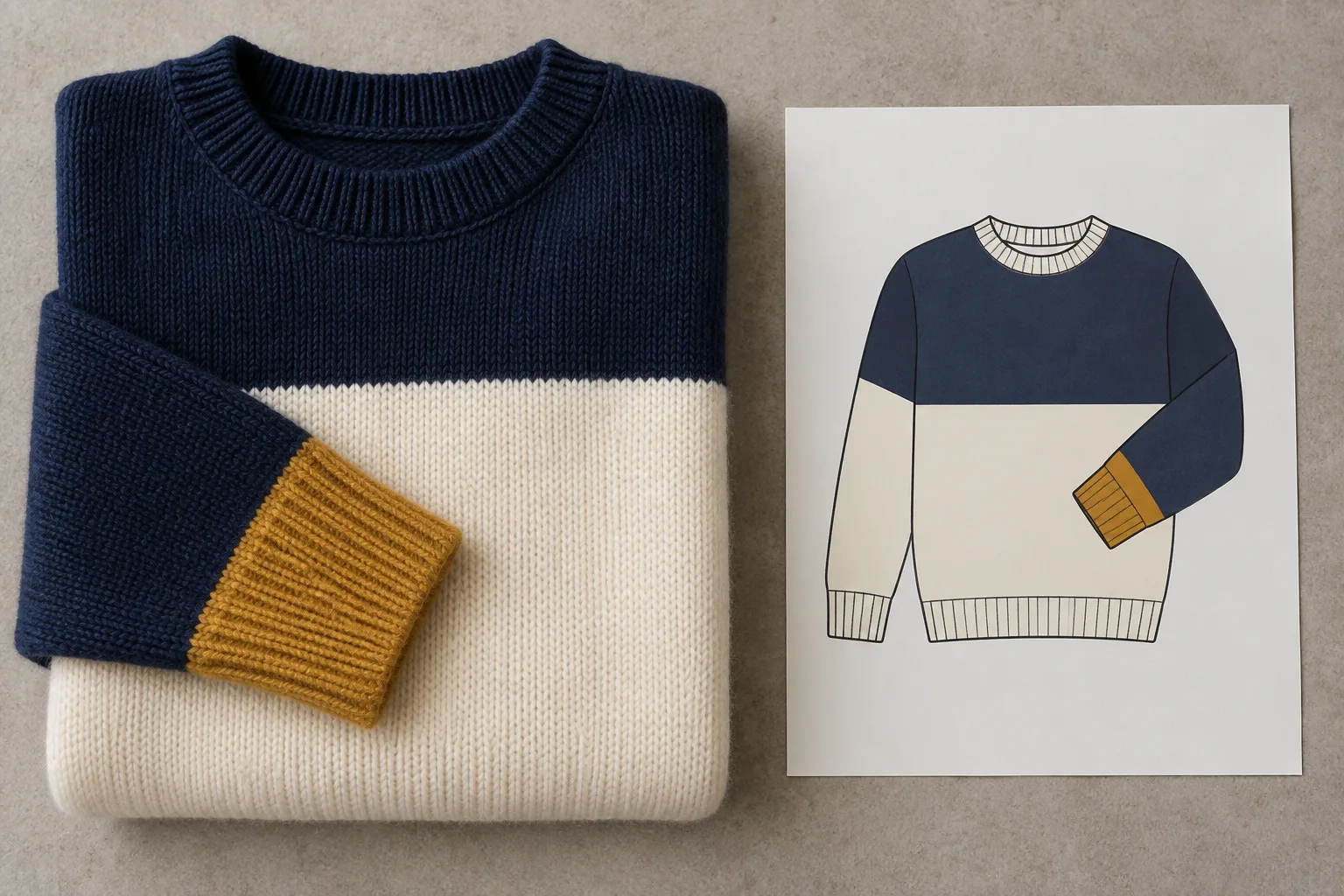
Draw the garment with each distinct material region identified. Include the main body, sleeves, neck, rib trims, contrast panels, sewing thread and attached labels. Record the yarn reference, proposed composition, colour and construction for each region. Two colours from one collection are not necessarily identical inputs, while two regions with the same composition may still have different constructions or finishing histories. Avoid using a photograph as the material specification.
Mark where contrasting areas meet and where they touch when the garment is folded, worn or packed. An ivory sleeve may contact a dark body even if the colours do not share a knitted boundary. A contrast cuff may lie against a pale panel inside the shipping bag. These contact relationships help identify questions for the testing provider; they do not prove that staining will occur or predict its severity.
The existing dye-lot risk guide owns approval of shade references and production-lot consistency. This map serves another purpose: identifying which approved materials must function together inside the same product. Keep both records linked, but do not regard a good shade match as evidence that the combination tolerates the intended treatment.
Define the shared treatment before comparing samples
Ask the supplier to identify the proposed finishing sequence and the intended consumer care route separately. They are not interchangeable. Record enough information to connect the sample to its treatment, with technical details retained by the responsible production team. A finished appearance that depends on an undocumented sample-room correction is not a usable reference for comparing later versions.
Choose the customer-facing care objective before requesting evidence. If the intended retail promise is easy home care, discover whether the complete product can support it before printing labels. If the appropriate supported route is different, assess whether that changes the commercial appeal. The care label evidence guide addresses the substantiation process. Here the decision is whether the selected colour and material combination belongs in that product at all.
Which failure are you trying to distinguish?
Separate shade mismatch from transferred colour
Use precise observations. A darker sleeve than the approved reference is a shade comparison; a pale panel acquiring colour after contact raises a different question. Record when the change was first observed, which regions were affected and what treatment or handling preceded it. Do not diagnose every visual difference as bleeding, and do not dismiss a new stain as ordinary batch variation without examining the evidence.
AATCC’s colorfastness overview lists distinct methods for laundering, water, perspiration and rubbing exposure. That separation matters when commissioning work: evidence for one exposure does not automatically answer all the others. Ask the testing provider which method and conditions address the proposed use. The public overview identifies method families; it does not provide the full procedure or a universal pass threshold for this sweater.
For a comparison of the finished garment with its colour reference, use the established shade variation control guide. Do not import its historical numerical or company statements as current evidence. Keep the present development record focused on the actual combination, observed change and next investigation, rather than turning a broad colour complaint into a presumed cause.
Separate overall shrinkage from regional distortion
Measure the whole garment and the relevant regions using agreed reference points. Overall body length can remain near its target while a boundary puckers, a contrast panel changes proportion or a sleeve twists. Conversely, a garment can change overall size without a local mismatch between colours. These are different observations and may require different corrective work. Keep photographs tied to measurements and sample identity.
ISO 5077 describes determination of dimensional change after specified washing and drying procedures. It is a method reference, not a garment tolerance or a claim that every colour region will behave identically. Ask the provider to document the selected procedures and measurements. The size-drift guide covers wider production consistency; this review concentrates on the interaction between regions under one accepted treatment.
How should you build the comparison trial?
Give each sample a question it can answer
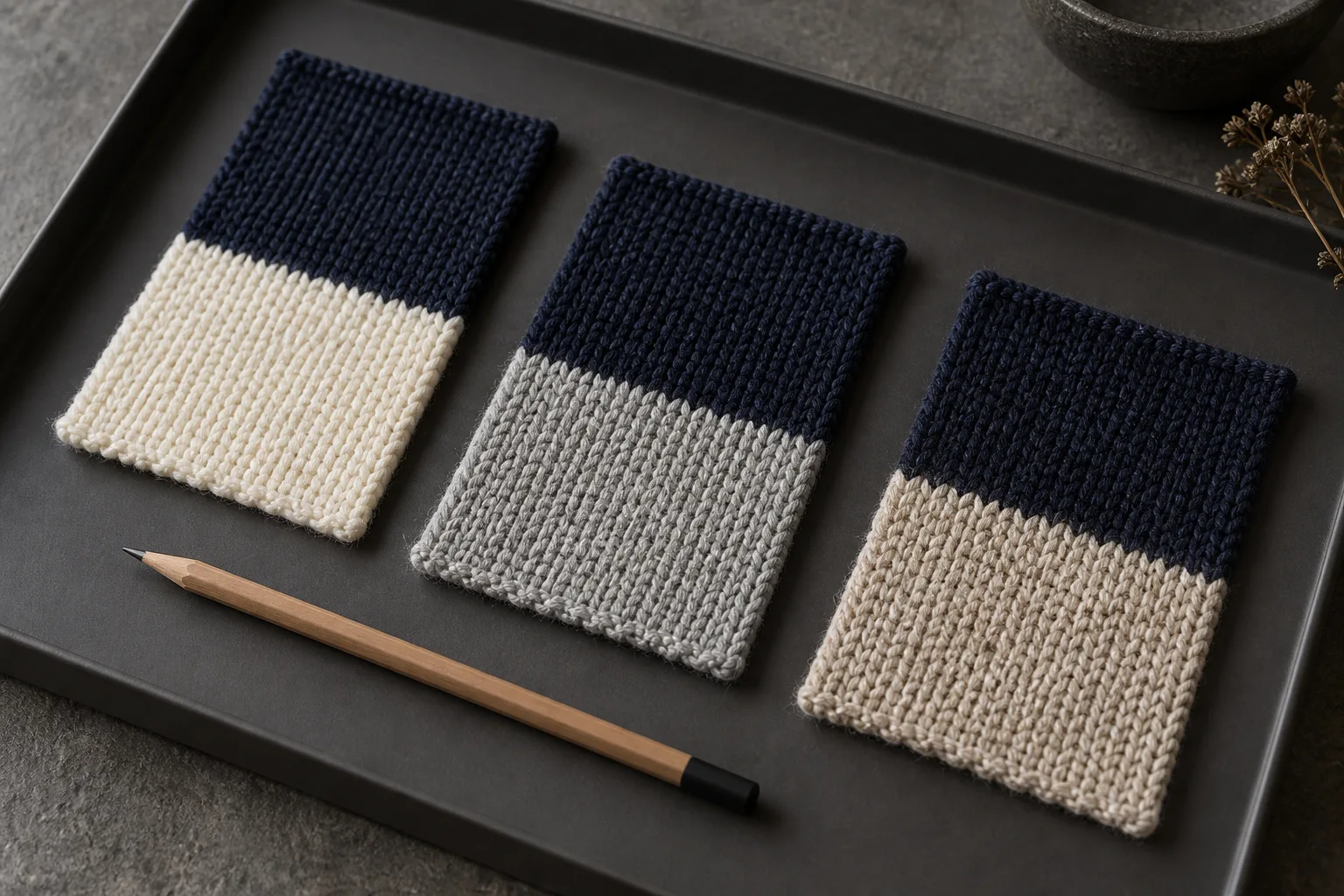
Begin with the smallest sample arrangement that addresses the uncertainty, then confirm the relevant outcome on the assembled garment. Separate yarn or fabric evidence may help isolate a variable, but it cannot reproduce every seam, trim, fold or contact condition. Ask the testing provider to explain what each specimen represents and what remains untested. Do not present a development swatch as a complete product approval.
Consider a hypothetical navy-and-cream sweater with a contrasting rib. One trial might examine the original material combination; another might substitute the cream yarn while preserving the design; a third could keep the materials but revise the joining construction. Each version should answer a different question. Changing the yarn, colour and finish simultaneously may produce a better-looking sample, but makes it harder to identify which change resolved the observed problem.
Record sample IDs, material references, preparation, treatment and observations before comparing results. The reference sample preparation guide helps make instructions reproducible. Specify which version is a control and which is a proposal. A verbal instruction to make it better gives neither the buyer nor the production team a reliable basis for deciding what to retain.
Use a matrix that preserves both appearance and evidence
The matrix should connect an observed issue to an investigation, not automatically prescribe a chemical treatment or factory setting. Keep technical intervention with the qualified production and testing teams. The buyer’s responsibility is to state what must remain acceptable, commission appropriate evidence and decide whether the revised product still fulfils the original brief.
| Observation | Comparison needed | Evidence to retain | Possible product decision |
|---|---|---|---|
| Pale area changes after treatment | Original and revised contrast combination | Identified specimens and method report | Change material or colour pairing |
| Boundary puckers while overall length holds | Regional measurements and join review | Before-and-after records for the same version | Revise construction and retest |
| Rib changes differently from body | Complete assembly under agreed care | Rib and body observations plus garment assessment | Replace rib input or reconsider care objective |
| Fold contact leaves a visible mark | Representative packing and handling investigation | Contact locations and controlled observations | Revise packing or reject the combination |
Do not mark an alternative approved merely because it improves one row. A replacement yarn could resolve a visible issue while changing handle, weight, fit or the permitted composition statement. List those consequences beside the result. The colour defect reduction guide provides broader context, but the acceptance decision must remain tied to this revised product rather than a general prevention checklist.
Can one care instruction serve every region?
Assess the complete product rather than its easiest component
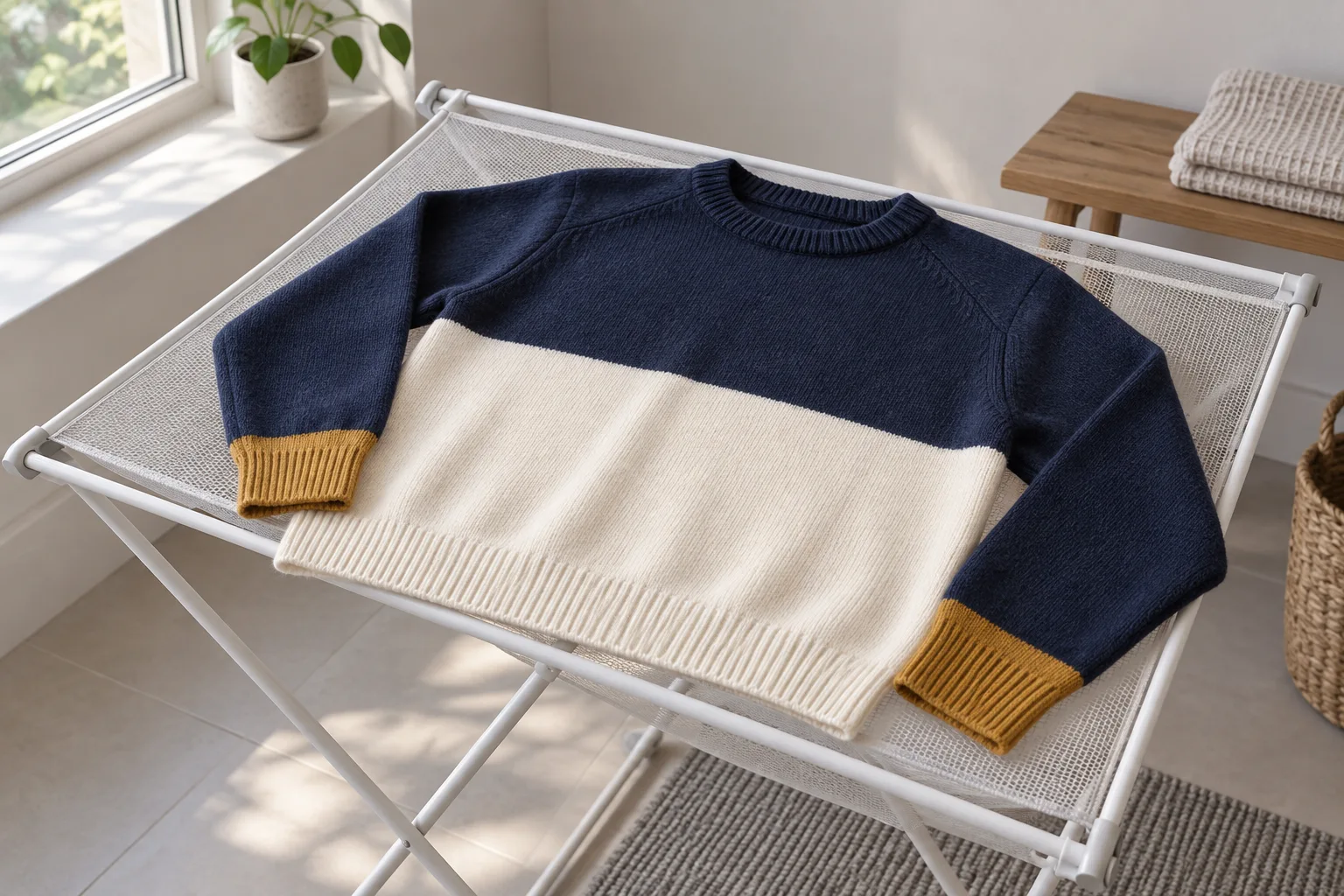
Bring the proposed care instruction into the trial review. If the main body supports one route but a contrast area or trim does not, the garment has not earned the easier claim merely because most of its surface behaves acceptably. Ask what evidence supports a safe and practical method for the entire item. Where evidence is incomplete, keep the wording unapproved rather than choosing a familiar instruction from another style.
For covered apparel sold in the United States, the FTC’s care labelling guidance describes the need for a reasonable basis for care instructions. That reference is market-specific. Buyers selling elsewhere should have the relevant requirements checked separately. A change to the garment should also trigger a review of whether the earlier care basis still represents it.
Use the care labels and fibre content guide when preparing the final label file. Keep fibre identification, care support and design compatibility as separate approvals. A correct composition label does not prove wash performance, and a successful appearance trial does not determine the wording legally required in every destination market.
Decide whether the supported route fits the retail brief
Sometimes the development team can support a route that the buyer does not want to sell. That is a commercial mismatch, not necessarily a defective product. Compare the options openly: accept the supported route and adjust the proposition, redesign the combination to pursue the original objective, or remove this version from the drop. Do not retain an unsupported claim simply to preserve launch copy.
If the care objective changes, check the ripple effects before approving it. Sales copy, labels, packaging inserts and staff guidance may all reference the earlier promise. The labels and packaging checklist helps locate those surfaces. Update only the affected version and retain the earlier approval record so that old printed instructions are not accidentally used with new goods.
Which redesign has the lowest unresolved risk?
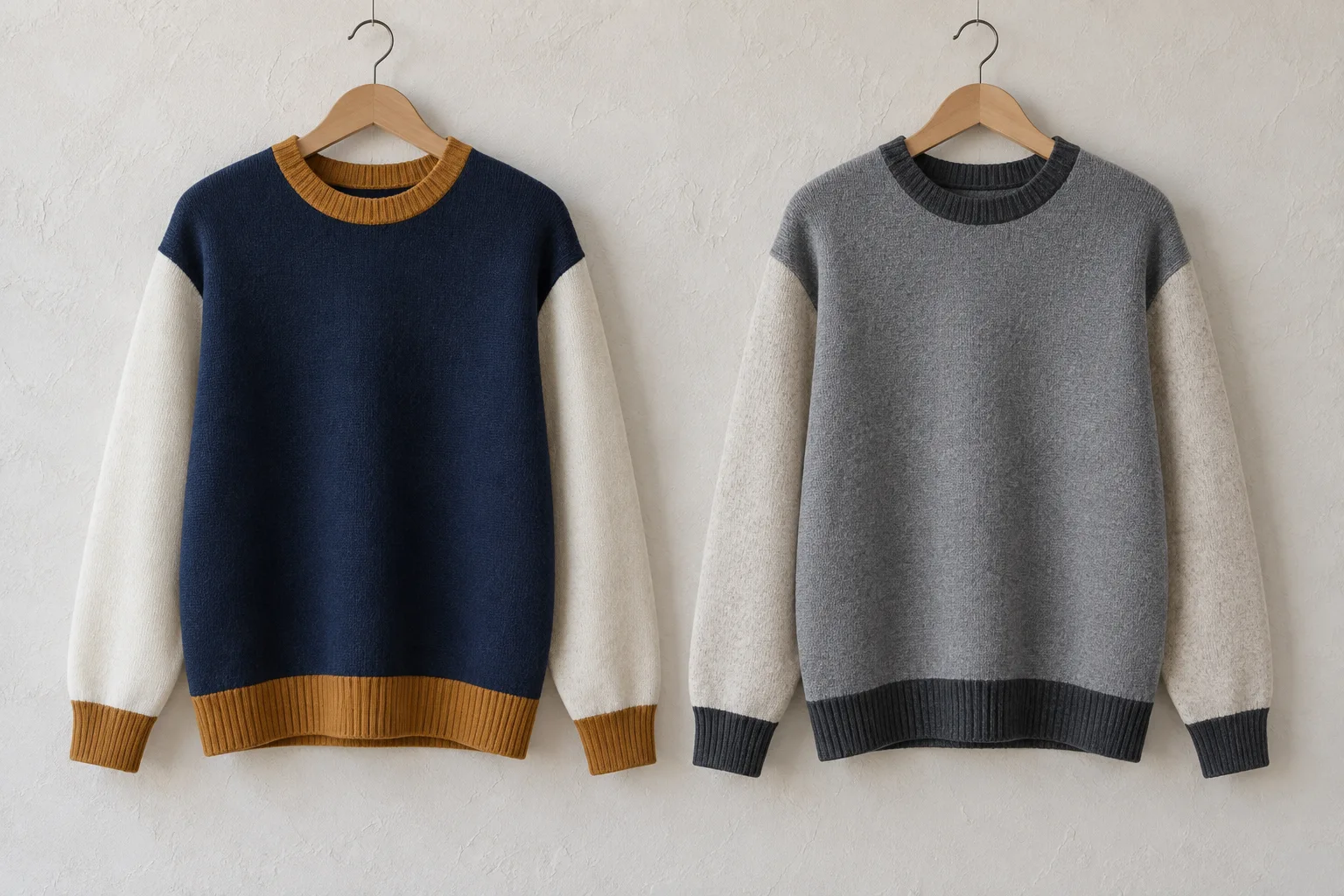
Compare material colour and construction changes separately
A lower-contrast palette may alter how noticeable a change is, but it does not prove that the underlying performance is acceptable. Assess the actual result against the agreed criteria. Likewise, selecting matching fibre descriptions for all regions does not establish identical dimensional response. The relevant evidence comes from the specified materials and product, not from a label category alone.
Use a decision sheet with the original brief on one side and each proposed change on the other. Record what it preserves, what it sacrifices and what needs another check. A material change might affect composition and cost; a construction change might affect appearance and size; a colour change might affect the range’s intended contrast. Avoid calling every revision a minor adjustment when its commercial effect is different.
Discuss these consequences through the private label yarn planning guide. Ask the supplier for the actual availability, minimums and quotation for a proposed replacement. This article does not assume that any alternative yarn is stocked or can be substituted within the existing order terms. A technically promising option still needs a feasible supply arrangement.
Set a stopping rule for the development round
Before another trial, write the question that remains and the decision its answer will change. For example, will an identified alternative allow the contrast boundary to meet the accepted appearance and dimensional requirements under the intended care route? If the answer would not change the purchasing decision, another sample may not be the useful next step. Resolve the commercial brief instead of repeating development without a defined purpose.
Consider the scope of the fall drop. Removing one unresolved colourway may be possible if the remaining versions have their own adequate evidence and the supplier accepts the changed order. It is not permission to treat every other colourway as automatically approved. Document which variants remain, their evidence coverage and the revised commercial terms. A smaller launch can still be incomplete if its remaining combinations were never assessed.
What belongs in the bulk release record?
Freeze the accepted combination and its limits
The release file should identify the material map, accepted construction, finished sample, relevant test reports, care version and destination scope. Record any approval limits, including the colourways and sizes actually represented. Keep missing coverage visible. A signed photograph is useful for appearance reference, but it cannot carry the entire technical and documentary approval on its own.
Use this release table to confirm the inputs and limits that belong to the accepted combination.
| Release input | Evidence to retain | Approval boundary |
|---|---|---|
| Contrasting material map | Identified material references and accepted construction | Recorded colourways and sizes represented |
| Finished sample | Physical sample location and version identity | Accepted combination shown by that sample |
| Test and treatment record | Relevant reports, stated conditions and provider limitations | Sampled version under the documented treatment |
| Care and packing version | Approved care version and packing arrangement | Named destination scope |
Use the pre-production sample review guide for the handoff into production. The added requirement here is to preserve the accepted relationship between contrasting regions. If a material, finish, trim or packing arrangement changes, identify which part of that relationship is affected and commission a proportionate review before extending the earlier approval.
Record the physical location of retained samples and who can access the reports. When a production question arises, the team should be able to compare the relevant version without reconstructing the approval from scattered messages. Keep the technical provider’s limitations with the result. A report’s sample identity and stated conditions are part of its meaning, not administrative details to remove from the buyer’s summary.
Define how a new observation changes the release
Ask production to report an unexpected difference before it becomes a shipment-wide assumption. Record the affected material references, units or process stage as available, then isolate the decision that needs review. Do not automatically prescribe reprocessing: it may change other accepted properties. A corrective proposal needs its own evidence and agreement about what will be rechecked.
For illustration, suppose a production substitution affects only the contrast rib. The review should examine the rib’s interaction with the body and the approvals dependent on that input. It need not reopen an unrelated artwork decision, but it should not be reduced to checking whether the new rib looks the same in a photograph. The scope follows the change and its consequences, not the convenience of the remaining schedule.
The final instruction should make clear whether the version is released, held for a defined answer or removed from the purchase. Record the reason in plain language. The aim is not a perfect-looking spreadsheet; it is a sweater whose selected regions can function together under the promised conditions, with enough evidence for the buyer to accept that specific combination.
Conclusion
Colorblocking adds a compatibility decision to sweater development. The buyer needs to know whether the selected regions can share finishing, care and ordinary handling without unacceptable interaction. Start with a material and contact map, distinguish staining from shade mismatch, and measure local changes rather than relying only on overall garment dimensions. Give each trial a defined question and preserve the identity of the version it represents.
Use the findings to choose a product, not merely another sample. A different material, palette or construction may be appropriate, but its consequences for fit, claims, supply and presentation need review. Release only the combination supported by the accepted evidence and record what would reopen that decision. Prepare your intended colour layout, material references, care objective and observed concerns before requesting a development discussion. Contact CNSweaters about your colorblock sweater brief.
Frequently Asked Questions
Does choosing one fibre composition remove compatibility risk?
No. A composition description alone does not establish how the specified colours, constructions and finishes behave together. Evaluate the actual combination under the intended conditions.
Can a colourfastness report replace a packed sample review?
Not automatically. Read what the report tested and under which conditions. Packing may create different contact and presentation questions that require a separate, representative review.
Should an unresolved colourway delay every version?
Determine whether the issue affects shared inputs or only that combination. Independently supported versions may have a different decision, subject to supplier agreement and clear separation of approvals.
Is a revised care label enough to resolve a failed trial?
Only if the revised instruction has an appropriate basis for the complete product and remains suitable for the intended market and proposition. Changing words alone does not demonstrate acceptable performance.