 CN Sweaters
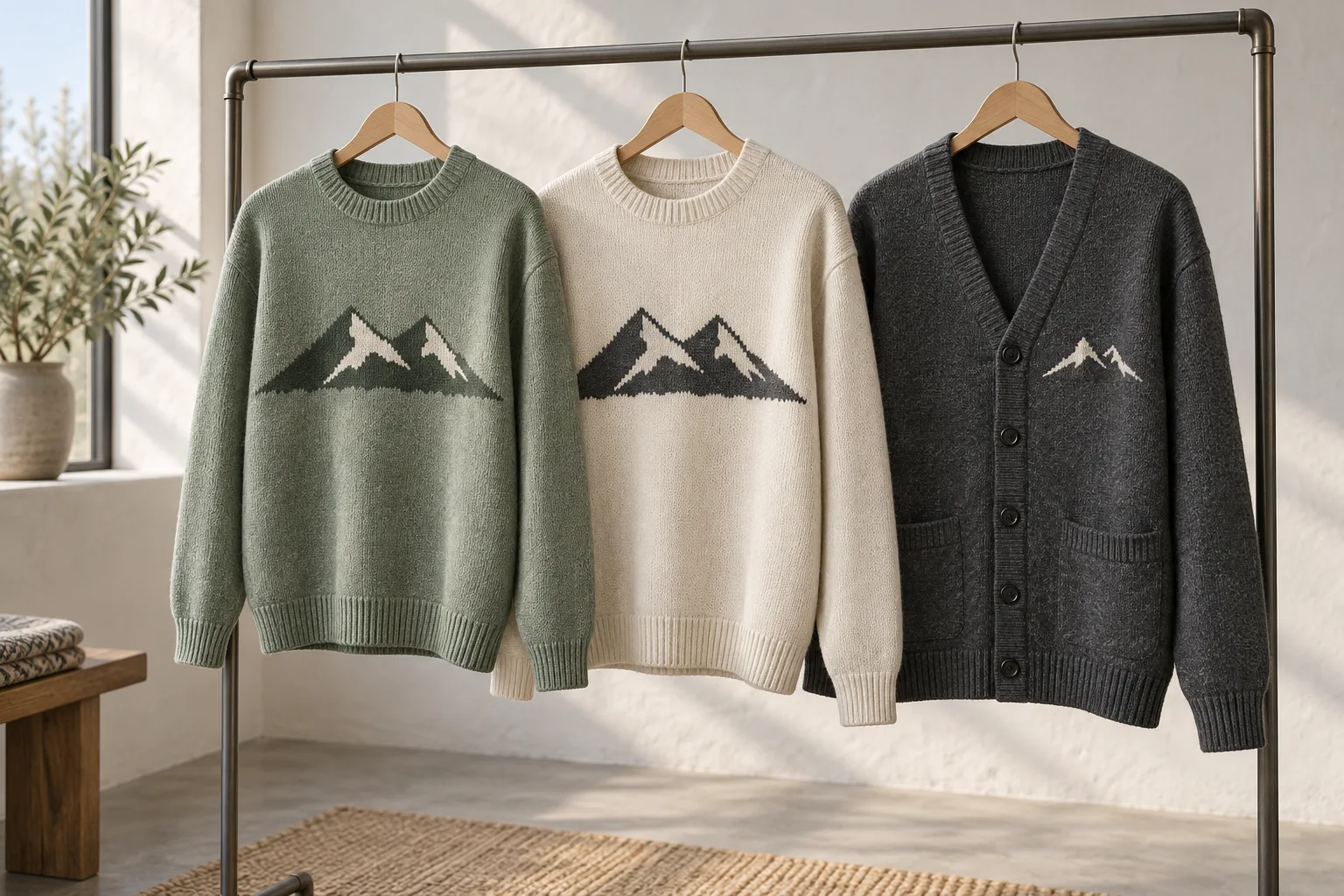
A custom jacquard sweater should not lose its identity when the brand moves the same artwork from a roomy pullover to a narrow cardigan. Approve the features that make the design recognisable, then allow controlled changes around them. One source illustration does not necessarily mean one knitting chart, and a chart that looks clear on screen does not release the entire collection.
This guide is for a design buyer who has already chosen knitted-in jacquard and owns or has permission to use the artwork. The decision is whether several styles and sizes can share an approved interpretation, need separate interpretations, or should lose a weak design variant. It is not a comparison of logo application methods. Use the custom sweater logo technique guide if that earlier choice remains open.
Before development, collect the authorised source file, garment drawings, proposed yarn and structure, size range and named artwork approver. Without those inputs, sample comments tend to alternate between requests for sharper detail and requests for softer fabric. The examples below are hypothetical planning tools.
What must a custom jacquard sweater preserve?
Separate recognition from decoration
Ask the designer to identify the smallest set of features that makes the artwork itself. For an invented mountain emblem, that might be one asymmetric peak, a clear opening beneath it and a short contrasting path. A tiny background star or an irregular outline may be optional. The technician needs this hierarchy before deciding which details can survive the knitted grid.
Write the hierarchy as observable conditions. “Keep the mountain feeling” leaves every reviewer with a different task. “Retain the taller left peak and an open channel between the two peaks” gives the sample review something to examine. Do not invent a numerical recognition score unless the brand has a defined way to measure it. A signed comparison between source, chart and physical panel is more useful than an unexplained percentage.
Keep the commercial story separate from technical approval. A landscape-inspired drawing does not establish a place of manufacture, fibre origin or a relationship with a particular community. If the campaign needs such claims, the evidence must come from the appropriate source. This article only controls the transfer of authorised visual elements into knitwear.
Assign an owner to each permitted change
The designer can approve removing a secondary line; the technical buyer can approve a measured placement within agreed limits. Neither should silently make the other’s decision. Name who approves changes to shape, colour role, scale and placement, and who confirms that the revised fabric still meets the garment brief.
Use the custom knit sweater tech-pack checklist to place those decisions beside the actual garment specifications. Keep an exclusion list as well: no mirrored emblem, no closed central opening, no extra colour introduced to repair an edge. Exclusions are particularly helpful when a sample room is trying to make a difficult shape attractive without knowing which compromise changes the brand’s meaning.
How should the illustration become a knitting chart?
Compare deliberate interpretations
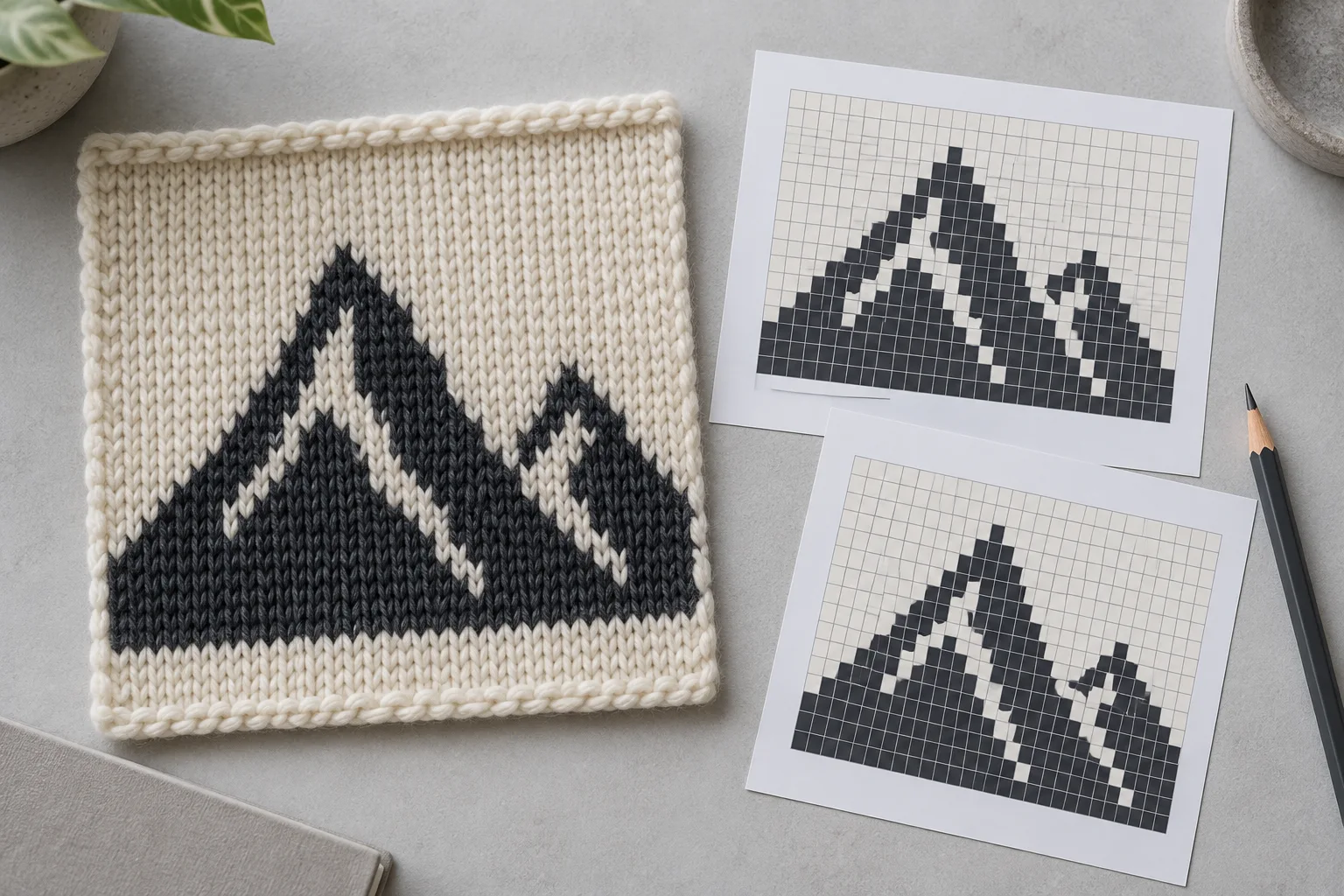
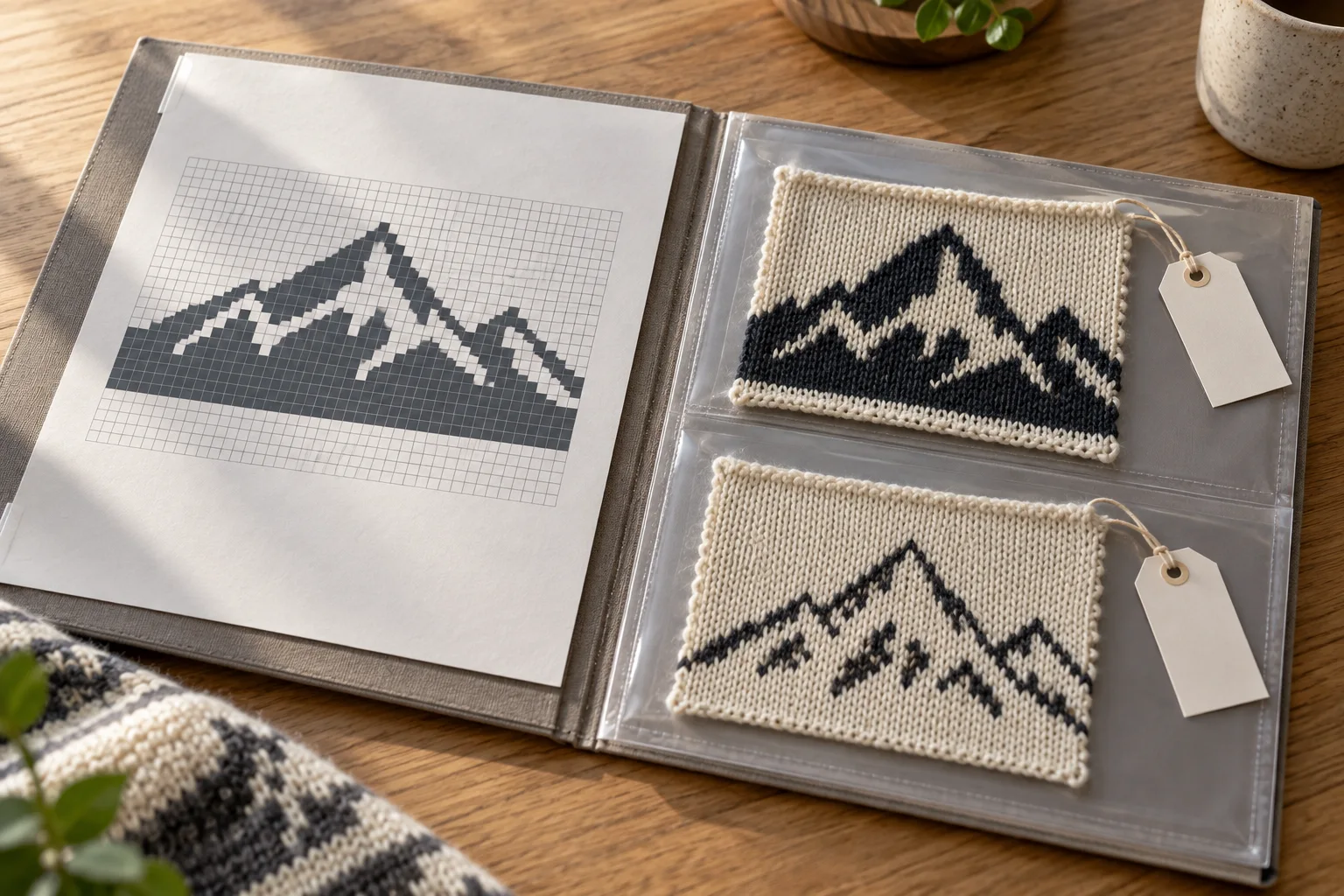
Request two purposeful chart options rather than repeated automatic reductions of the source. One might preserve the outer silhouette and remove interior detail. Another might retain a key interior opening while slightly broadening the surrounding line. Give each option a separate code and describe the trade-off before knitting. Neither option is approved merely because it is simpler to program.
ISO 23606 covers symbolic notation and pattern design for knitted fabrics. Its public scope does not prescribe the brand’s artwork approval method. For this project, require a readable key, colour identifiers and a clear relationship between the chart and its intended face. That is a communication requirement, not a claim that using a chart certifies the garment.
Make scale explicit. Record the chart width and height in stitches and courses, alongside the intended finished dimensions. If the supplier changes the structure or yarn, ask whether those dimensions and the visual relationship still hold. Do not assume that a square in a drawing becomes a square on the finished sweater.
Use a feature comparison before a full garment
The following hypothetical review concerns the invented mountain emblem. It records questions to resolve; it does not report successful samples.
| Identity feature | Original interpretation | Simplified alternative | Physical approval question |
|---|---|---|---|
| Taller left peak | Narrow stepped outline | Broader stepped outline | Does the left peak remain distinct? |
| Central opening | Fine pale channel | Wider pale channel | Is the opening still visible after finishing? |
| Lower path | Two closely spaced lines | One stronger line | Does the single line preserve the intended direction? |
| Background star | Small separate shape | Removed | Does its absence change the collection story? |
Review all four decisions together. Broadening a line may close the adjacent opening, and retaining every small feature can weaken the main silhouette. Ask the technician to mark the exact cells changed between versions. A whole new chart with no change map makes it difficult to connect improvement or failure to a specific edit.
For a repeated seasonal field rather than a brand identifier, the Fair Isle development guide addresses palette and repeat planning. Keep that work separate here: the output is an approved identity interpretation, not another general colourwork specification.
Which physical evidence proves the interpretation?
Review the actual viewing conditions
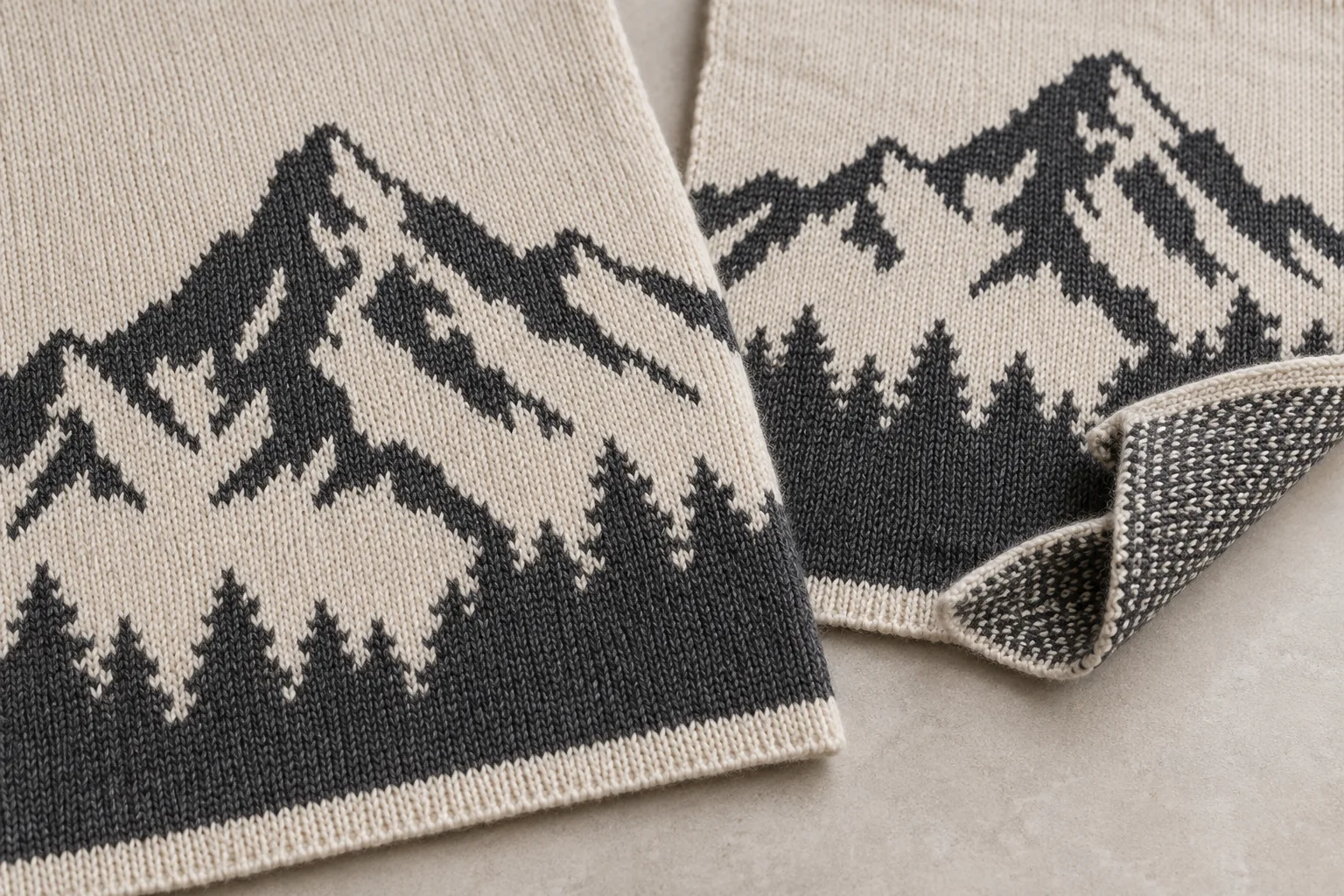
A close photograph can make detail look more legible than it will on a hanging garment. Review the panel at the agreed close inspection distance and at the intended retail viewing distance. Record both conditions. Ask reviewers to identify the essential features without first showing them a marked explanation; otherwise the explanation can lead the judgement.
Include the approved yarn, backing proposal and finishing route in the sample identity. Face clarity alone is insufficient if the panel becomes too stiff for the intended cardigan or the reverse is unsuitable around an open front. The designer should see the face while the technical reviewer checks the fabric condition. The two approvals must refer to the same physical sample.
ASTM D8007 addresses wale and course counts in weft-knitted fabrics. Those counts can help explain a changed motif proportion; they do not measure brand recognition. Ask the testing or technical team to select an appropriate counting procedure, then retain the count beside the finished dimensions rather than using a photograph as the density record.
Separate an artwork failure from a fabric failure
If a central opening disappears, compare the chart first. Was it removed during conversion, knitted differently from the approved chart, or obscured only after finishing? These lead to different corrections. Enlarging the opening in every file would be wasteful if only one finishing trial caused the problem.
The reference sample preparation guide helps keep the comparison objects identifiable. Label panels before and after the agreed finishing or care assessment, and preserve the rejected interpretation beside the selected one. The rejected panel explains what the approval excludes, especially when an attractive but incorrect version returns during a reorder.
Use an observation sheet with sample code, feature code, condition, reviewer and decision. Write “opening merged with adjacent field after the stated process” rather than “poor quality.” If the evidence cannot separate artwork from process, keep the decision open and request one controlled comparison. Do not commission three simultaneous material changes and expect the next sample to reveal which one helped.
Can different styles share the same interpretation?
Map the usable artwork area
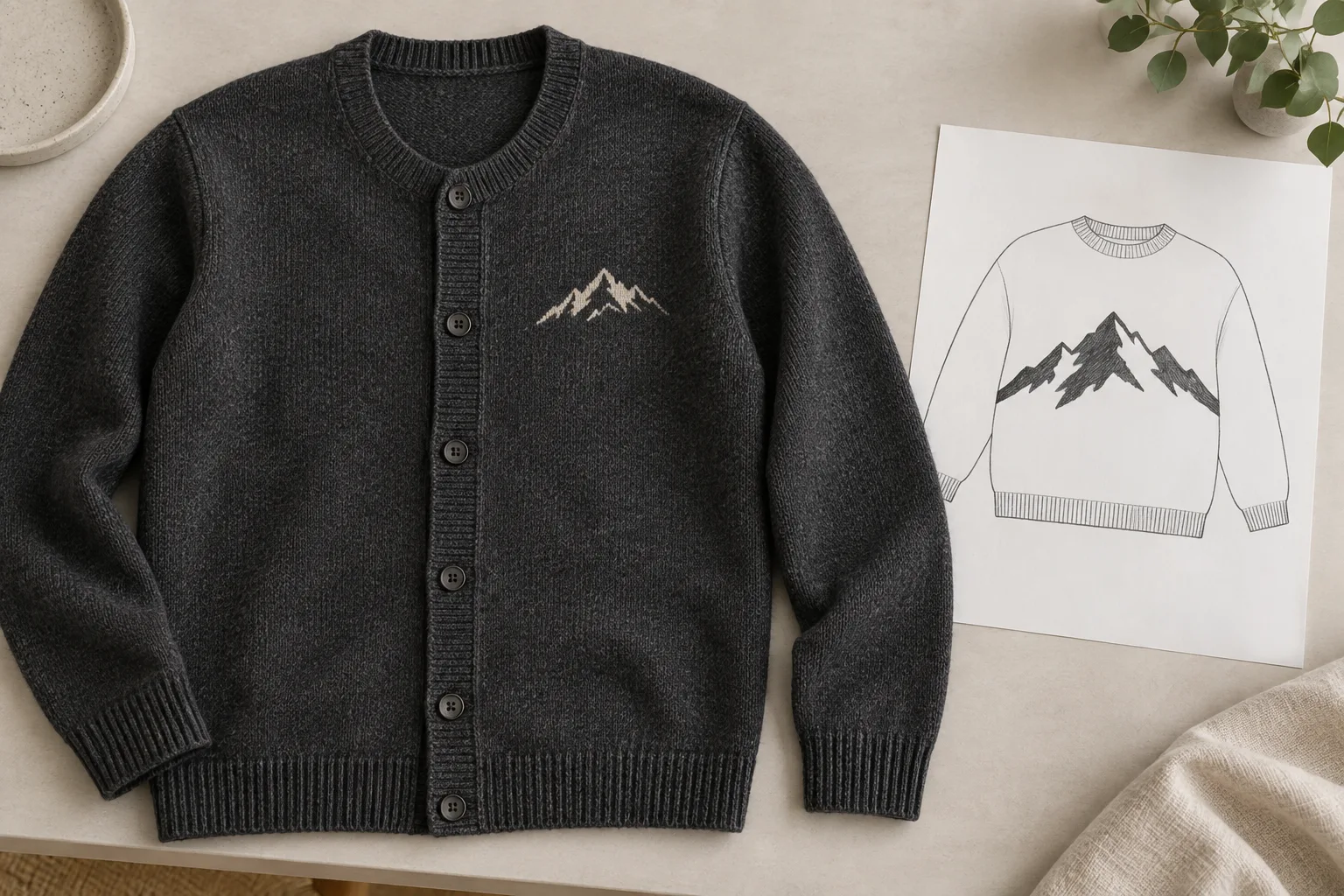
Place the accepted identity on each actual garment drawing. A wide pullover chest, a cardigan front interrupted by a placket and a sleeve are different spaces. Keeping the commercial motif name the same does not make their usable knitting areas equivalent. Show necklines, openings and shaping boundaries before comparing chart reuse.
Consider an illustrative collection with two pullovers and one cardigan, each in four sizes. That creates twelve style-size positions to assess, not automatically twelve independent artwork files. If both pullovers use the same protected centre element with separate placement instructions, they may share an interpretation. The cardigan may need an emblem on one side rather than a split emblem across its opening.
Do not stretch the approved block or move an armhole just to save a chart. If the garment fit changes, the team is no longer evaluating the original collection proposal. The fit sample and size-set comparison explains why a successful middle-size garment cannot stand in for the other positions where the artwork meets a boundary.
Count approval families separately from saleable variants
An approval family is a group for which the same interpretation rule is justified. It is not simply a group with the same colour name. Define why each member belongs: identical protected features, compatible finished scale, the same backing approach and placement that avoids an unapproved interruption.
In the hypothetical twelve-position collection, the buyer might propose one pullover identity family and one cardigan identity family. Each still needs checks at the positions where its rule is most constrained. If the smallest pullover closes the negative space, either give it another interpretation or remove that variant from the family. Do not mark all twelve positions approved because the family label appears on the spreadsheet.
The argyle pattern-control article covers repeating geometric landmarks and grading. Here the distinguishing test is whether the brand’s essential visual features survive the transfer. A repeated diamond can remain geometrically orderly while an emblem becomes unrecognisable; the two approvals answer different questions.
What belongs in the collection approval record?
Connect the design file to a specific sample
Maintain a short chain: authorised source revision, approved interpretation, production chart reference, physical sample code and permitted style-size positions. Include the decision date and approver. If the supplier controls a machine file that is not contractually deliverable, agree a stable reference and the change-notification arrangement rather than pretending the buyer owns that file.
The Craft Yarn Council’s chart-symbol guidance reminds readers to consult the pattern key because symbols can vary. It concerns knitting charts generally, not a particular factory’s software. Apply that modest lesson to handover: explain the actual key and file orientation instead of assuming the next technician reads the same display conventions.
Keep approval wording narrow. “Interpretation B approved for the pullover family, subject to the listed placement checks” preserves an unresolved condition. “Collection approved” may accidentally authorise a cardigan layout nobody has seen. Use the sample-feedback guide to replace adjectives with feature codes and a requested decision.
Record exceptions without turning them into a new standard
A buyer may accept a smaller optional detail on one size. Record that exception only against that size and interpretation. It should not authorise reduced clarity in every later colourway. If the exception affects a feature previously described as essential, return it to the design owner rather than relabelling it optional after production has started.
Separate artwork approval from yarn colour approval, fit approval and production release. The same panel may provide evidence for more than one decision, but each decision needs its own result. A beautiful image cannot close a missing colour assessment, and an approved colour cannot release an unreadable mark.
For pre-production sample review, attach only the current collection map and list superseded versions explicitly. Ask the supplier to acknowledge which interpretation applies to each order line. This catches a common administrative risk: the quote describes the latest design while the knitting instruction still references the earlier attachment.
When should a variant be revised or removed?
Price the remaining uncertainty
Ask for the additional work caused by each unresolved interpretation: another panel, a separate chart, a revised placement garment or further material assessment. Keep those items separate from the unit quote. The knitwear cost-driver guide provides the broader costing context; this decision concerns the cost of preserving identity across the selected range.
Suppose the cardigan contributes little to the collection story but needs a new identity arrangement and another approval round. The buyer can remove it, change the placement, or accept the development cost. Reducing the number of protected features without design approval is not a fourth commercial shortcut. Compare options against the purpose of that specific variant, not the sunk cost of its first sample.
Also separate recoverable work from repeated work. A newly approved interpretation might support a future style if the relevant conditions remain the same. A hurried correction with no readable chart or retained panel may have to be paid for again. Ask what will be retained and available for the next order before choosing the cheapest revision proposal.
Release only the mapped range
Approve the variants that have adequate evidence and hold the others by order line. The hold should name the unresolved feature, the required object and the person who can close it. “Waiting for design” is not enough if design is waiting for a physical panel that procurement has not requested.
Before any later extension, compare its available artwork area, yarn, structure, scale and placement with the approved family. Reopen the affected interpretation if those conditions differ. A new body shape should not inherit approval merely because its product page uses the same collection name.
Finally, retain a simple comparison sheet that shows the source, accepted interpretation and rejected alternative at the same scale. It lets a future buyer understand the original trade-off without reading a long email history. Keep proprietary artwork in the controlled project file, not in publicly shared supplier examples or unapproved marketing material.
Conclusion
Approve a jacquard collection through its essential visual features, not through a folder of similarly named artwork. Start with authorised source material and distinguish protected identity from optional decoration. Compare deliberate chart interpretations on the actual proposed fabric, then map the accepted result to each style and size where it will be used.
Shared interpretation can reduce repeated development, but only where the same visual rules remain valid. Open fronts, restricted panels and different finished proportions may require another arrangement. Keep those exceptions visible, separate them from fit and colour decisions, and retain the rejected examples that explain the final choice.
The useful outcome is a range map that a designer, technician and buyer can read in the same way. Where the evidence does not support a variant, revise or remove it before treating the collection as ready for production.
Discuss your jacquard artwork brief
Frequently Asked Questions
Can a digital rendering replace the physical panel?
No. It can help compare proposed arrangements, but it cannot establish the actual yarn surface, reverse construction or appearance after the agreed finishing process. Use it to choose what to sample, not to claim a sample has passed.
Must every size have a separate artwork file?
Not automatically. A shared interpretation needs evidence that its protected features and placement rule remain valid. Add a separate interpretation when a size crosses a meaningful constraint, rather than creating files solely because the size labels differ.
What if the designer cannot simplify the original mark?
Keep that restriction explicit. The buyer must reconsider the available placement, scale, fabric route or affected garment. Do not authorise a technically convenient redraw and later ask the designer to accept it as unchanged.
Does the approved interpretation cover a new colourway?
Only within its documented scope. A new contrast relationship may alter recognition even when the chart is unchanged. Assess the protected features in the new combination and keep colour approval distinct from approval of the chart itself.