 CN Sweaters

Choosing air vs sea freight for sweaters starts with the units that need an earlier arrival, not the transport label. If only a few size and colour combinations are missing from a retail allocation, flying the whole order may buy speed for stock that does not need it. Compare all-sea, all-air and a specific split shipment against the same receiving deadline and complete cost scope.
This guide begins with goods that have met their product-release requirements and can be prepared for dispatch. It does not use faster freight to excuse unfinished inspection, unresolved labelling or an unapproved garment. Its worked figures are invented decision inputs, not carrier rates, CNSweaters quotations or guaranteed transit times. Obtain current written offers for the actual route, cartons, service and dates before authorising transport.
What would air vs sea freight for sweaters solve?
Identify the missing variants and the customer need
Create a shortage list at style, colour and size level. Show the customer or channel requiring each variant, the required units, available accepted stock and the latest useful availability date. Keep confirmed commitments separate from a hoped-for launch or forecast. A statement that the collection is urgent hides whether the entire purchase matters equally or only a small part of it fills an immediate gap.
Check whether the earlier units would be sellable on their own. A retailer may accept a partial size run, require a complete assortment or refuse a split delivery. Get that answer before selecting cartons for air freight. Shipping medium sizes early does not resolve an order that requires a complete size set. Nor does an early arrival help if the warehouse cannot identify and allocate the pieces to the intended recipient.
Use the Q4 demand scenario guide for uncertain demand assumptions. The transport decision should display which shortage is evidenced and which is speculative. Do not describe an estimated sales opportunity as a guaranteed loss avoided by air freight. The distinction matters when the more expensive option is justified by revenue that might never occur.
Keep replenishment and shipping decisions separate
The wholesale knitwear reorder guide considers whether to place another production order. This article asks how to move accepted goods already available for dispatch. Reopening yarn, quantity or construction decisions would create a different problem and could invalidate the transport comparison. Confirm the available finished units before requesting a quote for a split that cannot actually be assembled.
Define success in observable terms. An acceptable result might be a named recipient receiving and booking in a specified assortment before an agreed date. Days saved in a transit estimate are not the outcome on their own. If an earlier transport service reaches the destination sooner but leaves the stock waiting for an appointment, the buyer has not necessarily obtained earlier usable inventory.
Which shipment measurements belong in the quote?

Quote the actual packed groups
Give the forwarder the number of packages, external dimensions and gross weights for the proposed shipment. Include any pallets or additional transport packaging where applicable. If the air group is picked from larger mixed cartons, it may need repacking; measure that final arrangement rather than allocating a fraction of the original carton dimensions. Keep a dated packing list linked to each transport option.
DHL Global Forwarding’s chargeable-weight explanation distinguishes actual gross weight from a volume-based calculation and notes that ratios can vary. It also distinguishes its LCL example from per-container FCL charging. Use the applicable quote rules, including minimums and rounding. Do not transfer a familiar express divisor to every air-freight offer or assume that ocean pricing uses the same basis.
For an illustrative calculation, ten cartons measuring 60 by 40 by 40 centimetres occupy 0.96 cubic metres in total. If each weighs eight kilograms, their gross weight totals 80 kilograms. Under an explicitly assumed air divisor of 6,000, their dimensional total is 160 kilograms before any carrier rounding or minimum. That is a comparison input, not a freight charge and not a universal billing rule.
Preserve product identity through repacking
Use the retail packaging and barcode guide to keep the selected units identifiable. When cartons are opened for a split, record what was removed, what remains and the new package identifiers. The total across both shipment lists must reconcile with the accepted goods. An unexplained count difference should be resolved before collection, not passed to the destination warehouse as a receiving problem.
Review the packing consequence of each option. Additional protection, carton changes or a different pallet arrangement can change dimensions and handling. The labels and packaging checklist helps retain the product requirements while making that change. A buyer should not remove necessary protection solely to improve a volume calculation or use a shipping label to conceal an unresolved product-label requirement.
Before comparing offers, use one input table to confirm that every quote describes the same identifiable shipment boundary.
| Quote input | Evidence to retain | Comparison boundary | Hold condition |
|---|---|---|---|
| Package count, dimensions and gross weight | Dated packing list for the proposed group | The final arrangement including transport packaging | Figures still come from a fraction of the original cartons |
| Chargeable-weight assumptions | Current offer rules, minimums and rounding | The rules for the selected service | A familiar divisor or basis has not been confirmed |
| Repacked unit identity | Revised package identifiers and both shipment lists | Air and sea totals against the accepted goods | An unexplained count difference remains |
| Protection, carton or pallet changes | Revised packing arrangement | The same product-protection requirements | Changes are unmeasured or necessary protection was removed |
How do you compare complete transport costs?

Use the same responsibility and destination boundary
Ask each offer to identify the included origin handling, main transport, destination handling, customs services where relevant and final delivery scope. Record taxes or other charges excluded from the quote separately rather than guessing them. State the named pickup and delivery points and the quote validity. Two totals are not comparable if one ends at a terminal and the other includes delivery to the retailer’s warehouse.
The US International Trade Administration’s Incoterms overview explains their role in allocating seller and buyer responsibilities. A transport mode and a sales term are different decisions. Use the EXW, FOB and door comparison guide for that separate scope question, without importing historical costs or treating a term as an end-to-end service guarantee.
List charges that repeat when an order is divided. Two shipments may require separate documentation, handling, brokerage or delivery appointments, depending on the actual offer. Request confirmation instead of assuming the smaller air group costs its proportional share of the full order. The cost drivers beyond unit price guide helps make those additional activities visible.
Compare incremental cost with a defined result
Consider an invented 600-unit order. The buyer has identified 120 units that would satisfy an earlier accepted allocation. Suppose comparable quoted totals were 1,000 currency units for all-sea, 3,400 for all-air and 1,900 for a 120-air plus 480-sea split. These are illustrative totals only; they do not represent market rates or include a promise that a split service exists.
| Option | Illustrative total transport cost | Extra cost against all-sea | Earlier allocation supported |
|---|---|---|---|
| All 600 units by sea | 1,000 | 0 | None if sea misses the relevant window |
| All 600 units by air | 3,400 | 2,400 | Up to the useful accepted units, not automatically all 600 |
| 120 by air and 480 by sea | 1,900 | 900 | The specified 120 units if timing and acceptance hold |
The split costs 900 more than the baseline, or 7.50 per urgently required unit in this example. All-air costs another 1,500 above the split. Ask what that additional 1,500 achieves for the other 480 units. If their earlier arrival has no demonstrated use, it should not be described as an equivalent benefit merely because the shipment moves faster.
Which dates make a transport option useful?

Build a receiving calendar for each option
Request the proposed collection date, handover requirements, estimated arrival milestone and final-delivery arrangements for the actual service. Distinguish a confirmed booking from an unbooked estimate. Include buyer-controlled receiving and allocation work. Do not compare an airport arrival estimate for air with warehouse availability for sea; that would give the options different finishing lines.
DHL’s freight FAQ notes that delivery times depend on multiple factors and directs shippers to route-specific information. Obtain current operational confirmation. A generic statement that one mode takes a fixed number of days cannot support a time-sensitive purchase decision across different origins, destinations, services and departure dates.
The sample-to-bulk lead-time planning guide covers the wider production calendar. Keep its upstream stages separate from this dispatch-ready comparison. If the factory cannot make the accepted goods available for the proposed collection, update the goods-ready assumption and obtain a revised service offer. Do not keep the old arrival estimate after its required pickup date has become impossible.
Test a delay case before accepting the extra charge
Ask how a missed handover, changed departure or delayed release would affect the usable arrival date. This is a sensitivity review, not a prediction of disruption. For each option, show the point at which the earlier units stop solving the identified shortage. If a modest change removes all the proposed benefit, the buyer should see that fragility before agreeing to a large incremental cost.
Keep the dates tied to operating calendars. A terminal arrival before a weekend may not translate into a warehouse booking on the next calendar day. Receiving hours, appointment availability and processing work must come from the responsible parties. Write unknowns as unknowns. An unsupported buffer can create the appearance of certainty just as easily as an unsupported transit promise.
When does a split shipment make sense?
Select the smallest complete useful group
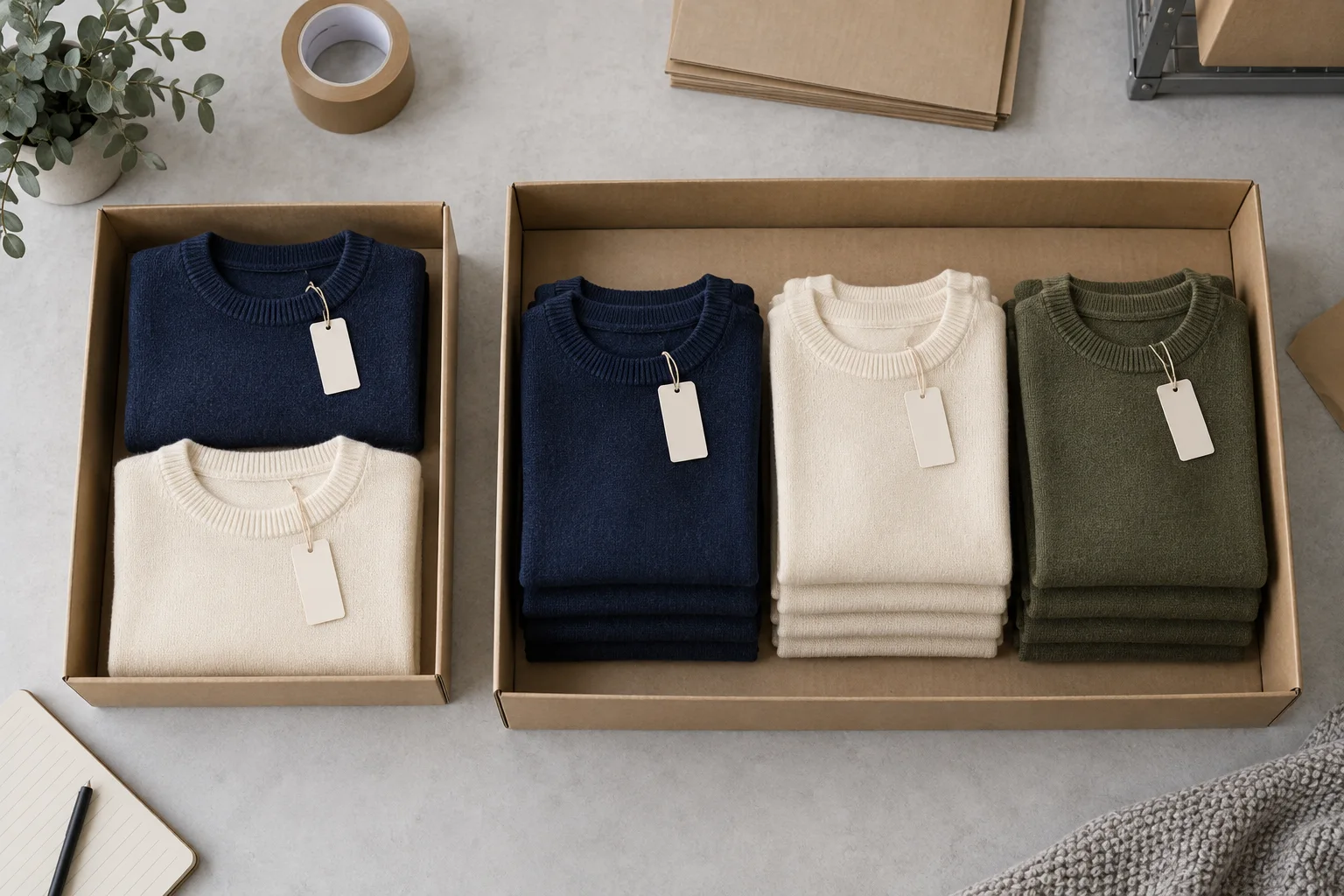
Start with the earlier allocation’s actual variant requirements. Include the pieces necessary to make it acceptable to the receiver, not merely those easiest to remove from cartons. Confirm whether the receiver will accept the remaining units later and whether separate deliveries alter its charges or purchasing terms. A split is only an option when both the origin operation and the destination can handle it.
For example, a hypothetical store allocation may need 20 units in each of six specified variants, giving 120 units. If the available cartons each contain mixed variants, the factory must confirm the repacking work and the revised counts. It is not enough to label any 120 units urgent. The buyer should approve a variant-level list and require the air and sea totals to reconcile with the full purchase.
Use the bulk knit sweaters planning guide for assortment quantities and allocation structure. The shipping file should refer to that agreed allocation rather than introducing a second version of it. When a requested variant is unavailable, return the substitution question to the authorised buyer instead of choosing a nearby size to preserve the transport schedule.
Include the work and risk created by the split
A split may introduce extra picking, documentation and receiving effort. Identify who performs each activity and how counts and identifiers are checked. Decide which party communicates with the retailer when only part of the order is arriving. The factory communication guide can support that controlled handoff; keep the shipping instruction specific to this allocation and revision.
Consider whether the urgent group creates a stranded remainder. If the retailer requires a coordinated presentation, sending a few variants early could leave both deliveries less useful than expected. Conversely, a clearly accepted replenishment gap may be served by a small group without disrupting the rest. There is no universal percentage of an order that should travel by air. The split follows the identified need and actual operating conditions.
What should be approved before collection?
Freeze one transport decision file
Record the selected option, current quote, shipment groups, packing lists, responsibilities, expected milestones and receiver acceptance. Add the approval date and person authorised to accept additional costs. Keep the accepted goods-release record connected without rewriting its quality decision. Transport approval should not be mistaken for approval of a product deviation that remains unresolved elsewhere.
Check quote validity against the intended booking date. If an offer expires or measurements change, ask what must be reconfirmed. Do not treat a saved screenshot as a booking or assume a quoted space remains available indefinitely. Similarly, instructions to collect should specify the goods and documents actually ready, not just the total order number, particularly when several shipments share that order.
Define the reporting milestones that matter to the buyer: collected quantity, departed group, destination release and received allocation. Use the carrier or forwarder reference for each group. Avoid declaring the whole purchase delivered when only the urgent portion has arrived. An accurate split-shipment update tells the receiving team both what it can expect now and what remains elsewhere.
Recalculate only when the decision inputs change
Reopen the comparison if the required variants, packing, quote, service availability or useful deadline changes. Keep the previous version for comparison and explain the effect of the change. A buyer can then see whether the selected option still solves the original problem. Do not repeatedly recalculate an unchanged decision merely because another team member asks for reassurance.
If the earlier arrival is no longer useful, decide whether the higher-priced service still has another justified purpose. There may be one, but it must be stated and accepted. The cost already spent on production does not prove that more spending on transport is sensible. Equally, the cheapest remaining freight option may not satisfy a confirmed customer obligation. Put both facts in the decision rather than using one to erase the other.
Record any untested commercial assumption. In the worked example, 7.50 per urgent unit is an incremental transport allocation, not a profit threshold. Product margin, cancellation terms, customer value and alternative stock all affect the business decision. These inputs belong to the buyer. The purpose of the comparison is to make the choice reviewable, not to produce a universal formula that automatically selects air or sea.
Conclusion
Choose sweater freight by the usable result it buys. Identify the exact shortage, confirm that the receiver accepts the proposed allocation, and quote the final packed groups. Compare all-sea, all-air and a specific split using the same responsibility boundary and receiving milestone. Display the extra cost against the baseline so that speed for useful units is not confused with speed for the entire order.
Before collection, confirm the current offer, goods-ready assumptions, packing lists and destination arrangements. Revisit the decision when those inputs change, not when an unchanged estimate merely feels uncomfortable. Faster transport cannot complete missing product approvals or create demand for unwanted variants. Bring the accepted quantities, carton measurements, destinations and latest useful availability dates to a logistics discussion, leaving rates and achievable dates for current confirmation. Contact CNSweaters about your sweater dispatch requirements.
Frequently Asked Questions
Is air freight always the right response to a late order?
No. First identify which accepted units can still arrive usefully and whether the receiver can process them. Compare current complete offers rather than assuming that faster main transport solves every delay.
Can the buyer quote an air split before repacking?
A preliminary estimate can use clearly identified assumptions. Obtain final dimensions, weights and counts for the actual packed group before relying on the quote or releasing collection.
Should additional freight cost be divided across all garments?
Show the total and a useful allocation. When only certain units need earlier arrival, display the incremental cost per urgent unit as well as any accounting allocation across the full order.
Does a confirmed transport booking guarantee retail availability?
No. Product release, documents, destination handling, receiving and allocation still matter. Keep service commitments distinct from the buyer’s complete customer-availability plan.