 CN Sweaters
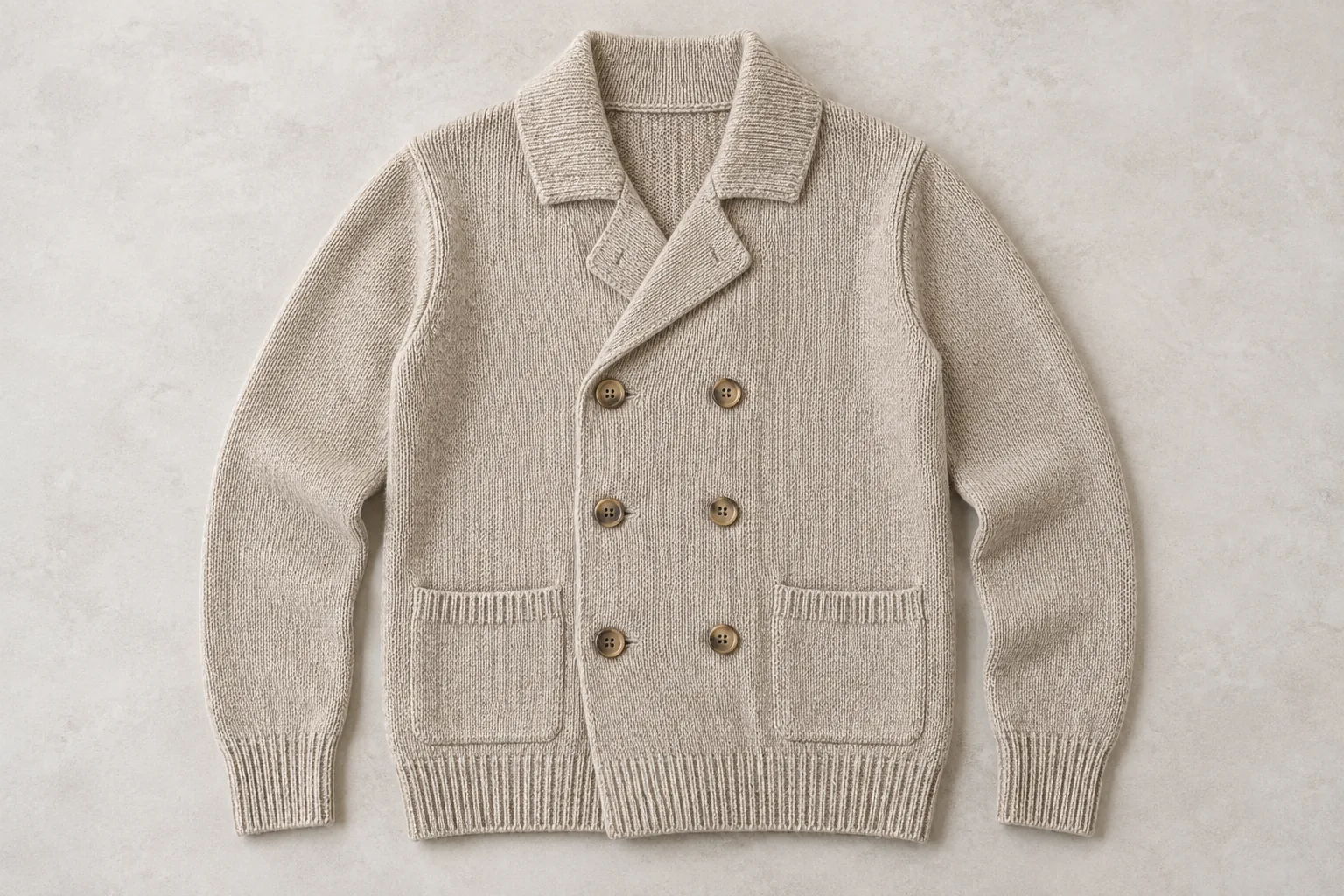
A double-breasted cardigan needs a button layout that controls both the visible overlap and the hidden under-front. Two knitted fronts cross over each other, both rows of buttons must stay parallel, and the hidden inner front has to stay put when the wearer moves.
Keep the working, decorative and inner fastenings on one front-panel drawing. Compare that layout open and buttoned before carrying it into the size set and bulk instructions. If you are starting a new style, you can also browse our cardigan category for construction references.
Why a double-breasted cardigan needs its own spec
A single-breasted cardigan closes near center front. Because the two fronts only meet, a small error in placket length shows up as a gap or a stepped hem, and it is easy to see. A double-breasted front behaves differently. One panel sits on top of the other across a wide overlap, so the knit carries load at points that are far from center front.
As a result, the tech pack needs more than a button spacing measurement. It needs an overlap width at several heights, the position of every button in both columns, and a clear note on which buttons actually work. Without that, a sample can match every single measurement and still twist when it is buttoned.
Working buttons and decorative buttons
Most double-breasted knitwear uses one working column and one decorative column. The working buttons pass through buttonholes on the top front. Meanwhile, the second column is often sewn on flat purely for balance. Some styles add an inner button, a snap or a tie to hold the under-front in place.
We ask buyers to mark each button as working, decorative or inner on the flat sketch. That single step prevents a common problem: a sample that looks right from the front but has no anchor for the under-panel, so it drops and bags below the waist.
Planning the double-breasted cardigan button grid and overlap
The button grid is the set of relationships between the two columns. First, we fix the distance between the columns. Next, we fix the vertical spacing and the position of the top and bottom buttons. Finally, we check how both relate to the neckline, the pockets and the hem.
For example, a high top button on a shawl or peak lapel changes how the neckline rolls. A bottom button placed too close to the hem rib can pull the rib into a point. So we look at the grid as a whole rather than as a list of separate numbers.
Overlap width on a double-breasted cardigan
Woven jackets rely on interfacing to keep a double-breasted front flat. A knitted front may use its stitch structure, a facing or other support to carry the closure; record the route used in the sample. Because knit stretches sideways more than it does lengthways, a buttoned overlap tends to pull the top front towards the side seam.
Plan the overlap together with the front band construction. A firm band knitted in a tighter structure, such as a milano rib or a double-layer band, holds the buttonholes better than the body stitch. On chunky gauges, a wider band often looks more balanced. On fine gauges, a narrow band keeps the front clean.
Buttons, buttonholes and thread
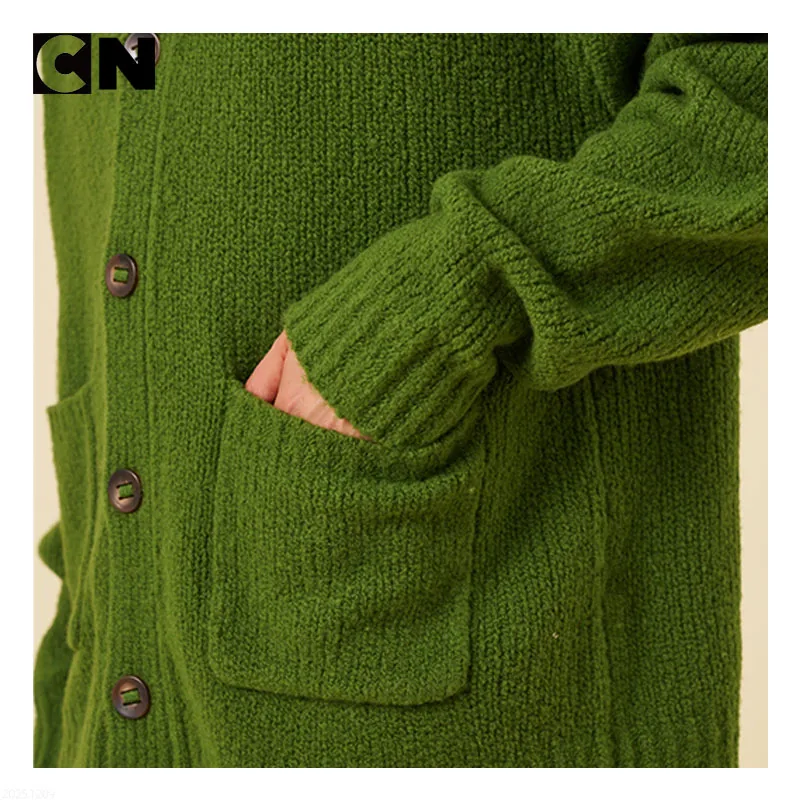
Button weight matters more on knitwear than on wovens. Heavy horn or metal buttons can load a fine-gauge front; review the actual trim in the agreed hanging and wearing conditions. Therefore we confirm the button size, weight and shank type before we knit the first sample, not afterwards.
Buttonholes can be knitted in, or cut and sewn after knitting. Knitted-in holes are neat on fine gauges, while sewn holes give a sharper edge on chunky yarns. Check the buttonhole against the actual button shape, thickness and band construction, including normal fastening and recovery. Use the accepted sample to set the opening dimensions.
If a brand needs its trims to meet a chemical safety standard, the buttons and threads count as accessories. For instance, OEKO-TEX STANDARD 100 covers accessories as well as yarn. Request the current certificate and check its holder, validity and product scope before applying an OEKO-TEX STANDARD 100 claim to these components.
Checking the double-breasted cardigan sample
When the first sample comes off the linking line, we check it in three states: fully open, buttoned on the table and buttoned on a form. Each state tells us something different.
Open and flat, we measure both front lengths, the band widths and the button positions against the spec. Buttoned on the table, we look for twist between the neckline and the hem. Then on the form, we check whether the top front pulls into diagonal drag lines towards the working buttons.
Common faults and their causes
- Top front lifts at the hem: the overlap is too narrow at the bottom, or the band is shorter than the body.
- Diagonal pulling from the buttons: the columns are too far apart for the body width, or the buttons are too heavy for the gauge.
- Under-front drops below the waist: there is no inner button or tie, or it sits too high.
- Button rows not parallel: one front knitted longer than the other, often from uneven tension or pressing.
- Band waves along its length: the band and body shrink differently after washing.
Once we find the cause, we correct the knitting program or the trim, not just the pressing. Pressing can hide a fault on one sample. However, it will not hold that fix through bulk washing.
Grading the button grid across sizes
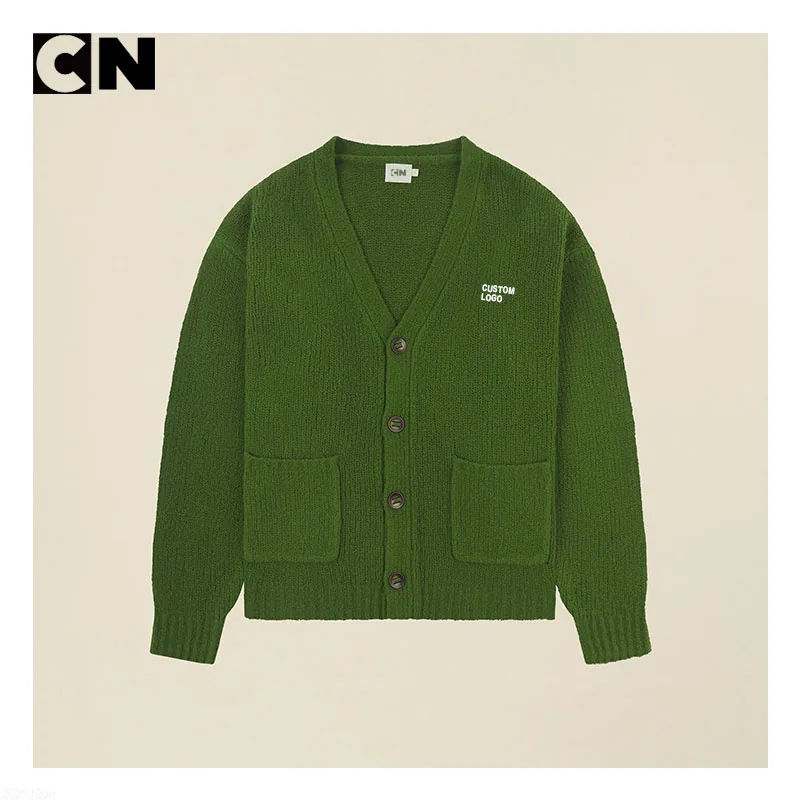
Grading a double-breasted cardigan is where many programs go wrong. If the grid scales in simple proportion to chest width, the large sizes end up with buttons far apart and the small sizes look crowded. In practice, the distance between the two columns usually grades in smaller steps than the chest.
We also check the vertical spacing. On a longer body, the brand might keep the same number of buttons and space them wider. Alternatively, it might add a button to the largest sizes. Both approaches work, but the choice should sit in the tech pack, not appear at the factory.
For that reason, we sample at least the smallest and largest sizes as well as the base size before bulk. Our guide to grading sizes for custom knit sweaters explains the wider method.
Care, pressing and bulk production for a double-breasted cardigan
A cardigan that looks right after pressing may change after its first wash. Because the band and the body often use different structures, they can relax at different rates. So we wash the approved sample through the agreed care route and measure it again before anyone signs off.
What we watch during bulk
During production, our in-house linking, washing and pressing teams all work to the same approved sample. For example, pressing staff use the sample to check band flatness, and QC inspectors check button position with a template instead of by eye. Record any column misalignment against the approved layout and its affected production group.
We also check sewing strength on a sample of buttons from each lot. Our OEM/ODM process page shows where these checks sit, from sample approval to shipment.
Button-layout inputs for a double-breasted cardigan quote
For a double-breasted cardigan quote, show the intended overlap in the closed state and identify which button row is functional. Include button diameter, spacing from the edge, base-size chest ease and at least one larger-size layout. Those choices determine whether the front pulls diagonally; a machine-gauge range alone does not settle button placement. Confirm the selected yarn, trims and sample rounds before assigning an order-specific quantity or date.
For broader guidance on bands, plackets and shoulders, read our custom cardigan construction and gauge guide.
Conclusion
The next double-breasted cardigan sample request should include the marked button layout, actual trims and open/closed fit comments. Keep any unresolved under-front support point with the sample revision so an attractive photograph cannot stand in for that decision.
Send us your sketch or tech pack and we will review the button grid before sampling.
FAQs
How many buttons does a double-breasted cardigan need?
Most styles use two columns of three or four buttons. However, the right number depends on body length and neckline depth. We confirm it on the base-size sample.
Do both rows of buttons need buttonholes?
No. Usually one column works and the other stays decorative. Also, an inner button or tie often holds the under-front, and we recommend it for longer bodies.
Which gauge suits a double-breasted cardigan?
Both chunky and fine gauges work. Chunky gauges suit heavier buttons and wide bands. Meanwhile, fine gauges need lighter buttons so the front does not drag.
Can you match buttons to my brand?
Yes. We can source standard buttons or work with custom branded buttons. Because weight affects drape, we test them on the sample first.