 CN Sweaters
A private label v neck pullover sweater succeeds when the neckline, fit, material and brand details are defined as one product system. “Make the V a little deeper” is not a specification, and a good-looking first sample is not enough evidence for repeatable bulk production.
The V controls exposure, layering, visual proportion and a demanding join on the front of the garment. Its width, depth, point, rib structure and recovery must work with the yarn, gauge, shoulder, chest and intended customer. Private-label inputs add labels, packaging, market information and SKU decisions that must be locked before production.
Start With the Private Label Product Position
The first decision is not the neckline measurement. It is the commercial role the sweater will play in the collection.
Define the customer, layer and selling season
Record the target customer, region, selling season, climate, retail channel and price position. State whether the sweater will be worn over a T-shirt, shirt, blouse, dress or directly against the skin. A V intended to frame a collared shirt needs different depth and width from a fashion pullover designed for open-neck wear.
Define the wearing state in the reference images. If a sample is photographed over a shirt, the buyer should still explain how the sweater should sit when worn alone. Include front, side and back references so the neckline is judged with the complete silhouette rather than as an isolated detail.
- Related guide: Custom Pullover Sweaters
Separate the pullover from a V-neck cardigan
A V-neck pullover has a continuous closed front below the neckline. A cardigan has a front opening, usually with a placket, buttons, zipper or open-front edge. Their product photographs can appear similar when a cardigan is closed, but their pattern balance, trim consumption, fastening controls and wearing behavior differ.
State “fully fashioned V-neck pullover” in the brief. Identify whether the body panels are knitted to shape, how the front-neck reduction is formed, how the rib is prepared and how the shoulder and side seams are assembled. If the intended product includes cut-and-sew panels, woven inserts or a false placket, describe those exceptions explicitly.
Build the collection architecture before the first sample
Decide whether the V-neck is a hero style, carryover core item or member of a coordinated family. Record the base size, fit direction, size range, color count, planned quantity and genuinely shared yarns, gauges, labels or packaging. Ask which choices affect material ordering and production grouping. MOQ and lead time depend on the selected yarn, color method, trims, quantity split and production calendar.
- Related service: OEM Knitwear Manufacturing Service
Engineer the V Neckline as Geometry
The V neckline should be specified with dimensions, shape and wearing behavior. A photograph alone cannot control all three.
Define width, depth and point position
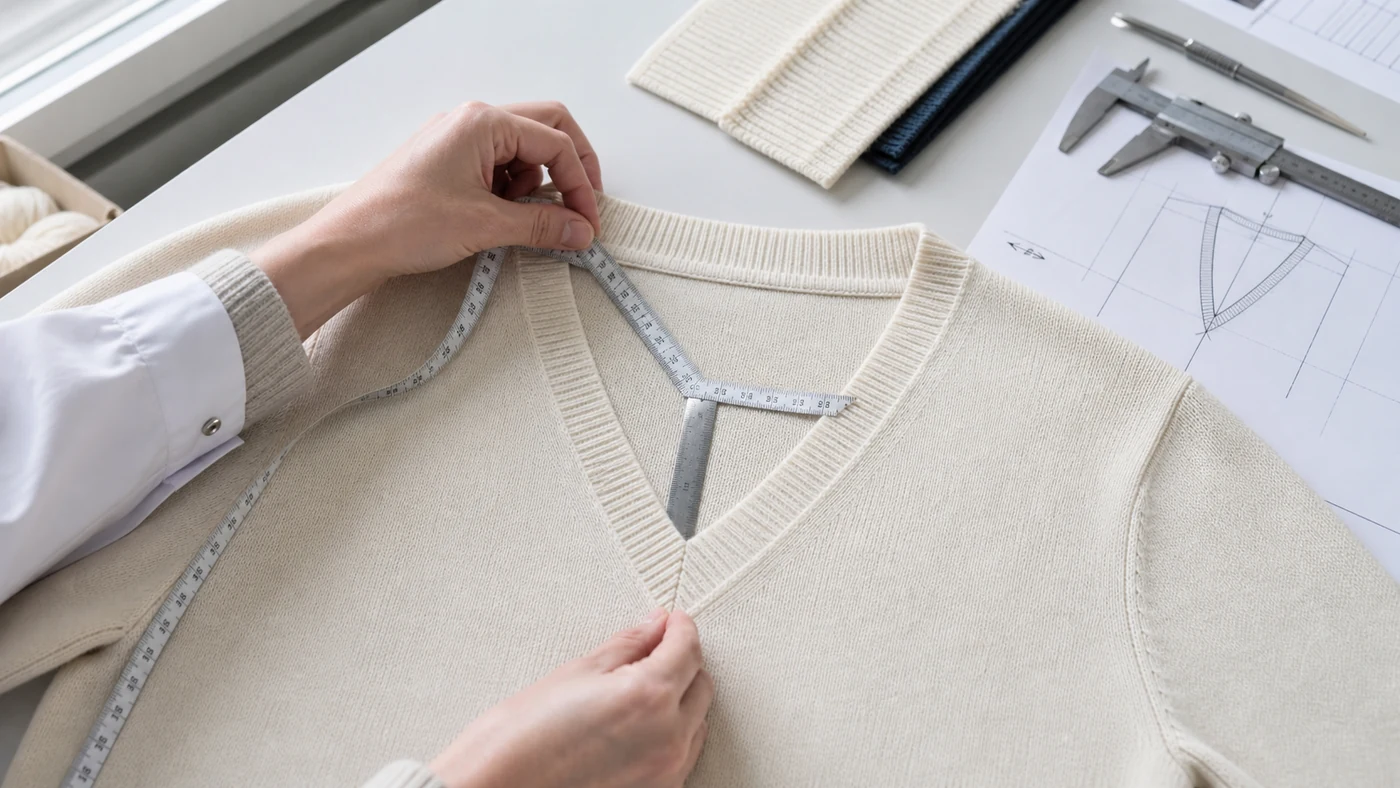
Record neck width at agreed reference points, front-neck drop from a defined shoulder or high-point reference, back-neck width and drop, total opening where relevant, rib width, and the vertical and horizontal position of the V point. Add a diagram that shows exactly where every measurement begins and ends.
The point can be sharp, softly rounded, overlapped or mitred. Describe the face and inside, whether the V legs are straight or curved, and any alignment with a cable, stripe, jacquard motif or logo. ISO 18890:2018 defines principal garment measurement points and permits additional points by agreement, so V-specific points belong on the buyer’s diagram.
- Official standard: ISO 18890 Garment Measurement
Decide how much skin or underlayer should show
V depth is a wearing decision as much as a flat measurement. Check the garment on the intended body or form with the planned underlayer. Record whether a shirt collar, T-shirt neckline or blouse edge should remain visible, and where the point should sit relative to the chest.
Specify modesty and exposure requirements without relying on gender labels alone. The same numerical depth can appear different when shoulder width, chest ease, rib width or garment stretch changes. Include the base-size wearing photograph and state whether the neckline may relax lower during use.
Control rib structure, point construction and symmetry
Specify rib structure, width, courses, yarn, ply and attachment method. State whether the rib is knitted separately, linked, folded, plated or integrated. The two V legs should have balanced tension, matching length and a centered point without puckering, holes, bulk or visible twisting.
Inspect the point against the center front, shoulder line and body grain. If one leg pulls more strongly, the neckline can rotate even when the flat measurements appear correct. Approval should include symmetry photographs, measurements and a gentle wear or handling check.
Match Yarn Gauge and Stitch to Neckline Behavior
The neckline cannot be approved separately from the material system. Yarn, gauge, density, stitch and finish determine whether the V holds its intended shape.
Approve yarn, gauge and stitch together
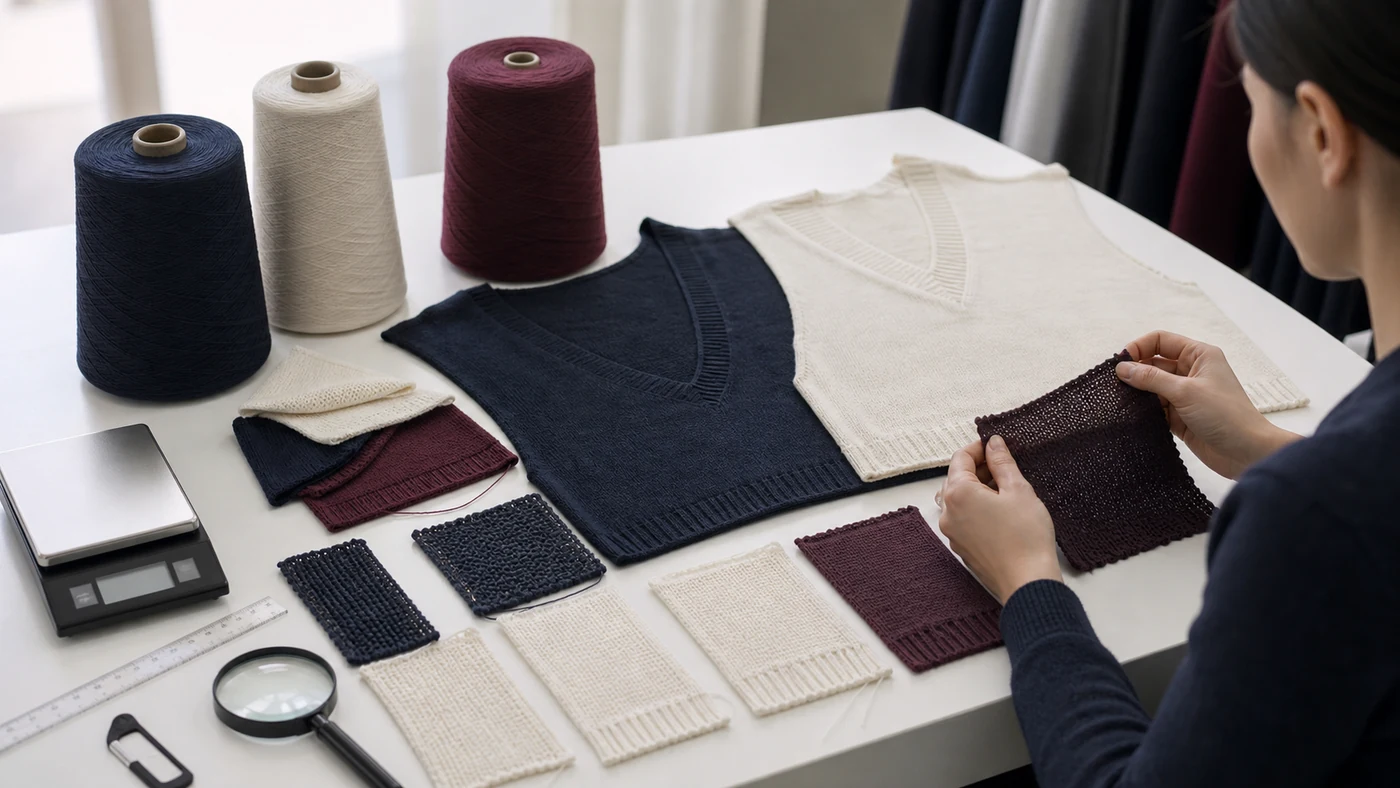
Define fiber composition, yarn count or metric, ply, twist or construction, supplier or approved equivalent, color method and any functional requirement. Then identify machine gauge, stitch structure, target density and finished handfeel. A nominal gauge does not define opacity, drape, weight or recovery by itself.
Ask for labeled knit-downs made with the intended yarn and finishing route. Review wale and course regularity, light transmission, edge curling, seam show-through and rib compatibility. Fine gauges can expose label shadows and point repairs; open or loose structures can make the neckline grow.
- Related guide: Private Label Knitwear Yarn Planning
Test stretch, growth and recovery for the intended risk
The wearer pulls the neckline when dressing, and the V legs can remain under low tension during wear. Review initial opening, extension under the agreed check, immediate recovery and recovery after a defined rest. Evaluate the body and rib as a system.
ASTM D2594/D2594M covers stretch and growth of low-power knitted fabrics. Its published guidance notes limitations for acceptance testing between laboratories, so buyers should agree the method, specimen, conditioning, load, duration and decision rule with a competent laboratory rather than copy an unsupported percentage.
- Official standard: ASTM D2594 Knit Stretch and Growth
For the complete garment, add a dressing simulation and worn-state inspection. Look for a point that drops, rib that rolls, V legs that flare or an opening that no longer returns to the approved position.
Lock finished weight and drape
Record finished garment weight for the approved sample size, including the conditioning or relaxation state and whether labels and trims are included. Also record key panel or swatch evidence when useful. Weight should support the desired layer, season and price position.
Seal a finished knit-down and PP garment as physical references. Bulk should be compared with both, not with an unwashed development swatch.
Lock Fit and Grade the Neckline Deliberately
Fit controls where the V appears on the body. Neckline grading must therefore be coordinated with shoulder, chest, body and sleeve grading.
Define shoulder, chest and body balance
Record shoulder type, shoulder width, chest, body length, armhole, sleeve length, bicep, cuff and hem. State whether the body is fitted, regular, relaxed, oversized, cropped or longline, then support the label with garment measurements and a fit reference.
A dropped shoulder can make a fixed V measurement look wider and lower. A narrow shoulder or close chest can pull the V legs outward. Review the base-size neckline while the shoulder seam, armhole and side seams sit in the intended positions.
Grade width, depth and rib without mechanical scaling
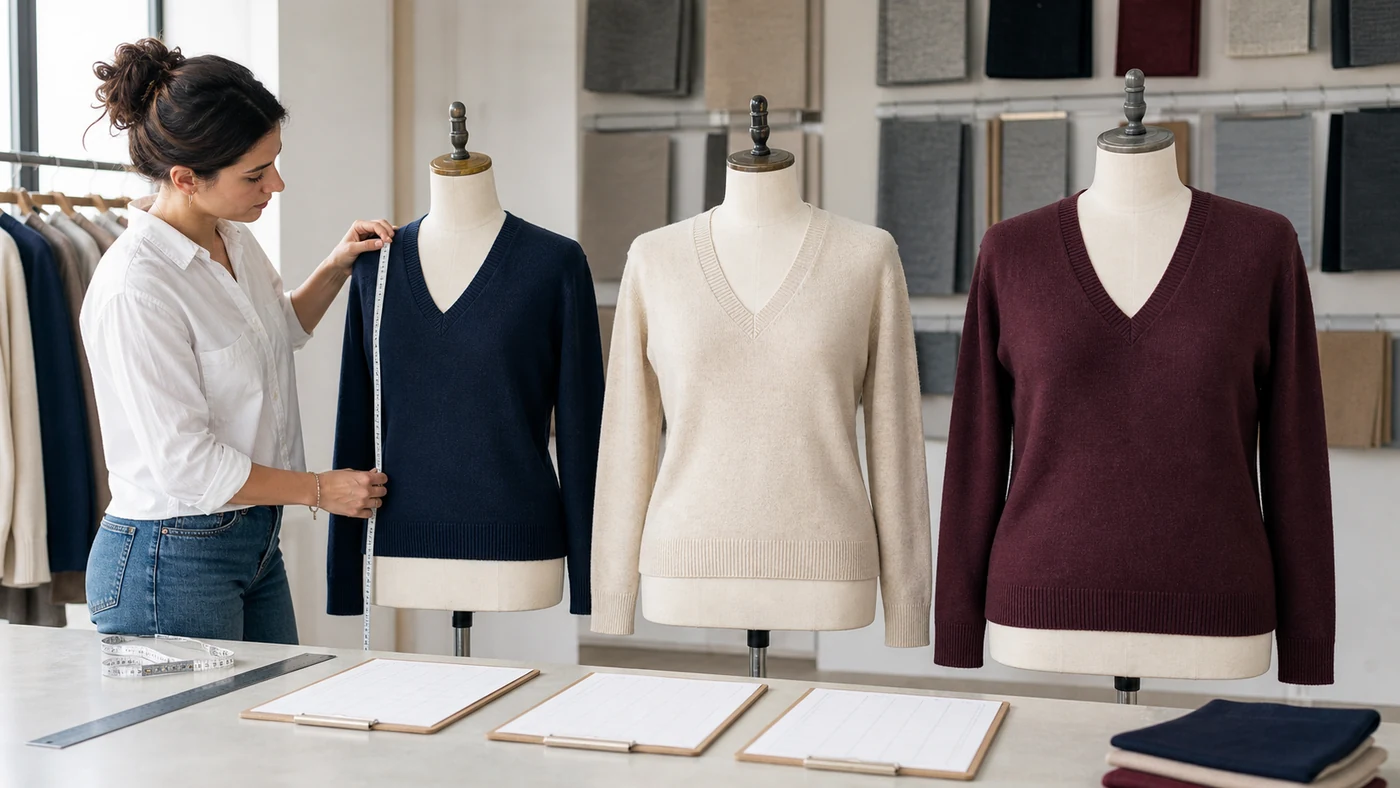
Do not add the same increment to every neckline dimension by habit. Define which points change across sizes and which visual relationships should remain stable. Some collections may keep depth nearly constant while adjusting width; others may require controlled depth changes to preserve proportion.
Grade the front drop, neck width, back neck, rib length and point placement with the shoulder and chest. Record how the V should look on the smallest, base and largest sizes. If the range includes extended sizes, verify the extremes rather than approving only the center.
- Related guide: Private Label Size Grading Guide
Approve a representative size set
Select sizes that reveal grading risk, typically the base plus meaningful small and large representatives. Measure every garment with the same method and conditioning state. Then compare worn proportion, symmetry, point position, rib tension, shoulder balance and sleeve behavior.
Do not approve a size set only because measurements fall inside a tolerance sheet. A V can meet width and depth numbers while looking distorted by shoulder placement or unequal rib tension. Use measurements and visual evidence together.
Plan Branding Labels and SKU Logic
Private-label execution adds brand components that can affect both appearance and production grouping.
Place branding without distorting the back neck
Define main label type, size, fold, material, color, attachment and exact position. A large or stiff label can show through a fine-gauge back neck, irritate the wearer or pull the neck out of shape. Ask for a physical label on the representative sample rather than approving artwork alone.
If the design includes embroidery, intarsia, jacquard, a metal plate or other branding, specify artwork scale, location, backing and appearance on the inside. Check how the branding changes stretch and drape near the chest or neckline.
Build a market-specific label pack
Prepare approved artwork and data for the main label, size label, fiber-content label, country-of-origin information, responsible business identity, care label, hangtag, barcode and packaging marks as required for the destination and channel.
For products sold in the United States, FTC apparel and labeling guidance summarizes federal expectations for most textile and wool products, including fiber content, country of origin, responsible business identity and care instructions. Other markets have different requirements, so the brand or importer should confirm current obligations for each destination.
- Official guidance: FTC Apparel and Labeling
The factory needs final language, symbols, translations, dimensions and placement. Do not ask the supplier to make legal decisions for markets that the buyer controls.
Rationalize colors, sizes and packaging variants
Calculate the opening order by style, yarn, color, size, label version and packing method. A total quantity can look healthy while each production variant is too fragmented for efficient yarn ordering, knitting, finishing or packing.
Identify carryover colors, seasonal colors and any custom-dyed yarn. Confirm whether labels, hangtags, barcodes or cartons vary by market. Ask the supplier to show which combinations can share material or production setup and which require separate approval.
Test Care and Bulk Repeatability
Care decisions should be supported before label artwork and bulk production are released.
Define washing and drying procedures
Agree the procedure that represents intended consumer care and the target market. ISO 6330:2021 specifies domestic washing and drying procedures for textile testing, including multiple machine and drying options. The buyer must identify the relevant procedure rather than writing only “wash test.”
- Official standard: ISO 6330 Domestic Washing and Drying
Measure dimensional change and neckline appearance
ISO 5077:2007 specifies a method for determining dimensional change after an appropriate washing and drying procedure. Define the required measurement points, number of cycles and pass rules for the actual program.
- Official standard: ISO 5077 Dimensional Change
For a V-neck, remeasure width, depth, point position, body length, chest and sleeves. Inspect whether the V legs ripple, the point shifts, the rib rolls or the back neck tightens. A garment can retain body length but still fail the customer experience because its neckline changes.
Do not invent a universal shrinkage limit. Set product-specific acceptance criteria based on material risk, market expectations, care claim and approved sample evidence.
Transfer approval into production controls
The PP release should identify approved yarn and lot controls, stitch program, gauge and density, neckline dimensions, rib specification, point construction, graded measurements, label pack, color standards, finishing route, care evidence and packaging.
- Related guide: Knitwear Quality Control Checklist
Build a Private Label Sampling Gate
Sampling should answer defined questions in sequence and end with a controlled release pack.
Give every sample a purpose
Label each round as concept, yarn or stitch review, fit, color, label trial, size set, sales sample or PP. State which materials and trims are final, which are substitutes and which decisions must be locked before the next round.
Avoid using one sample to approve everything when its yarn, color, labels or finish are temporary. A fit sample can confirm proportions while remaining unsuitable for wash, shade or handfeel approval.
Write measurable revision comments
Organize comments by neckline geometry, material, fit, grading, construction, branding, labels, color, finish and packaging. Replace “make V cleaner” with the observed issue, current evidence and requested outcome.
Use annotated front and inside photographs. Keep one revision log with dates and owners, and update the specification after every approved change.
Seal the PP release pack
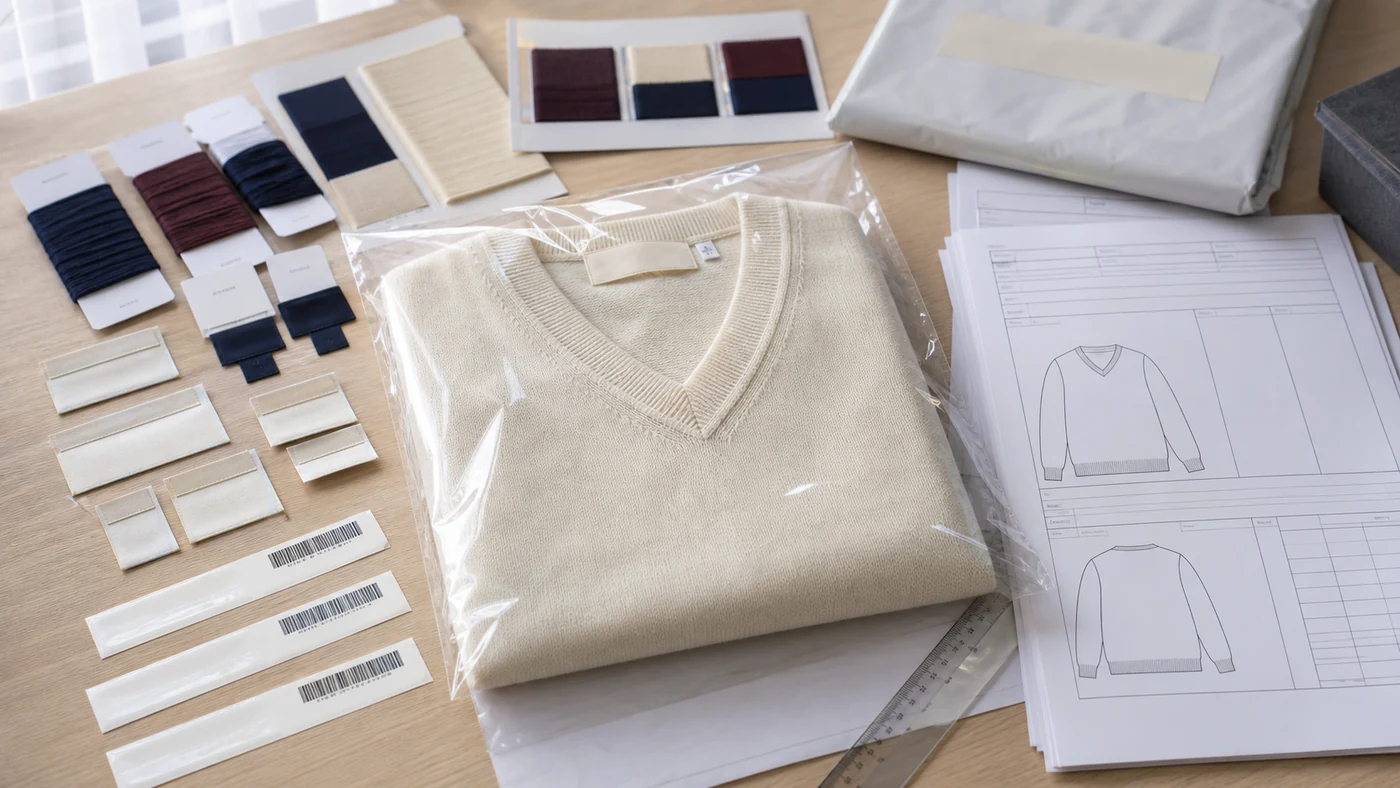
Before bulk, seal the approved V-neck sweater, finished knit-down, yarn and shade references, graded specification, neckline diagram, measurement method, wash evidence, labels, artwork, packaging, revision history, defect examples and inspection plan.
The table below shows the minimum decision path.
| Decision area | Lock before sampling | Evidence before bulk |
|---|---|---|
| Product role | customer, layer, season, price position | approved commercial and fit brief |
| V geometry | width, depth, point, rib, wearing state | diagrams, measurements and worn review |
| Material | yarn, gauge, stitch, density, weight | finished knit-down and PP garment |
| Fit and grading | block, balance, size logic | approved base and representative size set |
| Private label | branding, labels, colors, packaging | physical components and final artwork |
| Care and quality | procedure, checks, pass rules | wash evidence, sealed standards and QC plan |
This pack converts a visually successful sample into production evidence. Sealed standards should remain available to production, inline control and final inspection.
- Related guide: Bulk Knit Consistency From Sample to Production
Conclusion
A reliable V neck pullover sweater begins with a product position, not a reference photograph. Define the target customer, layer and season, then convert the V into measurable width, depth, point position, rib structure and worn appearance.
Approve yarn, gauge, stitch, density, weight and recovery together. Coordinate neckline grading with the shoulder, chest and body; verify representative sizes rather than relying on mechanical increments. Private-label buyers should also lock label construction, artwork, market information, color and packaging variants before those inputs fragment the order.
Finally, use a defined care procedure and transfer every approval into a sealed PP release pack. When the brief, sample comments and production evidence describe the same product, the factory can repeat the intended neckline, fit and brand presentation with fewer avoidable interpretations.
Related CNSweaters Resources
- Custom Pullover Sweaters
- OEM Knitwear Manufacturing Service
- Private Label Knitwear Yarn Planning
- Private Label Size Grading Guide
- Knitwear Quality Control Checklist
Preparing a Private Label V Neck Program?
Send the target customer, market, season, fit reference, neckline diagram, yarn and gauge direction, size range, colors, quantities, label artwork, care route, packaging and delivery date. The development team can review the inputs required for a practical sample and production plan.
FAQ
What measurements should a V-neck sweater tech pack include?
Include front-neck depth, neck width, back-neck dimensions, V-point position, rib width and length, shoulder, chest, body length, armhole, sleeve, cuff and hem. Add diagrams that define every measurement point.
Should V depth change across sizes?
Not automatically. The grading rule should preserve the intended visual proportion and wearing coverage while coordinating with shoulder and chest changes. Verify representative small, base and large sizes.
Can the first fit sample use substitute yarn?
It can when the substitution is documented and the sample has a limited purpose. It cannot prove final weight, handfeel, shade, recovery, washing or bulk repeatability.
When should labels and packaging be sampled?
Review physical labels and key packaging components before PP approval. Fine-gauge necklines can be distorted by stiff labels, and market or barcode variants can change the production and packing plan.
What makes a V-neck PP sample ready for bulk?
The final materials, neckline geometry, graded measurements, wash evidence, colors, branding, labels, finishing, packaging and inspection plan must be approved and controlled in the release pack.