 CN Sweaters
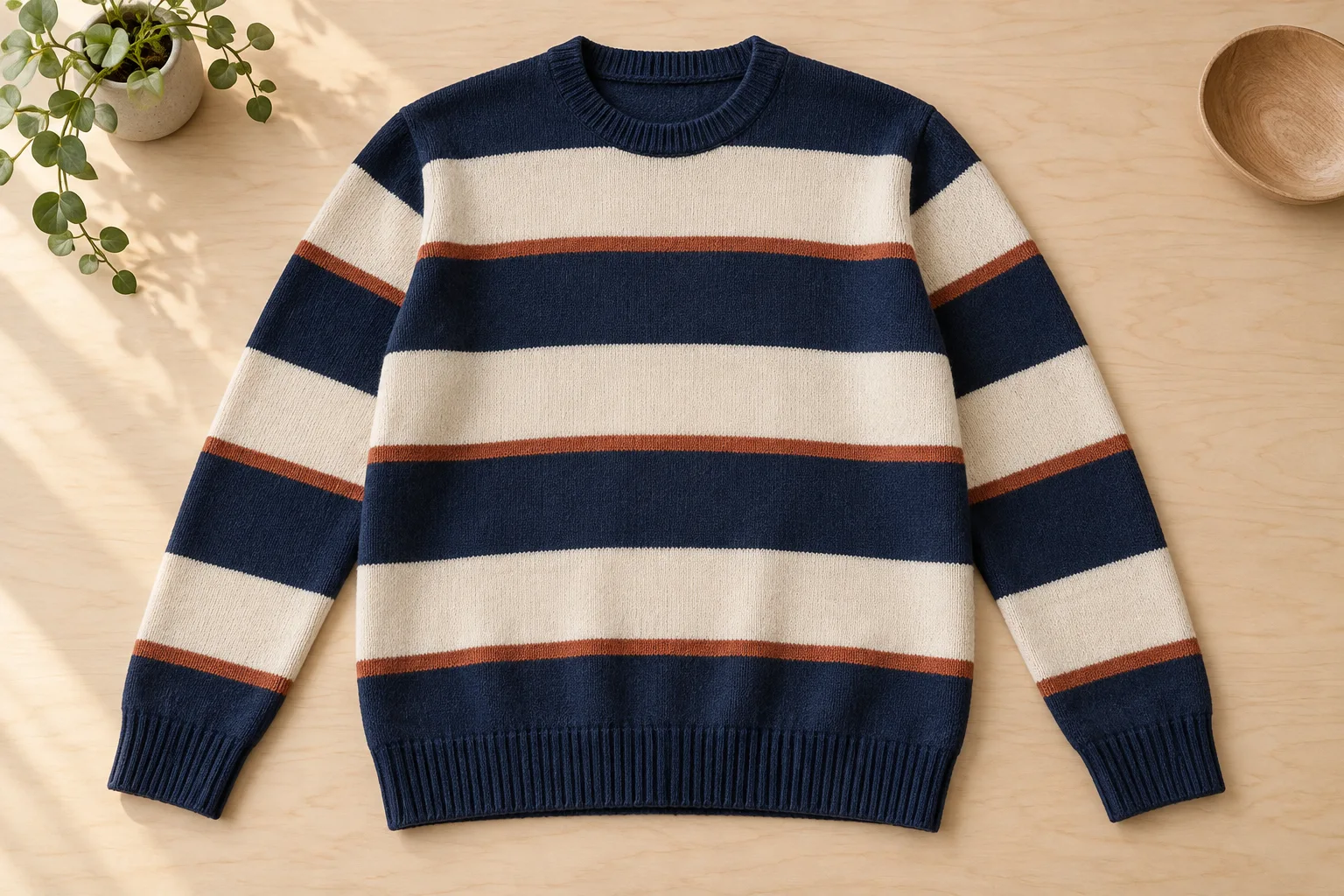
A striped knit sweater order should share a program only where the approved stripe sequence and garment fit can coexist. Before asking every seam to match, identify which meeting points matter and how they will be assessed. Then group sizes and components according to that rule. Adding or removing length without checking the stripe start can put otherwise correct panels out of phase.
This guide is for a technical buyer planning a multi-size order. Its decision is whether one stripe arrangement can serve the range or whether separate program families are needed. It is not a general colour-lot or size-grading guide. The size-drift article addresses dimensional consistency; this article controls where the stripe sequence arrives at named garment landmarks.
The examples use invented course counts to explain the planning arithmetic. They are not instructions for a particular machine, actual CNSweaters specifications or tested production results. A technician must map the approved drawing to the real fabric, garment construction and finishing route before the buyer releases any program family.
What should the striped knit sweater match?
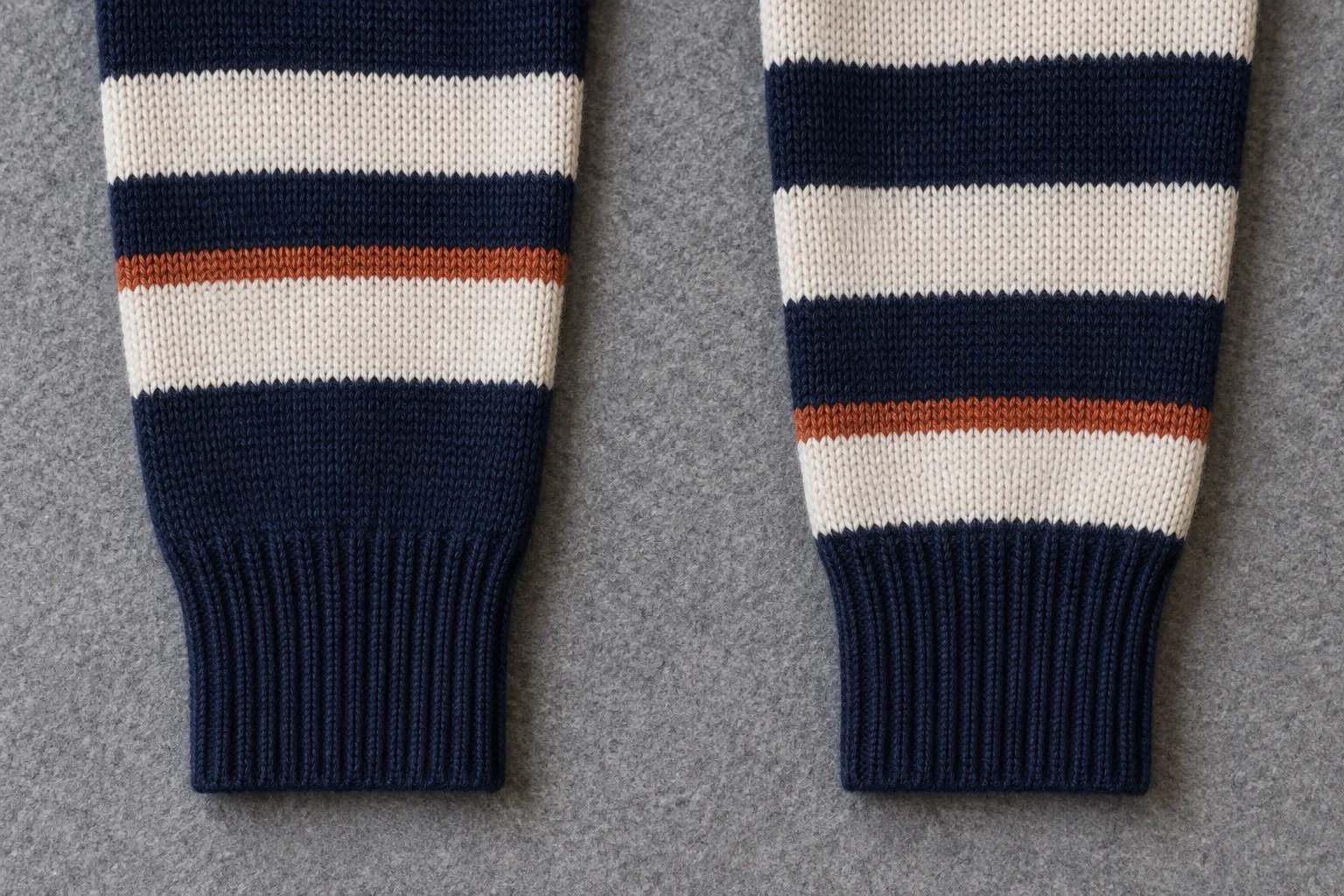
Rank the visible meeting points
Start with front, back and sleeve drawings that show the intended wearing position. Mark where continuity is essential, where a deliberate break is acceptable and where the buyer has no matching requirement. Side seams, a front opening and the body-to-sleeve relationship are different decisions. Do not write “all stripes aligned” unless the technical team has shown exactly what that means on the shaped garment.
For a hypothetical crew neck, the buyer might require matching at the lower side seams and a balanced pair of sleeves, while accepting an intentional interruption around the shaped armhole. That hierarchy protects the important result without forcing production to pursue an undefined match at every curved edge. The hierarchy must come from the design brief, not from the supplier’s easiest construction.
The crew neck specification guide covers the underlying garment. Retain those fit measurements while establishing the stripe requirements. A visually tidy sample that has been shortened to land on a convenient stripe has changed the approved product, not merely improved its pattern.
Name the reference instead of pointing at a photograph
Give each required meeting point a code and a defined measurement origin. For example, a lower side-seam check might reference the start of the patterned body above the hem treatment. A sleeve comparison might reference a named cuff transition. Record the exact edge or course used, because a broad rib band can make “from the bottom” ambiguous.
Specify whether the check compares colour boundaries, stripe centres or another visible feature. Two inspectors can agree that the same garment “matches” while using different references. Put the reference and assessment condition into the custom sweater tech pack, with a marked drawing that can be reproduced in the inspection file.
Use this input table to make each matching requirement reproducible before the phase calculation begins.
| Input to lock | Evidence to confirm | Boundary to record |
|---|---|---|
| Meeting-point hierarchy | Marked front, back and sleeve drawings | Essential match, intentional break or no requirement |
| Coded measurement origin | Named edge or course in the tech pack | Exact origin for each check |
| Visible comparison feature | Colour boundary, stripe centre or another defined feature | One stated feature for each reference |
| Approved garment fit | Retained measurements and garment specification | Stripe placement must not alter the approved fit |
How does stripe phase change with length?
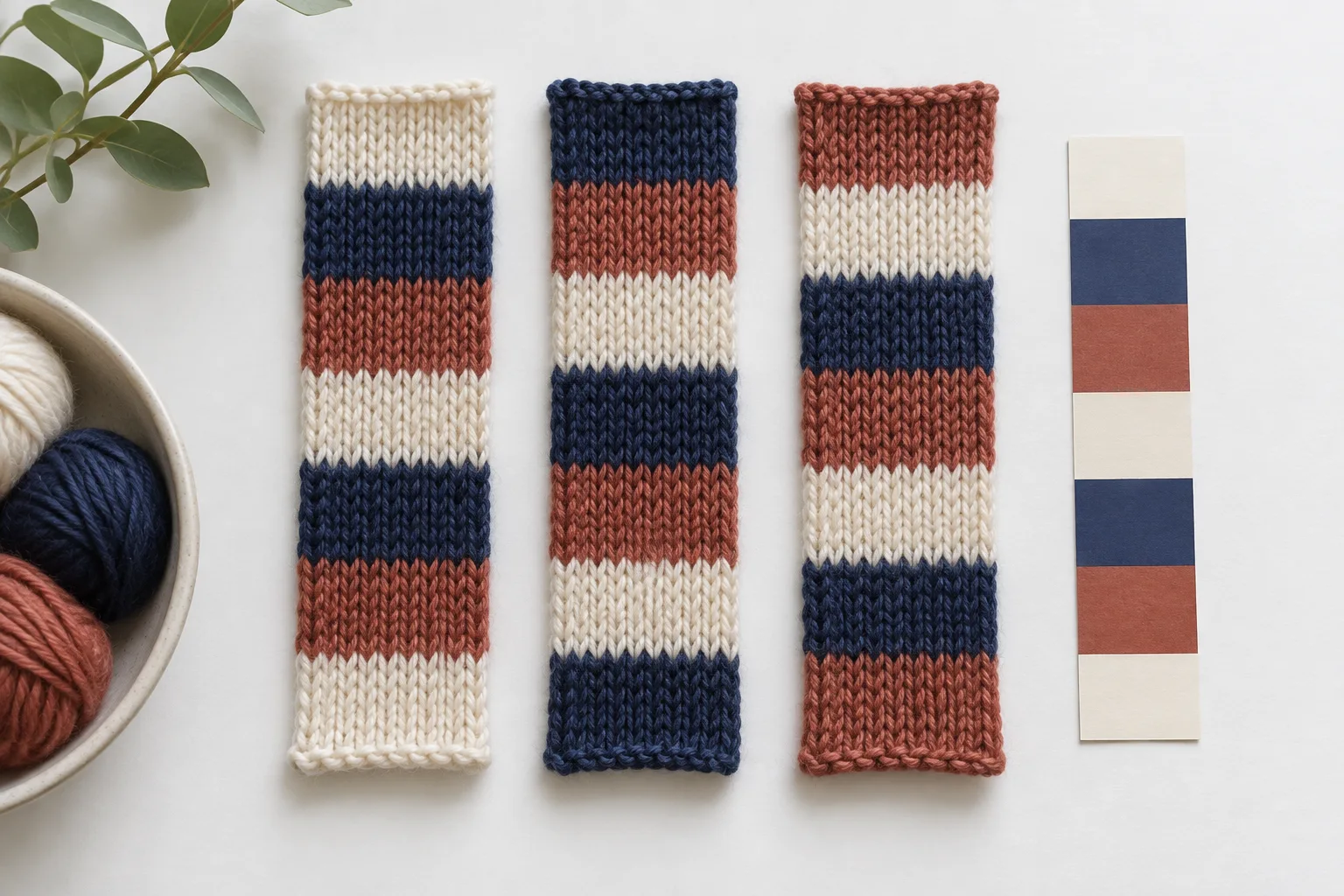
Write the sequence as countable information
Define the repeat in the order it is knitted, including each colour segment and its course count. A repeat of pale, dark and accent is incomplete without the relative widths and starting point. Number the sequence consistently and explain whether a stated start position uses zero-based or one-based counting. A one-course misunderstanding can survive several email rounds when the notation is never declared.
ISO 23606 covers symbolic notation and pattern design for knitted fabrics. Its scope does not set a stripe-matching tolerance. The practical requirement here is an unambiguous key that connects the commercial drawing to the technical sequence, not an unsupported claim that a drawing format guarantees matching.
In the hypothetical arithmetic below, the repeat contains twelve courses and positions are numbered zero through eleven. Adding twenty-four patterned courses returns to the same phase because twenty-four is two complete repeats. Adding eighteen advances by six positions. This arithmetic describes a repeating sequence; it does not prove that a real shaped seam will match.
Keep the start phase visible in the size map
Assume, only for this example, that the relevant matched region has no extra shaping events and that its finishing condition is equivalent across the compared pieces. The team can use the remainder after division by twelve to identify which layouts need review.
| Illustrative variant | Added patterned courses | Added courses modulo 12 | Planning consequence |
|---|---|---|---|
| Base arrangement | 0 | 0 | Retain the agreed reference phase |
| Longer arrangement A | 12 | 0 | Repeat count changes without a phase shift |
| Longer arrangement B | 18 | 6 | Review start phase or a separate arrangement |
| Longer arrangement C | 24 | 0 | Two extra repeats; still check the garment landmarks |
Do not solve arrangement B by deleting six courses if that breaks the approved length. Possible responses include another starting phase, a planned non-patterned zone or a separate design arrangement. Each response affects appearance differently. The buyer and technician should decide which is permitted, rather than using the arithmetic as authority to alter fit.
The bulk size-grading guide remains the owner of garment dimensions. Keep that table beside the stripe map so that an adjustment made to protect one does not silently damage the other.
Which components belong in one program family?
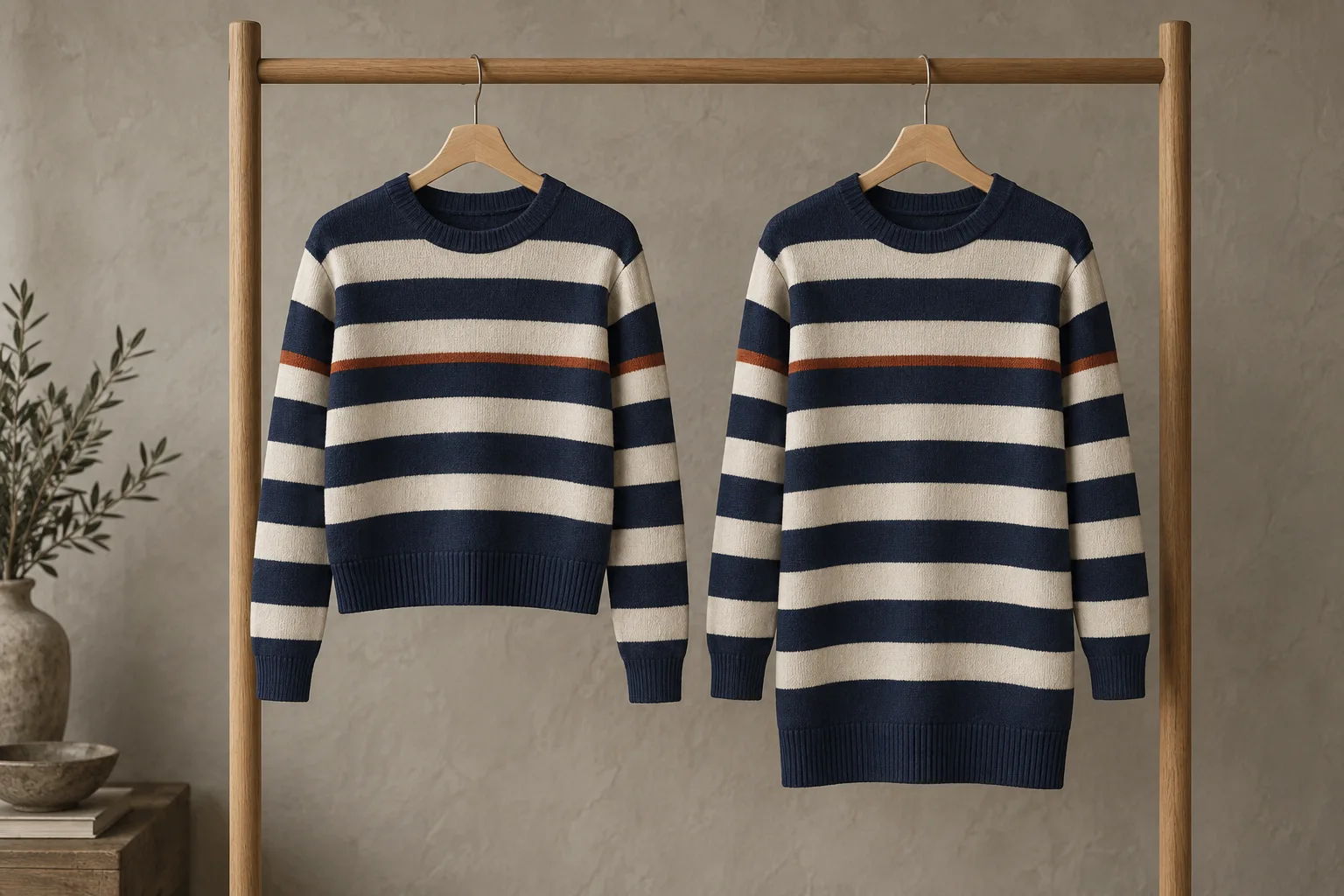
Group by the rule that remains valid
A stripe program family contains the variants for which the same approved arrangement rule works. It is not necessarily every size on one purchase order. Separate body blocks, different lengths or distinct sleeve treatments may require different families even if they share a retail style name and colourway.
Record body and sleeve components separately. A sleeve’s shaping and length are not simply a smaller copy of the body. Two components can use the same repeat but need different starting positions. Ask the technician to explain how the named matching requirement will be achieved without forcing a one-to-one correspondence along a shaped edge where the construction does not support it.
The argyle pattern-control guide explains a related need to separate garment and pattern logic. Its diamond scale and placement decisions are not the stripe decision here. This map is organised around sequence phase, starting courses and paired components, not the size of a repeated geometric motif.
Count the checks created by each family
Suppose a hypothetical five-size order uses one body arrangement for three sizes and another for two. That is two body families, but not automatically two complete garment approvals. If the sleeve arrangement changes at a different size, the combined garment at that transition also needs attention. List the combinations actually present in the order rather than multiplying every theoretical option.
Use a matrix with size, body family, sleeve family, reference phase and required sample. It should reveal the first size after each change in rule. If the matrix contains a size with no permitted combination, resolve it before the order file is issued. A blank cell is not permission to use the nearest available program.
The fit sample and size-set guide helps explain why transition sizes matter. Request the garments that test the proposed family boundaries, rather than relying on a habitual middle-size sample set that never crosses them.
How should sample matching be assessed?
Use the same condition for both sides
Compare the agreed references after the intended finishing and stated rest condition. Do not stretch one panel until its stripes line up with the other. If the body dimensions are different from the approved specification, record that first; a matching observation made under forced alignment will hide the reason for the discrepancy.
Measure the relevant stripe positions and retain the component identities. ASTM D8007 provides a method concerning wale and course counts in weft-knitted fabrics. Such counts can help separate a sequence issue from a changed fabric density. They do not supply the buyer’s acceptable visual offset or replace the garment measurement method.
For a matched pair, photograph both components in the same frame where practical, with the reference points marked outside the saleable inspection area. Keep the uncropped view as well as the close detail. A close crop can conceal that one sleeve is pulled lower or that the garment has been arranged asymmetrically.
Agree the visual acceptance method
The buyer and technical team should define the assessment distance, garment position, reference feature and permitted deviation. Do not borrow a millimetre limit from an unrelated style simply because its stripes also use two colours. A narrow accent and a broad field may need different visual judgements, and a retail design may deliberately interrupt the sequence at one seam.
The Craft Yarn Council chart guidance notes that chart symbols vary and the actual key should be consulted. Its general knitting guidance is not an industrial stripe inspection standard. The applicable lesson is modest: the sample reviewer must have the same sequence key as the programmer, including the stated starting position.
Use the sample-feedback guide to record the exact mismatch and requested response. “Sleeves uneven” could mean different lengths, different phases or asymmetric dressing. Identify which observation occurred before asking for a correction, and keep an unresolved fit issue separate from an unresolved stripe issue.
How should production preserve paired components?
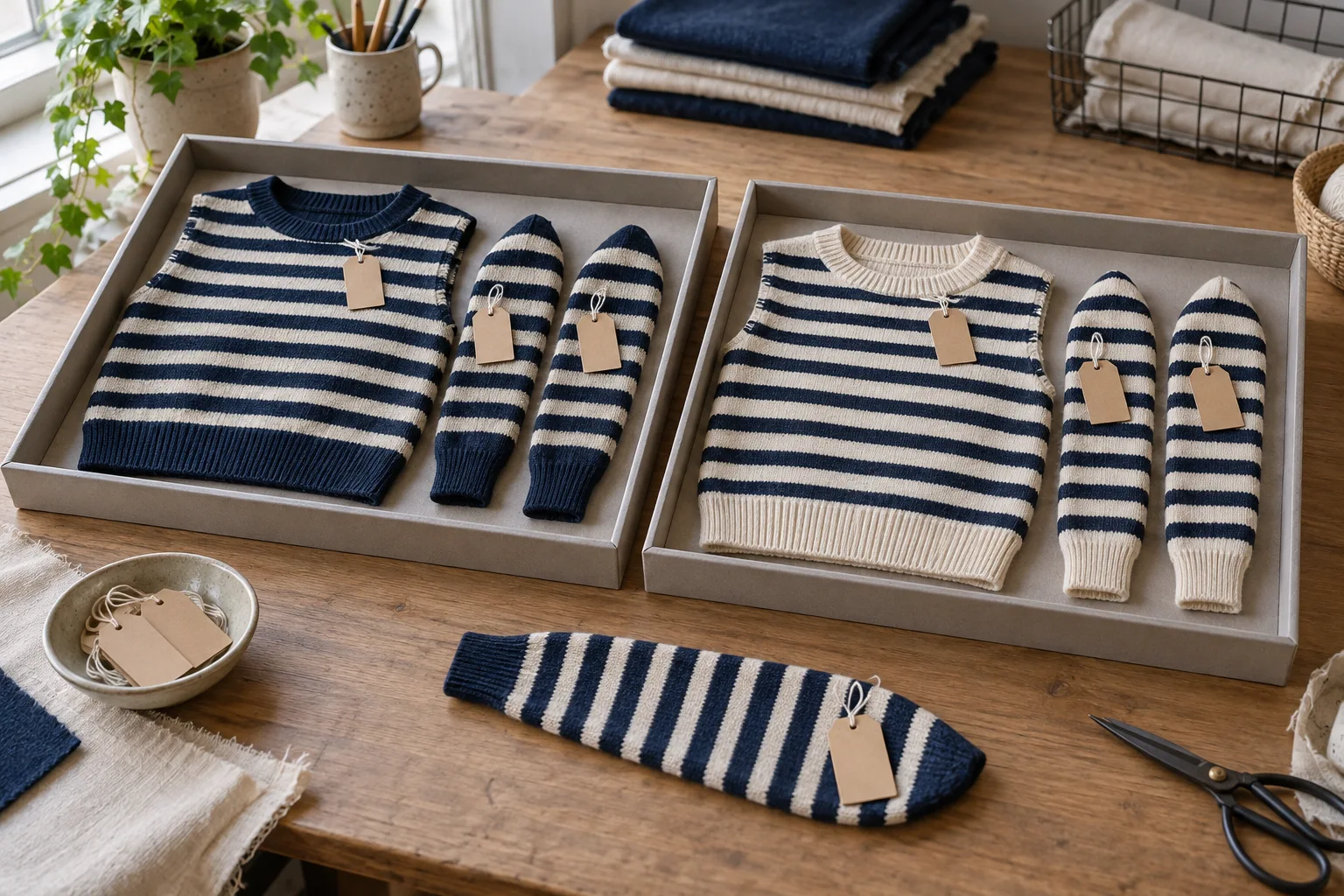
Make the family visible at the pairing point
The approved map must reach whoever sorts and joins the components. Ask how body, sleeve, size, colourway and program revision are identified in work in progress. A technically correct sleeve from another family may look plausible until the garment is assembled. The control should prevent that substitution, not depend entirely on final inspection finding it.
Request the supplier’s proposed pairing check at the stage where components meet. It might compare family codes and the specified stripe reference before joining. Buyers should agree the evidence they need without inventing a factory’s internal handling system. Keep any proposed mixed bundles on hold until the supplier can show how the correct pairs remain identifiable.
Plan replacement components as well as the original bundles. If a damaged sleeve is replaced after the main group has moved on, its size label alone may not identify the required starting phase. The replacement request should carry the garment’s approved family and revision, with a check against its surviving mate before joining. Otherwise a repair can introduce a mismatch into a garment that originally had a correct pair. Record the replacement against the affected unit or traceable group according to the supplier’s agreed handling system; do not invent serial tracking that production has not accepted.
For a polo or another garment with additional openings, the knit polo production QC guide covers the broader assembly checks. Add the stripe-family requirement to that route rather than assuming a general size label protects pattern pairing.
Investigate mismatches by source
If one size is consistently out of phase, compare its approved arrangement and the file actually used. If occasional units are wrong while the same family otherwise matches, investigate component identity and pairing records. If stripe positions change with a finishing group, check the actual measurements and condition. These are investigation paths, not diagnoses from a single photograph.
Segregate the units associated with the unresolved source while the supplier determines the cause. Do not average left and right offsets into a single value that hides an obvious pair mismatch. Keep the affected size, family, component and production identity with the record so the correction is targeted.
The pre-production sample review should confirm which first production combinations need comparison to the approved garments. A changed program or component allocation should reopen the relevant match check, even if its retail SKU remains unchanged.
When is another program family justified?
Compare the accepted appearance with the extra work
Ask the supplier to identify the development and approval work associated with another family. That may include a revised sequence, different placement documentation and another garment comparison. Do not assume a fixed programming fee or a universal number of extra days. Request the actual proposal for the order under discussion.
The knitwear cost-driver guide helps keep setup separate from repeat production. Compare a shared arrangement with its permitted visual compromise against the additional family that protects the desired match. If the compromise is not permitted by the design owner, its lower price does not make it an approved option.
Consider order distribution as well. A family used by only one low-volume variant still creates a distinct approval object. The buyer may keep it because that size is commercially important, simplify the stripe design across the range or reconsider a discretionary length option. Removing a core size merely to hide an unresolved technical decision should not happen without the brand’s deliberate choice.
Release and archive the actual map
Before release, reconcile the order lines with the family matrix. Confirm that every ordered size has an approved body and sleeve combination and that the current file references match the samples. State which visual breaks are intentional so an inspector does not request an unauthorised correction to a compliant garment.
Archive the repeat key, starting phases, matching references, family membership and physical comparison records together. On a reorder, changing length, hem treatment or sleeve design should prompt a review of the affected map. A new colour arrangement may also require another visual assessment even when the course counts remain unchanged.
The final record should let another technician explain why two sizes share a family and why a third does not. If it only lists file names, the decision is still held in someone’s memory. Add a short reason at every family boundary so future edits can preserve both the approved fit and the intended stripe relationship.
Conclusion
Stripe matching is a planned relationship between components, not a blanket request for every seam to align. Identify the important references, record the repeating sequence and show how its starting phase changes across the actual size range. Keep garment dimensions authoritative while the technician develops arrangements that support the agreed appearance.
A shared program family is useful only where its rule remains valid. Check the sizes and component combinations at the boundaries, assess them in the same finished condition and preserve their identities through pairing. When a match fails, separate sequence, dimension and component-allocation questions before approving a correction.
The completed order map should show exactly what can be released and what still needs evidence. Additional families are justified when their work protects a required result, not merely because more files look thorough. Discuss your striped sweater production plan.
Frequently Asked Questions
Must stripes match around every armhole?
Not automatically. Shaped components do not necessarily support continuous matching along the whole seam. Define the visible references that matter and ask the technician to demonstrate the intended relationship without altering the approved fit.
Can adding a complete repeat solve a length change?
It preserves phase in a simple repeating sequence, but it may not produce the required garment length. Check the actual fabric and construction. The arithmetic does not authorise adding length beyond the approved specification.
Should every colourway have another program family?
Not solely because the colour names change. Confirm whether the sequence and technical arrangement remain equivalent, then assess any changed visual contrast. Keep the program-family decision separate from the approval of yarn shades.
What if the first sample matches but bulk does not?
Compare the sample and bulk file references, component identities, dimensions and finishing records. The useful question is which approved condition changed. Repeating the original sample photograph does not identify the cause or release the affected garments.