 CN Sweaters
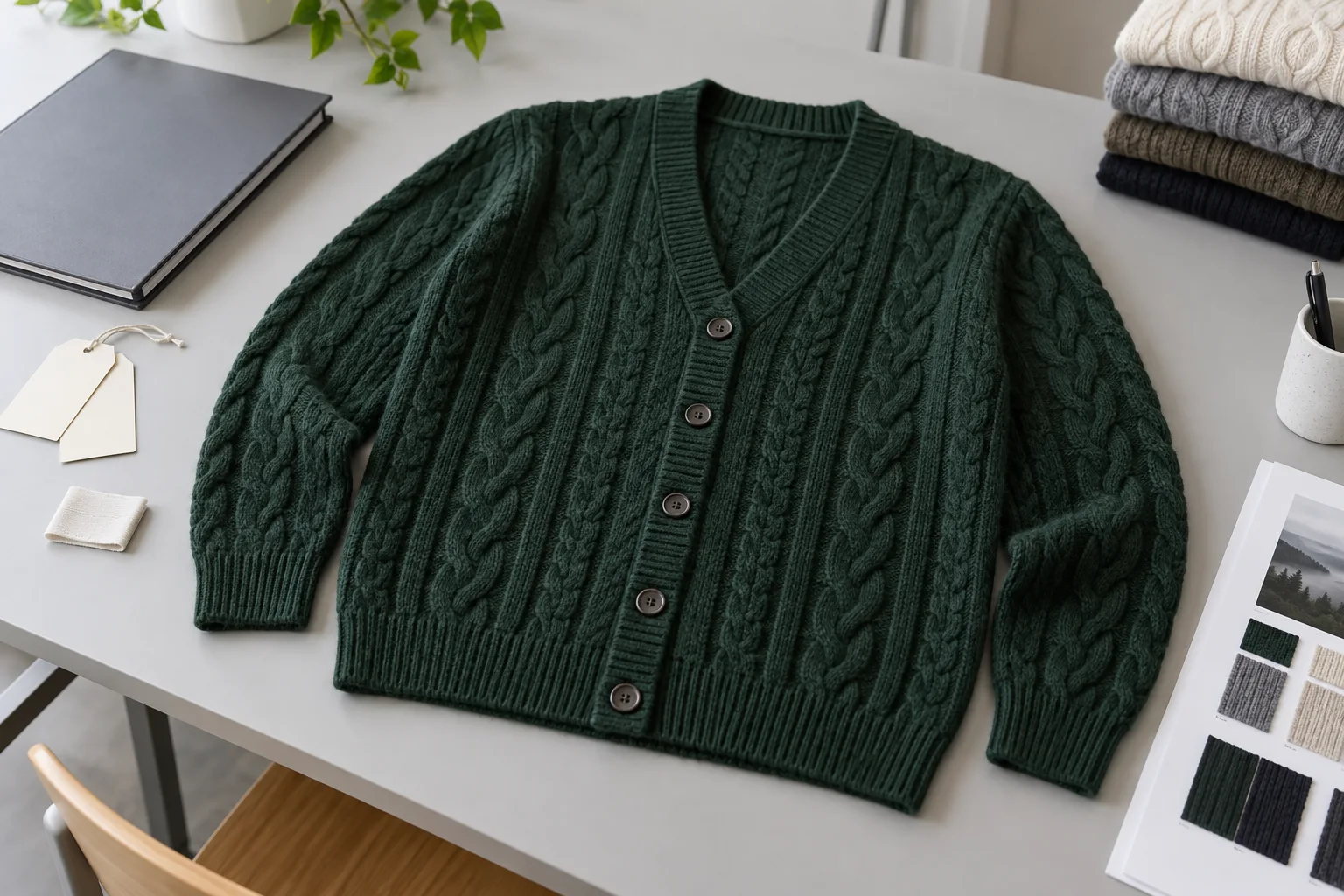
Canadian knitwear order document checks should connect one identifiable product to a controlled set of market documents. Approving the sweater, label artwork and commercial invoice separately leaves room for three different versions to reach the same shipment. The practical question is whether the garments, consumer information and receiving records still describe the same goods after provincial and channel requirements are considered.
This guide covers ordinary adult sweaters sold by a Canadian retail brand. It does not cover children’s clothing, sleepwear, protective clothing or a complete legal compliance assessment. The buyer must name the provinces, sales channels and businesses involved before using the document checks below. A warehouse address in Ontario does not answer whether the brand will also sell the product in Quebec.
The output is a release sheet that says which version can go where, who approved it and what remains on hold. It is not a new certificate for the factory.
Which markets must Canadian knitwear order document checks cover?
Define the destination beyond the delivery address
Start with the actual sales map: provinces served by stores, provinces accepted at online checkout, wholesale customer restrictions and the location receiving stock. Write these as separate fields. A retailer can receive one shipment at a single distribution centre and then allocate it to several markets with different information needs. Copying the warehouse location into the destination-market field conceals that distinction.
The scope also needs the intended wearer and product use. Record adult everyday clothing, the garment type, fibre specification and any unusual decoration. If a sales colleague later adds a children’s size range or a protective claim, reopen the scope review. That change is not simply another size or another sentence on the hangtag.
Use the existing manufacturer onboarding checklist to establish supplier contacts and document access. Keep this Canadian release file narrower: it controls the version sent to a named market, rather than repeating the entire supplier selection exercise.
Identify who can change each field
Name the retail business approving consumer copy, the party handling import declarations, the supplier issuing manufacturing records and the warehouse accepting cartons. Use legal business names where the document requires them; a familiar brand name or staff nickname may not identify the relevant entity. One employee may coordinate several roles, but the roles should remain visible.
Give each field a source and an owner. Product composition comes from the agreed product evidence, not from a marketing rewrite. Delivery quantities come from the actual packing record. Translations come from the approved language file. The importer or its adviser determines the customs treatment using the necessary facts; the designer should not select it from a previous invoice.
Finally, set a point at which the document set is frozen for production. After that point, request a change with the affected styles and quantities identified. A new attachment in an email thread should not silently replace an approved label across every order. The retail-ready private label guide helps distinguish branding components from the information those components must carry.
Which label facts need their own evidence?

Separate fibre information from the rest of the label
The Competition Bureau’s textile labelling summary identifies fibre information and dealer identification as key components. It describes bilingual fibre-content information and notes additional Quebec requirements. These are different questions from whether the artwork looks balanced or whether a care recommendation is appropriate.
Create separate approval lines for composition, dealer identity, care wording and any origin statement. Attach the source supporting each one. Do not treat a supplier’s label mockup as evidence for its own composition claim. The mockup is the proposed output. The evidence might include the agreed material specification and relevant product documentation, with any unresolved discrepancy clearly marked.
If the body and another component have different compositions, ask the responsible reviewer to determine the correct presentation rather than squeezing both into an inherited one-line layout. The care-label and fibre-content guide explains the production coordination, but it should not substitute for the Canadian rule review on this order.
Confirm the identity that will actually be printed
The Bureau explains that a CA Identification Number is optional and may replace a name and address on textile labels, subject to the stated eligibility rules. Do not invent a number while artwork is being developed or borrow the number printed on a reference garment. An application or a familiar-looking format is not confirmation of the identifier to use.
Ask the business responsible for the label to provide its approved identity field in a copyable form. Preserve spelling, address details and the approval date. If a group owns several brands, record which business stands behind this product; do not let a shared logo stand in for that decision.
Proof the actual printed sample at its final size. Check that the supplier did not shorten the address, omit an accent or shrink one language to fit. Then examine placement and attachment on the garment. The garment-label supplier confirmation guide is useful for converting the approved text into a controlled physical component. Text approval and component approval are separate signatures because either can fail while the other remains correct.
When does a Quebec destination change the document set?

Review packaging and accompanying material together
Do not stop the language review at the sewn-in fibre label. The OQLF’s product and trademark guidance addresses inscriptions on products, packaging and accompanying documents. It also describes rules effective from June 2025 for generic or descriptive elements within trademarks. Whether a specific name or statement falls within an exception needs a case-specific review.
Give the reviewer a complete pack: garment labels, hangtag, sleeve or bellyband, gift insert, care card and any printed packaging. Include the actual proposed wording, not a list saying “French included.” A translated fibre label can coexist with an unreviewed English-only product description on a gift card. That is precisely the mismatch this stage is meant to catch.
Keep promotional display material on its own review line. A store display and a product label are not interchangeable objects. If the supplier manufactures only the garment label, identify who controls the retail display and online copy instead of implying that factory approval covers them.
Choose one approved pack or an operationally real split
A single approved information pack may be easier to control than multiple market variants. That is an operational preference, not a finding that one pack automatically satisfies every market rule. Compare final readability, physical space, translation coverage and the buyer’s ability to keep the pack current before choosing it.
If separate versions are necessary, give them distinct internal codes. The following is a hypothetical control table, not an example of approved Canadian label wording.
| Order component | Shared across allocations | Market-specific check | Release evidence |
|---|---|---|---|
| Adult sweater specification | Material and construction revision | Confirm unchanged product scope | Approved product record |
| Sewn label | Confirmed fibre and dealer facts | Language and presentation review | Final-size label sample |
| Hangtag and insert | Supported product facts | Quebec wording and trademark review | Approved pack version |
| Warehouse allocation | Style and colour identities | Eligible destination for each pack | Receiving and pick rule |
The custom labels and packaging checklist helps specify the physical pieces. Add the market-version code to that specification. If warehouse staff cannot distinguish the variants without opening every garment, the split is not ready, even when both artwork PDFs have approval stamps.
How should the shipment record connect to the garment?
Use a product key instead of matching names by eye
Assign an internal key that connects the purchase order line, approved garment specification, label version, carton allocation and receiving record. It can be a style code combined with colour, size and revision. It does not have to replace any legally required identifier or the retailer’s barcode system. Its job is to make the commercial file traceable without relying on a photograph.
For example, an invoice description may say “adult knitted cardigan,” while a retail system uses a marketing name. Preserve a mapping between those descriptions and the actual style rather than demanding that every system use identical wording. What must remain consistent is the identity and relevant facts of the goods, not every display label.
Separate manufacturing country evidence from the country where an invoice was issued or a parcel was dispatched. Ask the import reviewer to resolve origin and classification using the actual facts. This article does not supply a tariff code, duty rate or preferential-origin conclusion. A supplier’s template is a request for verification, not an instruction to copy it into an entry.
Reconcile quantities before the carton list is final
Use a deliberately simple example. A hypothetical order has 180 cardigans: 60 small, 70 medium and 50 large. The current packing list shows 175 pieces because five medium units remain in rework. The receiving file should not promise 180 available pieces merely because that was the original purchase quantity. Record the five-unit difference and its agreed disposition.
If two information-pack versions are used, reconcile each version within those size totals. An aggregate count can be correct while the provincial allocation is wrong. The person approving the invoice, warehouse receipt and outstanding balance needs the same shortage record, even when each system stores it differently.
Review retail packaging and barcode setup when defining the scan-and-pick process. A readable barcode only proves that the scanner can read a code; it does not prove that the garment inside carries the corresponding label version. Add an actual packed-unit check to the receiving specification and retain the record with the shipment documents.
What should a Canadian release rehearsal reveal?

Walk one unit through the entire information chain
Select a production-intent sample and work forward from it. Read its style, colour and size, inspect its labels and packaging, find its order line, then find the corresponding receiving entry. Ask someone who did not assemble the file to perform the exercise. Their difficulty is useful evidence: an undocumented naming shortcut may be obvious to the buyer but invisible to warehouse staff.
Next, work backward from a carton allocation. Determine which physical label and insert should be inside it. This catches a different failure: the records may lead correctly from one carefully prepared sample while the packing instruction still names an obsolete version. The pre-production sample review guide provides the sample-control context; the rehearsal adds destination and document consistency.
Do not ask the reviewer simply whether the file is complete. Give specific tasks: identify the approved pack for a Quebec allocation, locate the source of the composition statement, explain a quantity difference and find the person authorized to resolve it. Record the answer and the source opened, not just a tick.
Test one plausible failure before bulk packing
Introduce a controlled desk exercise, not a real shipping error. Suppose artwork revision B adds approved French product text, but the packing instruction still calls for revision A. Can the packer identify which instruction controls? Can the warehouse stop the affected allocation without placing unrelated stock on hold? If the answer depends on calling one absent employee, improve the file before release.
The knitwear inspection checklist can hold the physical checks, but document identity needs its own acceptance line. A seam inspection result cannot establish that the correct language pack was used.
Agree how exceptions will be contained: separate the affected units, name the correction owner, identify the replacement component and specify the evidence needed for release. Do not permit a handwritten approval to cover unknown quantities. A useful exception record is narrow enough that another person can count the goods it covers and locate them in the warehouse.
Use this rehearsal table to turn each observed document break into a bounded release decision and a specific evidence request.
| Observed issue | Release risk | Buyer decision | Evidence needed next |
|---|---|---|---|
| Revision B artwork is approved but the packing instruction names revision A | An obsolete pack can reach the allocation | Hold the affected allocation and correct the instruction | Aligned artwork and packing records |
| The approved pack cannot be traced from a carton allocation | The physical version may not match the destination | Hold the identified units without blocking unrelated stock | Product-key and pack-version trace |
| The source of the composition statement cannot be located | The label line lacks retrievable support | Keep the affected label approval on hold | Source record linked to the product identity |
| A quantity difference cannot be explained | Packing and receiving records may describe different goods | Hold the named discrepancy for an agreed disposition | Reconciled packing, receiving and outstanding-balance records |
| An exception depends on one absent employee or covers unknown units | The correction cannot be contained or counted | Separate the affected units and narrow the hold | Named owner, replacement component, unit count and release evidence |
What must remain accessible after the order ships?

Preserve an order-specific record rather than a live folder
Keep the approved order snapshot separate from editable master templates. Otherwise a later address or label update can make the old shipment appear to have used the new version. Preserve the specification, final artwork, relevant source evidence, approvals, packing reconciliation and records actually issued for that shipment. Apply the current retention requirements determined by the responsible import and compliance advisers.
Record where the importer keeps its required customs records and who can retrieve them. Do not assume a supplier mailbox or broker portal is the buyer’s complete archive. Ask for a retrieval demonstration using an earlier order or a clearly labelled test record. The objective is to locate the supporting file when a question arises, not merely to show that someone once uploaded a PDF.
Use controlled access for business records. Staff who update website copy may need the approved consumer text but not the full purchase invoice. Providing the right view reduces uncontrolled copies without making essential information inaccessible. Keep the source record and the version sent to each recipient linked.
Reopen only the changes that affect the next release
A repeat order needs a change review, not automatic approval and not a complete restart. Check whether the material, manufacturing source, dealer identity, destination provinces, artwork, packaging or receiving system changed. For each change, name the affected document and the person who must approve it. Unchanged facts can retain their evidence when that evidence remains applicable.
The bulk production readiness guide helps place this review before manufacturing commitments. Keep commercial readiness separate from legal conclusions: an agreed price and a finished sample do not answer unresolved market-information questions.
Close with one of three precise decisions. Release the named version to the named allocation; hold identified units pending a listed correction; or remove the destination from this order’s approved scope until review is complete. Avoid “Canada approved” when the actual decision concerns one adult style, one pack version and specified channels. That narrower wording is more useful because the next buyer can see exactly what changed.
Conclusion
A Canadian knitwear order is easier to control when market scope, product facts and shipment records remain connected. Start by naming the sales provinces and channels, then approve the label and accompanying material as identifiable versions. Keep fibre evidence, dealer identity, language review and import decisions separate enough that the right person can check each one.
The final rehearsal should connect a packed garment to its order line and destination without relying on an employee’s memory. If that connection fails, correct the affected file or allocation before release. A shared document pack is useful only when it has actually been reviewed; a split pack works only when the factory and warehouse can distinguish it.
Prepare your adult product specification, intended provinces, proposed labels and receiving requirements before the production discussion. Contact CNSweaters to discuss the manufacturing inputs for your Canadian order.
Frequently Asked Questions
Can one warehouse receive several provincial pack versions?
Yes, operationally, if the warehouse can identify, store and allocate each version correctly. Confirm the pack codes and receiving checks before dispatch. A common delivery address does not eliminate the need to review the markets where the goods will be sold.
Is a CA number the same as a product approval?
No. It is a dealer-identification option described by the Competition Bureau, not evidence that a particular sweater, label translation or shipment has passed review. The product facts and applicable presentation still need their own verification.
Can the factory translate the label for the buyer?
The parties can agree who prepares a translation, but preparation is not final approval. Give the responsible market reviewer the actual text and final artwork. Retain the approved version, including accents and layout, before printing.
Should a colour change reopen every document?
Not automatically. Determine whether it changes only the colour identifier or also material evidence, consumer claims, product descriptions or pack allocation. Review the affected fields and preserve the decision. An unchanged style name is not proof that every underlying fact stayed the same.