 CN Sweaters
A ribbed cardigan can look simple in a line plan: vertical texture, a front opening, sleeves and buttons. In production, those elements create a tightly connected system. A small change in yarn, stitch length, machine setting, washing or front-band construction can alter the cardigan’s width, length, recovery, handfeel and closure line at the same time.
That is why a successful sample does not automatically guarantee stable bulk. The approved sample may have been knitted on one machine, from one yarn lot, by one operator and finished in a small trial. Bulk production spreads the work across more cones, machines, shifts, sizes and finishing batches. Without a recorded control standard, the rib can become wider, softer, heavier or more open as the run progresses.
For buyers working with cardigan manufacturers, the practical objective is not to eliminate all natural variation. It is to define which characteristics matter, how they will be measured and where the factory must intervene before variation becomes a shipment-level problem.
Define the Commercial Cardigan Before Setting Tension
The development brief should begin with the product’s commercial role. Machine settings are a response to that role, not a substitute for it.
State the intended layer, season and silhouette
Record whether the ribbed cardigan is a close-fitting top, a light layering piece, a relaxed core style or a heavier outer layer. Add the intended climate, retail window, price position, target customer and care expectation.
A fitted cardigan must close without horizontal strain lines, excessive rib opening or gaping between buttons. A relaxed cardigan needs enough structure to avoid looking stretched and tired on the hanger. A cropped style must keep the front and back hems balanced, while a longer style must resist vertical growth under its own weight.
Define the expected wearing state. Will customers wear it closed as a top, partly buttoned over a base layer or fully open? Each use changes the load on the front bands and the amount of ease needed across the chest and hip.
Convert the design image into production decisions
A reference image can communicate neckline, rib scale, length and styling. It cannot confirm fiber content, yarn count, machine gauge, stitch length, density, recovery, garment weight or wash behavior.
The tech pack should separate visible intent from technical controls. State the rib notation or approved visual standard, yarn reference, gauge, panel construction, neckline, shoulder type, sleeve shape, placket method, closure count, edge construction, target measurements and finishing route.
The CNSweaters cardigan construction, fit and gauge guide is a useful companion when translating a visual brief into cardigan-specific specifications.
Build the Rib, Yarn and Gauge as One Material System
Rib is not one universal fabric. Different needle arrangements and yarns produce different width stretch, recovery, thickness, opacity, surface scale and cost.
Compare rib structures on the intended yarn
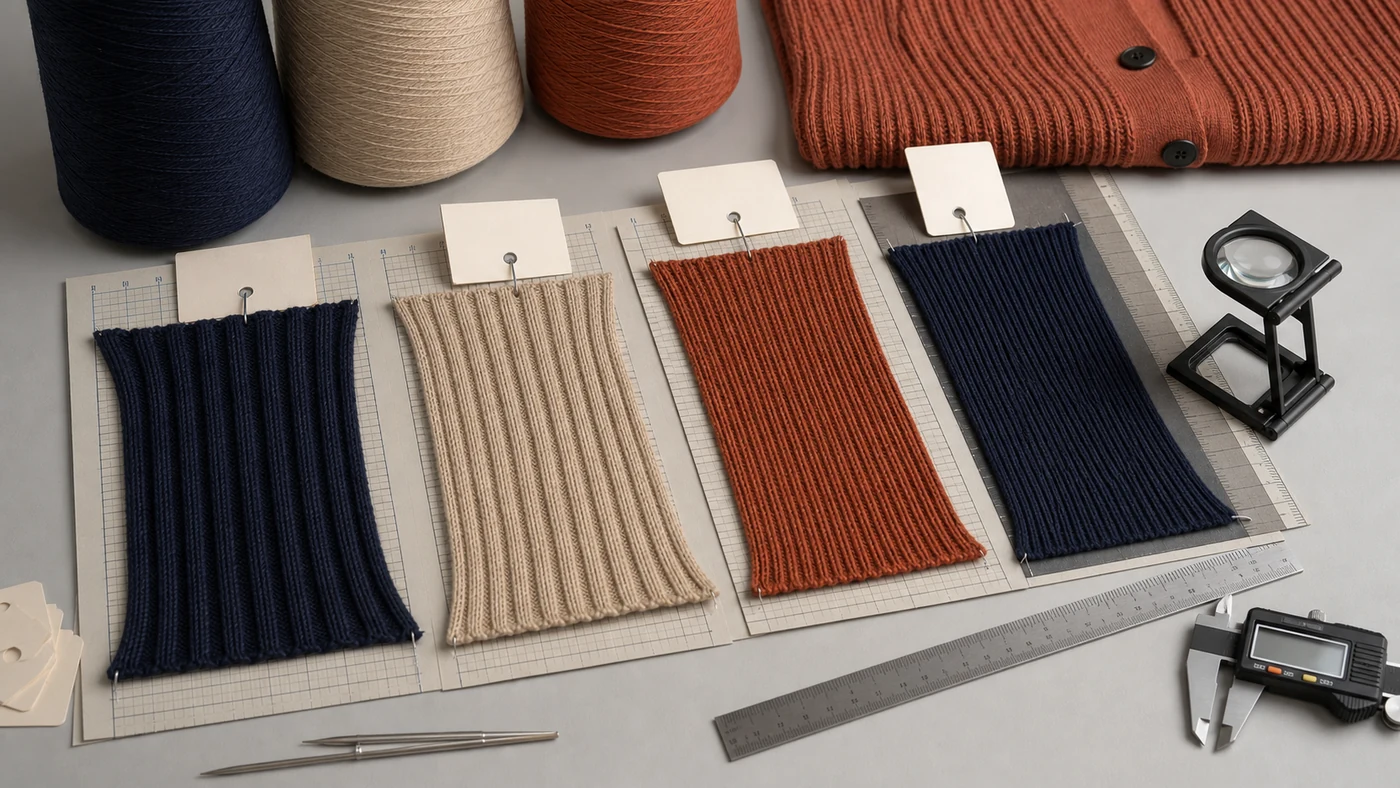
Ask for labeled swatches in the proposed yarn, gauge and finishing route. Compare 1×1, 2×2 or engineered rib arrangements only when they are relevant to the design. Keep the swatch labels with the physical samples so later decisions remain traceable.
CottonWorks’ technical overview of single and double knits explains that ribs use two needle beds and that their needle arrangement defines the visible structure. It also notes that rib tension can be supported by a stretch yarn in some constructions. That is a design option, not a universal recipe.
Review each swatch relaxed, lightly extended and recovered. Check rib width, valley depth, face appearance, opacity, handfeel, edge behavior and whether the structure returns after representative strain. A swatch that looks dense on a table may open considerably across the wearer’s chest or upper arm.
Match yarn behavior to the product promise
Evaluate fiber percentages, yarn count and ply, twist, color method, lubrication, elasticity, pilling risk, care method and availability. A cotton-rich cardigan can feel clean and seasonless but may need more deliberate recovery control. Wool and elastic blends behave differently during knitting, washing and steaming. Viscose-rich yarns can add fluidity while increasing growth risk.
Do not specify elastane or a fixed tension value simply because the product is ribbed. The correct choice depends on the yarn, structure, machine, fit and expected extension. If an elastomeric component is used, record where it is introduced and approve its effect on appearance, recovery, composition, dyeing and care.
The approved yarn standard should include supplier reference, composition, count or ply, color reference and lot-control method. If bulk uses a substitute yarn or a new lot, require a knit-down comparison before the production run continues.
Approve the finished material, not the greige panel
Knitting stores tension in the panel. Washing, steaming and relaxation redistribute that tension, which can change width, length, stitch definition and handfeel. Swatch approval should therefore use the intended bulk finishing route.
Keep both pre-finish and finished records where practical. Their difference helps the factory diagnose whether later drift began at the knitting machine or during washing and finishing.
Lock Stitch Length and Fabric Counts
“Use the same tension” is not a complete bulk instruction. The factory needs a measurable panel standard and a documented process window.
Lock stitch length and fabric count as a system
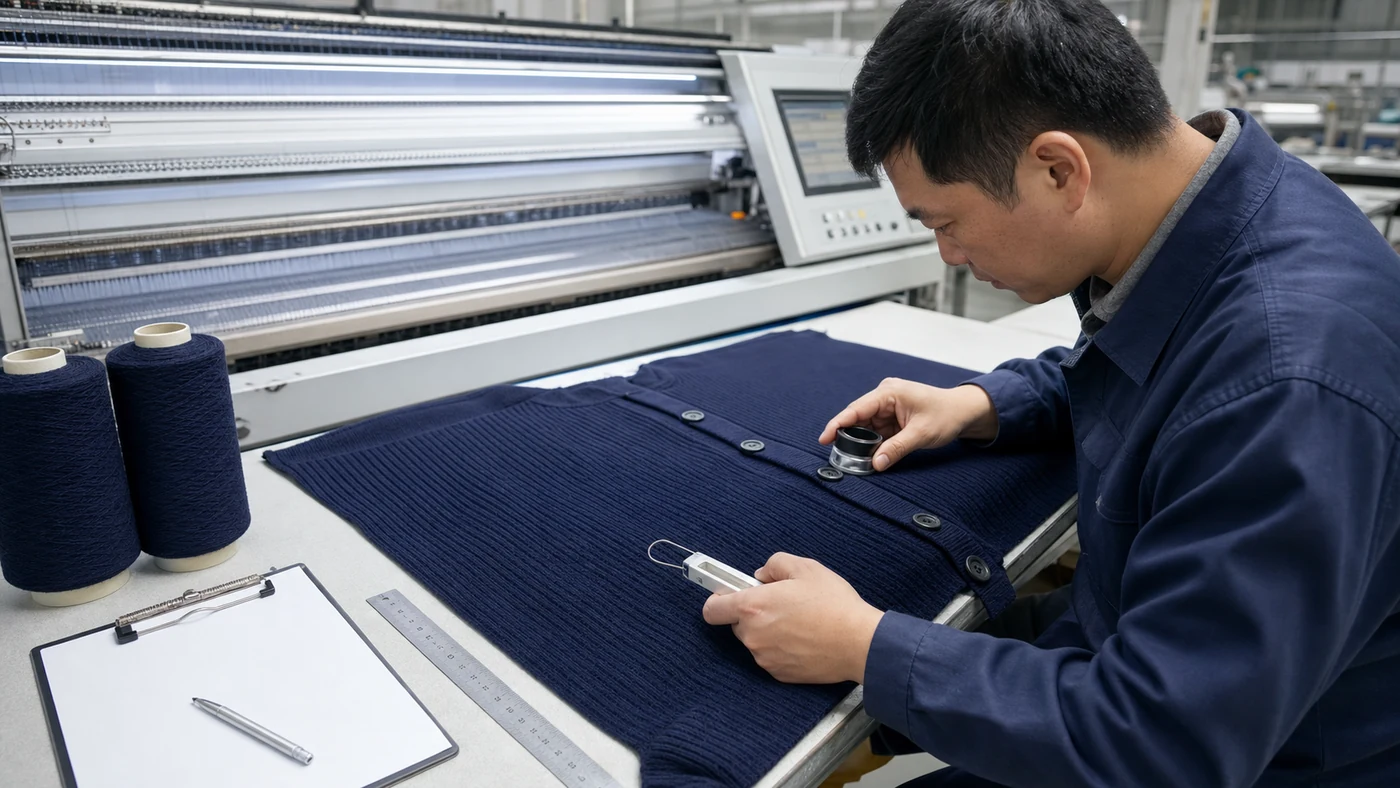
Stitch length describes the yarn consumed in a knitted loop under a defined method. Yarn feed tension affects loop formation, but the two are not interchangeable. Machine gauge identifies the needle density of the machine; it does not prove the finished fabric count or final garment measurements.
Record the approved stitch program, yarn reference, machine gauge, stitch length or course-length control used by the factory, and the measurement method. Add the finished wale and course counts, garment weight and key panel dimensions where these are useful for the style.
ASTM D8007-24 covers separate measurement of wale and course counts in weft-knitted fabrics, including rib structures. Those counts give buyers and factories a common way to compare the approved material with production, but they should be interpreted alongside yarn, finishing and garment measurements.
Create a physical and numerical control standard
Seal an approved swatch and pre-production cardigan. Attach or cross-reference the yarn lot, color, size, program revision, machine group, finishing recipe and approval date. Photograph the rib surface under consistent lighting and at a repeatable distance.
The control sheet can include:
| Control area | Record before bulk | Check during production | Escalation trigger |
|---|---|---|---|
| Yarn | supplier, composition, count or ply, color and lot | cone labels and knit-down match | unapproved substitution or visible lot shift |
| Rib construction | notation, gauge and approved surface | rib scale, valleys and edge behavior | visible density or structure drift |
| Loop control | approved stitch or course-length method | machine and panel records | movement outside the agreed process window |
| Fabric count | wale and course count after conditioning | representative panels by machine or batch | repeated difference from sealed standard |
| Garment weight | finished sample weight and condition | representative finished units | systematic high or low trend |
| Dimensions | defined points and measurement state | panel, PP, inline and final checks | trend toward tolerance edge |
Avoid treating any one number as proof of quality. Two cardigans can have similar finished chest measurements while differing in density, weight and recovery. A correct control system connects material, machine, panel, finish and garment evidence.
Monitor dimensional direction and rate of change
Bulk problems usually develop as a trend. If successive checks move toward the same tolerance limit, waiting for a formal failure wastes correction time.
Plot or review results by machine, operator, yarn lot, size and finishing batch. A cluster of wide bodies from one machine suggests a different cause from random variation across all machines. A single finishing batch with shorter sleeves suggests a different investigation from gradually shortening panels during knitting.
Engineer the Placket, Closures and Edges
The front opening makes a cardigan less forgiving than a pullover. The body, placket, neckline and closures must remain balanced in both relaxed and worn states.
Balance body fit with the front opening
Specify whether the front band is integrally knitted, separately knitted and linked, doubled, tubular or constructed by another approved method. Record its width, finished length, rib structure, attachment method and relationship to the body.
Check the cardigan open, fully closed and partly closed. Look for a front band that waves, flips, bows outward, pulls the neckline, shortens the front hem or creates diagonal stress from button to button.
The placket may need a different program or construction from the body, but “tighter” is not a sufficient instruction. Approve the finished relationship between band and body on the actual yarn, size and wash route.
Specify button and buttonhole behavior
Record button diameter, thickness, shank or hole type, material, color, quantity, spacing and attachment method. Define the buttonhole position, orientation, finished opening and reinforcement.
Review operation as well as appearance. The button should pass through without excessive force, but the hole should not relax so much that it opens during wear. Check the top and bottom positions carefully because neckline and hem tension can distort them differently from the middle closures.
Button placement must grade with the garment. If spacing or count changes by size, show the rule in the tech pack. Do not allow an operator to redistribute positions by eye.
Protect linked seams and transition points
Ribbed panels can disguise linking errors until the seam is stretched or washed. Inspect shoulder, armhole, underarm, side seam, neckline, pocket and placket intersections for skipped loops, doubled loops, holes, ridges and asymmetry.
The guide to linking quality in a knitwear factory explains why stitch-count and equipment matching matter to seam appearance and elasticity. For this cardigan, the buyer should define which seams are linked, how transition points should look and how much stretch the seam must accommodate in wear.
Specify Fit and Measurement Conditions
Rib stretches easily, so a relaxed flat measurement can hide a fit problem. Measurement and fitting evidence must describe the garment state.
Define how the cardigan is placed and relaxed
ISO 18890:2018 defines principal garment measurement points and allows additional points by agreement. A cardigan specification still needs style-specific diagrams and conditions.
State whether the garment is measured open or fastened, how long it relaxes after finishing, whether it lies flat without tension, and whether values are pre-wash or post-wash. Define the reference points for body length, chest, shoulder, sleeve, armhole, placket and hem.
Use the same method for the approved sample and bulk. If the sample is measured immediately after steaming while bulk rests overnight, the results are not directly comparable.
Fit the cardigan in all intended wearing states
Review the sample on the target body or form with the intended underlayer. Check front balance, neckline position, shoulder line, chest strain, sleeve pitch, arm movement, cuff recovery and hem behavior.
Close every button and observe whether the rib opens evenly. Gaping only at the bust may indicate insufficient ease or closure spacing; diagonal lines may indicate body balance, sleeve or shoulder problems. A front that hangs correctly open but pulls upward when closed is not approved fit.
Photograph front, side and back views under consistent conditions. Add close-ups of the neckline, placket, buttonholes, underarm and hem. Written fit comments should identify the problem, requested change and reference measurement rather than rely on “make it better.”
Validate the Size Range
A base-size approval does not prove that the rib, placket and proportions work at the ends of the size range.
Approve a representative size set

Select lower, base and upper sizes that expose grading risk. Measure and fit them after the approved finishing and relaxation route. If the range is broad or the body shapes differ materially, add sizes or use more than one fit form.
Check whether rib opening, opacity, button spacing, neckline width, shoulder position, sleeve volume, cuff tension and hem recovery remain appropriate. Larger sizes may need more than simple width additions, while smaller sizes can become over-built if placket width and closure scale do not change proportionally.
Review total garment weight by size as a diagnostic. Weight should not be forced into one universal tolerance across all sizes, but unexpected jumps can reveal grading, stitch or component errors.
Separate grading increments from tolerances
The grade defines the intended difference between sizes. The tolerance defines permitted manufacturing variation around each size. Mixing them can create overlapping finished measurements and inconsistent customer fit.
Document the size chart, grade rules, tolerance by point and any points that do not grade linearly. Neck opening, button count, pocket position, rib depth and cuff width may follow different rules from chest or body length.
For repeat orders, keep the approved size-set records. Recreating a grade from one remaining base-size sample increases the chance of silent drift.
Control Washing, Finishing and Surface Quality
Finishing is part of the construction. It changes the dimensions, touch and visual definition that the buyer actually sells.
Test the stated care route
ISO 6330:2021 specifies domestic washing and drying procedures for textile testing, and ISO 5077:2007 addresses determination of dimensional change after washing and drying. The buyer must still select the procedure that matches the intended care claim and agree the number of cycles and evaluation points.
Measure the complete cardigan before and after the selected procedure. Check body and sleeve dimensions, placket length, left-to-right balance, buttonhole shape, rib recovery, seam condition and surface appearance.
Do not test only the body panel. Closures, linked seams, labels and mixed structures can react differently from the main rib.
Fix the bulk finishing recipe and condition
Record the approved wash, softening, drying, steam, pressing and relaxation route at the level needed for repeatability. Record the finished handfeel and visual standard alongside the machine settings.
Over-pressing can flatten the rib and make the cardigan look wider. Uneven steam can change length or placket balance. Excess softening may improve first touch while reducing the crisp surface the buyer approved.
Compare finishing batches against the sealed PP sample under consistent light and after the same relaxation time. If a recipe must change because of yarn-lot behavior, approve a confirmation before the new method is applied to the remaining bulk.
Transfer the Approved Sample Into Bulk
Bulk consistency depends on controlled transfer, early checks and traceable decisions.
Build a complete pre-production pack
The PP pack should include the sealed cardigan, approved swatch, yarn and shade references, tech pack revision, measurement chart, grading rules, stitch and machine records, finishing route, trim approvals, label and packing layouts, defect examples and inspection plan.
Confirm that production teams are using the same revision. A technically correct old file is still the wrong standard if the buyer approved a later change.
The broader bulk knit consistency guide explains why the approved sample must be translated into process records rather than treated as a single showpiece.
Inspect drift before the run is complete
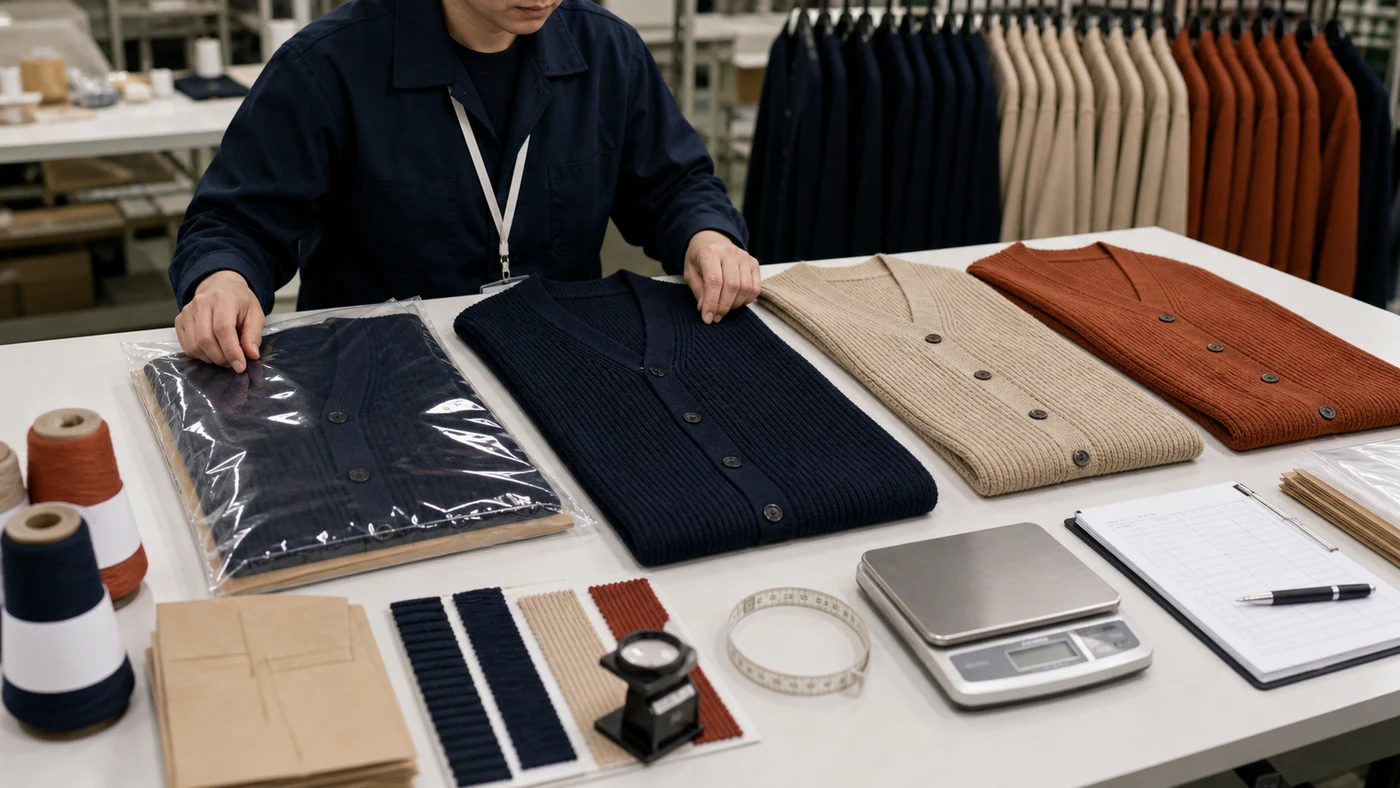
Check first-off panels and garments before full production. Then inspect representative units by machine, yarn lot, color, size and finishing batch at planned intervals.
Panel-stage checks should focus on structure, count, dimensions, weight, defects and left/right matching. Garment-stage checks should add linking, placket behavior, closures, measurements and appearance. Finished checks should add handfeel, shade, wash response, labels and packing.
Use the CNSweaters knitwear quality-control checklist to map pre-production, inline and final checkpoints. Final random inspection remains necessary, but it should confirm a controlled run rather than discover a systemic tension problem after every cardigan is packed.
Preserve records for replenishment
Archive the final approved specifications, physical standards, yarn lots, machine groups, program versions, finishing recipe, measurement results, defect decisions and shipment samples.
Before a refill order, identify what has changed. A new yarn lot, machine group, trim supplier or finishing line may require a confirmation sample even when the design is unchanged.
This record is especially valuable for core programs. A ribbed cardigan can become a dependable repeat style only when the factory can reproduce the approved material and fit, not merely recognize the product photo.
Conclusion
Consistent ribbed cardigan production starts by treating yarn, rib structure, machine control, finishing, fit and front-band engineering as one system.
Define the commercial wearing state first. Approve finished swatches in the actual yarn and construction. Record stitch and fabric controls that can be checked during bulk. Fit the cardigan open and closed, validate representative sizes, and test the care route on the complete garment.
Finally, transfer the sealed sample into a documented PP pack and inspect trends early by machine, yarn lot and finishing batch. That process gives buyers and factories evidence for correction before variation becomes a full-order problem.
Related CNSweaters Resources
- Custom Cardigan Manufacturing Capabilities
- Cardigan Construction, Fit and Gauge Guide
- Why Linking Quality Matters
- Bulk Knit Consistency From Sample to Production
- Knitwear Quality Control Checklist
Developing a Ribbed Cardigan?
Send the intended customer, season, silhouette, yarn or composition direction, rib reference, gauge, placket and closure design, size range, quantities, colors, care route, quality requirements and delivery date. The CNSweaters team can review a practical sampling and bulk-control path.
FAQ
Is stitch length the same as knitting tension?
No. Stitch length describes yarn used in a loop under a defined method. Yarn feed tension influences loop formation, while machine gauge, take-down, yarn behavior and finishing also affect the result. A bulk standard should connect process settings with finished fabric and garment evidence.
Which rib structure is best for a cardigan?
There is no universal best rib. The correct construction depends on silhouette, yarn, gauge, opacity, recovery, handfeel, weight, price and care expectations. Compare finished swatches and approve the complete garment rather than selecting by notation alone.
Why does a cardigan placket wave after washing?
The band and body may have incompatible lengths, densities, recovery or finishing behavior. Attachment tension, button spacing and pressing can also contribute. Compare the placket open and closed before and after the agreed wash route to identify the stage where distortion begins.
How should bulk consistency be checked?
Check first-off production and planned inline samples by machine, yarn lot, size and finishing batch. Compare structure, fabric counts, weight, dimensions, linking, placket behavior, handfeel and shade against the sealed PP standard. Review trends before results exceed tolerance.
Does one approved size prove the full size range?
No. Rib opening, closure spacing, neckline proportion, sleeve volume and hem recovery can change across the grade. Approve representative lower, base and upper sizes after the intended finishing route.