 CN Sweaters
A ribbed knit dress can look compact and opaque on a sample table, then behave very differently when it is stretched over the body, worn for several hours, hung in a boutique or washed at home. The ribs open, the dress carries its own vertical weight, and the areas under prolonged stress may not recover at the same rate.
For boutique buyers, this creates a specific sourcing problem. Small assortments still need professional material, fit and bulk controls, but every extra color or size also divides the order quantity. The product must be attractive enough to earn rack space and stable enough to avoid bagging, transparency, uneven length and inconsistent customer fit.
The reliable approach is to define the dress as a complete system: product role, target body, silhouette, yarn, rib construction, gauge, stitch density, garment weight, stretch, growth, recovery, opacity, dimensions, finishing, labeling and inspection. This guide explains how to brief and approve that system with a knit dress manufacturer.
Define the Boutique Product Role
A ribbed knit dress for late summer, early fall or winter layering cannot use the same material and construction by default. The buyer should define the commercial role before choosing yarn colors or approving a silhouette image.
Write the use case before the specification
Record the target customer, climate, selling window, retail channel, intended layer, length, sleeve direction, fit, price position and care expectation. State whether the dress should skim the body, fit closely, form a straight column or use shaped zones at the waist and hip.
Add the intended underwear and layering assumptions. A dress designed for a slip or lining has different opacity requirements from a single-layer style. A sleeveless transitional dress may need armholes that work alone and over a fine layer. A long-sleeve winter style must balance warmth, sleeve recovery and indoor comfort.
The product statement should guide every later decision. A close-fitting boutique dress needs controlled stretch and recovery at bust, waist, hip, seat and knees. A straighter silhouette may prioritize vertical stability and clean hang. “Ribbed midi dress” alone does not identify those requirements.
Separate fashion reference from production standard
Reference images can communicate mood, neckline, rib direction and overall proportion. They cannot prove yarn composition, gauge, density, garment weight, stretch, opacity or post-wash behavior.
Mark which features are inspiration and which are mandatory. If a reference comes from another brand, use it to discuss direction rather than request an exact copy. Convert the approved intent into an original tech pack, measurement chart and sample record.
For a coordinated boutique assortment, decide whether colors share one yarn and construction platform. A common base can simplify approvals and reorders, but each color still needs a confirmed shade and any material-specific risk checks.
Choose Rib Structure, Yarn and Gauge Together
Rib is a family of knitted structures, not one universal fabric. Rib notation, needle arrangement, yarn and density determine surface scale, width stretch, recovery, opacity, weight and drape.
Compare constructions with labeled swatches
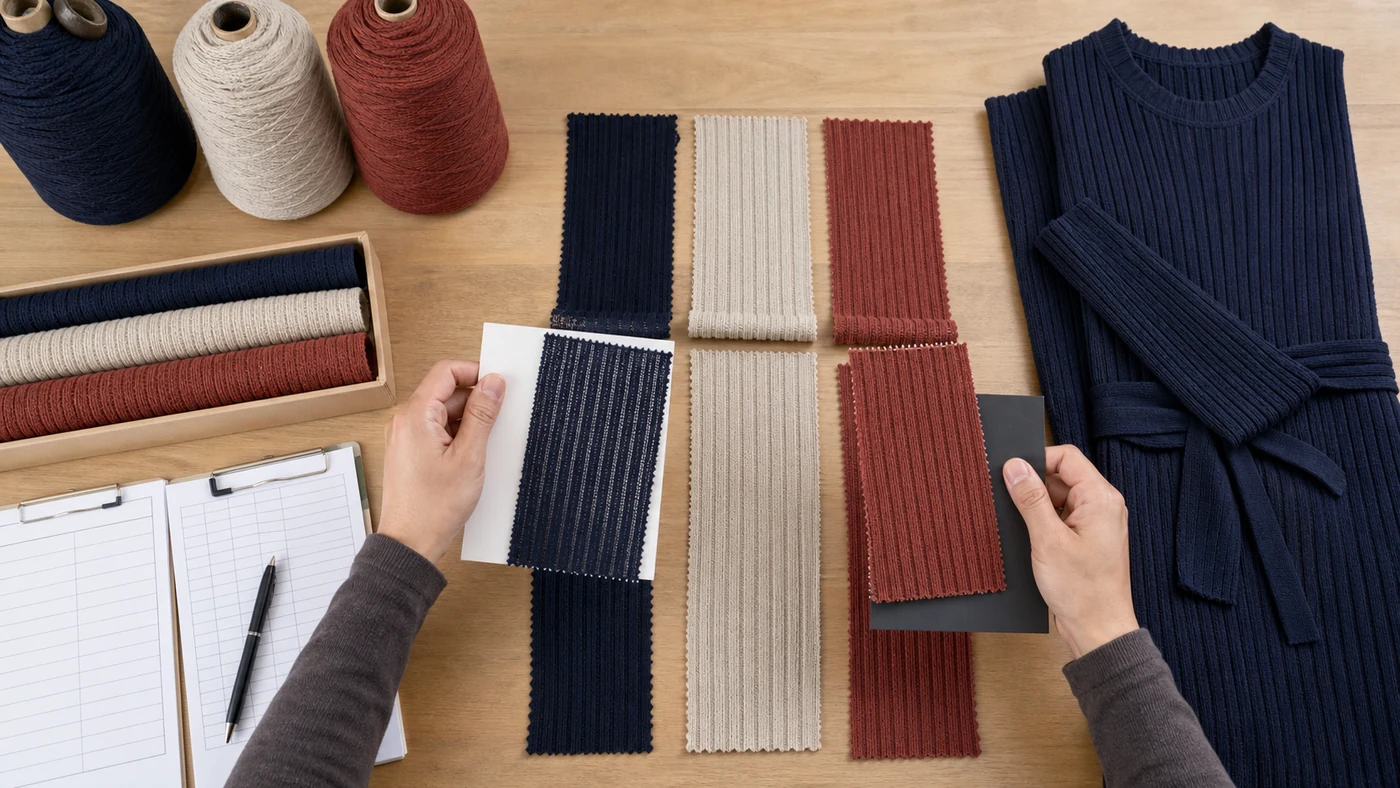
Ask the factory to produce swatches in the proposed yarn, gauge and finishing route. Record the rib structure, yarn reference, fiber percentages, count or ply, machine gauge, stitch density, swatch dimensions and condition.
Compare the swatches relaxed and extended. A narrow rib can create a refined vertical surface but open significantly across the body. A wider rib may look more graphic and distribute stretch differently. Alternating rib widths, plated constructions and engineered zones add design value but require more precise programming and approval.
Use the swatch to shortlist options, not to approve the whole dress. A full garment introduces length, body shape, seams, neckline, armholes, sleeves, hem and its own weight. The CNSweaters midi knit dress stable-fit guide explains why a dress behaves differently from a shorter sweater.
Select yarn for recovery, handfeel and care
Evaluate the fiber blend against skin contact, season, stretch demand, pilling risk, care method, cost and color plan. Do not add elastane automatically or specify a universal percentage. The appropriate construction depends on the base yarn, rib, target extension, recovery and dyeing route.
If elastomeric yarn is proposed, define where and how it is introduced and confirm that the composition, handfeel, color, care and production process remain acceptable. If the design uses no elastane, recovery must come from yarn elasticity, rib architecture, density and finishing.
The private-label yarn planning guide helps buyers connect fiber choice with price, MOQ, care and bulk risk. For this style, the approved yarn must also reproduce the intended rib opening and return.
Control Stretch, Recovery, Opacity and Garment Weight
Stretch, growth and recovery are related but different. A dress can stretch enough for movement yet remain permanently wider or longer after the load is removed.
Define the performance question before the test
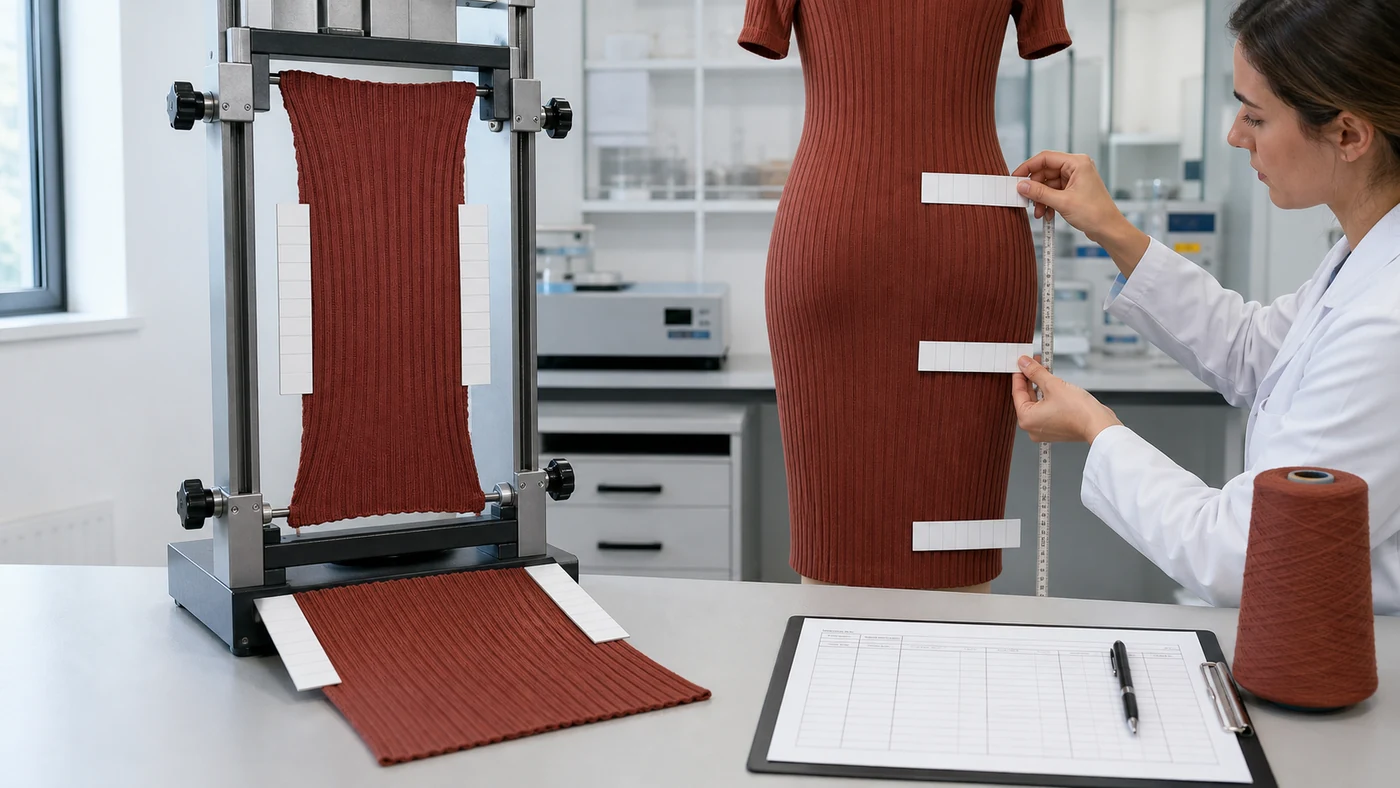
Stretch describes extension under a stated force or condition. Growth describes the residual dimensional change after a defined extension or prolonged stress. Recovery describes how far and how quickly the material returns toward its original state.
ASTM D2594/D2594M-21 covers stretch properties and growth of low-power knitted fabrics. ASTM notes that stretch and growth are useful when selecting fabrics expected to extend and return, including apparel under momentary or prolonged stress. It also notes limitations for commercial-shipment acceptance because between-laboratory precision can be poor.
ASTM D4964-96(2020) addresses tension and elongation of elastic fabrics using a constant-rate-of-extension machine where applicable. The buyer and testing party still need to agree the relevant tension, elongation and laundering conditions. A standard number without the selected parameters is not a complete requirement.
Use tests to answer the product’s risks: Can the hip area accommodate movement? Does the seat recover after sitting? Do knees remain bagged? Does the sleeve recover at the elbow? Does the waist hold its intended shape after several hours?
Check opacity in the worn condition
Review the relaxed swatch over light and dark backgrounds, then extend it to representative garment strain. Inspect the full sample on the intended body or form under front, side and back lighting.
Opacity can vary at bust, hip, seat and areas where the rib opens most. Dark colors may appear visually denser than pale shades even when the construction is the same. A pass/fail decision should therefore reflect the actual color range and intended underwear or lining policy.
Record whether the approval applies to an unlined garment, a separate slip or an attached lining. If lining is added, reassess stretch, recovery, seam behavior, comfort and care compatibility.
Treat finished garment weight as a vertical-load control
Record finished weight in a named size after the agreed finishing and relaxation condition. Weight helps identify changes in yarn consumption or density, but it must be used with yarn, gauge, stitch and dimension controls.
Conduct a hanging or wear-simulation review using a defined duration and recovery period agreed for the project. Measure total length, shoulder position, waist, hip and hem before load, after load and after recovery where relevant. A long dress can grow because the lower body continuously pulls on the upper structure.
Do not approve steaming or blocking as a temporary method for forcing the sample to target dimensions. The garment must remain stable after it has relaxed.
Specify Fit and Measurement Conditions
An elastic garment can produce different measurements depending on how it is handled. The tech pack must define both the target values and the measurement state.
Define body, garment and negative or positive ease
Identify the target body data and base-size fit. Body measurements describe the wearer; garment measurements describe the finished dress; ease is the relationship between them.
A close ribbed dress may use negative ease at selected circumferences, but the amount is a brand and construction decision. It should not be copied from a different yarn or product. Confirm mobility, comfort, opacity and recovery on the actual sample.
Map key fit zones: neckline, shoulder, bust, waist, high hip, full hip, seat, armhole, bicep, sleeve, cuff, total length and hem. Add slit position, flare or shaped panels where the style requires them.
Standardize the garment measurement method
ISO 18890:2018 defines principal garment measurement points and methods and permits additional points by agreement. The buyer should add diagrams for every dress-specific point and state how the elastic garment is placed.
Specify:
- required relaxation time and environment;
- whether the dress is laid flat without tension;
- how ribs and edges are allowed to settle;
- whether closures or belts are fastened;
- the reference point for total length;
- whether values are pre-wash, post-wash or finished-and-relaxed;
- the unit and point-specific tolerance.
Measure actual samples before fitting them. Then review the dress standing, walking, sitting and reaching. Record front, side and back photographs under consistent conditions.
Build the Size Range and Size-Set Approval
The size range must preserve silhouette, comfort, opacity and length across different bodies. A correct base size is not proof that the lower and upper sizes work.
Grade the body zones as a connected system
Decide how bust, waist, hip, shoulder, armhole, bicep, sleeve, cuff and length change. Do not apply one uniform increment. The rib’s available extension does not remove the need for correct graded garment dimensions.
Check whether each size uses a credible working range of the material. A smaller size should not sit nearly relaxed while a larger size relies on extreme rib opening. That would create different opacity, surface appearance and recovery within one product.
For long sleeves, grade shoulder, armhole, bicep, sleeve length and cuff together. For sleeveless styles, check armhole coverage and gape. For midi or maxi lengths, confirm that length grading and vertical growth do not create inconsistent hem positions.
The long-sleeve knit dress buyer checklist offers additional fit and size-set considerations for colder-season programs.
Sample sizes that expose risk

Approve the base size first, then select representative lower and upper sizes. Add any size where a new block, grading rule, slit, length or construction change begins.
Measure and fit each sample in production-intent yarn, gauge, rib and finishing. Compare:
| Control area | Buyer decision | Approval evidence |
|---|---|---|
| Target fit | Body profile and ease by zone | Fit statement and base-size record |
| Rib system | Structure, yarn, gauge and density | Labeled swatch and full sample |
| Extension | Required movement range | Agreed stretch evaluation |
| Growth/recovery | Seat, knee, elbow and vertical stability | Load/wear and recovery record |
| Opacity | Acceptable appearance by color and strain | Extended swatch and fit photographs |
| Length/weight | Finished target and measurement state | Relaxed, hanging and wash results |
| Size range | Graded values and rule changes | Lower/base/upper size set |
| Bulk tolerance | Point-specific acceptance | Signed specification |
If extreme sizes show different rib opening or silhouette, revise the grade or block rather than accepting a numerical chart that does not produce a consistent product.
Approve Seams, Edges and Finishing
Seams and edges must extend and recover with the body. A stable rib panel can still fail when linking, neckline, armhole or hem construction restricts it.
Match joining to the required extension
Inspect shoulder, side, underarm, sleeve and waist seams where applicable. Check seam allowance or linking quality, yarn tension, bulk, elasticity and alignment of rib columns.
The guide to linking quality in a knitwear factory explains how stitch-by-stitch joining influences stretch, appearance and durability. Review seam performance under the intended extension and again while the garment lies flat.
Look for popped or stressed stitches, wavy seams, mismatched ribs, twisting and localized tightness. If the dress uses fully fashioned shaping, confirm that decreases and increases are symmetrical and clean.
Stabilize neckline, armholes, cuffs and hem
Record edge structure, depth, attachment method and recovery. A neckline must pass over the head where required without remaining stretched. Armholes must cover appropriately without gaping. Cuffs should recover after wear, and the hem should remain level without flaring or pulling inward unexpectedly.
Approve the wash, steam, pressing and relaxation route. Finishing should establish the intended hand and dimensions without flattening the rib or creating shine.
Plan MOQ, Colors, Delivery and Retail Packaging
Boutique orders often require breadth with limited depth. The buyer should map assortment ambition to the real material and production constraints.
Identify every binding minimum
Ask about minimums for style, color, yarn purchase or custom dyeing, size, label and packaging. A total garment MOQ can hide a color or yarn constraint.
Build the SKU matrix before confirming colors. Core shades may justify deeper size coverage; test colors need a defined learning role. Avoid splitting a small order across so many combinations that no SKU receives a practical quantity.
Compare quotes on the same composition, yarn, gauge, rib, garment weight, measurements, labels, packaging, inspection and trade scope. A lower price based on a looser construction or different fiber is not a like-for-like alternative.
Protect the selling window and product shape
Build the calendar backward from the required receipt date. Include yarn and color approval, swatches, proto and fit rounds, size set, wash testing, label and packaging approval, PP sample, bulk knitting, linking, finishing, inspection and freight.
Choose folding, bag size, tissue or support and carton quantity according to the dress length and weight. Hanging can create growth; tight folding can create permanent ribs or creases. Test the packed sample after a representative storage period and allow it to recover before judging presentation.
Inspect Bulk and Preserve Reorder Records
Bulk inspection should compare the actual finished product with the sealed evidence and the purchase-order description.
Inspect across sizes, colors and process stages
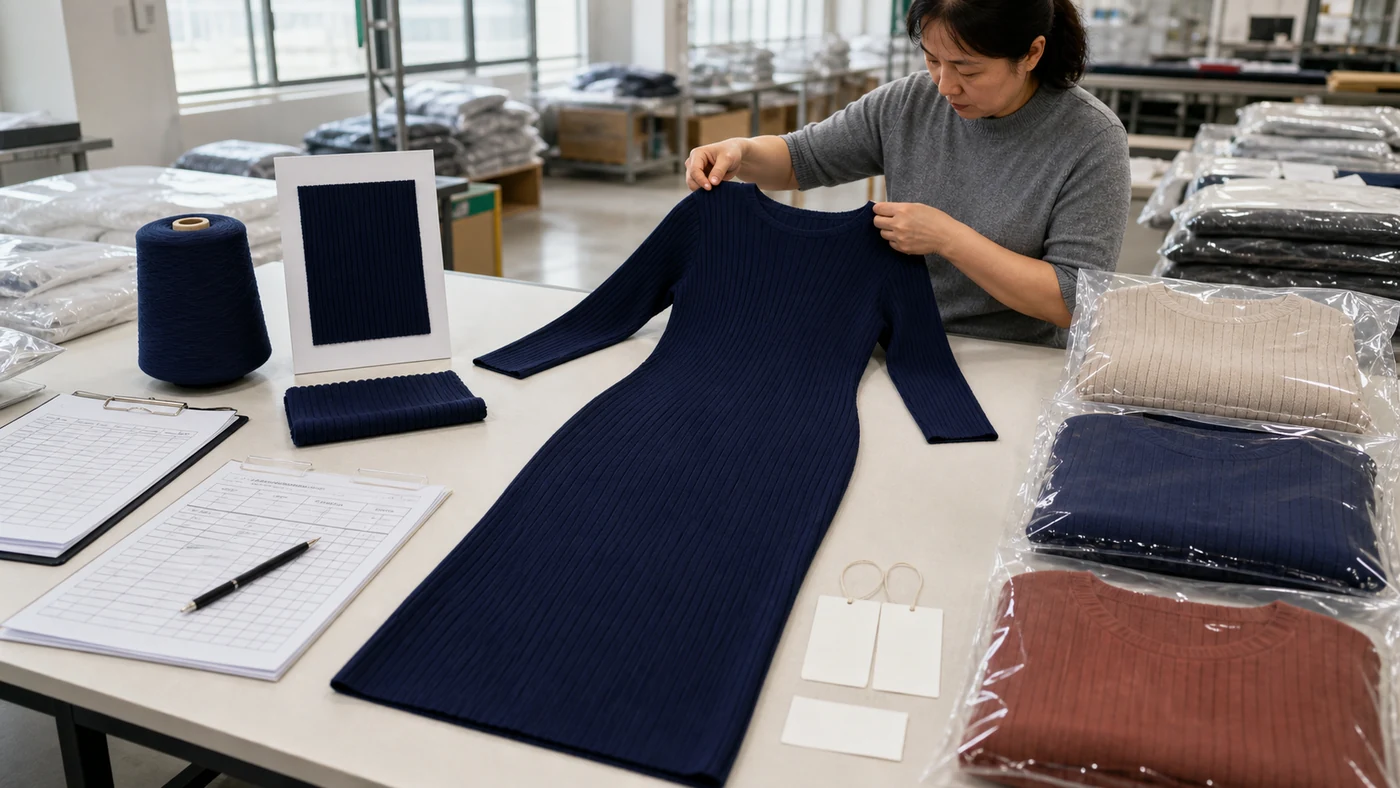
During production, monitor yarn identity, shade, gauge, rib density, panel dimensions, linking, finishing and garment weight. Check high-risk colors and representative sizes.
For final inspection, define defects relevant to the style: holes, dropped stitches, rib misalignment, seam failure, excessive growth, opacity failure, distorted neckline, uneven hem, twist, measurement failure, incorrect labels and poor packing.
ISO 6330:2021 provides current domestic washing and drying procedures for textile testing. Pair the selected procedure with ISO 5077:2007 where dimensional change is measured, and name the cycles, drying route, conditioning and acceptance criteria.
ISO 16322-2:2021 specifies procedures for measuring spirality or torque after domestic laundering in woven and knitted fabrics. Use the procedure appropriate to the agreed evaluation and do not compare results from different procedures as if they were identical.
Create the repeat pack
Store the final tech pack, graded measurements, diagrams, yarn and shade references, rib swatches, garment weight, stretch/growth/recovery records, opacity approval, wash and hanging results, size-set actuals, sealed PP sample, labels, packaging and inspection report.
Record substitutions and deviations. If yarn, dye route, gauge, density or finishing changes, decide which performance and fit approvals must be repeated.
After launch, review returns, fit feedback and sales by size and color where reliable. Create a new controlled revision for improvements rather than overwriting the approved first-order record.
Conclusion
A ribbed knit dress should be approved as an elastic, weight-bearing garment, not as a static swatch. Define its boutique role first, then lock rib structure, yarn, gauge, density, finished weight and finishing as one system.
Test stretch, growth and recovery separately, and check opacity while the ribs are extended on the intended body. Standardize measurement conditions, grade the size range around real fit and material behavior, and validate representative lower, base and upper sizes.
Finally, approve seams, edges, washing, packaging and bulk inspection against a sealed PP pack. The result is a dress that maintains its intended silhouette from sample room to boutique rack, customer wear and repeat order.
Related CNSweaters Resources
- Knit Dress Manufacturing Capabilities
- Knit Midi Dress Stable-Fit Guide
- Long-Sleeve Knit Dress Buyer Checklist
- Private-Label Knitwear Yarn Planning
- Why Linking Quality Matters
Developing a Ribbed Knit Dress?
Send the target customer, climate, selling window, silhouette, reference images, yarn, rib direction, gauge, length, sleeves, size range, color plan, quantities, opacity expectation, care route, labels, packaging and delivery date. The team can review a practical sampling and bulk-approval path.
FAQ
Is rib stretch the same as recovery?
No. Stretch is extension under a defined condition. Growth is the residual change after stress, and recovery is the return toward the original dimension. A dress can stretch comfortably but still bag at the seat or knees.
How should opacity be checked?
Check the swatch relaxed and at representative extension over light and dark backgrounds, then inspect the full dress on the intended body under consistent lighting. Review every planned color.
Does every ribbed dress need elastane?
No. The requirement depends on yarn elasticity, rib structure, density, target fit, extension and recovery. If elastane is used, approve its placement, percentage, handfeel, dyeing, labeling and care implications.
Which sizes should be sampled before bulk?
Approve the base size and meaningful lower and upper sizes. Add samples wherever a block, grading rule, length or construction changes. Measure and fit them in production-intent material and finishing.
When is the dress ready for bulk production?
It is ready when the final specification and samples agree; stretch, growth, recovery, opacity, fit, size set, wash, seams, labels and packaging have passed; and the sealed PP pack represents the intended bulk product.