 CN Sweaters

An August knitwear factory reply should be assessed as a current offer with a scope, evidence date and conditions, not as a reassuring answer to a general lead-time question. Before accepting the proposed route, distinguish the resources actually reserved for your order from those merely available when the reply was written. Then decide whether to proceed within that scope, retain a conditional option, separate a supported group or hold the affected work.
This review begins after the buyer has identified the proposed styles and receiving requirement. It does not repeat the earlier decision about which unapproved styles deserve a place in the range. Its output is a written response to the supplier’s present schedule: what the evidence supports, what must become true before commitment and what happens when an offer expires. No universal August deadline, factory output rate or delivery promise is assumed.
Is the Knitwear Factory Reply Current and Specific?
Match the answer to the exact request
Start with the date, sender, order or inquiry reference and specification revision. Confirm the actual style, color and size scope behind the dates. A response issued before a new yarn, closure or packing request may no longer describe the current order even if its delivery line has not changed. Ask the supplier to identify what was reviewed rather than interpreting an unchanged email subject as continuity.
The factory capacity questions provide the broader inquiry framework. This audit should avoid asking that entire list again when the answers already exist. Compare the received evidence with the current request and isolate the missing or conflicting item. That makes the next supplier response shorter and easier to evaluate.
Check the date definition too. Production completion, inspection availability and cargo handover describe different events. If the reply says delivery without identifying the event and place, ask for clarification before comparing it with a warehouse requirement. A short duration can still describe only one part of the route.
Separate a planning calculation from a live reservation
A software output may be useful without proving that resources are held. Oracle’s manufacturing lead-time documentation distinguishes fixed, quantity-dependent, processing and other lead-time concepts; it also describes limits of that calculation. Those are software planning definitions, not evidence of your supplier’s bookings or a recommendation that the factory use Oracle.
Ask what current confirmation sits behind the estimate. The reply should identify the relevant work, readiness assumption and responsible resource owner. A calculated finish date based on available material means something different from a dated material confirmation plus a reserved processing window. Preserve both as different evidence objects instead of allowing a polished schedule to replace the underlying answer.
Record the units used for each time statement. Working days, calendar days and a named production week are not interchangeable, and neither party should silently convert them. If a reply counts from an approval event, identify that starting event in the same row. The audit does not need to rebuild the supplier’s scheduling software; it needs enough clarity to prevent the buyer from comparing incompatible dates.
Which Resources Are Actually Held for This Order?
Review the route at its limiting activity
Find the activity the supplier says controls the proposed completion. It might involve material readiness, a relevant knitting group, linking, finishing or another operation. Ask for enough order-specific confirmation to understand the allocation and its dependencies. Do not demand unrelated customers’ order details or interpret a general photograph of busy machinery as proof of capacity for your own product.
The practical factory capacity and sampling guide explains why development and bulk resources should be distinguished. In this reply, check whether a confirmed sample slot has accidentally been presented as a bulk reservation. The supplier can be ready to answer a product question while the later production window remains open.
If the reply offers extra machines to recover time, ask which later activity changes with them. More knitting capacity does not by itself establish more finishing or release capacity. The peak-season capacity and price discussion can prompt the commercial questions, but no price premium, output figure or supplier-motive claim from that article should be copied into this assessment.
Mark the evidence status for each group
Use confirmed, conditional or unavailable as review categories with written definitions. Confirmed means current evidence supports the named resource and conditions, not that every later event is guaranteed. Conditional means a specific input or confirmation remains open. Unavailable means the proposed resource or route cannot presently support that request; it does not necessarily rule out a different, separately reviewed offer.
Consider a hypothetical program with three styles, five colors in total and four sizes per color. Style A has two colors, B has two and C has one: 20 style-color-size combinations, not 60. There are no real order quantities or factory commitments in this example.
| Group | Hypothetical reply | Audit outcome | Required next action |
|---|---|---|---|
| A, two colors | Current route and allocation identified against the reviewed revision | Supported within stated conditions | Check authority and downstream readiness before proceeding |
| B, two colors | Allocation offered only if a named sample issue closes before expiry | Conditional | Record closing evidence, owner and expiry consequence |
| C, one color | Required finishing route not available in the proposed window | Unavailable for that route | Request a separately assessed alternative or hold |
Do not average these rows into one confirmation. A well-supported group cannot supply missing evidence for another, and the total order value does not remove a resource constraint.
Where evidence conflicts, keep the contradiction visible. A commercial reply might describe B as confirmed while a referenced sample note still shows the stated condition open. Ask the responsible owners to resolve that mismatch before upgrading the row. The reviewer should not choose whichever attachment gives the better date, nor downgrade unrelated A evidence simply because B requires clarification. The decision boundary belongs to the affected resource and group.

What Turns a Conditional Reservation into a Firm One?
Name the event rather than a vague readiness promise
The reply should state the condition in an observable form: acceptance of a named sample revision, confirmation of a material lot, receipt of agreed information or another defined event. Ask who decides that it has occurred. Sending comments, making a request or dispatching a sample is not the same as closing the condition.
The sample-delay guide can help identify the missing input. The sampling-time review supports a focused question about controllable work, not a promised shortcut. Use the relevant existing record and ask only for the evidence that changes the conditional status.
In the hypothetical B group, fit acceptance might be the stated condition. The buyer needs the review outcome and the supplier’s confirmation that the offered allocation still applies afterward. A corrected sample arriving after the validity period cannot silently inherit the earlier route. Nor should a purchasing commitment be inferred from a request to keep the option under discussion.
Record expiry and the missed-condition response
Capture the exact validity date and time zone when time of day matters. Ask whether the offer lapses automatically, requires renewed confirmation or carries another agreed consequence. If the reply omits expiry, record that omission and request the answer; do not invent a default holding period based on past orders.
Name who alerts whom if the condition is at risk and which dates need revalidation. The buyer may choose to revise scope, request another route or stop the affected commitment. These are commercial decisions requiring appropriate authority, not automatic actions for a supplier or planning tool. Keep the terms and any existing obligations visible when evaluating them.
Test one missed-condition scenario before relying on the reply. Ask what happens if the named approval is not received by its stated point: which allocation is released, whether another group remains intact and when a replacement answer becomes available. This is a request for the supplier’s current response rule, not a demand for a guaranteed fallback. An unanswered scenario should remain a visible uncertainty in the decision.

Can the Supported Styles Start as a Separate Group?
Test independence across material and later work
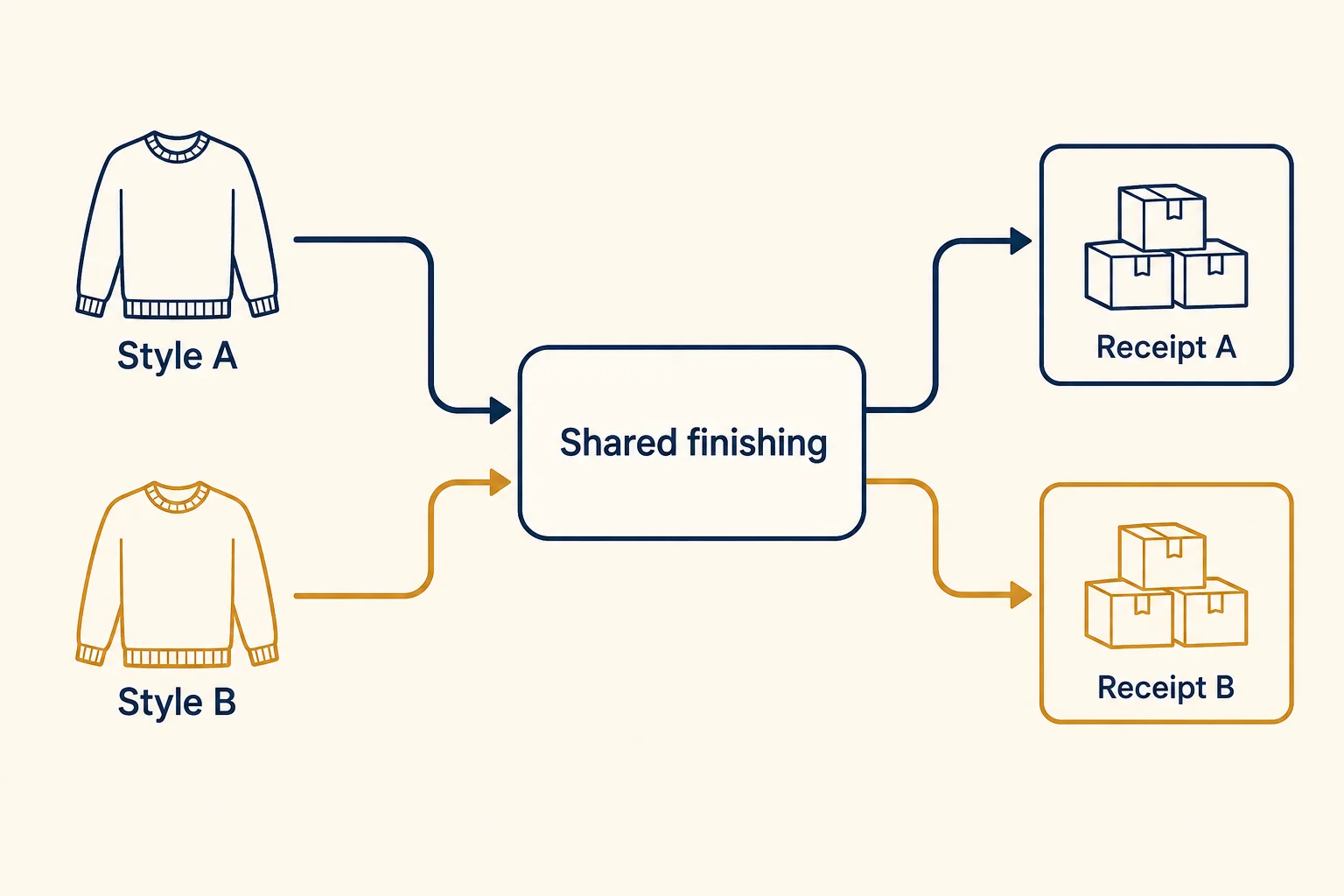
A split is useful only when the groups can be controlled separately without hiding shared constraints. Ask whether material quantities, lots, special components, finishing, inspection and packing permit the proposed separation. If A and B share a material purchase, proceeding with A may still affect B’s exposure. If they share a later operation, early knitting may not preserve an earlier handover.
Use the general knitwear lead-time guide for sequence context, while relying on the current supplier reply for actual timing. Do not assume that fewer units always take fewer calendar days or that splitting automatically protects the first receipt. Ask for the changed dependencies and dates before accepting the proposal.
The GAO schedule guidance supports examining how linked events and changes affect a plan. Its general project context does not verify a garment route. For this order, the practical test is whether the revised group has a coherent path through the activities it actually needs, rather than simply an earlier start line.
Keep the separated product and receiving identity intact
Define exactly which styles, colors, sizes and quantities belong to each group. Keep the relevant product revision and release references attached. A split that loses size coverage, mixes unresolved goods into released cartons or confuses the receiving documents has not solved the buyer’s problem. Confirm the destination accepts the proposed receipt pattern before describing it as a recovery plan.
The pre-production sample review owns the product-standard gate. A schedule split does not waive it. If a group uses a different material lot or process after separation, ask the responsible product owner what comparison is needed. The supplier’s ability to schedule the change and the buyer’s approval of its product effect remain different decisions.
What Must a Revised Offer Preserve?
Compare the changed scope and commercial basis
When the supplier proposes another route, ask for a clear old-to-new comparison: affected group, resource, material or process, dates, conditions and commercial effect. Keep the requested specification fixed unless a product change is expressly being proposed. A faster route that changes a defining finish is not the same offer with a better date.
Use the sweater quote comparison guide to check the commercial basis. Current price, additional handling, residual material, inspection or separate receiving work may need review. Do not assume who pays or present an unagreed cost as a supplier obligation. If the information is missing, the buyer cannot yet compare the alternatives on an equal basis.
For the hypothetical C group, a different finishing route could be investigated, but its availability does not prove product equivalence. The appropriate response may remain hold until the technical and commercial owners have the required evidence. Keeping the unsupported original date is not an alternative route.
Do not recover dates by hiding quality or sourcing changes
If the proposal moves work to another site or external process, identify the changed entity and the review it requires. The OECD garment and footwear supply-chain guidance addresses due diligence for risks in operations and business relationships. It is not a certification of a supplier. Here it supports keeping a new sourcing relationship visible rather than accepting it solely because it offers an earlier date.
Keep the agreed product checks within the revised route. The bulk knitwear testing guide helps assign the product questions; it does not supply an automatic test list or acceptance result for this order. A timetable should include the decision after a finding, not only the date of an inspection. Unresolved goods remain outside any assumed released quantity.

What Decision Should the Buyer Send Back?
Return a bounded acceptance or a precise hold
Write the result by group, referencing the current reply. State which scope is supported, which action is authorized, which conditions remain and which earlier proposal is superseded. If no action is authorized yet, say so. A broad message such as proceed with the order can erase distinctions that the review was intended to preserve.
For the example, the buyer might accept A’s defined route subject to the applicable release authority, leave B conditional until the named sample gate and validity check, and hold C pending another offer. These are hypothetical outcomes, not recommended decisions for an unknown order. The real response must follow the actual evidence and agreed terms.
Keep the concise outcome alongside the source documents. A useful review record includes supplier reply date, scope revision, resource status, condition, expiry, notification owner, receiving event and approved action. It should also preserve unresolved questions so that another team member cannot mistake an unanswered field for an unchanged fact.
Recheck on changed evidence rather than on reassurance
Specify the events that reopen the decision: missed approval, expired reservation, changed material or route, failed product check, altered receiving requirement or a revised supplier allocation. Ask for a new current answer for the affected group. Do not repeat an unchanged general capacity questionnaire merely because the calendar has advanced.
Finally, compare the response with the buyer’s internal commitment record. The supplier’s offer and the buyer’s authorization should describe the same group and conditions. Neither a clean audit table nor a confident email guarantees delivery. Their value is that the next action has an identifiable basis, and a new problem can be traced to the decision it actually changes.
Conclusion
Audit an August knitwear factory reply against the current specification and receiving requirement. Separate calculated dates from actual resource evidence, classify each group by its present support and make conditions, expiry and notification responsibilities explicit. A confirmed sample opportunity is not a bulk reservation, and one supported style does not confirm the entire order.
If separation or another route is proposed, review the complete dependency, product and commercial consequences before accepting it. Keep quality decisions and changed sourcing relationships visible, then send a bounded response that identifies what is authorized and what remains on hold. The result should be a current decision record, not another generic lead-time promise. To discuss a received schedule, its open conditions and the feasibility of a separate group, contact CNSweaters with your current knitwear factory reply brief.
Frequently Asked Questions
Is an available slot the same as a reserved slot?
No. Availability describes a current possibility; a reservation needs an identified scope and applicable terms or conditions. Ask what action has actually been taken, how long it applies and what would cause it to change.
Can a sample confirmation support a bulk start date?
Only as one relevant input. The bulk route needs its own current resource and readiness evidence. A sample team being available does not establish material readiness, knitting allocation, finishing availability or later release capacity.
What if a reservation expires during buyer review?
Request a current response rather than assuming the earlier offer survives. Record the missed condition and its effect on the affected group. Any existing obligations should be reviewed under the agreed terms by the responsible parties.
Does a split order always arrive sooner?
No. Shared materials, later processes, release decisions or receiving conditions may prevent useful separation. Ask for the revised complete route and commercial implications. An earlier start for one activity is not proof of an earlier usable receipt.
Should every new supplier message trigger another full audit?
No. Review the affected decision when evidence or a named assumption changes. Keep unchanged confirmations attached to the current record. A focused check is sufficient only when the team can identify what changed and what remains supported.