 CN Sweaters

Wholesale knitwear reorder quantities should be calculated for each style, color and size, using stock that can serve the intended customers and demand that has not already been fulfilled. A style-level sales total cannot show whether medium is short while large is overstocked. The useful output is a net quantity for each variant, with the assumptions and any commercial adjustment visible beside it.
This calculation follows the decision that a replenishment opportunity is still worth reviewing. The separate guide on when to reorder wholesale knitwear covers the timing and commitment decisions. Here the question is narrower: how much is supported, which options should receive less, and which apparent shortages disappear after the inventory records are reconciled? All numerical examples below are hypothetical, not CNSweaters orders or sales results.
Which Wholesale Knitwear Record Should You Calculate?
Use the variant and receiving location as the unit
Give every row an exact style, color, size and specification reference. Add the location or customer pool the stock is intended to serve. A navy medium cardigan in one warehouse does not necessarily cover an identical-looking shortage elsewhere if it cannot be transferred usefully. A changed specification should not silently inherit the prior variant’s demand history.
The SKU planning guide for distributors explains the wider option structure. For this calculation, retain only rows that could support a practical replenishment decision. Keep discontinued variants visible with a no-additional-buy note rather than deleting them and losing the explanation for the narrower order.
Choose one snapshot time for stock, unfulfilled orders and inbound quantities. A warehouse export from yesterday combined with today’s sales can count shipped units as both remaining stock and fulfilled demand. Reconcile the cutoff before adjusting the forecast; otherwise a precise-looking calculation will reproduce a bookkeeping difference.
Define the remaining demand horizon
Name the future period the proposed stock must cover and its ending date. This is not automatically the manufacturing lead time. A quantity intended to cover the remaining autumn offer needs a different demand total from one intended only to support a short confirmed customer allocation.
Write down when new units could first become available to that customer pool. Demand that must be fulfilled before their arrival cannot simply be moved into a later period. Separate genuine backorders from customers who have already cancelled or bought something else. Neither a calendar gap nor lost historical sales automatically becomes an order for the new delivery.
Avoid an undated target such as restore normal stock. Specify what normal means for the remaining offer: expected units to fulfill plus a chosen ending balance. The ending balance may be small or zero for a departing seasonal option; it should not preserve an old launch allocation by default.
How Should Stockouts Change the Demand Estimate?
Compare sales with actual selling opportunity
Review when each variant was genuinely available to buy in the relevant channel. Include launch delays, unavailable sizes, hidden listings and location restrictions where the records support them. A month in the catalog is not necessarily a month of selling opportunity, and recorded stock is not proof that customers could order it.
Read the metric definition before using a dashboard rate. Shopify’s inventory-report documentation defines its daily sales report using the selected period and notes that the quantity sold does not reflect inventory adjustments such as returns. That report is useful evidence of recorded sales, not a direct measure of unobserved demand during stockouts.
In a hypothetical example, a variant sells 20 units across 10 verified in-stock days within a 30-day review. That is two units per available day, compared with roughly 0.67 per calendar day. The difference flags a distorted comparison. It does not prove that another 40 units would have sold during the unavailable days.

Use a conditional range rather than invented lost sales
Check whether the available days included a promotion, a launch announcement or unusually strong store placement. Applying that rate to a quieter future period could overstate demand. Conversely, a variant that arrived after the main campaign has not had a fair test against one present from launch.
Use a lower, central and higher remaining-demand assumption when uncertainty matters. The Q4 demand-scenario guide addresses the broader forecast discussion. At this stage, show the specific assumption that changes a variant’s quantity: continued promotion, restored size availability, a confirmed customer request or a shorter remaining offer.
Keep recorded customer enquiries and substitutions separate from completed orders. Someone who bought large because medium was missing may support a fit or availability investigation, but that sale cannot also be counted as a certain future medium sale. With zero verified in-stock days, do not divide by zero or label the variant a failure. Record insufficient exposure and use a bounded test decision if the wider case supports one.
Which Stock and Inbound Units Can Reduce the Requirement?
Reconcile saleable physical stock and commitments
Use a definition that matches both sides of the calculation. Shopify’s inventory-state definitions distinguish on-hand, available, committed, unavailable and incoming quantities. In that system, on-hand includes several states, while available excludes committed and unavailable units. Other systems may label their fields differently.
The example here starts with saleable physical units in the chosen pool, including units allocated to its unfulfilled customer orders. The demand figure includes those same orders once. Damaged stock, unresolved quality holds and units committed outside this pool are excluded. This convention is deliberate: subtracting allocated stock and then adding its customer order again would count that requirement twice.
Do not treat every unavailable system unit as defective. Some may be a deliberate buffer. If that buffer is usable stock intended to remain at the horizon, include it in the physical balance and express the desired ending stock separately. Otherwise the same protection can enter the calculation twice. Reconcile the reason for each exclusion before using a total.
Count incoming units once and against their useful date
List the purchase order or transfer line, exact variant, remaining units and expected usable date. Deduct receipts already included in physical stock. Do not add the original purchase-order quantity when part has arrived, been cancelled or been reassigned to another destination.
An incoming status is not proof of saleability at the required date. Check the current receiving assumption and any unresolved release condition. The packaging and barcode setup guide helps identify receiving dependencies that can keep physically delivered goods from serving their intended channel. Do not count a speculative new order as confirmed inbound in the calculation that is proposing it.
Separate useful inbound from late or uncertain supply. A later arrival may reduce a later requirement without solving an earlier shortage. Retain its reference in the review so the business can decide what to do with it; excluding it from today’s useful supply is not an instruction to cancel it.

What Is the Net Quantity for Each Variant?
Show the calculation before commercial adjustments
For this worked example, proposed additional units equal remaining demand plus desired ending stock, minus saleable physical stock and qualified incoming stock, with a minimum result of zero. The inputs cover the same customer pool and future horizon. Remaining demand includes unfulfilled commitments and additional forecast demand without overlap.
Oracle’s min-max planning documentation similarly shows that netting choices, on-hand supply, open supply and demand affect the suggested quantity; order modifiers can change that suggestion. The example below is a transparent buyer worksheet, not an implementation of Oracle’s full algorithm or a claim that one setting fits every retailer.
| Hypothetical variant | Remaining demand | Ending target | Saleable stock | Useful inbound | Net additional units |
|---|---|---|---|---|---|
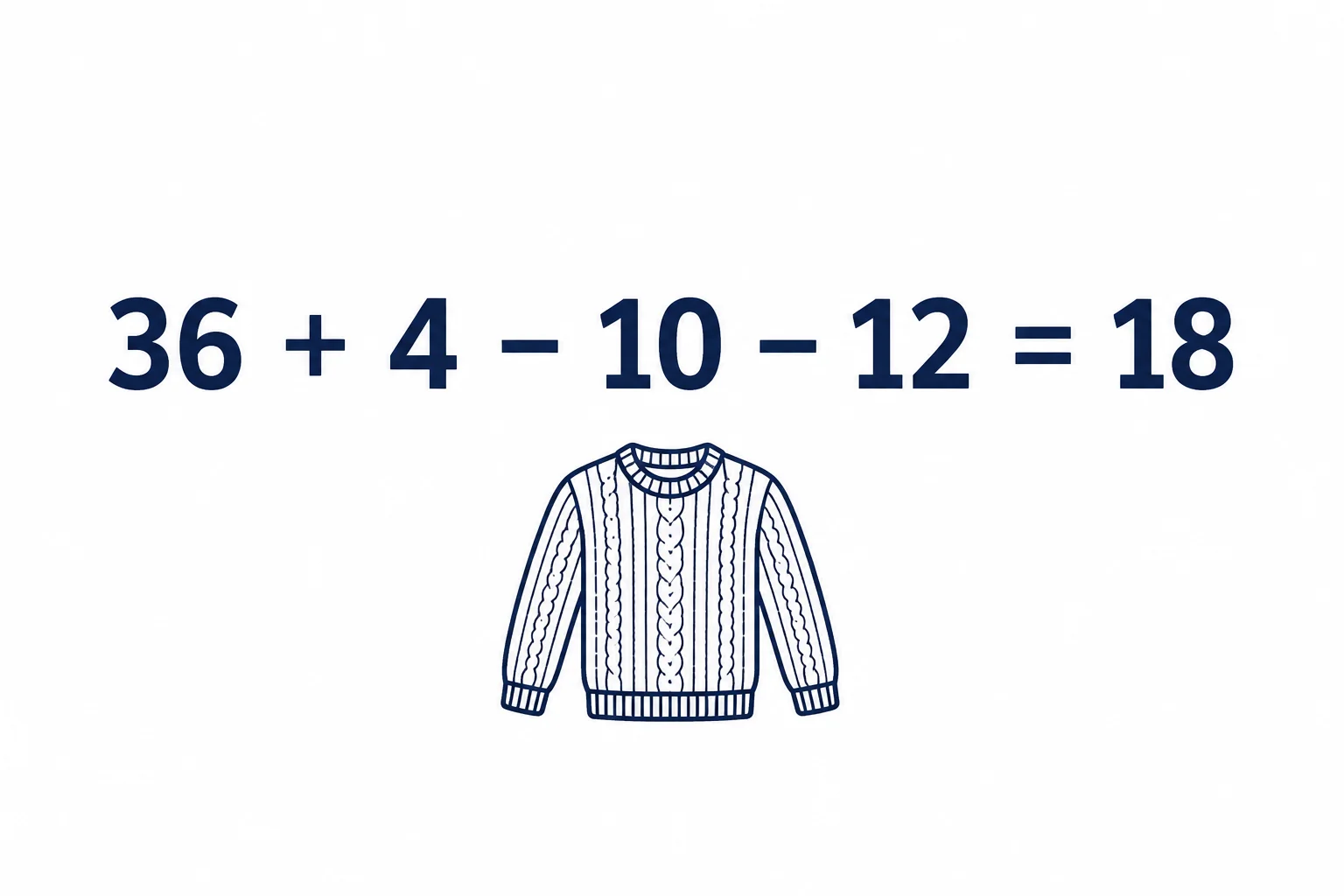
| Navy medium | 36 | 4 | 10 | 12 | 18 |
| Navy large | 20 | 4 | 22 | 8 | 0 |
| Rust medium | 12 | 2 | 5 | 0 | 9 |
For navy medium, 36 plus four minus 10 minus 12 gives 18. Navy large produces a negative balance before the zero floor, so it needs no additional units under these assumptions. Its existing inbound remains a separate commercial matter. The table does not imply equal confidence in all three demand estimates.
The same navy medium stock position produces a different proposal if remaining demand changes. A hypothetical lower estimate of 28 gives 10 additional units; a higher estimate of 44 gives 26. Hold the other inputs constant to see this sensitivity. The difference belongs to forecast uncertainty, not to an unexplained change in the warehouse balance.
Test the commitments and timing behind the result
Suppose the navy medium demand of 36 already includes eight units from open customer orders. Do not add those eight again after the calculation. If the 10 physical units include stock allocated to those orders, do not also subtract that allocation from stock. A spreadsheet using only uncommitted stock would need a correspondingly different demand definition.
Check each time bucket before treating a positive net quantity as useful. If six units must reach customers before any replenishment can arrive, the final-period balance alone hides that gap. Identify whether current stock or a qualified transfer covers it. Otherwise distinguish a customer-service decision from a purchase quantity; later units cannot undo an earlier missed sale.
Keep the unconstrained net requirement in its own column. Add another for the final proposed buy and a reason for any difference. That separation makes an increase for a pack multiple or a reduction for budget visible instead of disguising it as stronger or weaker customer demand.
Which Colors and Sizes Should Receive Less?
Distinguish a product problem from insufficient exposure
Read return reasons alongside sales rather than applying one overall return percentage to every variant. Repeated reports of sleeve tightness in one size call for a product review before more of that size is bought. A color returned because its online image was misleading creates a different action from a damaged delivery.
A returned unit reduces the stock requirement only after its physical condition, identity and availability are established. A refund is a financial event, not proof that the garment is back on a saleable shelf. Avoid automatically subtracting all refunds from demand and adding every returned unit to stock; first trace what happened.
The core-and-trend range guide can help explain a variant’s continuing role. A core style can justify dropping an unproductive color while retaining its useful sizes elsewhere. Past sampling cost or the desire for a symmetrical line sheet does not supply evidence for another purchase.

Expose the cost of rounding a small requirement
Send the proposed size-color matrix for a current commercial check. The wholesale jumper buying guide sets the wider context, while the distinction between yarn and garment minimums explains why a plausible unit requirement may not be a feasible standalone order. No supplier minimum is assumed here.
If the hypothetical rust medium requirement is nine and a separately confirmed packing rule requires multiples of six, rounding it to 12 creates three additional units. Label those three as rounding exposure, not forecast demand. The buyer must decide whether the extra inventory is acceptable, another arrangement is available or the option should receive no new buy.
Do not move those extra units into another size solely to make the total look efficient. Check the other variant’s net need first. Budget pressure should likewise lead to a visible prioritization of customer requirements, not an unexplained proportional reduction across every size and color.
What Should the Final Quantity File Preserve?
Keep the calculation and product identity together
Retain the snapshot date, row identity, demand range, availability observations, stock exclusions, inbound references, ending target, net requirement and final proposed units. Add the reason for each override. This lets another reviewer reproduce the number without reconstructing a chain of messages.
A repeat quantity still needs to refer to the intended product. The shade-variation guide helps frame the question when new and remaining stock may be sold together. If a changed shade would create a visibly different option, do not pool its demand and stock merely because the supplier kept the same informal color name.
For programs that actually use an organic cotton claim, the cardigan reorder-continuity guide covers the separate material and evidence questions. The quantity worksheet does not verify fiber content or certification. It should link to the current product reference and flag a changed or unresolved identity.
Explain the difference from the previous order
Compare the proposed matrix with the remaining customer need, not just the original purchase-order ratio. State why medium receives more, a color receives nothing or one location relies on a transfer. A short reason such as verified stockout exposure, existing inbound coverage or unresolved return issue is more useful than a generic bestseller label.
Preserve the initial net calculation when commercial terms produce a revised buy. If a later stock count, customer cancellation or inbound change alters an input, recalculate the affected rows against a new timestamp. Do not overwrite the old reasoning while keeping its original date.
The finished file should distinguish calculated need, commercially adjusted proposal and any unresolved condition. It supports an authorized buyer’s order decision; it is not itself a purchase instruction. Keep the larger questions about commitment timing and release authority with the existing reorder process rather than expanding this worksheet into another full production manual.
Conclusion
Wholesale knitwear replenishment becomes clearer when every proposed unit can be traced to a variant, a remaining customer need and a consistent stock definition. Review actual selling opportunity before copying sales ratios, and separate uncertain lost demand from orders that customers still expect you to fulfill.
Calculate the net requirement before adjusting it for commercial terms. Saleable stock, useful inbound, unfulfilled commitments and the desired ending balance must each appear once. Keep timing gaps visible even when the final-period total looks sufficient.
The final matrix should explain where depth increases, where an option receives nothing and where packing or material conditions create extra exposure. It should also retain the product identity behind the quantity. Bring the dated sales, availability, stock and inbound records to a project-specific review, then contact CNSweaters to discuss your wholesale knitwear quantity plan.
Frequently Asked Questions
Can total style sales determine the reorder quantity?
Not reliably on their own. Calculate by style, color, size and relevant customer pool. One size can have excess stock while another has an evidenced shortage. The style total is a summary after the variant calculation, not a substitute for it.
Should stockout days be treated as zero demand?
They show no completed sales through that unavailable route, not necessarily no demand. Compare verified in-stock exposure with promotions and other selling conditions. Any estimate of missed demand remains an assumption; it should not be presented as recovered customer orders.
Should committed inventory be deducted twice?
No. Match the stock and demand definitions. This example keeps saleable allocated units in physical stock and includes their open orders once in remaining demand. Using uncommitted stock requires a compatible demand figure rather than adding the same requirement again.
Does a zero net requirement mean cancel existing inbound?
No. It means no additional units are indicated by the stated calculation. Existing purchase orders and transfers need a separate review of their purpose and terms. A worksheet result is not cancellation authority or proof that cancellation is possible.
Can MOQ turn a small shortage into a larger buy?
It can change the commercial proposal, but not the underlying demand evidence. Keep the calculated requirement and adjusted buy separate, and show any extra exposure. Consider a narrower option set or a different arrangement without inventing demand for unwanted units.