 CN Sweaters
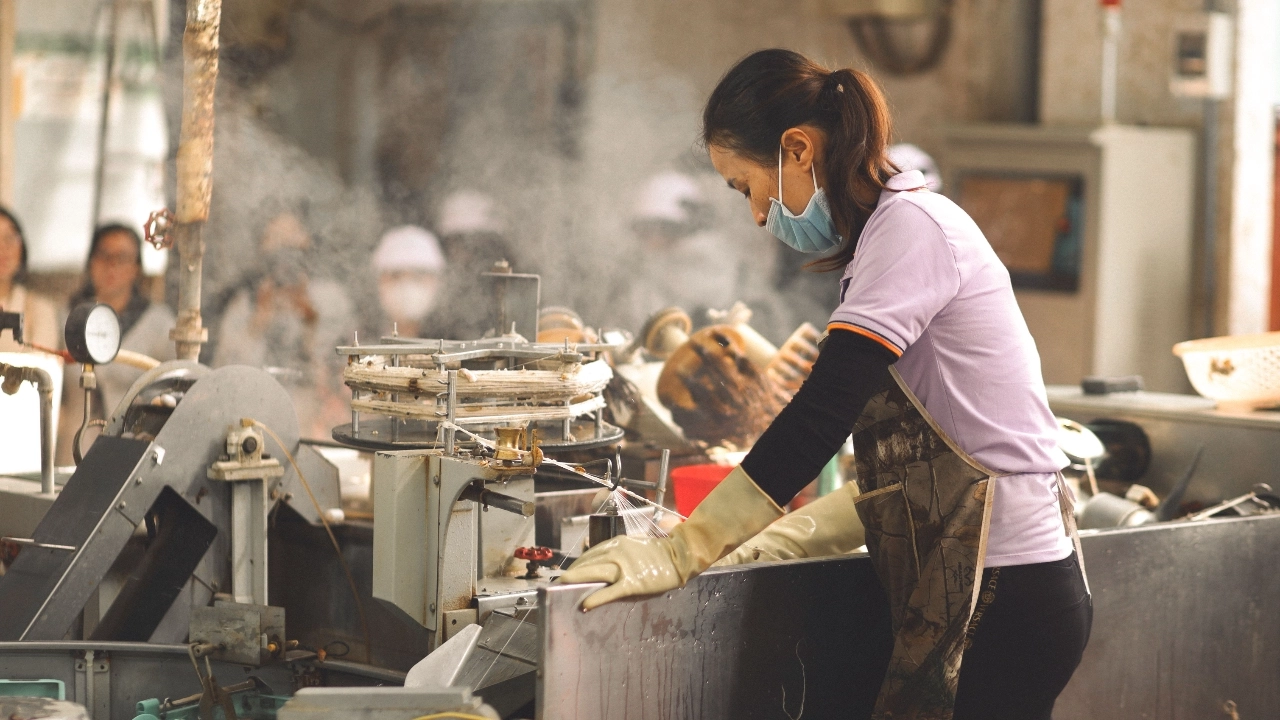
A low quoted unit price from a knitwear factory in July or August often hides the largest cost a B2B buyer can take in autumn: a missed selling window. From a factory perspective, peak-season pricing is not an isolated number. It is the visible output of yarn availability, loom and flat-knit machine occupancy, dyeing slots, linking lines, finishing throughput, and inspection bandwidth at the moment the order lands. When all of these are tight, a cheaper quotation usually means the supplier needs the deposit more than it has the capacity, or it is planning to subcontract parts of the order without telling the buyer.
This is the decision most procurement managers, private label teams, and merchandise planners get wrong between June and October. They compare three quotations side by side, pick the lowest, and treat lead time as a separate, almost negotiable variable. In peak knitwear production season, lead time is not negotiable. It is set by the yarn dye lot calendar, the gauge mix already on the machines, and the queue at the linking and steaming stations. A buyer who only looks at the unit price is, in effect, paying for a slot the factory may not actually have.
The judgment this article supports is simple. Evaluate a knitwear manufacturer on real available capacity, then on quality systems, and only then on unit price. The order of those three questions, in peak season, decides whether bulk knit sweaters arrive on shelves in time, on spec, and at the total landed cost the buyer originally planned.
Why Peak Season Changes the Real Cost of a Knitwear Factory
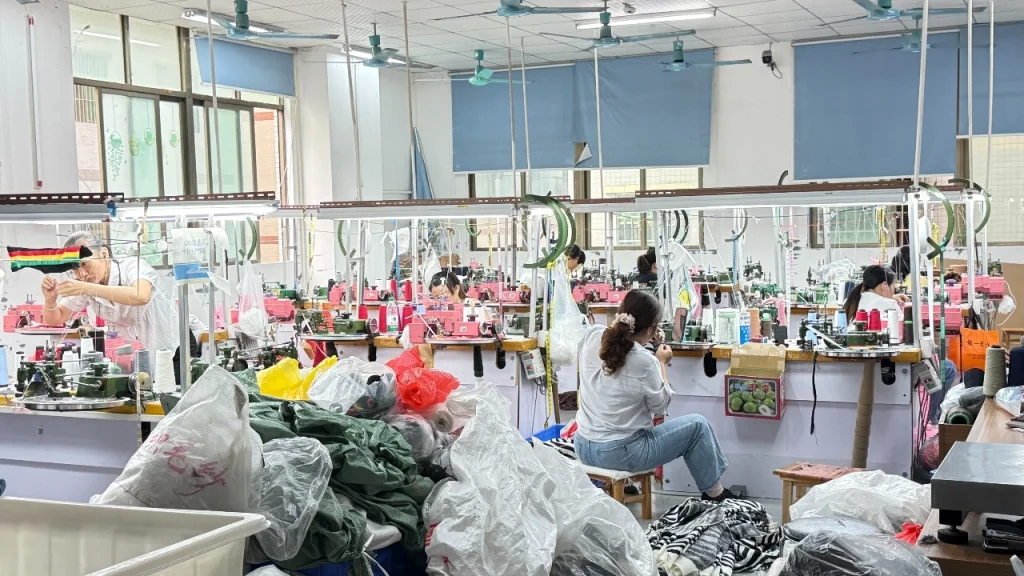
Peak season for a sweater factory typically runs from late June for early autumn programs through November for holiday and resort drops. During this window, mills, dye houses, and finishing units operate close to their installed capacity. The International Textile Manufacturers Federation tracks installed spindles, rotors, and looms globally each year and consistently reports utilization rates above 80 percent in major producing regions, and its global textile industry statistics make clear how little headroom exists once seasonal demand stacks on top of base load. A factory operating at 90 percent capacity in March behaves very differently from the same factory at 110 percent committed capacity in August.
Hidden Costs Behind a Cheap Peak-Season Quote
When a knitwear manufacturer quotes aggressively in peak season, the cost usually moves somewhere else rather than disappearing. Yarn may be substituted to a stock count that is close to but not exactly the specified composition. Dye lots may be combined to fill a vat, increasing the risk of shade variation across cartons. Linking operators may be shared across orders, which lengthens cycle time and raises the rate of seam defects. Inspection windows shrink. The buyer eventually pays the difference through reworks, air freight, markdowns, or canceled reorders.
Why Total Landed Cost Matters More Than Unit Price
The unit price on a PI is only one line in the total cost of a knitwear program. Add late delivery penalties, air freight upgrades on a portion of the order, in-store markdowns when the goods miss the window, and the carrying cost of unsold inventory pushed into the next season. In our experience as a knitted sweater factory, a unit price three to five percent below the realistic market range in peak season is rarely a real saving. It is usually a signal that the supplier is either overbooked, underquoted on yarn, or planning to compress quality steps.
Reading a Knitwear Manufacturer’s True Production Capacity
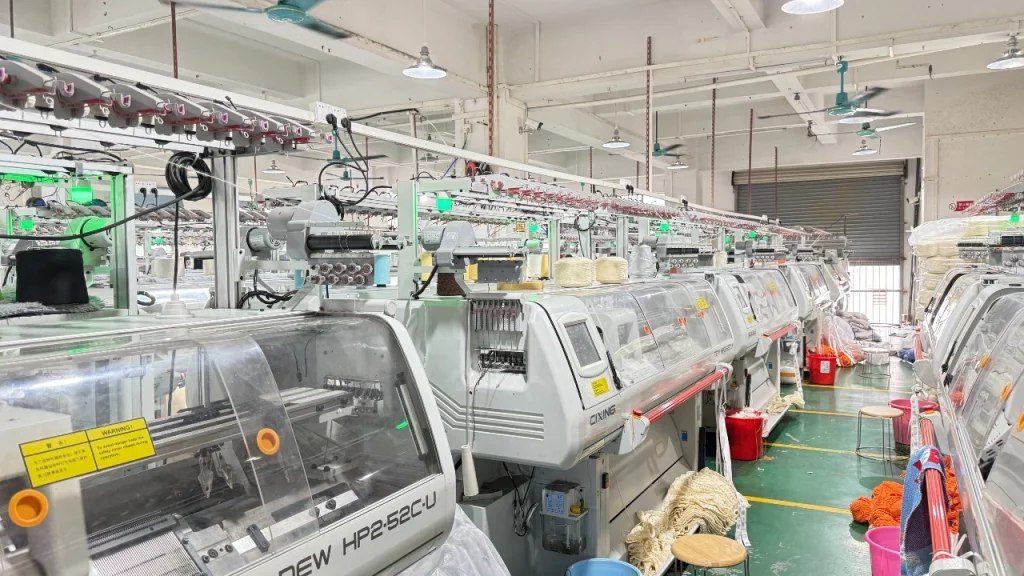
Capacity is not the number of machines on a brochure. It is the number of machines available for your gauge, your yarn type, and your delivery window. A wholesale knitwear supplier with 300 flat-knit machines may only have 40 that are set up for 12gg cotton-blend and free in week 34. That is the number that matters.
Machine Gauge, Yarn Type, and Real Throughput
Different gauges run at different speeds and require different setups. The Woolmark Company publishes practical guidance on how fully fashioned knitting machine gauge ranges from 9gg to 33gg and how yarn count must be matched to needle density. Switching a machine from 7gg chunky to 12gg fine knit is not a same-day change. It involves cam adjustments, tension recalibration, sampling, and lost production hours. In peak season, factories minimize these changeovers, so a buyer asking for a gauge outside the factory’s running setup will wait longer or pay more.
The table below shows typical relationships between gauge, yarn count, and indicative daily output per single-system flat-knit machine for bulk knit sweaters. Actual numbers depend on stitch structure, panel size, and operator skill.
| Gauge | Typical Yarn Count | Common Product | Indicative Pieces per Machine per Day |
|---|---|---|---|
| 3gg–5gg | 2/8 Nm to 2/14 Nm | Chunky pullovers, heavy cardigans | 6–10 |
| 7gg | 2/17 Nm to 2/20 Nm | Mid-weight sweaters, hoodies | 10–14 |
| 12gg | 2/26 Nm to 2/30 Nm | Fine-gauge sweaters, knit dresses | 14–20 |
| 14gg–16gg | 2/48 Nm and finer | Lightweight tops, vests | 18–26 |
These ranges show why a single monthly capacity number is misleading. The same factory can deliver very different volumes depending on which gauge slot your order occupies.
Reserved Capacity Versus Available Capacity
Most established custom knitwear manufacturers reserve a portion of their peak-season capacity for repeat key accounts before the season starts. The capacity offered to a new buyer in August is the residual after those commitments. Asking a factory to state, in writing, the available machine count by gauge and the earliest start date for cutting yarn separates real availability from sales optimism.
Yarn Lead Time and Dyeing Slots in Peak Season
For wholesale knitted sweaters in wool, cashmere, merino blends, or custom colors, the yarn calendar usually decides the delivery date long before knitting begins. The International Wool Textile Organisation, as the global authority on wool standards since 1930, documents the seasonal flow of wool from auction through topmaking and spinning, and that flow does not bend to a single buyer’s PO date.
Stock Yarn, Reactive Dye, and Custom Color Reality
Stock service yarn in core colors can ship within one to two weeks in normal months and three to four weeks in peak season. Custom dyed yarn typically requires lab dip approval, bulk dyeing in minimum lot sizes, conditioning, and quality checks. In peak season, dye houses run multi-shift schedules and still queue orders by color family to reduce changeover loss. A reactive shade for cotton blends or a low-temperature acid dye for wool blends each has its own waiting line.
Minimum Dye Lots and Color Risk
Most spinners and dye houses operate minimum bulk dye lots in the 100 to 300 kilogram range per color, depending on machine size. A buyer ordering 600 pieces split across six colors will often hit the minimum on each color, and any color that falls short either gets combined with another order’s lot or waits for the next slot. This is one of the most common reasons a wholesale knitwear order slips two to three weeks in peak season, and it is rarely visible in the original quotation.
Stitch Structure, Quality Risks, and Inspection Pressure
A compressed production schedule changes how quality risks appear in the final goods. From a factory perspective, peak-season defects are not random. They cluster in the steps that operators rush first when management pushes shipment dates.
Defects That Multiply When Lines Run Hot
Dimensional drift on body and sleeve, uneven linking at shoulder and armhole, dropped stitches in jacquard or cable structures, shade variation between cartons, and pilling caused by under-conditioned yarn are the recurring failure modes. International testing standards such as ISO 3759 for the preparation, marking and measuring of textile fabrics give buyers a defensible basis to specify shrinkage tolerances and measurement methods in the PO, rather than leaving them to factory discretion.
Third-Party Inspection as a Capacity Stress Test
When a buyer books third-party inspection at AQL 2.5 for major defects and 4.0 for minor, the inspection report itself becomes a measurement of how much pressure the line was under. Independent textile and apparel inspection services provided by Intertek and similar accredited bodies cover during-production checks, final random inspection, and container loading checks, and the consistency of those reports across batches is often a better indicator of factory capacity health than any sales claim. A factory that refuses mid-production inspection in peak season is almost always overbooked.
Comparing Knitwear Suppliers Beyond the Unit Price
A like-for-like comparison of knitwear suppliers in peak season needs a structured question set. Asking only for FOB price per piece gives the buyer the least useful number. The questions below, asked in writing and answered in writing, reveal whether a knitted garments manufacturer has real capacity behind its quotation.
Questions That Surface Real Capacity
Ask for current order book occupancy by month for the next four months. Ask for the number of machines by gauge that are currently free and the number that will free up before cutting yarn. Ask which steps are done in-house and which are subcontracted, and where the subcontractors sit on the same capacity curve. Ask for the yarn supplier name and the confirmed dye slot date. Ask for the inspection plan, the AQL level, and whether the factory accepts third-party in-line checks. A knitwear supplier that answers these directly is showing operational confidence. A supplier that deflects to price-only conversation is, in most cases, hiding a capacity gap.
Total Cost Comparison Framework
For high-stakes peak-season programs, build a simple total cost view rather than relying on the FOB line. Add yarn premium for confirmed in-house stock, dye slot certainty premium, expected air freight percentage if the goods slip, expected markdown if delivery moves past the in-store date, and the cost of inspection. The cheapest unit price almost never wins this comparison. The supplier with the most predictable schedule usually does. Our internal approach to MOQ and lead time planning is built around exactly this calculation, because it reflects how buyers actually lose or protect margin in autumn and winter sell-through.
Building a Resilient Peak-Season Order Plan
Resilience in peak season is built into the order before the deposit is paid, not after. Buyers who treat the PO as a flexible document and treat the factory’s first answer as final tend to absorb the most risk.
Critical Path and Buffer Allocation
Map the critical path from PO to in-store. Yarn confirmation, lab dip approval, sealer sample, pre-production sample, bulk start, bulk knitting, linking, washing or steaming, finishing, inspection, packing, and shipping each have a duration. In peak season, add a buffer of seven to ten days across the path, allocated to the steps with the highest historical variability for that specific factory and that specific yarn. A short buffer at lab dip and a longer buffer at finishing is usually more realistic than spreading the buffer evenly. Aligning these buffers with the published knitwear OEM and ODM service flow gives both sides a shared timeline rather than a contested one.
Locking Quality Standards Before Bulk
Lock measurement specs, shrinkage tolerance, color tolerance, packing specs, and labeling specs in the sealer sample, not in the bulk. Once knitting starts, every change order in peak season costs more time than it would in March. A clear, documented quality control standard attached to the PO reduces the volume of email discussion during bulk and lets the factory plan capacity around fixed targets. This is also the stage where buyers should confirm carton labeling, hangtag positioning, polybag specifications, and master carton markings, because changes to packaging in the final week often jam the finishing line and push shipment by several days.
Conclusion
Peak season rewards buyers who treat capacity as the primary number and unit price as a secondary one. A reliable knitwear factory that openly shares its order book, machine availability, yarn timeline, and inspection plan will almost always deliver better total cost than a cheaper quotation that quietly relies on luck. Bring your full brief into the conversation early, including style, yarn composition, gauge, color plan, size range, quantity, target delivery window, inspection requirements, packaging, and shipping deadline. Send your required styles, yarn composition, gauge, color plan, size range, order quantity, target delivery window, inspection requirements, packaging details, and shipping deadline through our full range of knitwear products and the Cainan team to check whether the available knitwear factory capacity can support your peak-season order.
FAQ
What is a realistic MOQ for custom knitwear in peak season
MOQ behavior changes between off-season and peak season. In quieter months, 200 to 300 pieces per style across two to three colors is workable for many fine-gauge programs. In peak season, factories prioritize orders that fill dye lots and gauge slots efficiently, so the practical MOQ may rise to 300 to 500 pieces per color or require consolidated color plans. Discussing MOQ alongside yarn count and dye lot economics, rather than as a fixed number, usually produces a better outcome.
How long does sampling take when factories are at peak capacity
Standard sweater sampling runs about 10 to 15 working days in normal periods. In peak season, sampling can extend to 18 to 25 working days because sample rooms share operators and yarn with bulk lines. Buyers who finalize tech packs, measurement charts, and color references before sending the brief usually see faster sampling, since the sample room avoids back-and-forth on missing information.
How do I verify a knitwear supplier’s real available capacity
Request a written statement of monthly capacity by gauge, current order book occupancy for the next three to four months, the earliest date yarn can be cut for your order, and the names of in-house versus subcontracted steps. Cross-check with a video walk-through of the knitting floor and a sample of recent shipping documents. Suppliers comfortable sharing this information are typically the ones with genuine spare capacity.
What quality risks rise most when factories run hot
Dimensional variation between size runs, shade differences between cartons, linking irregularities at shoulder and armhole, and inconsistent finishing weight are the most common. Booking during-production inspection and a final random inspection at AQL 2.5 for major defects, with measurements taken against an agreed measurement standard, catches most of these before shipment.
Should I split a peak-season order across two factories to reduce risk
Splitting can reduce single-supplier risk but usually adds cost through duplicated sampling, duplicated yarn lots, and color matching between two dye houses. For most programs under 5,000 pieces, consolidating with one capable supplier delivers better color consistency and lower total cost. For larger programs or strict on-shelf dates, a primary-plus-backup split with a clearly defined volume share can be appropriate.