 CN Sweaters
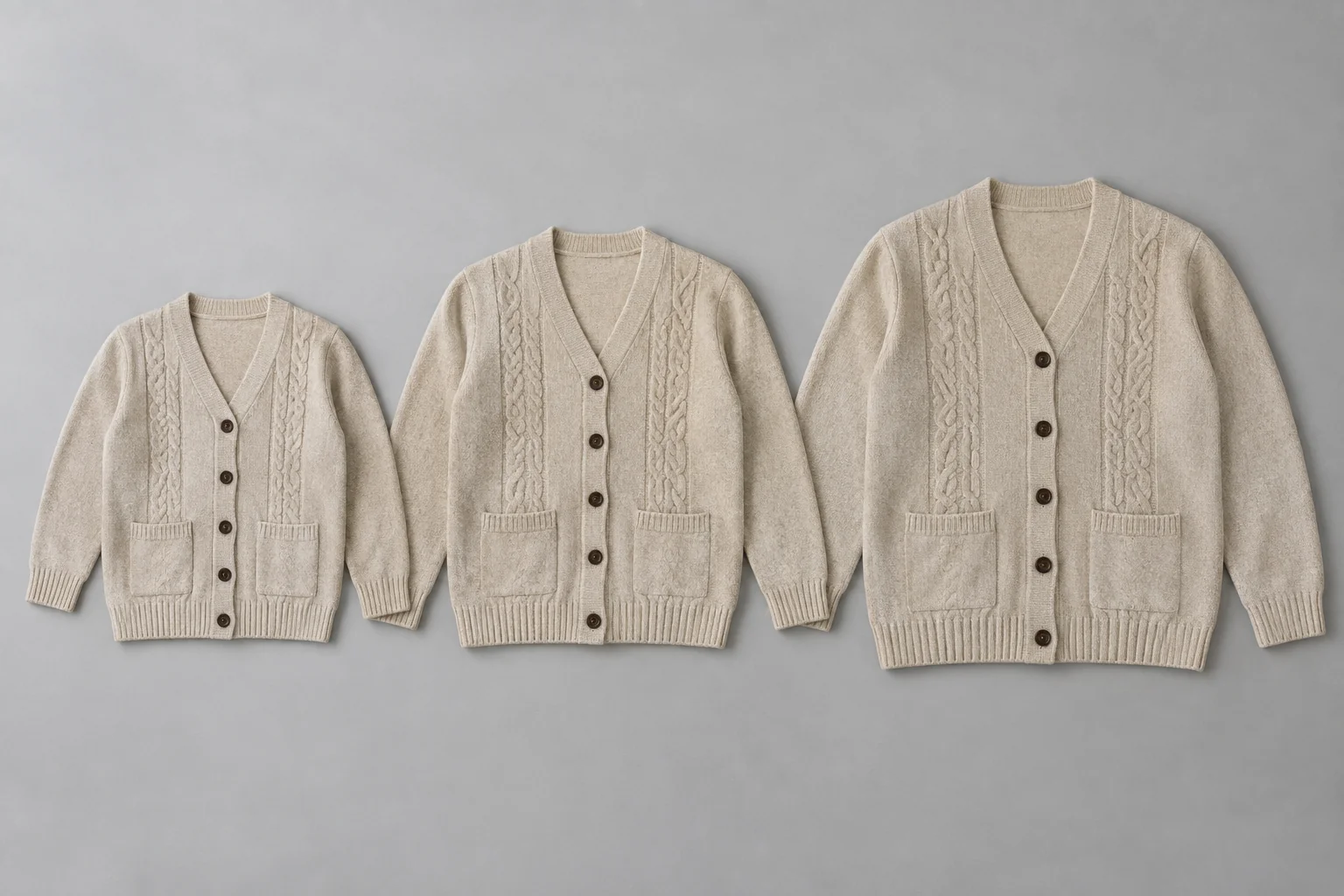
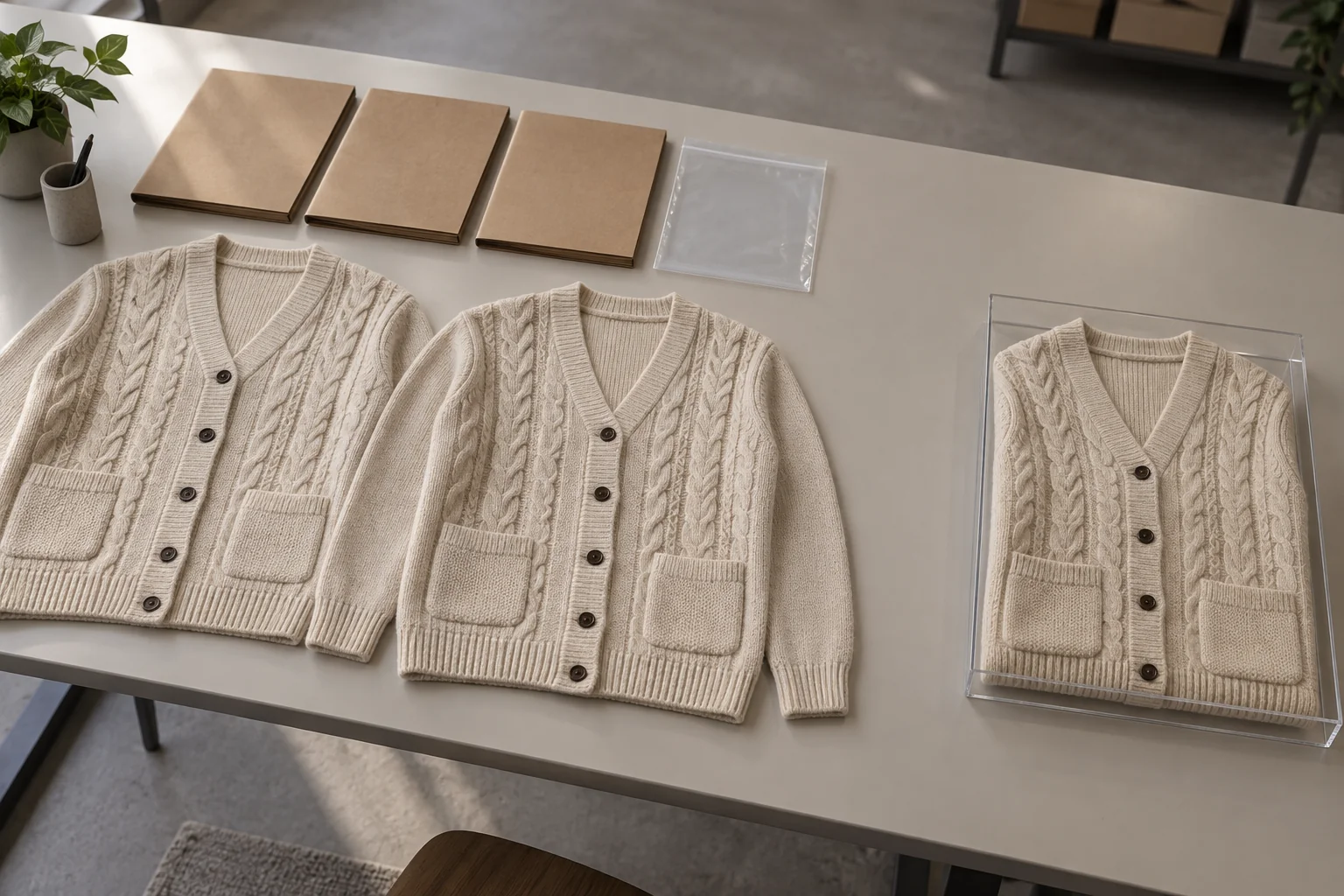
A base-size cable cardigan can look correct while the smallest or largest submitted size loses the intended pattern balance. The garment may meet its chest and length measurements, yet a cable column can move too close to the placket, a pocket can interrupt a different part of the motif, or the two fronts can look unequal when buttoned. Cable cardigan size set approval is the buyer decision that checks those cable-specific relationships before the approved size range moves forward.
This review begins only after the base fit and grade rules are stable. Buyers who still need to separate those stages should first use the guide to comparing a fit sample and a size set sample. The broader knit sweater size grading guide owns the general work of setting grade increments. This page addresses the narrower question that remains: does each reviewed size preserve the approved cable panel, front opening, pocket relationship and post-care appearance well enough to release that version?
Use a controlled pattern map, comparable photographs, named measurement points and a disposition for every submitted size. A model image or “looks good” comment is insufficient. This review does not decide the assortment, cable architecture, price or lead time; it decides whether cable-specific evidence is complete and tied to one revision.
What Does Cable Cardigan Size Set Approval Cover?
Define the decision after base fit is stable
Record the approved base sample ID, size-chart and grade-rule revisions, yarn and program references, color, closure and finishing route. Name every provisional item and the result it prevents from carrying into bulk.
Before review, create a cable evidence index for the submitted set. List every size received, the cable program or pattern reference attached to it, the available open and closed views, and whether a post-care result exists. Mark any grade boundary where motif distribution changes. This index does not decide how many sizes a general size set needs. It shows whether the samples chosen for this cable decision actually cover the relationships the buyer intends to approve.
The guide on developing cable knit cardigans covers construction inputs and sample controls. The article on cable design effects on cost and lead time owns pattern complexity. Treat those records as fixed inputs or declared exceptions during this review.
Give each reviewed size one decision: pass; pass with a named non-blocking observation; revise and resubmit the affected evidence; or reject the version. “Approved with comments” is insufficient unless the record says whether work may proceed and which operation the comment affects.
Separate ordinary POM checks from cable-specific checks
Keep ordinary points of measure in the controlled size chart. The cable overlay adds landmarks showing how the motif sits inside that garment: a main column centerline, its nearest point to the placket, its shoulder or neckline relationship, the part hidden by a pocket and its termination above the hem.
A photograph can reveal imbalance while hiding a dimensional miss; a table can pass while two fronts look unequal when closed. Keep both forms of evidence. Use the sweater measurement chart guidance for general POM definitions, then add only the cable landmarks needed for this decision.
Which Cable Landmarks Must Stay Comparable?
Build a pattern map around stable garment references
On a flat drawing or approved base-size photograph, mark center front, shoulder, armhole, side seam, pocket opening and hem. Then identify the design-bearing cable elements: main column center, panel edge, termination, mirrored crossover or trim spacing.
State how each landmark is controlled. Some use a measurement from a garment reference; others use an approved visual proportion because a cable repeat is not a freely scalable graphic. The supplier explains its working-file control, while the buyer records the expected visible and measurable result.
Avoid scaling every motif by overall percentage. A larger body may carry more plain ground, or an approved program may change repeat distribution at a stated size. Either is acceptable only when documented and reviewed; an unexplained change fails the pattern map.
Review symmetry and transitions where the pattern meets a boundary
Inspect paired fronts together. Align approved reference points, close the garment as specified and check whether mirrored landmarks form the intended pair. Record whether the view is buttoned, unbuttoned or both.
At shaping and component boundaries, ask whether the intended hierarchy survives: the main cable remains recognizable, the placket does not crowd it, the neckline keeps a critical section and a pocket does not cover an arbitrary part in one size.
Annotate each issue with size, sample ID, garment state, view and landmark. Place the base image beside the submitted size, and link an intentional difference to its authorizing revision.
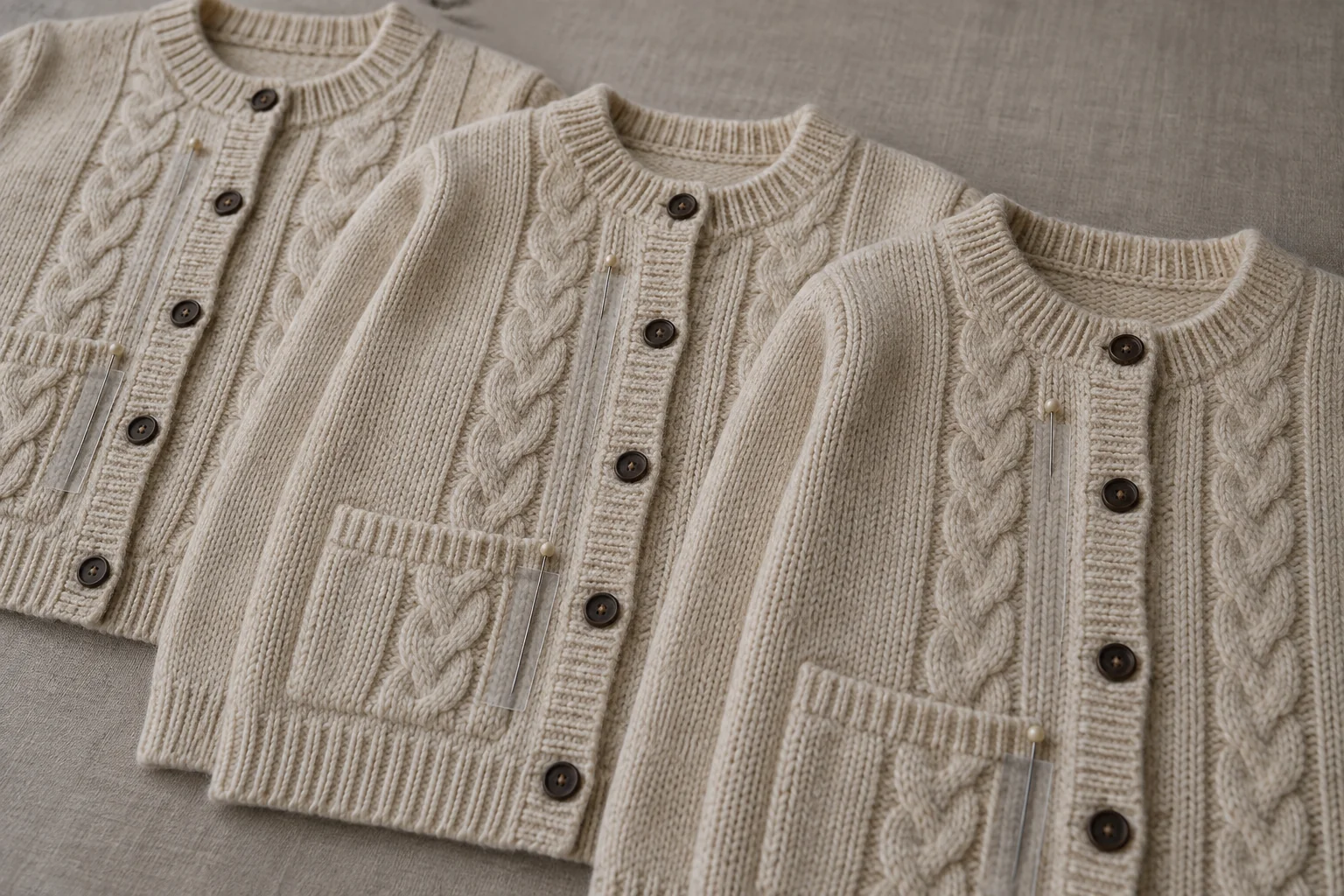
How Should Buyers Record the Cross-Size Comparison?
Use repeatable preparation and image views
State whether garments are received, relaxed, steamed or washed, and keep that state consistent. ISO 139 defines standard atmospheres for textile conditioning and testing. A formal measurement report should name the agreed conditioning method and environment.
Prepare fixed views: front open and closed, back when relevant, both pocket details, placket close-up and one selected transition. Keep the surface, camera direction and garment alignment consistent. Use a scale where needed; perspective cannot replace a signed measurement report.
Keep photographic treatment consistent as well. Unequal camera distance, crop, lighting or garment smoothing can make one cable appear wider or more prominent than another. Retain the uncropped source view beside any annotated detail, and do not digitally reshape the garment. If a comparison cannot be reproduced from the saved view and sample ID, treat it as an observation that needs better evidence rather than a pass or fail.
ISO 3759 covers preparation, marking and measurement for garment dimensional-change tests. It supports a disciplined before-and-after method but does not supply the brand’s cable specification or decision.
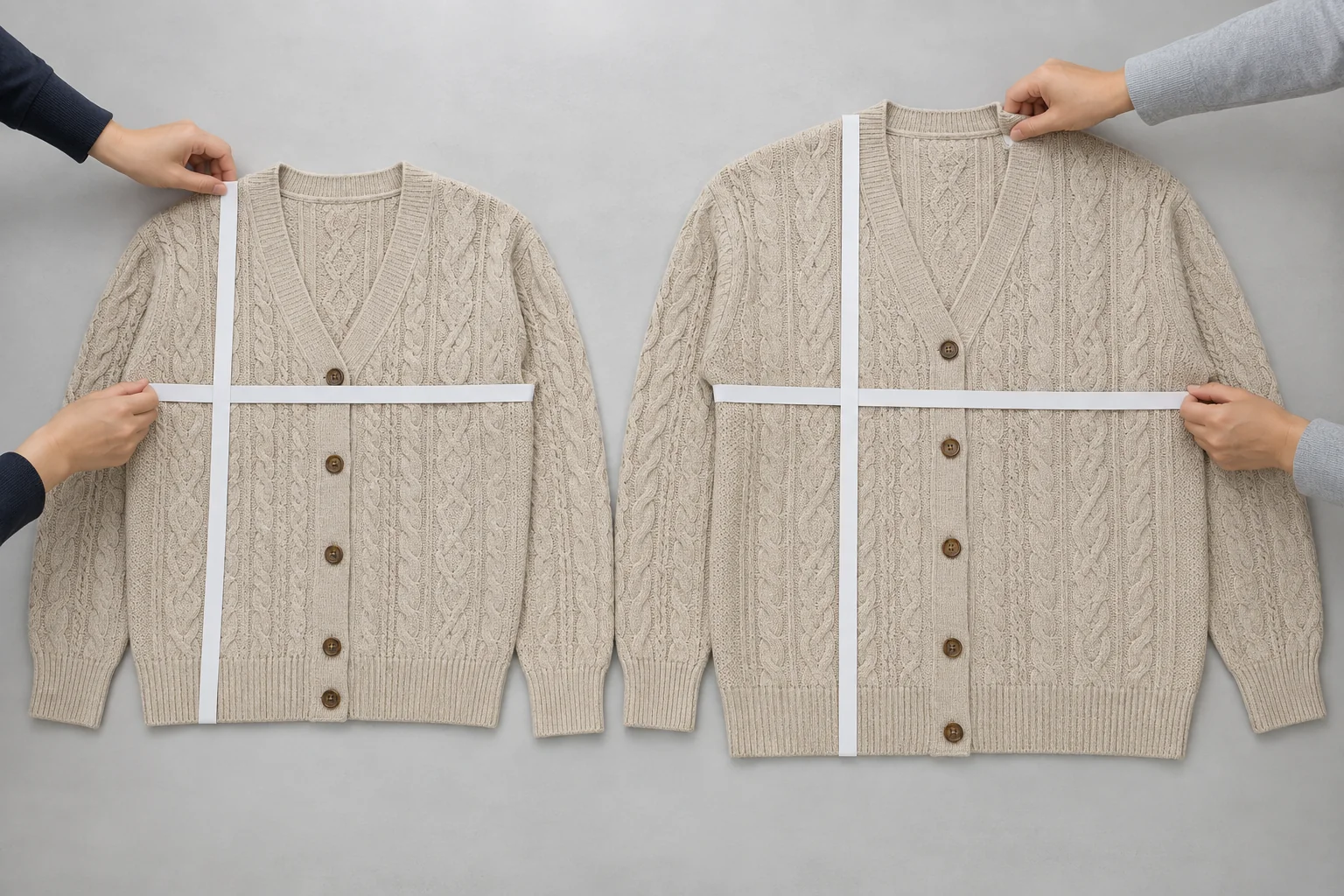
Compare one controlled line instead of unrelated samples
Arrange sizes in sequence and compare one landmark at a time. Start with the base, move to each extreme and place a grade-rule boundary beside its neighbors. Look for where the relationship changes, not which garment looks best alone.
Use a table that connects each observation to evidence and a decision:
| Approval item | Evidence to compare across sizes | Decision question | Required record |
|---|---|---|---|
| Main cable position | Annotated front views and named garment reference | Does the main motif remain in the approved visual zone? | Size, landmark, actual observation, disposition |
| Paired front balance | Closed-front view plus placket and cable references | Do left and right fronts form the intended pair? | Closure state, image IDs, exception owner |
| Pocket interaction | Pocket position and cable section visible above and below | Does the pocket preserve the approved motif relationship? | Pocket reference, affected size, retest need |
| Hem termination | Cable end, hem line and body-length record | Does the motif finish deliberately above or into the hem? | Submitted version and comparison image |
| After-care result | Matched pre-care and post-care measurements and views | Are dimensional and visual results both acceptable? | Procedure, cycle count, report and decision |
Use one row per size when outcomes differ. A combined pass is useful only when its images and measurements remain identifiable. A failed size should be classified as isolated, at a grade boundary or evidence that the pattern map is wrong.
What Must the Placket and Pocket Review Prove?
Check the front opening as a cable interface
Measure the placket normally, then compare how it frames the nearest cable in each size. Check the closed front flat and, when the fit stage requires it, on the appropriate form or wearer. Do not pull one side into place for a photograph.
The pattern map may define a center-front measurement, an edge relationship or an accepted visual band. Use one repeatable method. If placket width, button spacing or the neckline transition changes at a size boundary, show that the new combination was examined.
“Cable too close” leaves the interface undefined. Name the size, garment state, reference points, observation and requested outcome, plus whether one front, both fronts or closure function is affected. General rules belong in the knitwear measurement tolerance guide; this record applies them to one cable-placket relationship.
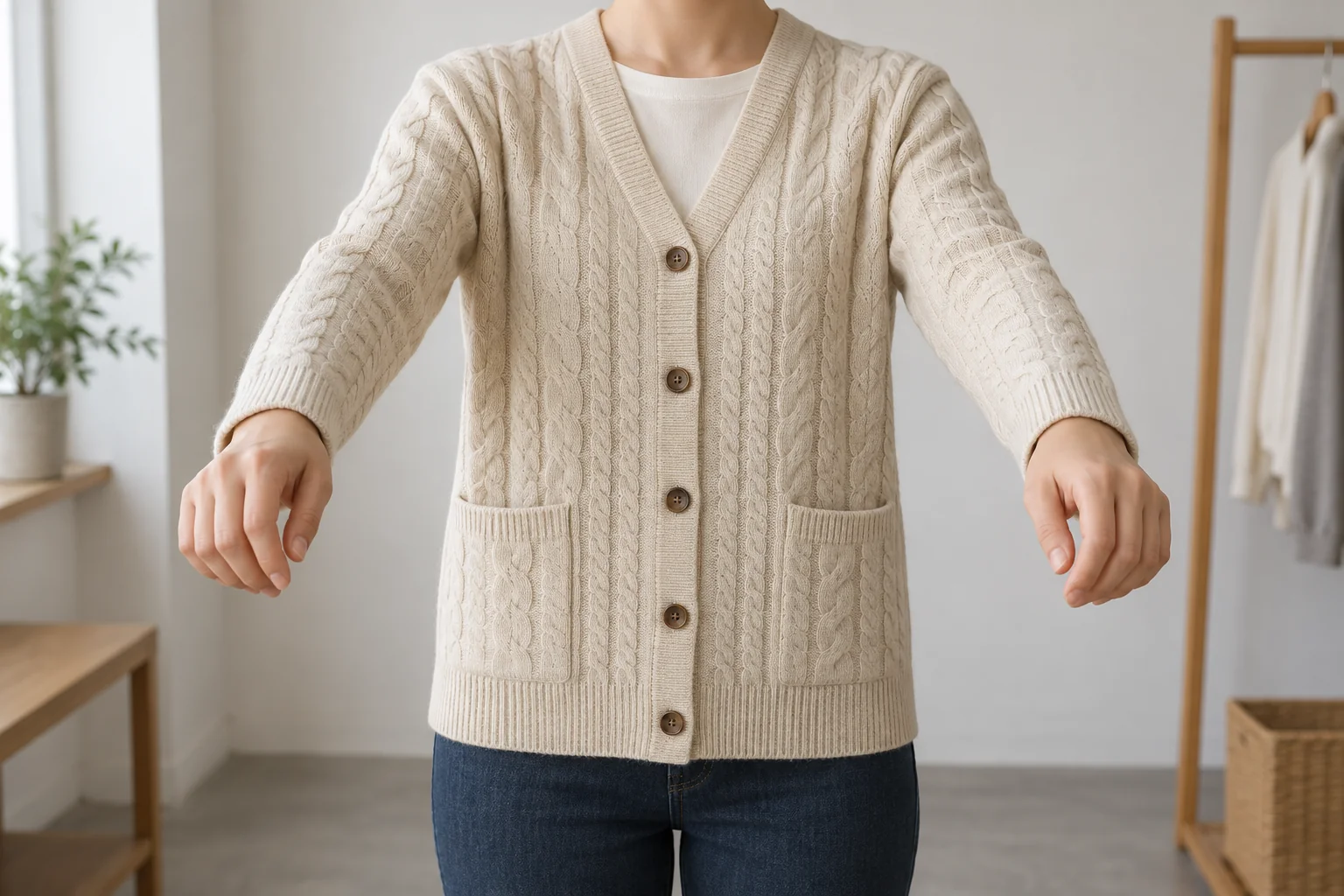
Treat pockets as interruptions that need an approved rule
Define whether a pocket should cover, cut across or sit beside a cable. Show the opening and edges, visible cable section and intended alignment with the placket or hem. Review both pockets when they form a pair.
Do not approve from side-seam distance when the concern is the motif, or move a pocket for appearance without checking measurements and function. Record which requirement controls and which specification changes.
A pocket may follow a named garment reference while the visible cable area changes. Show that this adjustment was reviewed. Route changes to the base design, grade rule or knitting program to their owners instead of hiding them in a size-set comment.
How Should Wash Evidence Affect Release?
Match procedure, sample ID and measurement state
Record size, sample ID, initial condition, measuring method, wash and drying procedure, cycle count, post-treatment conditioning and report date. ISO 6330 specifies domestic washing and drying procedures for textile testing; ISO 5077 addresses dimensional change after specified washing and drying. Neither supplies a universal pass value.
Compare the agreed POMs and cable landmarks after treatment. Body width cannot show cable-placket balance, while a photograph cannot establish dimensional change. Link both records and identify any blocking criterion.
For each treated sample, place the pre-care and post-care values on one line and pair them with matched landmark views. Note whether a visible change remains after the agreed conditioning period. If the garment was pressed, pinned or manually reshaped before the second image, record that intervention; otherwise reviewers may compare unlike states. A reversible presentation adjustment and a persistent change can require different follow-up, but neither outcome should be guessed without the recorded sample.
If only one size is treated, limit the claim to that sample. Decide whether it represents the relevant cable or boundary risk and whether another size is needed. Record the reason instead of relying on a fixed sample count.
Review appearance and component interaction separately
ISO 15487 describes apparel appearance assessment after domestic washing and drying, including surface appearance and component damage. Define cable-cardigan views for the pattern, placket, seams and closures; retain the actual method, observations and report.
Record dimensional change, cable-position appearance and component condition separately. A combined “wash passed” hides which result was actually checked.
The article on evidence for care label claims explains why an instruction needs a basis. Confirm that the approval treatment matches the test request and route any label change to its owner. A changed care direction may require new evidence.
When Is the Cable Size Set Ready for Release?
Close issues by affected size and controlling file
Build a release matrix with the sample ID, size, measurement report, image set, cable-landmark result, placket result, pocket result, after-care result, exception and decision. Name the owner and due date for every blocking item. Link comments to the full size chart, pattern map and product revision so a later email cannot be mistaken for approval of a different version.
Read the matrix by downstream operation. A resolved visual note may permit the next sample stage, while an open program change may prevent knitting and an unresolved wash result may prevent care or bulk release. State the permitted operation beside each exception. This prevents a team from treating approval to revise one sample as approval to start production, and it keeps later reviewers from reopening decisions already closed against the same revision.
Use the narrowest justified retest. A changed pocket position may require new evidence for the affected sizes and the relevant grade boundary. A revised base fit may invalidate the whole set. A new yarn, stitch program or finishing route may require the technical owner to define a wider repeat. State the impact before requesting samples. This protects the decision without turning every comment into a full restart.
The pre-production sample review owns the broader check of bulk materials, trims, labels and packing. Cable size-set approval should transfer its signed evidence into that stage, not replace it. Keep unresolved exceptions visible until the affected operation is closed.
Give production and inspection one usable reference
The released pack should identify the approved physical sample or controlled image set, full size-chart revision, cable pattern map, annotated landmark views, placket and pocket references, after-care report and closed exception log. The knitwear tech pack guide can organize the broader product file; this page adds the evidence needed to reproduce the cable-specific appearance across sizes.
Define how the first production pieces will be compared with the approved set. The published AQL inspection guide explains acceptance sampling at the shipment level. That process does not correct an unclear cable reference. Inspectors need the same landmark definitions, garment condition and decision rules used during size-set approval.
Do not release on a score assembled from unrelated passes. A measurement pass cannot cancel an unexplained motif shift, and an attractive closed-front photo cannot cancel a missing wash record when that evidence was required. Release occurs when every blocking item for the submitted version has a traceable result, or when the buyer records a specific, authorized exception and the operation it permits.
Conclusion
Cable cardigan size set approval should answer one controlled question: does the approved cable design remain deliberate and reproducible across the reviewed size range? Start after base fit and grade rules are stable. Compare named cable landmarks against the placket, pockets, neckline, shoulder and hem using matched measurements and repeatable views. Link any wash result to the sample ID, stated procedure, conditioning method and post-care appearance, then give every size a clear disposition.
Keep the general grading, assortment, cost and pre-production decisions with their existing owners. The release pack for this task needs only the cable pattern map, size-specific evidence, closed exceptions and the controlling product revision. To review a real set, prepare those records and contact CNSweaters about your cable cardigan size set.
Frequently Asked Questions
Can a size set pass measurements and still fail cable approval?
Yes. Ordinary POMs can fall within the agreed limits while the main cable shifts relative to the placket, a pocket covers the wrong part of the motif, or the two fronts lose their approved visual balance. Record the numerical and visual outcomes separately and let the controlling specification decide which one blocks release.
Must every cable be identical in every size?
No. The approved rule may allow a documented change in repeat distribution, surrounding plain ground or motif position at a size boundary. The buyer should verify that the change is intentional, traceable to the correct revision and acceptable in the final garment. Unexplained variation is the problem.
Should the cardigan be reviewed open or buttoned?
Use the state named in the specification, and use both when the decision depends on both presentations. A closed view is essential for paired-front and closure alignment; an open view may reveal edge behavior and pocket relationships. Label each image so reviewers do not compare different garment states.
Does one washed sample approve the whole size range?
Not automatically. It proves only the identified sample under the recorded procedure. Decide whether that size represents the relevant cable and component risk, and explain why. Include another size when a grade boundary, different cable distribution or component relationship could produce a different result.
What change usually requires another cable review?
Any change that can move or alter a controlled landmark should trigger an impact decision. Examples include a revised body or placket measurement, pocket relocation, new stitch program, changed yarn or finishing route, and a different care procedure. Retest the affected sizes and boundaries rather than assuming a full set or no retest.