 CN Sweaters
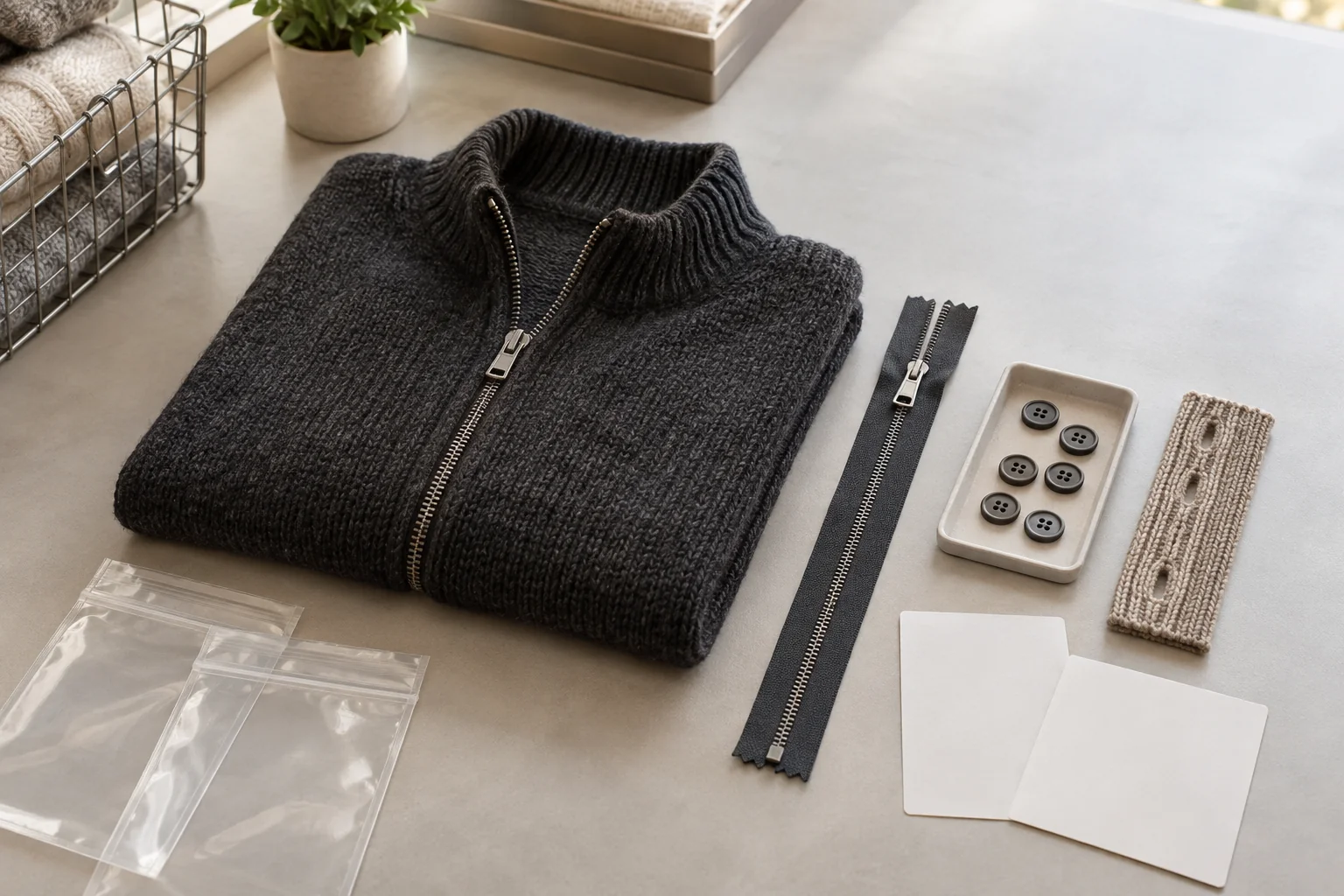
A wholesale sweater spare parts kit gives customer service and repair partners an identified replacement part without turning a complaint into guesswork. The kit is planned after the garment, closure and approved trim references are fixed. Its job is to preserve a controlled quantity of matching zippers or buttons, show which product version each part belongs to and define when a part may be released.
This guide is for buyers managing adult private-label knitwear after bulk approval. It does not choose between a full-zip sweater and a button cardigan, redesign a placket or approve a production substitution. Those decisions belong in the full-zip sweater development guide and the zip-up knit sweater specification guide. The decision here begins later: what to reserve, how to identify it and how to control its use after goods enter stock or reach customers.
Bring the approved trim references, size and color quantities, packing plan, repair policy, supplier terms and any relevant service history. Where no history exists, use an explicit planning assumption and a review date rather than inventing a universal spare percentage. A bag of similar-looking parts is not a service system. A useful kit connects each physical part to one approved garment version and one permitted after-sales action.
What After-Sales Job Should the Kit Cover?
Define the service event before ordering parts
Start with the events the business is prepared to handle. A missing spare button, a damaged button during use, a lost zipper pull and a complete zipper replacement create different work. Some can be handled by sending a component with clear identification. Others require a repair professional to examine the garment, confirm compatibility and decide whether replacement is practical. Write the intended service route beside every proposed spare.
The wholesale knitwear reorder guide can support the separate decision about finished garments. A spare-parts plan should not become a hidden finished-goods forecast. Its demand unit is a service case requiring a particular component, not another saleable sweater.
Keep the kit outside product approval
Only reserve a part after its role in the approved garment is clear. A zipper used in an early sample, a button shown in a reference photo or a trim described as equivalent is not automatically the production reference. Ask purchasing and the supplier to identify what was actually used for the accepted bulk version.
The kit does not cure an unresolved production decision. If a production zipper is still conditional, hold the corresponding spare order with it. If a button shade changes before bulk, update the garment and spare references together. The pre-production sample review guide helps distinguish a reviewed sample from permission to proceed; the service kit should inherit the resulting identity rather than create a second approval route.
Which Zipper and Button Records Belong in the Kit?
Identify a zipper as a complete approved assembly
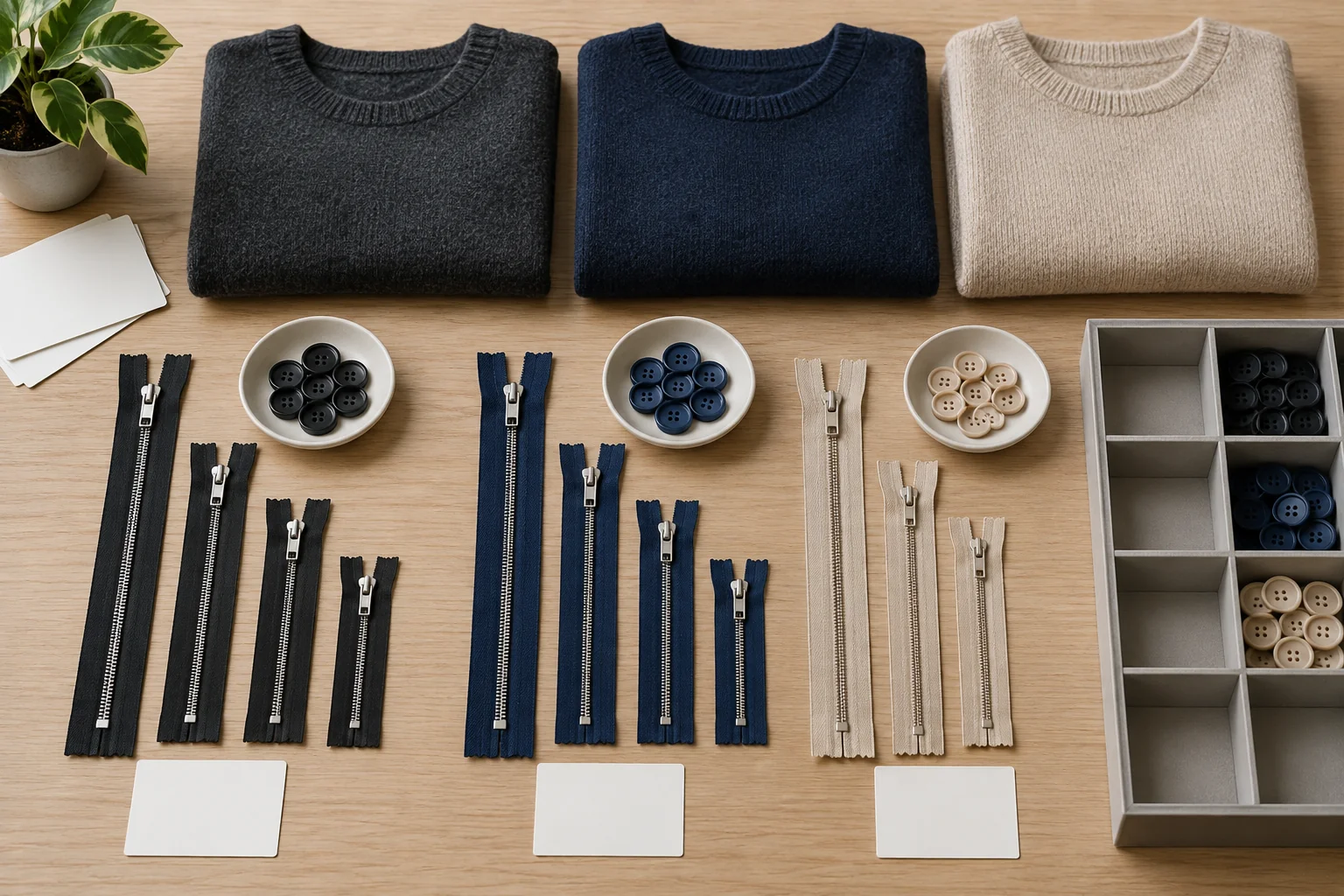
Record the supplier, article or series, chain type and size, separating function, slider and puller, tape color, finish, length method and garment sizes served. Include the purchase-order or trim-order reference and the approved garment or first-off sample that used it. Where the zipper length changes by garment size, create separate stock items rather than one general “navy zipper” entry.
YKK’s official zipper structure explanation identifies elements, slider and tape as parts of a cooperating closure. That vocabulary helps a buyer describe what is being replaced; it does not prove that one slider or chain will fit another manufacturer’s product. Ask the actual supplier to confirm its part identity and compatible service options.
Decide whether the kit holds a complete zipper, an approved slider-and-puller assembly or another supplier-defined service component. A puller that looks similar can differ in attachment. A slider can move onto a chain yet still be the wrong type or size. Avoid offering individual pieces merely because they are cheaper to store. The release record should say what the spare can replace and which checks remain for the repairer.
Where mechanical evidence is required, match it to the actual item and intended decision. The public scope of ASTM D2061 covers strength tests for zippers and zipper parts and cautions against treating one test as suitability for every use. A standard reference is not an order-specific pass result. Retain the applicable supplier or laboratory record with the approved item rather than copying a test name onto every spare label.
Tie buttons to the garment version and color lot
For buttons, record supplier reference, material description supplied by the source, dimensions, shape, visible finish, hole or shank configuration, artwork where applicable and the approved color reference. Also identify the garment style, colorways and positions served. A neck button, cuff button and spare sewn into the same garment may not be interchangeable.
Connect the button to its attachment decision without turning the kit into sewing instructions. Thread, backing support, stitch pattern and placement can affect the repair, but the correct method depends on the garment and service provider. The garment label supplier confirmation guide illustrates why artwork, physical item and applied result require separate checks. Apply that same separation to buttons: part identity does not prove the finished repair.
Give every approved spare item a stable internal code. The code should survive staff changes and language differences, and it should point to the controlled record rather than attempt to contain every specification. Retain supplier aliases in the mapping so a future buyer can reconcile the code with an invoice or replacement proposal.
How Should a Buyer Set Spare Quantities?
Build the quantity from observable inputs
There is no universal percentage that suits every closure program. Begin with the number of garments by style, color and size; the number and type of closures on each garment; supplier minimums; the consequence of a shortage; and the time needed to obtain an approved replacement. Separate button demand from full-zipper demand because one button reference may serve several sizes while zipper lengths often do not.
If the business has service history, classify cases before using it. Count confirmed part replacements by product version and reason. Remove duplicate contacts and cases resolved without a component. Keep production rework separate from after-sales demand because a factory correction before shipment does not forecast consumer repair needs in the same way.
When no history exists, record a provisional opening quantity for each serviceable part and name the event that will review it. The assumption may be influenced by order size, part customization, supplier availability and the brand’s service promise, but it remains an assumption. The sweater quotation comparison guide can help normalize quoted inclusions, minimums and ownership; ask for spare parts as an explicit line rather than assuming they are included with garments.
Use a decision table for each stock item
Create one row per physical spare item, not one row per broad garment family. The example below is a planning format. It contains no recommended percentage or proof that a real order has passed.
| Stock decision | Evidence to record | Quantity input | Release boundary |
|---|---|---|---|
| Complete zipper by length | Article, sample ID, color and size map | Size units, service assumption and supply time | Professional repair after a match check |
| Slider and puller assembly | Supplier-confirmed chain compatibility | Eligible zipper population and case history | Named repair route only |
| Main-front button | Reference, dimensions, finish and colorway map | Buttons per garment and service history | Matching garment version only |
| Branded button | Artwork, supplier lot and approved sample | Relevant positions and residual minimum | No substitution without review |
| Prepacked spare | Packing instruction and garment SKU map | One per garment where approved | Ships with the identified unit |
For each row, show opening stock, committed stock, issued stock, quarantined stock and available balance. A total of 100 is misleading if 40 belong to a superseded color or the wrong zipper length. Keep sample-room parts and approved service stock in separate balances unless the same control applies to both.
Agree the review frequency from the program’s pace. A seasonal limited order may need one review before closeout, while a continuing style may need a regular threshold check. The bulk consistency guide helps keep production references tied to repeat orders; the service balance should reopen whenever the garment or trim reference changes.
How Should Kits Be Packed, Labeled, and Stored?
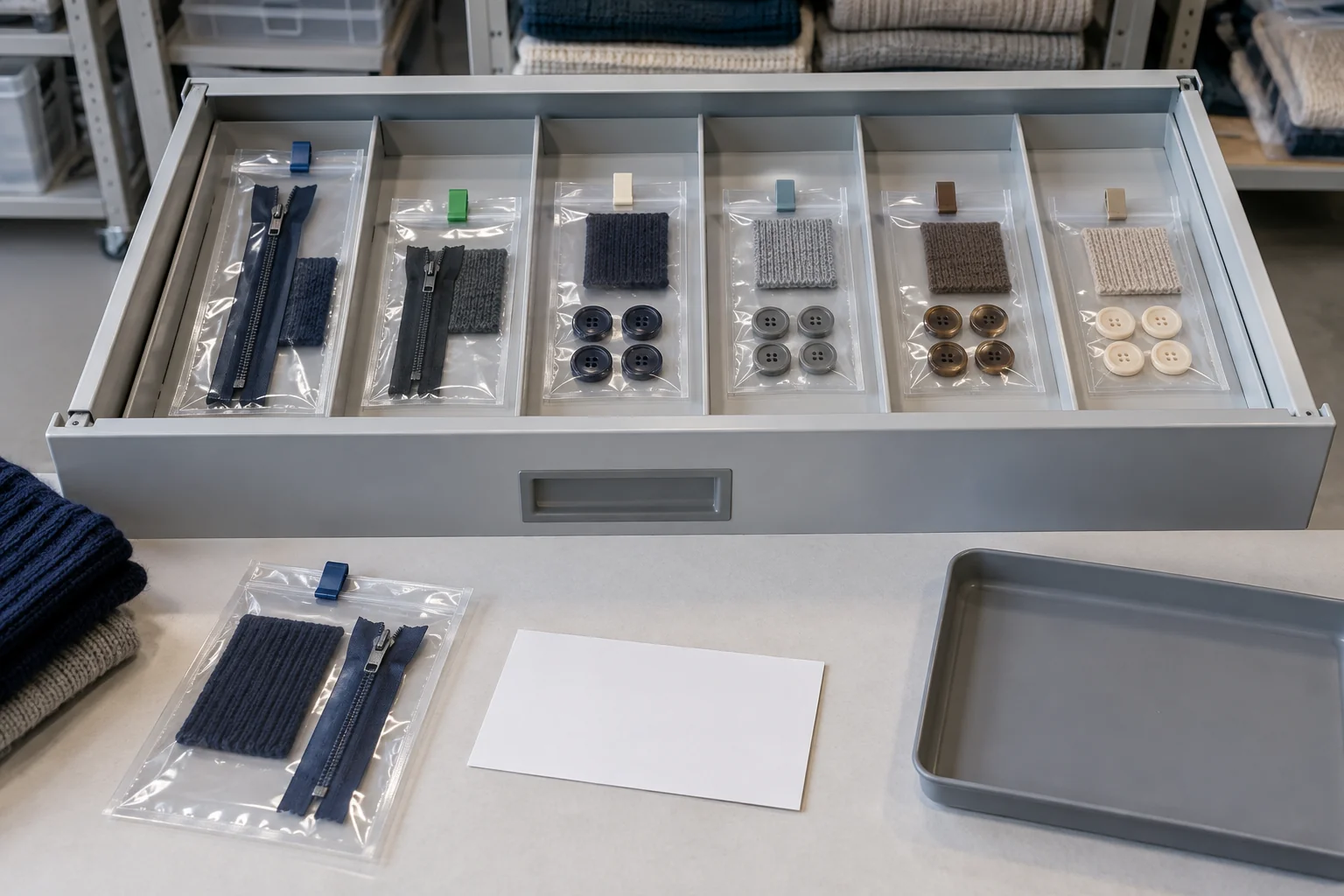
Make the service pack self-identifying
Pack parts so the receiver can identify the garment version without relying on color alone. A service label can show the internal part code, garment style, applicable color and size range, supplier lot or order reference, packing date and any release limitation. Do not print consumer-facing claims that have not been approved for that destination and use.
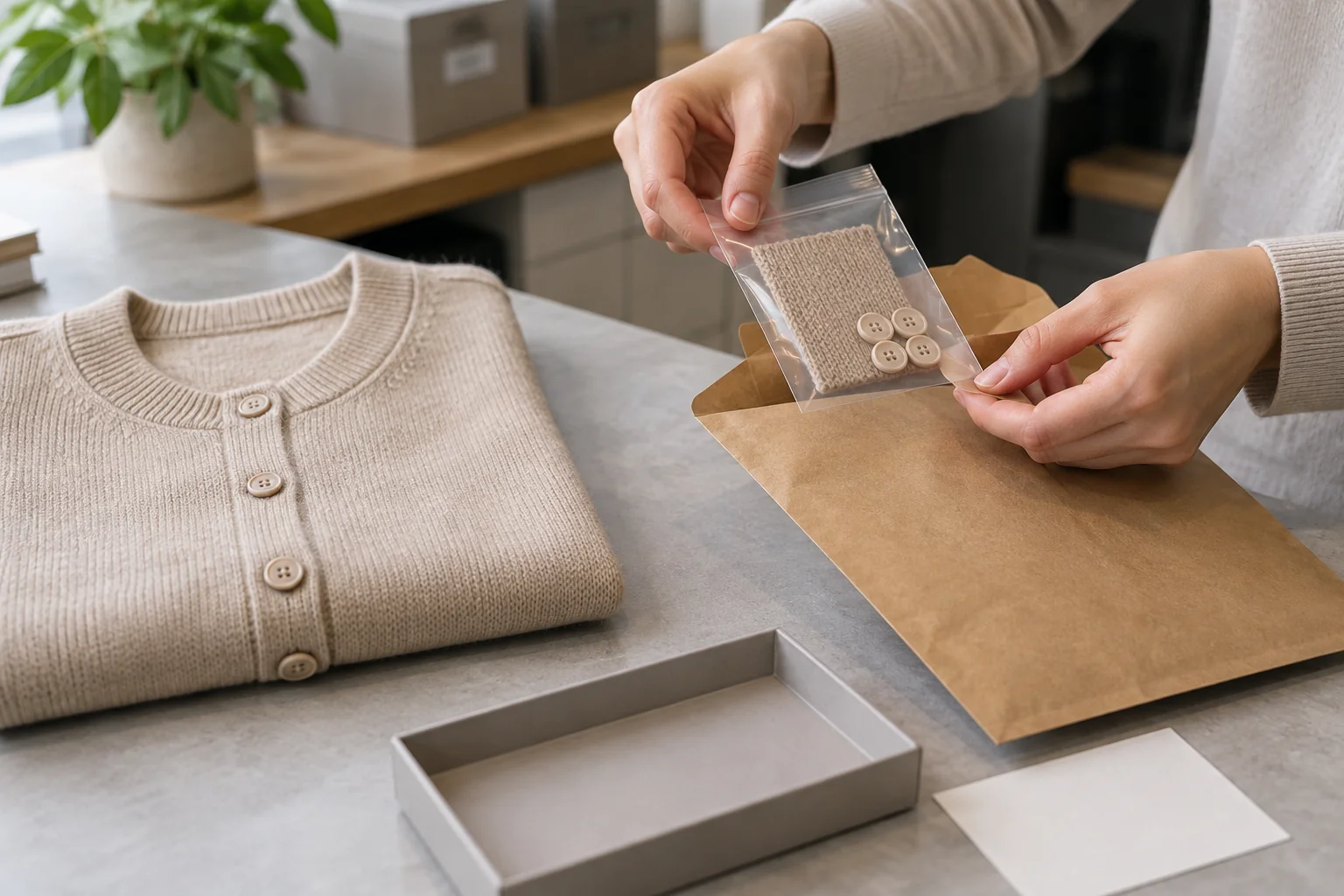
If a spare is packed with every garment, connect it to the correct saleable SKU during packing inspection. If it is held centrally, connect the service pack to the inventory location and withdrawal record. The retail packaging and barcode guide covers the wider relationship among product, pack and receiving identity.
GS1’s GTIN Management Standard governs identification decisions for trade items and changes. Use the responsible brand or data team’s interpretation where a spare kit is sold or distributed as a trade item. An internal service code does not automatically require a GTIN, and a GTIN does not replace the technical part mapping.
Control locations condition and withdrawals
List each physical location holding approved spares: factory balance, brand warehouse, distributor, repair partner or store. Record the accountable owner and the stock condition that location must report. Do not let the same units appear as available in more than one ledger after a transfer.
Use first-in records to maintain traceability, but do not automatically mix old and new lots. Compare a replenishment lot with the retained garment and approved service reference. Quarantine unexplained or mixed parts until purchasing can identify them. The knitwear quality-control guide can organize incoming and final checkpoints; the spare kit needs a narrower component-specific inspection.
Record every withdrawal with case number, part code, quantity, destination and authorizer. If a part is returned unused, inspect and relabel it before restoring stock. This small transaction history becomes the evidence for later quantity planning and shows whether a supposed shortage came from real repairs, sample-room borrowing or poor ledger control.
Who May Release a Part for Repair?
Triage the garment before selecting a component
Customer service should first identify the garment using order, product code, color, size and available photos or labels. Record what failed or went missing and whether the garment has been altered. A photo can locate a button or zipper problem, but it may not establish exact part compatibility or the condition of the surrounding knit.
Route the case according to the planned service event. A matching replacement button may be sent with limited guidance if the business has approved that route. A full zipper replacement normally needs a repairer to evaluate garment condition, removal risk, length, endpoints and the effect on the knitted front. The service team should not promise a result before that assessment.
Before release, compare the requested garment version with the part mapping and check available stock status. If the match is uncertain, hold the shipment and request the missing identifier. Substituting the nearest visible color can create a second complaint and destroy the evidence needed to understand the first.
Keep instructions claims and feedback in scope
For covered United States apparel, the FTC’s Care Labeling Rule guidance explains that care instructions require a reasonable basis and concern the complete product. A replacement part can affect that product context. Review whether the existing care statement remains supported after a material repair rather than promising that any replacement leaves care unchanged. Other destinations require their own review.
Ask the repairer or service team to close the case with the part used, outcome and any mismatch observed. Record whether surrounding knit damage prevented repair, whether the approved part fitted the garment version and whether another component was required. Do not convert one successful repair into a universal compatibility claim.
When Should the Kit Be Reordered or Retired?
Replenish against demand and supplier change
Set a reorder point for each item using the available balance, confirmed open cases, expected program life and current supplier response. A generic threshold across all buttons and zippers hides the different replacement paths. Review size-specific zipper stock individually and aggregate only parts that are proven to be identical and approved for the same use.
Link the replenishment decision to the current garment program. If the finished style is still selling or will be reordered, consider the additional population the part must support. If the program is closing, compare a last-time purchase with the documented service period and the risk of unusable excess. Do not publish a long service promise merely because residual trim exists.
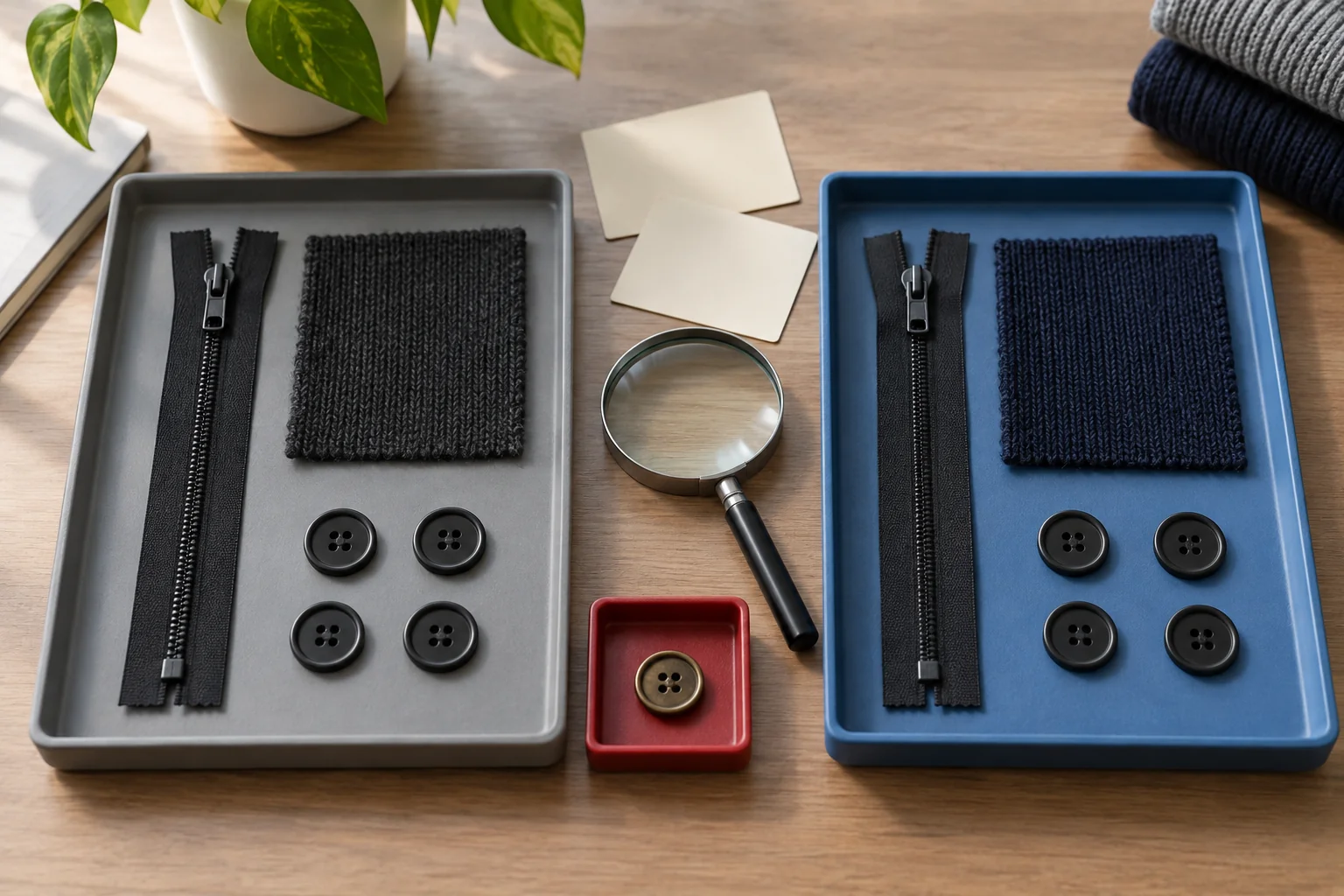
Retire superseded stock without losing history
Quarantine a spare when its identity is unclear, its condition is unacceptable or the linked garment revision has been superseded. Record the reason and affected stock. Do not relabel it for a new style because it appears close enough. Purchasing and the responsible technical reviewer should decide whether it can serve any other approved use.
When a style closes, retain the mapping, transaction history, supplier references and disposition of remaining parts. These records explain later service decisions and prevent an old bag from returning to active stock without review. The physical stock may be used, returned, retained or disposed of according to the business’s documented decision; this guide does not prescribe a universal route.
Conclusion
A wholesale sweater spare parts kit should begin only after the garment and its production trims are approved. Identify every zipper or button against the actual supplier reference, garment version, color and size mapping. Set opening quantities from order data, service policy, supplier constraints and clearly dated assumptions, then separate available, committed and quarantined stock.
Pack each component with a recoverable code, control every location and withdrawal, and require a garment match before customer service releases a part. Complex zipper work should follow an assessed repair route, while case outcomes should feed quality, replenishment and product teams without blurring their decisions. Recheck supplier changes before reordering, and close obsolete stock with its history intact. To build an order-specific reserve plan, prepare the approved trim records, garment SKU matrix, service policy and current supplier terms, then contact CNSweaters about your sweater spare parts kit.
Frequently Asked Questions
Should every wholesale sweater include a spare button?
Only when the brand has deliberately approved that packing plan and mapped the button to the correct SKU. Some programs hold parts centrally or use a repair partner. Record who owns the stock and how the customer obtains the right part.
Can one zipper length serve every sweater size?
Do not assume it can. Zipper length and endpoints may vary with the approved garment pattern. Create size mappings from the production reference and keep different physical lengths as separate stock items.
Is a matching puller enough to repair a zipper?
Appearance alone is insufficient. The slider, puller, chain and attachment may be product-specific. Ask the zipper supplier or qualified repairer to confirm compatibility before release or installation.
How many spare parts should a buyer order?
Use garment quantities, component mapping, service policy, supplier minimums, replacement timing and relevant case history. If history is unavailable, label the opening quantity as an assumption and set a review event instead of adopting a universal percentage.
Can unused production trims become service stock?
They can be considered only after their identity, condition and relationship to the accepted bulk garment are confirmed. Transfer them into the service ledger with a physical count; do not treat an undocumented factory balance as available stock.