 CN Sweaters
A cropped cardigan can fit perfectly in the approved base size and still fail as a retail size range. The risk is not simply that XS becomes too small or XL too large. The crop can move to the wrong point on the torso, the hem can lose its relationship to the waist, the armhole can become restrictive, and the front opening can change shape as width and length are graded.
Private-label buyers therefore need more than a sample photograph and a list of finished widths. They need a grading system that connects the target customer, body data, intended ease, knit construction, garment measurements and post-wash performance. The objective is not to enlarge every dimension by the same amount. It is to preserve the design’s proportions and function across the approved size range.
This guide explains how to brief, sample and approve that system with a custom cardigan manufacturer before bulk production.
Start With the Target Body and Base Size
Grading begins with a target population and a fit decision, not with a generic alphabetic size. “Women’s medium” does not identify a universal body shape, and another brand’s measurement chart may reflect a different market, age profile, fit model or product category.
Separate body data, garment measurements and ease
Body measurements describe the intended wearer. Garment measurements describe the finished product. Ease is the planned difference between the two, distributed according to the silhouette, construction and wearing position.
ISO 8559-1:2017 provides current anthropometric definitions and measurement principles that product teams can use when selecting population segments and developing size-and-shape profiles. ISO 8559-2:2025 covers primary and secondary body dimensions for clothing size designation. These references do not prescribe one finished cardigan specification. The designer and manufacturer still decide garment dimensions, ease and style allowances.
That distinction matters for a cropped cardigan. A body-bust increment does not automatically become the same finished half-chest increment, and a change in body height does not require body length to grow in direct proportion. The brand must decide how the cardigan should sit on each target body.
Choose and prove the base size
Name one base size and identify the body measurements, fit model or approved form used to evaluate it. Record the intended layer under the cardigan, the desired chest and hem ease, the shoulder position, sleeve fit, neckline, front overlap and crop location.
If the approved base sample was fitted over a thin camisole, do not silently change the intended use to layering over a shirt. If the cardigan is designed to finish at the natural waist, identify how the brand defines and checks that location. “Cropped” alone is not a measurable instruction.
Commercial body tables can help frame a target market. For example, ASTM D5585-21 provides body measurements for an adult female misses figure type in sizes 00–20. It is a reference population, not a universal brand block. Buyers should use data that matches their actual customers and document any adjustments informed by sales, returns or fit feedback.
Define Cropped Length as a Fit Relationship
Body length is the defining feature, but a fixed number does not fully describe the fit. The crop is a relationship among the shoulder or high-point reference, bust level, waist position, rib depth and the bottoms with which the garment will be merchandised.
Lock the measurement method before the increment
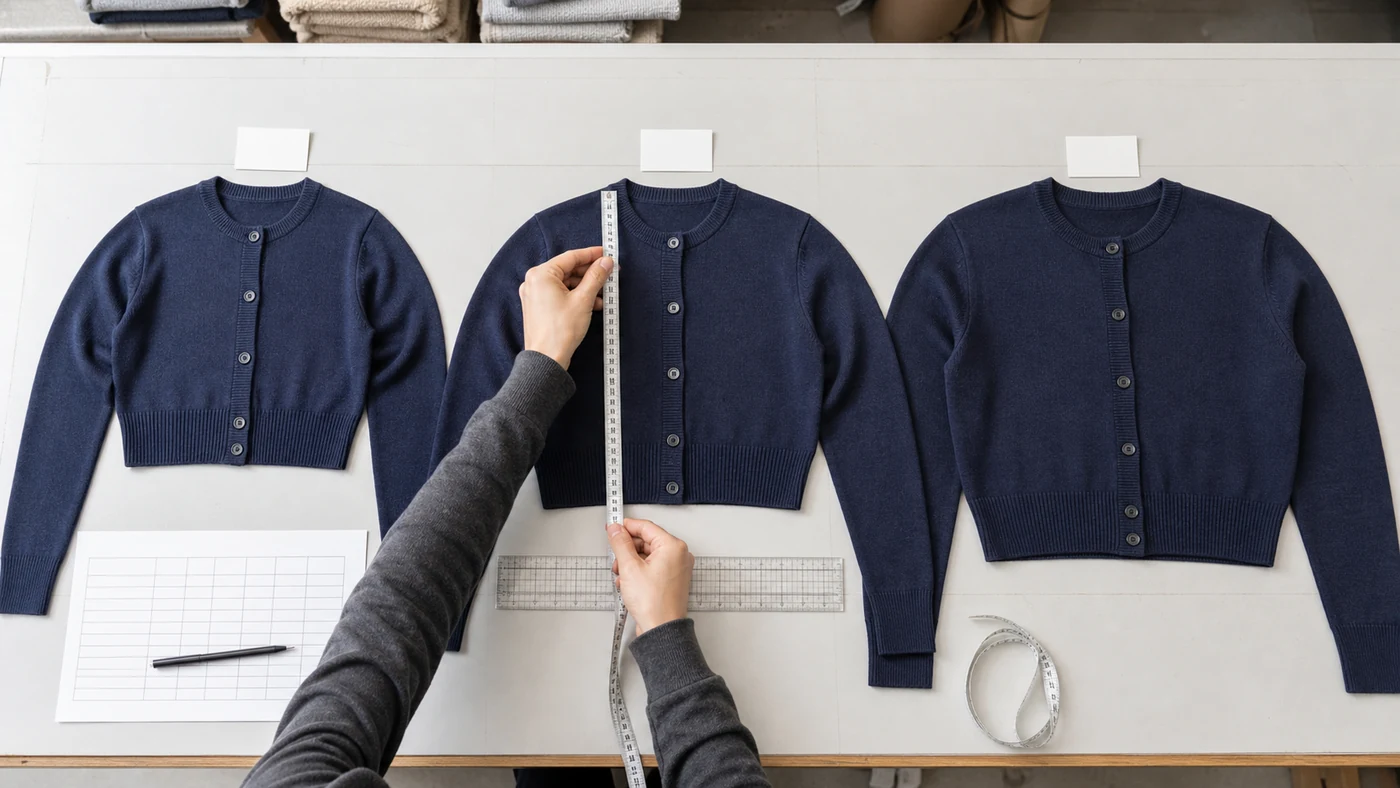
State exactly where body length starts and ends. A high-point-shoulder measurement can differ from a center-back measurement, especially when the neckline changes. Define whether rib height is included, whether the garment is buttoned, how it is laid flat and how long it must relax before measurement.
ISO 18890:2018 defines principal garment measurement points and methods, while allowing interested parties to agree additional points. A cropped program usually needs extra clarity around front length, back length, rib depth, front-edge length and the distance from underarm to hem.
Use diagrams in the tech pack. A label such as “body length” without arrows, landmarks and garment condition invites different interpretations among the brand, sample room and inspector.
Grade for the intended visual position
Do not assume length should increase at the same rate as chest or sweep. Test whether the crop should remain visually stable, lengthen slightly for larger sizes, or use separate rules for different ranges. The answer depends on the target bodies, silhouette and merchandising intention.
Evaluate the ratio of crop length to chest width and sleeve volume, not only the isolated measurement. A larger size that gains substantial width but almost no length may look boxier and shorter than intended. A mechanical length increase may turn a true crop into a standard cardigan at the upper end of the range.
For extended sizes, consider whether a new block or grading nest is required. Extending straight-size increments indefinitely does not account for changes in body shape and proportion. A separate fit evaluation is more defensible than assuming the same geometry remains valid.
Grade Width, Armhole and Sleeve as a System
Chest, sweep, shoulder, armhole, bicep, cuff and sleeve length interact. Changing one measurement can alter hang, mobility and the visual balance of the whole cropped cardigan sweater.
Protect mobility without losing the silhouette
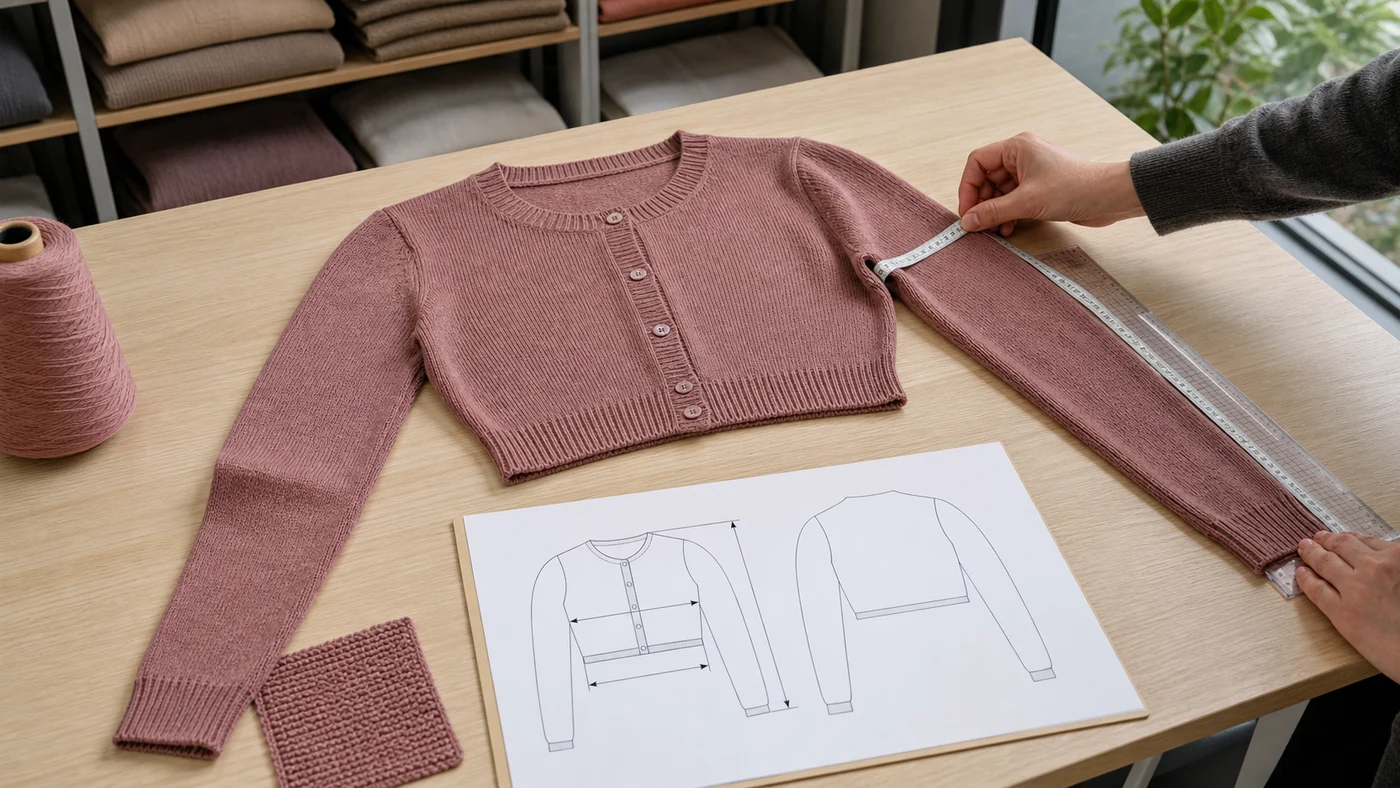
Begin with the target chest and hem ease for each size. Then evaluate how that width is distributed through the front and back panels, how the shoulder is positioned and how the armhole supports movement.
For a set-in sleeve, larger sizes may require coordinated changes at shoulder width, armhole depth, across-back width, bicep and sleeve cap. For a drop shoulder, the shoulder point and sleeve length must be read together because part of the apparent sleeve comes from the body panel. Raglan constructions need their own seam and neckline relationships.
Do not copy a woven block without checking the knitted construction. Yarn, machine gauge, stitch structure, density, finishing and relaxation determine how stitch and course counts translate into finished centimeters. The broader custom knit sweater grading guide explains why a knitwear grading nest must be validated at the actual production construction.
Check the extreme sizes early
The base size can conceal proportion drift. Review at least a lower, base and upper size that represents the intended range. If the range is broad or includes a separate plus-size block, sample the relevant extremes rather than extrapolating from three adjacent middle sizes.
On each sample, check:
- chest, waist or body width and hem sweep;
- shoulder or raglan position;
- armhole depth and shape;
- bicep, elbow area and cuff opening;
- sleeve length in relation to shoulder construction;
- front and back body length;
- rib recovery and edge tension;
- mobility when reaching forward and lifting the arms.
A visually small numerical difference can be significant on a short body. Judge the full silhouette on the intended fit model or form, not only a flat table.
Keep the Front Opening Balanced Across Sizes
The front opening makes cardigan grading different from grading a closed pullover. The placket, buttons, buttonholes, neckline and hem must remain balanced while the body changes.
Control placket length and button placement
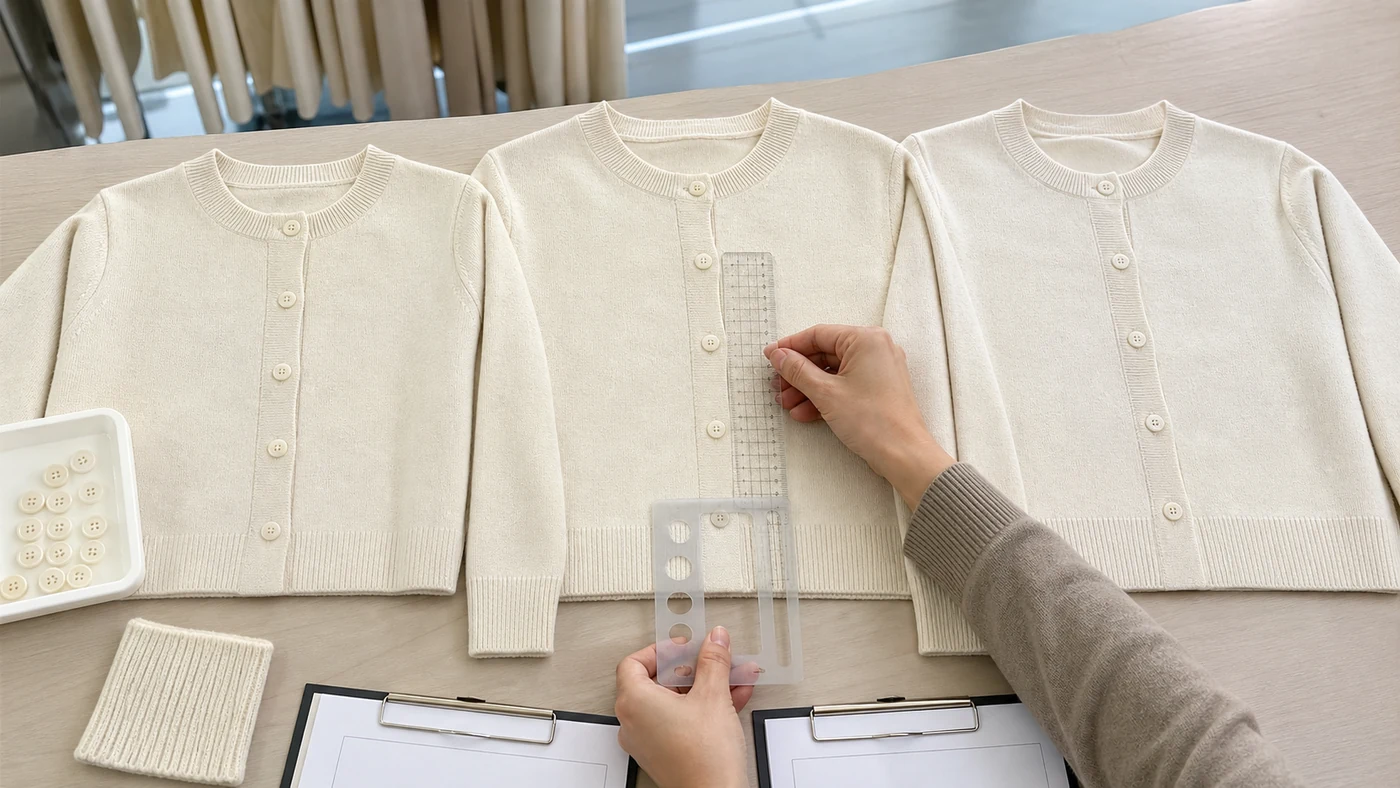
Specify finished placket length, width, overlap, button count, button diameter, first and last button positions, and the measurement method for spacing. Decide whether spacing stays constant, changes by size or is recalculated between fixed anchors.
If body length changes while the button count remains fixed, the spaces can become visibly uneven unless the rule is explicit. If button count changes in larger sizes, define the transition and confirm that retail photography, trim quantities and sewing instructions reflect it.
Check the cardigan buttoned and unbuttoned. Look for front-edge waving, gaping at the bust, overlap drift, twisted button bands and a hem that steps up or down at the center front. The front should hang symmetrically without forcing the body width into the placket.
Coordinate neckline, bust and hem
On a V-neck cropped cardigan, the depth and width of the V influence where the first closure sits and how the garment controls the bust. A shallow V cannot simply be enlarged in every direction. On a crew-neck cardigan, neck opening and collar or neck-rib recovery must remain comfortable while holding the front edges together.
Front length may need its own point of measure rather than relying only on back length. This is particularly important where bust shape, front overlap or a curved hem creates a different visual crop at the front.
Buyers can review the factory’s broader cardigan manufacturing capabilities when selecting placket, closure and construction options, but every private-label style still needs its own graded front-opening specification.
Build a Measurement Chart the Factory Can Execute
A grading table should communicate the approved result and the logic needed to reproduce it. It should not ask the factory to infer the brand’s fit from a base sample alone.
Include the complete graded specification
For every point of measure, provide a code, name, diagram, method, base-size value, values for all sizes, unit and tolerance. Mark measurements that apply only to a particular construction. State whether values are pre-wash, post-wash or finished-and-relaxed targets.
| Control field | Buyer decision | Approval evidence |
|---|---|---|
| Target body | Market, body data and fit profile | Named body table or brand dataset |
| Base size | Size, fit model and intended under-layer | Approved fit record and photographs |
| Crop position | Landmark and visual relationship | Front/back length diagrams and fit notes |
| Width and ease | Chest, body and hem intent | Full graded measurements |
| Sleeve system | Construction, armhole, bicep, cuff and length | Lower/base/upper size-set samples |
| Front opening | Placket, overlap, buttons and neckline | Buttoned and open-front approval |
| Measurement state | Relaxation, fastening and lay-flat method | Written procedure |
| Wash result | Procedure and dimensional targets | Before/after measurement report |
| Bulk tolerance | Point-specific acceptance range | Signed specification and PP pack |
Avoid using a single blanket tolerance for every measurement. The acceptable range should reflect the importance of the point, knit construction, gauge, measurement repeatability and commercial risk. A short front length or placket offset may be more visually sensitive than a low-risk internal point.
Freeze assumptions through change control
Record the file version, date and approval status. If yarn, gauge, stitch density, finishing, button size, neckline or fit changes, identify which measurements and samples require reapproval.
An OEM/ODM private-label workflow should make responsibility clear: the brand approves the target fit and graded specification; the factory translates it into programs, stitch counts and production controls; both sides retain the approved evidence.
Verbal comments such as “add a little room to XL” are not a finished instruction. Convert every accepted fit change into the measurement chart, construction notes and sample record.
Validate the Size Set Before Bulk
A graded spreadsheet is a hypothesis until representative garments have been knitted, finished, relaxed, measured and fitted. Size-set approval is where private-label buyers test whether the planned relationships survive the actual material and process.
Select sizes that expose the risk
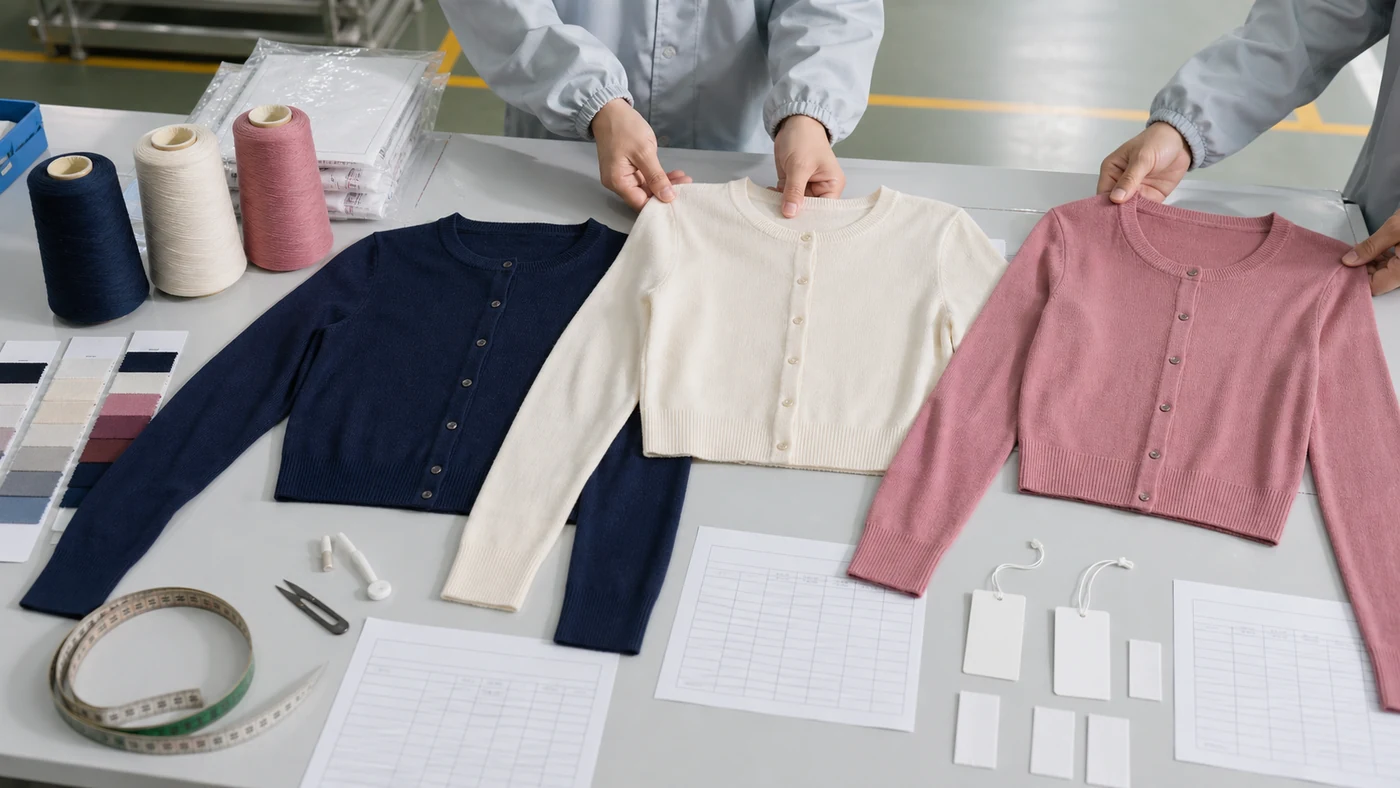
At minimum, include the base size and meaningful lower and upper sizes. Select additional sizes when a grading rule changes, a new block begins, button count changes or the product spans a wide range.
Use production-intent yarn, gauge, stitch structure, placket construction and finishing. Measure every sample using the agreed method before fit review. Record actual values rather than marking the sample “approved” from appearance alone.
Fit the samples on the intended bodies or validated forms. Review the crop against the planned bottoms, both standing and moving. Check reach, arm lift, closure function, neckline position, sleeve volume and whether the hem rides up. Photograph consistent front, side and back views with the garment in the same state.
Seal the pre-production evidence
After corrections, issue the final graded chart and approve a pre-production pack that includes the relevant size samples or signed measurement records, final yarn and color references, placket and button standards, labels, packaging and wash results.
Do not allow a corrected sample to coexist with an old table. The sealed physical sample and controlled files must describe the same product. The CNSweaters factory profile outlines the role of graded specifications and sealed PP references in repeatable production.
Control Wash, Color and Production Variation
Knit measurements change through washing, drying, steaming, pressing and relaxation. A size range that is correct immediately off the machine can move outside the intended fit after finishing or consumer care.
Define the condition of every target
State whether the finished specification is measured after factory finishing, after a defined relaxation period, after home laundering, or at more than one stage. Record the wash and drying procedure, cycles, conditioning and calculation method.
AATCC TM150-2025 addresses length and width changes in garments after home laundering. ISO 5077:2007 specifies determination of dimensional change after an appropriate washing and drying combination. The buyer must select a method that matches the product’s care route and define acceptance criteria; citing a standard number alone does not establish the required result.
Compare change at body length, width, sleeve length, front edge and rib areas. Also review torque, placket distortion, button alignment, neckline shape and recovery.
Verify material and color changes
Different yarn lots or colors can behave differently in finishing. If evidence shows a meaningful risk, include representative colors in testing and size-set confirmation. Do not “correct” one color by informally changing the knitting program without updating the controlled specification.
During bulk, check measurements after the process stage that sets final dimensions. Sampling should cover sizes and colors according to buyer risk, not only the easiest middle size. Record actual findings so a drift trend can be corrected before packing.
Preserve the Approved Grading for Reorders
The first order should leave a repeatable product record. Without it, a reorder can match the photograph but differ in crop position, sleeve proportion or button balance.
Create a controlled repeat pack
Store the final tech pack, graded chart, diagrams, fit comments, size-set actuals, approved yarn and shade references, knitting program or stitch information available to the project, wash recipe, finishing conditions, trims, labels, packaging and inspection results.
Record substitutions and deviations by date. If a yarn or finishing route changes, compare the new proposal with the approved baseline and decide which size-set and wash checks must be repeated.
Feed customer evidence back into the next grade
Review returns, exchanges, fit comments and sell-through by size where the data is reliable. Distinguish a grading problem from a buying-allocation problem. Frequent exchanges from one adjacent size pair may indicate unclear separation; complaints about the same crop position across several sizes may indicate a shared length rule.
Do not overwrite the original approved record. Create a new revision, explain the reason and validate the affected sizes. This makes improvement traceable and prevents a later factory or team member from restoring an obsolete rule.
Conclusion
A successful cropped cardigan range preserves a design relationship, not a simple scaling formula. Start with the target body and intended base-size fit. Define the crop through named landmarks and measurement methods, then coordinate length, width, shoulder, armhole, sleeve and front opening across the range.
Use current body-measurement and garment-measurement references to create a common language, but let the brand’s customer, silhouette and material determine the finished specification. Validate representative lower, base and upper sizes in production-intent construction, then confirm finishing and laundering before bulk.
The final output should be a controlled graded chart, size-set evidence and sealed pre-production pack that the factory can reproduce. That protects fit consistency in the first shipment and gives the next reorder a measurable starting point.
Related CNSweaters Resources
- How to Grade Sizes for Custom Knit Sweaters in Bulk
- Custom Cardigan Sweaters
- Cardigan Manufacturing Capabilities
- OEM/ODM Knitwear and Private Label
- CNSweaters Home
Developing a Cropped Cardigan Size Range?
Send the target market, body data, base-size measurements, fit reference, size range, yarn, gauge, stitch structure, crop position, placket details, wash route, labels, packaging and order quantities. The team can review a practical sampling and size-set approval path.
FAQ
Can one standard grade rule be used for every cropped cardigan?
No. The appropriate increments depend on the target body, silhouette, size range, yarn, gauge, stitch structure, sleeve construction, front opening and wash behavior. Reuse a rule only after confirming that these inputs and the intended fit remain compatible.
Should body length increase in every size?
Not automatically. Decide how the crop should relate to the target body and silhouette, then validate representative sizes. Some ranges need a modest change, some need a different rule at the upper sizes, and some require a separate block.
Which sizes should be included in a size set?
Include the base size and lower and upper sizes that expose the grading range. Add any size where a rule, block, button count or construction detail changes. A broad or extended range may need more than three samples.
Why do front plackets fail after grading?
Common causes include uncontrolled body-length changes, fixed button spacing without defined anchors, incorrect front overlap, tension differences and finishing distortion. Approve placket length, width, overlap, button positions and hem alignment in representative sizes.
When is the grading ready for bulk production?
It is ready when the final chart, diagrams and actual size-set samples agree; representative garments pass fit, measurement and wash review; changes are closed; and the sealed PP evidence reflects production-intent yarn, construction, trims and finishing.