 CN Sweaters
A merino wool quarter zip sweater should not enter sampling until the buyer has locked the fibre claim, yarn specification, gauge, finished measurements, collar shape, zipper system, care route, and bulk acceptance standard. If any of these decisions remain open, the first sample may look acceptable while still hiding cost, fit, durability, or compliance problems that surface later in production.
For autumn and winter programs, July is a useful development window because buyers still have time to compare yarns, review a prototype, correct the fit, approve colours, and reserve bulk capacity. The real goal is not to make a sample quickly. It is to create a specification that a knitwear manufacturer can repeat across sizes, colours, production lots, and future reorders.
Which Merino Wool Specification Should Buyers Lock First?
The fibre specification comes first because “merino” alone does not define softness, durability, yarn construction, traceability, or legal labelling. Buyers should describe the required composition and performance instead of treating the material name as a complete brief.
Confirm fibre content and micron direction
Merino wool is generally finer than broader wool types, but fibre diameter still varies. The Woolmark Company explains that wool is commonly grouped by fibre diameter and that Merino wool used for apparel is generally below 22 microns. That makes micron direction relevant to hand feel, especially where the quarter-zip collar touches the neck, but a smaller number should not automatically be treated as better. Very fine fibres can support a softer product position, while a slightly stronger specification may be more practical for an everyday sweater expected to handle repeated wear.
The purchase specification should state whether the garment is:
- 100% merino wool;
- a merino-rich blend with another identified fibre;
- a wool blend in which “merino” cannot be used as an unsupported headline claim; or
- made with a traceability or responsible-sourcing requirement.
For products entering the United States, the FTC Wool Products Labeling Rules require relevant wool products to disclose fibre content, country of origin, and the identity of the manufacturer or responsible marketer. This means the composition written in the tech pack, yarn certificate, care label, purchase order, and final test report must tell the same story.
Decide whether traceability is a product requirement
If responsible wool sourcing is part of the brand proposition, define the required standard before yarn sourcing. The Responsible Wool Standard chain-of-custody model requires certification through the supply chain to the final business-to-business seller. A buyer therefore needs more than a verbal statement that a yarn is “responsible.” The project may require a valid scope certificate, transaction documentation, supplier identification, and approval of logo claims.
That decision affects sourcing options, minimum quantities, documentation, and price. It should be included in the request for quotation, not introduced after the sample has already been knitted in an unverified yarn. Buyers conducting supplier due diligence can also review CNSweaters’ certifications and compliance gallery, which includes certificate images and downloadable audit or test documents.
How Should Yarn Count and Gauge Be Matched?
Yarn count and machine gauge must be selected as one production system. A fine yarn on an unsuitable machine, or a heavy yarn forced into a dense structure, can create poor recovery, excessive weight, an unstable surface, or a sample that cannot be reproduced efficiently in bulk.
Specify the intended fabric character
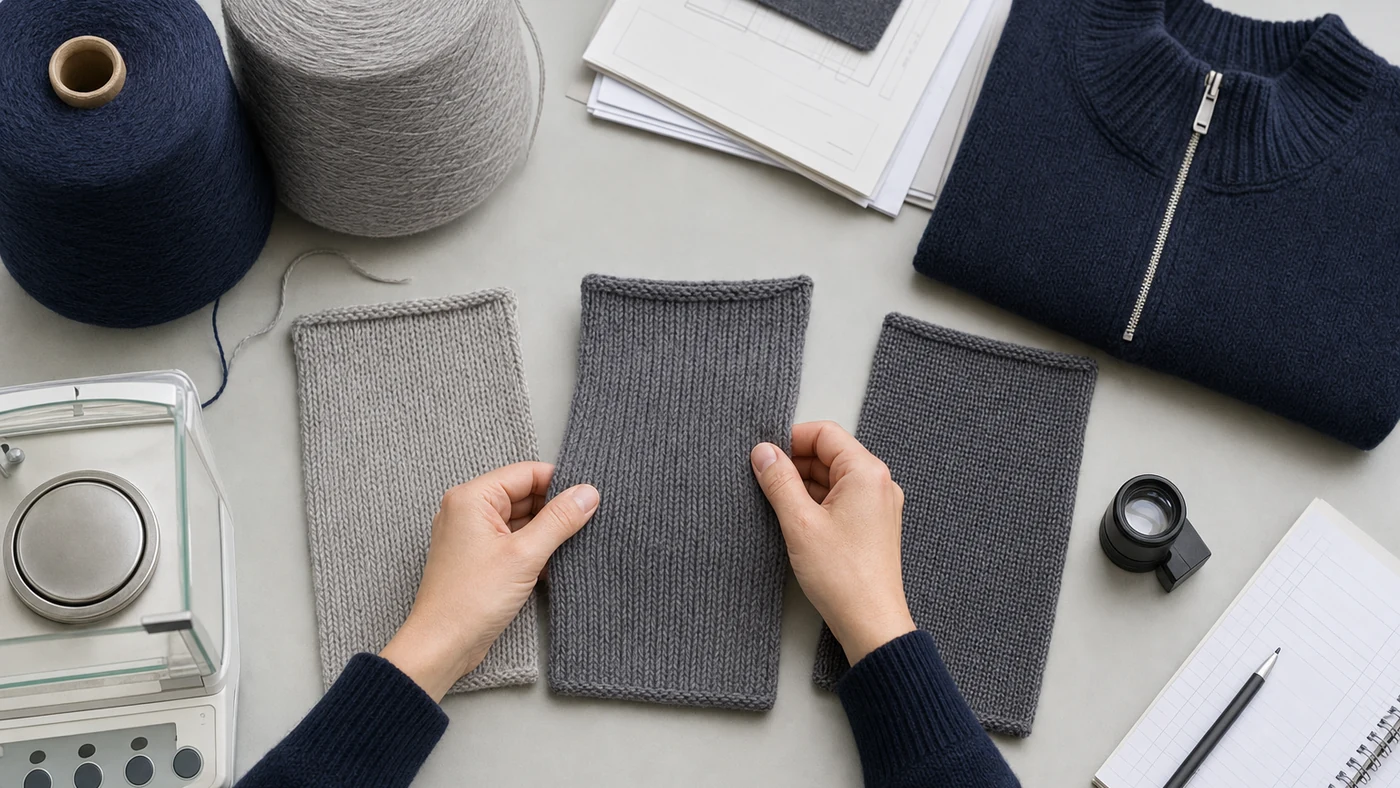
Before asking a factory for a gauge number, describe what the customer should feel and see:
- lightweight or mid-weight;
- compact or lofty;
- smooth or visibly textured;
- close-fitting or relaxed;
- suitable for layering or intended as the main warm layer;
- clean business-casual surface or more casual knitted character.
This use case lets the factory propose a workable combination of yarn count, ply, gauge, stitch, and finished weight. The final approved combination should then be recorded. CNSweaters’ professional sweater manufacturing capability covers multiple gauge and stitch directions, but the correct machine must still be confirmed against the actual yarn and silhouette during development.
The buyer should request a yarn card or cone reference, colour reference, composition document, yarn count, ply, supplier reference where appropriate, and an approved hand-feel standard. A physical swatch is more useful than adjectives such as “premium,” “soft,” or “heavy,” because those words can be interpreted differently by a buyer, merchandiser, mill, and factory. For a closer comparison of merino, blends, gauge and zipper stability, see the guide to selecting yarns for a premium mens half zip jumper.
Set a measurable weight target
Garment weight is a useful control point, but it must be defined carefully. Record whether the target refers to a particular size, whether trims and the zipper are included, and what tolerance is acceptable. A single number without a reference size can create confusion because larger sizes naturally consume more yarn.
The following table shows the decisions that should be connected rather than approved separately.
| Specification | What the buyer should define | Why it affects production |
|---|---|---|
| Fibre content | Exact percentages and claim wording | Controls sourcing, labels, testing, and price |
| Fibre diameter direction | Target hand feel or verified micron range | Affects neck comfort and product positioning |
| Yarn count and ply | Approved yarn reference | Determines machine compatibility and fabric character |
| Gauge and stitch | Approved machine gauge and knit structure | Controls density, appearance, stretch, and knitting time |
| Garment weight | Target for a named sample size with tolerance | Helps detect yarn or density drift |
| Finish and care route | Wash, steam, softening, and care expectation | Affects shrinkage, hand feel, and repeatability |
The table is not a substitute for a swatch and prototype. It is a way to ensure that the swatch, quote, and technical file describe the same product.
What Collar and Zipper Details Prevent Bulk Defects?
The quarter-zip area deserves its own construction specification. It combines an elastic knitted body with a relatively stable zipper tape, so poor tension control can create waves, twisting, puckering, a collar that rolls outward, or a zipper that does not lie flat.
Lock the collar geometry before grading
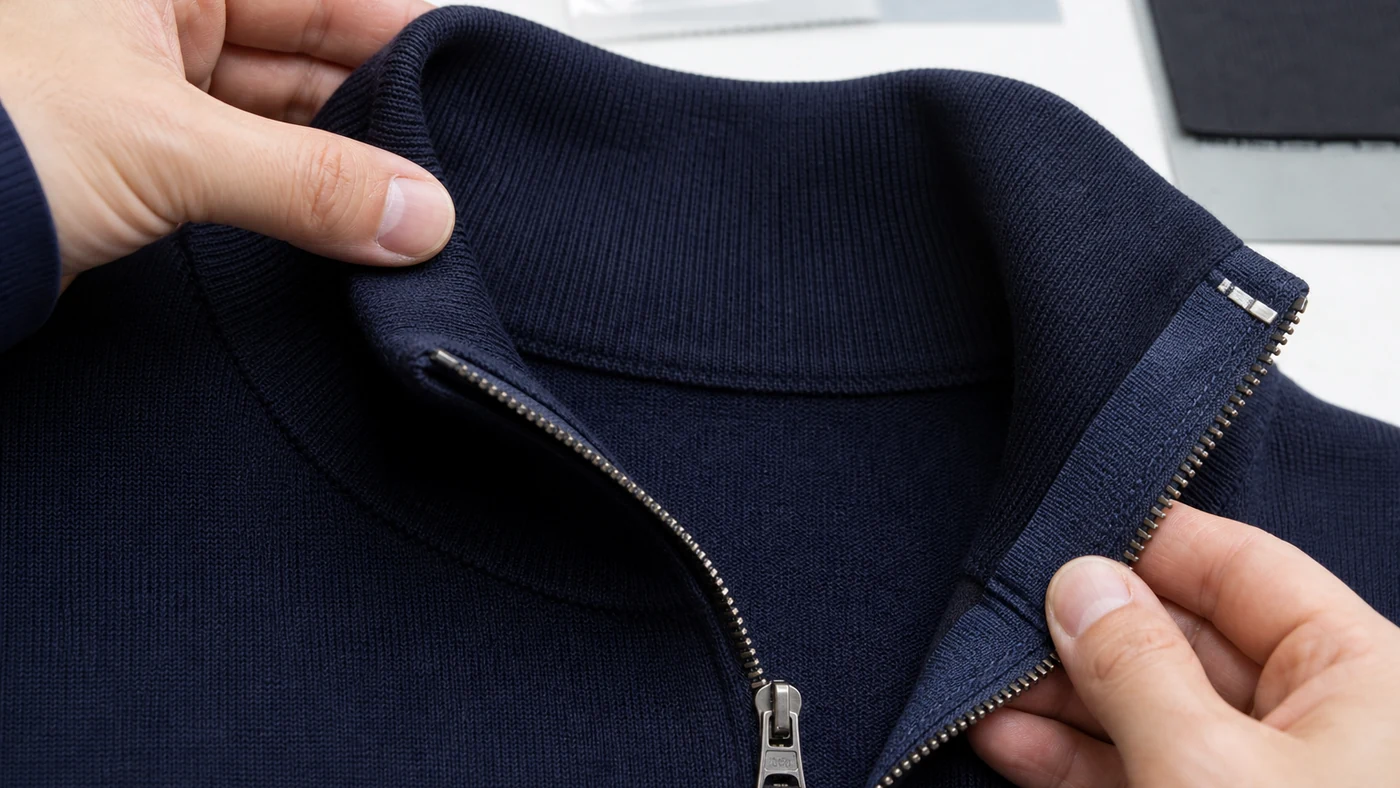
The tech pack should show collar height when fully closed, collar shape when open, neckline depth, front opening length, overlap or facing construction, rib structure, and finished stretch. It should also define whether the collar is single-layer or double-layer, whether it includes reinforcement, and how the zipper tape is covered on the inside.
The open position matters as much as the closed position. A collar can meet its flat measurements while spreading awkwardly on the body. Buyers should therefore review front, side, and inside photographs on a fitted sample, not only a garment laid flat on a table.
For a program developed through custom zip-up knitwear development, the zipper length, tape, slider, puller, teeth type, colour, and insertion method should be approved as a coordinated system. Changing one component after fit approval may alter the opening length, weight, drape, or visual balance.
Treat zipper waviness as a system problem
Zipper waviness is rarely solved by asking sewing operators to “make it flatter.” The root cause may involve excessive knitted-panel stretch, unstable edge construction, incorrect tape length, feeding tension, finishing shrinkage, or a mismatch between zipper stiffness and fabric weight.
The approved sample should record:
- zipper brand or approved equivalent;
- zipper type and exact usable length;
- tape and teeth colour reference;
- puller design, finish, and orientation;
- seam allowance and attachment method;
- inside facing or knitted cover;
- bar-tack or reinforcement points;
- top and bottom stop position;
- acceptable appearance when closed and open.
A practical bulk standard also includes a limit sample showing acceptable flatness. Written instructions help, but a visual reference reduces subjective decisions at the sewing and final-inspection stages.
Which Measurements and Fit Points Must Be Controlled?
Quarter-zip fit should be controlled through both body measurements and functional neckline measurements. Buyers need enough points of measurement to protect the intended silhouette without creating an unnecessarily complicated specification that cannot be inspected consistently.
Build the measurement chart around product risk
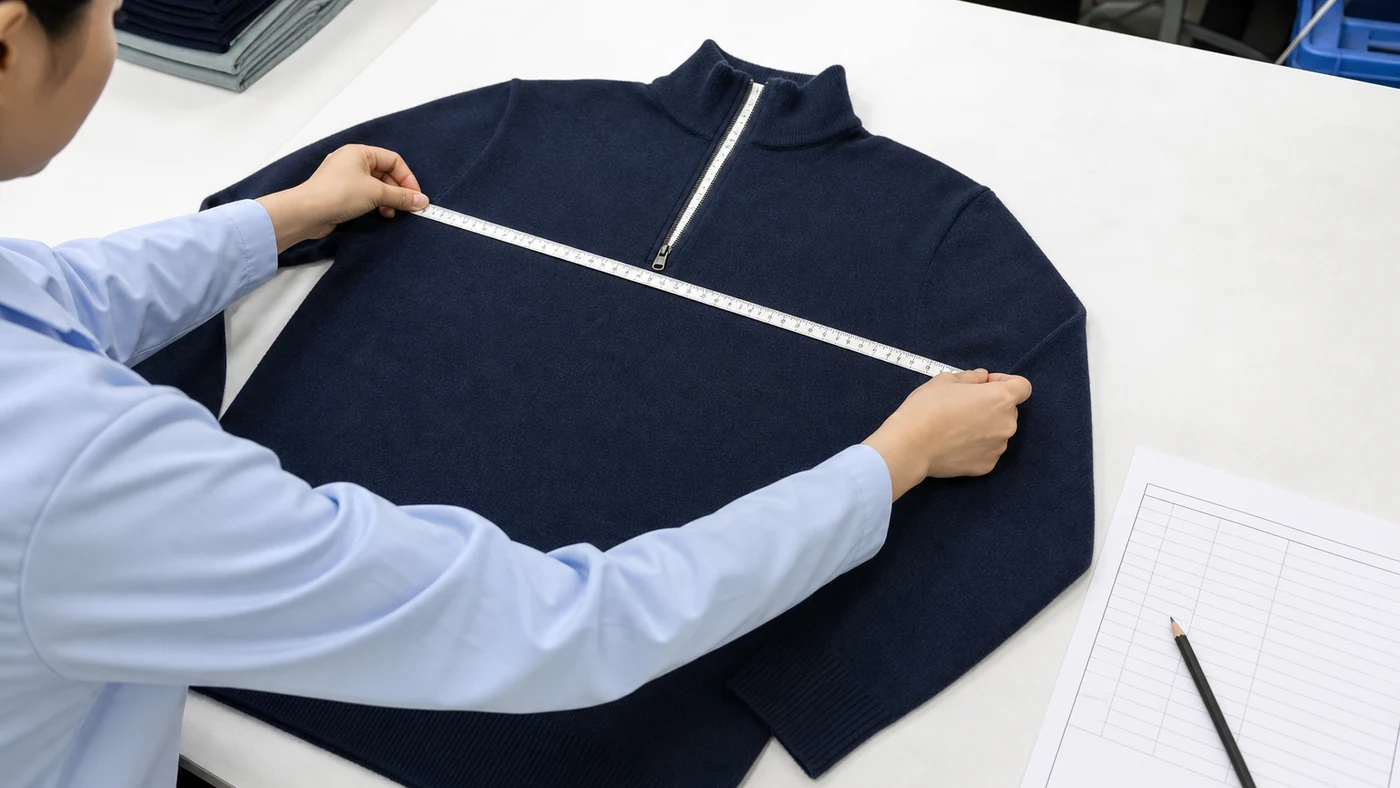
Core points normally include chest width, body length, shoulder width, sleeve length, armhole depth, bicep, cuff opening, bottom opening, collar height, neckline width, front opening length, and zipper length. Depending on the construction, the chart may also need back-neck drop, front-neck drop, shoulder slope, sleeve cap, rib height, and placket width.
Each point should include:
- a clear measurement method;
- the sample size value;
- grading increments;
- finished garment tolerance;
- whether the garment is measured relaxed or extended;
- whether measurement occurs before or after finishing.
Knitted products can relax after they leave the machine and change again after washing, steaming, or prolonged hanging. The measurement stage must therefore be consistent. Comparing an unfinished panel with a finished garment creates misleading conclusions even when both numbers are technically correct.
Review grading around the neck and zipper
Buyers often focus grading attention on chest and body length while assuming the zipper and collar will scale automatically. That can create a small size with an opening that feels too deep or a large size with a collar that looks undersized. The factory should confirm whether zipper length stays constant across sizes or changes by a defined increment.
The first fit review should assess movement as well as static measurements. Check whether the collar presses against the throat, whether the zipper end creates a hard point, whether the shoulder pulls when the zipper is closed, and whether the open collar falls symmetrically. These observations should be converted into measurable corrections before the next sample. Teams expanding the approved base size into a full range can use this custom knit sweater size-grading guide to structure the next review.
What Testing Should Be Approved Before Bulk Production?
Testing should reflect the claimed care method, target market, material risk, and end use. A generic instruction to “test shrinkage and pilling” is incomplete because different methods and conditions can produce results that are not directly comparable.
Define wash and appearance methods
The current ISO 6330 domestic washing and drying procedures provide defined washing-machine, detergent, ballast, washing, and drying options for textile testing. Buyers should select a method that matches the intended care label rather than allowing a laboratory or supplier to choose an unspecified default.
For dimensional stability, record the number of cycles, wash temperature, drying method, measurement points, conditioning method, and allowable change. The collar, front opening, body length, sleeve length, chest, and bottom width deserve particular attention. A quarter-zip garment can remain within overall body tolerance while the placket and collar distort visibly.
Post-wash appearance should include:
- zipper flatness and operation;
- collar shape and symmetry;
- surface felting or matting;
- seam puckering;
- colour change and staining;
- dimensional change;
- hand-feel change;
- trim damage;
- twisting or spirality.
Set pilling criteria with a named method
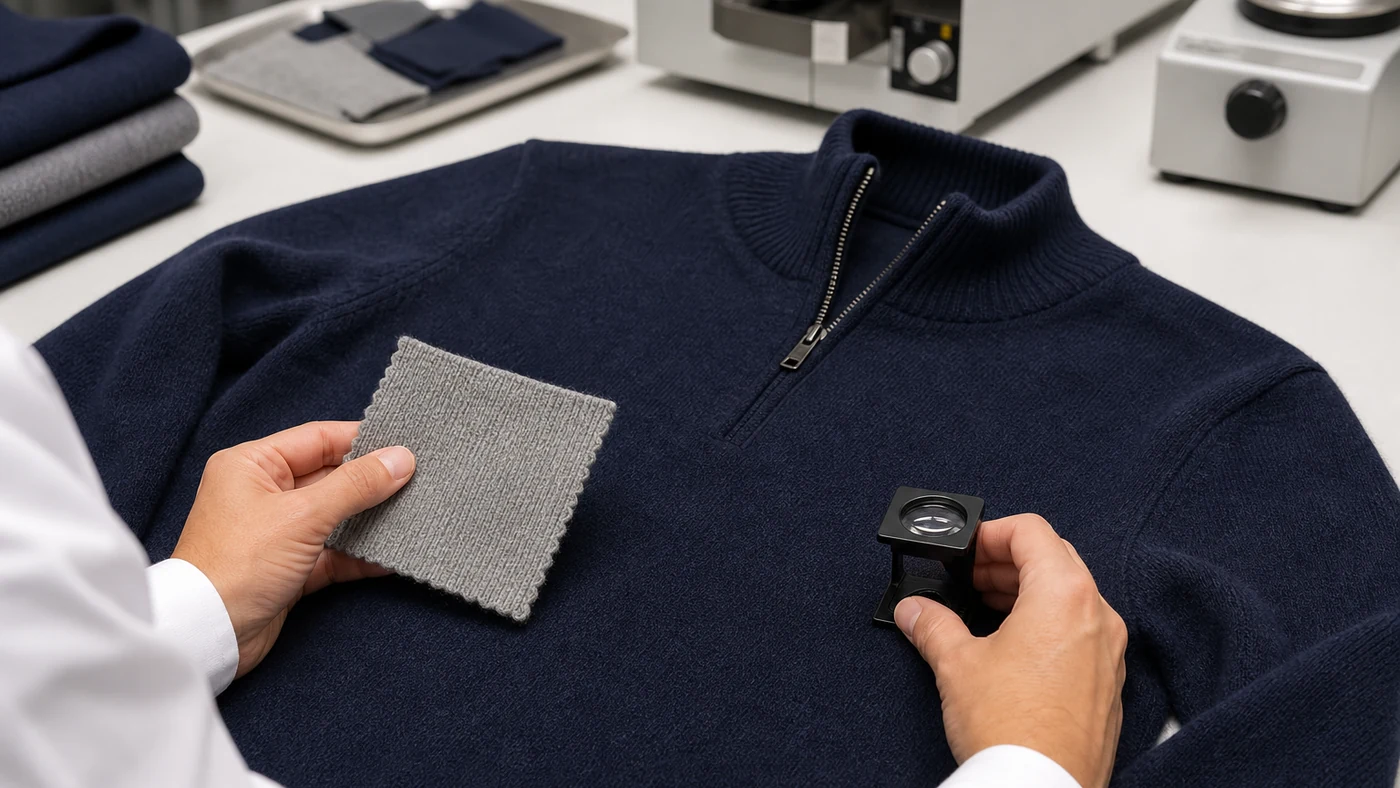
Merino garments can develop surface fuzz and pills through abrasion, but a useful requirement must name the test and acceptance level. ISO 12945-3:2020 specifies a random-tumble method for assessing resistance to pilling, fuzzing, and matting in many woven and knitted fabrics. Other valid methods may be used, but buyer and supplier must agree on the same method, duration, specimen preparation, and rating scale.
Laboratory results should be read alongside wear expectations. A soft, lofty sweater and a compact uniform-style knit may require different trade-offs. The buyer should define which surfaces are most visible, how the garment will be worn, and whether a blend, yarn twist, stitch density, or finishing change is acceptable if testing misses the target.
How Should the Approved Sample Become a Bulk Standard?
Bulk consistency depends on converting approval comments into controlled records. Email phrases such as “make the collar cleaner” or “use the softer option” are not strong production instructions unless they point to a numbered sample, swatch, trim card, measurement chart, and dated approval.
Build a complete approval pack
Before the purchase order is released, the approval pack should include:
- final tech pack and measurement chart;
- approved yarn, colour, and hand-feel references;
- fibre-content and traceability documents where required;
- approved zipper and trim card;
- sealed fit or pre-production sample;
- wash and pilling test requirements;
- care, composition, origin, and branding artwork;
- packaging instructions;
- inspection level and defect definitions;
- approved substitutions and escalation contacts.
An OEM knitwear manufacturing service can coordinate these inputs, but responsibility remains shared. The buyer must provide clear market, fit, labelling, and commercial requirements; the manufacturer must identify feasibility conflicts before bulk yarn or trims are committed.
Protect the autumn and winter delivery window
Seasonal timing should be planned backward from the required warehouse date. Yarn confirmation, lab dips, trim development, sampling, fit corrections, testing, bulk knitting, linking, finishing, inspection, packing, and transport all require time. A delay in colour or zipper approval can block the entire order even when knitting capacity is available.
Use the factory’s current MOQ and lead time planning information as a starting point, then request a project-specific schedule. Quantity, colour count, size range, yarn availability, zipper customisation, test requirements, revision rounds, and peak-season capacity can all change the actual timetable.
The purchase order should identify the critical approval dates and explain what happens when the buyer misses one. A transparent schedule is more useful than an optimistic delivery promise that assumes immediate approvals.
What Should Buyers Check During Bulk Inspection?
Bulk inspection should verify the approved product system rather than focus only on obvious workmanship. The inspector needs the sealed sample, measurement chart, trim card, colour standard, test requirements, packing instructions, and defect classification. The site’s detailed knitwear quality-control checklist and inspection protocol explains how PP, inline and final checks work together.
Inspect high-risk features by colour and size
Quarter-zip programs should be sampled across sizes and colourways because yarn behaviour, dye lots, zipper shades, and finishing response may differ. Inspection points include:
- composition and care labels;
- colour against the approved standard;
- garment weight by named size;
- key measurements and grading consistency;
- collar height, shape, and symmetry;
- zipper length, colour, operation, and flatness;
- seam and linking integrity;
- surface pilling, holes, dropped stitches, oil marks, and repairs;
- finishing, pressing, folding, and packaging.
Do not evaluate the zipper only while the garment lies flat. Open and close it several times, check the inside finish, and examine the collar on a form or wearer when possible. Functional defects can be missed by a purely visual table inspection.
Define decisions before defects appear
The quality agreement should distinguish critical, major, and minor defects and state who can approve rework, replacement, concession, or shipment. A measurable standard prevents commercial pressure near the ship date from turning an unacceptable issue into an improvised decision.
When a problem appears, isolate the affected lot, size, colour, machine group, or trim batch before assuming the whole order is identical. Traceability makes corrective action faster and reduces unnecessary reinspection.
Conclusion
A successful merino wool quarter zip sweater begins with connected specifications, not a reference image and a material name. Buyers need to align fibre content, micron direction, yarn count, gauge, weight, fit, collar geometry, zipper construction, care route, testing, labelling, and bulk inspection before production commitments are made.
The strongest development pack makes every approval traceable to a physical or measurable standard. It also leaves room for the manufacturer to flag trade-offs before they become sample failures or bulk claims. You can review CNSweaters’ knitwear manufacturing capabilities before submitting a brief. If you are planning an autumn or winter quarter-zip program, send your project requirements with the intended market, composition, target quantity, size range, colour plan, delivery date, reference images, and technical file. That information allows the development team to evaluate yarn, gauge, zipper construction, sampling steps, and a realistic production schedule.
Related CNSweaters Resources
- CNSweaters custom knitwear manufacturing
- Premium mens half zip jumper yarn planning
- Custom knit sweater size-grading guide
- Knitwear quality-control checklist and inspection protocol
- Custom zip-up knitwear development
- MOQ and lead-time planning
Planning a Merino Quarter-Zip Program?
Send your target composition, quantity, size range, colour plan, zipper requirements and delivery date. Our development team will review the yarn, gauge, construction and production schedule.
FAQ
What information is needed to quote a merino quarter zip sweater?
Provide the fibre composition, target micron or hand-feel direction, yarn reference if available, gauge or fabric-weight target, size range, colour count, zipper specification, branding, packaging, quantity, destination market, testing requirements, and required delivery date. A reference image helps explain appearance but does not replace technical specifications.
Should a buyer choose gauge before asking for a sample?
The gauge should be agreed before the full prototype, but it can be selected with the manufacturer after reviewing yarn and swatch options. Approving a small swatch first is useful when the buyer is deciding between different weights or surface characters.
How can zipper waviness be reduced in knitted garments?
Control the knitted edge structure, panel stretch, zipper-tape length, feeding tension, attachment method, and finishing shrinkage as one system. Approve the zipper on a finished sample and retain a visual limit standard for bulk inspection.
Which tests matter most for a merino quarter zip?
Typical priorities are fibre composition, dimensional stability under the intended care method, pilling or fuzzing, colourfastness where relevant, post-wash appearance, zipper performance, seam integrity, and finished measurements. The exact methods and acceptance levels should match the destination market and product use.
When should buyers start an autumn or winter program?
Start early enough to allow yarn review, colour approval, trim development, at least one fitted sample, corrections, testing, bulk production, inspection, and transport. July can be a practical development period for northern-hemisphere autumn and winter programs, but the project schedule still depends on yarn, quantity, revision rounds, and the required warehouse date.