 CN Sweaters
A profitable pre-fall short sleeve cotton sweater program begins with SKU architecture, not a large color card. Wholesale buyers need to decide what job the style performs, how much inventory risk belongs in each color and size, and which product standards must remain unchanged if the line is reordered.
The garment itself still matters: composition, gauge, weight, opacity, fit and wash stability determine whether the product is commercially usable. But wholesale execution adds another layer. MOQ, quote scope, size depth, labels, packaging, inspection and delivery milestones must all support a coherent assortment rather than a collection of disconnected samples.
What Role Should the Sweater Play in Pre-Fall?
The assortment role determines the right construction and inventory depth. “Pre-fall” is a selling window, not a technical specification, so the buyer must define how this knit bridges current warm weather and the first demand for layering.
Define the use case before the SKU count
Write a one-sentence product role such as: “A lightweight short-sleeve crewneck for indoor wear, early-fall layering and coordinated presentation with existing bottoms.” Add the target customer, retail channel, intended layer, climate, target delivery date and price position.
This statement guides product and buying decisions. A next-to-skin style may need a smoother yarn, more controlled opacity and a softer neck finish. A layering piece may need slightly more ease through the body and armhole. A high-volume commercial basic needs a construction and color platform that can be reproduced without recreating the product at every reorder.
Buyers can review sweater manufacturing options to place the style within a broader knitwear range. The specific wholesale program still needs its own approved yarn, measurement chart, color standards and release criteria.
Separate core volume from test inventory
Classify each proposed SKU before sending the purchase order. Core colors are expected to carry the line and may justify deeper size coverage. Test colors or directional shades should have a clear learning purpose and a controlled exposure. Do not give every color equal depth merely because the order sheet is easier to build that way.
The same logic applies to size allocation. Use the retailer’s relevant historical sales, returns and fit information where available. If the style or customer is new, document the assumption behind the size curve and protect the first order from false precision. A test order should produce information that improves the reorder; it should not scatter a small quantity across so many combinations that no SKU provides a readable signal.
Lock Cotton, Gauge, Weight and Wash Performance
Quotes and samples are comparable only when they refer to the same product. “Cotton short-sleeve sweater” leaves too many variables open to support a wholesale decision.
Approve composition and construction as one system
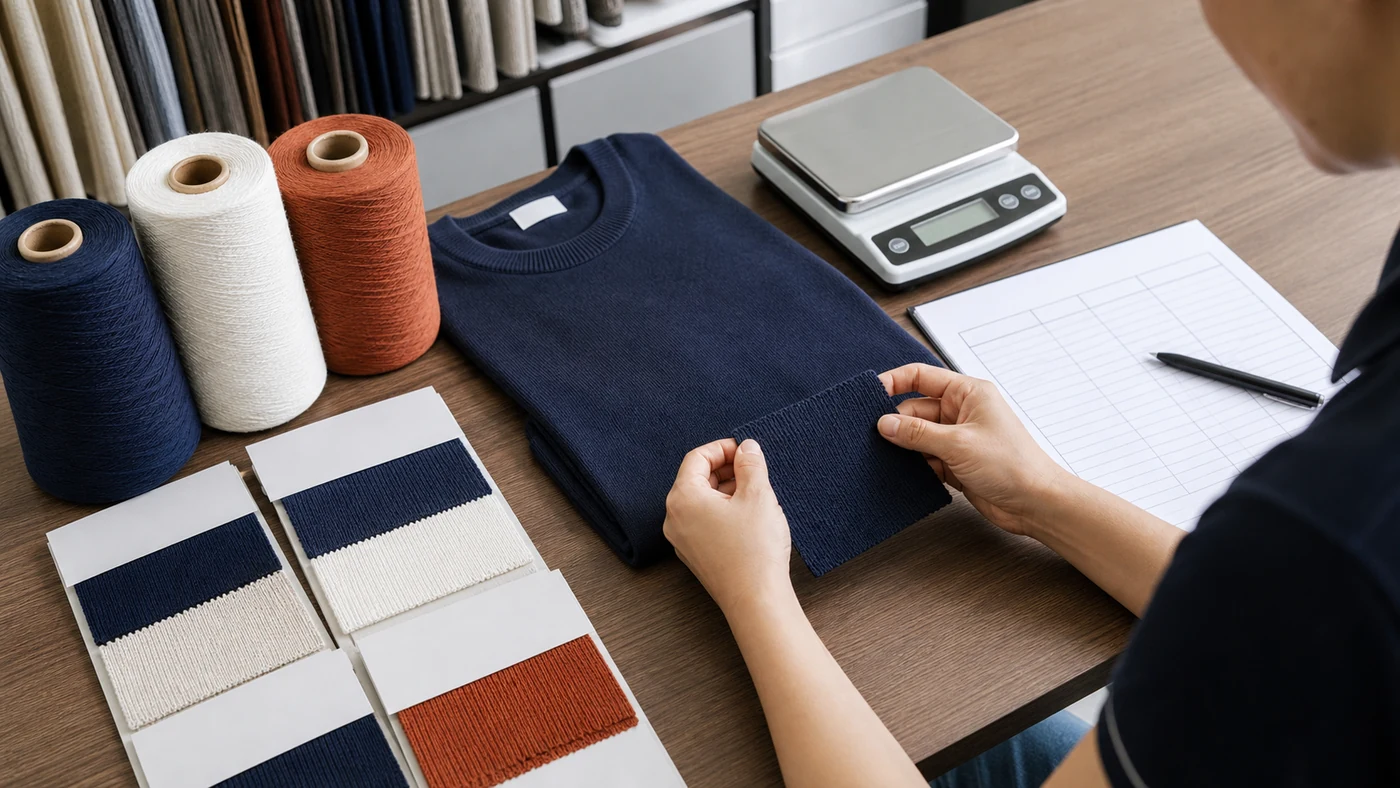
Record the exact fiber percentages, yarn reference, count or ply, machine gauge, stitch structure, stitch density and finished garment weight in a stated size. Add the intended opacity, handfeel and care route. If a blend is acceptable, define which performance or cost need the blend should solve rather than inviting unrestricted substitutions.
The Federal Trade Commission’s cotton labeling guidance explains that covered products sold in the United States must present fiber content accurately. A product should not be called “100% cotton” unless it contains only cotton apart from permitted trim. Named cotton types and related advertising claims also need truthful supporting composition.
For procurement, that means the fiber statement in the quotation, yarn document, test request, label artwork and product listing should agree. If the supplier proposes a different composition to meet cost or delivery, treat it as a new product decision and recheck performance and labeling.
Test the finished garment, not only the swatch
A labeled swatch is useful for comparing yarn, gauge, surface and opacity, but it cannot prove garment fit or edge stability. Approve a full sample with target weight, neck opening, shoulder, armhole, sleeve opening, body measurements and hem recovery recorded.
Define the wash and drying procedure, number of cycles, conditioning and dimensional tolerances. ISO 6330:2021 specifies standardized domestic washing and drying procedures for textile testing. The buyer should pair the selected procedure with recorded pre- and post-wash garment measurements and an appearance review.
Inspect shrinkage, growth, torque, neckline shape, sleeve flare, hem recovery, pilling, color change and handfeel. If a material, stitch density or finishing route changes after approval, determine whether the sample and test evidence remain valid.
Build Color and Size Depth Around Commercial Risk
The strongest assortment is not necessarily the one with the most SKUs. It is the one where each SKU has a defined role, a credible quantity and an approval standard that can be repeated.
Use a core, support and test structure

Assign every color to one of three practical groups. Core colors carry the main volume and should work across the largest share of the size range. Support colors add assortment breadth while remaining compatible with the yarn and trim platform. Test colors answer a specific question about demand, channel or styling direction.
Before confirming colors, check yarn availability, dyeing requirements, color minimums, shade continuity and the effect of the shade on opacity. Pale colors may reveal the body or underlayer more readily than dark colors in the same construction. Review samples under consistent lighting and retain the approved physical or measured color reference.
Avoid adding a marginal color simply to reach a visual merchandising count. Each additional color creates another yarn or dye approval, label and packing combination, inspection segment and potential reorder mismatch.
Build the size curve from evidence
Set the size range and distribution using relevant channel information. If historical data exists, separate true demand from stockout effects: a size cannot sell after it has run out, and low sales do not always mean low demand. Review fit-related returns and customer feedback when available.
For a new program, choose a documented starting curve and plan how it will be evaluated. The PP and size-set samples should verify the highest-risk ends of the range. Check body length, chest, shoulder or cross-back, armhole, sleeve opening and neck measurements along with the garment’s visual proportions.
The following table links wholesale decisions to the evidence required before release.
| Wholesale decision | Buyer input | Supplier evidence | Release gate |
|---|---|---|---|
| Product role | Customer, channel, wearing window and price position | Construction proposal and sample | Role and sample agree |
| Cotton claim | Exact composition and permitted wording | Yarn document and label draft | Product and claim match |
| Color depth | Core, support and test status | Yarn/color feasibility | Each color has a purpose |
| Size allocation | Range, curve and fit risk | Graded chart and size set | Risk sizes approved |
| Quote comparison | Common specification and trade scope | Itemized quotation | Costs use the same basis |
| Delivery | Required warehouse date | Milestone schedule | Approvals fit the calendar |
| Bulk quality | Defects, tolerances and sampling plan | Inspection protocol | Shipment acceptance defined |
| Reorder | Records to preserve | Yarn, shade and PP references | Repeat pack complete |
This table should be completed with the actual program data. A supplier’s general capability does not replace style-level evidence.
Compare Wholesale Quotes on the Same Specification
The lowest unit price is not necessarily the lowest commercial cost. A quote becomes useful only when the included product, services, terms and assumptions are visible.
Normalize the product before comparing price

Send shortlisted suppliers the same RFQ package: tech pack, measurement chart, composition, yarn or surface direction, gauge, target weight, colors, size distribution, quantity, labels, packaging, testing, inspection, delivery destination and required date. Mark which fields are fixed and which may be proposed.
Then compare whether each response uses the same fiber content, yarn route, stitch structure, trim quality and packaging. A lower quote based on a lighter garment, different blend or simpler finish is not a price advantage for the approved product. It is a different offer.
The wholesale supplier MOQ and QC guide provides a broader supplier-screening framework. For this program, the decisive evidence is whether the supplier can explain the current yarn, sampling, quantity, quality and timing logic in writing.
Separate product cost from order conditions
Record the currency, Incoterm or delivery scope, payment terms, quotation validity and included services. Ask whether sampling, tests, inspection, labels, packaging, cartons, freight, duties or other charges are included. Do not add unlike totals and call the result a landed-cost comparison.
Identify cost drivers that can be changed without weakening the product: reducing weak colorways, consolidating trims, using an approved available yarn or simplifying packaging may be viable. Changing the composition, weight, stitch density or testing can alter the product and should be evaluated accordingly.
An OEM knitwear manufacturing service can translate a controlled tech pack into sampling and bulk production. The buyer remains responsible for confirming that the final quotation and approval pack describe the same commercial product.
How Should Buyers Plan MOQ and Delivery?
MOQ and timing should be solved at the level where the constraint occurs. A headline “pieces per style” number can hide minimums tied to yarn, dye lot, color, size, trim or packaging.
Map each minimum to the SKU plan
Ask the supplier to state the minimum by style, color and any relevant yarn or trim condition. Separate stock-service yarn from custom-dyed yarn and standard buttons from custom trims. A workable total order can still contain an unworkable low-volume color.
If the plan misses a minimum, first test commercial solutions: remove a weak color, increase a core color, share an approved yarn across related styles, use an available shade, or treat a directional SKU as a later test. Do not distribute units into sizes that the sales plan does not support merely to reach a number.
The MOQ and lead-time planning page can help frame the conversation, but the current quotation and order confirmation must state the applicable conditions. Avoid presenting a website number as an unconditional commitment.
Build the calendar backward from receipt
Start with the warehouse receipt date and work backward through transport, customs where relevant, final inspection, packing, finishing, assembly, knitting, yarn and trim procurement, PP approval, testing and sample revisions. Add dates for buyer decisions, not only factory activities.
The critical path often includes color approval, label artwork, packaging or a buyer response that sits outside knitting. Assign an owner and deadline to each approval. If a milestone slips, update the downstream dates rather than preserving an impossible final date on paper.
Keep the reorder route in mind. A successful first shipment is more valuable when yarn reference, shade standard, measurement history, trim source and approved packaging are organized for a faster repeat decision.
Approve Retail Readiness and Bulk Quality
Wholesale acceptance includes more than garment appearance. The product must arrive with accurate labels, correct size and color identification, approved packaging and evidence that the bulk lot meets the agreed standard.
Seal a retail-ready PP pack
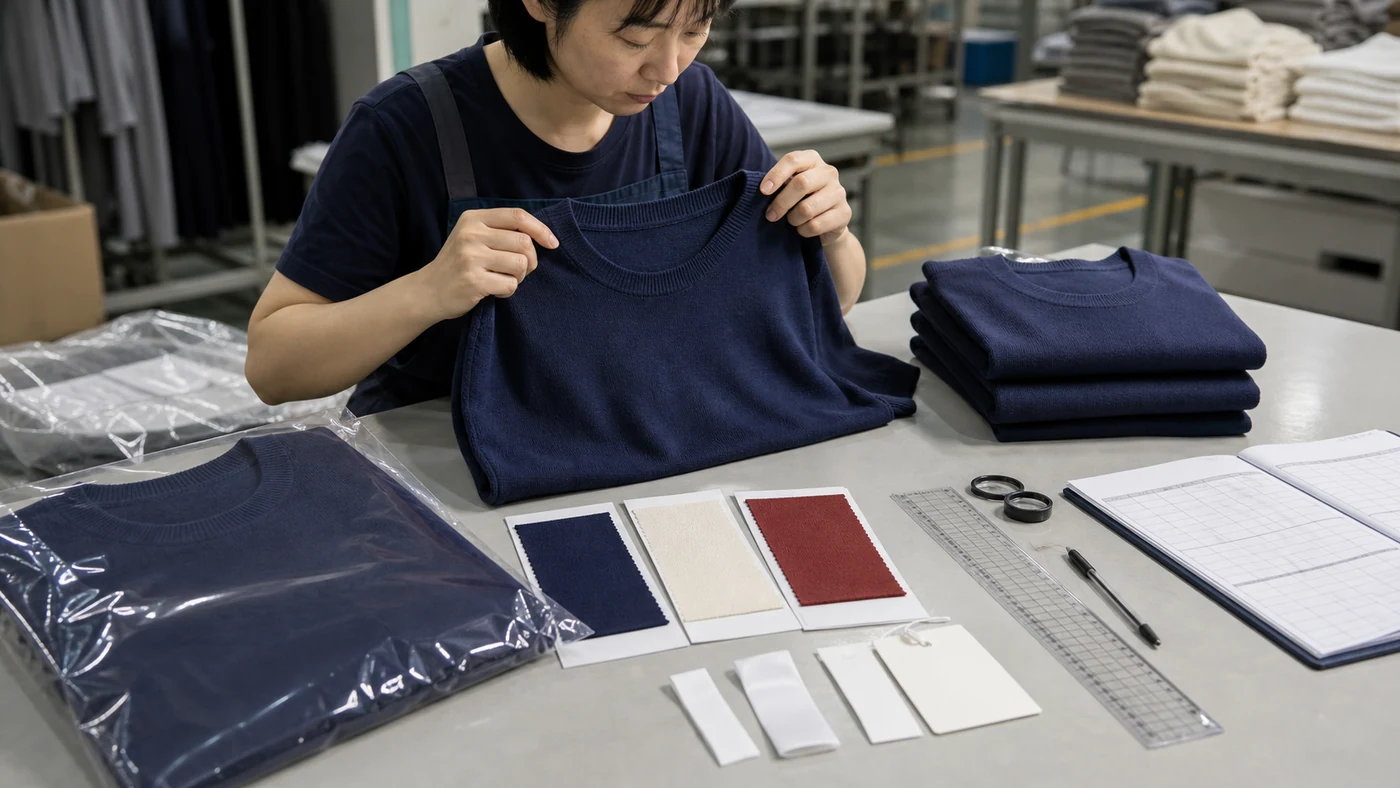
The PP pack should contain the dated approved sample, final tech pack, graded measurement chart and tolerances, yarn and shade references, trim card, label artwork, ticketing, packaging, carton marks, test reports and approval comments. Separate market-specific labels and documents when the order serves more than one destination.
FTC clothing and textiles guidance summarizes U.S. requirements relating to fiber content, country of origin, responsible-party identity and care information. The importer should confirm all obligations for the intended market and ensure that sewn labels, hangtags, packaging and online copy do not conflict.
Conduct a packing trial before bulk packing begins. Confirm fold, polybag or alternative packaging, size marking, barcode readability where required, carton assortment and carton identification. A good garment packed against the wrong SKU is still a wholesale failure.
Define inspection before production
Agree defect categories, measurement tolerances, sample selection, acceptance rules and reporting format before the order is complete. ISO 2859-1:2026 is the current edition defining AQL-indexed acceptance-sampling schemes for lot-by-lot inspection; it replaced the withdrawn 1999 edition.
An AQL plan does not define which cardigan or sweater defects matter. The buyer must still classify issues such as holes, dropped stitches, severe shade variation, incorrect labels, measurement failures, distorted necklines, sleeve flare, loose seams and packing errors. High-risk colors and sizes should be represented in the inspection sample.
Inline checks should identify yarn, shade, density, measurement and workmanship issues while correction is still practical. Final inspection then verifies the finished and packed lot against the sealed PP standard and purchase order.
Preserve Reorder Data Before the First Shipment
Reorder readiness should be built during development rather than reconstructed after the first stock sells. The objective is to know exactly what must remain the same and which changes require fresh approval.
Create the repeat pack
Store the final tech pack, approved measurements, yarn and dye references, shade standards, stitch information, garment weight, trim sources, label files, packaging, test results, inspection report and shipment comments. Record approved substitutions and the dates of every material change.
Do not rely only on a style name or product photograph. Two garments can look similar online while using different yarn, density, finishing or sizing. The repeat pack gives buyer and supplier a common baseline for feasibility, cost and timing.
Review the first order with SKU-level evidence
After launch, compare sales, stockouts, returns, markdowns and fit feedback by color and size where the channel provides reliable data. Separate product problems from inventory-allocation problems. A strong color may appear average if key sizes stocked out early; a weak size may simply have been overbought.
Use the evidence to decide which SKUs deepen, reduce, change or stop. If the material or construction changes, treat it as a controlled development revision and determine which fit, wash, label and cost approvals must be repeated.
The pre-fall program becomes more valuable when the first order produces a clear second decision, not merely a shipment.
Conclusion
A wholesale short sleeve cotton sweater program should be built as a controlled assortment, not a collection of attractive samples. Define the product’s pre-fall role, then lock composition, yarn, gauge, weight, opacity, fit and wash performance before comparing quotes. Allocate colors and sizes according to commercial purpose, and map each MOQ to the actual yarn, color, trim or packaging constraint.
Before release, seal a retail-ready PP pack and define inspection against current, named methods and buyer-specific defects. Preserve the yarn, shade, measurement, trim, label and packaging evidence needed for a repeat order. This approach makes the first buy easier to inspect and the second buy easier to decide. The result is a line where inventory exposure, product quality and supplier execution can be reviewed from the same set of records.
Related CNSweaters Resources
- Knitwear Products and Development Categories
- Low-MOQ Wholesale Sourcing Guide
- OEM Knitwear Production Checklist
- Practical Sweater Factory Guide
- CNSweaters Custom Knitwear Manufacturing
Planning a Pre-Fall Wholesale Program?
Send your target customer, channels, launch date, composition, construction, color roles, size curve, quantities, labels, packaging, inspection needs and delivery destination. The team can use those inputs to review a practical sampling, MOQ and production route.
FAQ
How many colors should a first wholesale order include?
There is no universal number. Use only colors with a defined core, support or test role, and verify that each quantity works with the yarn, dyeing, trim, inspection and reorder plan.
Is garment MOQ the only minimum buyers need to check?
No. Ask about minimums connected to style, color, yarn, dye lot, size, trim and packaging. The binding constraint may sit below the total style quantity.
How can buyers compare two sweater quotations?
Send the same specification and order assumptions, then compare composition, weight, construction, trims, services, trade scope, payment terms and exclusions. Different products should not be treated as price alternatives.
Which samples should be approved before bulk?
Approve the construction and fit sample, colors, size set where required, labels and packaging, then seal a PP sample with the final tech pack, measurements, trim card and testing evidence.
What should be saved for a reorder?
Keep the final specification, yarn and shade references, measurements, garment weight, trims, labels, packaging, test reports, inspection record and approved changes. Add SKU-level sales and return evidence after launch.