 CN Sweaters
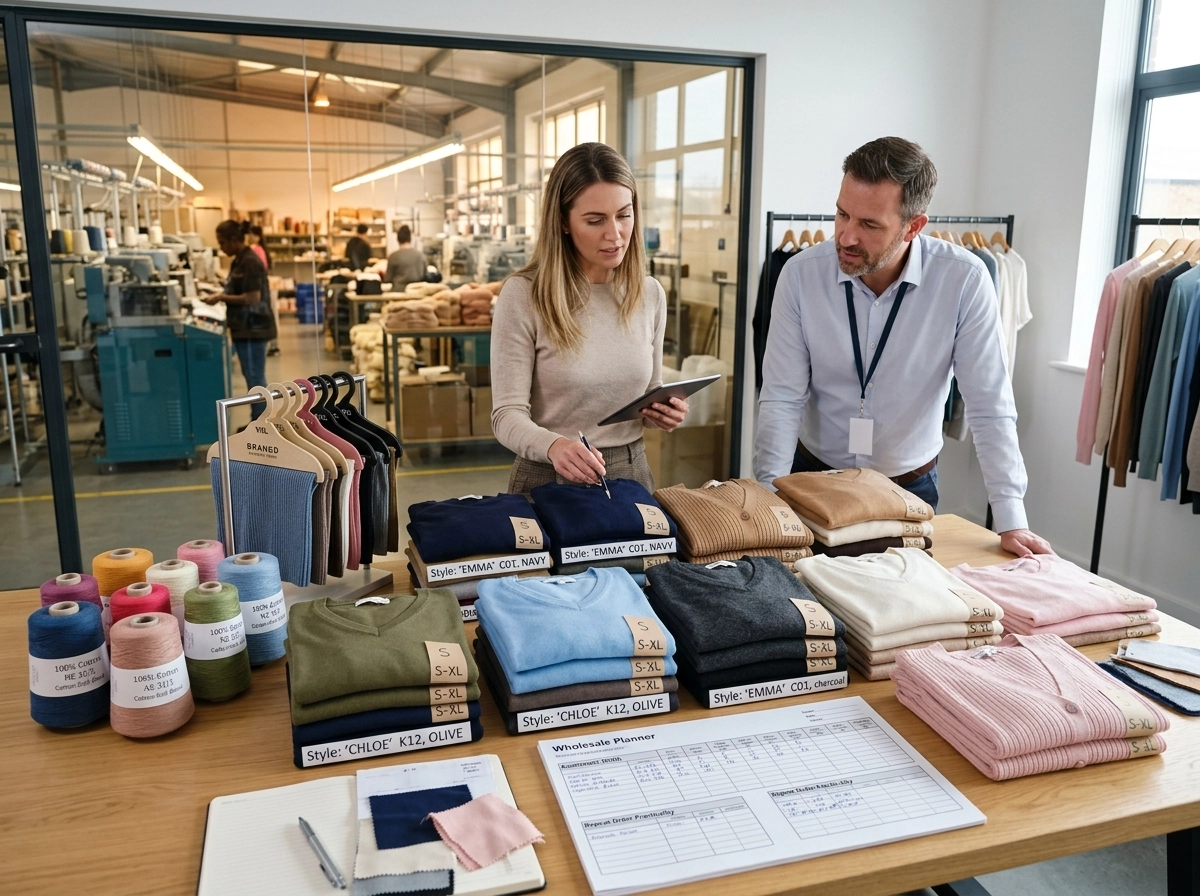
A cotton sweater is one of the most versatile pieces in a B2B knitwear range, but it is not a universal answer for every season, fit, or price point. From a factory perspective, cotton works best when the buyer treats it as a spring/summer and trans-seasonal yarn with specific structural needs, not as a wool substitute. When a cotton knit sweater is matched to the right gauge, structure, and product use, it delivers excellent softness, breathability, and skin comfort. When it is forced into thick winter silhouettes or stretch-heavy fits, retail complaints around shrinkage, sagging, and shape loss tend to follow.
The reason this matters for buyers is simple. Cotton has a low natural elasticity, a higher density than wool, and a tendency to shrink in length under standard home laundering. These are not minor details. They directly affect how a cotton jumper looks after the third wash, how shoulders hold up on a hanger, and how returns trend after the first retail season. Brands that understand these limits before development can use cotton confidently in the categories where it truly performs.
This guide focuses on where cotton sweaters add value, where they create risk, and how gauge, structure, and blend choices change the result for cotton knitwear in spring/summer ranges, casual basics, and lightweight transitional layers.
Where Cotton Sweater Wins in a B2B Product Range
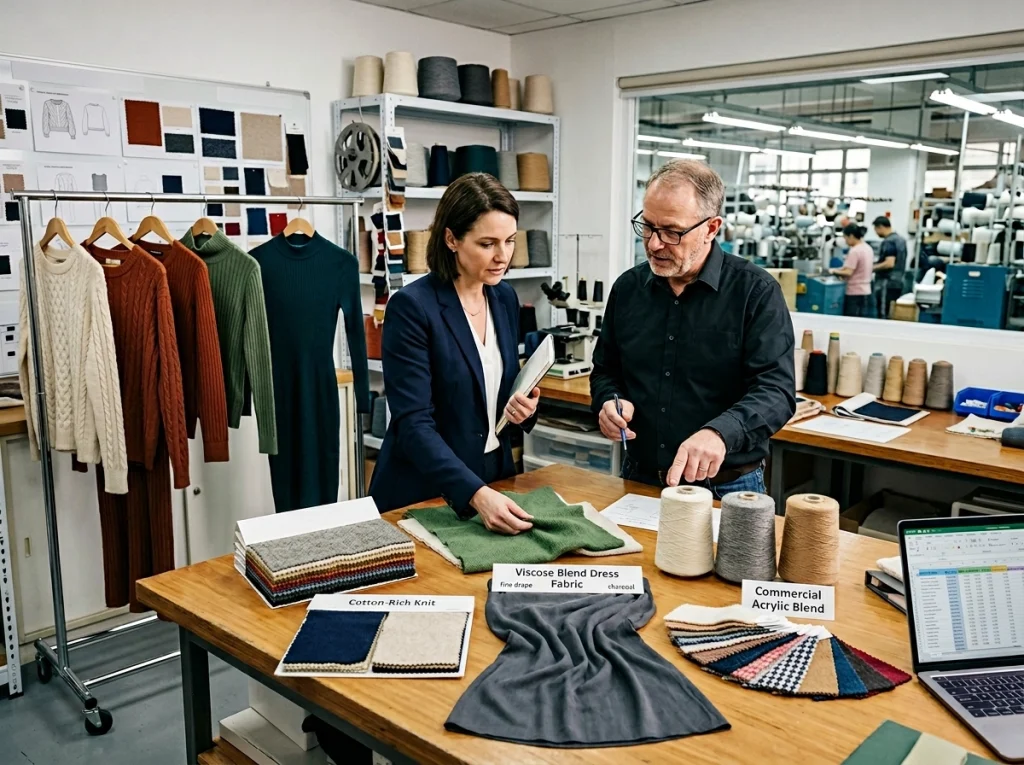
A cotton sweater wins when the product brief prioritises softness against the skin, breathability, and a clean, casual hand feel rather than warmth or heavy structure. For spring/summer ranges, smart-casual basics, and trans-seasonal layering pieces, cotton offers consistent advantages that wool and acrylic cannot replicate at the same price tier.
Cotton fibre is naturally hydrophilic, which is why a cotton knit sweater feels cool on the skin and works well in humid climates and shoulder seasons. The fibre is also low in pilling tendency compared with short-staple wool blends, especially when long-staple cottons are used. For brands selling into Southern Europe, North America, the Middle East, Australia, or East Asia, this seasonal fit is one of the strongest commercial reasons to keep cotton in the range.
Best categories for cotton knitwear
From our development experience, cotton performs most reliably in:
- Lightweight cotton crew neck sweater styles for spring drops
- Cotton cable knit sweater pieces in 5gg–7gg for trans-seasonal use
- Open-knit and pointelle cotton jumpers for resort and SS collections
- Casual cardigans and short-sleeve knit tops for women’s basics
- Men’s smart-casual pullovers where wool feels too warm
You can see these constructions across our Sweaters range when planning a balanced fibre mix in a seasonal buy.
Where cotton struggles
Cotton is not the right answer for heavy winter outerwear knits, high-stretch fitted bodies, or silhouettes that depend on strong recovery. It is also weaker than wool in moisture-vapour management once the garment is fully wet, and it dries more slowly. Buyers planning AW pieces, ski-adjacent knitwear, or strongly fitted ribbed bodies should expect to either blend cotton with elastane and synthetic staple or move to a wool-led construction.
What Are the Real Limits of Cotton in Knitwear
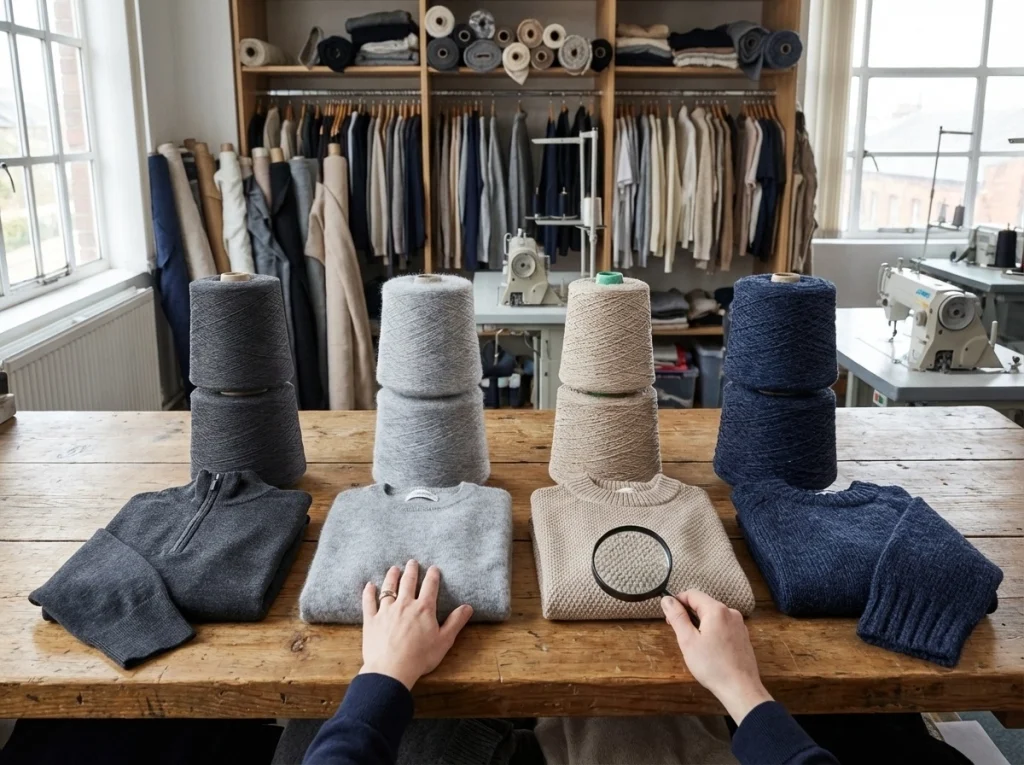
Cotton’s main limits are low elasticity, weight, slow drying, and dimensional change after washing. These are inherent to the fibre and cannot be fully removed, only managed through yarn engineering, gauge choice, finishing, and care instructions. Treating them as design parameters rather than defects is the difference between a profitable cotton knitwear program and a returns problem.
Cotton fibre has very low natural crimp and elasticity compared with wool. In a knit structure, this means a 100% cotton jumper recovers less after stretching, which shows up as bagging at the elbows, cuffs, and hem after wear. The fibre is also denser than wool, so a cotton sweater at the same gauge and stitch length will feel heavier on the body and on the hanger, which affects shoulder line stability over time.
Shrinkage is the other major commercial risk. Cotton knit fabrics typically shrink more in length than in width during the first home wash, and the shrinkage can continue across the first several wash cycles if the fabric was not properly relaxed and finished. Industry guidance from CottonWorks knit basics explains how stitch length, tension, and finishing directly influence dimensional behaviour, which is why tech pack tolerances must be agreed before bulk.
The table below summarises the typical trade-offs we discuss with buyers during development.
| Property | 100% Cotton Sweater | Cotton/Acrylic Blend | Cotton/Wool Blend | Cotton/Elastane Blend |
|---|---|---|---|---|
| Softness next to skin | High | Medium | Medium-High | High |
| Breathability | High | Medium | Medium-High | Medium |
| Elastic recovery | Low | Medium | Medium | High |
| Shrinkage risk after wash | Medium-High | Low-Medium | Medium | Medium |
| Warmth for winter | Low | Medium | High | Low |
| Best season | SS / trans-seasonal | All-season basics | AW | Fitted SS styles |
For B2B buyers, this means fibre choice is not just a cost decision. It changes returns, retail life, and how the garment performs at the third or fourth wash, which is when most negative consumer feedback appears.
How Does Gauge and Structure Change Cotton Sweater Performance
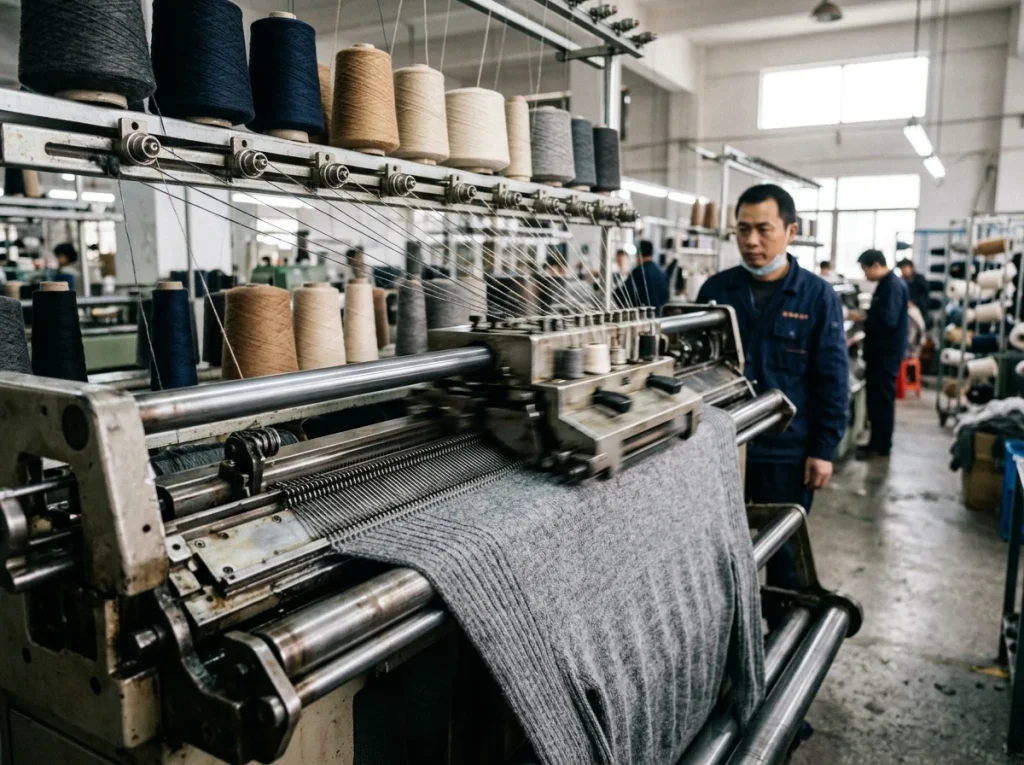
Gauge and stitch structure are the two strongest levers a buyer has to manage cotton’s weaknesses without changing the fibre. The same cotton yarn can produce a soft, drapey summer pullover or a heavy, sag-prone winter piece depending on machine gauge, stitch length, and structural choices. From a factory perspective, getting these right at development stage is more important than chasing a specific yarn count.
Finer gauges, typically 12gg and 14gg, produce lighter cotton knit sweater fabrics with better drape and lower total garment weight. These are ideal for cotton crew neck sweater styles, fine-knit polos, and lightweight cardigans. Coarser gauges, such as 3gg, 5gg, and 7gg, produce visible texture and are better suited to cotton cable knit sweater designs, chunky summer pullovers, and casual men’s basics. However, coarser gauges in 100% cotton can become heavy and prone to sagging if stitch length is too loose.
Structure choices that improve cotton behaviour
We typically recommend buyers consider the following structural choices when working with cotton:
- Use jersey or fine links-links structures for lightweight SS pullovers to keep weight under control
- Use cables, moss stitch, and structured rib mixes to add visual interest at 5gg–7gg without going too heavy
- Use double-layer or interlock-style structures only when garment weight is acceptable for the target retail price
- Avoid long unsupported floats in 100% cotton, since cotton’s low recovery makes float-related distortion more visible
Why this matters for retail performance
For a private label or wholesale buyer, gauge and structure decisions directly affect shipping weight, freight cost per unit, perceived quality at the hanger, and how the garment ages over a season. A cotton jumper at 12gg in a 2/28Nm yarn behaves very differently from the same yarn at 7gg with a loose stitch length, even though the fibre composition is identical on the label.
Shrinkage, Washing and Dimensional Stability in Cotton Sweaters
Shrinkage is the single most common post-shipment complaint we see on 100% cotton knitwear, and it is almost always preventable at the development and finishing stage. Cotton fabric shrinks because the fibre swells when wet and the knit loops contract as internal stresses relax during washing and drying. The result is a garment that can lose 3–8% in length and a smaller amount in width if the fabric was knitted under high tension and not properly relaxed.
The most reliable controls happen before bulk production, not after. Yarn pre-treatment, controlled stitch length, fabric relaxation, steam finishing, and realistic wash testing on bulk-representative panels all reduce the risk. Brands that skip wash testing on production-equivalent samples often see the first complaints land after the third or fourth consumer wash. Care labels also need to match what the fabric can realistically tolerate, since hot tumble drying will amplify any latent shrinkage.
Practical controls we apply in production
In our development process, we typically combine several controls:
- Choose mercerised or compact-spun cotton for tighter, more stable yarn structure
- Run bulk-representative wash tests at 30°C and 40°C with line dry and tumble dry to map dimensional change
- Adjust stitch length and gauge to match the agreed weight without over-tensioning the fabric
- Apply controlled steam relaxation before measuring final dimensions
Independent testing such as the dimensional stability and care label services described by Intertek textile testing can be commissioned by the brand or coordinated through the factory, depending on the buyer’s QA framework.
What buyers should ask for in the tech pack
For B2B orders, we recommend buyers specify allowed shrinkage tolerances (commonly ±5% in length and ±4% in width for cotton knits, though this depends on construction), wash temperature, drying method, and the test standard to be used. Without these, the factory and the buyer end up debating who is responsible when a retailer reports size complaints. Clear tolerances in the tech pack also make refill orders and seasonal repeats far more predictable, because the same controls can be re-applied on the next production batch.
Cotton Sweater Versus Blends for B2B Product Lines
A 100% cotton sweater is not always the best commercial answer, even when the brand’s marketing direction favours natural fibres. Blending cotton with small percentages of other fibres can solve the elasticity, weight, and shrinkage limits while keeping cotton as the dominant fibre on the label. The right blend depends on the product use, price tier, and target market.
For casual everyday basics where stretch recovery matters, a 95/5 or 97/3 cotton/elastane blend can significantly improve cuff, hem, and body recovery without changing the cotton hand feel. For trans-seasonal pieces where buyers want warmth without going fully to wool, a 70/30 or 60/40 cotton/wool blend keeps cotton dominant while adding loft and elasticity. For value-tier programs where price is the main constraint, cotton/acrylic blends in the 50/50 to 70/30 range can hold their shape better than 100% cotton and reduce shrinkage risk, though hand feel softens differently than pure cotton.
When to recommend organic cotton sweater options
Organic cotton makes commercial sense when the brand has a sustainability story to tell at retail and when the supply chain can support certified yarn sourcing. The fibre performance of organic cotton is broadly similar to conventional cotton, so it is more a question of certification, traceability, and target customer rather than a technical performance upgrade. For private label buyers, we usually recommend confirming the certification scope (yarn only versus full garment) and aligning the labelling with what the certificate actually covers.
Custom sweater builds for blended programs
For brands building a custom sweater range across multiple blends, the practical approach is to lock the construction (gauge, stitch length, structure) and vary the fibre blend across SKUs so that the silhouette and weight stay consistent on the rack. This makes seasonal repeats and refill orders far easier to manage, and it gives the visual range without forcing buyers to re-approve fit on every new fibre. Buyers can review existing constructions in our Products library when planning blend variants on a known base.
How to Brief a Cotton Sweater Project for Reliable Bulk Results

A reliable cotton sweater bulk starts with a clear, factory-readable brief. Most production problems we see on cotton are not caused by the factory or by the yarn alone, but by missing information in the tech pack, unclear washing expectations, or unrealistic timelines. Buyers who treat cotton as a managed material from the brief stage onward tend to get cleaner approvals, fewer revisions, and more predictable refill orders.
The brief should cover yarn count, fibre blend with allowed tolerance, gauge, stitch structure, target weight per garment, finished measurements with grading, shrinkage tolerance, wash test conditions, and care label intent. It should also state the season, target retail price, and the primary market, since these affect which trade-offs we recommend during sampling. For example, a cotton crew neck sweater for a US wholesale program may need different shrinkage tolerances than the same style for an EU resort brand.
Sampling, MOQ and lead time expectations
For OEM and ODM cotton knitwear, we typically work to the following ranges, though final numbers depend on yarn availability and construction complexity:
- Development sample: 10–15 working days from confirmed tech pack
- Pre-production sample after bulk yarn arrival: 7–10 working days
- MOQ for standard constructions: usually 300–500 pieces per colour per style for stock yarn, higher for custom-dyed yarn
- Lead time for bulk: typically 45–60 days after PPS approval, depending on yarn dyeing and order size
- Refill orders on the same construction: shorter, since fit, fabric, and finishing are already locked
These ranges are typical, not guaranteed. Custom-dyed cotton, specialty yarns, and peak-season capacity can extend timelines, and we always confirm specific dates against current capacity before the buyer commits to a launch window.
Reducing risk before bulk
Two simple steps reduce most bulk-stage problems on cotton: wash test the pre-production sample on bulk-representative fabric, and confirm the care label and shrinkage tolerance in writing before cutting. When these are skipped to save time, the risk usually reappears at the retail end, which is far more expensive to resolve than a one-week PPS extension.
Conclusion
Cotton sweaters earn their place in a B2B range when they are matched to the seasons, silhouettes, and price points where the fibre performs naturally. Treat cotton as a spring/summer and trans-seasonal yarn, manage gauge and structure to control weight and drape, agree shrinkage tolerances in the tech pack, and use blends where elasticity or warmth are non-negotiable. With these controls, cotton knitwear delivers strong retail performance, low complaint rates, and clean refill orders season after season.
If you are planning a cotton-led drop or rebalancing your fibre mix, share your artwork, tech pack, target garment weight, fibre blend preference, quantity per colour, branding requirements, and target delivery date through our knitwear development team at Cainan so we can recommend the right yarn, gauge, and product use for your project.
Ask for cotton yarn, gauge, and product-use suggestions for your sweater project.
FAQ
What is the typical MOQ for a custom cotton sweater program? For standard cotton constructions using stock yarn, MOQ usually starts at 300–500 pieces per colour per style. Custom-dyed cotton, specialty yarns, or complex multi-colour jacquards generally require higher minimums to cover yarn dyeing lots. We can confirm the exact MOQ once the yarn count, blend, and colour count are defined.
How long does sampling take for a cotton knit sweater? A first development sample typically takes 10–15 working days from a confirmed tech pack and artwork. A pre-production sample after bulk yarn arrival takes another 7–10 working days. Adding wash testing on bulk-representative fabric is strongly recommended before approval, since cotton’s shrinkage behaviour is best confirmed on production-equivalent samples.
Can shrinkage be fully eliminated on a 100% cotton sweater? No. Some dimensional change is inherent to cotton knit fabrics. It can be reduced significantly through yarn choice, controlled stitch length, fabric relaxation, steam finishing, and accurate care labels, but a realistic tolerance (commonly around ±5% in length for cotton knits, depending on construction) should be agreed in the tech pack rather than promised at zero.
When should we choose a blend instead of 100% cotton? Choose a blend when the silhouette needs strong stretch recovery, when the season requires more warmth than cotton alone provides, or when the price tier needs better shape stability over time. Small percentages of elastane improve fitted bodies, wool blends add loft for AW, and acrylic blends help on value-tier programs without losing the cotton-dominant label.
How do we plan a reorder on a cotton sweater style? Lock the construction (gauge, stitch length, structure, finishing) and the wash test parameters on the first bulk run, then reuse the same specification for refills. This makes lead times shorter, keeps fit consistent across drops, and lets us flag any yarn lot variation before it affects retail. Confirming reorder windows in advance also helps us reserve capacity during peak season.