 CN Sweaters
A Q4 knitwear forecast is not a purchase order written with softer numbers. It is a decision file that tells the factory what may need capacity, yarn, sampling work or a later confirmation, and what is still too uncertain to reserve. If the file contains only one total unit number, the production team cannot tell whether that number represents confirmed customers, a merchandising ambition, a replenishment option or a sales target.
The useful unit of planning is the decision that can be made now. A buyer may ask a factory to keep an option open for core styles and a possible replenishment while declining to authorise yarn buying. That works only when scope, evidence, date and order owner are clear.
This guide turns a Q4 knitwear forecast into factory inputs: demand signals, size and colour assumptions, material exposure, capacity choices, commercial scenarios and change triggers. Public data can supply context; the buyer still owns the product and channel evidence.
What Question Is This Forecast Supposed to Answer?
Start by writing the question the forecast must answer. “How many sweaters will we sell?” is too broad for a production partner. A workable question is narrower: “What capacity and yarn options should be protected for these styles if the retailer confirms the base assortment by this date?” The answer determines which details belong in the pack.
Separate an estimate from a commitment
Label each number by its commercial status. Use terms such as confirmed order, customer indication, sell-through based replenishment, internal target, or exploratory range plan. Include the evidence date and the person who can change the status. A factory can then distinguish a quantity that belongs in a purchase order from one that should only inform a capacity conversation.
Avoid turning a forecast into a disguised MOQ promise. If the base case is 1,200 units but the customer has confirmed only 500, show both numbers and label the remaining 700 as an option, estimate or non-commitment. The supplier can then price a hold without treating the higher figure as sold.
The custom knit sweaters tech-pack checklist is the right companion for this distinction. It holds the product facts that do not change with the forecast, such as construction, measurement points, intended yarn and trim requirements. The forecast pack should point to the current technical file rather than duplicating it in a spreadsheet where an old colour or gauge can silently become the working instruction.
Fix the planning horizon and decision date
Name the period covered by each scenario. “Q4 demand” may mean sales, deliveries, or factory work that must begin before Q4. Put the selling window, factory-ready date, yarn commitment, sample approval and order deadline in one view.
For each deadline, record the consequence: a later ship date, stock yarn, a cancelled capacity indication, or a new sample. This lets the buyer decide whether a reservation is worth the cost before the factory has to guess.
Which Demand Signals Are Fit for a Factory?

A factory does not need every retail dashboard. It needs the signals that explain the range, likely volume and confidence around the next decision: customer commitments, dated wholesale feedback, prior comparable sales, stock on hand and planned promotions.
Keep channel, geography and timing visible
Break the forecast by channel when channels buy differently. Add market, delivery month, style, colour family and size run. A total can conceal that all upside sits in one late colour or one unconfirmed customer.
Use public data only as context. The OECD calls its Composite Leading Indicator an early, qualitative signal of broader economic turning points, so it cannot justify a specific garment reservation. OECD composite leading indicator The Census Bureau’s monthly retail surveys similarly show broad, revisable retail activity rather than a brand’s colour or size mix. U.S. Census Monthly Retail Trade
Show a range, not an invented precision
Create lower, base and upside cases. The lower case must be commercially possible; the upside needs a real trigger, such as a retailer option or replenishment threshold. State source, confidence and review date beside each.
Use a range when the evidence does not support a single number. A neutral crewneck may be expected at 600 to 900 units, with 750 as the base if a buyer review is completed by a stated date. The factory can quote three thresholds instead of renegotiating later.
Keep separate assumptions where one customer wants a deep size run and another wants only two sizes. The mix affects yarn, packing, labels and remaining stock. A total is enough for an early capacity screen, not colour booking or release.
How Should Forecast Be Translated Into Production Inputs?

The factory should be able to turn a scenario into a preliminary production question without reconstructing the assortment from slides. Provide a row for each style and delivery group, and show the unknowns.
Split style volume from colour and size exposure
List style code, colour family, size range, expected units, confidence, channel, desired delivery and next decision date. Where size mix is unknown, show a labelled working ratio. Use last season only where product, price and channel are comparable.
The wholesale knitwear SKU planning guide can help the commercial team separate breadth from depth. A forecast with eight colours and thin depth may create a very different yarn and packing question from the same number of units in three repeat colours. The buyer should decide which variants are core, which are conditional and which may be removed before material is committed.
For a carryover, say whether block, yarn article, colour, trim, label and packing carry over. “Same as last year” is not a material instruction. A new shade or yarn lot can reopen approval even when the style number is unchanged.
Flag material and route constraints early
For every row, identify proposed yarn, stock or custom colour, material minimum, long-lead trim, gauge dependency, test requirement and sample status. These are flags, not purchase instructions; they let the supplier say what can be held and what needs approval first.
Use the private-label knitwear yarn planning guide to keep yarn, blend, count, colour, consumption basis and substitution rule together. Mark a mood-board colour as development work; identify the retained reference for a repeat shade.
This is also where compliance ownership belongs. Include intended content, evidence owner, selling markets and final-label deadline. The U.S. Federal Trade Commission requires fibre-related information to be clear and non-deceptive, so flag a pending label decision rather than copying an old hangtag. FTC textile and wool labeling guidance
What Can the Factory Actually Reserve?
There are different kinds of reservation. A supplier may be able to keep a conversation open about a machine group, prepare a yarn quote, hold a residual lot, schedule a knit-down, or place a material order. Each carries a different cost and cancellation consequence. The forecast should ask for the smallest commitment that protects the buyer’s next decision.
Ask separately about capacity and development work
Ask the factory what capacity can be tentatively identified for the base case, how long the indication remains valid, and which event will release it. Do not assume a familiar supplier has spare capacity because it handled a similar product last season. Request the relevant month, gauge or machine type, linking or finishing requirement, and any dependency on a still-unapproved sample.
For development, ask what the next sample is intended to decide. A knit-down may resolve a colour, density or surface question. A fit sample may resolve proportion, neck recovery or sleeve balance. A pre-production sample should confirm the route that bulk will use. The sampling checklist helps keep those questions separate, so a forecast does not spend weeks making full garments to answer a yarn question.
The response should state whether the factory has only supplied an estimate or has taken an action. “Capacity discussed” is not a hold. “Capacity held until 15 August, subject to fit approval” is a decision that can be managed. Put that wording in the log with a named buyer owner.
Ask separately about yarn, trims and packing
Material exposure often controls the forecast before knitting does. Ask whether the material minimum is based on a yarn article, a dye lot, a colour, a blend, a trim, labels or finished pieces. Request the source of the number, validity date, residual-stock condition and what happens if the lower case is ordered.
The custom sweater MOQ guide explains the threshold behind a quote. A low finished-garment quantity may still leave residual yarn. Show the options: narrow colours, hold a lot, accept residual exposure, move delivery or defer the variant.
For packing, identify open label version, barcode, fold, bag, carton and market document. Keep them with the forecast row; they can break a late replenishment when no one knows which version applies.
How Should Volume Scenarios Be Costed?

Cost scenarios as pathways, not just unit-price columns. Show what must be committed and what is lost when demand lands below or above plan.
Build lower, base and upside cases from the same file
Use one current specification, currency and delivery basis. Vary only what changes: units, colour depth, size mix, yarn, testing, material minimum, packaging and capacity. A simplified lower case and an approved-construction upside are two quotations, not scenarios.
| Scenario choice | Evidence required before commitment | Buyer consequence |
|---|---|---|
| Lower case | customer signal, size mix, material threshold and delivery window | fewer variants or residual-material exposure may remain |
| Base case | current specification, sample status and factory capacity reply | a controlled route can be costed and dated |
| Upside case | trigger, decision deadline, additional material and capacity response | replenishment is possible only within stated limits |
| Pilot first | sample scope, test question and hold period | more calendar is spent before bulk can start |
The custom knit sweaters cost guide separates construction-dependent cost from development, testing and threshold cost. Ask what changes if a colour, size mix or yarn route changes.
Make the last safe decision visible
Every scenario needs a last practical decision point. Map backward from delivery through yarn, sample approval, knitting, finishing, inspection, packing and transport. Include quote validity and any capacity not yet held.
Do not use a single “lead time” cell to hide dependencies. The base case may be feasible if yarn is confirmed by 1 August, while the upside case may require stock yarn or a later delivery. If the buyer wants to hold both, the pack should state the cost or condition of doing so. The knitwear lead-time planning guide can be used to check the sequence, but the order-specific factory response is the evidence that governs the plan.
When Must the Forecast Be Reopened?
A forecast stays useful only while its named assumptions hold. Set triggers before asking a factory for capacity or material information.
Define change triggers by decision, not mood
Use clear triggers: a customer option expires, sell-through misses the agreed range, a new colour is added, the size mix moves, a yarn lot changes, a sample fails a named check, a label claim changes, or the factory cannot meet the stated capacity window. Each trigger should name the affected forecast row and the decision that must be revisited.
For example, an upside replenishment can remain open only if the buyer confirms within the supplier’s capacity-hold period and the approved yarn route is still available. If either condition changes, the team should request a revised option rather than treating the original quote as binding. That protects both sides from a delayed decision being presented as a factory failure.
Keep a dated decision log
Record the current scenario, source date, open item, owner, next check, decision deadline and factory response. When a choice is made, say what it replaces. “Use the base case of 750 units, remove cobalt, retain two core sizes, capacity indication expires 15 August” is far more useful than a chat message saying “go with the latest forecast.”
The log should also state what was not approved. If the buyer declined a yarn hold, say so. If a colour cannot proceed without a new knit-down, retain that gate. A later team member can then distinguish a deliberate commercial boundary from an overlooked task, and the factory is not asked to infer permission from incomplete files.
What Has to Be Handed Off Before Q4?
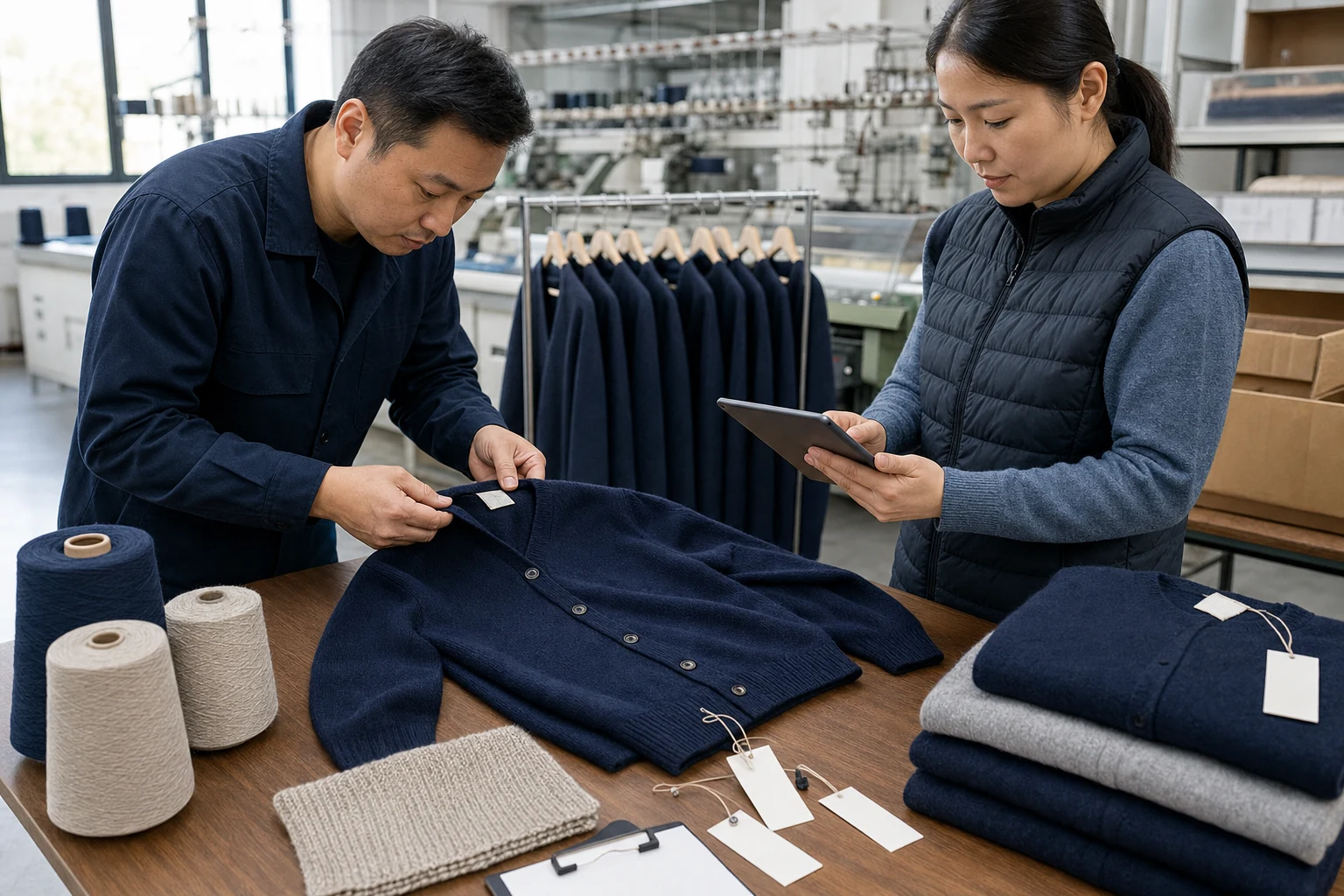
The handoff should allow the factory to respond with a specific option, not a generic production promise. It should be short enough to read, but complete enough to expose the constraints that change price, capacity or timing.
Assemble the forecast pack
Include the current technical pack and sample status; a scenario table by style, colour, size and channel; source and confidence for every demand signal; expected delivery; material and capacity questions; known minimums; label and packing status; a calendar with decision dates; and a log of open decisions. Link to the pre-production sample review guide when the final forecast decision depends on a first-off or pre-production approval.
Send one named file owner from the buyer side and ask for one production-side owner. If different people own yarn, capacity, quality and quotation, the response should say so. The objective is not to make the factory responsible for retail forecasting. It is to provide enough structured information for it to explain what can realistically be offered and what has to wait.
Carry the forecast into first-off and reorders
Once a quantity becomes an order, freeze the approved scenario with the order date and the production route. The first-off should be checked against the technical standard, current yarn or material record, size mix, label version and packing requirement. A beautiful sample made from a different lot or finished through a different route does not prove that the forecasted bulk path is ready.
For a later reorder, compare the new request with the archived scenario. Ask whether the style, yarn, colour, size mix, trim, packing, factory route and delivery assumption are unchanged. Reopen only the decision gates affected by a declared change. The bulk knit sweaters planning guide is a useful place to document those gates, owners and current evidence.
Conclusion
A Q4 knitwear forecast earns its place in a factory conversation when it identifies a real decision: what may need capacity, which material route is still only an option, and when the buyer must convert the plan into a confirmed order. The useful pack labels confidence, source, date, style, colour and size assumptions instead of concealing them inside one total.
Before asking a supplier to reserve anything, compare lower, base and upside scenarios against the same technical file. Record the conditions, costs and deadlines of each route. Then name the changes that require the forecast to be reopened. That gives the buyer a repeatable commercial record and gives the factory a precise brief to answer.
Frequently Asked Questions
Is a forecast the same as an order?
No. A forecast is a scenario with a status, evidence source and decision date. An order authorises a defined quantity and route. Keep the two separate so the factory does not treat an estimate as a material commitment.
What is the minimum information a factory needs?
Provide the current technical pack, style and colour assumptions, size mix or working ratio, delivery window, lower/base/upside quantity, source date, material and capacity questions, and the date when the buyer will make the next decision.
Can public retail data set my unit forecast?
No. It may provide broad context, but it cannot identify your channel, product, customer option, colour or size mix. Use it to challenge assumptions, then rely on your own commercial evidence for factory decisions.
When should yarn be reserved?
Only after the buyer understands the material threshold, option validity, residual exposure and consequence of ordering below the base case. If those conditions are not acceptable, request a different route rather than treating a loose forecast as approval.
What changes require a new forecast review?
Review the affected row when customer demand, size or colour mix, material lot, sample status, label claim, capacity window or delivery date changes. Record the new decision and retire the older assumption.