 CN Sweaters
Distributors who lose money on knitwear rarely lose it on a single bad style. They lose it on assortments that look broad on a line sheet but collapse in the warehouse, where five colors of a slow seller block reorder cash for a proven core. For wholesale knitted sweaters, the SKU plan is the business model, not a back-office detail. Before any purchase order goes to a factory, a distributor needs to know exactly how many styles will carry the season, how deep each one will be bought, and which ones are allowed to fail.
The challenge is structural. Sweater categories naturally multiply: a pullover becomes six colors, five sizes, two gauges, and three yarn blends, and one “simple” style turns into ninety SKUs before the first container ships. Industry inventory frameworks consistently show that a small share of items drives most of the revenue, with the classic 80/20 pattern observed across retail categories according to ABC inventory analysis principles published by NetSuite. For wholesale knitwear, that pattern is even sharper because color and size depth amplify every planning mistake. The job of the buyer is not to maximize choice but to engineer an assortment where core, seasonal, and test layers each play a defined role.
How Should Distributors Size the Total SKU Count

Total SKU count should be sized to the buyer’s reorder cash and warehouse throughput, not to the supplier’s catalog. A distributor serving 40 to 80 independent retail accounts in one country typically operates well with 30 to 60 active sweater SKUs per season, while regional wholesalers covering multiple channels may justify 80 to 150. Beyond that range, picking error rises, slow movers absorb shelf space, and the buyer loses the ability to reorder fast on proven winners.
Anchoring SKU Count to Budget and Turn
Start from the first-order budget and the targeted inventory turn. Mid-market apparel buyers commonly plan around 4 to 8 stock turns per year, with faster turns expected in basic knit sweater programs and slower turns in heavier wool or wholesale cashmere jumpers. Divide the seasonal budget by the average landed cost per unit, then by a realistic minimum depth per SKU. If the math forces fewer than 80 to 120 units per SKU at first order, the assortment is too wide and must be cut before negotiating with wholesale knitwear suppliers.
Style Width vs Color and Size Depth
Width and depth are not interchangeable. A buyer offering ten silhouettes in three colors and four sizes carries the same 120 SKUs as one offering five silhouettes in six colors and four sizes, but the second assortment usually sells faster because each style reaches enough visual presence at the retailer to be noticed. As a practical rule for wholesale knitted jumpers, keep core silhouettes at four to six colors and trend pieces at two to three. Anything broader should be justified by a confirmed reorder commitment from accounts.
What Is the Right Core, Seasonal, and Test SKU Split
A balanced wholesale knitwear assortment usually splits roughly 50 to 60 percent core SKUs, 25 to 35 percent seasonal SKUs, and 10 to 15 percent trend or test SKUs. This ratio protects cash flow because core styles are repeatable and forecastable, while the test layer is small enough that failure does not damage the season. Buyers who invert this ratio, loading the assortment with trendy knitwear, almost always end the season with deep markdowns and shallow reorders.
Defining Core SKUs That Carry Reorders
Core SKUs are the basic knitwear pieces that retailers expect on shelf year after year: round-neck pullovers, V-neck pullovers, classic cable knit sweater silhouettes, fine-gauge cardigans, and quarter-zip styles in stable color palettes. They are produced in mid-gauge cotton blends, merino blends, or acrylic-wool blends with predictable shrinkage and pilling behavior. Garment construction principles described in CottonWorks knit textile design guidance explain why these basic constructions hold dimensional stability through repeated wash cycles, which is precisely what makes them safe for continuous replenishment. A complete core program lives on the sweaters category page and the cardigans collection, where standard silhouettes are documented for OEM/ODM development.
Seasonal and Trend Layers
Seasonal SKUs adjust yarn weight, fiber blend, and color story for the calendar window: heavier 7gg or 5gg constructions and richer tonal palettes for autumn–winter, lighter cotton-linen blends and softer pastels for transitional months. Trend SKUs are short-cycle bets, usually limited to two colors and a narrow size run. They should never be re-cut without confirmed sell-through data from at least three retail accounts.
How to Allocate Budget Across Sweater Categories
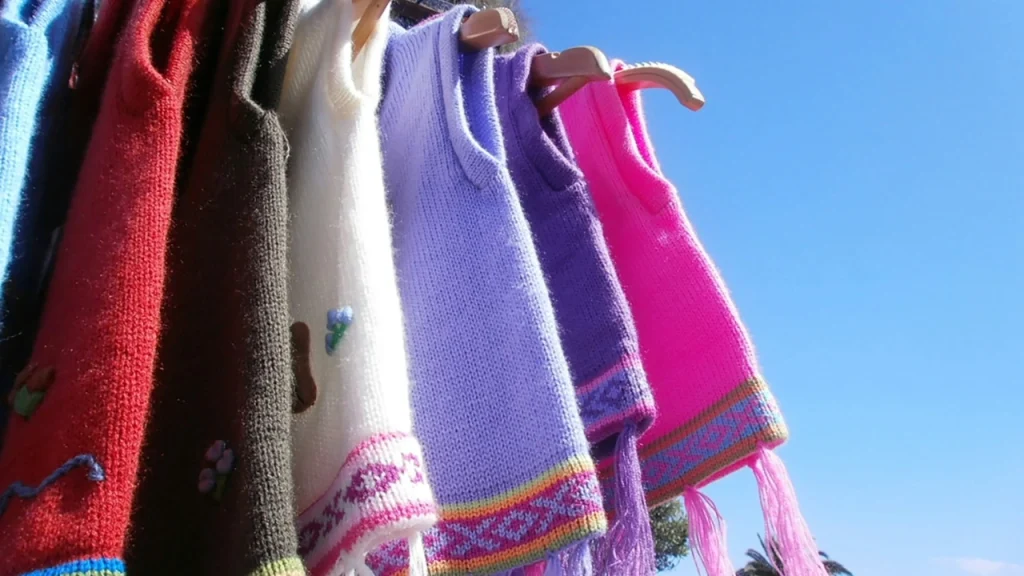
Budget allocation should reflect the actual purchasing behavior of the distributor’s end channel, not personal preference. For most multi-brand wholesale buyers serving general menswear and womenswear, pullovers absorb 45 to 55 percent of the sweater budget, cardigans 20 to 30 percent, vests and sleeveless knitwear 8 to 15 percent, and premium fiber programs such as wholesale cashmere jumpers another 8 to 15 percent. Hoodies and zip knitwear fluctuate by region and channel.
Category Allocation Reference Table
The reference split below works as a starting point for distributors building a wholesale knitted sweaters program from scratch. It should be adjusted against actual sell-through, but the proportions illustrate how the assortment dollars typically distribute when reorder discipline is enforced.
| Category | Budget Share | Typical SKU Count (mid-market) | Core / Seasonal / Test Mix |
|---|---|---|---|
| Pullovers (round, V, crew) | 45–55% | 18–35 | 60 / 30 / 10 |
| Cardigans | 20–30% | 10–18 | 55 / 30 / 15 |
| Vests & Sleeveless Knitwear | 8–15% | 4–10 | 50 / 35 / 15 |
| Cashmere & Premium Blends | 8–15% | 4–8 | 70 / 25 / 5 |
| Hoodies & Zip Knitwear | 5–12% | 4–10 | 45 / 35 / 20 |
Treat this as a planning baseline. A buyer focused on premium boutique accounts may push cashmere and cardigan shares higher, while a value-channel buyer may compress everything into pullovers and zip knitwear. The vest layer is often underweighted by new distributors; the vest and sleeveless knitwear range is useful precisely because it spreads risk across seasons.
Mens vs Womens Allocation Discipline
Wholesale mens knitwear typically runs deeper per SKU and narrower in color: three to four colors at depth, with a stronger lean toward neutrals and earth tones. Wholesale womens knitwear and wholesale womens jumpers tend to require wider color stories, more silhouette variation, and slightly shallower depth per color. Buyers who apply men’s depth logic to women’s assortments end up overbought in single colors; buyers who apply women’s width logic to mens jumpers wholesale end up with thin coverage on every shade. Plan the two grids separately, even when budgets are shared.
How to Build the Color and Size Matrix
The color and size matrix is where most assortment plans fail. A clean matrix requires that every active SKU have a defined minimum order quantity, a defined size ratio, and a defined reorder threshold before it ever enters production. Without those three numbers, the matrix is just a wish list.
Color Count Discipline by SKU Role
Core SKUs in bulk knit sweaters justify four to six colors because they will be replenished. Seasonal SKUs hold two to four colors aligned to the season’s palette. Trend SKUs stay at one or two colors. Across the full assortment, no more than 25 to 30 percent of total SKU lines should be the lightest or brightest shades, because these consistently produce the deepest markdowns. Stable neutrals (charcoal, navy, oatmeal, black, ecru, deep green) should anchor at least half of core color slots.
Size Curves and Tolerance
Size curves vary by market and channel, but a workable European/UK starting curve for wholesale knitted jumpers is roughly 1-2-3-3-2-1 across XS–XXL for womens and 1-2-3-3-2-1 across S–XXXL for mens. North American curves usually shift one size up. Dimensional tolerance on bulk production should be agreed with the factory before sampling, because measurement consistency drives return rates more than any other quality variable. Inspection regimes built on Intertek’s AQL-based textile and apparel inspection framework give buyers a defensible standard for measurement, appearance, and construction defects before goods leave the factory. The associated ANSI/ASQ Z1.4 sampling tables published by ASQ define exactly how many garments must be pulled from a lot at each inspection level, which protects the buyer when disputes arise.
How to Negotiate MOQ Color Mix and Reorder Terms
Most assortment failures trace back to MOQ structures that were never negotiated properly. The published MOQ is rarely the real constraint; the real constraints are per-color minimums, per-size minimums, and reorder lead time. A distributor who locks these three correctly can carry more SKUs with less cash than one who simply accepts the headline figure.
MOQ, Color Splits, and Size Splits
Ask wholesale knitwear suppliers three questions before placing any first order. What is the minimum per style, per color, and per size? Can colors share a yarn dye lot to reduce the per-color floor? Is the size split flexible within the total per color, or fixed? Published MOQ and lead time conditions for a given factory should be confirmed in writing; the MOQ and lead time reference page shows how these parameters can be structured for OEM and ODM development. Production budgeting fundamentals described in Maker’s Row guidance on apparel production budgeting show how unit cost typically falls as quantity per color rises, which is why consolidating colors usually beats adding them.
Reorder Windows and Trend Risk
Reorder lead time for wholesale knitted sweaters is typically 30 to 60 days depending on yarn availability and gauge, sometimes longer for cashmere or specialty blends. That window dictates how aggressive trend buys can be. If the reorder window is longer than the trend’s expected sell-through cycle at retail, the trend SKU should be treated as one-shot only. Inventory planning research summarized by the National Retail Federation on inventory and operational efficiency reinforces that aligning reorder cadence with actual sell-through is more valuable than expanding forecast accuracy on slow movers.
How to Validate the Plan With the Supplier
A wholesale knitted sweater plan only becomes real when the supplier confirms feasibility on every line. The validation step prevents the most expensive late-stage problems: yarn unavailability on a hero color, gauge mismatch on a cable design, or a size that the factory’s machine bank cannot produce efficiently at the planned depth.
Tech Pack, Sampling, and Pre-Production Approval
Each SKU needs a tech pack with composition, gauge, stitch structure, panel construction notes, measurement chart with tolerance, trim specification, wash and care, and packaging. Sampling should cover at least the first proto, a fit sample, and a pre-production sample in the actual bulk yarn lot. Buyers who skip the pre-production sample to save two weeks routinely discover dimensional drift or hand-feel shifts in the first bulk delivery. The development workflow described on the OEM and ODM services page follows this sequence and connects sampling outputs back to the main products catalog so that approved SKUs flow into bulk planning without ambiguity.
Closing the Loop on Quality and Reorder Conditions
Before the first PO closes, agree on the AQL level for finished-goods inspection, the measurement tolerance per point of measure, the rule for handling shade variation across dye lots, and the reorder pricing structure for the first six months. Documenting these in the PO removes most of the friction that otherwise surfaces during peak shipping season, when negotiating leverage is lowest.
Conclusion
A disciplined wholesale knitted sweaters assortment is engineered, not assembled. Core, seasonal, and test layers each carry a defined role; budget is split deliberately across categories; color and size matrices are governed by reorder logic; and MOQ, lead time, and reorder terms are negotiated line by line with the supplier rather than accepted as defaults. Distributors who run this process consistently sell through more units at full margin, reorder faster on proven SKUs, and carry less dead stock into the next season.
Send your target market, sales channels, planned sweater categories, target price bands, color and size matrix, first-order budget, inventory limits, and expected reorder volume to review a distributor-ready wholesale knitted sweater assortment with the CN Sweaters team.
FAQ
What is a realistic first-order MOQ for a new wholesale knitted sweaters program
For a new program, expect per-style minimums in the 200 to 500 piece range across colors and sizes on standard gauges, with per-color floors typically starting around 80 to 150 pieces for stocked yarns. Specialty fibers such as cashmere usually carry higher per-color minimums because dye lots run smaller. Confirm per-style, per-color, and per-size minimums separately before committing.
How many colors should a core sweater style carry at first buy
Four to six colors is the working range for a true core style in wholesale knitwear. Two colors usually means the SKU is being treated as a seasonal or trend bet, while more than six dilutes depth per color and complicates reorders. Anchor at least half of those slots in stable neutrals to protect resale value across multiple seasons.
How long does bulk production take after sample approval
Typical bulk lead time for wholesale knitted sweaters runs 45 to 75 days after pre-production sample approval, depending on yarn availability, gauge, stitch complexity, and order size. Heavier gauges and intarsia or cable constructions sit at the longer end. Reorders on previously produced styles are usually 30 to 60 days when yarn is in stock.
When should a trend SKU be promoted to a core SKU
A trend SKU earns core status only after at least two consecutive seasons of sell-through above the assortment average, ideally validated across multiple retail accounts and channels. Promotion should trigger a wider color buy and a documented reorder protocol; without those, the SKU stays in the seasonal or test layer.
How is shade variation between dye lots controlled
Shade variation is controlled through approved lab dips, a master shade band signed off before bulk, and an agreed tolerance on color difference per dye lot. The inspection protocol should specify how shade-band failures are handled, including whether out-of-tolerance lots are reworked, repriced, or rejected. This needs to be in the PO, not negotiated after delivery.