 CN Sweaters
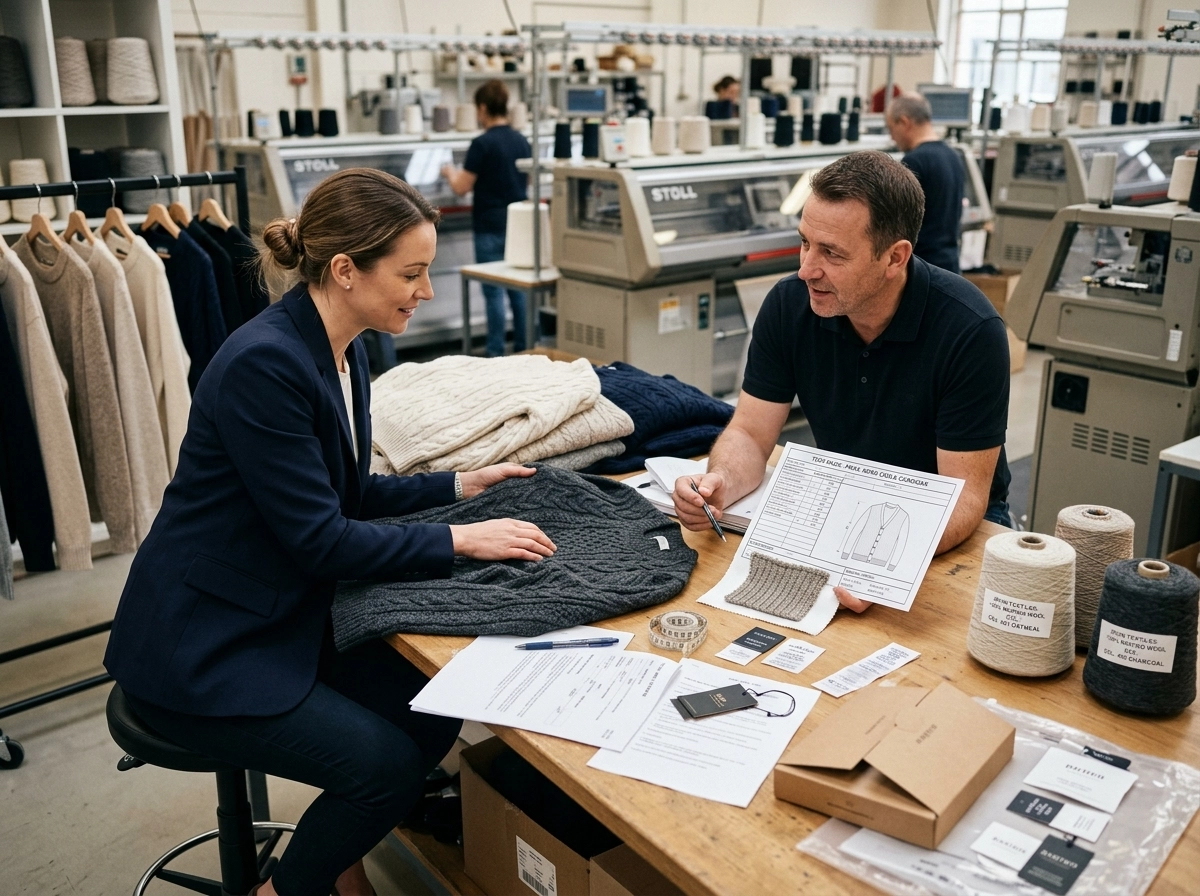
If you’re sourcing bulk knit sweaters for the UK or EU market, the decisions that
determine whether your first bulk order runs smoothly aren’t made at production—they’re
made before a single sample is cut. Yarn selection, sizing spec, gauge, stitch
construction, labelling requirements, and packaging format all need to be locked in
before sampling begins, because changes made after the proto stage cost time and money
that rarely appears on any initial estimate.
This article is written from a factory perspective, for brand owners, wholesalers,
distributors, and procurement managers who are preparing to move from concept to
sampling. It covers what to confirm before you request a proto, where UK and EU buyers
most commonly get caught out, and how the decisions you make upstream protect your
timeline and margin downstream.
Why the Decisions You Make Before Sampling Determine Bulk Outcomes
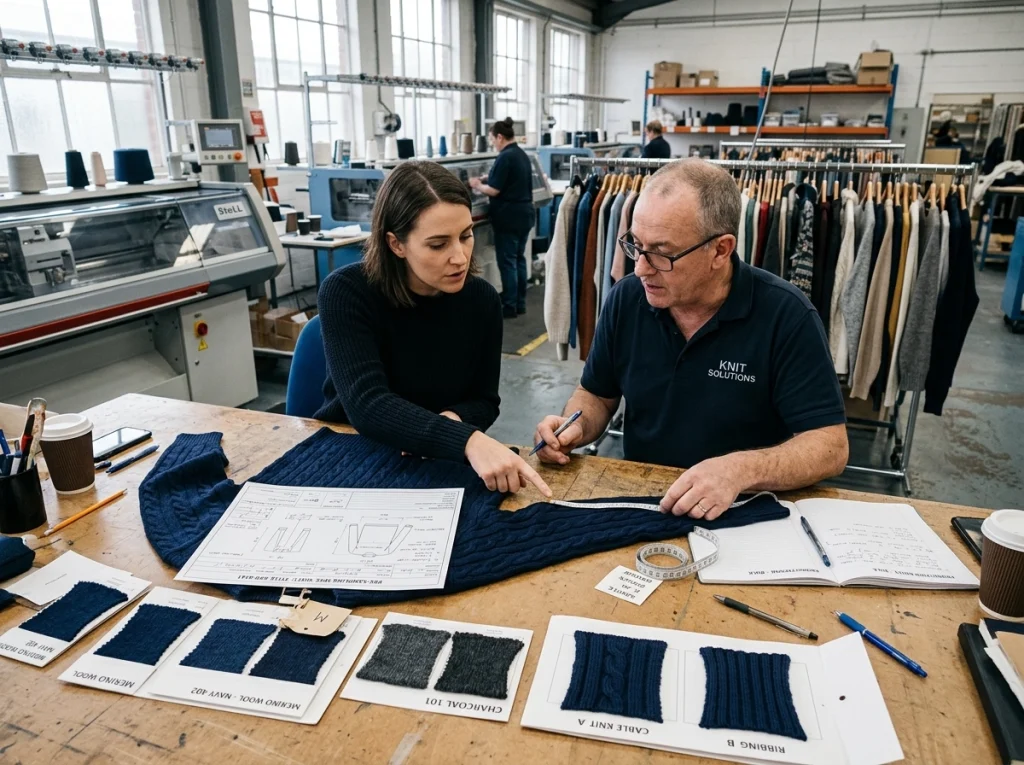
The single most effective thing a buyer can do before approaching a
knitted jumper manufacturer is reduce the
number of open variables in their brief. The more that’s confirmed upfront—fibre, fit
spec, gauge, label requirements—the fewer iteration rounds the sampling phase requires.
And in knitwear, iteration rounds are expensive in ways that don’t always show up on
an invoice.
What rework actually costs in a knitwear workflow
In most apparel categories, resending a sample because of a fit adjustment is a minor
inconvenience. In knitwear, it means re-knitting panels from scratch. If the gauge
specification changes between the first proto and the revision request, the factory
needs to re-program machines, re-measure yarn tension, and re-cut the entire
construction. That process typically adds 7–14 days to the sampling timeline, and
depending on the agreement in place, may trigger additional sample charges.
Three revision rounds on a complex construction—a cable-front jumper with intarsia
colour detail, for example—can push the full sampling phase to six or seven weeks
before any PP approval is possible. Six weeks in sampling is six weeks not spent
confirming delivery windows, building stock, or managing seasonal timing. The cost
rarely appears as a line item, but it shows up clearly when a launch date moves.
The more common underlying cause isn’t factory quality—it’s buyers arriving at the
sampling stage with a half-formed brief. Construction decisions that should have been
made before the RFQ—gauge, yarn composition, dyeing method, sizing spec—end up being
made reactively during sampling. That’s where lead time bleeds away.
The factory workflow and where decisions lock in
From a factory perspective, the sampling workflow follows a defined sequence: RFQ →
proto sample → fit approval → pre-production (PP) sample → bulk sign-off →
production. Each stage assumes the decisions from the previous stage have been
confirmed. When yarn composition is still under discussion at the PP stage, or when
sizing specs are revised after the proto has already been graded, the timeline doesn’t
just pause—it resets.
The three decisions hardest and most expensive to change late are fibre composition
(affects labelling, cost, and wash performance), gauge (determines machine allocation
and panel programming), and size grading (requires re-knitting every size if the spec
changes post-proto). None of these are finalisation tasks. They’re starting conditions.
Yarn and Fibre: Lock This Before Anything Else
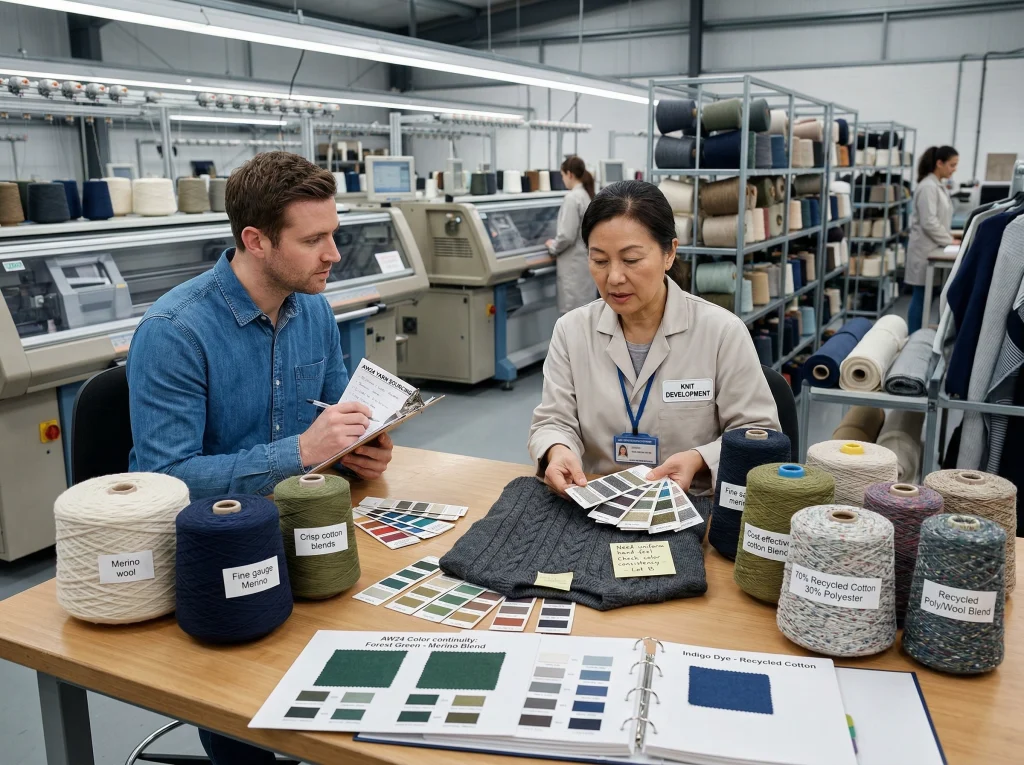
Yarn selection has the longest downstream reach of any decision in a knitwear brief.
It shapes hand-feel, unit cost, care label content, compliance requirements, and the
sustainability credentials your buyers may ask you to substantiate. It also affects
production scheduling, because specialty or custom-dyed yarns require longer lead times
than in-stock options.
Fibre options and their trade-offs for UK and EU retail
The most commonly requested fibres for wholesale knit jumpers in the UK and EU are
merino wool, cotton, wool-acrylic blends, pure acrylic, recycled polyester, and blends
incorporating modal or viscose. Each carries a different trade-off profile.
Merino and fine wool blends position well in UK and EU premium retail and support
higher wholesale price points, but they require careful wash performance testing and
are sensitive to shrinkage if care instructions are not clearly specified. Cotton
knitwear works well for spring or transitional ranges and is simpler to care-label,
but it runs heavier per unit, which increases shipping cost on larger orders.
Acrylic and synthetic blends offer the most cost efficiency across most gauge ranges
and deliver good dimensional stability through repeated washing. The trade-off is that
EU buyers working to sustainability targets may push back on high synthetic content
unless the yarn carries recycled certification such as GRS. If your buyers require
certified recycled materials, that requirement needs to reach the factory before yarn
is sourced—not after the proto has already been sampled in a standard option.
Blended yarns introduce a labelling complexity worth noting early: under both UK and
EU textile regulations, exact fibre percentages must be declared on the content label
using standardised fibre names. Confirming the precise yarn composition before
sampling means your content label can be drafted in parallel with the proto, not
sequentially after approval.
Dyeing method and colour continuity risk
As CottonWorks outlines in their sweater design guidance,
colour is one of the most consequential decisions in product development—and the choice
of dyeing method affects not just appearance but consistency across a bulk run and
between refill orders.
Yarn-dyed product, where yarn is dyed before knitting, generally delivers tighter
colour consistency lot to lot. This matters if you’re placing multiple colourways in
the same season or planning to repeat the same style in subsequent seasons. Piece-dyed
or garment-dyed knitwear can shift slightly between dye baths, which is acceptable in
some markets but problematic when tight colour matching across sizes is a retail
requirement.
Lock in your colourway references and dyeing method at the RFQ stage. Submit Pantone
or physical colour references early so that lab dips can be approved as part of the
sampling process—not chased down after PP sign-off, where they become a delay.
Where UK and EU Buyers Often Get Caught Out
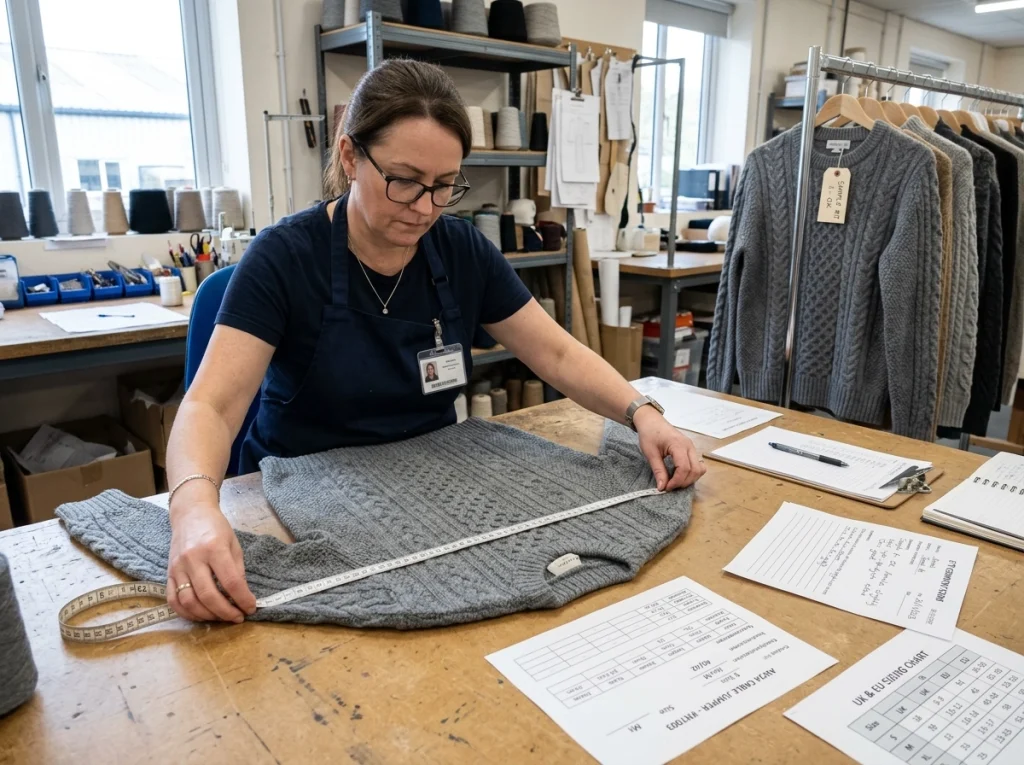
Sizing is the area where UK and EU buyers most frequently arrive under-prepared.
The two markets use different labelling conventions, consumers in each market carry
different fit expectations, and factories need a precise graded size specification
before they can program panel dimensions correctly. Assuming a factory’s standard
grade matches your target market is one of the more common—and more expensive—
assumptions in wholesale knitwear development.
UK vs EU size labelling conventions
The UK market typically labels knitwear using letter sizes (XS through XXL) paired
with a chest-to-fit measurement in inches. EU markets—Germany, France, Italy, Benelux,
and Scandinavia in particular—use numeric sizing or the same letter sizes mapped to
chest measurements in centimetres. The conversion is not always symmetrical.
| Size Label | UK Chest To Fit (inches) | EU Chest Equivalent (cm, approx.) |
|---|---|---|
| XS | 36″ | 88–92 cm |
| S | 38″ | 92–97 cm |
| M | 40″ | 97–102 cm |
| L | 42″ | 102–107 cm |
| XL | 44″ | 107–112 cm |
| XXL | 46″ | 112–117 cm |
If you’re selling into both markets from a single range, the woven neck label and
care label specs need to reflect this—typically by including both the letter size and
the centimetre chest equivalent. Many buyers distributing into Germany or Benelux add
the EU numeric equivalent alongside the standard letter size. This needs to be decided
before sampling so your label artwork can be confirmed at the proto stage, not
produced twice at additional cost.
Graded size sets and measurement tolerances
A graded size set is the full panel measurement specification across every size in
your range: chest width, body length, sleeve length from centre back, hem width,
armhole depth, and neck opening, each with a stated tolerance. Without a confirmed
grade, a factory will apply their standard block, which may not match your target
consumer or retail fit.
In knitwear, measurement tolerances are wider than in woven construction because knit
fabric has inherent stretch and recovery. A chest tolerance of ±2 cm is common and
generally acceptable in most UK and EU wholesale contexts. The risk is not in the
tolerance range itself—it’s in whether the base measurement is correctly specified in
the first place.
Provide your full graded measurement spec before sampling begins, or request your
factory’s standard grade in your target gauge and confirm it in writing before the
proto is cut. Changing the grade after proto approval means re-knitting every size—
additional cost and additional time that will typically shift your schedule by two to
three weeks.
Gauge and Stitch Construction: What to Specify Before Sampling
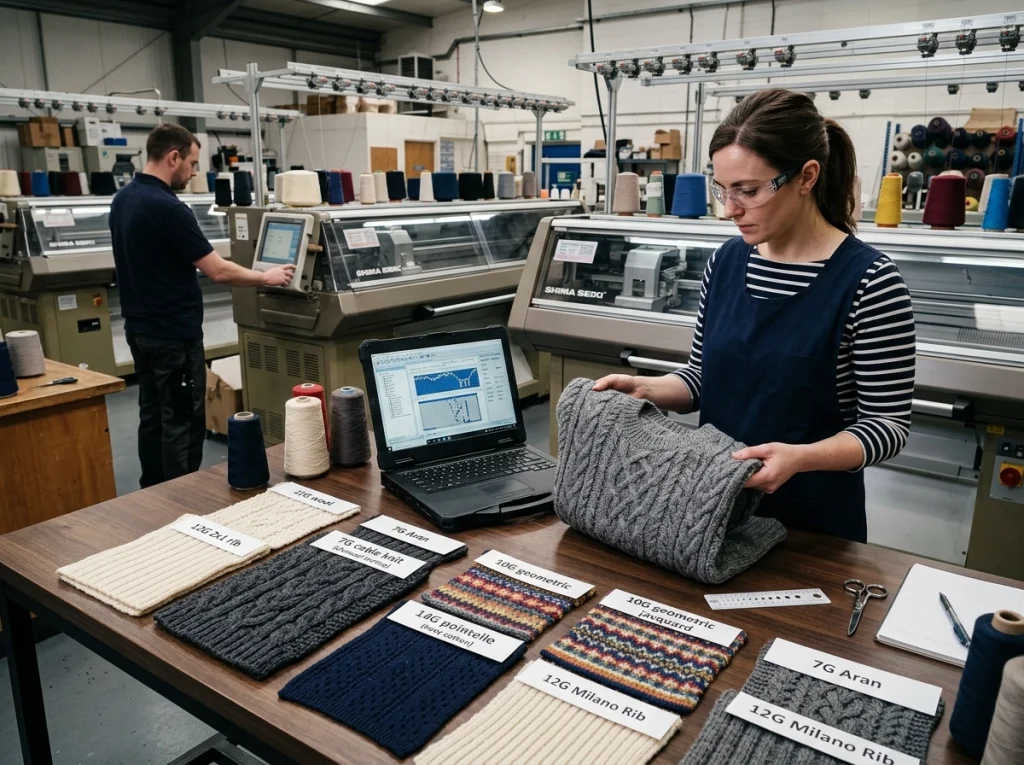
Gauge and stitch are the most technically specific decisions in a knitwear brief.
They determine machine allocation, production programming, per-unit cost, hand-feel,
and which construction options are even feasible within a given timeline. Leaving
them open at the start of development is not flexibility—it’s ambiguity that will be
resolved expensively later.
How gauge affects price, hand-feel, and lead time
Gauge is the number of needles per inch on the knitting machine. It directly controls
fabric density, weight per unit, texture, and drape—and determines which machines a
factory needs to allocate to your project. A 5-gauge chunky knit uses entirely
different equipment and programming from a 12-gauge fine-knit sweater. Once a machine
is allocated and programmed for a specific gauge, changing mid-development is not a
minor revision.
Fine-gauge styles (10–14 gauge) generally take longer to program and sample,
especially when the construction involves Jacquard or intarsia patterns. Chunky styles
(3–7 gauge) are faster to knit per unit but heavier to ship, which affects landed cost
calculations for UK buyers factoring duty on shipments arriving from outside the UK.
If unit cost is a critical variable in your sourcing decision, gauge selection needs
to happen before sampling—not as a consequence of it. Choosing a gauge after you’ve
seen the first proto means you’re already committed to machine allocation and may be
looking at a restart if the cost or hand-feel doesn’t land where you need it.
Stitch options and when complexity adds risk
Standard ribs, cables, and plain jersey constructions are well within the capability
of any established custom knit jumper supplier and can be sampled within normal
timelines. Jacquard, intarsia, pointelle, links-links, and waffle constructions
require more machine programming time and may raise MOQ thresholds depending on the
factory’s capacity planning.
If your design involves a significant stitch feature—cable panels, multi-colour
intarsia, fine pointelle detail—send a clear stitch reference or physical swatch
before sampling begins, not a mood board image. A factory working from a precise
stitch spec will produce a more accurate proto on the first round than one
interpreting a reference photograph. For complex or brand-specific constructions,
a custom knit project brief is more
appropriate than a standard OEM sample request and allows for more detailed technical
alignment before any machine programming begins.
Reviewing the range of sweater styles and construction options
a factory can produce within standard lead times is also useful at this stage—it gives
you a practical reference for what’s achievable before you commit to a construction
that may require extended development time.
Labelling and Compliance: What to Prepare for Your Factory
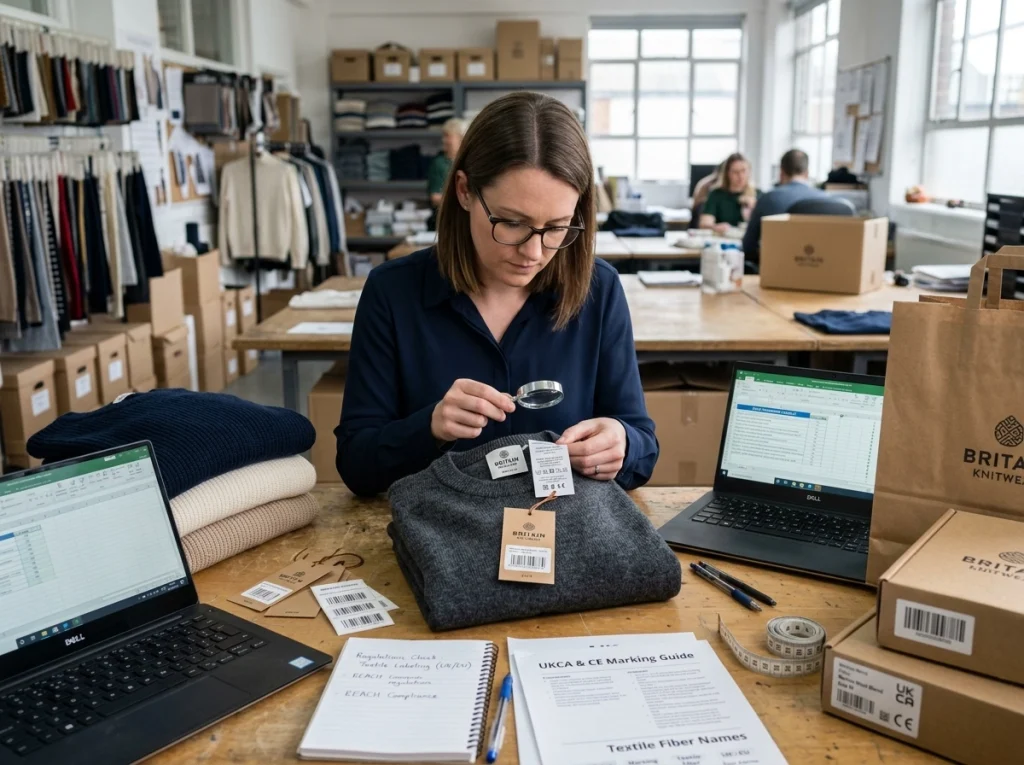
Labelling is the area where the most preventable compliance errors happen in wholesale
knitwear—usually because buyers treat it as a finishing task rather than a pre-sampling
decision. Getting label content wrong after bulk packing has begun is among the more
expensive correctable mistakes in a knitwear order.
UK and EU fibre content label requirements
Both the UK and EU require that textile products carry a fibre composition label that
is durable, legible, and securely attached. In the UK, this is governed by
The Textile Products (Labelling and Fibre Composition) Regulations.
In the EU, the equivalent framework is
Regulation (EU) No 1007/2011.
The two are virtually identical in their core requirements: fibre names must use the
standardised terminology listed in each regulation, percentages must be accurate, and
labels must be in the official language of the member state where the product is sold.
One requirement frequently missed by buyers focused on the main body fibre: any
non-textile parts of animal origin—leather trims, horn buttons, real fur details—must
be declared on the EU label with the phrase “Contains non-textile parts of animal
origin.” This applies to decorative knitwear trims and is a common compliance gap.
Care instructions, country of origin, and member state variations
Neither the EU regulation nor UK law strictly mandates care labels or country-of-origin
markings for standard knitwear. In practice, however, both are expected by retailers
in both markets, and their absence typically generates a compliance query at the point
of delivery.
Major UK retailers require ISO 3758 care symbols. Most EU retail and wholesale buyers
expect the same. Country-of-origin labelling becomes mandatory when an explicit origin
claim is made—if you’re sourcing from China, the label must state “Made in China” if
origin is declared anywhere on the product or packaging.
EU member state variations add a layer of complexity for buyers distributing across
multiple markets. France requires additional sorting and recycling information under
the AGEC law, including the Triman logo and fibre-specific sorting symbols—mandatory
for the French market. Italy requires producer identity and product type specification
on the label beyond what the core EU regulation demands. If your distribution footprint
spans multiple EU countries, build a label that satisfies the most demanding
requirements in your range, not just the baseline.
Private label setup: what to provide your factory
For buyers developing private label jumpers,
the label setup information to provide before sampling includes: woven neck label spec
(dimensions, content, and a vector logo file), care label spec (fibre content, ISO
care symbols, language requirements per target market), hangtag brief or artwork,
barcode format (EAN-13 is standard for EU; post-Brexit UK usage varies by retailer),
and packaging artwork including polybag sticker and price ticket if applicable.
Providing these at the RFQ or proto stage—not at PP approval—means your factory can
produce physical label samples for review during the sampling phase. Catching a label
error at proto costs almost nothing. Catching one after bulk packing has started costs
significantly more.
Packaging and Incoterms: Don’t Leave These Until After PP
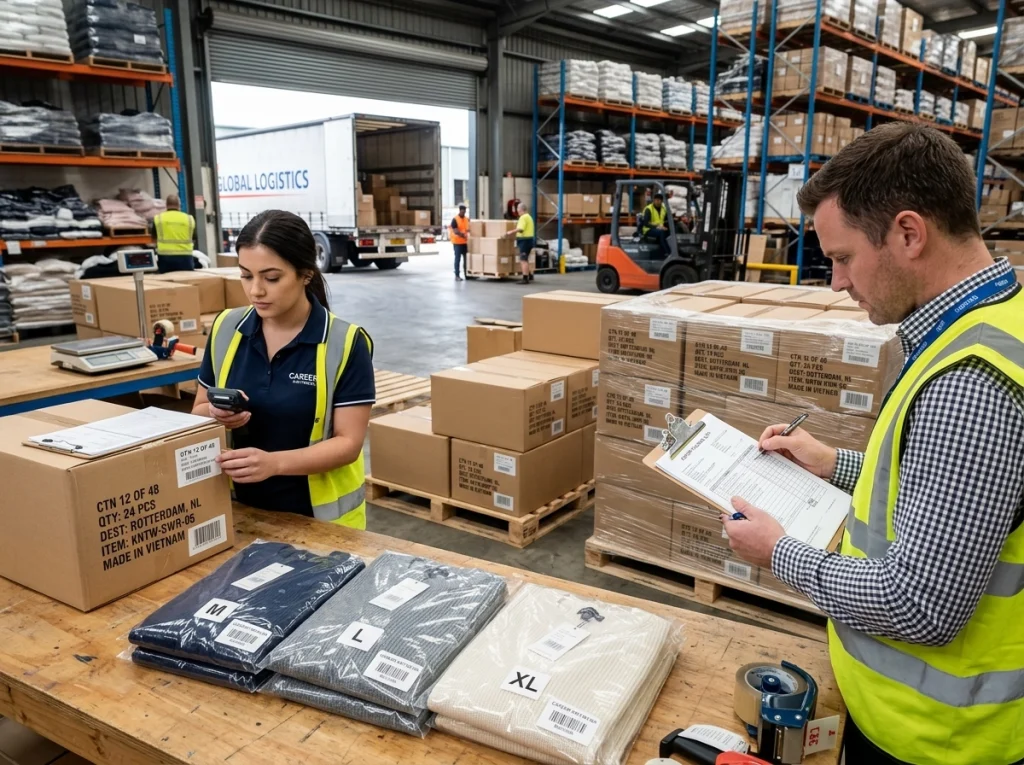
Packaging and Incoterms decisions are routinely deferred by buyers until late in the
development cycle. From a factory perspective, late packaging specs are among the most
common causes of preventable shipment delays.
Polybag, folding, and carton specs
Knitwear ships in individual polybags per unit, typically with a barcode sticker and
size indicator attached. The folding method—flat fold versus rolled or hanger pack—
affects polybag dimensions, which in turn affects how many units fit per carton and
what the carton gross weight works out to. If your retailer or distribution centre
has specific carton weight or dimension requirements, confirm those before your factory
commences packing design.
For cardigans and longer-bodied styles, folded
dimensions differ significantly from standard crew-neck pullovers. A longer garment
folded to a polybag spec designed for a shorter style results in a bulkier carton
with lower fill ratio—and a higher freight cost per unit than your original landed
cost estimate. This is easy to resolve when addressed before the packing trial, and
costly to discover at the point of shipment.
Incoterms and shipping risk for UK and EU buyers
For UK buyers post-Brexit, import duty and VAT on knitwear arriving from China must
be factored into landed cost at the sourcing stage, not the payment stage. FOB (Free
on Board) is appropriate for buyers with a nominated forwarder and experience managing
freight and customs clearance. DDP (Delivered Duty Paid) transfers more responsibility
to the factory or their logistics partner, which simplifies the process for new
importers but typically adds cost to the unit price.
EU buyers need to be aware that import duties apply at the EU external border and
that the HS code classification for knitted jumpers affects the applicable tariff rate.
Confirming the HS code with your customs broker before finalising your factory quote
avoids a misclassification being discovered at customs—which delays the entire
shipment, not just the affected SKUs.
Conclusion
Sourcing bulk knit sweaters for the UK or EU market successfully comes down to how
much is resolved before the first sample is made. Yarn fibre, dyeing method, sizing
spec, gauge, stitch construction, labelling requirements, and packaging format are not
details—they’re the variables that determine whether your sampling phase takes two
rounds or five, and whether your bulk order lands on time or accumulates rework charges
and revised delivery dates.
From a factory perspective, buyers who arrive with a clear, confirmed brief convert
from proto to bulk faster, generate fewer revision costs, and build more stable
supplier relationships because the operational friction on both sides is lower. The
time spent tightening a brief before sampling is returned in reduced lead time and more
predictable production scheduling.
If you’re preparing to develop a knitted jumper range for the UK or EU market—whether
you have a full tech pack, a reference sample, or a clear concept without specs yet—
get in touch with the team at CNSweaters to discuss yarn
options, gauge selection, sampling timelines, and what we need from you to get
development moving efficiently.
FAQ
What is the typical MOQ for wholesale knitted jumpers from a China OEM factory?
For most OEM factories, the practical starting point is 200–300 pieces per style and
50–100 pieces per colour, though this varies with yarn type and stitch complexity.
Simpler constructions in standard in-stock yarns tend to offer more flexibility at
the lower end; complex constructions or specialty fibres typically require higher
minimums to justify the setup and yarn procurement involved. If your order volume
sits below the factory’s standard MOQ, expect the unit price to reflect that.
How long does sweater sample development take before bulk?
For standard constructions in readily available yarns, a proto sample typically takes
7–14 days. Complex constructions—Jacquard, intarsia, detailed cable panels—can take
10–20 days. A realistic full sampling phase covering proto, one revision round, and PP
approval runs 4–7 weeks before bulk production can begin. Locking specs before
development starts is the most effective way to compress this.
Do I need to provide a tech pack to start sampling?
A tech pack with measurements, construction detail, and trim specifications is the
most efficient starting point. If you don’t have one, a factory experienced in
sweater sample development can work from
a reference sample or a detailed brief covering gauge, fibre, fit reference, and key
measurements. Either way, the critical information—sizing spec, yarn composition,
and construction detail—needs to be agreed before knitting begins.
What labelling is required on knitted jumpers sold in the UK and EU?
Both markets legally require a fibre content label using standardised textile fibre
names. In practice, buyers should also include care symbols, country of origin, and
size labelling—these aren’t universally mandated at the regulatory level but are
expected by most retailers and required under individual member state rules in certain
EU countries. France requires sorting information and the Triman logo; Italy requires
producer identification. If you’re distributing across multiple EU markets, build a
label that meets the most demanding requirements in your footprint.
How do I protect re-order stability across seasons?
Re-order stability in knitwear depends primarily on three things: confirmed yarn lot
records, archived colour lab dips, and standardised sizing specs maintained from
the original bulk. A factory that keeps traceable yarn lots, sealed PP samples, and
AQL inspection records can replicate a style accurately in subsequent seasons. When
evaluating a wholesale jumpers supplier for ongoing partnership, ask specifically
about their lot traceability process and how they manage shade continuity between
separate production runs.
External References
- CottonWorks — Sweater Design —
https://cottonworks.com/learning-hub/sweater-manufacturing/sweater-design/ - GOV.UK — Textile labelling —
https://www.gov.uk/guidance/textile-labelling - Eurofins — Textile Labelling Regulations in the European Union and the United Kingdom —
https://www.eurofins.com/textile-leather/articles/textile-labelling-regulations-in-the-european-union-and-the-united-kingdom/