 CN Sweaters
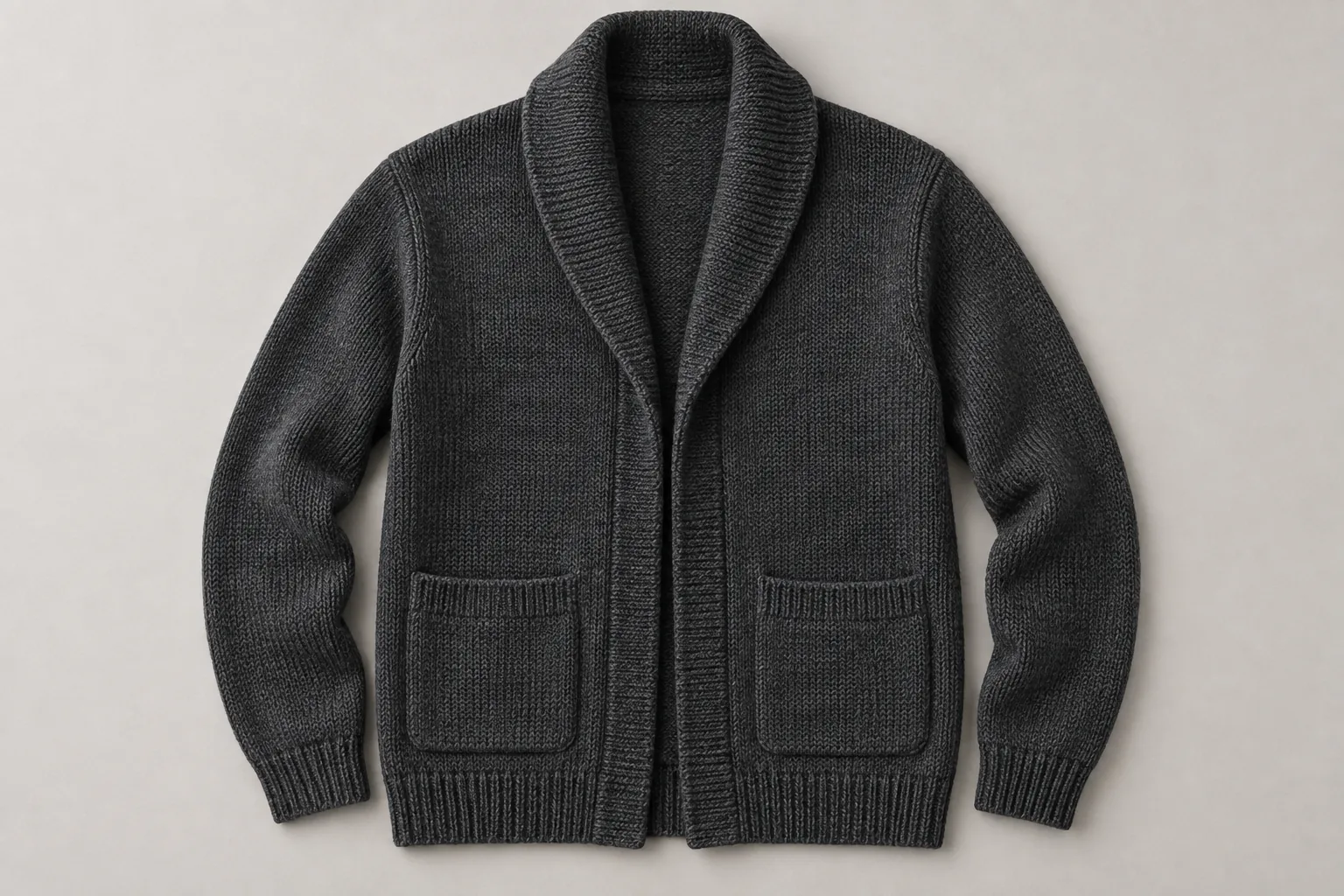
The shawl collar cardigan is a menswear classic, and women’s lines now carry it too. Its appeal comes from one soft, continuous curve that runs from the back neck down to the first button. Define the intended curve and record any collapse, flipping or sideways pull against that reference.
That curve is the roll line. Keep its shape connected to the collar structure, back-neck join, linking and finish used in the sample.
What the roll line does on a shawl collar cardigan
A shawl collar has no notch and no separate lapel. Instead, the collar and the front band form one piece that folds back along a line. Above the top button, the collar turns outward. Below it, the band lies flat against the body.
The roll line is the fold between the visible outer collar and the hidden stand. On a woven blazer, a tailor shapes it with canvas and steam. A knitted collar needs its own record of stitch structure, joining, any support and finishing; a woven tailoring reference cannot specify that route by itself.
Why knitted collars lose their shape
Knitted fabric relaxes. So a collar that looks crisp after pressing may open up, flatten or twist once it has hung on a hanger for a few days. The weight of the collar itself adds to this, especially in chunky gauges.
Three things usually cause trouble. First, the collar rib is too loose for its weight. Second, the back-neck seam is too long, so the collar floats away from the neck. Third, the collar is linked on with uneven tension, so one side rolls higher than the other.
Shawl collar cardigan construction options
There are two common ways to make a shawl collar on a flat knitting machine. Each one suits different gauges and budgets.
Collar knitted separately and linked on
The most common method knits the collar as a long rib strip. Linkers then join it to both fronts and the back neck, stitch by stitch. This gives good control over rib structure and collar depth. However, it depends heavily on linking skill, because the linker must feed the same number of stitches on each side.
Our in-house linking team handles this step, and its tension and alignment need to match the approved construction. For more on why this matters, read our article on linking quality in a knitwear factory.
Collar knitted with the front panel
On some styles, the collar grows out of the front panel as an extension. This avoids a seam along the front edge. Still, it needs a back-neck seam, and it limits which rib structures you can use. It suits fine and mid gauges better than very chunky ones.
Choosing rib and yarn for the collar
The collar structure decides most of the roll behavior. A 2×2 rib gives a soft, rounded roll. A 1×1 rib lies flatter and thinner. Meanwhile, a full cardigan stitch or half-cardigan rib adds bulk and body, which suits classic chunky styles.
Yarn matters too. Compare the proposed yarns at the intended collar weight, stitch setting and finish. A fiber name alone does not establish mass or recovery. Record the roll shape before and after the agreed wear and care conditions, including any proposed collar-to-body setting difference.
We also look at collar depth. A deep collar looks generous on a sketch, but it adds weight at the neck. As a result, it may pull the front open when the wearer sits down.
Matching the collar to the gauge
- 3G to 5G: chunky collars with strong character; watch weight and back-neck length.
- 7G: a versatile middle gauge for knitwear collars in wool blends.
- 12G to 14G: fine, flat collars that suit tailored and layering styles.
If gauge is part of the collar decision, ask for identified yarn and stitch options at each proposed gauge. Compare the roll on complete cardigans; the existence of a 3G–14G machine range alone does not establish which version will hold the approved line.
Testing the shawl collar cardigan sample
Ask for three views of the same identified cardigan: flat measurements at the back neck and both front bands; buttoned on the intended form; and after an agreed hanging period. Record that period and the garment state so a change in the collar roll can be compared rather than guessed from a freshly pressed photograph.
Record the hanging duration and compare both sides after the stated rest. Uneven linking, geometry, material or finishing can contribute to a changed roll; the appearance alone does not establish which caused it.
Checking the shawl collar cardigan after washing
If post-care shape is part of approval, use the proposed care route on an identified sample and compare the same collar and body points after drying and rest. Different structures may change differently: a shorter collar can draw the fronts upward, while a relaxed collar can lose its fold. The result depends on the actual yarn, assembly and procedure.
Neutral test methods help keep this comparison fair. AATCC publishes widely used methods for dimensional change after home laundering. Your lab and our QC team should agree the method before the test.
Pressing a shawl collar cardigan for bulk consistency
Pressing can set the roll line temporarily, so judge the collar again after cooling and rest. Record any shaped pressing used in the trial. If the line holds only while warm, compare the knit, collar dimensions and join rather than approving a photograph of the freshly steamed garment.
Carry collar symmetry, back-neck fit and top-button position into the inspection plan with the approved sample and size-specific views. Agree how many pieces and which sizes are checked; a blanket statement that every piece receives the same test is not a substitute for an order-specific QC record. The quality-control overview describes the general factory checkpoints.
Sizing and grading a shawl collar cardigan
Collar depth should not grade in full proportion to chest width. Otherwise, large sizes get heavy collars that drag, and small sizes look skimpy. In practice, we grade collar depth in small steps and keep the rib structure the same in every size.
The top button position also needs a decision. Some brands keep it at a fixed distance from the shoulder. Others link it to the body length. Both methods work, as long as the tech pack says which one applies.
The custom cardigan sweaters range shows the broader construction choices. For this style, send a front-view reference showing the desired roll at the top button, plus the size-set measurements for collar depth and band length. A quote or delivery date should follow the selected yarn, collar structure and approved sample, not a generic cardigan lead-time estimate.
Conclusion
Give inspectors the shawl collar cardigan’s accepted roll views, paired measurements and finishing state. Keep any size-specific collar revision with those records so a changed production sample has a defined comparison.
Contact our team to discuss a shawl collar style or request a sample.
FAQs
Why does my shawl collar flip up at the back?
A rising roll line can come from a short back-neck join, a collar rib that changed after care or another construction difference. Compare the joined length and care states before selecting a correction; the photograph alone cannot identify the cause.
Which rib works best for a shawl collar cardigan?
A 2×2 rib gives a soft round roll. Meanwhile, a full or half cardigan stitch gives a fuller collar. For fine gauges, 1×1 rib keeps the collar flat.
Can a cotton shawl collar cardigan hold its roll?
Yes, but it needs care. Since cotton recovers less than wool, we tighten the collar stitch and keep the collar depth moderate.
Do you make shawl collars with pockets and toggles?
Patch pockets, horn-look buttons and toggles are possible design options, but their weight and attachment can change the front hang. Include the actual trim in a sample comparison before treating it as approved for this cardigan.