 CN Sweaters
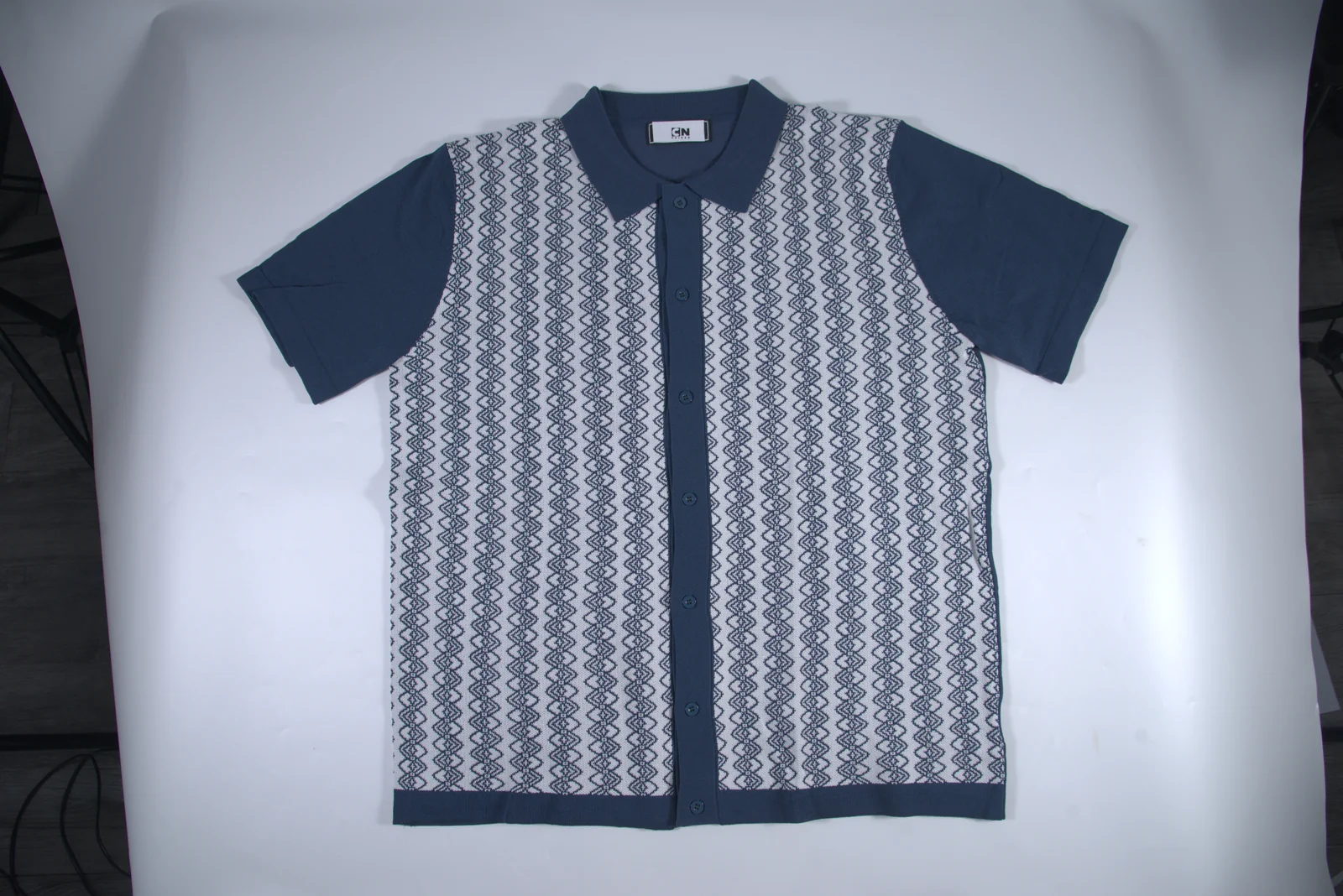
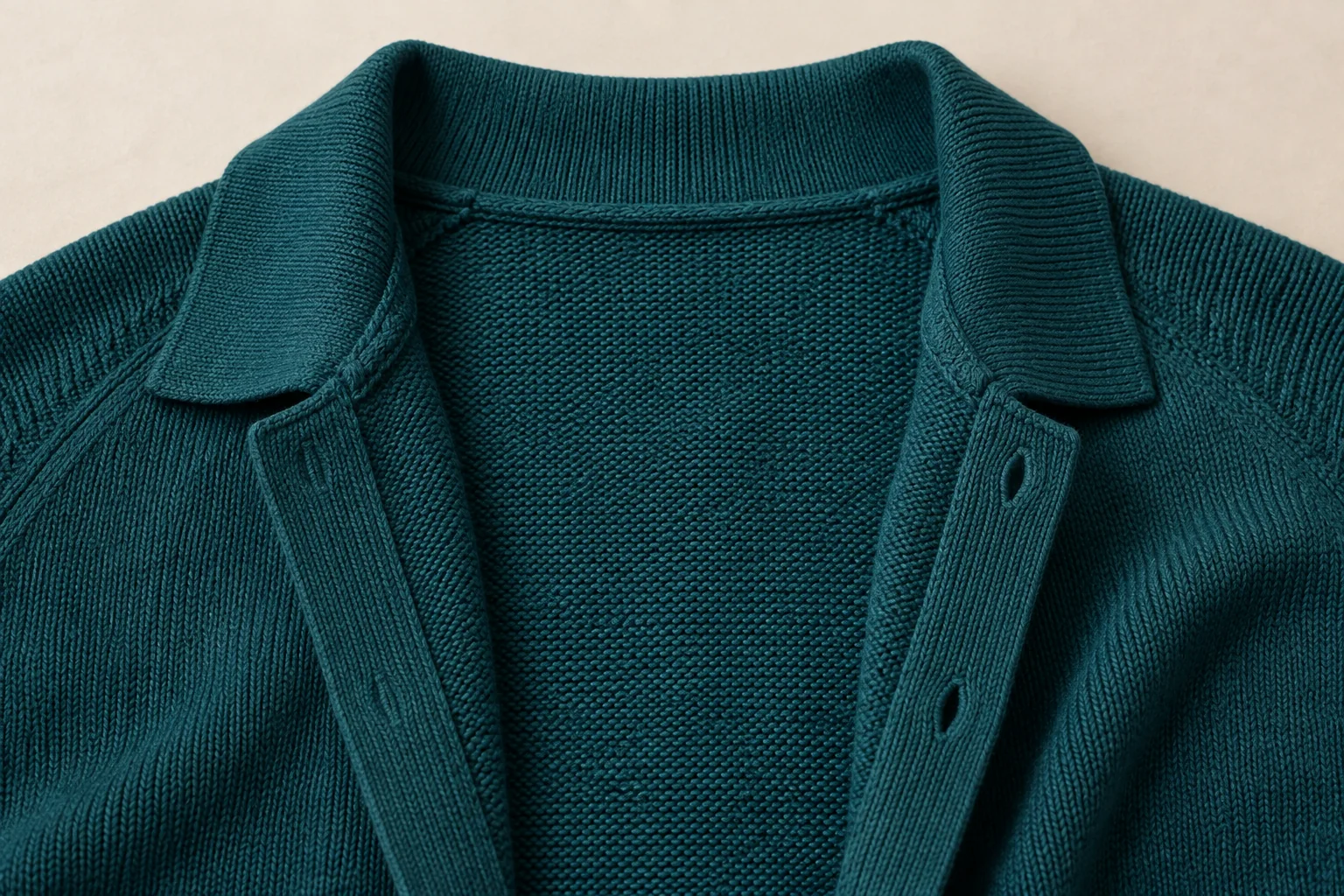
Open the top button before approving a polo cardigan collar. A junction that looks balanced with every button closed may spread, turn under or lift one front when it opens. The developer needs to decide which buttoning states the product will support, then compare the same collar attachment, band tops and fastening in those states.
Which wearing states define the polo cardigan?
Separate a full opening from a short placket
A polo cardigan has two front edges continuing to the hem. Show how the collar meets those edges and how the fronts hang when the garment opens. A short-placket polo reference leaves that full-opening relationship unresolved.
Draw the complete front before enlarging the collar detail. Mark the intended meeting line, overlap direction, band width and neckline ends. Identify whether the collar finishes at the front edge, stops before it or extends beyond it. A technician should be able to locate these positions without estimating them from the model’s pose.
Name the intended underlayer and closure states
Choose the actual underlayer for the sample review. A shirt collar, a crew-neck tee and bare-neck styling give the polo cardigan different contact surfaces. Record which of these the product must accommodate, together with the intended fit model or form. Photograph the underlayer before adding the cardigan so another reviewer can reproduce the arrangement.
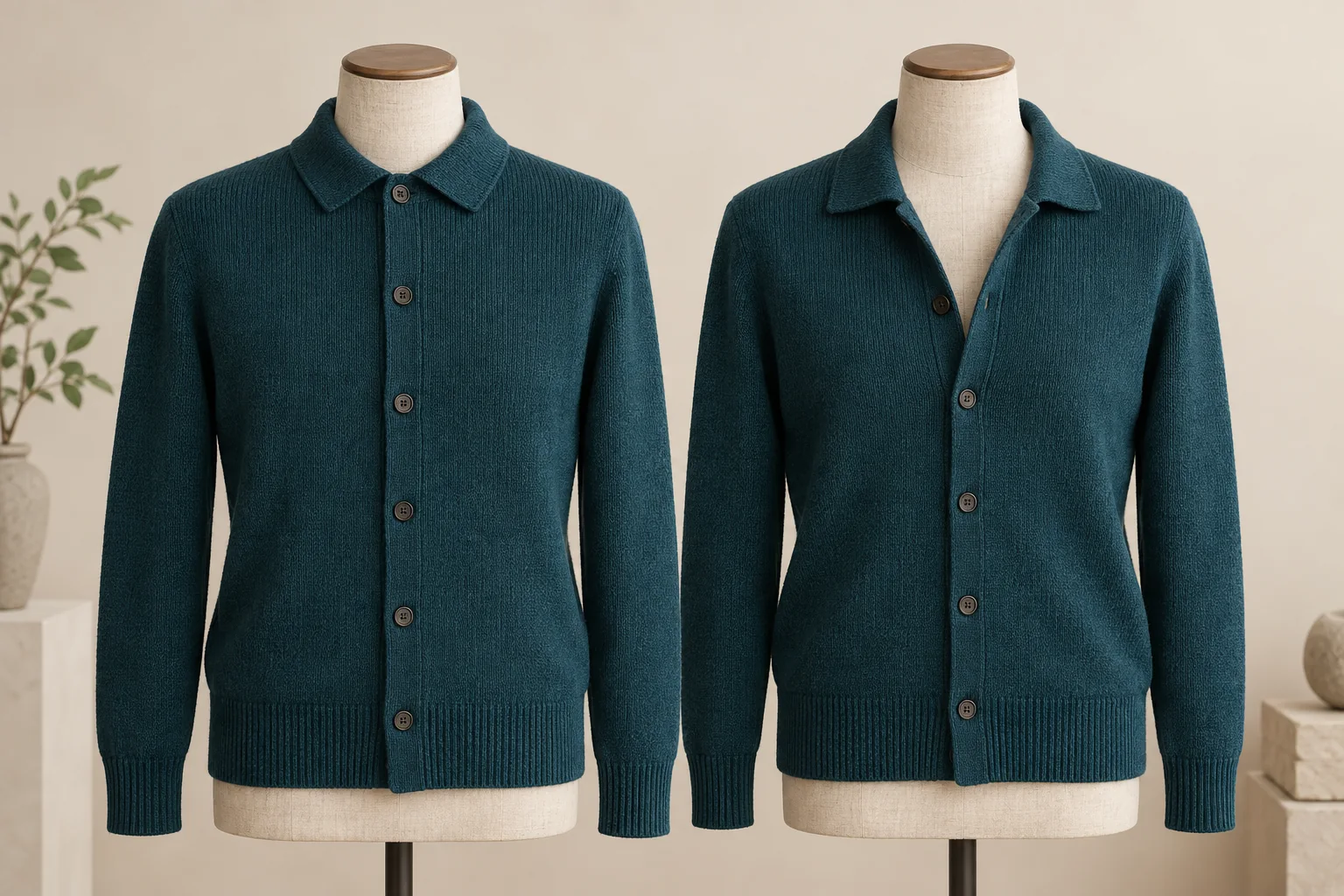
Define the buttoning sequence in the brief. A buyer might require all buttons closed, the top button open and the cardigan fully open. Those are proposed review states, not a universal test set. If campaign styling uses another arrangement, include it before approving collar spread or front-edge position.
Keep the sample resting naturally between views. Pulling the band down or folding a collar point by hand can hide the behaviour being reviewed. When an adjustment is necessary to explain a fault, retain an unadjusted view alongside it.
What belongs on the polo cardigan junction drawing?
Locate the polo cardigan neckline and band edges
Give each measurement a start point, end point and garment state. For example, a collar-point position may be described relative to the front meeting line and neckline attachment. A top-button position needs its own reference; measuring from a folded collar edge can change the reading when the fold moves.
ISO 18890 addresses garment measurement points. Agree any additional junction measurements with the technical team. The reference does not supply a preferred collar angle or a tolerance for this design. Put those product decisions into the approved drawing and measurement sheet.
This input table identifies the records needed before the upper front can be compared consistently.
| Junction item | Record to supply | Comparison it enables | Responsible decision |
|---|---|---|---|
| Collar ends | Attachment line and visible end positions | Left and right placement against the opening | Designer confirms intended outline |
| Band tops | Width, finish and relation to neckline | Junction height and exposed layers | Technician specifies construction |
| Top fastening | Button centre, hole position and overlap | Alignment in the closed state | Buyer approves appearance and use |
| Wearing states | Underlayer and buttoning sequence | Repeatable collar spread and front hang | Brand defines required states |
| Sample identity | Yarn, programme and finishing revision | Separation of construction changes | Sample room records the version |
| Assessment limits | Agreed measurements and visual references | Consistent acceptance or revision | Buyer and supplier confirm criteria |
The drawing should also show what the reviewer cannot see from the outside. Include the collar seam, band return and any local facing or support. Their existence must come from the construction record or sample inspection, not from a smooth-looking photograph.
Keep dimensions and appearance references connected
A dimension records one distance; an image shows relationships. Use both where the collar can meet the measurement sheet while looking different from the intended shape. Identify the image that defines the accepted point position, roll and opening. Avoid a folder of unlabelled photographs with conflicting buttoning states.
Discuss measurement tolerances only after agreeing the measurement method. Keep a dimensional allowance separate from a visual requirement such as symmetrical collar points. Neither automatically replaces the other.
How does the top fastening affect collar balance?
Compare the polo cardigan before and after fastening
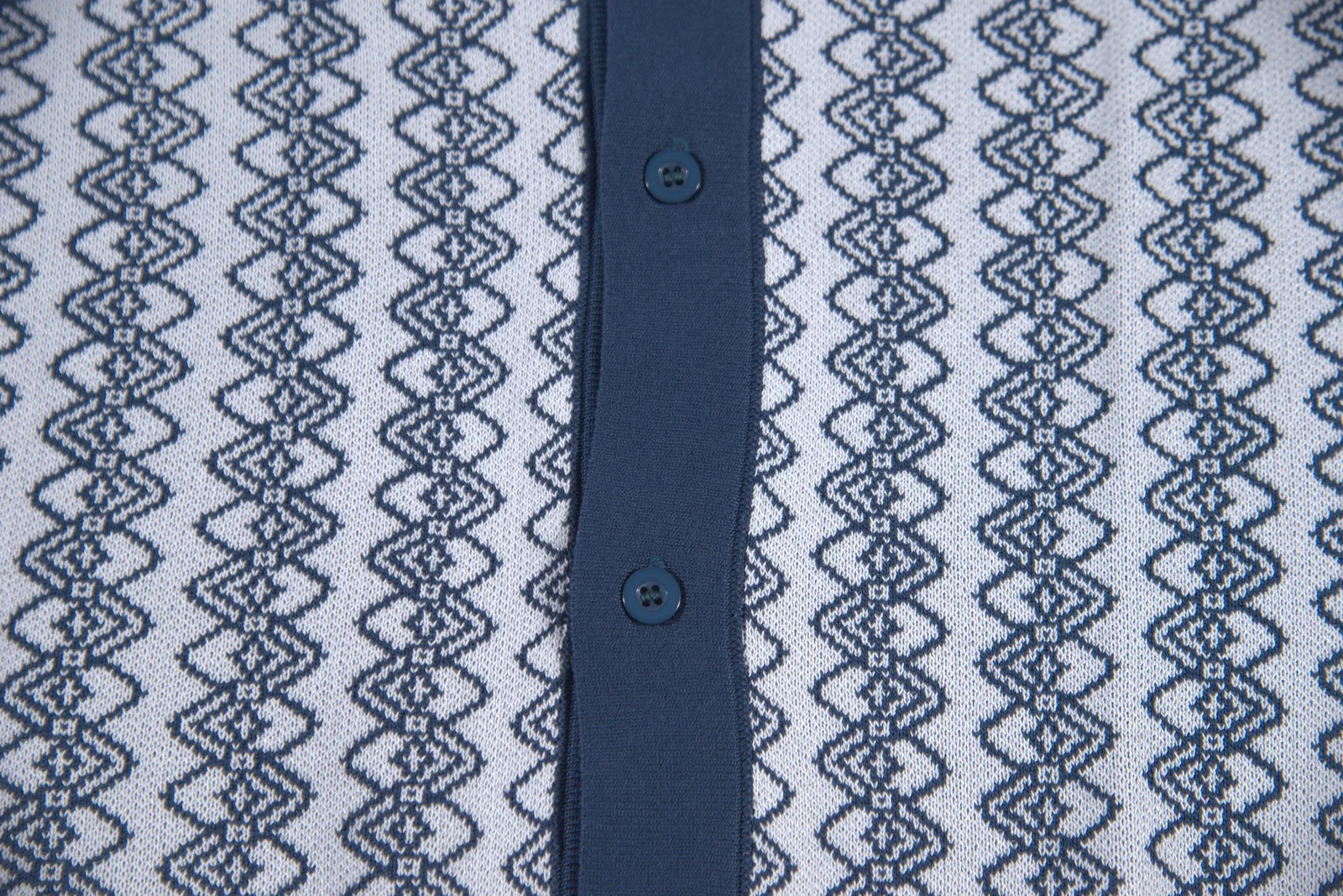
Lay the polo cardigan flat with the bands untensioned. Record where the two band tops and collar ends sit. Then close the required buttons without pulling one side to meet the other. Compare the neckline shape, point position and upper-front height against the open view.
If closing changes the appearance, note the change before naming a cause. A raised band top could involve button placement, overlap, local band length, collar attachment or body fit. The observation identifies a junction problem; it does not prove that the collar pattern is wrong.
Inspect the actual button and hole together. Confirm button thickness, shank or attachment arrangement and how the hole behaves during use. A substitute button with a similar face diameter may sit differently against a thick band. Keep the trim item on the record when comparing two prototypes.
Review the polo cardigan collar during movement
Review the approved wearing states on the selected wearer or form, then add the movement needed for the product. Turning the head, reaching forward or sitting may change the position of the upper front. Choose a sequence that the next reviewer can repeat and record the starting posture.
Look separately at collar-point movement, neckline displacement and whole-garment movement. If the entire cardigan shifts backwards, the collar may be moving with the body. If one point folds while the neckline stays in place, inspect that local area. These distinctions help the next sample address the observed relationship.
Which comparisons isolate a construction change?
Change one recorded input at a time where practical
Ask for proposals that answer a named question. If the concern is the band-top finish, retain the collar dimensions and button arrangement while comparing that finish, where the construction allows it. When several inputs must change together, list them as a combined proposal and avoid crediting the result to one detail.
Compare the proposed yarn, stitch arrangement and joined layers in a physical sample. A drawing identifies the construction option; handling and wearing the sample show its local thickness and movement.
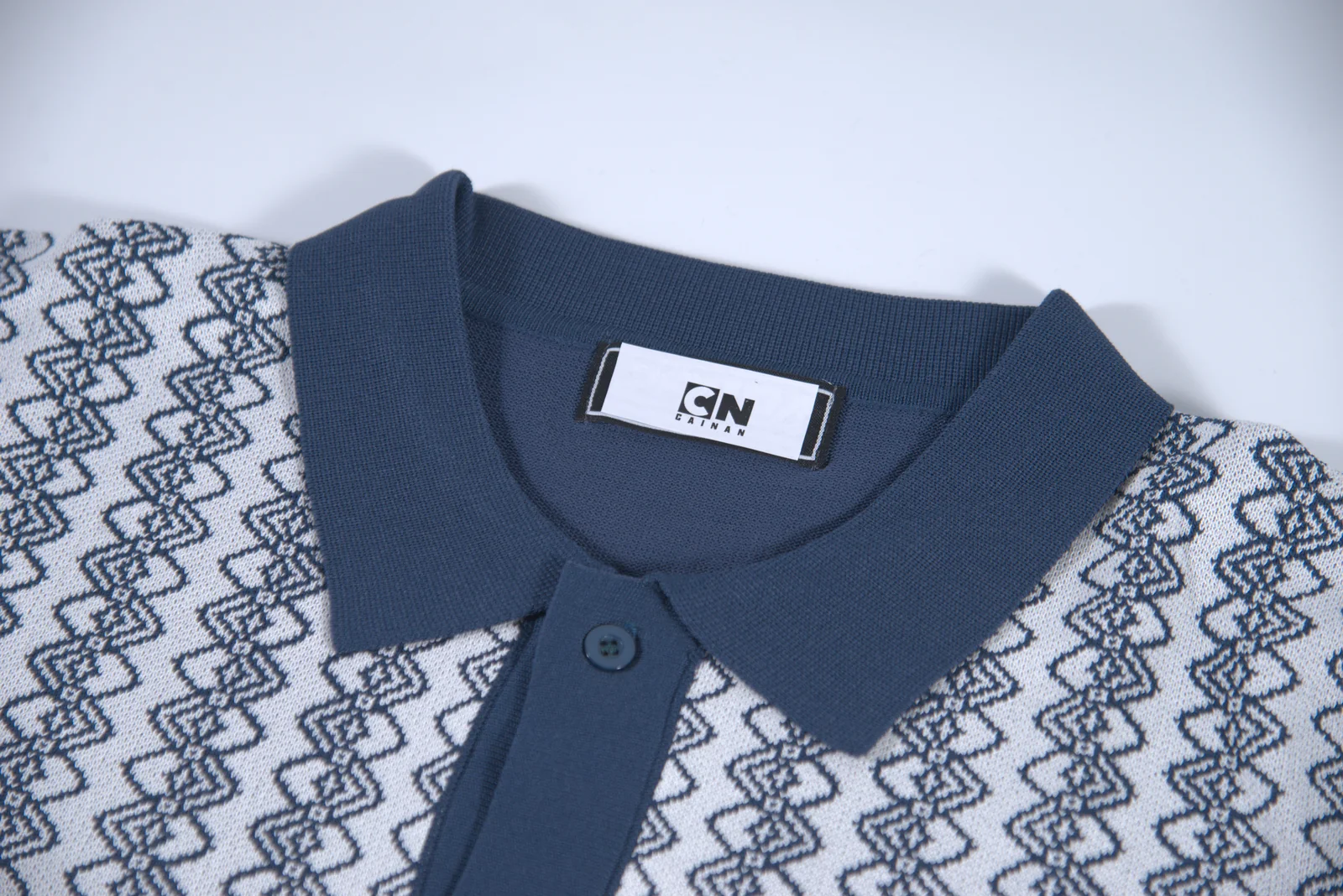
Include an inside view of each candidate junction. Local thickness may come from a collar seam, folded band, facing, button attachment or their overlap. If the supplier removes a layer, record which layer and why. Do not describe a thinner photograph as proof that comfort or durability has improved.
Keep care and rest conditions comparable
Compare samples in the same declared state. Record whether the garment has been steamed, washed, dried, pressed, worn or rested since the previous measurement. A newly finished collar and a worn reference can differ for reasons unrelated to the proposed construction change.
AATCC TM150 concerns laundering-related garment dimensions within its applicable scope. Agree the method and care route with the responsible technical team. A routine sample wash should not be described as a completed standard test unless the required procedure and records support that claim.
Retain before-and-after views of the same identified junction, using the same buttoning states. Record whether a collar point returns without handling or needs to be arranged manually. Keep temporary displacement, persistent shape change and damage as separate observations.
How should sizes and substitutions be represented?
Follow the polo cardigan collar through the size range
A base-size approval leaves a question about the other sizes. Record which collar dimensions change, which band details remain fixed and where button spacing changes. If several sizes share a collar component, identify that group explicitly and review the junction on the represented bodies.
Select comparison sizes around any construction transition. A new collar component, a changed button count or a revised band width deserves attention even if the size lies in the middle of the range. The smallest and largest sizes are useful only when they represent the decisions being tested.
Reopen the affected comparison after a change
A yarn substitution can alter the sample relationship without changing the drawing. Use the yarn substitution review to identify which evidence the replacement must reproduce. Keep its identity separate from the original sample even when the visible shade is similar.
Apply the same discipline to buttons, backing, band finish and collar attachment. State the changed item and the observations that need repeating. A trim change may require a local junction review; a change that also affects front hang needs a wider comparison.
When is the polo cardigan junction ready for handover?
Turn each observation into a bounded action
Use the finding to define the next comparison. A vague request to improve the collar leaves the sample room to choose both the diagnosis and the intended result.
| Observed condition | What remains uncertain | Buyer action | Evidence to close the comment |
|---|---|---|---|
| One band top rises when buttoned | Placement, band length or attachment | Request a matched open-and-closed comparison | Revised junction map and paired views |
| Collar point folds during movement | Local support versus body displacement | Compare the point and neckline separately | Unadjusted movement and resting views |
| Inside junction feels bulky | Which layers contribute to the stack | Review a documented layer proposal | Inside view and handled prototype |
| Shape changes after care | Construction, finish or care-state difference | Hold the affected version for comparison | Identified pre-care and post-care records |
| A size transition changes the opening | Shared collar or grade relationship | Review the affected size group | Size-to-component record and sample views |
| Substitute trim changes closure | Fit of button, hole or attachment | Recheck the actual trim assembly | Updated trim identity and closed-front result |
Retain the accepted construction drawing, trim identity, size grouping and finishing reference together. If packing requires a particular collar fold, include that fold as a separate presentation instruction. Packing should preserve the accepted garment; it should not be used to force an unresolved collar into position.
For a development discussion with CNSweaters, include the front drawing, current sample photographs, intended buttoning states and the unresolved collar comment when you share your polo cardigan brief.
Frequently Asked Questions
Can two polo cardigan sizes share one collar?
They can be proposed as a shared-component group, but the group needs a recorded fit review. Compare collar-end positions, neckline attachment and the opening in the affected sizes. A matching collar label or unchanged programme number does not establish that the component sits correctly on every body size.
Should the top button sit directly below the collar point?
The design must define the relationship. Collar-point length, overlap and the intended open-neck appearance can lead to different arrangements. Use a drawing with stable references and compare the actual closed and open states. Do not borrow a button position from a short-placket polo without checking the full cardigan front.
Can a replacement button use the same approval?
Review its effect on the actual hole and attachment before carrying the approval forward. A similar diameter does not establish identical thickness or fastening behaviour. Record the replacement item and repeat the affected closure views, expanding the review if the new assembly changes band position or front hang.
What if the collar looks correct only after pressing?
Record the exact finishing state and compare it with the wearing and care states required by the brief. A photograph immediately after pressing proves only that appearance at that moment. Ask for the relevant later observations before deciding whether the construction meets the product requirement.
Does a collar photograph prove fibre content or performance?
No. Use material records for fibre identity and appropriate sample or test records for performance. Photographs help locate construction details and document visible shape in a named state. They cannot establish a yarn composition, an unseen reinforcement or a result that was never measured.