 CN Sweaters
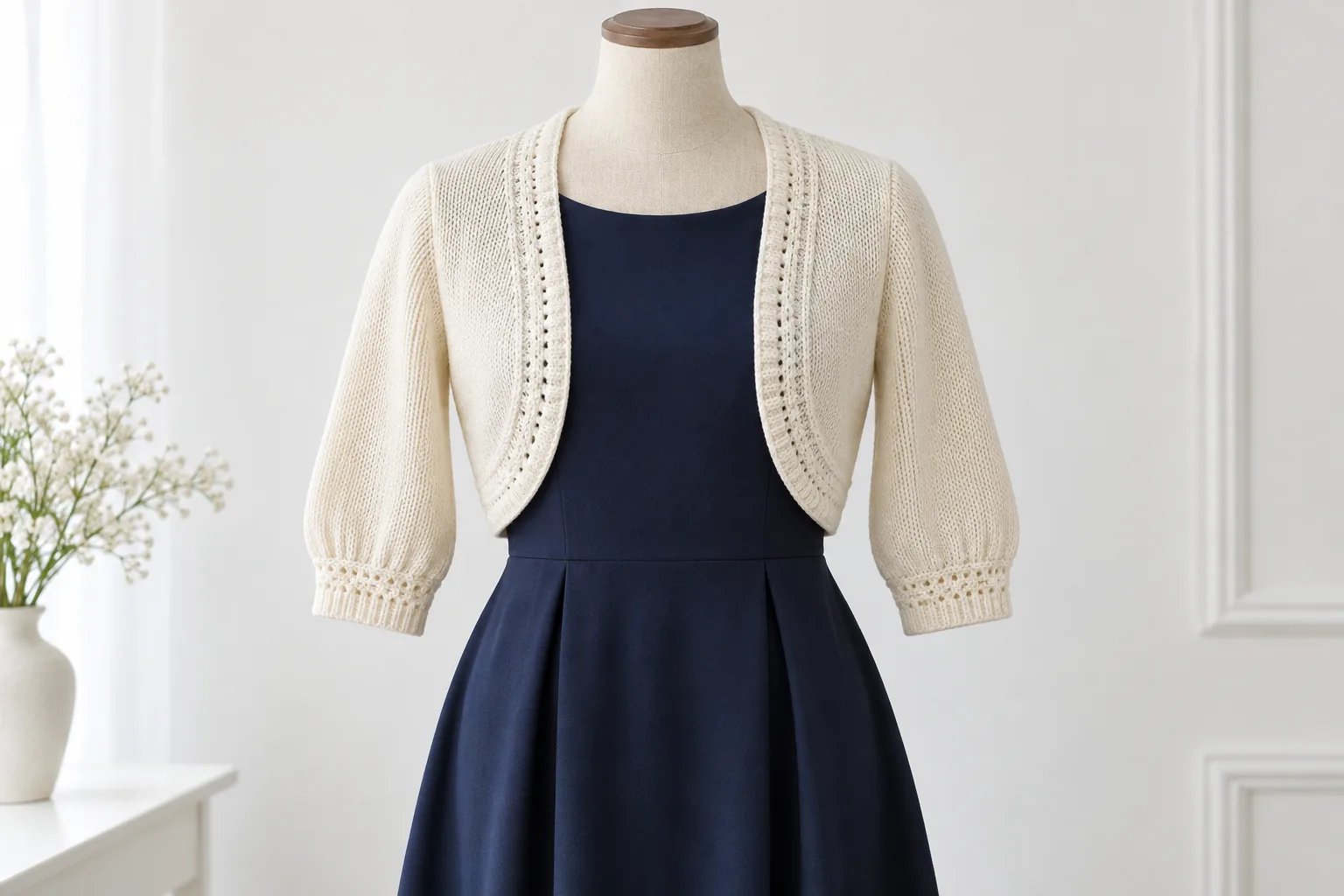
For a customer buying a bolero to frame a dress bodice, the opening must leave the intended detail visible after ordinary reach. A sample that meets its flat dimensions can still catch the dress armhole or lift its short side body. Review the bolero over the actual outfit before selecting body, opening and sleeve proportions.
Which outfit defines the bolero cardigan approval?
Fit the bolero cardigan over its intended underlayer
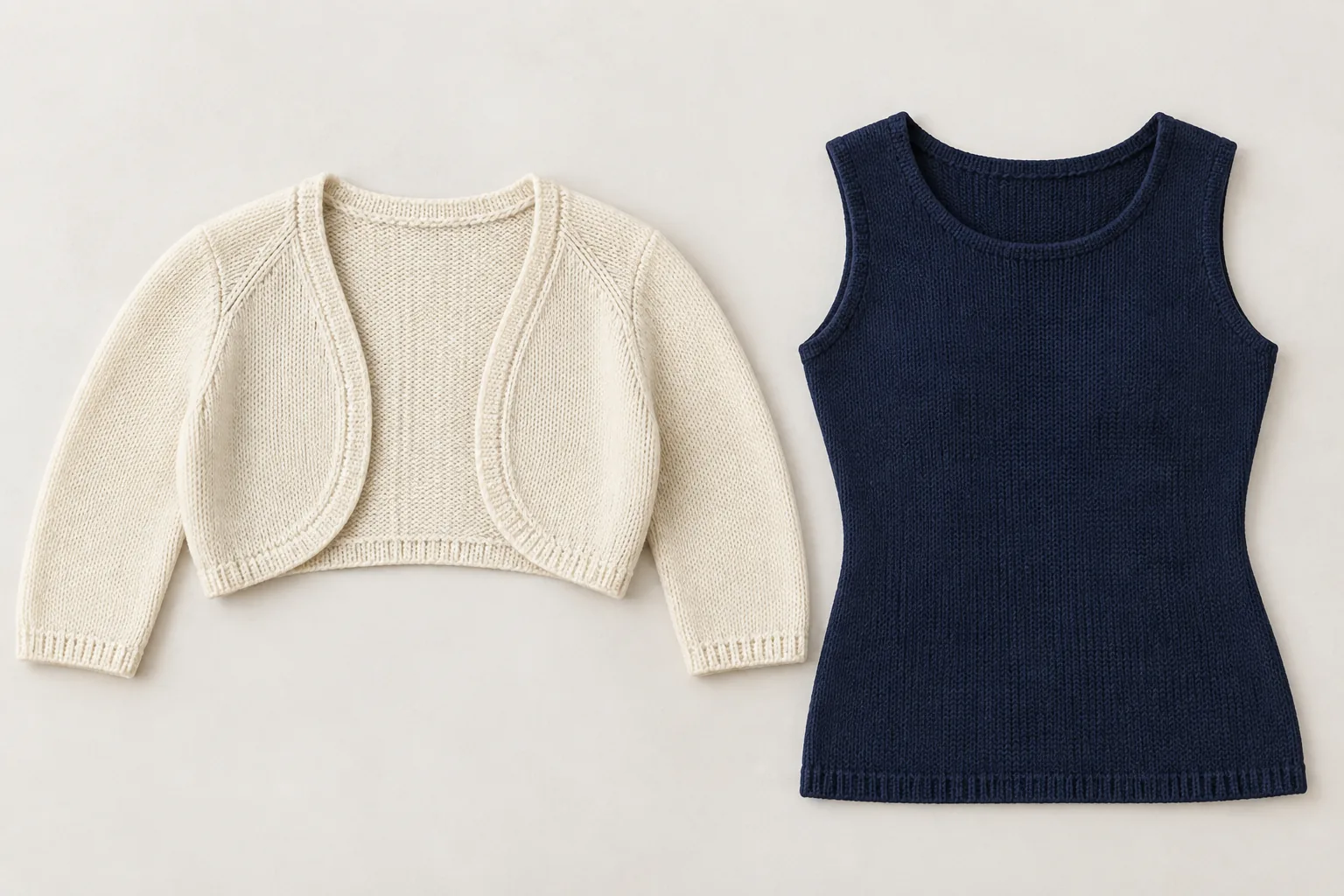
Specify whether the bolero accompanies a sleeveless dress, camisole, fitted top or another garment. Describe the underlayer neckline, shoulder coverage, armhole and surface where those features affect contact. If a particular dress is part of the product offer, use that actual reference. A convenient studio tee may sit quite differently beneath the short fronts.
Ask design to identify what the cardigan should reveal. The opening might frame a neckline, finish above a waist seam, or leave a decorative bodice unobstructed. Turn that intention into landmarks visible in front and side photographs. “More flattering” gives a technician little guidance; “the lower front should sit above this seam in the standing position” identifies a checkable relationship.
For a bolero cardigan sold on its own, choose a defined set of representative underlayers. A narrow strap, broad shoulder panel and raised decorative surface can create different contact points. The buyer should identify which combinations are part of the approval and which are styling suggestions only. Keep any temporary fastening on the dress visible in the fitting notes, since it may change where the bolero rests.
Agree which movements belong to normal use
Choose a short sequence consistent with the outfit: arms relaxed, forward reach, a seated position, and returning to rest may be appropriate. Record the chosen actions and the starting position. The team should not stretch the garment to an arbitrary extreme and call the resulting lift a defect.
Observe whether the bolero cardigan returns by itself or requires arranging. A sleeve can draw the short side body upwards while the opening looks unchanged from the front. For that reason, take a side view after movement and before anyone pulls the hem down.
How should buyers measure the bolero cardigan?
Establish a vertical reference independent of the sleeve
A bolero leaves little distance between the armhole and lower edge. Record the origin used for front length, back length, side-body depth and the lowest point of a curved opening. Do not let one “body length” value stand for all four.
A curved front may intentionally finish higher near the centre than at the side seam. Measure the intended geometry instead of pulling the panel into a rectangle. Include a relaxed photograph with the measuring references identified in the accompanying drawing; marks on the working record should never be mistaken for finished-garment features.
Separate opening clearance from garment width
Chest width alone does not describe an open-front bolero cardigan. Add the gap between the fronts at agreed heights, the shoulder-to-front-edge relationship and the position of the lower corners. Specify whether the technician measures these gaps flat, on a form or over the approved outfit.
Use this worksheet to compare the bolero cardigan with its intended outfit.
| Relationship | Reference to record | View or measurement | Decision it supports |
|---|---|---|---|
| Front edge and bodice | Underlayer neckline and design feature | Relaxed front view over the actual layer | Required detail stays visible |
| Short side body | Armhole bottom and lower-edge origin | Side view plus side-depth measurement | Movement has enough local room |
| Back coverage | Neck point and intended back endpoint | Back length and seated view | Coverage matches the brief |
| Sleeve endpoint | Shoulder construction and cuff position | Arm relaxed and after forward reach | Sleeve length belongs to this body |
| Paired lower fronts | Curves, corner positions and fastening state | Left and right records separately | Intended symmetry can be reproduced |
Where should a fitting correction begin?
Find why the bolero cardigan rises during reach
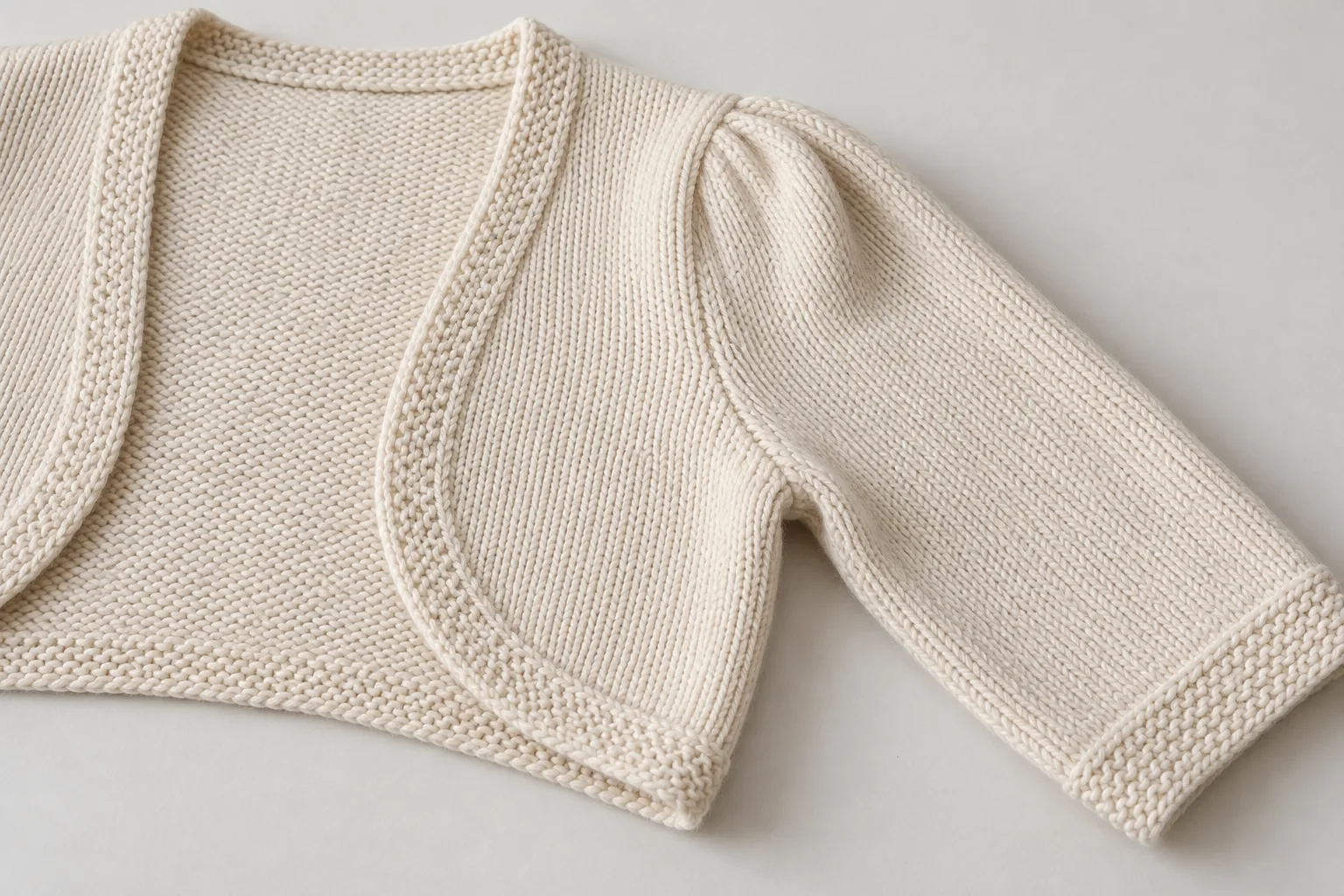
When reaching raises the lower edge, compare the before-and-after positions of the shoulder, armhole and side body. Check whether the underlayer is catching the knit. If the armhole restricts movement, adding body length alone may preserve more coverage while leaving the restriction untouched.
Ask the technician to describe the proposed correction and its expected effect. An armhole change can move the sleeve join and reduce the remaining side-body depth. A shoulder change can alter both sleeve endpoint and front opening. The next sample should therefore revisit the connected landmarks, even if the initial comment concerned only the hem.
Inspect the edge when only a front corner moves
A front corner that curls or hangs away from the body presents a different question. Compare its knitting programme, edge construction, attachment and finishing with the opposite side. Check whether a trim or fastening adds local weight.
Preserve the corner before pressing it flat. If normal finishing produces the desired appearance, write down that route and examine the rested result. If a one-off manual correction is necessary for the photograph, retain the uncorrected view and keep the affected sample open for review.
Yarn and stitch changes can alter how the same small panel hangs. Before asking the factory to move a curve, confirm that the sample uses the intended yarn item, knit structure and finishing route. The gauge selection guide supports that material discussion. The technician may need to reverse a geometry correction once the intended production yarn arrives.
What must the size set demonstrate?
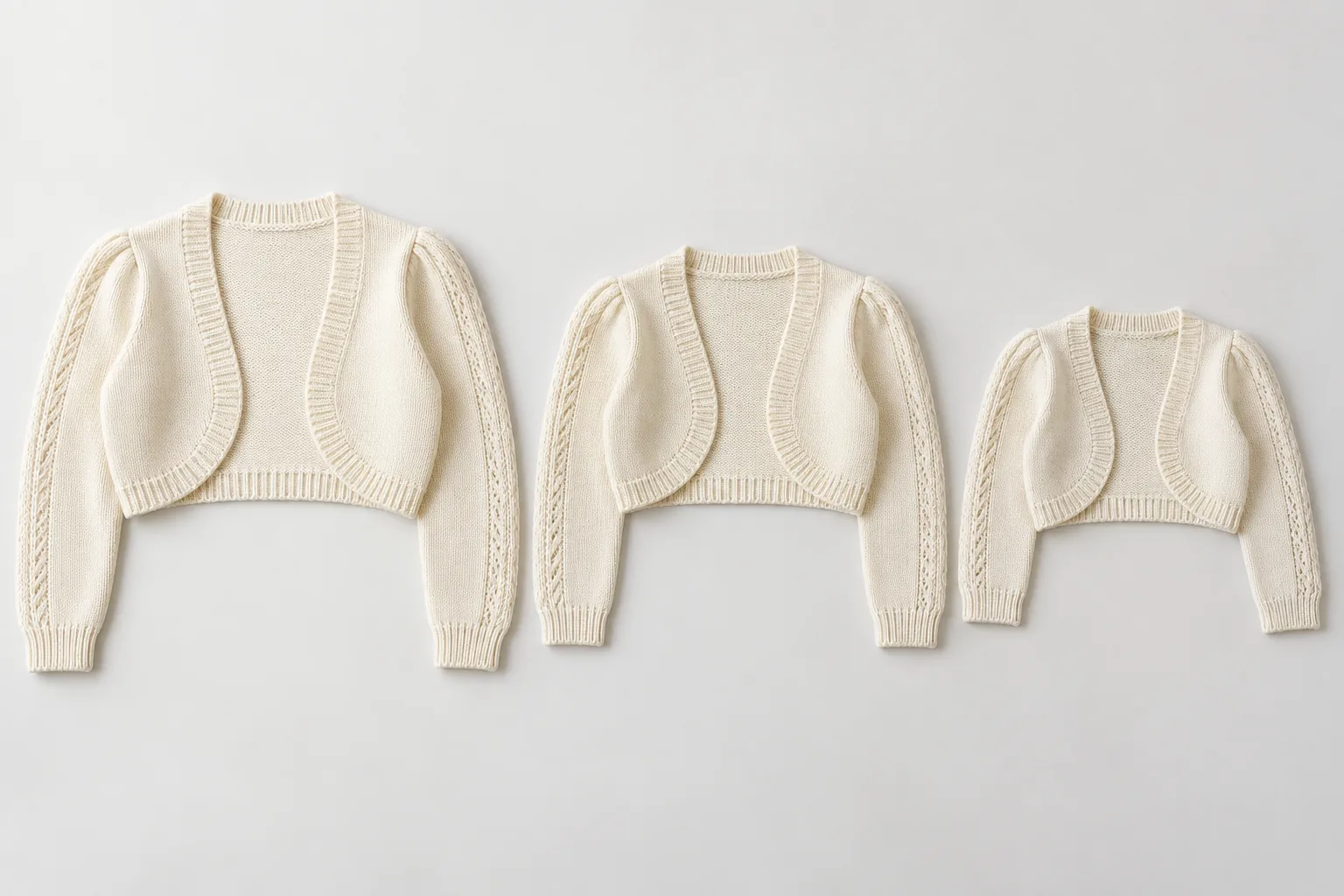
Grade the opening and side body as separate controls
Increasing chest circumference does not automatically determine how far a bolero should extend downwards. Agree how shoulder width, armhole depth, side-body depth and front clearance change from the base size. Mark which bolero cardigan endpoint should stay aligned with the outfit.
For petite, tall or other wearer blocks, record the vertical references separately. A different wearer block may require a different outfit relationship even when the cardigan carries the same retail size label.
Compare neighbouring bolero cardigan sizes consistently
Review the size set in order, keeping underlayer type and photograph angles consistent. Check adjacent sizes as well as the smallest and largest examples. One abrupt armhole or opening change can disappear when reviewers look only at the endpoints.
Record sleeve endpoints relative to the same landmarks. Measuring from a dropped shoulder on one sample and from the neck on another creates apparent disagreement that belongs to the method, not necessarily to the garment.
If one underlayer is unavailable, identify the substitute and the comparisons it cannot support. The buyer can assess knitting and measurements while leaving the outfit interaction pending. That is more precise than recording a full fit pass from an unrelated layer.
Keep sleeve weight distribution in the comparison when cuffs, flares or decorative sections differ. A long flared cuff may load the shoulder differently from the narrow sleeve used in the approved base sample. Compare the actual sleeve route before diagnosing a body-length problem. If design chooses different sleeve options, give each combination a clear sample identity rather than carrying one bolero-body approval across all sleeves without review.
Which finishing and packing checks protect the bolero?
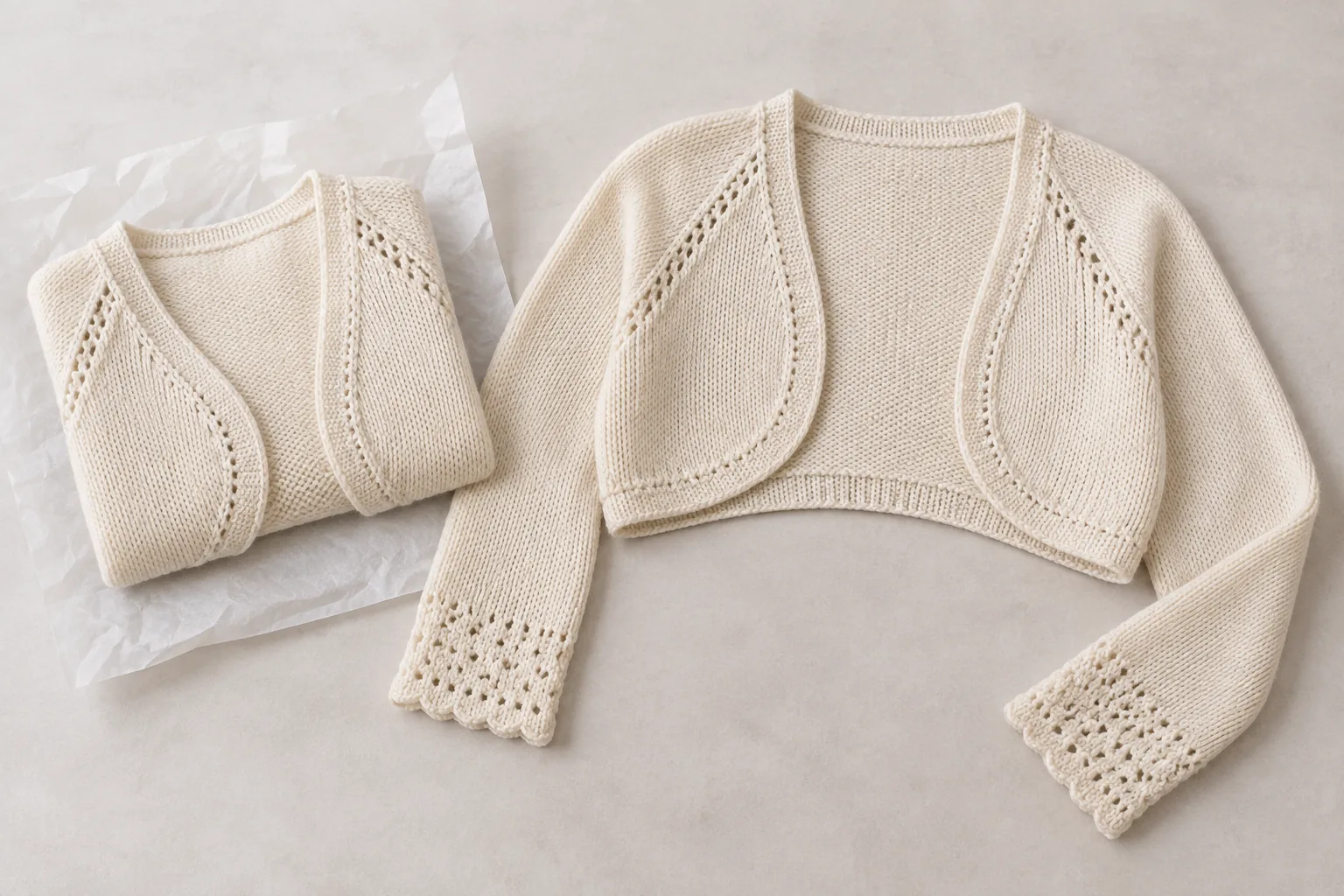
Measure the bolero cardigan after the agreed care
Record whether reviewers examine the sample before or after its proposed care route, how technicians dry or support it, and when they measure it. AATCC TM150 addresses garment dimensional change after home laundering; a qualified team must select applicable conditions for the actual knit.
Keep front length, back length, side depth and sleeve values separately. A general statement that the sample “washed well” cannot reveal whether a short side panel changed differently from a long sleeve.
Inspect the presentation that will reach the buyer
A long sleeve folded across a small body can conceal a turned front corner. Agree the fold and fastening state with the packing team, then examine a representative unpacked garment after the stated rest.
Distinguish a temporary packing crease from an incorrect panel shape. The former may call for a packing change; the latter needs construction evidence. If an inspector presses or pulls the unpacked garment into position for a photograph, record that intervention beside the image.
When can bolero cardigan proportion approval close?
Assign an action to the actual finding
This table links fitting observations with the next responsible action.
| Finding | Check before changing the design | Action | Record needed to close |
|---|---|---|---|
| Entire bolero rises during reach | Armhole restriction and underlayer interference | Return fit relationship for correction | Updated armhole, sleeve and side-depth comparison |
| One front corner lifts at rest | Edge programme, trim weight and finishing | Hold the affected construction | Paired corner views before and after the correction |
| Larger size covers an intended dress detail | Opening grade and underlayer reference | Revise the size-specific opening rule | Revised overlay and fitted sample |
| Measurements match but one sleeve looks long | Shoulder origin and sleeve measuring method | Resolve the reference before cutting length | Agreed origin and equivalent views |
| Unpacked front stays folded inward | Packing route and rested shape | Change packing or investigate the edge | Unpacked comparison without hidden arranging |
| Buyer chooses a different endpoint | Current style brief and affected sizes | Approve a design revision | Signed reference, grade chart and dated comment |
Send the bolero, matching outfit reference, annotated front/side endpoints and unadjusted movement views when you contact CNSweaters about bolero development. Name the detail the opening must reveal and the fit change still needed.
Frequently Asked Questions
Can a sleeveless dress be replaced with a tee for approval?
A tee may support some measurements, but its shoulders, armholes and surface can change contact with the bolero. Record the substitution and retain the outfit-specific fit decision as pending.
Must every size keep exactly the same body length?
That depends on the intended endpoint and body blocks. The grade should explain vertical changes rather than assuming either constant length or uniform increases.
Does a curved hem need different tolerances on each side?
Intentional asymmetry requires a defined reference. Otherwise, paired measurements help expose differences; the technical team should specify the applicable limits.
Can a brooch be added after the sample is approved?
Its weight and attachment may change front balance. Treat it as a component revision and revisit the affected opening, support and wearing conditions.
What should happen if two reviewers arrange the fronts differently?
Agree how the garment is placed and which corrections are permitted. Repeat the comparison from the same natural starting state before judging the construction.