 CN Sweaters
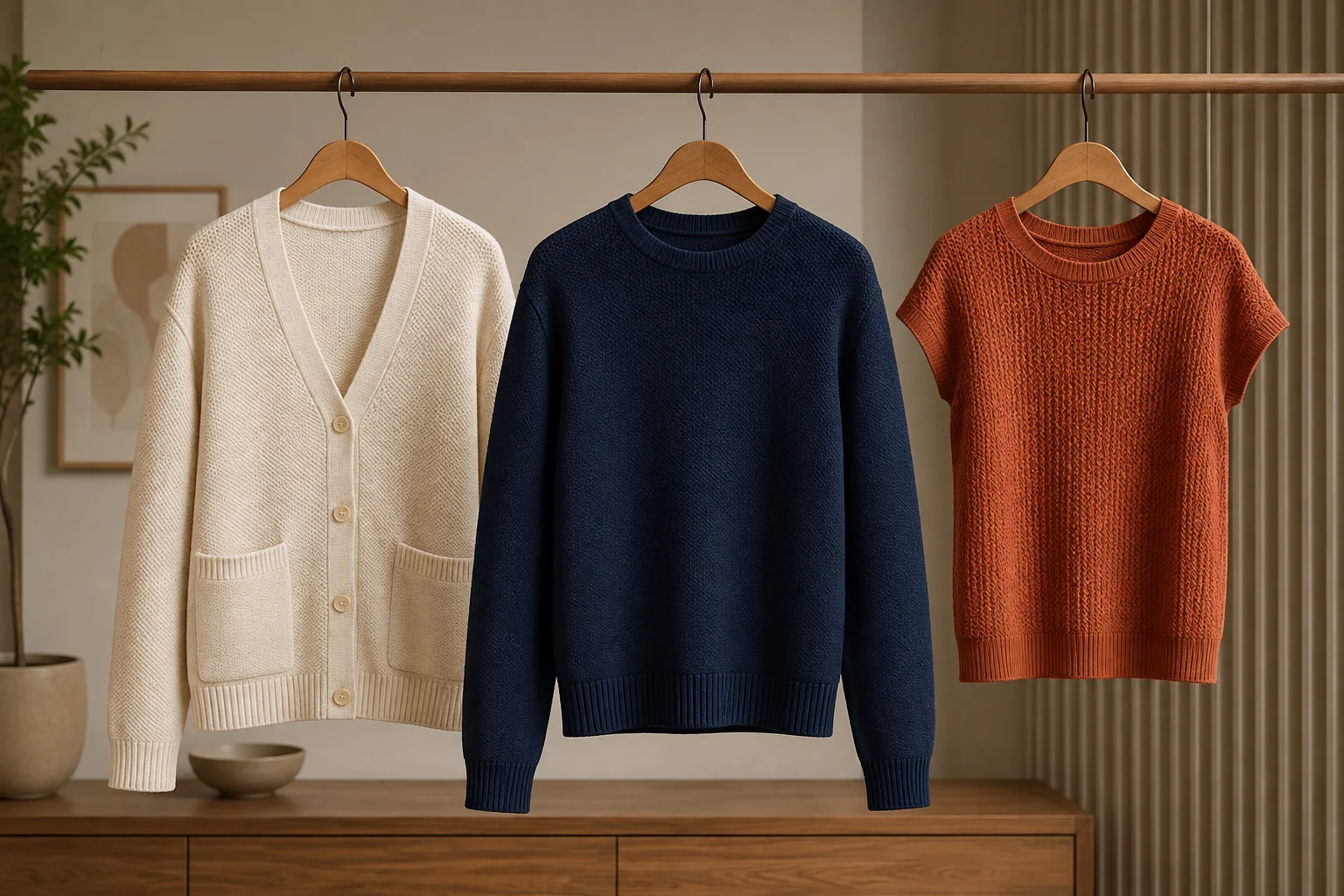
At a July range review, an unfinished knitwear style needs a decision about its place in the first Q4 delivery, not another optimistic date in a spreadsheet. Keep it in the first group only when the remaining evidence and current route support that choice. Otherwise, remove it from that group or defer it to a separately reviewed opportunity. Calling the whole collection a Q4 order can hide the difference between an approved core and an unresolved experiment.
Knitwear lead time still depends on the actual product, quantities, approvals and destination. There is no universal July cutoff, and the end of the month does not make a provisional route firm. This guide focuses on the product-scope decision: which styles and colors belong in the first delivery, what can remain conditional, and what the buyer must not accidentally authorize while keeping an option open.
What Does the July Knitwear Lead Time Gate Decide?
Define the first delivery in usable terms
State where the goods must be received and what commercial job that first receipt serves. A distribution-center arrival, factory collection and retail availability are different events. Record the actual location, target window and receiving assumptions before deciding that a late sample still has time. If the team only has a general Q4 ambition, the immediate task is to clarify that event, not to manufacture precision from a calendar label.
Use the general knitwear lead-time guide for the broader sequence, without copying its numerical ranges. This July review should identify the styles that can share the first delivery and the unresolved items that would change its usefulness. A collection may have several later opportunities; they should not all inherit the first group’s target by default.
Ask the commercial owner to describe the smallest first offer that still works. It might require a complete size range in one supported core rather than a few sizes across several unfinished concepts. Another channel may need a coordinated set and find a partial assortment unusable. Those conditions belong in the decision before the team proposes a smaller shipment as an apparent solution.
Separate product selection from purchase authority
A keep decision means that a style remains in the proposed first-delivery scope, subject to its stated gates. It is not automatically permission to buy yarn, start knitting or accept residual material. Name the person who can authorize each commercial commitment and the document that records it. If the buyer only requests an option, say explicitly which spending or production actions are not authorized.
The Q4 forecast scenario guide owns the wider demand-to-commitment discussion. Here the narrower choice is whether an unapproved item belongs in the first group at all. Customer interest, sample approval and material authorization answer different questions. Combining them into one green status can conceal an unsupported commitment.
Which Unfinished Styles Should Stay in the First Group?
Compare the missing evidence with the style’s purpose
List the unresolved question for each candidate. A corrected administrative field is not the same as an untested yarn substitution or a fit change that may alter the entire garment. Ask the responsible technical owner what evidence closes the issue and whether that evidence could require another decision. Do not decide that a problem is minor merely because the sample already looks attractive.
Then ask what the first offer loses if the item moves out. Does it serve a distinct customer need, complete a required outfit or support a confirmed order condition? Or does it add another color to a role already covered? Keep the commercial consequence visible without turning it into a forecast of certain sales. An important style may deserve more investigation, but importance does not make its remaining work disappear.
Distinguish missing information from negative evidence. An unavailable shade decision calls for an answer; a rejected shade calls for a changed proposal or another route. A sample that has not been reviewed is different from one that failed the intended fit. Writing both as pending conceals the work required to reach a decision and makes the first group’s assumptions harder to challenge.
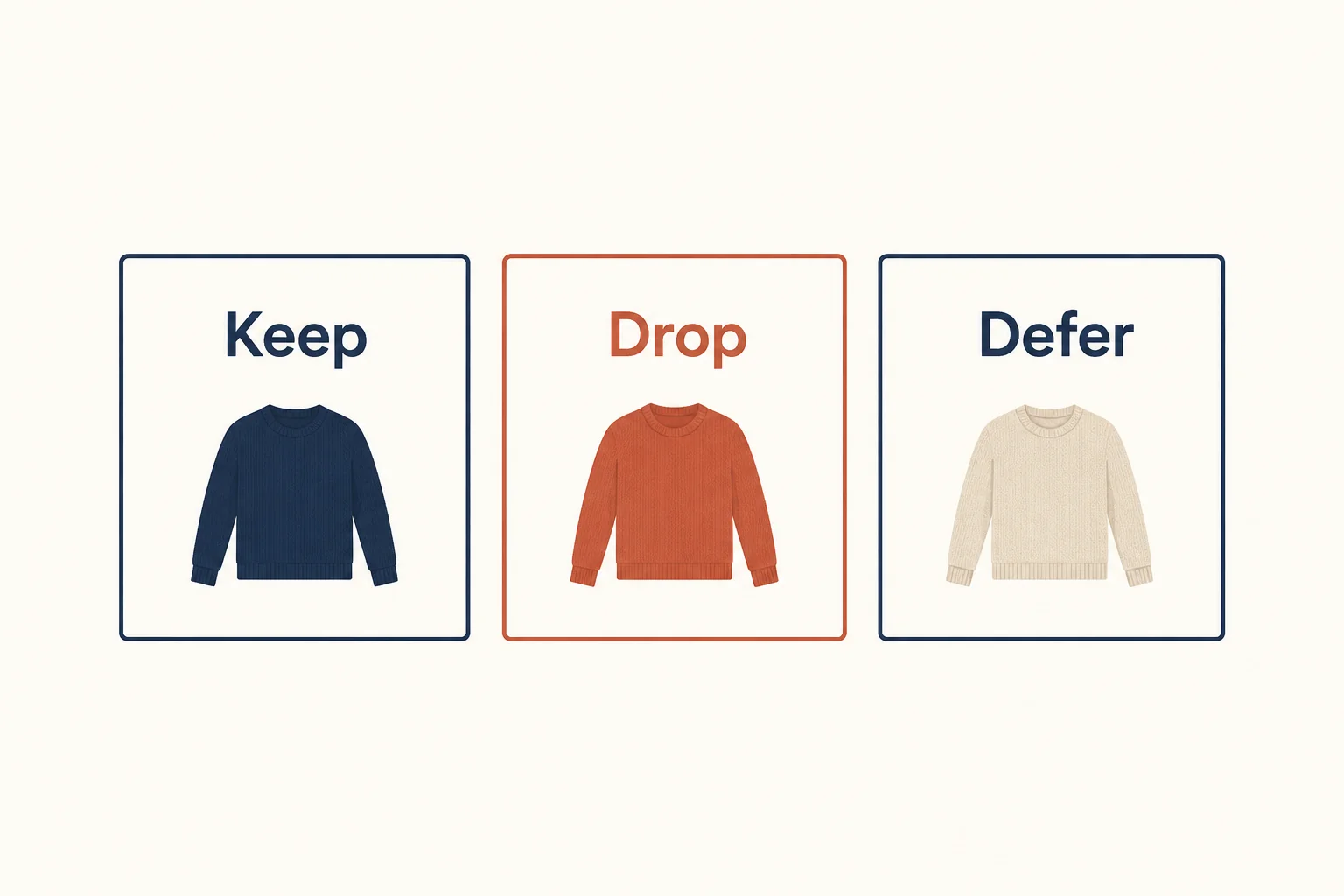
| July decision | Required basis | First-group consequence | What is not implied |
|---|---|---|---|
| Keep subject to named gates | Relevant role and a current route to close missing evidence | Remains in the proposed first scope | No automatic material or bulk authorization |
| Drop from first group | Duplicated role or unacceptable remaining exposure | Remove its units and dependencies from that group | No automatic cancellation of existing obligations |
| Defer | A distinct role but insufficient evidence for first receipt | Review a separate later opportunity | No guaranteed later slot or delivery |
| Request a smaller decision | One bounded question can reduce uncertainty | Limit current work to that question | No approval of the complete style |
Do not let a sample expense become the buying reason
Keep development expense separate from proposed inventory. A sample may have taught the team that the style is not suitable for the first offer. That learning does not require a bulk purchase to become useful. Likewise, a nearly completed sample can remain outside the first group if its unresolved feature changes the commercial proposition.
The fall sampling checklist helps define the evidence request. Use it for the specific question that matters to the July decision, rather than restarting every sample stage by habit. Record whether the next submission is expected to close a fit issue, test a color or reveal feasibility, and who must interpret the result.
Can Approved Core Styles Proceed Independently?
Map the dependency before proposing separation
Two styles on different rows may still share a yarn purchase, dye lot, special button, label order or finishing arrangement. Ask which commitments and activities are genuinely independent. Removing one experimental style may leave the core physically unchanged but alter a material threshold or quotation. Conversely, an unrelated shade review should not automatically prevent a fully supported core color from being considered separately.
The factory capacity questions address the underlying resources. At this stage, request the minimum current answer needed to test independence, rather than assuming that a smaller first group must be faster. The supplier may need to revise the route after the scope changes. A buyer’s spreadsheet split is not evidence of a production reservation.
Check dependencies in both directions. If the test style is removed, could the core lose an agreed combined-material condition? If the core proceeds, would the test style later need a different lot or a fresh comparison? Record the answer without assuming that sharing is always beneficial. A proposed split may solve one timing problem while introducing a new product or commercial question.
Keep the consequences connected to the schedule
For each dependency, identify the event that must happen first and which later date changes if it does not. The GAO Schedule Assessment Guide explains how an integrated schedule supports analysis of events, completion dates and change. It is general scheduling guidance, not evidence of a knitwear factory’s available time. Apply the principle by asking for linked current milestones, not by borrowing a standard duration.
In a hypothetical example, a core pullover and an experimental cardigan share a proposed color purchase. The cardigan still needs a fit decision. The buyer could ask whether the pullover’s material requirement can be identified and committed separately, but should not assume the supplier accepts that split or that leftover material has no cost. If the answer is conditional, preserve the condition on the first group’s record.
What Can Be Committed Before Full Approval?
Describe the smallest authorized action
An inquiry, a quotation, a temporary hold and a purchase are different actions. Ask the supplier what is being offered, its validity and the condition for converting it into a commitment. If material is involved, clarify the quantity basis, identity, storage or residual arrangement and what happens when the style is dropped. These terms require agreement; this article does not determine the parties’ legal obligations.
Use the yarn and garment MOQ discussion to separate the thresholds that could be affected. A reduced garment group may still leave a material issue. The decision is whether that exposure is understood and authorized, not whether the total garment quantity looks smaller. Unknown minimums and current prices must remain unknown until the responsible party supplies them.
For clarity, a buyer’s message could request a quotation for holding an identified material quantity while expressly withholding purchasing approval. That is an example of communication scope, not contractual wording guaranteed to work in every jurisdiction. If the supplier’s response describes an action already taken, resolve the discrepancy with the authorized parties before relying on the option. Do not treat silence as agreement.
Bound the condition and the review date
State exactly what must become true for the next action to proceed. An example might be acceptance of a named sample revision before an offer expires; another could be confirmation of the final color quantity. Do not label a condition closed because someone sent a file. The responsible owner must determine whether the file answers the question and record the resulting decision.
If the condition is missed, require a new response rather than silently carrying forward the old assumption. The sample-delay review can help identify the unresolved input. A delay notice should name the affected style, current missing evidence and consequence for first delivery. It should not automatically reopen unrelated approved products or authorize an alternative material.
How Should the Receiving Route Affect Keep or Defer?
Distinguish transport responsibility from the arrival plan
Confirm the handover event and the remaining route to the required receiving point. A proposed factory-completion date is not the same as a warehouse appointment. Ask the responsible logistics parties to review the current transport and receiving assumptions when the group changes, including any effect of separate cartons, inspection releases or documents.
The ICC Incoterms 2020 explanation distinguishes obligations, risk and costs and makes clear that the rules are not a complete sales contract. They do not, by themselves, resolve most consequences of delay. Do not treat a trade-term abbreviation as a guarantee that a deferred style can still reach the retailer on time.
The EXW, FOB and door-delivery comparison is a useful starting point for questions. Obtain project-specific advice and current quotations where needed. No transport mode should be selected on an invented transit range or assumed ability to recover unfinished product approval.
Verify that a smaller delivery is still receivable
A separated core group must still make sense at the destination. Confirm whether the retailer or warehouse accepts partial receipts, whether the first group has enough useful size coverage and which data must accompany it. A garment can be physically finished without being ready for the receiving process. Moving an unresolved style to a later group may require changes to order records or presentation plans.
For logistics identification, GS1’s logistic-label guidance describes the SSCC’s role in connecting physical units with electronic messages. Where that system is used, ensure the changed group is represented correctly. It does not establish a warehouse’s individual booking rules. The knitwear packaging and barcode guide can support that separate receiving-data review.

What Must Be Written Down When July Closes?
Issue one scope decision with traceable assumptions
Create a short decision record for each unresolved item: style and revision, missing evidence, first-delivery purpose, dependency, authorized action, decision owner, review date and consequence if the condition fails. Use the actual response date and reference. If a key input is unavailable, name it rather than filling the cell with an apparently reasonable estimate.
The pre-production sample review owns the later product-release evidence. Your July scope record should point to that gate without claiming it has happened. A keep decision can coexist with an open production gate, provided nobody mistakes the former for permission to pass the latter.
Reconcile the first group’s style, color and size quantities after every removal. Check supplier attachments, internal buying totals and retailer-facing availability information. Do not leave a dropped style in one file while another file describes it as deferred. The next person reading the record should be able to identify the current scope without interpreting a sequence of conflicting messages.
A hypothetical closing note might retain a supported pullover, defer a cardigan until a named fit question is answered, and remove an additional color that no longer has a distinct first-delivery role. It should also say whether any material action was approved. The useful evidence is the referenced decision and response, not the neatness of the note or the fact that July has ended.
Reopen only when a named assumption changes
Choose the events that require another scope decision: an unsuccessful sample review, expired offer, altered material route, changed first-receipt requirement or a new customer condition. A change should identify the affected row and what earlier decision it replaces. Routine progress that leaves the assumptions intact does not require restarting the complete range review.
The output handed into August is a selected first scope plus explicit unresolved conditions, not a claim that capacity has been reserved. A later review must examine the supplier’s actual current response and its validity. Keeping these stages separate prevents an early commercial preference from becoming supposed evidence of a factory commitment.
Conclusion
Use the July knitwear lead time review to decide what belongs in the first Q4 delivery. Define the required receipt, separate approved core styles from unresolved candidates, and assess each missing answer against the item’s commercial purpose. Keep, drop and defer should have visible consequences for quantities and dependencies, not merely different colors in a spreadsheet.
If a limited action can protect an option, state its scope, authority, conditions and expiry before anyone commits resources. Check whether a smaller group can progress and be received independently, and do not treat a transport term as a delivery guarantee. Close July with one traceable scope record, while leaving actual production and shipment gates intact. For a review of the proposed first group, open sample decisions, material questions and receiving requirement, contact CNSweaters with your Q4 knitwear scope brief.
Frequently Asked Questions
Is the end of July a universal approval deadline?
No. The relevant decision date depends on the actual style, current route and required receipt. July is the review context here, not a guaranteed lead-time allowance. Ask for current evidence before treating any remaining interval as sufficient.
Does dropping a style cancel a material obligation?
Not automatically. Review what has already been authorized and the applicable agreed terms with the responsible parties. Removing units from an internal assortment sheet does not by itself change an existing purchase or other commercial commitment.
Can a core group go ahead while a test color waits?
Possibly, if the relevant material, production, release and receiving arrangements are genuinely independent and confirmed. Identify shared dependencies first. A separate spreadsheet row or different color name is not proof that the groups can proceed independently.
Should every outstanding comment require a new garment?
No universal rule applies. The responsible technical owner should identify the evidence needed for the specific issue. Some changes may require physical review; others may have a documented approval route. The buyer must not assume either outcome without that decision.
What happens to a style that is deferred?
It stays outside the first group’s commitment and receives a separate review condition. Reconsider its remaining commercial purpose and current feasibility before assigning a later delivery. Deferral preserves a question; it does not reserve a later production slot.