 CN Sweaters

When a received custom knitwear order looks different from the approved reference, preserve the goods and their identity before trying to prove who is wrong. Stop the affected stock from entering ordinary fulfillment, record which units your team has actually checked, and tell the supplier what you observed. A photograph of two sweaters can start the conversation. It cannot establish the extent, cause or commercial remedy for the whole delivery.
This is a receiving-stage guide for buyers dealing with a possible shade mismatch after arrival. The dye lot prevention guide covers the earlier approval and production controls. Here, the buyer’s decision is different: what should remain on hold, what evidence is needed to investigate, and which handling option can both parties agree on and carry out? Treat a suspected dye-lot issue as a working description until the comparison and traceability evidence support a more specific conclusion.
Which custom knitwear stock should you hold first?
Stop ordinary picking without declaring the whole delivery defective
Identify the order, delivery, style and color associated with the first observation. Ask the warehouse to place the identifiable affected stock on hold in both its operating instructions and inventory system. Record where it is stored and who may access or move it. A note in the buyer’s email does not prevent an already assigned picking team from shipping it.
Separate the team’s findings from the stock it has not yet examined. If two checked cartons show a difference, record those observations and the wider stock population that may be related. Do not report the entire delivery as inspected. If the team cannot yet establish reliable boundaries, use a broader precautionary hold while the team reconstructs them; label that as containment, not a final rejection.
Check whether any units have already moved to stores or customers. Record the locations and ask the appropriate internal team what temporary action is needed. A shade complaint alone does not establish a product safety issue or a recall requirement. Any additional safety or compliance concern needs its own qualified assessment.
Preserve carton identity during the first review
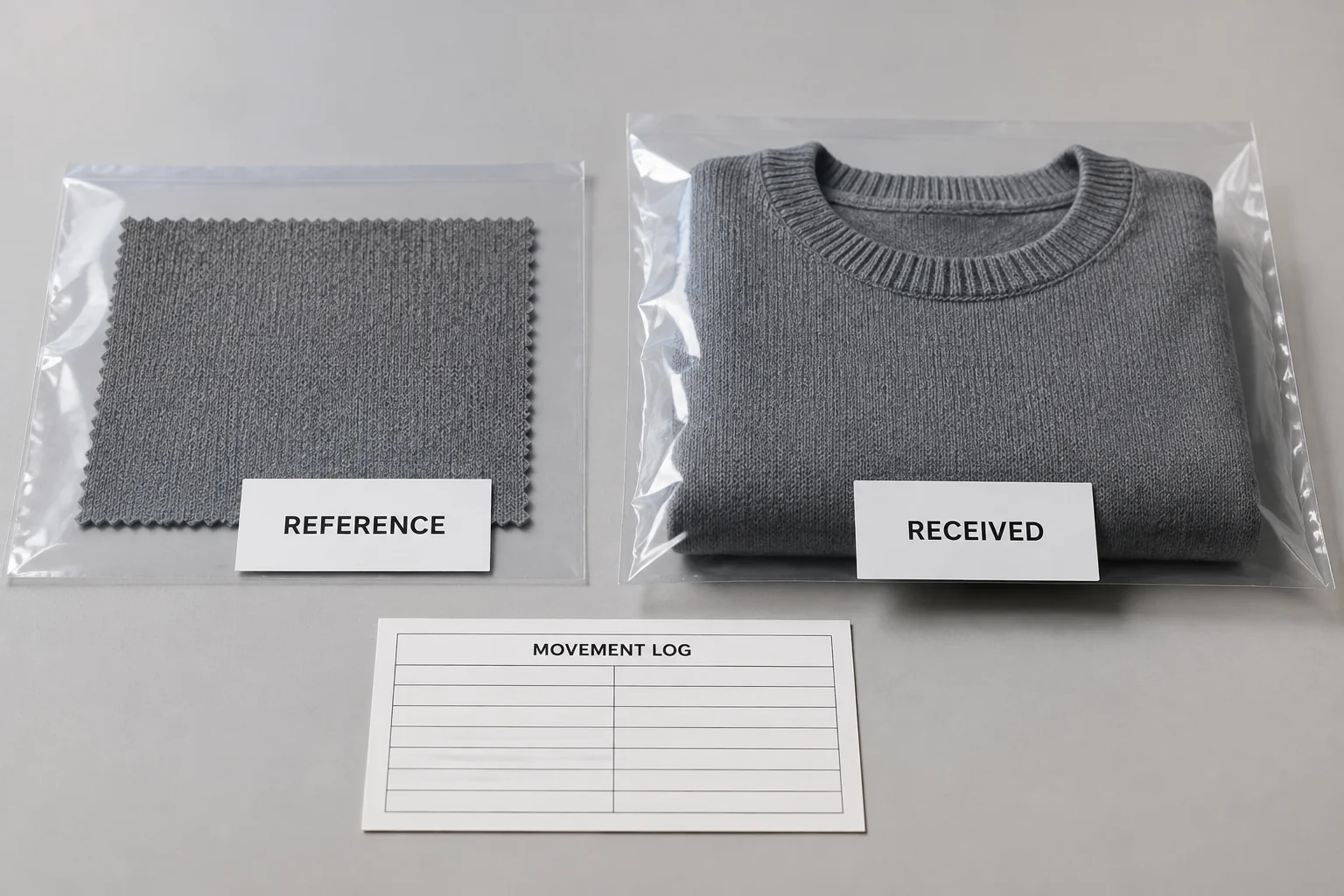
Before unpacking more goods, photograph carton identifiers and record the contents associated with each selected specimen. Keep the original packaging and labels where practical. If you remove samples from a carton, record their identifiers, who moved them and each new location. Do not regroup all similar-looking garments into one pile and lose their source identity.
The packaging and barcode guide provides the normal product identification context. For a dispute, add a case reference that connects the physical specimen to the receiving record without changing its product label.
Choose a case coordinator and a warehouse contact. The coordinator should maintain the current hold scope; the warehouse contact should confirm actual movements. If the hold expands or narrows, issue a replacement instruction with a date and affected identifiers. Retain the previous instruction so the team can explain why stock moved, rather than reconstructing the sequence from memory.

What evidence should remain unchanged for the comparison?
Recover the reference that governed this order
Locate the approved physical reference, its identification and the approval correspondence. Distinguish a development lab dip, a fit sample made in substitute yarn, a finished pre-production sample and a garment retained from an earlier delivery. Several attractive samples in an office drawer do not establish which one controlled this purchase.
Use the lab dip approval article to identify what an earlier color approval should describe. Do not repair a missing approval by selecting a new favorite sample after the delivery has arrived. If the parties relied on different references, record that disagreement and recover the underlying communications before deciding what was promised.
Ask how the parties stored and used the reference, including any wear, washing, display exposure or other changes. Ask the supplier to identify its retained counterpart and report its condition too. A changed reference may still provide useful context, but its history must remain visible. Do not call two specimens identical retained masters merely because they carry the same style number.
Retain received specimens before alteration or testing
Set aside identified examples of the reported issue and any relevant comparison units. Keep them in their received condition using suitable storage and handling. Do not wash, steam, brush, redye or relabel all available examples in an attempt to make the mismatch disappear. Before a reviewer tests or treats a specimen, agree which identified pieces they may use and retain untreated counterparts where feasible.
Maintain a simple movement log for specimens sent to a supplier, laboratory or reviewer: identifier, sender, recipient, date, stated purpose and return or retention arrangement. This supports a shared investigation; it is not a guarantee of legal admissibility or a substitute for advice about contractual evidence requirements.
Preserve original photographs and files, with their associated specimen details. Clearly mark any annotated copy. Avoid editing color, substituting generated imagery or presenting a compressed chat image as a measured shade result. The pre-production sample review guide helps recover the original approval context, but it does not decide the received-stock complaint by itself.
How should both sides compare custom knitwear shades?
Reconcile viewing conditions before exchanging conclusions
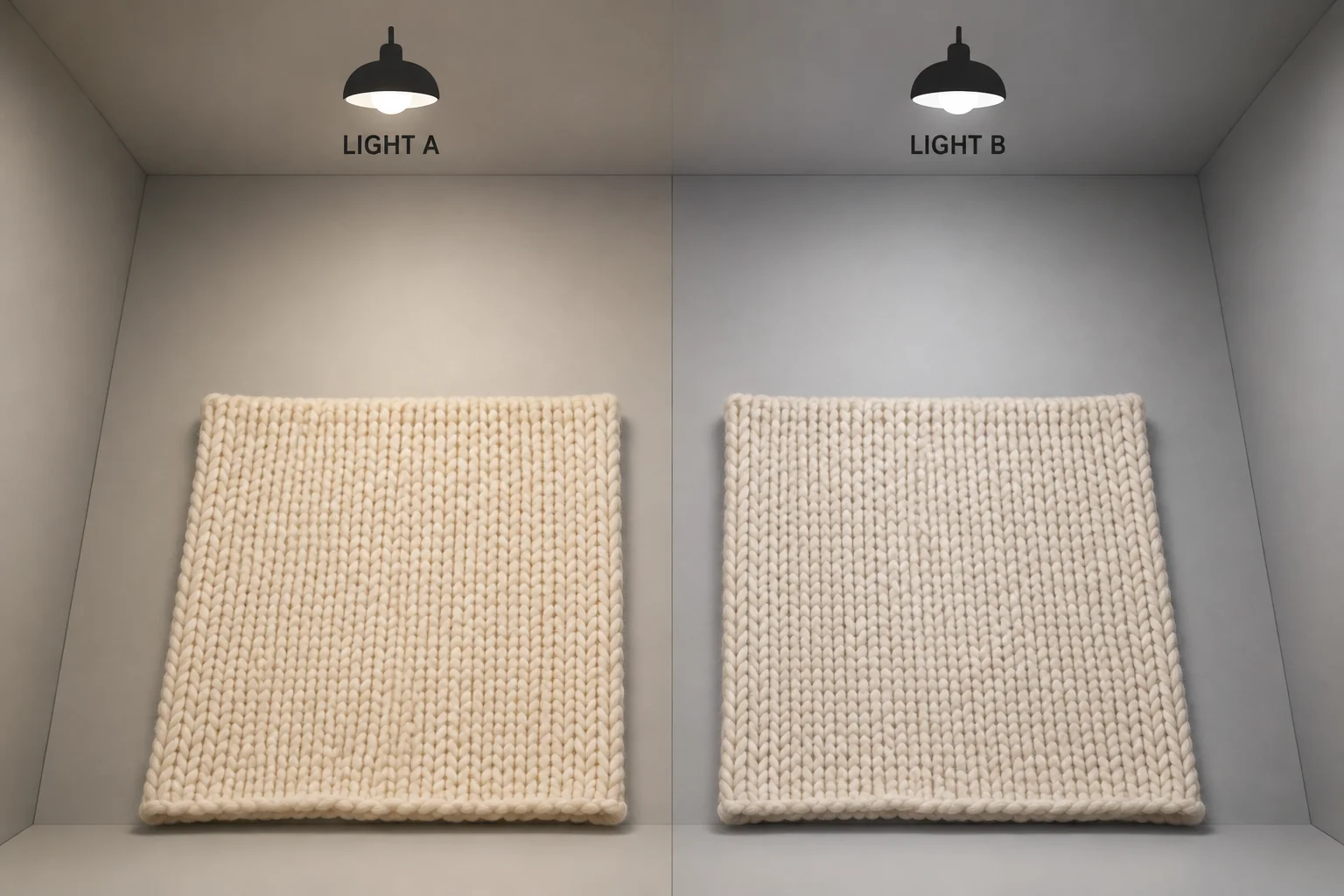
Ask each reviewer which specimens they compared, under which light and in what physical arrangement. A supplier checking a retained panel and a buyer checking a folded garment under office lighting may be answering different questions. Arrange a comparison using the agreed reference and suitable controlled conditions, with a competent reviewer where needed.
X-Rite’s visual color assessment overview explains that samples can match under one light source and separate under another, a metameric effect. A second viewing condition can therefore be useful evidence. It is not permission to choose whichever light makes one party’s position look strongest, nor does a photograph establish that metamerism caused the complaint.
Record how using the same comparison conditions changed each reviewer’s findings. If both sides now see the same difference, move to the agreed acceptance basis and affected scope. If they still disagree, identify the remaining variable and consider a jointly selected independent assessment. The shade variation control article covers the wider technical context; this case needs a reproducible comparison of the actual received specimens.
Ask what an instrument result actually represents
Request the full relevant report, not only a pass label or a single color-difference number pasted into an email. Ask the evaluator to identify the reference, specimens, measurement settings, preparation and criteria used. Datacolor’s textile color management guide describes consistent standards, measurement procedures and controlled visual assessment as connected parts of color evaluation.
Have a qualified evaluator explain any mismatch between the numerical result and the observed garment appearance. Do not invent a universal Delta E limit for textured, brushed or mixed-color knitwear. If the parties never agreed a numerical acceptance criterion, acknowledge that gap rather than presenting a newly selected number as an original contract condition.
Keep separate issues separate. A report about color change after washing does not by itself answer whether the delivered garment matched the approved reference on arrival. Likewise, an initial shade comparison does not resolve a complaint about later dye transfer. State the question the proposed assessment is meant to answer before authorizing it or relying on its result.
What should the supplier investigation establish?
Send one factual case summary with a clear request
Give the supplier a concise description of the observed difference, the identified specimens, the approval reference and the stock currently held. Include the checked quantity separately from the potentially affected quantity. Ask for an acknowledgment, a responsible contact and a proposed investigation response date. Do not bury the request among unrelated fit comments and price negotiations.
The public abstract of ISO 10002 complaints-handling guidance addresses organizational complaint processes, including evaluation and improvement. It does not cover disputes referred outside the organization. Use that limited distinction here: a structured supplier complaint is an investigation route, not an arbitration decision or a promise of compensation.
Ask both sides to distinguish observations, explanations still under investigation and agreed findings. The table below is a case-working record, not a defect-rate estimate or legal evidence standard. Complete it with actual identifiers and retain any uncertainty instead of filling blanks with assumptions.
| Case item | Buyer evidence | Supplier response needed | Current decision |
|---|---|---|---|
| Received appearance | Identified specimens and viewing record | Comparable retained specimen review | Confirm or investigate difference |
| Acceptance reference | Dated approval and reference identity | Counterpart and approval interpretation | Reconcile the governing reference |
| Potential scope | Carton and movement records | Material, finishing and packing traceability | Maintain or revise hold boundaries |
| Proposed treatment | Intended result and retained originals | Feasibility, trial and side-effect review | Accept trial, revise or decline |
Trace the observed pattern without deciding the cause in advance
Ask for the records relevant to the identified stock: material lot allocation, finished batch identity and packing connections where available. Compare those records with the pattern found at receipt. A visible difference between sizes is a useful observation; it is not proof that each size came from a different dye lot.
Record gaps openly. If carton records cannot connect a garment to a material lot, do not recreate that link from a color name. Ask what other records can narrow the investigation and which uncertainty remains. The sample-to-production consistency guide supplies the broader continuity questions without replacing the specific shipment trail.
The color defect reduction article belongs to prevention and process review. Use it after the case evidence identifies a relevant weakness. Requesting a broad promise to improve dyeing is less useful than establishing whether this complaint concerns a changed reference, a material difference, finishing, viewing conditions or another documented cause.
Which handling options can you negotiate without losing evidence?
Compare a feasible treatment with keeping the stock unchanged
A supplier may propose a trial treatment, replacement, return arrangement or a commercial discussion about identified units. Ask what each option would do to the goods, when the result could be checked and who would perform the work. Do not approve a bulk treatment solely because the supplier says the shade can be corrected.
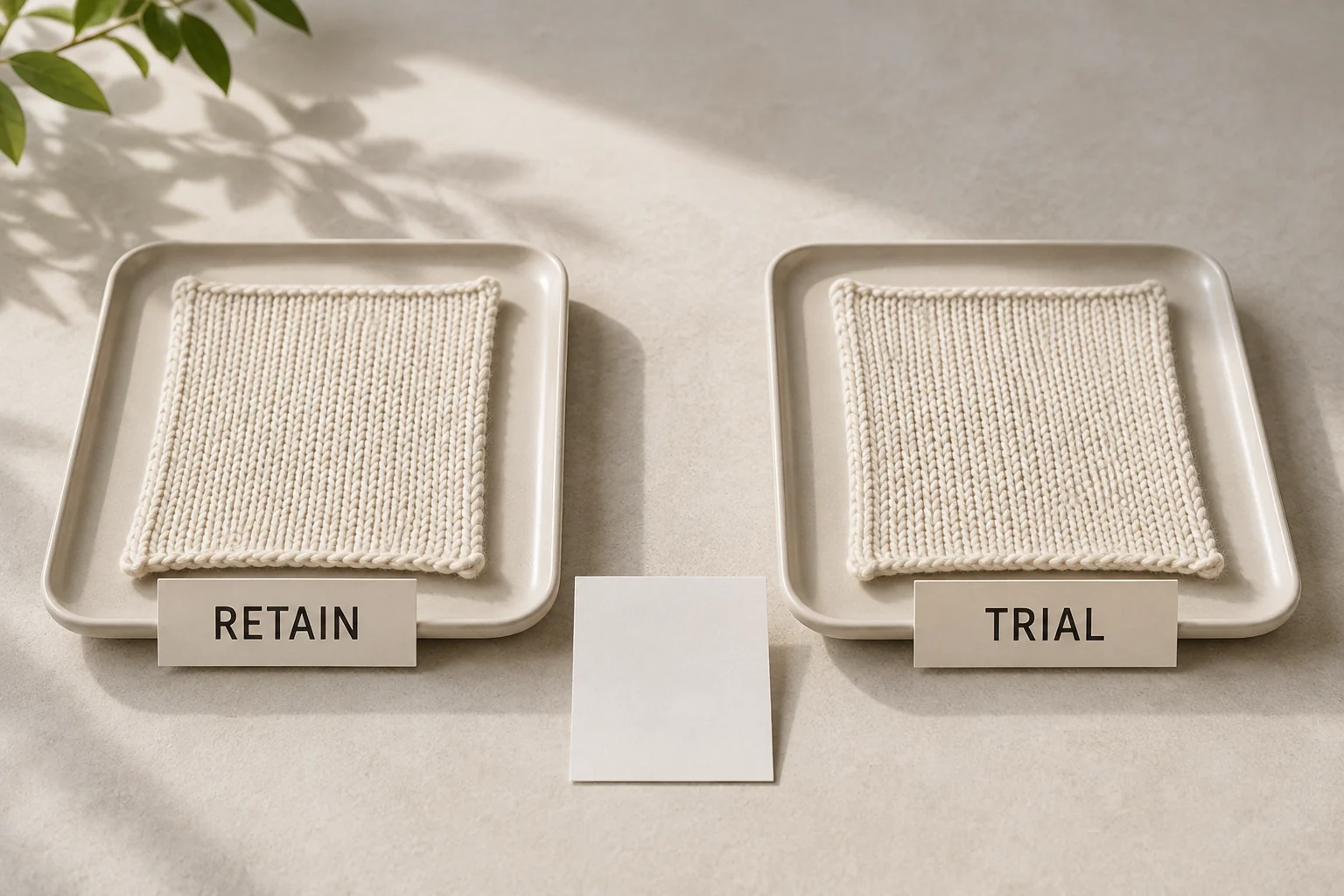
For a trial, identify the specimens the operator will treat, retain comparison pieces and agree the review questions in advance. Ask how the evaluator will check relevant effects on dimensions, hand feel, trims, labels and the garment’s intended performance. The exact assessment depends on the proposed treatment and product; this guide does not prescribe a redyeing recipe or claim that correction is technically possible.
Compare the trial outcome against the agreed objective before discussing wider use. A closer color that creates another unacceptable product change is not an automatic resolution. If the trial does not work, keep its result in the case record and review the remaining options rather than repeating an unproven operation across more stock.
Separate the commercial proposal from an entitlement claim
Prepare an itemized discussion of verified quantities, documented handling costs and the operational consequences of each proposed option. Distinguish costs already incurred from estimates and avoid counting the same item twice. Label replacement timing or resale assumptions as proposals until the relevant party confirms them.
A buyer can explain why an option is commercially unacceptable without asserting that every associated loss must be reimbursed. Contract terms, applicable law and the facts of the case may matter; seek qualified advice where rights, notice deadlines, payment withholding or settlement language are at issue. This article gives no legal or compensation guarantee.
Do not destroy, return, rework or dispose of disputed goods merely to clear warehouse space while responsibilities remain unsettled. Agree the action and necessary records first. Also check who has authority to accept the commercial arrangement: a laboratory reviewer may assess shade, while a different buyer representative must authorize cost and inventory consequences.
When can you release held custom knitwear stock?
Release only the identified scope with an accepted disposition
Write the decision against specific stock identifiers and quantities. State whether the units remain held, are accepted as assessed, move to an agreed trial, or follow another agreed arrangement. Describe any conditions that must be completed before warehouse release. A general message that the issue is solved should not unlock all related inventory.
Use the knitwear inspection checklist for the surrounding product review. If the team sorted or treated goods, confirm the completed quantity and appropriate recheck results. Ask the warehouse to acknowledge its updated instruction, and reconcile removed specimens and already distributed units so the case totals remain understandable.
Close the physical stock decision separately from an unfinished payment or commercial discussion. If the parties agree to release identified goods while another issue remains open, record that limited scope accurately and obtain appropriate advice on the wording. Neither warehouse release nor a supplier credit proposal should be represented as settling matters that the parties have not actually resolved.
Turn the finding into a specific repeat-order condition
Before another order, identify the precise missing control revealed by this case. It might be a reference mismatch, missing receiving identification or an unreviewed process change. Request evidence that the chosen corrective action addresses that finding. A new inspection report with no connection to the observed cause is not enough to explain why recurrence is less likely.
The wholesale knitwear reorder guide supports the separate demand decision. Keep that decision distinct from confidence in the corrective action. A selling need does not close a shade investigation, and an agreed financial adjustment does not prove that the next production will match.
Retain the case summary, reference identity, comparison results, supplier findings, disposition and any conditions for a repeat. Mark unresolved points as unresolved. The next buyer should be able to understand what happened and what was accepted without inheriting an unsupported promise that the issue can never occur again.
Conclusion
A received custom knitwear shade complaint should begin with identifiable stock and preserved references, not an immediate argument about fault. Contain the affected scope, retain specimens in their received condition and establish a comparison that both sides can understand. Record the difference between checked quantities, suspected exposure and confirmed findings so the investigation does not turn assumptions into a rejection of the entire delivery.
Ask the supplier for a factual response and relevant traceability, then compare feasible handling options with their evidence, timing and commercial consequences. Obtain qualified advice where contractual rights or settlement wording need interpretation. Release only the stock covered by an accepted decision, and keep outstanding matters visible. For a repeat order, connect the corrective action to the actual finding rather than relying on a general assurance of better quality.
Frequently Asked Questions
Does a visible difference prove a dye-lot defect?
No. It establishes an observation requiring investigation. Reconcile the reference, viewing conditions and specimen identity, then ask for relevant material and production records. Avoid naming a confirmed cause before that evidence supports it.
Should all delivered cartons be rejected immediately?
Do not confuse a precautionary hold with final rejection. Establish which units your team has inspected and which others may be related. Broaden containment if reliable boundaries are missing, then revise the scope as evidence becomes available and the appropriate decision is made.
Can the warehouse steam the garments before comparing them?
Preserve identifiable received-condition specimens first. If steaming or another treatment is proposed, agree the trial and retain untreated comparisons where feasible. Changing every example can remove information needed to understand the original complaint.
Does a passing numerical color result settle the dispute?
Not by itself. Check the reference, specimen preparation, measurement conditions and agreed acceptance basis. Have a competent evaluator address any conflict with controlled visual assessment; do not introduce an arbitrary tolerance after delivery.
Must the supplier pay all handling and replacement costs?
This guide does not determine entitlement. Document actual costs and proposed options, discuss them with the supplier and obtain qualified advice on the contract and applicable requirements. A complaint record supports discussion but does not guarantee a particular remedy.