 CN Sweaters
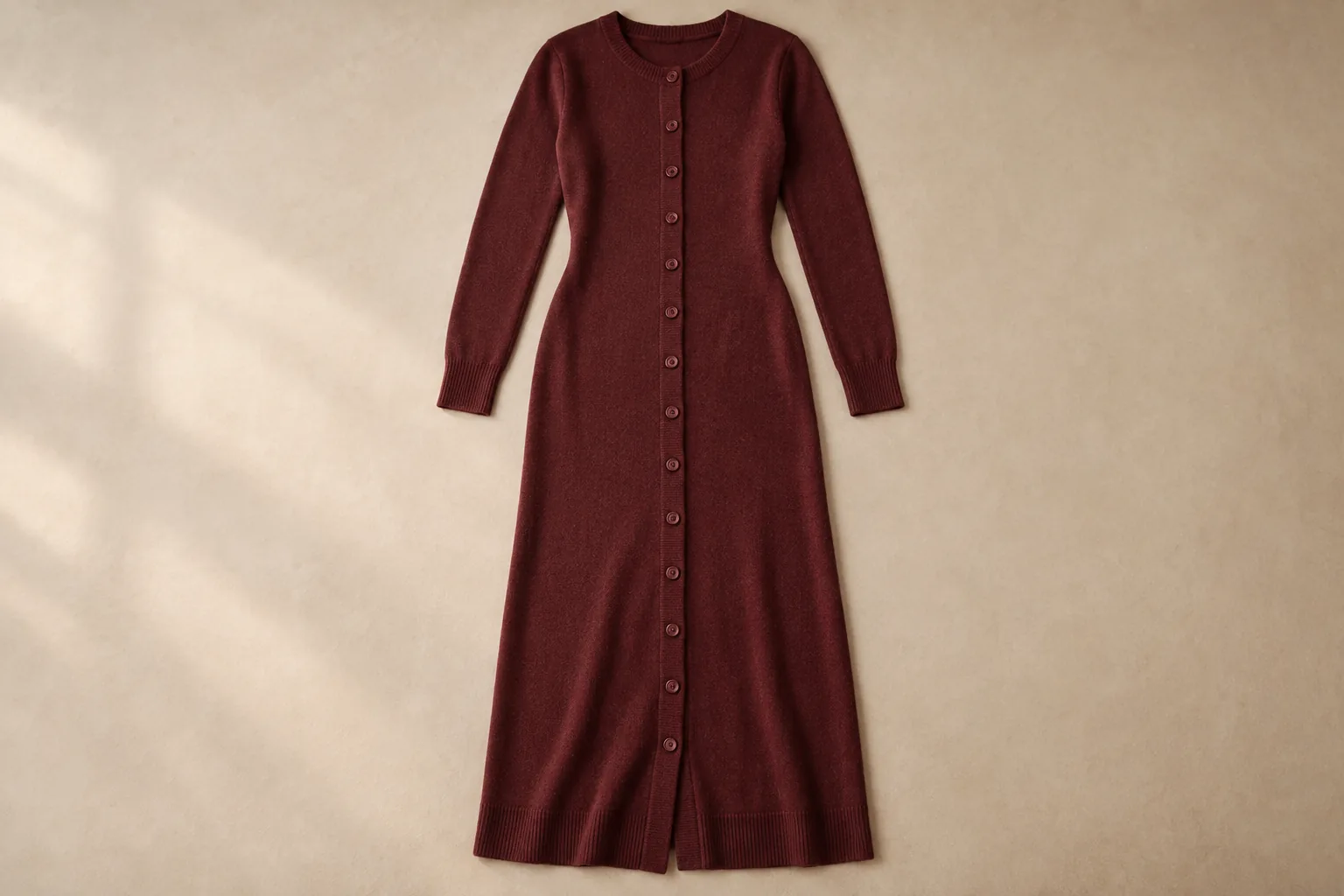
Review the front placket of a button-down knit dress together with its body fit and closure state. When the band and the body do not move together, the front ripples, the buttons pull, or the hem steps down on one side. The chest width can still match the spec, yet the dress looks wrong the moment someone buttons it.
Record the actual band, buttons, buttonholes and paired front measurements before choosing a correction. Compare the same assembly open, closed and after the selected care route. For development options, see our custom knit dresses page.
What causes placket wave on a button-down knit dress
A knitted body is flexible. It stretches under its own weight, and it can shrink or relax in the wash. Meanwhile, the placket is a narrow, firmer strip with buttons and buttonholes along its whole length. Different changes in the band and body can produce wave, puckering or an uneven front. Paired measurements and attachment records are needed to identify the cause.
A dress makes this harder than a cardigan. Because the placket runs much further, a small difference per button space adds up. In addition, waist shaping, pockets or a belt can pull the front at certain points. Therefore we look at the whole front, not just the band.
Common signs we look for
First, a wavy band that will not lie flat when closed. Second, gaping between buttons at the bust or hip. Third, one front hanging longer than the other at the hem. Finally, buttonholes that twist or stretch into ovals. Each sign points to a different cause, so we record which one we see and where.
Choosing the button-down knit dress placket construction
There is no single right placket. Instead, each option trades flatness against weight and handfeel. We choose one with the buyer based on yarn, gauge and the look of the dress.
Band options
A separate rib band, linked to the front edge, is the most common choice. It looks clean and suits most gauges. However, a 1×1 rib can grow in length on a long dress. A milano rib or a double-layer band is firmer and holds buttons better. An integral band, knitted as part of the front panel, avoids a seam but needs careful stitch settings to stay flat.
For heavier styles, we sometimes add a woven or knitted tape inside the band. The tape limits stretch along the length while the band still bends with the body. Also, the tape can run full length or only where the load is highest, such as the bust and waist.
Matching band length to body length
The band and the body front must finish at the same length. Because knitted pieces relax after linking and washing, we check both after finishing, not straight off the machine. Our in-house linking team joins the band loop to loop. As a result, the seam can move with the knit, and we can adjust linking tension if the band pulls.
For wider guidance on bands and plackets, our custom cardigan construction guide covers the same principles on shorter garments.
Buttons and buttonholes on a button-down knit dress
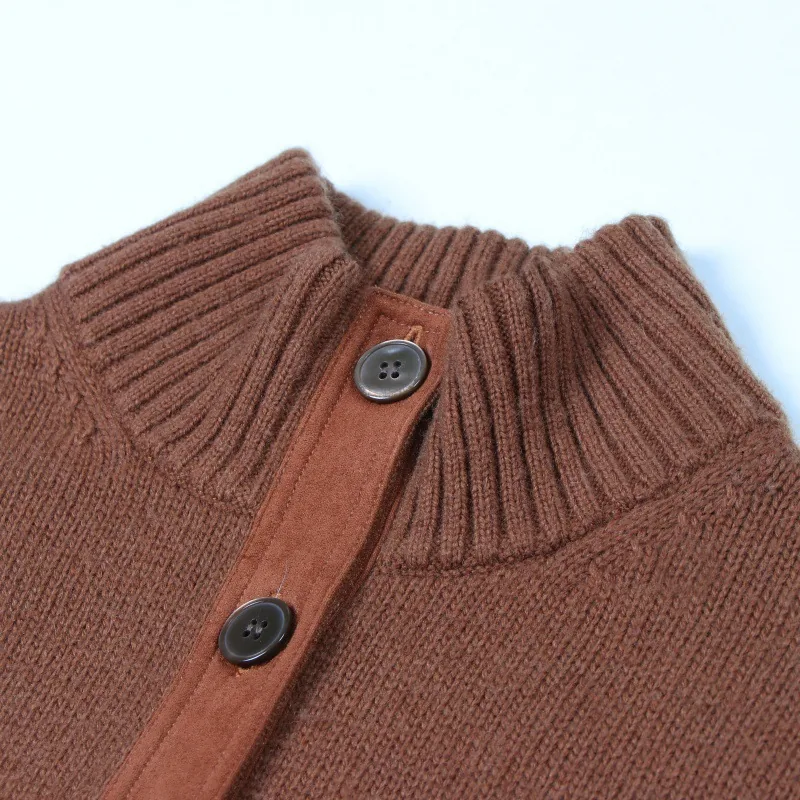
Button weight matters more on knitwear than on woven fabric. A row of heavy buttons can load a fine-gauge front; compare the actual trim under the agreed hanging and wearing conditions. So we confirm button size, thickness, weight and shank type before we knit the sample. If the sample uses a temporary button, we treat the approval as provisional until the real button arrives.
Buttonhole method also affects the front. Compare knitted-in and sewn buttonholes with the actual button, band and reinforcement. Inspect opening growth and bulk at the stressed positions; neither method guarantees better shape retention in every construction.
Button spacing on a long front
Spacing sets how the front behaves between closures. Wide spacing lets the band gape at the bust. Close spacing looks tidy but adds weight. In practice, we place a button at the bust point and at the waist, then space the rest evenly. After that, we check the lowest button against the hem so the front does not flare open at the bottom.
Measuring points for a button-down knit dress front
We measure both front lengths separately, from the high point shoulder to the hem. Next, we measure back length, placket length, placket width at the top, middle and bottom, and the center-front overlap. We also record button positions and chest, waist and hip widths, using the measurement principles in ISO 18890.
A matching total length can hide one longer front. Similarly, even button spacing can hide a curved closure line. Therefore we keep left and right values side by side. We also note whether the dress was open or closed when we measured it.
Checking a button-down knit dress open and closed
We review the sample in three states. First, fully open, to see how the front edges hang freely. Second, lightly aligned without buttons, to see whether both fronts match in length. Third, fully buttoned, to see whether closures pull the body or twist the band.
We also button the dress from top to bottom and then from bottom to top. If the result changes, record the difference and check front geometry, button placement and the fastening sequence before assigning a cause. We do not press the band flat by hand for photos. Instead, we photograph it exactly as it hangs on the form, so the buyer sees the real front.
Wash and rest
Next, we wash, dry and rest the sample using the planned care route. Our routine follows AATCC TM150, which describes dimensional change of garments after home laundering. Then we measure both fronts, the band and the button positions again.
If the body and the band change by different amounts, the wave usually gets worse after washing. In that case, we adjust the band structure, the tape or the body stitch setting. We avoid fixing it with heavy steam, because a steamed band often returns to its wave after the first home wash.
Bulk control for a button-down knit dress
Once the buyer approves the washed sample, we lock the yarn, gauge, stitch setting, band structure, tape, buttons, buttonhole method and linking tension. If any trim changes, we check it on a new sample first. Even a button that looks the same can weigh more and pull the band.
During production, our QC team measures both fronts on finished dresses from every size and color. We also button a sample from each lot on a form and check it against the approved reference. Our knitwear QC checklist explains how these checks fit into inline and final inspection.
A button-down knit dress needs a placket specification before quoting: button diameter and spacing, band width, intended ease across the bust and how the front should lie after care. Record the approved closed view on the base and relevant larger size, then price the chosen yarn and trims. The OEM/ODM process explains the general sequence; the actual placket sample and size-set rounds determine the order calendar.
Conclusion
Use the accepted button-down knit dress as a named assembly reference: band, button item, buttonhole route and front geometry belong together. Keep any unresolved post-care wave or fit comment with its sample revision before issuing bulk instructions.
Send us your dress sketch and we will suggest a placket construction before sampling.
FAQs
Why does the placket wave on my knit dress?
Usually the band and the body front have different lengths or change differently after washing. Heavy buttons and waist shaping can also pull the band out of line.
Should a button-down knit dress use tape in the placket?
Tape helps on long or heavy dresses. However, it adds some stiffness, so we test it on the sample first.
Which gauge works for a button-down knit dress?
Both fine and medium gauges work. Fine gauges need lighter buttons, while medium gauges suit a wider, firmer band.
Can the dress be worn open as a long cardigan?
Yes, if the design allows it. In that case, we also review the open front as a selling state, not just as a check.