 CN Sweaters
A wholesale jumper program rarely fails on unit price alone. It fails when MOQ, color count, size range, yarn choice, sample sign-off, and reorder timing are decided separately instead of as one connected plan. From a factory perspective, the buyers who get clean deliveries and stable reorders are the ones who treat these six variables as a single budget, not six independent line items.
This guide is built around that reality. The price you negotiate today only matters if the yarn lot is still available in three months, if your size curve actually matches your channel sell-through, and if your sample approval timeline leaves enough room for bulk. A buyer asking only “what is your MOQ for a knit jumper?” usually ends up with one of three outcomes: a higher per-unit cost than expected, color drift on the second order, or a late shipment because sampling pushed bulk into peak season.
One language note worth fixing early. In the UK, Ireland, Australia and most of continental Europe, buyers and tech packs use jumper or knit jumper. In the US, the same product is called a sweater. The garment is the same; the procurement vocabulary is not. When a British buyer writes “wholesale knitted jumpers” and a Chinese factory replies with “sweater” quotations, both sides are talking about the same construction, but spec sheets, hangtags and customs descriptions still need to be aligned to avoid retail-side confusion. A short explanation of the jumper versus sweater terminology helps explain why the two words coexist in trade documents.
How Should Buyers Plan MOQ Across Styles and Colors

Plan MOQ at the color-size level, not the style level. Most knitwear factories quote a headline MOQ per style — commonly 100 to 300 pieces in the China market for full-package OEM — but the cost reality sits one layer deeper, at how that quantity splits across colors and sizes. A 300-piece order in one color and four sizes behaves very differently from 300 pieces split into five colors and six sizes.
From a factory perspective, every color change means a separate yarn cone setup, a new dye lot reservation, and an extra round of in-line color checks. Every size adds a new knitting program on the flat machine. When a wholesale jumper order spreads thin across color-size combinations, the per-piece cost rises even if total volume looks healthy on paper. Industry MOQ practice for custom knitwear typically lands between 50 and 100 pieces per style per color for mid-tier factories, with lower thresholds usually reserved for repeat customers or simpler constructions.
What MOQ Structure Works for Mixed Style Programs
For a wholesale knitwear program with three to five styles, a workable starting structure looks like this:
| Order Scenario | Styles | Colors per Style | Sizes | Realistic MOQ Range |
|---|---|---|---|---|
| Test launch | 2–3 | 1–2 | 3–4 | 100–150 pcs per color |
| Standard wholesale | 3–5 | 2–3 | 4–5 | 150–300 pcs per color |
| Private label core | 1–2 hero styles | 3–4 | 5–6 | 300–500 pcs per color |
| Replenishment | 1 carryover | 1–2 | 3–5 | 80–150 pcs per color |
The pattern is consistent: as color count grows, per-color MOQ should also grow, otherwise dyeing and setup costs make the program economically unstable. Buyers planning MOQ and lead time should also reserve buffer quantity per color for QC rejects, sample replacement, and showroom samples — typically 3 to 5 percent of bulk.
Which Yarn Choice Suits a Wholesale Knit Jumper Program
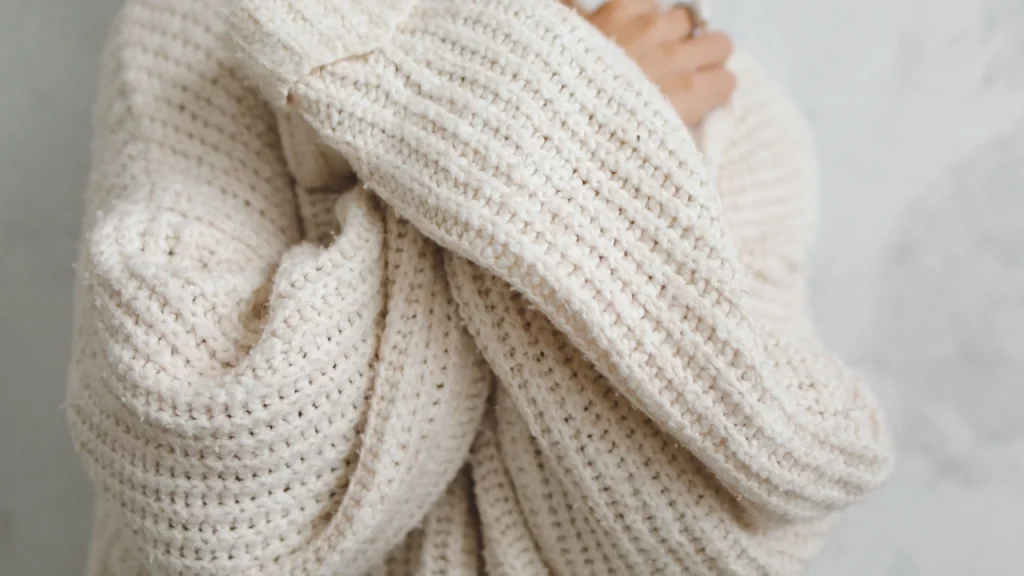
Yarn choice should be made before MOQ negotiation, not after. The yarn defines lead time, color stability, minimum dyeing quantity, hand feel, and reorder feasibility. A buyer who locks the price first and the yarn second often discovers that the chosen yarn has a minimum dye lot higher than the order itself, or a delivery window incompatible with the shipping target.
Wholesale jumper buyers usually choose between five main families: acrylic, cotton, wool, wool blends, and cashmere or cashmere blends. Each behaves differently in production, retail, and reorder cycles. Acrylic gives the broadest color range and the lowest yarn MOQ, which is why it dominates volume programs and fast-fashion private label. Cotton and cotton blends sit in the middle, with stable hand feel but slower drying during finishing, which can extend lead time in humid seasons. Wool and wool blends give the cleanest retail story for autumn-winter knit jumper ranges, but mill MOQs are higher and dye lots are tightly controlled.
How Yarn Selection Affects MOQ and Lead Time
Yarn-driven constraints are the single biggest source of late-stage surprises in wholesale knitted sweaters projects. A common scenario: the buyer selects a fine merino at 2/48Nm count for a lightweight knit jumper, then finds the mill requires a 500 kg minimum per color for custom dyeing. If the program only needs 200 kg per color, the buyer must either accept stock colors, increase order quantity, or pay a dyeing surcharge.
From a factory perspective, we usually recommend confirming three things before quoting bulk: yarn count and composition, whether the color is stock or custom-dyed, and whether the mill can hold reserve stock for a planned reorder. A short reference on yarn structures and knit basics is useful for buyers who want to understand why count and ply choices change both cost and hand feel.
Why Sampling Drives the Whole Wholesale Knitwear Timeline

Sampling is not a formality; it is the gate that decides whether bulk can start on time. A wholesale knitwear program with weak sampling discipline almost always ships late. Most experienced buyers treat sample sign-off as the actual project start date, not the PO date.
A standard sampling sequence for a custom knit jumper runs through four stages: yarn swatch and color lab dip, knit-down or stitch sample, pre-production sample (PPS), and size set. Each stage answers a different question. The lab dip confirms color against a physical standard under D65 daylight. The knit-down confirms gauge, hand feel, and structure. The PPS confirms construction, measurements, and trims. The size set confirms grading across the full size run.
What Is a Realistic Sampling Timeline
For a typical wholesale jumper development cycle, expect the following durations when working with an experienced OEM partner. These numbers assume tech pack quality is good and revisions are limited to one round per stage.
| Sampling Stage | Typical Duration | Common Delay Triggers |
|---|---|---|
| Yarn sourcing and lab dip | 10–15 days | Custom color, niche fiber |
| Knit-down or proto | 7–10 days | Complex stitch, cable structures |
| Pre-production sample | 10–14 days | Trim sourcing, label approval |
| Size set | 7–10 days | Grading disputes, fit revisions |
| Bulk production after PPS approval | 35–55 days | Capacity, finishing queue |
Buyers who compress sampling below these ranges usually pay for it in bulk — either through higher reject rates, color mismatches, or rushed finishing. A clear understanding of the OEM and ODM development flow helps procurement teams align internal approvals with factory milestones, so PPS sign-off does not sit waiting on a buyer’s office for a week.
How Should Bulk Knit Sweaters Be Quality Controlled
Quality control for bulk knit sweaters works best when it is built into three checkpoints, not one. Buyers who only inspect at final stage discover defects too late to fix without delaying shipment. The standard structure used by most reputable third-party inspectors covers initial production check (IPC), during production check (DUPRO), and final random inspection (FRI), each tied to an Acceptance Quality Limit.
The AQL framework, used in Intertek’s textile and apparel inspection and most ISO 2859-based sampling plans, defines the maximum percentage of defective units acceptable in a lot. For mainstream wholesale knitwear, AQL 2.5 for major defects and AQL 4.0 for minor defects is a common contractual baseline. Tighter levels — AQL 1.5 — are usually reserved for premium price points or certified retail accounts.
What Defects Matter Most in Knit Jumper QC
Knit-specific defects differ from woven garments. The high-frequency issues we see in flat-knit and circular-knit jumper production fall into four groups: gauge and measurement deviation, stitch faults (dropped stitches, holes, broken yarn), color and dye lot inconsistency, and finishing problems (linking marks, uneven hems, distorted neck rib). Measurement tolerance for a standard knit jumper is typically ±1 cm on body length and ±0.5 cm on neck width, but the exact figure should always be written into the PO, not assumed.
From a factory perspective, the most cost-effective QC investment is the DUPRO inspection at 20 to 30 percent production completion. Catching a systematic linking issue at that point allows correction on remaining units; catching it at FRI usually means rework or rejection of the entire lot. Buyers planning their first wholesale knitted jumpers order should also confirm whether the factory’s internal QC team is separate from the production team — this single structural detail predicts a lot about defect rates.
How Does Reorder Logic Work for Wholesale Knitted Sweaters
Reorder logic should be designed during the first order, not requested after sell-through data arrives. The two most expensive reorder mistakes are color mismatch and yarn unavailability, and both are preventable with a documented reservation plan.
The core issue is dye lots. Yarn is dyed in batches, and different dye lots can show visible color variation even when the color code is identical. Two cones with the same Pantone reference but different lot numbers may look fine in factory light and noticeably different in retail daylight or product photography. For wholesale jumper programs running across multiple drops, this becomes a brand consistency problem, not just a production problem.
What Reorder Planning Looks Like in Practice
A workable reorder structure has three parts. First, reserve extra yarn from the original dye lot at PO stage — typically 10 to 20 percent above bulk consumption, depending on expected reorder size. Second, agree storage terms with the factory or mill in writing, including how long the yarn will be held and at whose cost. Third, set a reorder decision deadline aligned with the yarn shelf life and the next production window.
| Reorder Scenario | Yarn Reservation | Decision Window | Typical Reorder Lead Time |
|---|---|---|---|
| Same color, same lot | 15–20% buffer | Within 60–90 days | 35–45 days |
| Same color, new lot | None needed | Anytime | 45–60 days (+ lab dip) |
| Carryover next season | 10–15% buffer | Within 6 months | 50–70 days |
| Color expansion | New dyeing | Plan with main order | 60–80 days |
The trade-off is straightforward. Yarn reservation costs money upfront but protects color continuity and shortens reorder lead time. Skipping reservation saves cash but adds a lab dip cycle and accepts visible color drift between drops. For private label programs where the same sweater style ships across multiple months, the reservation cost is almost always recovered through fewer customer complaints and cleaner photography.
What Cost Trade Offs Define a Wholesale Jumper Budget
A wholesale jumper budget has to reconcile yarn cost, labor cost, MOQ-driven setup cost, sampling cost, QC cost, and shipping cost as one number. Looking at unit price alone hides the fact that a low-MOQ order with five colors and six sizes can cost more per landed piece than a higher-MOQ order with two colors and four sizes.
Industry guidance on production budgeting consistently points to the same principle: setup and overhead costs are fixed per style and per color, so they amortize down only when quantity per color rises. A buyer trying to launch with maximum SKU variety and minimum quantity per SKU pays the highest possible per-unit cost.
How Should Landed Cost Be Structured
A realistic cost structure for a mid-weight wholesale knit jumper, FOB China to UK or EU, usually breaks down roughly as follows: yarn 35 to 50 percent of FOB depending on fiber, knitting and linking labor 20 to 30 percent, trims and packaging 5 to 10 percent, finishing and washing 5 to 8 percent, factory overhead and margin 10 to 15 percent. Shipping and duty then add 8 to 15 percent on top of FOB depending on Incoterms and tariff position.
For B2B buyers, the practical implication is that yarn upgrades — for example, moving from acrylic-rich blend to a wool-rich blend — affect FOB more than any other single decision. A 20 percent yarn cost increase typically lifts FOB by 8 to 12 percent. By contrast, adding an extra color to a style with stable per-color quantity adds only 2 to 4 percent. Knowing these ratios helps procurement teams negotiate where it actually matters, instead of chasing small savings on trims while accepting expensive yarn surprises.
Conclusion
A successful wholesale jumper program is built on connected decisions, not isolated quotes. MOQ has to be planned at the color-size level. Yarn has to be locked before pricing. Sampling has to be treated as the real start of the timeline. QC has to be staged across IPC, DUPRO, and FRI. Reorders have to be designed into the first PO through yarn reservation and dye lot discipline. And the total cost has to be read as landed cost per SKU, not headline FOB per piece.
Buyers who apply this discipline get cleaner deliveries, fewer color complaints, and a reorder pipeline that actually compounds across seasons. If you are scoping a new program and want a realistic MOQ, yarn, and production timeline read on your specific styles, share your plan with our team through the Cainan wholesale knitwear contact channel so we can map it against current capacity.
CTA: Send your wholesale jumper style mix, target quantity, yarn preference, color plan, and reorder schedule for MOQ and production planning advice.
FAQ
What is a realistic MOQ for a first wholesale jumper order?
For custom OEM development, expect 100 to 300 pieces per style as a working range, with 50 to 100 pieces per color depending on yarn and construction. Lower MOQs are possible on stock yarns and simpler stitch structures, but custom-dyed colors usually push the minimum upward because mill dye lots have their own thresholds, often 300 to 500 kg per color.
How long does it take to develop and ship a custom knit jumper?
A standard timeline runs roughly 30 to 50 days for full sampling (yarn, lab dip, knit-down, PPS, size set) and 40 to 55 days for bulk after PPS approval. Total development-to-shipment usually lands at 75 to 105 days for first orders. Carryover styles using approved yarn and trims can compress to 45 to 60 days because sampling stages are reduced.
Can yarn from the original dye lot be reserved for a reorder?
Yes, but it has to be negotiated at the original PO stage and confirmed in writing. Typical reservation is 10 to 20 percent extra yarn held at the mill or factory, with a defined storage window — often 60 to 180 days. Without reservation, a reorder requires a new dye lot and a fresh lab dip cycle, which adds lead time and introduces visible color variation risk.
What is the difference between a knit jumper and a sweater in B2B sourcing?
The garment is the same; only the regional vocabulary differs. UK, Irish, Australian and most European buyers use jumper or knit jumper. US buyers use sweater or pullover. For tech packs and POs working with Asian factories, listing both terms in the product description avoids translation errors and customs description mismatches, especially when the same style ships to multiple markets.
How should QC be structured for bulk knit sweaters?
Use a three-stage plan: initial production check at first output, during production check at 20 to 30 percent completion, and final random inspection at 80 percent finished and packed. Contractual AQL levels of 2.5 major and 4.0 minor are standard for mid-tier wholesale; tighter AQL 1.5 is common for premium retail accounts. Always confirm that the factory’s internal QC team operates independently from production.