 CN Sweaters
Color shade variation is the single most common quality complaint in wholesale knitwear, and in most cases it is preventable when buyers and factories agree on a clear color approval process before bulk production starts. If you are sourcing wholesale knitwear and seeing mismatches between samples and bulk, between sizes inside the same carton, or between an original order and a reorder, the root cause is almost never random. It usually traces back to yarn dye lots, fiber composition, lab dip approval, finishing, or the lighting used during inspection.
From a factory perspective, we see the same pattern repeat across brands, wholesalers, and private label teams. A buyer sends a Pantone code, approves a sample under office light, and then questions the bulk shipment when the cartons are opened under retail lighting. By that point, the yarn has already been dyed, knitted, washed, and packed. Fixing color at that stage means rework, delayed shipment, or accepted loss. The realistic way to protect a wholesale knitwear order is to build color control into sampling, yarn purchasing, and bulk planning, not into final inspection.
This piece walks through where shade variation actually comes from, what the approval workflow should look like, how reorders should be handled, and which tolerances are reasonable to write into a purchase order.
Why Wholesale Knitwear Orders Develop Color Shade Variation

Shade variation in wholesale knitwear almost always starts at the yarn stage, not the garment stage. Knitwear is built loop by loop from pre-dyed yarn (yarn-dyed) or knitted in greige and then piece-dyed. In both routes, the color you see on a finished sweater is the result of fiber absorption, dye recipe, dye bath conditions, and finishing — not just a Pantone reference.
Yarn dye lots and fiber behavior
Every spinning mill produces yarn in dye lots. Two lots of the same shade number, dyed weeks apart, can still show a measurable difference under a D65 light box. Natural fibers amplify this. Wool, cashmere, cotton, and viscose absorb dye unevenly depending on harvest, micron, moisture, and pre-treatment. Acrylic and polyester are more stable but still shift between lots. When a bulk order needs 800 kg of one color and the mill ships it from two lots, the risk of cross-shade in the finished garments is real unless the factory segregates lots through knitting, washing, and packing.
Recipe, bath, and finishing variables
Even within one lot, dye uptake depends on bath temperature, time, pH, liquor ratio, and the exact auxiliary chemicals used. Post-dye processes — softener, anti-pilling, steaming, tumble finishing — all shift the final hand and shade. A sweater washed at a slightly higher temperature in finishing will look duller than one washed at the approved setting. This is why an approved lab dip is not the same as an approved bulk shade until the full process has been locked.
What Approval Documents Actually Control Color in Bulk Production
A Pantone number alone does not control bulk color. Pantone is a printing reference system on coated or uncoated paper, and dyed yarn rarely matches a Pantone chip exactly because fiber, twist, and knit structure change how light reflects off the surface. The documents that actually control color in custom knitwear production are the lab dip, the standard physical swatch, and the signed shade band.
Lab dip versus standard swatch
A lab dip is a small dyed yarn or fabric submission from the mill, sent for buyer approval before bulk yarn is dyed. The buyer compares it to a physical reference under agreed lighting and either approves, rejects, or asks for a re-submission. Once approved, that lab dip — not the Pantone code — becomes the contractual color standard for the order. The standard swatch is the approved physical sample kept by both buyer and factory, sealed and dated, used as the reference for every later inspection.
Why one Pantone code is not enough
Two factories given the same Pantone TCX code will produce two visibly different yarns, because they will use different fibers, dyestuffs, and recipes to hit that target. A Pantone code tells the dyer the target. The lab dip tells the dyer how that target looks on the actual yarn used for your order. Skipping lab dip approval to save a week almost always costs more time later in rework or claims.
The table below summarizes how each document functions in a typical wholesale knit sweaters program.
| Document | What it controls | When it is issued | Binding for bulk? |
|---|---|---|---|
| Pantone TCX/TPX code | Target hue direction | Buyer brief stage | No, reference only |
| Lab dip submission | Yarn shade on actual fiber and recipe | Before bulk yarn dyeing | Yes, once signed |
| Standard physical swatch | Master reference for inspection | After lab dip approval | Yes |
| Shade band (light/std/dark) | Acceptable tolerance range | Before bulk knitting | Yes |
| Bulk top sample | Confirmation of full process color | After first bulk production | Yes, gates shipment |
In practice, the shade band is the document that prevents most disputes, because it makes the acceptable range visible rather than verbal.
How Lighting and Inspection Conditions Affect Color Judgment
The same sweater can look like two different colors under two different lights. This is called metamerism, and it is the reason buyers and factories sometimes disagree on whether a shipment is on-shade. The fix is not arguing about who is right — it is agreeing on the light source before production.
Standard light sources for textile inspection
Industry practice is to evaluate color inside a light box with controlled sources. D65 (artificial daylight) is the primary source for most apparel programs. TL84 (European store light), CWF (US cool white fluorescent), and UV are used as secondary checks depending on the buyer’s retail market. The AATCC test method library covers the standardized procedures used across the textile industry for these evaluations, and most reliable knitwear manufacturers keep a calibrated light box on the QC floor.
Writing inspection conditions into the PO
A purchase order for bulk knit sweaters should specify the primary light source, the secondary checks, and whether metameric pairs are acceptable. If the buyer’s retail environment is dominated by LED store lighting, that should be the controlling source, not D65 alone. For B2B buyers, this is a meaningful clause: agreeing on light source up front turns “the color is wrong” into a measurable question with a defined answer.
A buyer who sends a Pantone reference and an approved swatch but skips the inspection light clause is leaving the most subjective part of the judgment open. That gap is where most disputes start.
How to Manage Color Across Sizes, Cartons, and Batches
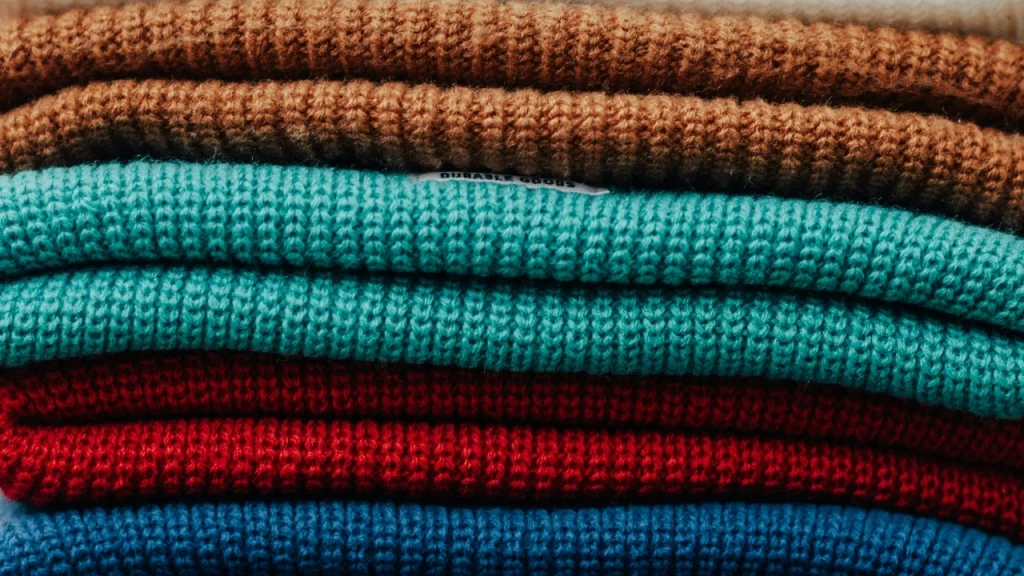
Inside a single wholesale knitwear order, shade can drift between sizes, between knitting machines, and between production days. This is not a sign of a bad factory — it is a sign that yarn dye lots and machine timing were not segregated. Controlling it requires planning before knitting starts.
Lot segregation and traceability
The standard approach is one dye lot per size, or at minimum one dye lot per carton range. If two lots must be used in one order, the factory should label cartons by lot and the packing list should record which cartons hold which lot. For bulk knit sweaters going to a single retailer, mixing lots inside one carton creates visible side-by-side shade differences on the sales floor and should be avoided.
Knitting and finishing batch control
Even with one yarn lot, color can shift if half the order is finished on Monday and half on Friday with different operators or settings. Finishing parameters — water temperature, softener concentration, drying time — should be locked once the bulk top sample is approved. The first 50 to 100 pieces off the line should be checked against the standard swatch before the rest of the order is finished.
For high quality knitwear programs, the factory should retain a small reserve of bulk yarn and a sealed reference garment after shipment. These two items become the baseline for any reorder discussion later, and they are the cheapest insurance against future claims.
How to Handle Reorders Without Visible Shade Difference
Reorders are where most color complaints surface, because the buyer naturally compares the new shipment to garments already on the shelf. From a factory perspective, an exact reorder match is rarely possible without explicit planning, and buyers who expect a perfect repeat without protected yarn or a re-approved lab dip are setting themselves up for disappointment.
Yarn reservation and re-approval
The most reliable way to match a reorder is to reserve yarn from the original dye lot at the time of the first order. If 1,000 kg was needed for the first run, reserving an extra 200 to 300 kg for an expected reorder protects the match. Without reserved yarn, the mill must re-dye, and a new lab dip approval is required before bulk dyeing. Treating the reorder as a fresh color approval — not a copy-paste of the previous PO — is the realistic standard.
Communicating tolerance for reorders
Reorder tolerance should be written separately from original order tolerance. A common practice is to accept a slightly wider shade band on reorders, evaluated against the original standard swatch rather than the new lab dip. This sets expectations on both sides. Buyers who need an exact match should plan one large order rather than splitting it into multiple small runs spaced months apart. For wholesale knit sweaters programs with predictable demand, forecasting yearly volume and dyeing yarn in one campaign is the most cost-effective way to keep color consistent across the season.
This is also where MOQ and lead time interact with color control. Smaller, more frequent reorders mean more dye lots, more lab dips, and more risk. Buyers reviewing MOQ and lead time terms should factor color stability into the calculation, not just unit price.
What Testing and Documentation Buyers Should Require
Color control is not only a visual process. Independent testing and clear documentation give buyers a defensible record if a dispute reaches a chargeback or claim stage. The cost of testing is small compared to the cost of a rejected shipment.
Colorfastness and shade testing
Standard tests for knitwear include colorfastness to washing, rubbing (crocking), light, and perspiration. The methods are well established through bodies like AATCC and ISO, and third-party labs such as Intertek’s colorfastness testing services issue reports that both buyer and factory can rely on. For wholesale knitwear suppliers serving regulated markets, these reports are often required by the buyer’s QA team before shipment release.
Pre-shipment inspection and shade evaluation
A pre-shipment inspection should include shade evaluation against the standard swatch under the agreed light source, side-by-side checks across sizes, and a sampling plan that covers multiple cartons rather than only the top layer. Independent inspection bodies such as Intertek’s textile and apparel inspection teams can perform this on behalf of buyers who cannot send their own QC. The inspection report should record the light source, the sample size, the location of any off-shade pieces, and the cartons they came from.
For cardigans and other styles where the same color is used in body and trim, the inspection should also check shade between knitted parts, not only between garments. Mismatched body-to-trim shade is a frequent complaint and a frequent missed item in standard AQL inspections.
Building a Practical Color Control Workflow With Your Supplier
A workable color control workflow for quality knitwear does not need to be complicated. It needs to be agreed in writing before the first lab dip is dyed, and it needs to be the same workflow every season. The factories that produce consistent color are not the ones with the most expensive equipment — they are the ones with the most disciplined process.
A minimum workflow worth requiring
The minimum workflow for any wholesale knitwear program should include: a Pantone reference plus a physical color standard from the buyer, two to three rounds of lab dip approval under the agreed light source, a signed standard swatch and shade band, a bulk top sample approval before mass knitting, lot segregation during production, in-line shade checks during finishing, third-party colorfastness testing on bulk yarn, and a pre-shipment shade inspection against the standard swatch. Each step adds one to five days to the timeline. Skipping steps to save time almost always costs more time later.
Buyers who treat color control as a checklist tend to receive more consistent shipments than buyers who treat it as a final inspection problem. The earlier color is locked, the cheaper it is to keep it locked.
Conclusion
Shade variation in wholesale knitwear is a process problem, not a luck problem. The buyers who consistently receive on-shade shipments are the ones who approve lab dips on actual yarn, sign a physical standard swatch with a defined shade band, agree on an inspection light source before bulk, segregate dye lots through production, and reserve yarn when reorders are likely. None of these steps require advanced technology, but each one closes a specific gap where color drifts.
If you are planning a multi-color program, a private label launch, or a repeat order on an existing style, the right time to discuss color control is before sampling — not after the cartons arrive. Send your Pantone references, approved color swatches, yarn composition, color quantity, order volume, reorder plan, target market, and acceptable shade tolerance to our knitwear production team so the color approval process can be reviewed before sampling and bulk production.
FAQ
What is an acceptable shade tolerance for wholesale knitwear orders? Most B2B knitwear programs work with a shade band of light-standard-dark approved physically, rather than a numeric Delta E target. A common practical range is a visual pass under D65 with a secondary check under the buyer’s retail light source. The exact tolerance should be written into the PO and tied to the signed standard swatch, not left to verbal agreement.
Can a Pantone code alone be used to approve bulk color? No. A Pantone code is a target reference, but dyed yarn on wool, cotton, cashmere, acrylic, or blends will not match a Pantone chip exactly because fiber and knit structure change reflection. A lab dip on the actual yarn used for your order, approved against a physical standard, is what should govern bulk production.
How much extra time does proper color approval add to lead time? Two to three rounds of lab dip approval typically add 10 to 18 days before bulk yarn dyeing starts, depending on courier time between factory and buyer. A bulk top sample adds another 5 to 7 days. Buyers who plan this into the schedule rarely face shade disputes; buyers who compress it usually do.
How can I match a reorder to my original wholesale knitwear shipment? The most reliable method is to reserve yarn from the original dye lot at the time of the first order. If yarn was not reserved, the mill will need to re-dye, and a new lab dip should be approved against the original standard swatch with a slightly wider tolerance agreed in advance.
Who is responsible if bulk color does not match the approved sample? Responsibility depends on what was approved and how the deviation is measured. If a signed standard swatch and shade band exist, and a pre-shipment inspection under the agreed light source shows the bulk falls outside the band, the factory is generally responsible for rework or a negotiated allowance. Without a signed standard, disputes become subjective and harder to resolve.