 CN Sweaters

EU private label knitwear release files should connect the sweater a factory will make with the product a customer will receive and the business responsible for its information. A folder containing unrelated certificates, an old label and a new product photograph does not make that connection. Before production approval, the buyer needs to know which product version the evidence covers and which fields remain unresolved.
This guide is for an EU brand coordinating ordinary adult knitwear made by a production partner. It excludes the UK, Switzerland, children’s products, protective clothing and garments with electronic functions. It is a method for organizing a product-specific review, not a legal opinion or a declaration that an order complies with every applicable requirement.
The decision is narrow: release the identified version for the named EU destinations, or hold the affected work until its product, responsibility and information records agree. The following file structure makes that decision inspectable.
What belongs in EU private label knitwear release files?
Begin with one product and named destinations
Open a record for the style, material revision, colour range, intended adult use and countries where it will be offered. Include retail and online channels separately. “Europe” is not a sufficiently precise destination field. Neither is the address of a distributor who may later sell into other markets. Ask the commercial owner which countries the current approval actually includes.
Record what the product does not claim. An everyday cardigan should not acquire protective, medical or other functional claims because a sales description sounds stronger with them. If a new claim or component changes the review scope, pause that version and assign a qualified assessment. Do not preserve an obsolete scope statement merely to keep the order moving.
The existing UK and EU bulk sweater guide covers broader buying inputs. This file does not combine those markets. It deals with the information handoff for one EU product version after the buyer has identified the intended manufacturing route.
Distinguish a useful file from a large file
Use an index with the product key, document name, revision, evidence owner, covered variants and approval state. Link to the source document rather than pasting fragments into several spreadsheets. A reviewer should be able to tell whether a record applies to the current button, yarn or label without opening every attachment in the folder.
Separate documents that describe the product from documents that evaluate it. A specification says what is intended. An inspection or test report records what was examined under stated conditions. A supplier statement has its own author and scope. They can support the same decision without being interchangeable.
The startup manufacturer inquiry guide helps assemble the initial questions. At release, convert questions into named evidence or explicit open items. “Supplier to confirm” is not a closed record, even when it has appeared in the workbook for several weeks. Keep the unresolved field visible and identify the decision it prevents.
Who must approve the product and responsibility map?
Separate commercial titles from reviewed roles
List the brand business, production business, importer where relevant, distributor and any appointed representative involved in the route. Ask the responsible compliance reviewer to determine the applicable roles and duties under the current General Product Safety Regulation and other relevant rules. Do not assume the company operating knitting machines is the only business with manufacturer responsibilities, or that an invoice title settles the legal question.
Record the review outcome with the relevant entity name, contact information, product scope and source of the determination. This is particularly important when a business sells goods made for it under its own brand. A sourcing employee can assemble the facts, but should not invent a role assignment to fill a blank cell before printing.
The EU’s product safety guidance makes clear that businesses involved in selling products on the EU market have safety obligations. It is not a product approval service. Use current applicable rules and qualified advice to turn that general obligation into the specific responsibilities for your route.
Assign document access and correction authority
For each role, name the person who can obtain supporting records and the person authorized to approve a correction. A representative’s contact details printed on packaging are not, by themselves, proof that the business has the agreed documents or has accepted the intended role. Confirm the actual arrangement before presenting it as settled.
Test access while the supplier relationship is active. Ask the nominated contact to retrieve the material revision and the evidence for one selected trim. Record whether the document can be supplied, whether it identifies the current product and whether translation or clarification is needed. A promise to search after a complaint is weaker than an orderly file available now.
Keep factory audit questions in their proper place. An audit can inform the assessment of a supplier’s systems. It does not close a missing product identifier or substitute for the buyer’s role determination. Likewise, an attractive brand presentation cannot explain who must correct an inaccurate online offer.
How should a product identifier connect the evidence?

Map the buyer’s code to the supplier’s code
A brand style number and a factory program number can coexist. Create an explicit mapping rather than forcing one business to rename its whole system. Include material and construction revisions, affected colours and sizes, and the retained sample reference. If the same retail style number covers two manufacturing versions, the mapping must distinguish them.
Use a hypothetical example: retail style EU-K41 links to supplier program P218 revision C, with button specification B7. A replacement button B8 arrives during production. Even if the customer-facing style name remains unchanged, the evidence map now needs a review of the replacement and its affected quantities. Do not leave B7’s document attached as if nothing happened.
The pre-production sample approval guide helps define the physical reference. Add a photograph of the actual identification method and its location to the release file. This makes it possible to compare a received garment with the file without inferring identity from its colour alone.
Make coverage visible at component level
Attach material and component records to the part they describe. A report for one yarn does not automatically evaluate a different finish, decoration or button. Ask the reviewer whether evidence can legitimately cover a family of variants and record the reasoning. Do not demand unnecessary duplicate reports, but do not infer shared coverage just because two garments look similar.
| File item | Must identify | Cross-check against | Hold trigger |
|---|---|---|---|
| Product specification | Style and manufacturing revision | Production-intent sample | Unrecorded construction change |
| Material evidence | Material and covered variants | Current component list | Different yarn or finish |
| Information artwork | Approved text and layout version | Attached label or pack sample | Obsolete business details |
| Online offer record | Product image and version | Goods offered for sale | Photograph of another variant |
| Shipment mapping | Affected units or lots | Packing and receiving records | Identity cannot be traced |
Use this table as a working index, not a compliance certificate. The OEM production checklist can hold the manufacturing approvals, while this mapping explains which evidence follows the resulting product. The two records should reference each other without copying all their content.
Which label and online fields need separate review?

Match approved composition to the physical label
The official EU textile labelling guidance describes fibre-composition information, presentation and destination-language requirements. Keep the approved composition text separate from optional care and marketing copy in the artwork file. Have the responsible reviewer check the relevant languages for the intended countries before a final layout is printed.
Examine the actual label attached to the garment, not only the supplier’s screen proof. Confirm the revision, legibility, placement and agreement with the approved product facts. If a supplier proposes a smaller label, assess the resulting layout rather than automatically carrying forward approval from the larger version.
The fibre-content and care-label guide explains the production relationship between material choices and consumer information. It does not turn a care statement into composition evidence. Keep each claim linked to its own basis, especially when marketing wants a stronger description than the material record supports.
Treat the online offer as another controlled output
Create a draft of the actual product offer using the current garment image, product identity and reviewed business and safety information. Have the compliance owner check the applicable distance-sales requirements for that offer. A complete factory file does not prove that the ecommerce team has displayed the required information correctly or in the appropriate language.
Check variant selection as well as the first screen. If choosing another colour shows a photograph of a different button or changes the composition text, determine whether the listing is accurate for that variant. Save the reviewed version and identify who can edit it after release. A hidden spreadsheet is not the same object as information shown to a buyer.
Use the custom label and packaging checklist to synchronize physical outputs with the online file. The product’s facts should agree across them, although their layouts differ. Keep a list of claims intentionally excluded from both, such as an unverified sustainability description or unsupported certification statement, so a later copy edit does not restore them.
What evidence should block a manufacturing release?
Separate product safety questions from commercial defects
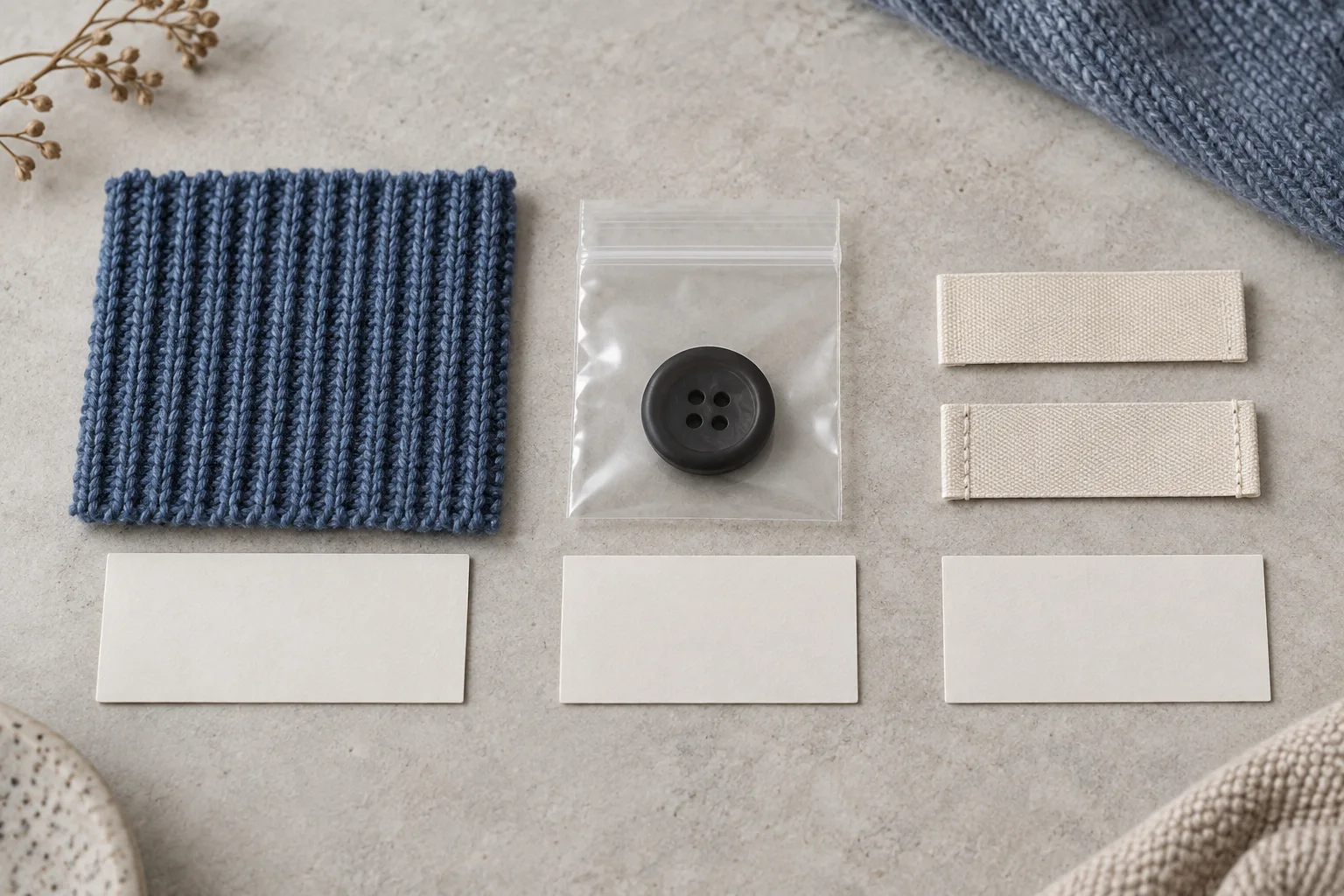
Write open items in terms of the decision they block. A missing colour approval may prevent knitting that colour. An unresolved material or safety question may affect a broader set of variants. An incorrect contact field may prevent final information-pack approval. Ask the appropriate reviewer to define the affected scope rather than marking every issue as a generic quality problem.
Commercial inspection and product safety review have different purposes. The AQL inspection guide addresses sampling-based acceptance of a shipment. Do not use a satisfactory visual inspection to close a question about an unexamined substance, component or claim. The evidence must answer the actual question being held.
Keep a record of the product risk questions considered, the evidence requested and the person evaluating it. This article does not prescribe a universal test package or chemical threshold. The route, material and product features determine which requirements and evaluations need attention. A generic “all tests passed” sentence without product coverage is not useful evidence.
Do not add a CE mark to fill a perceived gap
The EU’s CE marking guidance states that the mark is for products covered by rules that specifically require it; it must not be used where no such requirements apply. Do not request a decorative CE logo for an ordinary fashion sweater as a shortcut to reassurance. Reassess the scope if the product includes functions that may bring different rules into play.
Instead, identify the missing evidence precisely. If the buyer cannot connect a document to the current garment, obtain the mapping or a suitable new evaluation. If a record is inaccessible, fix access. If a claim is unsupported, remove or resolve it before using it. None of these problems is solved by adding an unrelated mark.
The bulk production readiness guide helps distinguish the manufacturing actions that are ready from those that remain conditional. A limited production instruction should name exactly what it permits. Avoid issuing a broad “approved” email while attaching a spreadsheet containing unresolved release blockers.
How can the team rehearse a release and later correction?

Perform a two-direction file check
First, start with one packed production-intent sample. Find its product mapping, approved information pack and relevant supporting evidence. Then start with one online offer or warehouse record and locate the physical version it describes. These checks expose different gaps. A beautifully documented sample is not enough if the warehouse system cannot distinguish later versions.
Use someone who did not prepare the file for part of the exercise. Ask them to locate the correct business contact and identify which colours a material document covers. Record the path they used and any assumption they had to make. Replace those assumptions with explicit links or fields before the file is used for release.
For a hypothetical change exercise, replace the planned trim with an unapproved alternative on paper only. Determine which documents would need review, which units would be held and who could authorize the revised instruction. Do not perform an actual substitution merely to test the workflow. The point is to establish a usable correction route without putting goods at risk.
Record the rehearsal in a short decision table so that each observed gap leads to a bounded release instruction.
| Rehearsal observation | Decision risk | Release decision | Next action |
|---|---|---|---|
| A packed sample cannot lead to its current evidence | Coverage may be inferred from colour or appearance | Hold the affected version | Repair the product-to-evidence links |
| An online offer or warehouse record cannot identify the physical revision | Later versions may be confused | Hold the related information or shipment release | Add the missing version and shipment mapping |
| An independent reviewer must guess the business contact or covered colours | Access or coverage remains unresolved | Keep those fields open | Replace assumptions with named contacts and explicit coverage |
| A paper trim substitution leaves the documents or affected units unclear | The correction route cannot be acted on | Do not approve the replacement | Name the records, units and authorized approver |
Preserve the approved snapshot and its limits
Save a dated release index listing approved destinations, versions and remaining exclusions. Preserve the source documents referenced by that index. Keep later master-template updates separate so an old shipment does not appear to have carried information that was added months afterward. Record the actual product and shipment link when goods are packed.
The index should also identify where complaints or product questions will go and how the responsible team can retrieve the relevant records. This is a practical continuity check, not a replacement for statutory reporting, corrective-action or retention duties. Those duties need current product-specific review by the accountable businesses.
Finish with a narrow instruction: release this product revision and information pack for these destinations; hold the named variants for the listed reason; or request a revised scope. A supplier can act on that instruction without guessing what the brand meant. The same clarity allows a later reviewer to distinguish an approved order from a file that was merely almost complete.
Conclusion
An EU private label release file is useful when it explains the relationship between the physical sweater, the evidence and the information given to the customer. It should identify the product revision, intended destinations, reviewed business roles and the people who can retrieve or correct the records. More attachments do not compensate for a missing connection between them.
Before approval, test the file in both directions: from a garment to its evidence, and from a listing or shipment record back to the garment. Resolve the specific mismatches that test reveals. Keep product safety review distinct from commercial inspection, and do not add a mark or claim simply because another supplier’s document contains it.
Bring the product specification, destination list and outstanding evidence questions to the manufacturing discussion. Contact CNSweaters to discuss the production inputs for your EU private label order.
Frequently Asked Questions
Can the factory’s style number be the only internal reference?
It can be part of the reference system, but ensure that your records distinguish the actual revision and variants. If one number covers changed materials or components, add a mapping that allows the relevant goods and evidence to be identified without guesswork.
Does a factory audit close the product review?
No. An audit concerns the assessed operation and scope. The release file still needs to connect the current product to its applicable evidence and approved information. A system assessment does not establish that a particular label or online offer is correct.
Can one file cover several EU countries?
It may use a shared product record with destination-specific information sections. Confirm the applicable requirements and language versions for the actual countries. A shared file is an organizational choice, not proof that all destinations have identical requirements.
What happens when a component changes after approval?
Identify the affected version and quantities, then ask the responsible reviewer which evidence and information must be reconsidered. Keep the previous release snapshot intact. Do not silently attach old component evidence to the replacement or assume the retail style name proves equivalence.