 CN Sweaters

A profitable mens cardigan program rarely fails because of design taste. It fails because the buyer picked a style image, asked for the lowest unit price, and discovered too late that the yarn, gauge, fit, and trim choices did not match the target shelf, the target consumer, or the target margin. For retailers and wholesale buyers building or expanding a men’s knitwear range, sourcing decisions need to start from the customer and the channel, then work backwards into materials, construction, MOQ, and supplier capability.
This guide walks through how experienced buyers structure a mens cardigan assortment, how each yarn and silhouette behaves in production and at the rail, and what to confirm with the factory before locking samples and bulk. The aim is to reduce the classic failure modes — mismatched price points, over-fragmented ranges, distorted plackets, pilling complaints, and reorders that arrive a season late — and to help merchandising and product teams build a range that actually sells through.
Who Is Your Mens Cardigan Customer and Where Will It Sell

Range planning has to begin with the end buyer, not the moodboard. A 28-year-old urban consumer shopping a contemporary multi-brand boutique, a 55-year-old golf-club shopper at a department store, and a value-driven family shopper at a mass retailer will respond to completely different versions of a mens cardigan sweater. Yarn weight, fit, button hardware, color palette, and price ladder all shift accordingly.
Before requesting samples, define three things in writing: the channel (mono-brand, department store, e-commerce, off-price, wholesale to independents), the consumer age and lifestyle, and the price band. These three inputs decide whether your range leans toward a refined mens wool cardigan or a softer, easier-care mens cotton cardigan, and whether shawl collar and chunky pieces belong in the first drop or in a later seasonal capsule.
Aligning Channel, Price Band and Style Mix
A useful working rule is to split a mens cardigan range into three tiers. Core never-out items (around 40–50% of units) cover basic v-neck and button cardigans in stable colors. Seasonal pieces (30–40%) introduce shawl collars, zip-ups, and chunky textures tied to autumn-winter or transitional drops. Trend test units (10–20%) carry novelty stitches, bolder colors, or experimental fits at lower quantities to read demand before reordering.
Why Channel Shapes the Tech Pack
A premium boutique often accepts heavier units, natural-fiber blends, and refined trims because shoppers expect quality detail. A volume retailer needs lighter weight, simpler trims, and faster lead times. Communicating this to the factory upfront prevents costly mid-development pivots.
How to Choose Yarn and Composition for Mens Cardigans

Yarn drives 50–70% of the perceived value of a cardigan, plus most of the after-sale risk: shrinkage, pilling, hand-feel changes, and color shift. Each fiber behaves differently in knitting, finishing, and consumer washing, so the composition decision must align with the target shelf price and the care expectation set on the label.
Comparing the Main Fibers Buyers Specify
The table below summarizes how the most common compositions behave in a men’s cardigan context, drawn from general knit manufacturing practice and the official wool care guidance published by The Woolmark Company on washing and shape retention.
| Yarn type | Typical use | Hand-feel | Pilling risk | Care | Suited price band |
|---|---|---|---|---|---|
| Mens wool cardigan (lambswool / merino) | Autumn-winter core, structured pieces | Warm, with body | Moderate, controllable with twist and finishing | Hand-wash or wool-cycle | Mid to upper-mid |
| Mens cashmere cardigan | Premium retail, gift gifting | Very soft, light | Higher, especially in low-twist yarns | Hand-wash, lay flat | Premium |
| Mens cotton cardigan | Transitional, spring-summer, easy-care | Cooler, drier | Low to moderate | Machine-wash gentle | Entry to mid |
| Cotton-acrylic or cotton-poly blend | High-volume, price-sensitive doors | Stable, less natural | Moderate; depends on staple length | Machine-washable | Entry |
| Wool blends (wool-acrylic, wool-nylon) | Cable knit cardigan for men, chunky pieces | Warm, durable, more stable than 100% wool | Lower than pure wool in many cases | Wool or gentle cycle | Mid |
A mens merino cardigan typically sits between lambswool and cashmere on hand-feel and price, and is generally a safer choice than 100% cashmere when machine-wash claims are needed. The International Wool Textile Organisation provides background on wool fibre properties and testing for buyers who need to validate supplier claims about wool content and origin, including overviews on its wool science resources.
Matching Yarn to Target Price and Risk
A premium positioned mens cashmere cardigan can support a high ticket, but requires tighter incoming yarn QC, careful twist selection, and explicit pilling expectations on the spec — otherwise returns will eat the margin. A mens lightweight cardigan in cotton or cotton-blend is more forgiving in production but needs strong color and dimensional stability, since shoppers wash these more frequently. Always tie the composition decision to the shelf price and the wash claim before approving development.
Which Mens Cardigan Styles Belong in the Range
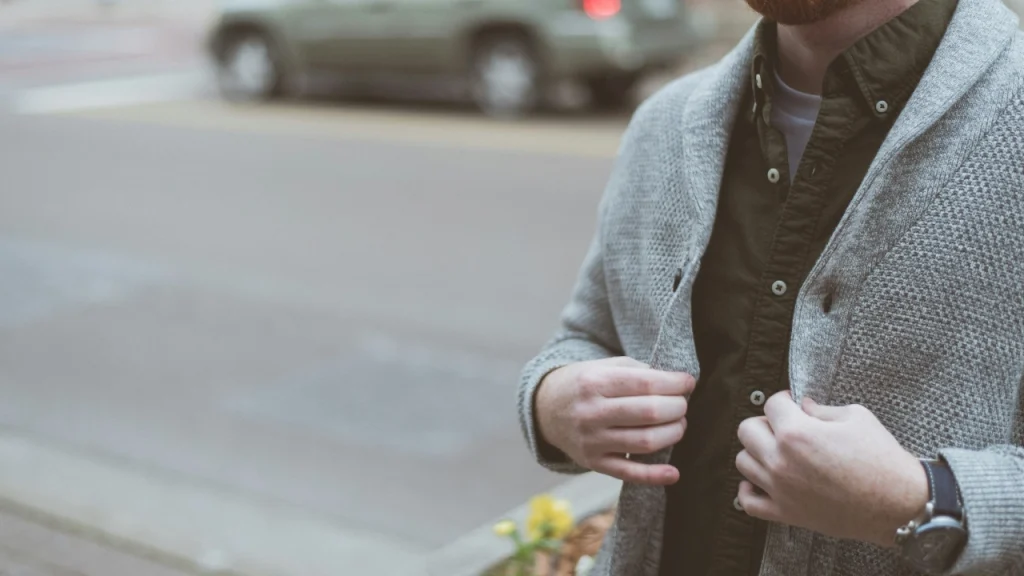
Style breadth should follow channel logic, not catalog completeness. Carrying every silhouette dilutes buy depth and inflates sample costs. A focused selection of three to five styles, each with a clear job, almost always outperforms a sprawling assortment.
Comparing Core Silhouettes
- A mens v neck cardigan and a mens button cardigan form the most reliable basics, suitable for office-leaning and smart-casual shoppers across age groups.
- A mens zip cardigan or mens zip up cardigan reads more contemporary and active, often performing in urban casual and sportswear-adjacent doors.
- A mens shawl collar cardigan adds presence and a heritage cue, working at higher price points and in autumn-winter.
- A cable knit cardigan for men and a mens chunky cardigan deliver visual weight and texture, useful for newness and editorial moments but heavier per unit and more expensive to produce.
How Style Choice Affects Cost and Production
Heavier gauges (3GG, 5GG) and complex structures like cables, intarsia, or jacquard increase yarn consumption, knitting time, and linking labor, raising FOB significantly versus a plain 7GG or 12GG jersey-stitch piece. Zip styles add hardware cost and require careful zipper selection and attachment to avoid wave or rippling along the placket. Shawl collars need stable knit structures and accurate finishing to keep the collar from rolling or losing shape after wash. When planning a range, balance one or two visually rich seasonal pieces with reliable core silhouettes so the program does not become uniformly expensive or uniformly basic. CN Sweaters’ cardigans category shows how different gauges and structures translate into different production complexities and price ladders.
Fit and Sizing Decisions That Decide Sell-Through
Sizing mistakes are one of the most common reasons mens cardigan programs underperform: returns climb, the size curve goes out of balance, and buyers blame the design when the real problem was an under-specified measurement chart.
Key Measurements to Lock Before Sampling
For each size and silhouette, lock chest width, shoulder, body length, sleeve length, armhole depth, cuff and hem rib height and stretch, placket width, and collar dimensions. Define ease — slim, regular, or relaxed — relative to a clear body block, not relative to a competitor garment. Confirm grading rules between sizes so proportions stay consistent, particularly sleeve length and armhole on larger sizes, which are common failure points on men’s knit garments.
Tolerances and Post-Wash Stability
Dimensional change after washing is where many sweater programs lose money. The U.S. test method most commonly referenced for assessing this is AATCC TM135, Dimensional Changes of Fabrics after Home Laundering, which gives a controlled laundering protocol used across the industry. Buyers should agree post-wash tolerances in writing — for example, ±3% length and ±3% width for a stable wool-blend, tighter for premium pieces — and require the factory to test pilot bulk before approval. Without this, samples can look perfect and bulk can fail after one home wash.
Trims, Hardware and Construction Details That Affect Quality
Trims look like a minor line item on the cost sheet but drive a disproportionate share of consumer complaints on cardigans, because the placket is the structural and visual centerline of the garment.
Buttons, Zippers and Plackets
Specify button material (corozo, real horn, polyester, metal), diameter, and ligne weight, plus the number of stitches per button attachment and a pull-test requirement. Confirm button spacing relative to body length and ensure buttonhole stitch density matches yarn count so holes do not stretch out. For zip cardigans, specify zipper brand, tape type, tooth or coil construction, length tolerance, and slider pull. A mismatched zipper tape weight relative to a soft, fine-gauge knit is the most common cause of wavy plackets.
Stitch Quality, Linking and Finishing
Linking stitch count per centimeter, seam tension at shoulders and armholes, collar attachment quality, rib elasticity and recovery, and consistent color across panels all separate a saleable cardigan from a return. Ask the factory to commit to specific seam construction (full-fashioned linking versus cut-and-sew) and inspection points. Independent inspection bodies such as Intertek’s textile and apparel inspection service describe the typical mid-production and final random inspection structures B2B buyers can require as part of the contract.
What to Confirm With the Factory Before Sampling and Bulk
Strong supplier communication is the single biggest predictor of whether a mens knitted cardigan program meets sample, ships on time, and reorders cleanly. The conversation needs to be specific and documented, not verbal.
The Supplier Confirmation Checklist
Before approving any sample, get written confirmation on yarn supplier and lot, exact composition with tolerance, yarn count and ply, gauge, target garment weight, full measurement chart with tolerances, color standards with light source for approval, sample fee, MOQ per color and per style, color and size assortment rules, sampling timeline, bulk lead time, shrinkage and pilling test plan, packaging method, hangtag and label placement, and inspection level. CN Sweaters publishes baseline expectations on MOQ and lead time and on quality control procedures that are useful templates for structuring this confirmation. For custom cardigan and custom cardigan sweaters projects, also confirm tech pack ownership, label compliance with destination-market labelling laws — for example the EU’s textile fibre labelling rules under Regulation (EU) No 1007/2011 — and reorder triggers.
Sample-to-Bulk Risk Control
Approve pilot bulk before full production where possible, particularly on new yarns or new constructions. Require the factory to retain sealed samples for shade, hand-feel, and measurement reference. Build inspection checkpoints at mid-production for measurement and seam quality, and at final pre-shipment for visual defects, count, and packaging compliance, before releasing the shipment. CN Sweaters’ OEM/ODM service overview outlines how this can be structured within a development calendar.
Final Recommendations for Buyers Building a Mens Cardigan Range
A mens cardigan program performs when the customer, channel, yarn, silhouette mix, fit, trims, and supplier conversation all line up. Lead with the customer and the price band. Choose yarn to match both the perceived value and the realistic care behaviour. Limit the range to a focused mix of core, seasonal, and trend-test styles. Lock fit and post-wash tolerances against recognised test methods. Specify trims and inspection points in writing, and require pilot bulk before full production. Done this way, the range protects margin and supports clean reorders rather than generating returns and markdowns. Send your target customer, preferred men’s cardigan styles, yarn composition, gauge, fit, color and size plan, order quantity, target price, branding requirements, testing standards, and delivery schedule through the CN Sweaters contact page to review suitable sourcing and production options.
FAQ
What is a realistic MOQ for a mens cardigan program?
MOQ depends on yarn, gauge, and color count. Plain-stitch cotton or wool-blend pieces in standard colors usually have lower per-color minimums than cable knit cardigan for men or intarsia styles with custom-dyed yarns. Confirm MOQ per style, per color, and per size before approving development, and ask whether mixed-color or mixed-size allowances are possible for first orders.
How long does sampling and bulk take?
Allow roughly 10–20 days for the first proto, an additional round for size set and pre-production samples, and typically 45–75 days for bulk after sample approval, with variation depending on yarn lead time, complexity, and season. Heavier gauges, custom dyeing, and complex stitches extend the timeline.
How do I prevent pilling and shrinkage complaints?
Specify yarn quality, twist, and finishing in the tech pack, and agree on objective tests — for example dimensional change per AATCC TM135 — with written tolerances. Require pilot bulk testing before full production, and align the wash label with the care behaviour the yarn can actually support.
What should the tech pack include for a custom cardigan?
A complete tech pack includes a flat sketch with all detail callouts, full measurement chart with tolerances, yarn composition and count, gauge and structure, color standards, trim specifications including buttons and zippers, label and packaging instructions, and target shelf price for cost alignment.
Can buttons and zippers be sourced to brand specifications?
Yes. Buyers can supply approved trim sources or ask the factory to source against a specification sheet covering material, color, dimensions, attachment method, and required pull or shear strength. Confirm trim approval as a separate sign-off step before bulk knitting begins.