 CN Sweaters

A waffle knit sweater earns attention through texture rather than decoration. Its raised grid creates shadow, depth and a relaxed casual character that works across core layering programs. That same three-dimensional structure also makes production more sensitive than a smooth jersey sweater.
The cells can change when yarn, stitch program, knitting tension, washing, steaming or pressing changes. A sample with clean, deep squares may become flatter or wider in bulk. A cotton-rich waffle may relax and shorten after washing. A heavier cell structure may consume more yarn than the buyer expected and shift both cost and garment weight.
For brands sourcing a waffle knit jumper, the reliable approach is to define the product as a connected system: customer, season, yarn, cell scale, gauge, stitch program, finished weight, dimensions, stretch, seams, washing, finishing, packaging and inspection. This guide explains how to brief and approve that system with a sweater manufacturer.
Define the Casual Retail Product
The first decision is not the machine setting. It is the role the sweater must play in the collection.
State the season, layer and customer
Record the intended climate, selling window, target customer, fit, retail channel, price position and care expectation. A lightweight transitional waffle worn over a T-shirt needs different yarn and weight decisions from a winter thermal layer or a substantial overshirt-style jumper.
Define whether the sweater should feel dry and structured, soft and relaxed, compact and warm, or airy and breathable. Those words should then be converted into physical references and measurable specifications.
Add the expected wearing state. If the product is a base layer, the interior handfeel and seam bulk matter more. If it is an outer casual layer, cell definition, shoulder shape and hanger presentation become stronger priorities.
Separate the mood image from the production standard
A reference photo can show cell scale, neckline, silhouette and styling. It cannot prove fiber content, yarn count, gauge, loop construction, finished weight, stretch or wash behavior.
Mark which visual details are mandatory and which are inspiration. Convert the approved direction into a tech pack with front, back and detail views, finished measurements, yarn and color references, waffle repeat, rib trims, shoulder construction, sleeve shape and care route.
The CNSweaters knitwear tech pack guide helps buyers turn a visual brief into production fields that can be quoted, sampled and inspected.
Build Yarn, Cell Structure and Gauge Together
“Waffle knit” describes a family of textured constructions, not one universal fabric or fiber.
Compare cell scales with finished swatches
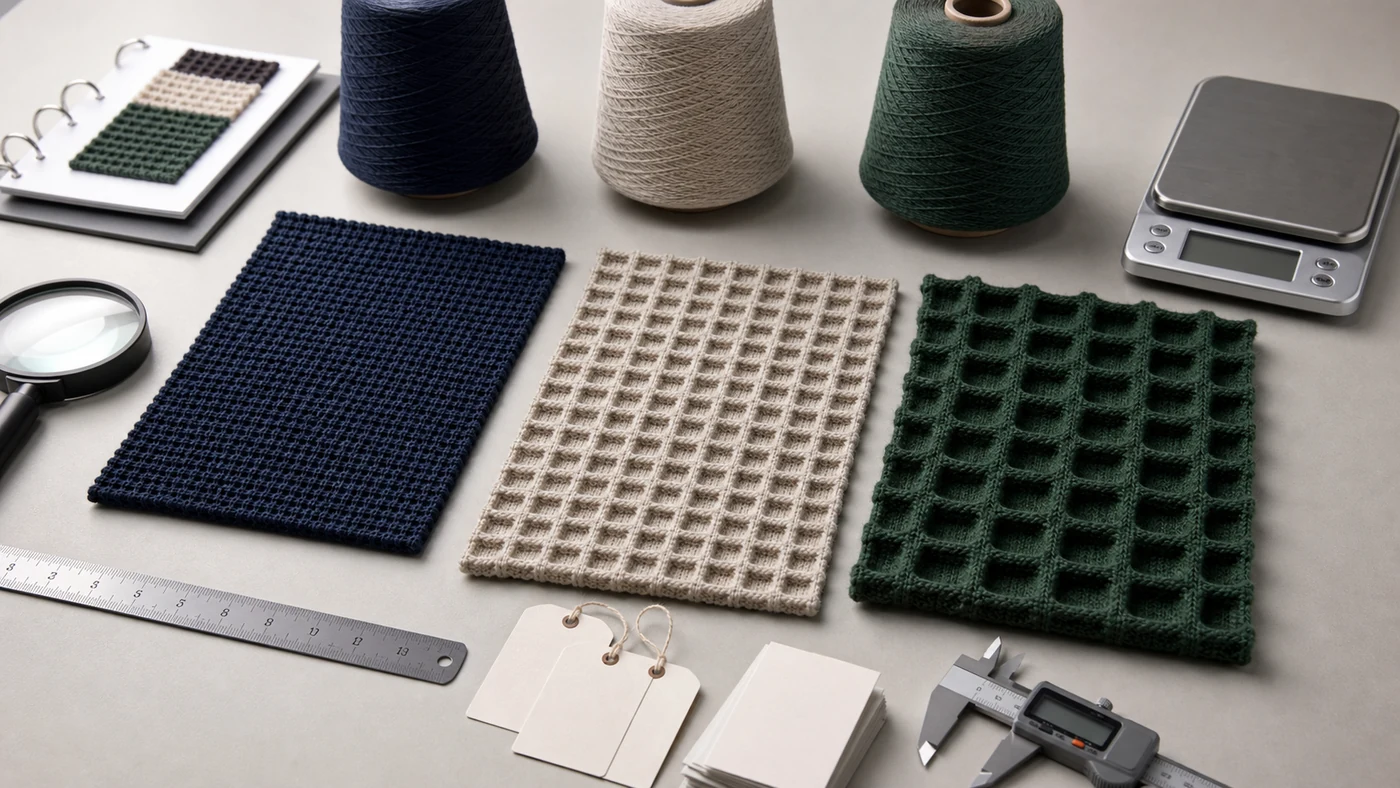
Ask the factory for labeled swatches in the proposed yarn, gauge, program and finishing route. Compare mini, standard or larger cells only when they fit the product brief. Record the repeat dimensions and identify the approved face and back.
ISO 8388 vocabulary describes a weft-knitted waffle or honeycomb construction as jersey-based layers connected with tuck loops. The practical point for buyers is that the texture is created by knitting architecture, not by printing or embossing a flat surface.
Review each swatch from the front, side and back. Check ridge height, recess depth, cell regularity, edge behavior, opacity, thickness, handfeel and recovery after light extension. Photograph the approved swatch under consistent side lighting because frontal light can hide depth.
Choose yarn for the intended surface and care
Evaluate fiber percentages, yarn count and ply, twist, hairiness, elasticity, color method, pilling risk, care method, availability and cost. Cotton can support a familiar casual story but may need careful dimensional control. Wool and blends can add warmth and recovery while changing the surface. Viscose-rich yarns can create drape but may flatten or grow under weight.
The private-label yarn planning guide explains why fiber, gauge, structure, garment weight, MOQ and care must be considered together. For waffle, the yarn must also hold the intended cell definition after finishing and wear.
Do not specify one fiber or elastane percentage as a universal answer. Approve the actual combination that meets the product brief. If a bulk yarn lot or substitute changes, require a knit-down comparison before the full run proceeds.
Distinguish visual loft from actual warmth
Raised cells create pockets and a sense of thermal volume, but performance still depends on fiber, density, thickness, fit, moisture and layering. Do not promise a fixed warmth level from the word “waffle” alone.
Cotton Incorporated research describes waffle or honeycomb thermal structures as cellular pockets that can trap air. Use that as design context, then validate the final garment against the brand’s actual wear and test requirements.
Control Cell Definition and Garment Weight
The buyer needs both a physical standard and numerical evidence. Cell appearance alone can hide changes in yarn consumption or density.
Record cell geometry, stitch program and weight
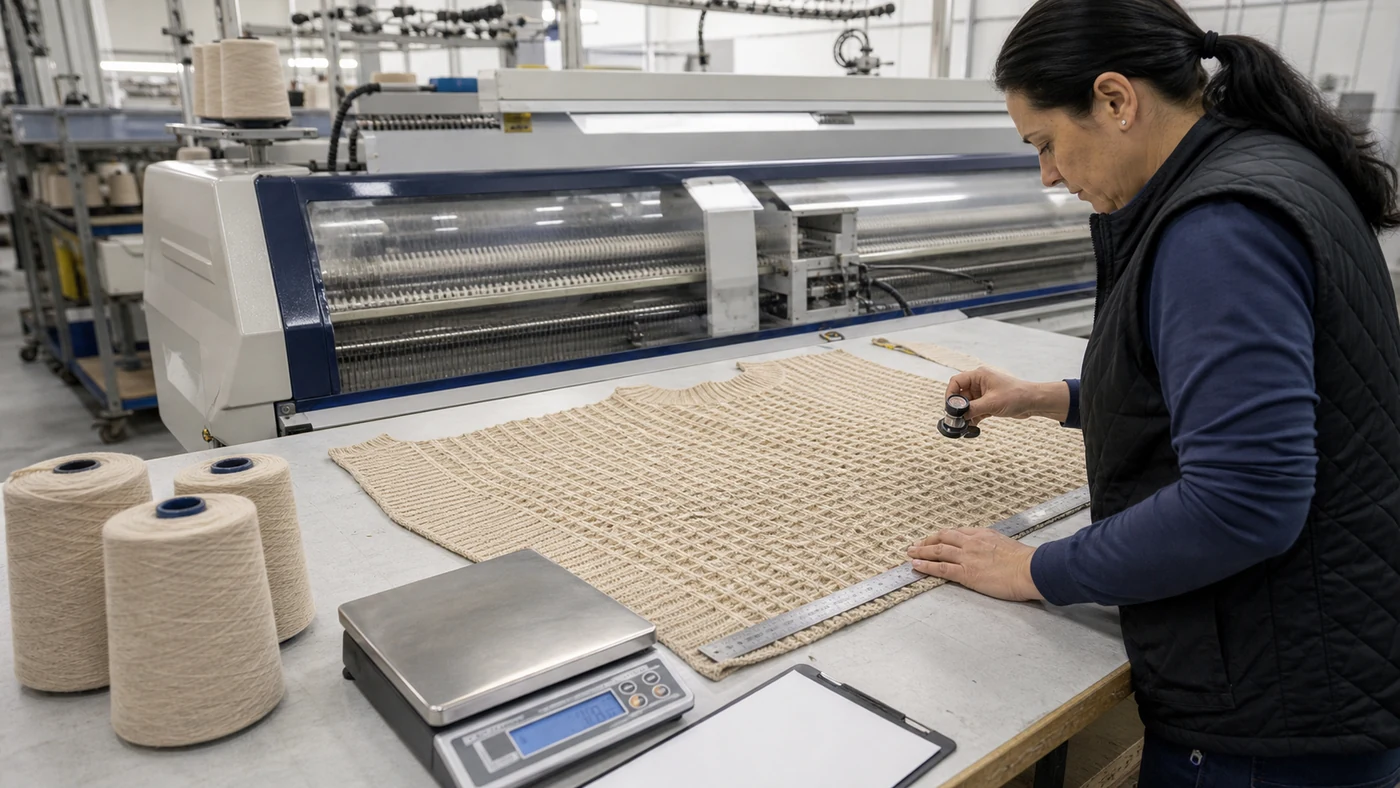
Seal an approved finished swatch and pre-production sweater. Record yarn reference and lot, color, machine gauge, program revision, cell repeat, stitch or course-length control used by the factory, finished swatch dimensions, garment size and finished weight.
ASTM D3776/D3776M covers methods for measuring fabric mass per unit area. For fully fashioned sweaters, buyers may also track complete garment weight because trims, seams and size affect consumption. The method and conditioning state must be consistent if results are compared.
Use weight as a diagnostic, not as a substitute for appearance or fit. Two sweaters can weigh the same while differing in cell depth, body width or finish. A correct standard connects weight with structure, dimensions and handfeel.
Build a production control table
The PP pack can use a simple control map:
| Control area | Approved reference | Inline evidence | Risk if it drifts |
|---|---|---|---|
| Yarn | supplier, composition, count or ply, color and lot | cone labels and knit-down | shade, handfeel or cell change |
| Waffle cell | repeat, face, depth and visual photo | swatch or panel comparison | flat, irregular or enlarged cells |
| Machine program | gauge and approved revision | machine and panel records | inconsistent repeat or dimensions |
| Weight | conditioned swatch and finished garment state | representative panels and garments | cost, warmth or density shift |
| Dimensions | defined points and relaxation state | panel, PP, inline and final checks | fit and size inconsistency |
| Finish | approved wash, steam, press and handfeel | batch records and sealed comparison | shrinkage, flattening or harsh touch |
Avoid copying a universal GSM, gauge or weight from another product. A mini-waffle base layer and a fully fashioned chunky jumper require different benchmarks.
Watch trends by machine and batch
Bulk drift often appears gradually. Review results by machine, yarn lot, size, color and finishing batch. A group of shallow cells from one machine suggests a different root cause from flattened texture across one pressing batch.
Do not wait for a formal failure if measurements and weights move steadily toward a tolerance edge. Early correction protects more units and shortens the investigation.
Engineer Fit, Trims and Seam Transitions
Texture affects proportion. The same pattern can fit differently when the cells relax, spread or gain depth.
Fit the sweater in its actual layer
Measure the sample after the agreed finishing and relaxation time, then fit it on the target body or form over the intended underlayer. Check neckline position, shoulder line, chest ease, sleeve pitch, elbow movement, cuff recovery, body length and hem balance.
ISO 18890:2018 defines main garment measurement points and allows additional points by agreement. The buyer must still add style-specific diagrams and state whether the garment is laid flat without tension, fastened if applicable, and measured pre-wash or post-wash.
Waffle can appear narrower when the cells are deep and wider when they flatten. Compare the worn surface with the relaxed flat sample. If the cells open excessively across the chest or upper arm, the issue may be fit, structure or both.
Match ribs and edges to the waffle body
Neck, cuff and hem ribs should stabilize the body without pulling or flaring. Record their structure, depth, yarn, gauge, attachment and finished dimensions.
Review transition lines where waffle meets rib. The cell repeat should meet the edge cleanly, and the rib should not make the body buckle. A heavy hem can pull down a light waffle body; a short tight cuff can distort sleeve length and forearm fit.
If the style includes a placket, zipper, pocket or side slit, approve the reinforcement and balance in the finished garment. Texture can make these areas look uneven even when the flat measurements pass.
Protect the waffle repeat at linked seams
Fully fashioned panels must be joined without skipped loops, holes, excessive ridges or mismatched pattern position. Check shoulders, armholes, side seams and underarms while relaxed and lightly stretched.
The CNSweaters linking-quality guide explains why loop count and equipment matching affect seam elasticity and appearance. For waffle, add an approved seam photo showing how the cell grid should meet across each visible join.
Validate the Size Range
One approved base size does not prove that cell scale, proportion and trim behavior work across the full grade.
Approve representative lower, base and upper sizes

Select sizes that expose the largest grading risks. Measure and fit them after the approved wash, finish and relaxation route. Compare shoulder, chest, body length, sleeve, cuff, neckline, hem and any pocket or placket positions.
Check how the waffle cells look on each size. The repeat may remain constant while the number of cells changes, or specific shaped zones may require a revised program. Do not stretch one panel program across sizes if that changes cell geometry.
Review garment weight by size as a consistency check. Expected weight should rise with material area, but unexplained jumps may reveal program, yarn or trim differences.
Keep grading separate from tolerance
The grade defines the intended change between sizes. The tolerance defines acceptable production variation around each target. If the two are confused, finished sizes can overlap and customer fit becomes inconsistent.
Document which points grade linearly and which require specific rules. Neck opening, cuff width, rib depth and pattern placement may change differently from chest or body length.
Keep the size-set records with the sealed PP sample so refill orders do not have to reconstruct the grade from one remaining garment.
Test Washing, Recovery and Surface Durability
The final product is the washed and finished sweater, not the panel immediately after knitting.
Select the care procedure before testing
ISO 6330:2021 specifies domestic washing and drying procedures for textile testing, while ISO 5077:2007 covers dimensional change after washing and drying. The buyer still needs to select the procedure, cycles and evaluation points that match the intended care claim.
Measure the full sweater before and after the agreed route. Check body and sleeve dimensions, cell repeat, ridge depth, hem balance, cuff recovery, seam condition, shade and handfeel.
Do not test only a small swatch. The garment introduces seams, trims, shaped panels and its own weight. These can react differently from the material sample.
Separate stretch, growth and recovery
Stretch is extension under a defined condition. Growth is residual change after stress. Recovery is the return toward the original state.
ASTM D2594/D2594M-21 addresses stretch and growth of low-power knitted fabrics and notes that the method is useful for selection but has limitations for commercial-shipment acceptance. Agree the relevant condition and interpret results with garment wear tests.
For a casual waffle sweater, review elbows, cuffs, hem and any close-fitting zones after representative wear. A cell that opens during movement should return sufficiently for the product role; otherwise the surface can look bagged even when the yarn is undamaged.
Protect cell depth during finishing
Record the approved washing, drying, softening, steaming, pressing and relaxation route. Over-pressing can flatten the cells. Excessive softening can change handfeel and definition. Uneven steam can alter measurements or make one panel look different from another.
Compare finishing batches under side lighting and after equal relaxation. If a recipe changes, approve a confirmation sample before applying it to the remaining bulk.
Plan Colors, MOQ and Retail Presentation
Texture affects both assortment planning and how the product arrives at the store.
Approve every color on the actual structure
Dark shades can hide cell valleys, while pale or bright shades may make shadows and irregularities more visible. A yarn color card is not proof of the final textured appearance.
Approve a knit-down or sample in each bulk color. Check shade under agreed lighting, cell visibility, surface hairiness and cross-panel matching. If body and trims use different structures, confirm that their apparent shades remain coordinated.
Plan quantities by color, size and yarn requirement. Custom-dyed yarn, special counts and fragmented assortments can change commercial feasibility. The factory should quote the real program rather than one headline MOQ detached from colors and sizes.
Pack without crushing the texture
Approve folding, tissue, polybag size, carton fill, moisture protection and hanger use where relevant. Excess compression can flatten the cells and create hard fold lines.
Run a packing trial and reopen the unit after a representative rest period. Check whether the sweater recovers its intended surface and presentation without aggressive steaming at the retailer.
The packing standard should include a photo and garment orientation. This helps the factory reproduce the method across shifts and protects the first impression at unboxing.
Transfer the Approved Standard Into Bulk
Stable production requires a complete PP pack and inspection before defects spread.
Release bulk from one approved revision
The pack should include the sealed sweater, finished swatch, yarn and shade references, current tech pack, measurement chart, size grade, machine and program record, cell photo, finishing route, trim approvals, labels, packing method and defect examples.
Confirm that merchandising, programming, knitting, linking, finishing and QC teams use the same revision. A superseded file can reproduce an old decision perfectly and still create the wrong product.
The bulk knit consistency guide gives buyers a broader framework for translating sample approval into repeatable production evidence.
Inspect early production by machine and batch
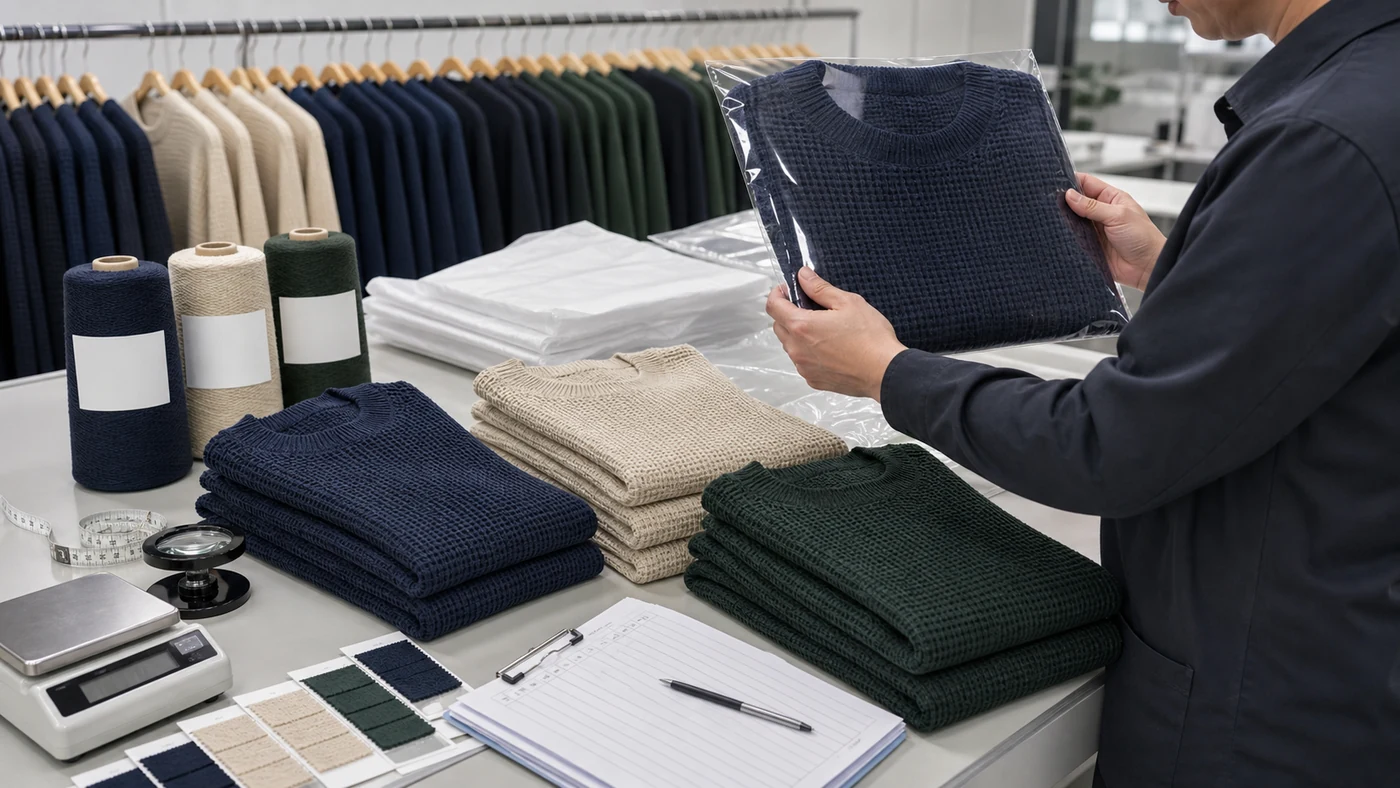
Check first-off panels before full knitting. Then inspect representative units by machine, yarn lot, color, size and finishing batch.
At panel stage, review cell repeat, surface regularity, dimensions, weight, defects and left/right matching. After assembly, add linking, neckline, cuffs, hem and full-garment measurements. After finishing, add handfeel, shrinkage response, shade, labels and packing.
Use a tiered knitwear quality-control checklist across pre-production, inline and final stages. Final random inspection is still necessary, but it should confirm a controlled run rather than discover a system-wide cell or shrinkage problem after packing.
Preserve records for repeat orders
Archive the approved files, physical standards, yarn lots, machine groups, program versions, finishing records, inspection data, defect decisions and shipment samples.
For a refill order, identify what changed. A new yarn lot, machine group or finishing line may justify a confirmation sample even if the sweater design is unchanged.
That record turns a fashionable textured item into a reliable core program that can be reproduced across seasons.
Conclusion
A successful waffle knit sweater is built by controlling the three-dimensional surface and the garment around it.
Define the product role first. Approve the actual yarn, cell scale, gauge, weight and finishing route. Fit and measure the complete sweater after relaxation, validate representative sizes, and check stretch, growth and recovery where the product experiences stress.
Finally, transfer the approved sample into a documented PP pack and inspect structure, weight, dimensions and finishing trends early. That gives buyers and factories time to correct drift before it becomes a bulk-order problem.
Related CNSweaters Resources
- Private-Label Knitwear Yarn Planning
- Knitwear Tech Pack Essentials
- Bulk Knit Consistency From Sample to Production
- Knitwear Quality Control Checklist
- Why Linking Quality Matters
Developing a Waffle Knit Sweater?
Send the customer, season, silhouette, yarn or composition direction, waffle reference, gauge, size range, colors, quantities, care route, retail packing and delivery date. The CNSweaters team can review a practical sampling and bulk-control path.
FAQ
Is waffle knit a fiber or a structure?
It is a knitted structure. Cotton, wool, synthetic and blended yarns can all be used, but they will produce different handfeel, weight, recovery, warmth, care and cost.
What makes waffle cells become flat in bulk?
Possible causes include a changed yarn, stitch program, machine setting, washing, softening, steam or pressing. Compare the affected batch with the sealed swatch and PP sweater to identify the stage where depth changed.
Should every color have a knit-down?
Yes when shade, cell visibility or yarn behavior could differ. Texture creates shadows, so a color that looks correct on a yarn card can appear different on the finished waffle surface.
How should waffle sweater shrinkage be checked?
Select a wash and dry procedure that matches the care claim, measure the complete garment before and after, and assess dimensions, cell repeat, hem balance, seams, recovery and surface appearance.
Does final AQL inspection guarantee stable cells and wash performance?
No. A final visual sample can identify visible defects, but it cannot replace earlier material, wash and inline controls. Cell definition, weight and dimensional stability should be checked before the entire order is packed.