 CN Sweaters
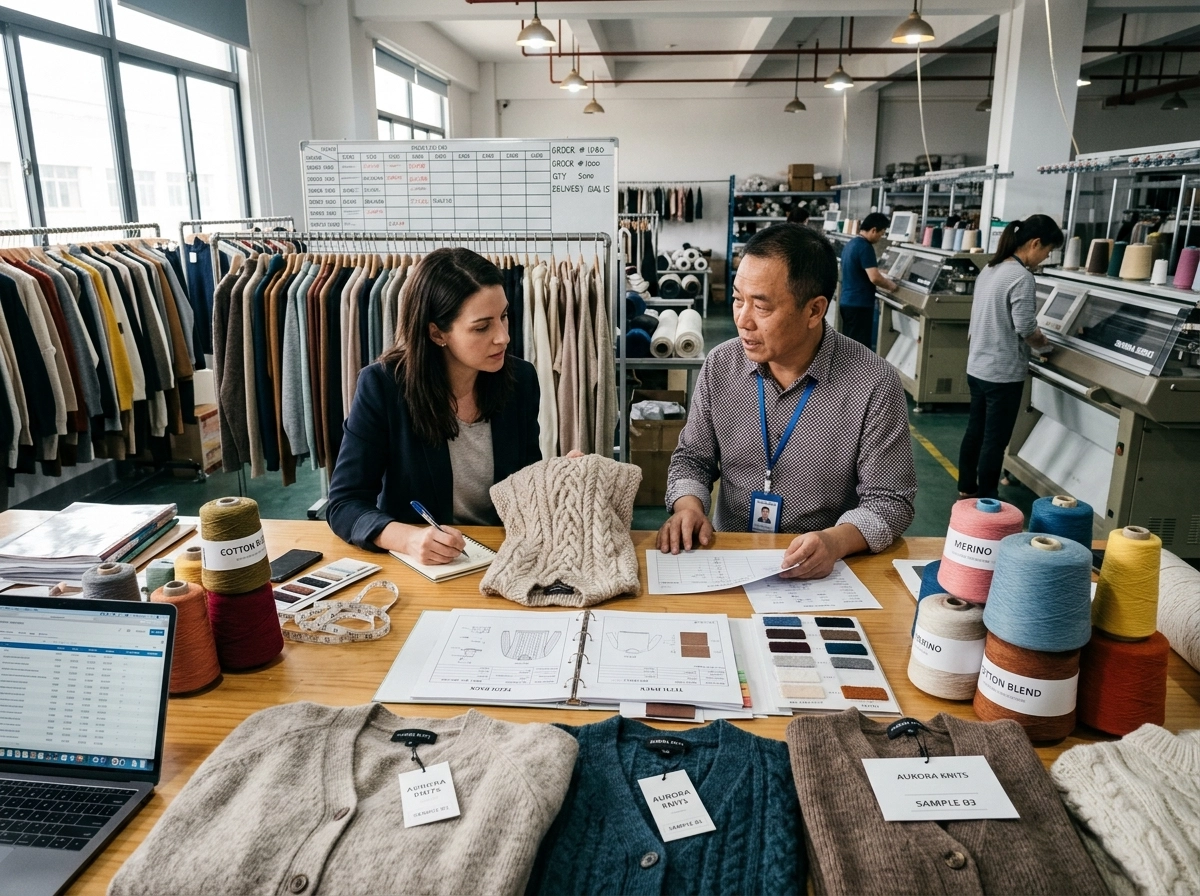
Choosing a knitwear manufacturer is less about finding the cheapest quote and more about matching your product category, order scale and quality expectations to a factory’s actual technical capability. From a factory perspective, the brands that build long-term relationships with us are the ones who evaluate sampling behavior, MOQ logic, quality control depth and compliance posture before signing a PO, not after the first shipment fails QC.
This guide is written for apparel brand owners, procurement managers, early-stage startups, wholesalers and product development teams who need a practical framework to vet a sweater factory or knitwear supplier. We will cover technical expertise, OEM and ODM lead times, sampling logic, MOQ trade-offs, AQL-based quality control, and ethical compliance. Wherever numbers appear, we explain what they mean for your buying decision, not just what they are.
Evaluating Technical Expertise in Knitwear Development
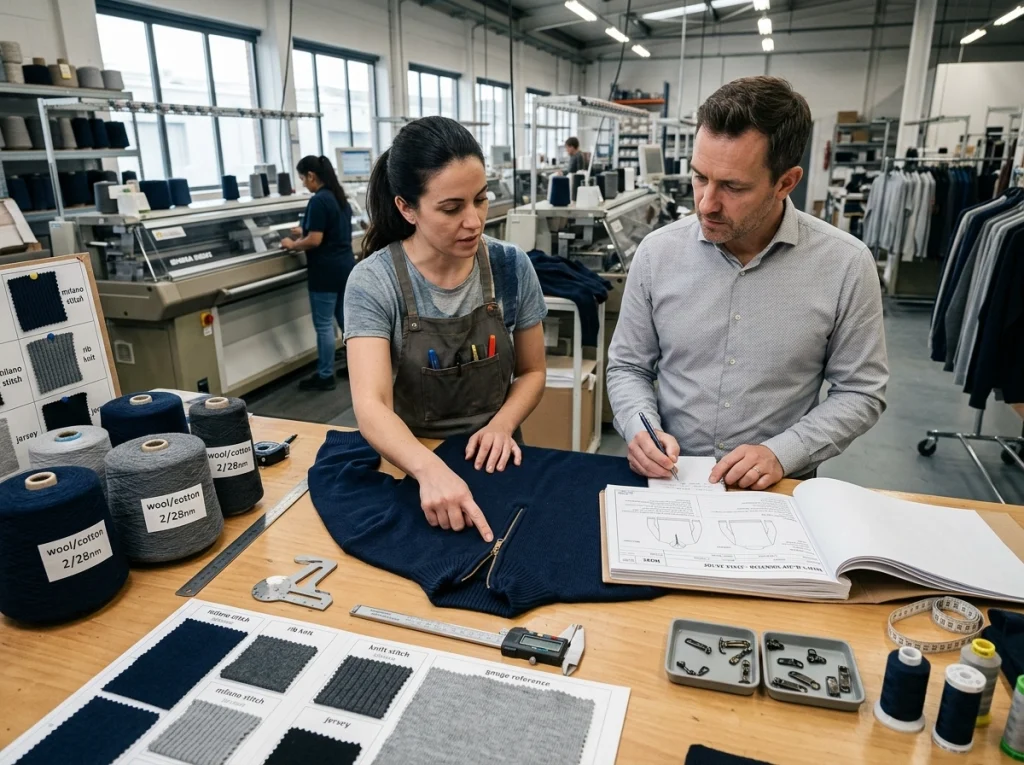
A capable knitwear manufacturer should be judged first on its technical expertise, specifically gauge range, yarn handling and machinery mix. If a factory cannot explain how it would knit your style at a specific gauge, with a specific yarn, on a specific machine type, it is probably not the right partner for a technical program. Price comparisons only become meaningful after this baseline is confirmed.
Gauge Range and Fabric Construction
Gauge determines how fine or chunky the knit looks and feels, typically expressed as needles per inch. A 3GG chunky cardigan and a 14GG fine merino pullover require different machines, different yarn counts and different operator skills. When you review a potential supplier, ask which gauges they run in-house versus outsource. A factory that runs 3GG to 14GG on its own floor can keep quality and timing under control; one that subcontracts half of its gauge range introduces variability you will pay for later. For brands building broad assortments across sweaters, cardigans and knit dresses, this in-house gauge coverage directly affects consistency across a collection.
Yarn Knowledge and Sourcing Networks
Yarn is where most knitwear quality problems begin. A serious knitwear supplier should be fluent in cotton, wool, merino, cashmere, acrylic, viscose blends and recycled fibers, and should maintain working relationships with mills that can supply stock-service yarns as well as custom-dyed lots. Stock-service yarn shortens lead time and lowers MOQ pressure; custom-dyed yarn gives color precision but adds lab dip cycles and dye-lot minimums, often one kilogram per color at the mill level, which cascades into garment MOQ. Ask the factory how they handle shade approval, how many lab dips are typical, and what their colorfastness testing looks like before they commit yarn to bulk.
Machinery Mix and Finishing Capability
Machinery signals what a factory can actually deliver. Shima Seiki and Stoll computerized flat knitting machines, including WHOLEGARMENT or knit-and-wear programs, allow seamless construction but add programming time, sometimes an extra week during development. Linking machines, overlock units, steam tunnels, washing lines and pressing tables all shape the final hand-feel. A custom knitwear manufacturer that can support jacquard, intarsia, pointelle, cable and rib structures in-house will give you more design flexibility without pushing work to uncontrolled subcontractors.
How to Navigate Lead Times for OEM and ODM Production
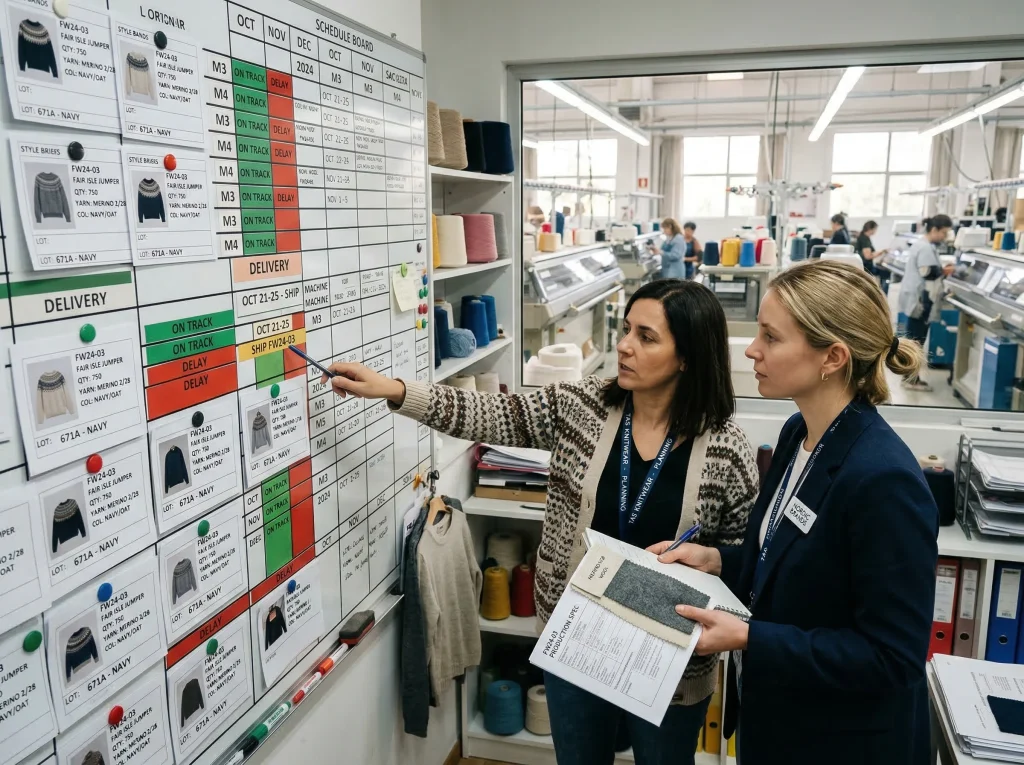
Lead time is driven more by your production model than by factory speed alone. From a factory perspective, OEM programs with custom yarn and new tech packs realistically need three to six months from kickoff to shipment, while ODM programs built on existing blocks can move in roughly one to three months. Buyers who treat these timelines as negotiable rather than structural usually end up paying for air freight or accepting quality compromises.
Sampling Windows You Should Expect
Fast-track samples using stock-service yarn can be ready in three to five business days when the tech pack is complete. Standard samples typically take seven to ten business days. If custom-dyed yarn is required, add lab dip time and dye-lot scheduling, which can push sampling to around three weeks. For WHOLEGARMENT development, add programming and first-article tuning on top of that.
Bulk Production Windows
For low to moderate MOQ orders using stock-service yarn, bulk production usually runs twenty-one to thirty-five days after all approvals. Industry-wide, bulk apparel orders of one thousand to five thousand pieces commonly sit in the twelve to fourteen week range when counting material sourcing, production and finishing. Shipping adds another four to eight days by air or twenty to thirty-five days by sea, which matters when you plan retail launches.
OEM vs ODM at a Glance
The table below summarizes typical timeline and MOQ behavior we see across OEM and ODM projects. Numbers reflect common ranges, not guarantees, and will shift with yarn type, complexity and season.
| Stage | OEM (Your Design) | ODM (Factory Block) |
|---|---|---|
| Tech pack review | 5–10 business days | 2–5 business days |
| Proto sample | 10–15 business days | 3–7 business days |
| SMS / pre-production sample | 10–15 business days | 7–10 business days |
| Bulk production | 30–60 days | 15–35 days |
| Typical MOQ per color | 300–500 pcs | 100–200 pcs |
| End-to-end total | 3–6 months | 1–3 months |
In practice, OEM is the right choice when design ownership, fit precision and brand identity matter more than speed. ODM fits brands that want faster market entry and lower development cost, accepting that silhouettes and constructions are partly shared. Many buyers blend both within one season, running core basics as OEM and seasonal drops as ODM to balance risk.
Why Sampling is the Most Critical Step in Supplier Vetting
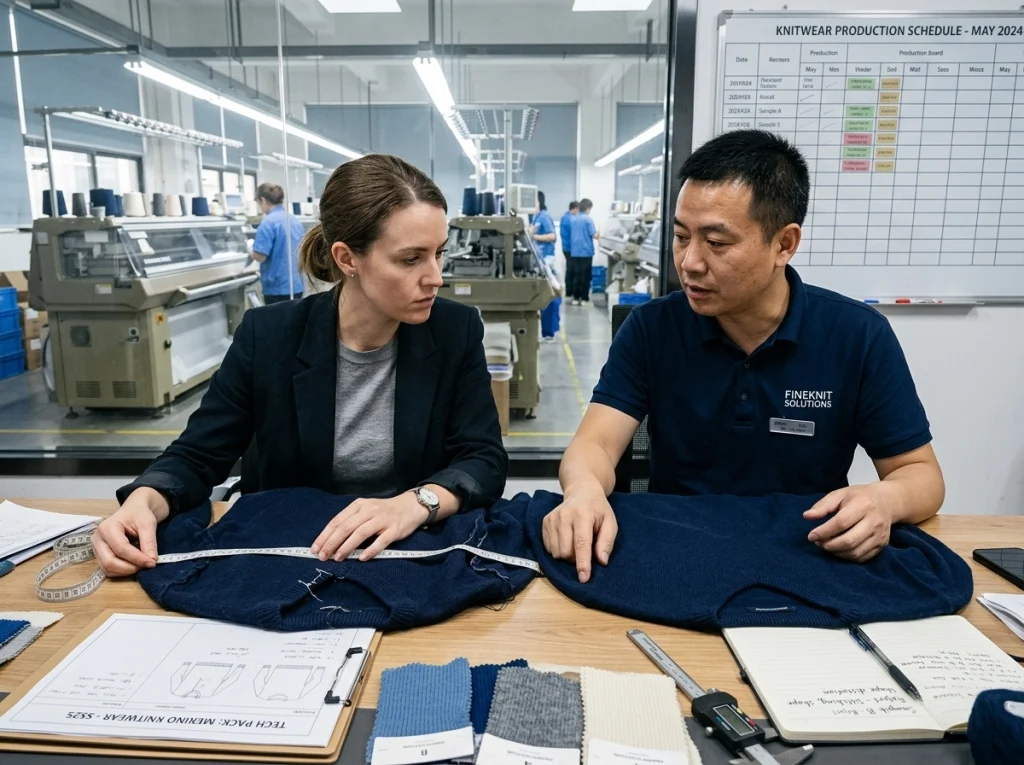
Sampling tells you more about a factory than any certificate or sales deck. From a factory perspective, the way a supplier handles proto and SMS stages reveals their pattern accuracy, communication discipline and willingness to solve problems before bulk. If sampling is chaotic, bulk will be worse.
Proto Sample vs SMS
A proto sample, sometimes called a development sample, is built to confirm silhouette, gauge, yarn and basic construction. It may not use final color or final trims. A salesman sample, or SMS, is produced after proto approval in the final yarn, final color and final trims, intended for sales meetings, fit validation and pre-production sign-off. Skipping SMS to save time is a common mistake; the SMS is your last controlled checkpoint before the factory schedules bulk machines and commits yarn.
What to Inspect in Each Round
On proto, check measurement accuracy against the tech pack, gauge and stitch density, rib tension, collar and cuff construction, and overall hand-feel. On SMS, re-check measurements after washing, verify color against your approved Pantone or lab dip, confirm trim placement, care label content, branding details and packaging layout. We recommend buyers keep a signed, sealed SMS on file; it becomes the reference for any AQL dispute later.
Communication Quality During Sampling
Response time, clarity of English, ability to read a tech pack and willingness to flag issues proactively are all signals. A knitwear supplier that asks detailed questions about yarn substitution, shrinkage tolerance or linking method is usually more reliable than one that simply says yes to everything. For brands running custom knit projects, this sampling dialogue is where technical risk is actually managed.
Balancing MOQ Barriers with Cost in Custom Projects
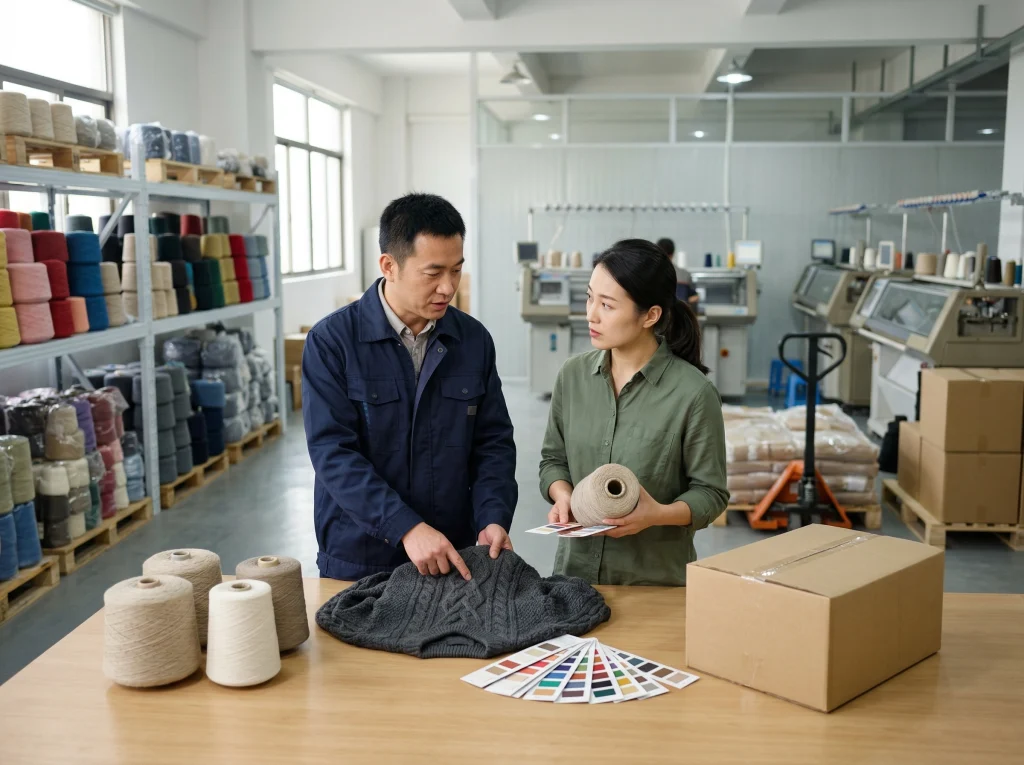
MOQ is not a number the factory invents to frustrate you. From a factory perspective, MOQ is driven primarily by yarn economics, machine setup time and dyeing minimums. Understanding this lets buyers negotiate realistically instead of chasing suppliers who quote impossibly low MOQs and then compensate with quality shortcuts or hidden surcharges.
Why Yarn Dictates MOQ
Most mills sell yarn in minimum lots, commonly one kilogram per color for stock-service shades and substantially more for custom-dyed colors, where dye-lot minimums can reach fifty to one hundred kilograms. A sweater may consume roughly three hundred to six hundred grams of yarn depending on style and gauge, which means one dye lot sets a floor on how many pieces per color you can produce efficiently. For cotton and acrylic blends, stock yarn availability keeps MOQs flexible; for cashmere and specialty wool, MOQs tend to be tighter because yarn cost and dyeing complexity are higher.
Typical MOQ Ranges
Across the industry, low MOQ programs for private label knitwear commonly sit in the fifty to three hundred units per color band. Basic cotton jersey styles can sometimes start at one hundred to two hundred units, while custom-dyed organic cotton or cashmere programs often move to three hundred pieces or more per color. Small-batch orders below one hundred pieces frequently carry a twenty to forty percent unit price premium because setup costs, yarn waste and linking time are spread across fewer units.
Negotiating MOQ Without Hurting Quality
There are practical levers. Use stock-service yarn to avoid custom dye minimums. Consolidate colorways so each color clears its yarn minimum. Group similar styles across hoodies & zip knitwear and pullovers to share trims and packaging. Plan tiered reorders so the factory can reserve machine time. These tactics protect margin on both sides and usually produce better pricing than forcing an artificially low MOQ on the first PO.
Implementing Quality Control and AQL Standards
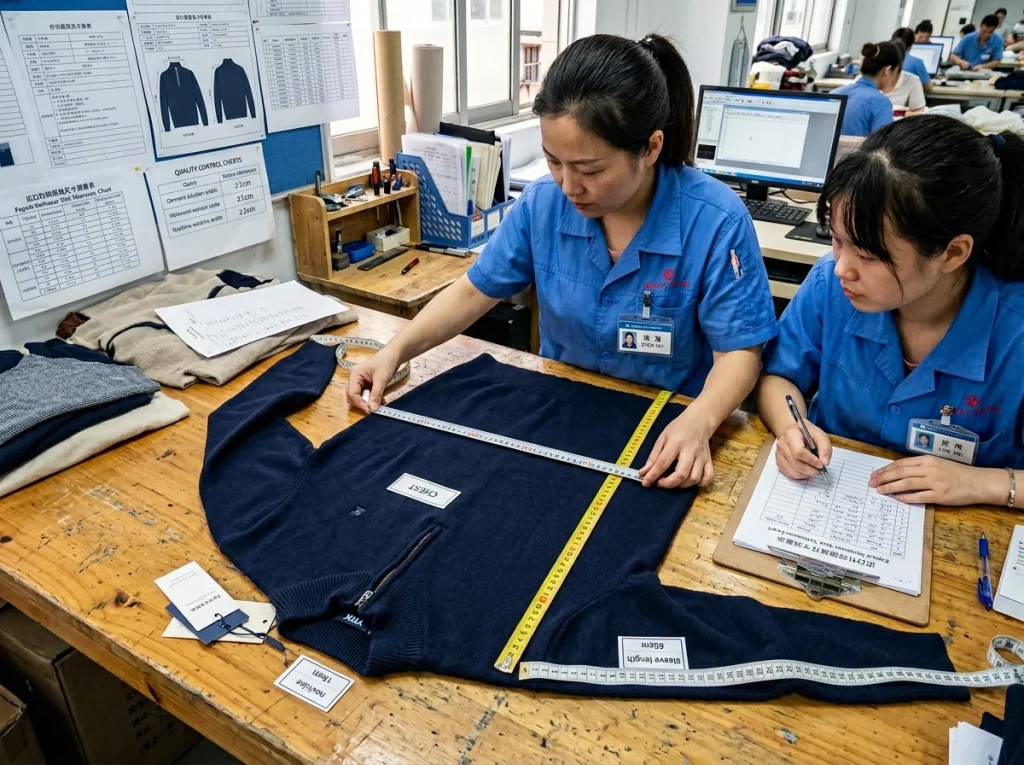
Quality control in knitwear is a three-stage system, not a single final check. From a factory perspective, brands that only rely on pre-shipment inspection catch problems too late, when rework is expensive and timelines are already compressed. A credible knitwear production partner should show you a documented QC protocol covering raw materials, in-process checks and final AQL audit.
Stage One: Pre-Production and Raw Material QC
This stage covers yarn lot verification, colorfastness checks, GSM confirmation, shrinkage tolerance testing and trim inspection. Yarn is checked for slubs, knots, uneven twist and cone stability. Lab dips are approved against a sealed standard. Trims such as zippers, buttons, labels and hangtags are verified against the tech pack. Catching a yarn defect here costs a few kilograms; catching it after linking costs whole garments.
Stage Two: In-Process and Inline QC
During knitting, operators monitor tension, stitch density and panel symmetry. Inline measurement checks catch shrinkage drift early. During linking and sewing, QC staff inspect seam strength, stitch per inch consistency and trim attachment. For printed or embroidered panels, a hundred percent check before assembly is common. Inline audits let the factory correct a machine or an operator before a defect multiplies across thousands of units.
Stage Three: Final AQL Inspection
Pre-shipment inspection typically uses the Acceptable Quality Limit standard, commonly AQL 2.5 for major defects and 4.0 for minor defects in general apparel. A statistical sample is pulled from packed cartons and checked against measurements, color, surface defects, seam integrity, labeling, packaging and carton markings. Defects are classified as critical, major or minor, with different thresholds. Brands can run this internally, ask the factory to host it, or engage a third-party inspector such as SGS, Bureau Veritas or Intertek for an independent report. For higher-risk programs or first-time partnerships, third-party AQL is worth the fee.
Why Ethical Compliance Certifications are Non-Negotiable
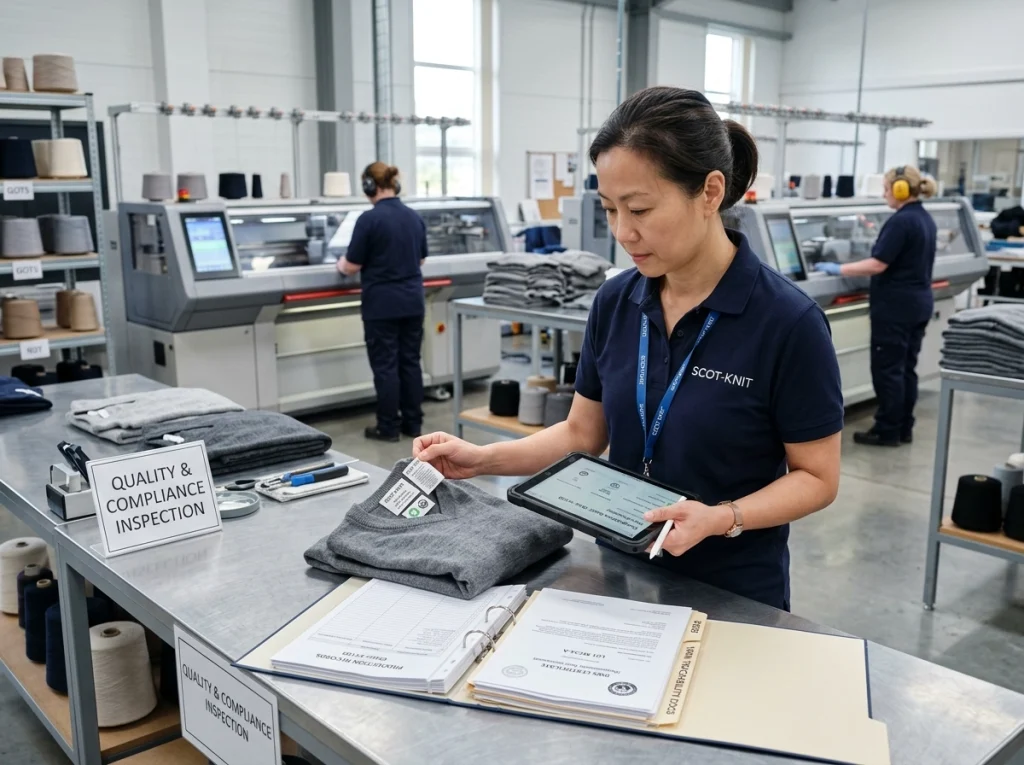
Ethical compliance has moved from a nice-to-have to a baseline expectation for any serious private label knitwear buyer. From a factory perspective, brands that skip compliance due diligence are exposed to reputational, legal and customs risks that can exceed any short-term unit cost saving. Three frameworks are particularly relevant: OECD due diligence, amfori BSCI and WRAP.
OECD Due Diligence as the Baseline Framework
The OECD Due Diligence Guidance for Responsible Supply Chains in the Garment and Footwear Sector sets a six-step, government-backed framework: embed responsible policies, identify adverse impacts, cease or mitigate them, track performance, communicate, and enable remediation. It applies to brands of any size and explicitly asks buyers to examine how their own purchasing practices, such as unrealistic lead times or last-minute order changes, may contribute to supply chain risk. Using OECD as your internal checklist helps you ask the right questions during supplier vetting.
amfori BSCI Social Audit Coverage
The amfori BSCI program audits factories across thirteen performance areas, including fair remuneration, decent working hours, occupational health and safety, prohibition of child and forced labor, freedom of association, environmental protection and ethical business behavior. A valid BSCI audit report gives buyers a structured view of a factory’s social compliance posture and is widely accepted across European and North American retail channels. Full audits typically repeat every two years, with follow-up audits targeting gaps.
WRAP Certification for Sewn Goods
The WRAP certification program is built around twelve principles covering legal compliance, prohibition of forced and child labor, compensation, working hours, health and safety, freedom of association, environment, customs compliance and security. Certification comes in Silver, Gold and Platinum levels reflecting the degree of compliance and audit history. WRAP certifies individual facilities rather than brands, so always ask for the specific factory certificate and its validity date, not a parent company claim.
Conclusion
Choosing a knitwear manufacturer is a structured decision, not a price comparison. Evaluate technical capability across gauge, yarn and machinery. Match your timeline to the realities of OEM versus ODM. Use sampling, especially the SMS round, as your real vetting tool. Understand that MOQ is a function of yarn economics, not negotiation willpower. Insist on a three-stage QC system anchored by AQL, and require documented ethical compliance through OECD-aligned due diligence, BSCI or WRAP. When you are ready to move forward, send your tech pack, target garment type, quantity per color, preferred fabric or yarn, target delivery date and branding requirements to our team through the custom knit projects intake so we can return a realistic quotation and development timeline.
FAQ
What is a typical MOQ for a new knitwear brand?
Answer: For private label knitwear using stock-service yarn, MOQs commonly start at fifty to one hundred pieces per color per style, with one hundred to three hundred being more typical for balanced pricing. Custom-dyed yarn or cashmere programs usually require higher MOQs to cover dye-lot minimums and yarn sourcing costs. Expect a unit price premium of roughly twenty to forty percent on very small batches compared with standard production runs.
How long does sampling take before bulk can start?
Answer: Fast-track samples with stock yarn can be ready in three to five business days. Standard proto samples usually take seven to ten business days, and a full proto plus SMS cycle with custom-dyed yarn can run three to four weeks. Incomplete tech packs, late trim approvals and color revisions are the most common causes of delay, so front-loading specifications shortens the overall path to bulk.
What artwork and tech pack files should I send?
Answer: A complete tech pack should include flat sketches front and back, measurement sheet with tolerance, yarn composition and target gauge, stitch or structure details, color call-outs with Pantone references, trim and label specifications, care content and packaging instructions. Artwork for logos or prints should be vector files when possible, with clear placement and size. The more complete the file set, the fewer sampling rounds you will pay for.
How should I plan shipping and reorder timing?
Answer: Air freight typically takes four to eight days and sea freight twenty to thirty-five days depending on destination port. For seasonal launches, work backward from your retail on-floor date and reserve a buffer for customs clearance and domestic distribution. Refill orders on the same style and color are faster because yarn, patterns and programs are already proven, often shaving one to three weeks off the original timeline.
Do I need third-party inspection if the factory has its own QC?
Answer: Internal QC should always be in place, but third-party AQL inspection adds an independent layer that is useful for first orders, high-value programs or when you cannot visit the factory. Agencies such as SGS, Bureau Veritas or Intertek can run pre-shipment inspections against an agreed AQL level. The cost is modest compared to the risk of accepting a shipment with hidden defects.