 CN Sweaters
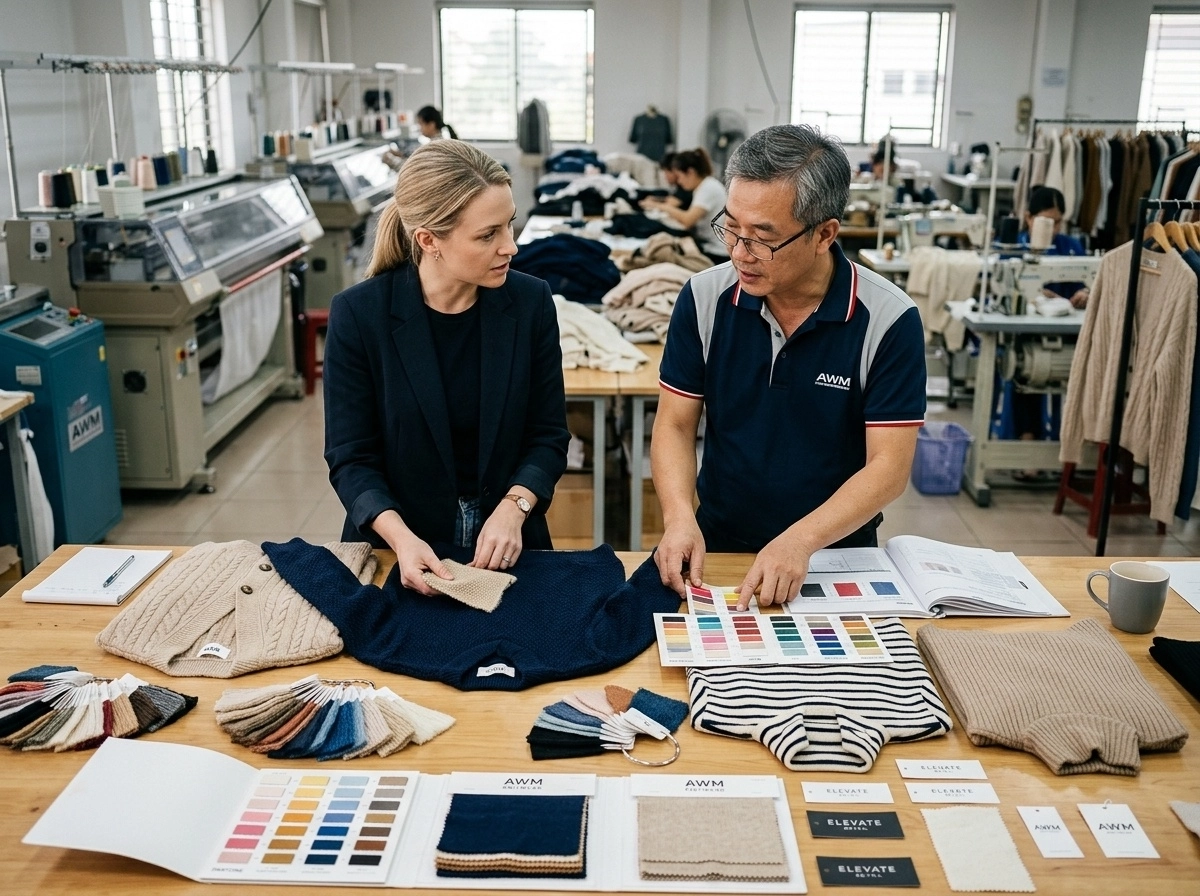
For brands that want margin, control, and a recognizable product identity, private label cardigans are the more strategic choice than buying generic wholesale stock. From a factory perspective, the difference is not marketing language; it is who owns the pattern, the fit block, the yarn specification, and the right to repeat. This article is written for procurement managers, brand owners, private label teams, and product developers who are evaluating a custom cardigan manufacturer and need to make decisions about MOQ, lead time, sampling, quality control, and shipping risk.
We will not romanticize the process. Private label knitwear takes longer, costs more upfront, and requires clearer technical input than picking blanks from a catalog. In return, you get a product that is yours, a fit your customers can repeat-buy, and a supply chain you can plan around. Below, we cover seven decision areas that come up in almost every cardigan development project we run, and where buyers most often lose time or money when they skip the details.
Why choose private label cardigans over wholesale options?
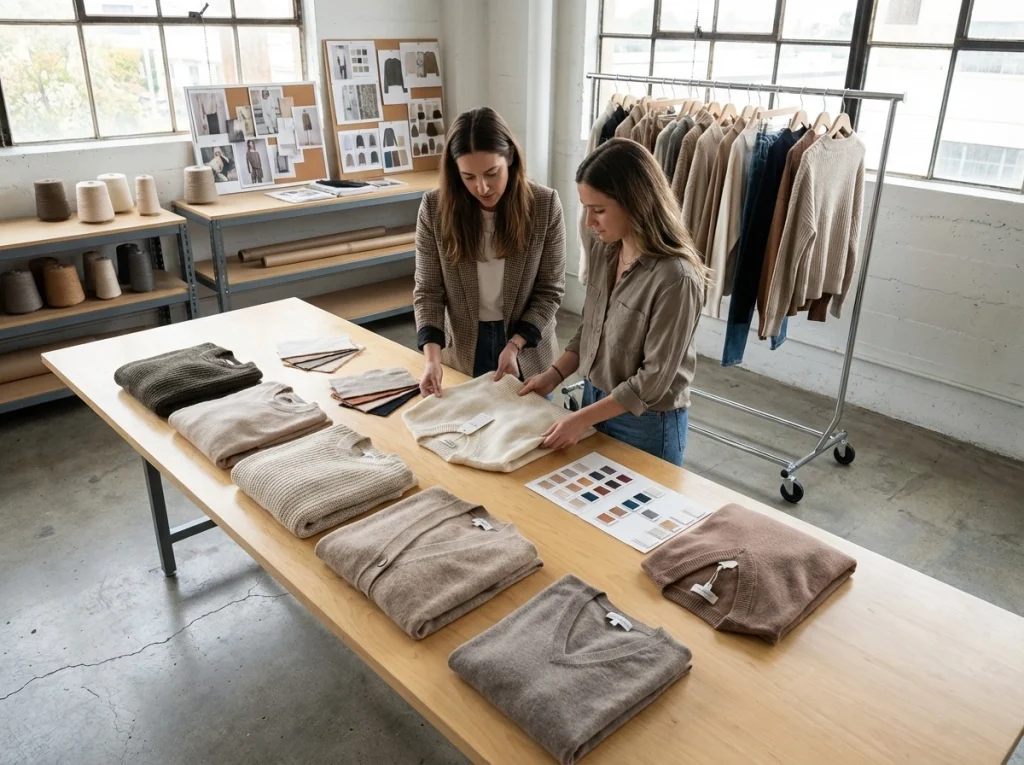
Private label cardigans make sense when your brand needs differentiation, repeatable fit, and margin control. Wholesale or white label stock is faster and cheaper to start, but the product is shared with every other buyer pulling from the same catalog. From a factory perspective, the trade-off is clear: white label optimizes for speed and low risk, while private label optimizes for ownership and long-term brand equity.
Where the two models actually differ
The confusion usually starts because both models let you put your own label inside the garment. The difference is upstream. With white label, the manufacturer owns the design, the fit, and the construction. You add a hangtag and a sew-in label. With private label, you (or the factory working to your tech pack) own the pattern, the yarn spec, the trims, and the right to reorder that exact SKU. Maker’s Row on private label manufacturing describes the same split from a brand-side perspective.
Below is a comparison we walk new buyers through during the first call.
| Decision Factor | Private Label Cardigans | White Label / Wholesale |
|---|---|---|
| Design ownership | Brand owns pattern, fit, yarn spec | Factory or distributor owns design |
| Customization | Yarn, gauge, color, trims, labels, packaging | Branding only (label, hangtag, polybag) |
| Typical MOQ | 50–300 pcs/style/color (stock yarn) up to 500+ for custom | Often single-piece pickup or low pack minimums |
| Lead time | 6–12 weeks development plus 3–5 weeks bulk | Days to a few weeks, ex-stock |
| Margin potential | Higher, exclusive product | Lower, shared with other resellers |
| Reorder consistency | Same pattern, same yarn lot logic | Subject to catalog changes |
| Best fit for | Brands building a long-term cardigan line | Quick market tests, gift channels, fast fill-ins |
The practical reading: if you plan to run the same cardigan across two or more seasons, private label is almost always cheaper per unit over a 12-month horizon, even though the first PO looks more expensive. White label is a tool for testing demand, not for building a brand.
How to evaluate manufacturer sampling and technical skill?
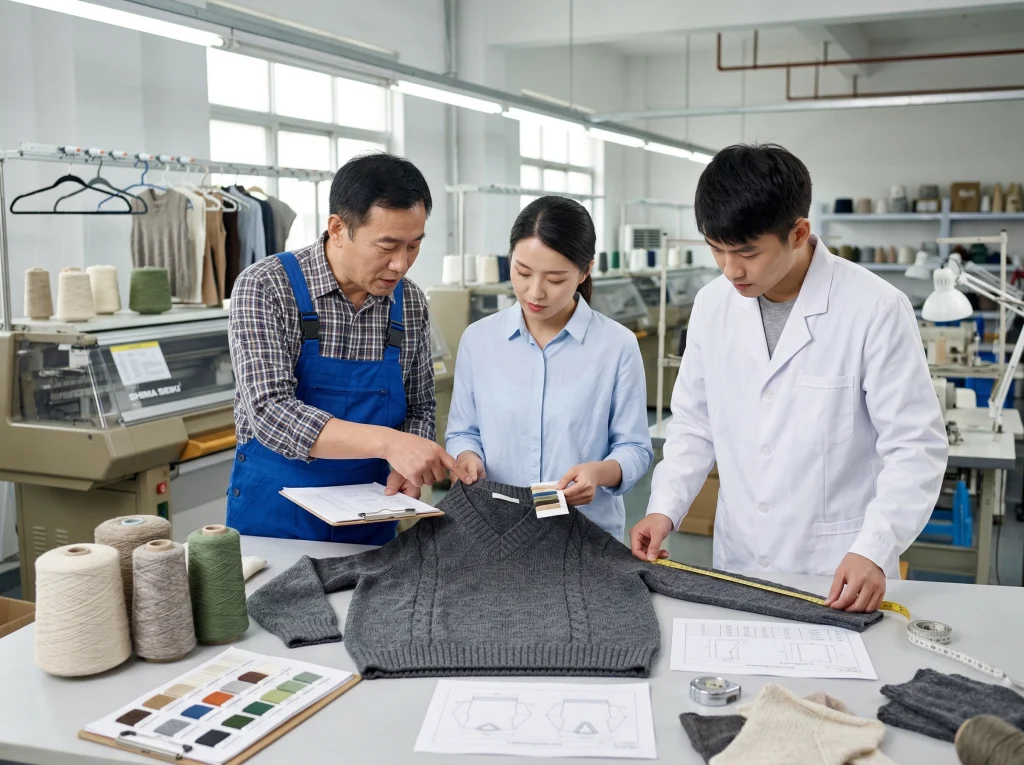
The fastest way to judge a cardigan manufacturer is to read the first proto sample carefully, especially the buttonhole and the ribbing. These two areas show whether the factory has real knitwear engineering capability or is just running generic programs. A clean photo and a tidy hangtag tell you nothing about whether the cardigan will survive 20 wears.
Buttonhole reinforcement
Buttonholes on knitted cardigans tend to stretch under the weight of buttons and repeated opening. A capable factory will reinforce them with bar tacks, interfacing on the placket, or a grosgrain ribbon stay on the inside of the button band. On heavier yarns, you should see a wider, longer buttonhole with thicker thread; on fine-gauge merino, smaller and tighter. If the proto comes back with raw, unreinforced buttonholes that already look loose, that is a structural signal, not a finishing detail.
Ribbing tension and recovery
Ribbing on hems, cuffs, and button bands is where uneven tension shows up first. We typically knit ribbing on finer needles than the body, and on dense patterns we may reduce stitch count by roughly 20–30% to control flare. After washing, the ribbing should recover to its original width, not stay stretched. Press the cuff, release it, and watch. A factory that cannot hold ribbing tension across pieces will produce cardigans that look uneven on the rack within a few wears.
What to ask for in the first sample round
- A size-set proto in your target base size, not just a development sample.
- A yarn swatch card showing all proposed colors in the actual gauge.
- A construction photo of the inside placket, shoulder seam, and neck rib.
- A wash test result on a duplicate sample after 3 home washes.
If a factory resists any of these, the issue is usually capability, not policy.
What are the MOQ and lead time realities in 2026?
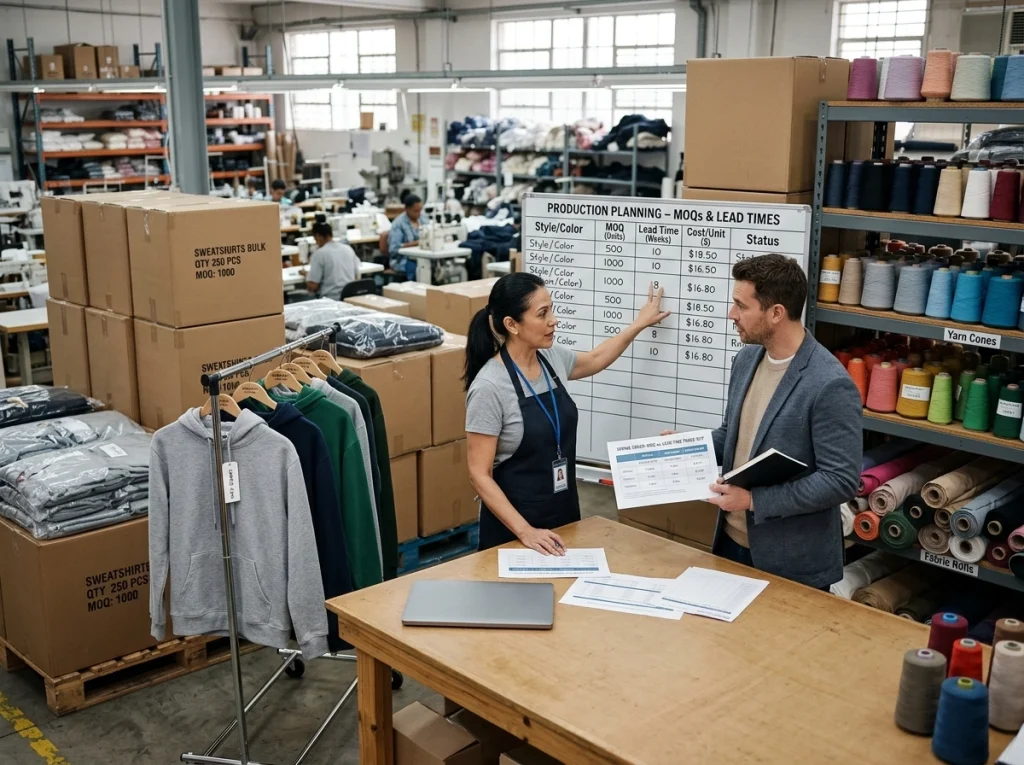
For most knitwear factories working with brand clients in 2026, realistic MOQs sit at 50–100 pieces per style per color when stock-service yarn is used, and 300–500 pieces per style per color when the yarn must be custom-dyed. Lead times sit at 3–7 days for a basic sample and roughly 25–35 days for bulk after sample approval. Anyone quoting dramatically lower numbers without conditions is either subsidizing the order or omitting steps you will pay for later.
Why MOQ varies so much
The driver is yarn. Spinning mills typically require a minimum of about 1 kg per dyed color, and dye lots have their own minimums. If your cardigan uses 500 g of yarn per piece in two colors, you can hit a 100-piece run on stock yarn. If you want a custom pantone match in a niche fiber, the mill minimum may force you up to 300–500 pieces per color. This is also why many factories publish a 50-piece floor for “stock yarn only” and a different floor for custom development. It is not a sales tactic; it is the upstream supply chain.
Lead time components you should plan for
- Tech pack review and counter-sample: 7–14 days.
- Yarn sourcing or dyeing: 7–21 days for stock yarn, 3–6 weeks for custom dye lots.
- Bulk knitting, linking, washing, finishing: 21–35 days for typical orders.
- Inspection, packing, export documents: 5–7 days.
- Sea freight to US/EU: 4–6 weeks; air freight: 5–10 days at higher cost.
From PO to landed goods, a realistic full cycle for a first private label cardigan run is 12–18 weeks. Repeat orders on the same SKU using the same yarn can compress to 8–10 weeks because development and yarn qualification are already done. Buyers who plan a season around an 8-week first cycle almost always end up paying air freight to recover.
Yarn selection for premium brand positioning and budget
Yarn choice drives price, hand feel, durability, and brand positioning more than any other decision in a cardigan project. From a factory perspective, three yarn families cover most private label work today: pure merino, cashmere blends, and cotton-merino. Each has clear use cases and trade-offs.
Merino wool
Superfine merino (18.5–19.5 micron) is the workhorse for premium positioning. It is soft enough for next-to-skin wear, has natural elasticity that helps the cardigan hold shape, and is widely available in certified options such as RWS-certified merino. Wholesale wool prices have been firm into 2026, with the Eastern Market Indicator up notably year-on-year, so merino cardigans retailing under a certain threshold are getting harder to produce honestly. For brands targeting USD 150+ retail, merino is usually the right baseline.
Cashmere blends
Pure cashmere remains a luxury tier. Most brand buyers we work with land on a blend, commonly 70% wool / 30% cashmere or a 90/10 cashmere-merino, which gives the softness consumers expect from cashmere at a more controlled cost. Pilling resistance is the main trade-off; finer cashmere fibers tend to pill more, especially in low-twist constructions. We typically recommend a slightly higher twist and a controlled gauge to balance softness with surface stability.
Cotton-merino
Cotton-merino blends, often around 50/50, work well for transitional-season cardigans and for markets where pure wool is too warm. The cotton component gives a cleaner stitch definition and lower cost per piece, while the merino adds elasticity and recovery. This is often the right choice for retailers who want a year-round cardigan SKU rather than a winter-only piece. Buyers focused on margin against a USD 80–120 retail point usually find cotton-merino the most workable yarn family.
How to ensure consistent quality control in bulk production?
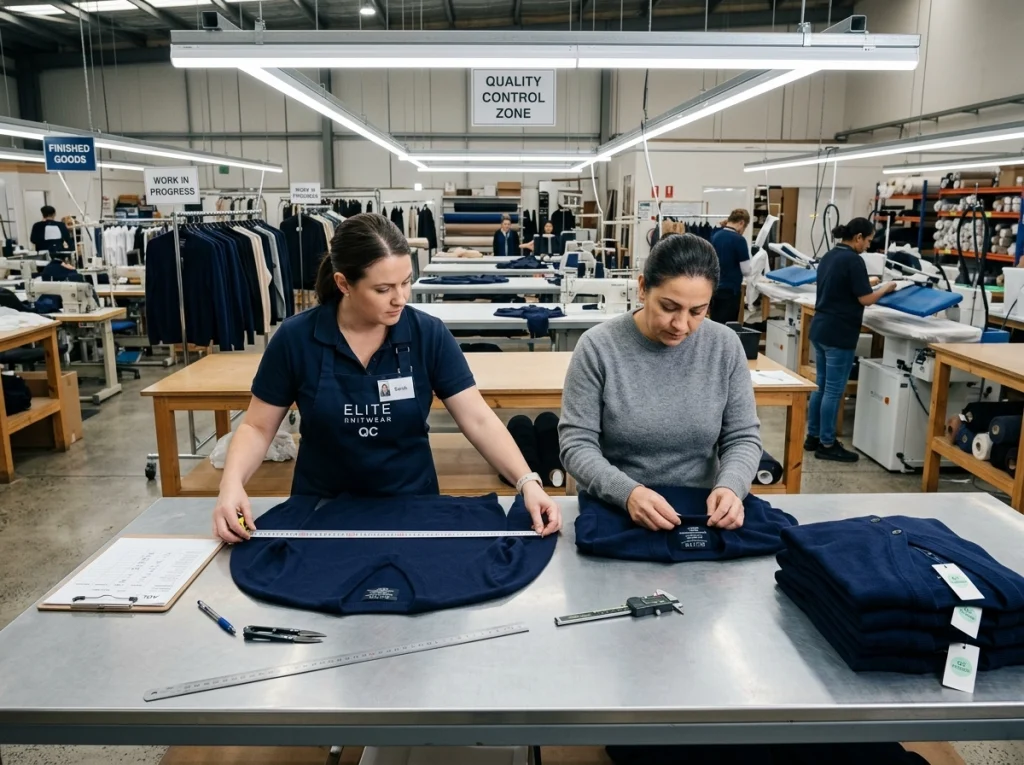
Consistent quality on a private label cardigan run depends on three control points: washing, sizing, and stitching. Most cardigan complaints in the field, such as shrinkage, twisted side seams, uneven hems, or pilling, trace back to one of these three areas. The factory should be able to show you the standard for each before bulk starts, not after.
Washing and finishing
Knitwear must be washed and dried before it is graded as finished. This is what allows the fibers to relax and the garment to settle into its true measurements. Factories that skip or shortcut this step deliver cardigans that look correct on the table but shrink 3–5% after the customer’s first home wash. We recommend a documented wash recipe (water temperature, detergent, cycle, drying method) attached to the tech pack, and a wash-test sample evaluated against the spec sheet at three points: pre-wash, post-wash, and after three home washes.
Sizing and measurement tolerance
Every cardigan size should have a measurement chart with tolerances, typically ±1 cm on chest, ±1.5 cm on body length, and ±0.5 cm on sleeve length. During bulk production, QC should pull random pieces from each size and measure against this chart. If your factory cannot produce a measurement report on request, you have no real grade-out data, and returns risk goes up.
Stitching and linking
On premium cardigans, shoulder, side, and sleeve seams should be linked stitch-by-stitch rather than overlocked. Linking creates a flatter, stronger seam that preserves the stretch of the knit. For more detail on construction approaches we apply across our knitwear manufacturing services, the same principle holds: visible cost up front, fewer returns later. AQL 2.5 is a reasonable inspection level for most retail programs; tighter levels are available but add cost and time.
Navigating the custom knit cardigan development process
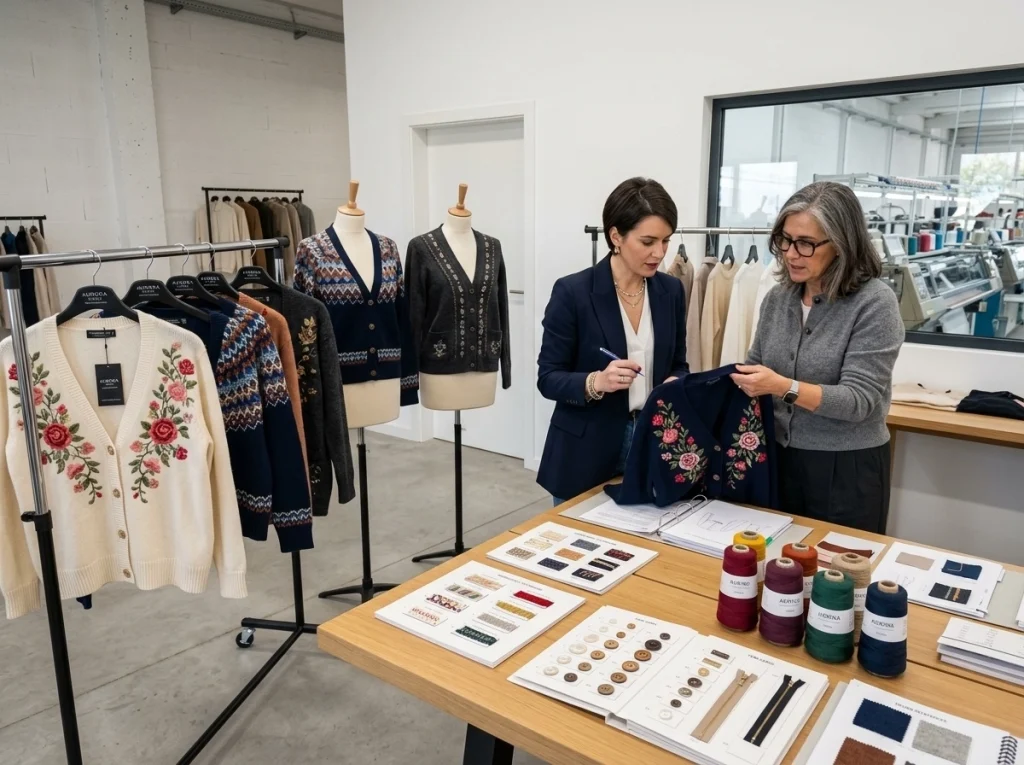
A clean custom knit cardigan development process moves through five stages: tech pack, yarn and color confirmation, proto sample, size-set sample, and bulk production. Skipping or compressing stages is the single most common reason private label projects miss their delivery window. From a factory perspective, the development phase is where the project succeeds or fails; bulk production is mostly execution.
Tech pack and brief
The tech pack should include the cardigan silhouette, gauge, yarn composition, color list, measurement chart with tolerances, trim spec (buttons, zippers, labels), packaging spec, and any compliance requirements. If you are starting from a sketch rather than a tech pack, a capable factory should be able to translate it, but expect 1–2 extra weeks. Brands that want to control the design language tightly often look at past custom knit projects to align expectations before sending the brief.
Sampling rounds
Two rounds of samples are typical: a development proto to confirm construction, and a size-set or pre-production sample (PPS) to confirm grading and bulk readiness. Each round costs sampling fees, which usually run USD 60–150 per piece depending on yarn and complexity. Trying to merge these into one round to save time tends to cost more in the end because corrections found at PPS stage may force re-knitting.
Trims, labels, and packaging
Buttons, zippers, woven labels, hangtags, and polybags all have their own lead times, often 10–20 days. Factories will quote bulk lead time assuming trims arrive on time. If your woven label vendor is slow, the cardigan production schedule slips with it. We recommend confirming all trims in parallel with the size-set sample, not after.
Managing logistics and delivery risks for retail seasons
Retail seasons are unforgiving. A cardigan that lands two weeks late for an autumn drop loses both full-price sell-through and shelf priority. The way to manage this risk is not to push the factory harder; it is to build buffer into the calendar and to maintain weekly communication during bulk. From a factory perspective, the orders that ship on time are almost always the ones with the clearest schedule and the most responsive buyer.
Buffer time by season
For autumn/winter cardigan deliveries to US or EU retail, we recommend confirming POs no later than late spring, with bulk completion targeted 6–8 weeks before in-store date. That buffer absorbs normal disruptions: yarn dye lot rejection, port congestion, customs delays, or trim shortages. For S/S cotton-merino cardigans, the same logic applies, shifted earlier. Buyers who confirm POs only 12 weeks before in-store date almost always end up either air-freighting or accepting partial delivery.
Communication rhythm
A weekly production update, with knitting progress, linking status, and finishing status, is reasonable for any order over 500 pieces. For tighter timelines, twice-weekly is appropriate. Buyers who only check in at sample stage and shipping stage are often surprised at the end. The factory’s ability to flag issues early, such as a yarn delay or a knitting machine bottleneck, depends on whether the buyer is engaged in the process.
Shipping and refill orders
Sea freight is the default for full-season orders; air freight should be a fallback, not a plan. For refill or top-up orders mid-season, factories that hold remaining yarn from your original lot can usually run a faster cycle. Confirming this at PO stage rather than mid-season is what makes refills viable. For brands looking to formalize a recurring cardigan program, our cardigan production capabilities page outlines what we typically hold in reserve for repeat clients. Resources like Printful’s guide on starting a clothing brand also discuss season planning from a brand-side angle.
Conclusion
Private label cardigans are not a shortcut. They are a longer, more demanding path than buying wholesale, and they pay back in product ownership, repeatable fit, and margin that is actually yours. The brands that succeed treat the factory as a development partner: they send clear tech packs, they review samples carefully, they plan around realistic MOQs and lead times, and they build buffer into their retail calendar. The brands that struggle treat private label as a faster version of wholesale and get surprised when the timeline does not compress.
If you are evaluating a custom cardigan manufacturer for an upcoming season, start with the sample, the yarn spec, and the production schedule, not the headline price. To discuss your next cardigan program, you can contact our custom cardigan manufacturing team for sample planning, MOQ review, and production timeline support.
FAQ
How much do cardigan samples typically cost?
Sampling fees for private label cardigans usually run USD 60–150 per piece depending on yarn and construction complexity. Cashmere blends and intricate stitch patterns sit at the higher end. Most factories credit sampling fees back partially or fully against bulk orders that proceed. Free sampling is rare for genuinely custom work because the development labor and yarn cost are real.
Can I run a small batch of 50–100 pieces for a market test?
Yes, when you use stock-service yarn. Small-batch programs at 50–100 pieces per style per color are workable in 2026 if the yarn is already on the shelf at the spinning mill. Custom-dyed yarns push the floor higher, typically 300+ pieces per color, because of mill dye-lot minimums. Expect a slight per-unit price premium on small batches due to setup time and yarn loss.
How durable are merino and cashmere blend cardigans?
Superfine merino cardigans, properly washed and finished, hold up well to regular wear and resist odor better than most fibers. Cashmere blends are softer but pill more, especially in low-twist constructions. Durability depends as much on construction as on fiber: linked seams, reinforced buttonholes, and correct ribbing tension matter more than the marketing tier of the yarn. Care instructions, hand wash or wool cycle, also affect lifespan significantly.
What is a realistic lead time for a first private label cardigan order?
From signed PO to goods landed at a US or EU warehouse, plan for 12–18 weeks on a first run, including development, bulk, and sea freight. Repeat orders on the same SKU compress to 8–10 weeks because the pattern, yarn, and trims are already qualified. Air freight can shave 3–4 weeks but materially raises landed cost.
Do I need a finished tech pack to start, or can the factory help develop one?
A capable factory can develop a tech pack from a brief, sketches, or a reference garment, but expect an extra 1–2 weeks and possibly a development fee. Buyers who arrive with a clean tech pack typically save time and reduce sampling rounds. If you are early in the brand-building stage, share what you have, including target retail price and core fit references, and let the factory help structure the spec.