 CN Sweaters
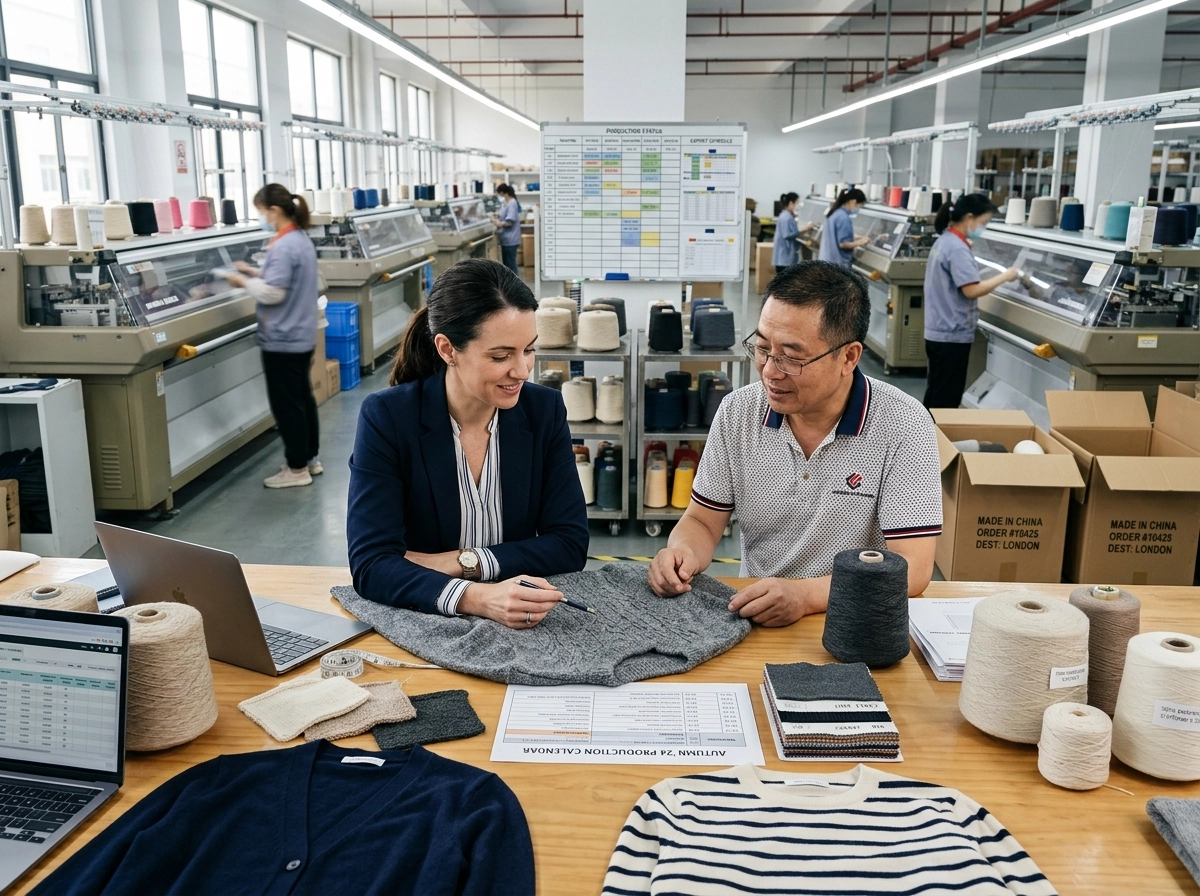
Western brands usually source wholesale knitwear from Dongguan when they need more than a low initial quote. They are often looking for a sourcing base that can support product development, sampling, bulk execution, repeat orders, and export coordination with fewer avoidable delays. Dongguan’s position inside the Pearl River Delta also matters because the region is known for clustered supply chains, strong manufacturing depth, and a transport network built around export efficiency. HKTDC Research China Briefing
For buyers comparing wholesale knitwear suppliers, that difference is important. Knitwear is rarely difficult because of one big problem. It becomes difficult when many small decisions go wrong at the same time: yarn selection, stitch feasibility, sample revisions, measurements, surface quality, labeling, packing, and shipment timing. From a factory perspective, Dongguan tends to make sense when a brand wants tighter coordination across those moving parts, especially for sweaters, cardigans, zip knits, and ongoing private-label programs. China Briefing
Dongguan Makes Sense When Buyers Need More Than a Low Price
The real advantage is coordination, not just cost
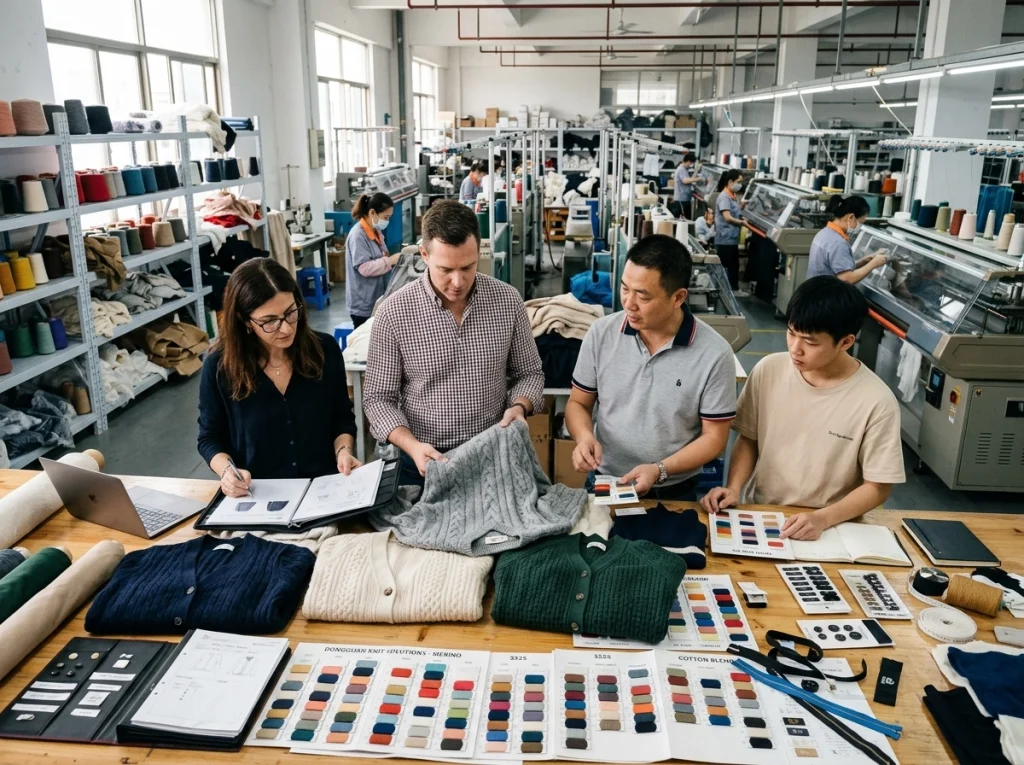
A lot of buyers start with price, but experienced sourcing teams usually stay focused on execution. A supplier can look competitive on paper and still become expensive later if sampling drags on, the approved hand-feel changes in bulk, or a replenishment order turns into a new development cycle. That is one reason Western brands often choose Dongguan for wholesale knitwear: the region is built around manufacturing coordination, not only unit cost. Dongguan has long been positioned at the center of the Guangzhou-Hong Kong corridor and developed into one of China’s major manufacturing hubs, which helps explain why so many export-oriented programs are managed there. China Briefing
In knitwear, coordination affects commercial results. If yarn sourcing, development feedback, knitting, finishing, and export handover are handled in a fragmented way, the buyer usually feels it in missed launch windows, unstable quality, or margin pressure. If those steps are better aligned, the buyer gains predictability. That does not mean every Dongguan factory is automatically the right factory. It means the location gives buyers access to an ecosystem where decisions can often move faster and with less friction. HKTDC Research
Why wholesale knitwear buyers care about supply-chain density
The Pearl River Delta is valuable because it is not just a map location. It is a supply-chain environment where upstream and downstream industries are close enough to shorten feedback loops. HKTDC describes the region as a place where parts, components, and accessories can be sourced conveniently, allowing orders to be completed more quickly while specialization improves efficiency and reduces cost. That logic applies well to knitwear, where development often depends on practical coordination between yarn, gauge, trims, finishing, inspection, and logistics. HKTDC Research
Dongguan also sits inside a broader export system rather than working in isolation. The PRD has a complete water, land, and air transport network, while Dongguan’s proximity to Hong Kong, Shenzhen, and Guangzhou has helped it attract manufacturing investment for decades. For buyers, that does not just mean “better geography.” It usually means more options when production schedules tighten, when shipment modes need to change, or when a repeat order has to move faster than the original launch. HKTDC Research China Briefing
| Buyer Priority | Why Dongguan Can Help | What Still Needs Verification |
|---|---|---|
| Faster sampling | Development and production can be coordinated more closely | Actual sample queue, yarn readiness, revision rounds |
| MOQ control | Factories may offer more workable options depending on yarn and construction | Real MOQ by style, color, gauge, and fiber |
| Bulk consistency | Stronger workflows can reduce avoidable errors from sample to shipment | QC checkpoints, approval process, defect handling |
| Repeat orders | Existing specs and production memory can improve reorder stability | Yarn continuity, capacity booking, lead-time discipline |
| Export flexibility | PRD transport links and Dongguan logistics access support delivery planning | Incoterms, forwarder setup, seasonal congestion |
| Cost control | Better coordination can reduce hidden costs, not only factory price | Whether the supplier really fits the program type |
Who benefits most from sourcing here
Dongguan is usually a better fit for buyers who are building a program, not just placing a one-off order. That includes private-label brands developing seasonal knitwear, wholesalers that need stable commercial styles, and product teams launching a custom sweater line that requires multiple sample decisions before bulk approval. These buyers care about whether a supplier can handle product detail, not only whether the first quote is attractive.
It is also useful for brands that expect reorders. If you are selling dependable core items such as sweaters, cardigans, or hoodies and zip knitwear, the value of a supplier often shows up in the second and third order, when timing, shade continuity, workmanship stability, and packing accuracy matter more than sales language.
What Western Brands Usually Need From Wholesale Knitwear Suppliers
Sampling speed matters before bulk price matters
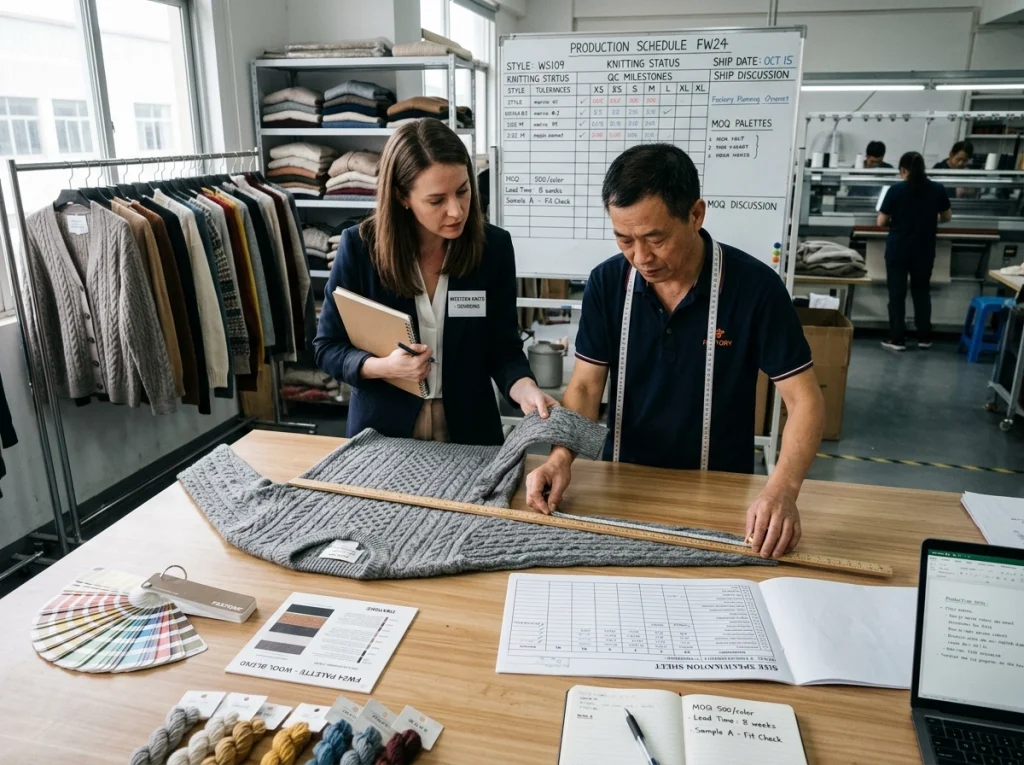
Most buyers do not really know whether a knitwear supplier fits their project until sampling starts. A good sample is not just a preview of appearance. It is where the buyer learns whether the yarn hand-feel makes sense for the target market, whether the gauge supports the silhouette, whether the stitch structure is stable enough for bulk, and whether comments can be translated into clear revisions. That is why sampling speed often matters before final bulk pricing. Slow or unclear development wastes more money than many teams expect.
From a factory perspective, sampling is where practical sourcing problems become visible early enough to fix. A supplier that can move efficiently from tech pack or reference sample into yarn matching, stitch planning, and fit confirmation gives the buyer a better decision base for bulk. If you are evaluating an OEM/ODM knitwear service rather than a simple trading quote, that development stage is where the real value usually appears.
MOQ and lead time affect launch risk
MOQ and lead time are not separate questions. They are part of the same risk calculation. A buyer may accept a slightly higher MOQ if the supplier can deliver more stable quality, better packaging accuracy, and a smoother repeat-order path. On the other hand, a low MOQ is less attractive if the yarn cannot be replenished cleanly or if a second order will need to restart development from zero.
This is where many sourcing discussions become too simplistic. In knitwear, real MOQ depends on yarn type, color count, gauge, and construction complexity. Real lead time depends on sample approval speed, raw material readiness, seasonality, and how early bulk planning is locked. That is why buyers should be cautious about promises that sound universally flexible. A workable program is usually based on aligned expectations, not on the most aggressive claim.
Quality control matters most when brands want repeat orders
Quality control in knitwear is not only about final inspection. It starts much earlier. A sound knitwear process begins with yarn quality decisions and continues through distribution, panel checking, appearance inspection, size ratio checks, trimming, full garment inspection, and packing and shipping. That sequence reflects something experienced buyers already know: most bulk problems are easier to prevent than to fix.
For Western brands, the most important QC question is usually not “Do you inspect?” It is “What exactly do you control before the goods are already finished?” In knitwear, that often includes measurements, seam integrity, linking quality, surface consistency, labeling accuracy, and packing details. If the buyer plans to reorder, those controls become even more important because the goal is not just a passable first shipment. The goal is consistency across multiple POs and seasons.
Why Dongguan Works Well for Knitwear Development and Bulk Production
Factory-side communication is easier when development is close to production
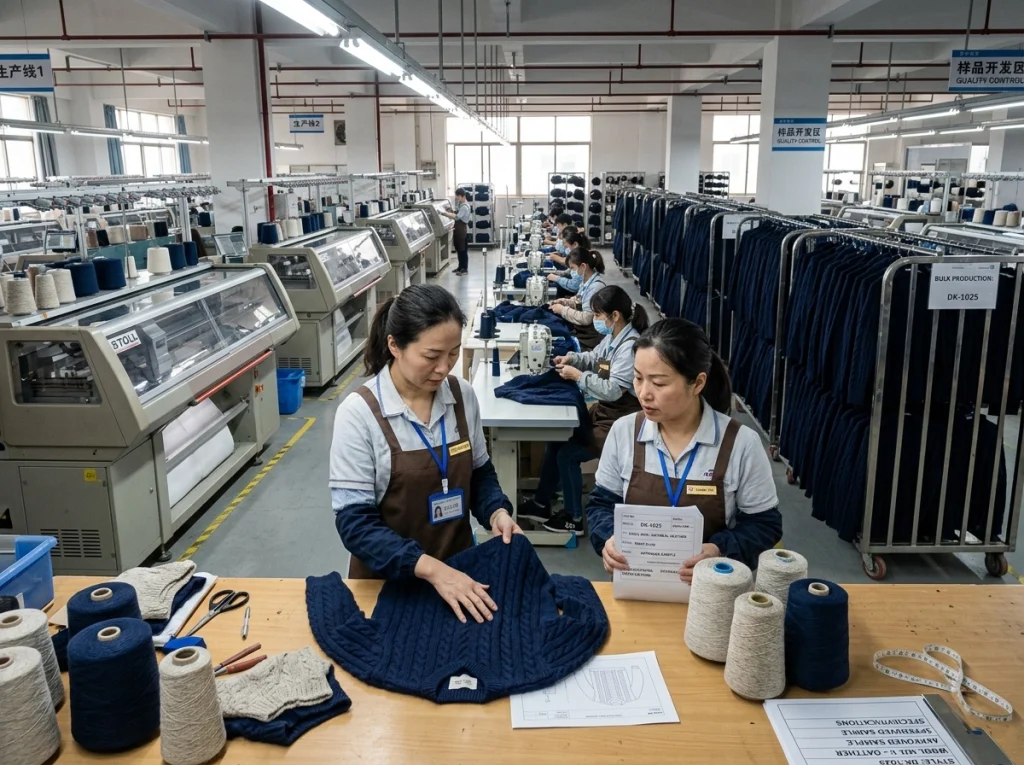
A common reason buyers source wholesale knitwear from Dongguan is that development can stay closer to the people who will actually execute bulk. That matters in knitwear because small changes in yarn, stitch, gauge, or finishing can affect fit, hand-feel, weight, and cost at the same time. If product development is disconnected from production reality, sample comments may be misunderstood or solved in the wrong way.
A more practical setup is when the same manufacturing side can evaluate yarn options, gauge feasibility, construction choices, and finishing risks before bulk starts. That is especially useful for programs involving custom knit projects or styles with multiple technical decisions, where a buyer needs commercial advice, not just order taking.
A mature knitwear workflow reduces avoidable mistakes
Knitwear production is one of those categories where workflow discipline directly affects commercial reliability. A typical production process shows how many checkpoints sit between yarn purchase and final shipment: supplier selection, yarn handling, panel weaving, panel inspection, trimming, full garment checking, and packaging. None of those steps are glamorous, but they are exactly where a factory either protects the buyer’s margin or damages it.
Dongguan’s advantage is not that it removes all risk. It is that the surrounding manufacturing ecosystem makes disciplined execution easier to support. China Briefing describes Dongguan as a city with a comprehensive manufacturing system covering tens of thousands of product types across multiple industries, while Humen alone developed into a major apparel cluster with a large labor base and export orientation. For knitwear buyers, that kind of environment tends to support better technical problem-solving and faster handoff between development and production. China Briefing
Repeat orders become easier when specs are already stabilized
The strongest case for sourcing in Dongguan often appears after the launch, not before it. Once a sweater, cardigan, or zip knit has an approved yarn direction, measurement set, construction method, and finishing standard, repeat business becomes more manageable. That is when buyers start to value stable workmanship, clearer communication, and better production memory.
For wholesalers and brands with carryover styles, this matters a lot. Repeat orders are where hidden sourcing costs show up. If the supplier cannot maintain shade continuity, stitch balance, labeling accuracy, or packaging standards, reorder margins shrink quickly. If the supplier can maintain them, the buyer gains confidence and can plan more aggressively. That is one reason long-term buyers often care as much about reorder discipline as they do about the first sample.
The Trade-Offs Buyers Should Understand Before Choosing Dongguan
Dongguan is not automatically the best option for every project
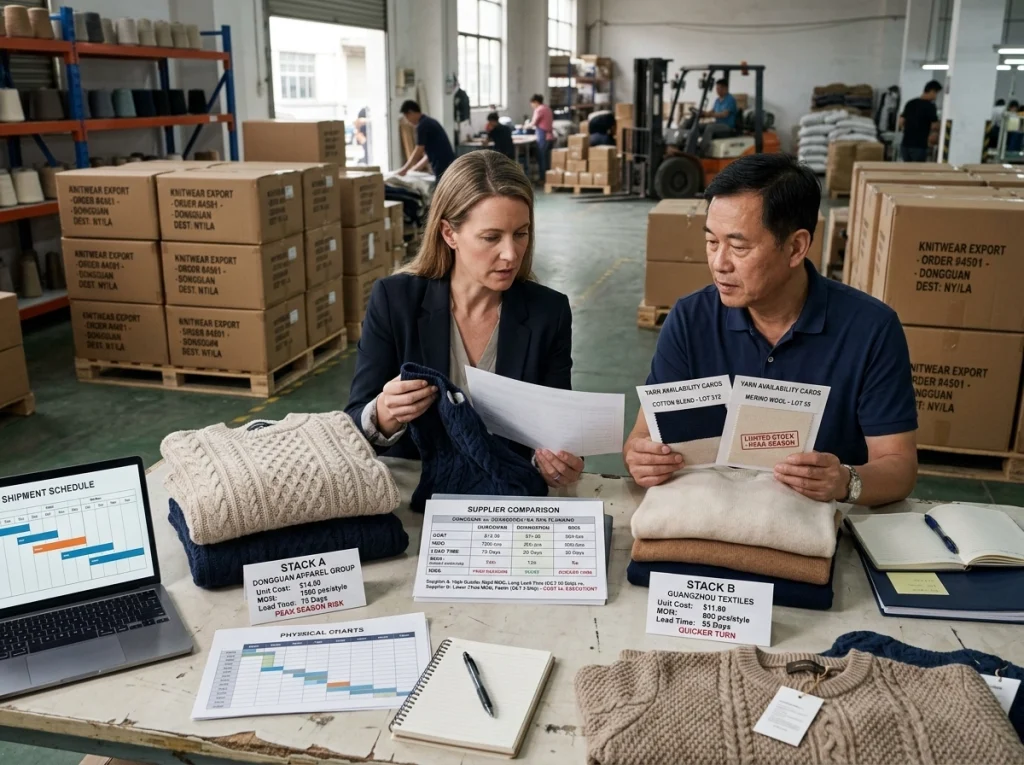
A balanced sourcing decision should say this clearly: Dongguan is not the answer to every project. If the order is a very simple commodity style with minimal development needs and heavy price pressure, another setup may be good enough. If the buyer only wants the absolute lowest entry cost and can accept more execution risk, the location itself will not solve that trade-off.
The same applies to ultra-small test orders. Some factories can support small pilot runs, but low volume does not automatically mean low complexity. In knitwear, a highly customized small order can still require real development time, yarn planning, and technical approval. Buyers should judge fit by program type, not by generic assumptions about country or city.
Peak season, yarn booking, and approval delays still create risk
A second trade-off is timing. Dongguan may offer strong manufacturing coordination, but it still operates within real seasonal pressure. When raw materials tighten, when peak season fills sample and bulk lines, or when approvals are delayed, lead time risk rises like it would anywhere else. That is why good sourcing results usually depend on how early the buyer confirms yarn, comments, and shipment windows, not only on where the factory is located.
This is also why experienced teams separate “possible” from “safe.” A factory may be able to accept a late program, but that does not mean the margin for error is comfortable. If your launch depends on narrow calendars, it is better to ask how the supplier books yarn, manages PPS or PP approvals, and protects repeat-order capacity than to rely on broad turnaround claims.
Logistics advantages help, but they do not replace planning
Logistics are a real advantage in the Dongguan context, but they should be described correctly. The PRD’s transport network gives exporters multiple options across water, land, and air. In addition, the Hong Kong International Airport logistics project in Dongguan shows how the region is actively reducing export friction. The Dongguan park allows customs clearance and security screening before cargo reaches Hong Kong airport, and the sea-air mode has been described as saving hours compared with standard road-based procedures. Cargo prepared in the evening can potentially catch next-morning flights, which is a meaningful advantage for time-sensitive export programs. CNBayArea
Still, logistics convenience is not the same as logistics control. Buyers still need confirmed packing details, realistic shipment mode decisions, workable Incoterms, and enough buffer for bulk inspection and handover. In other words, better regional infrastructure can improve the ceiling, but disciplined planning still determines the actual result.
How to Tell If Dongguan Is the Right Fit for Your Brand
It is a strong fit if you need OEM or ODM support
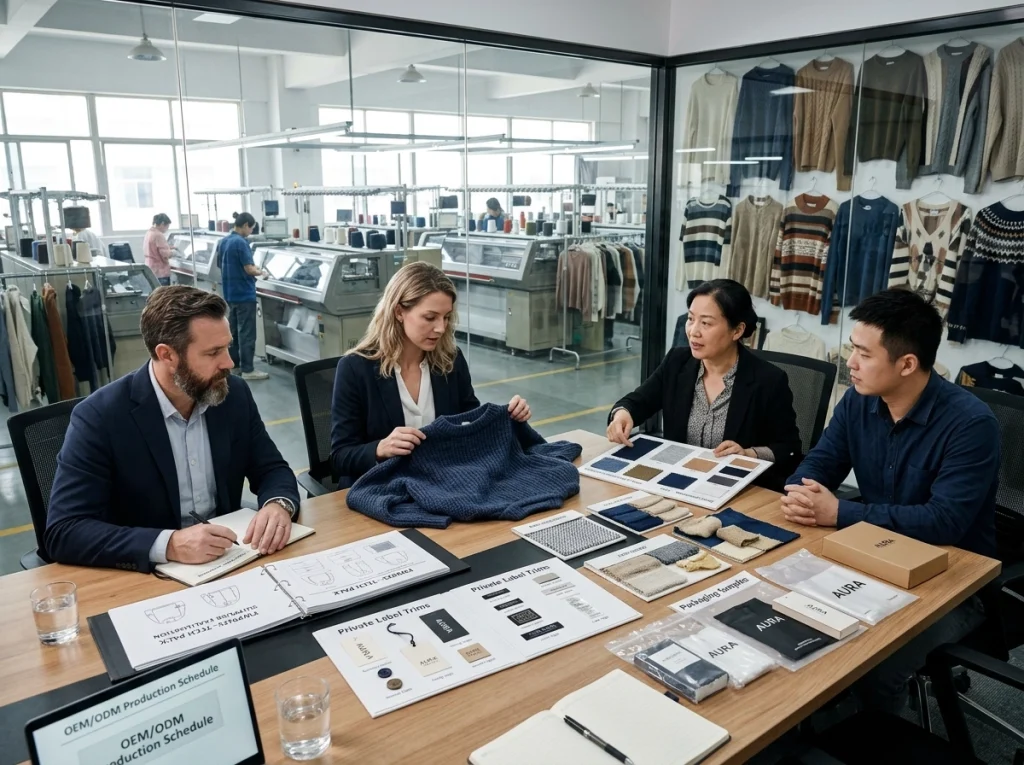
If your team needs help turning a concept into a production-ready style, Dongguan is often a practical place to look. That is especially true when the project needs real OEM or ODM coordination rather than a simple price submission. A supplier that can advise on yarn, gauge, stitch, fit, trims, and sampling workflow is usually more valuable than one that only responds after every decision has already been made by the buyer.
This matters even more for brands developing a custom sweater program or expanding into knit categories for the first time. In those cases, the buyer often benefits from factory-side judgment about what is commercially workable, what will create avoidable risk, and where a design needs adjustment before sampling becomes expensive.
It is a strong fit if you expect repeat business, not just one-off buying
Dongguan tends to work best when the buyer is building a sourcing relationship, not chasing a one-season transaction. If you expect repeat orders, replenishment, or line extensions, the value of a capable supplier compounds over time. Product knowledge stays in place, approved standards are easier to maintain, and the buyer spends less time re-explaining the same commercial requirements.
That is one reason buyers in this category often look beyond one core item. They may start with sweaters and later expand into cardigans, hoodies and zip knitwear, or related custom knit projects. When that growth happens inside one coordinated manufacturing relationship, execution usually becomes simpler.
Questions to ask wholesale knitwear suppliers before placing an order
The best way to judge fit is to ask operational questions, not generic ones. Ask what the real MOQ is by yarn, color, and gauge. Ask how sample revisions are managed and how many rounds are realistic. Ask which QC points are checked before final inspection and how bulk consistency is protected across sizes and colors. Ask how the supplier handles packaging details, labeling, and shipment handover.
These questions matter because they reveal whether the supplier understands the whole order, not only the factory price. The right wholesale knitwear suppliers should be able to explain the trade-offs clearly. If the answers stay vague, the project will probably become vague as well.
Conclusion
Western brands source wholesale knitwear from Dongguan when they want a sourcing process that is easier to manage, not just a cheaper starting point. The real value usually comes from tighter coordination between development and production, stronger control over knitwear-specific quality risks, better support for repeat orders, and practical export advantages inside the Pearl River Delta. HKTDC Research CNBayArea
That said, Dongguan is not automatically the best fit for every buyer. It makes the most sense when your brand needs development support, stable bulk execution, and a supplier relationship that can grow with future orders. If that sounds like your situation, it is worth discussing your next project with a knitwear manufacturer that can review your tech pack, target price, timeline, and product goals in practical terms.
FAQ
Is Dongguan a good place to source wholesale knitwear?
Yes, for many brands it is a practical sourcing base when they need more than a low quote. Dongguan sits inside a manufacturing and logistics environment that supports development, production coordination, and export handling more efficiently than a fragmented supply setup. The fit is strongest for buyers who care about sampling quality, repeat orders, and long-term execution, not just short-term price. China Briefing HKTDC Research
What MOQ should buyers expect from wholesale knitwear suppliers?
There is no single MOQ that applies to every knitwear order. Real MOQ depends on yarn type, gauge, color count, and how customized the style is. Buyers should ask for MOQ by style and by color, not just a headline number. That is the only way to understand whether the order is commercially workable and whether the quoted structure can still support repeat business later.
How long does custom sweater sampling usually take?
It depends on the style and revision level, but buyers should focus less on a generic promise and more on the development process behind it. A custom sweater sample moves faster when the tech pack is clear, yarn direction is realistic, and comments are consolidated. If the style is heavily customized or the approvals are slow, sampling time naturally extends because knitwear development involves technical decisions that affect both appearance and production feasibility.
Why do repeat orders matter when choosing a knitwear factory?
Repeat orders are where a supplier’s real value becomes visible. The first bulk order may look acceptable, but reorder performance shows whether the factory can maintain measurements, surface quality, color continuity, trims, labeling, and packaging standards without restarting the whole learning process. For wholesalers and brand owners, a factory that handles repeat orders well usually protects margins better over time than one that only performs well during sales discussions.
What should buyers check before placing a bulk knitwear order?
Buyers should confirm five things before bulk starts: approved sample standard, real MOQ and lead time, yarn and color readiness, QC checkpoints, and packing/shipment details. In knitwear, many shipment problems begin long before final inspection, so the buyer should make sure the supplier can explain how quality is controlled from yarn selection through garment checking and packing.
External References
- China Briefing — Dongguan, the World’s Factory in Transition (Part I) — https://www.china-briefing.com/news/dongguan-the-worlds-factory-in-transition-part-i/
- HKTDC Research — Pearl River Delta Economic Profile — https://research.hktdc.com/en/data-and-profiles/mcpc/provinces/guangdong/pearl-river-delta
- CNBayArea / China Daily — HK airport: building a twin cargo base in GBA — https://www.cnbayarea.org.cn/english/News/content/post_1070105.html