 CN Sweaters
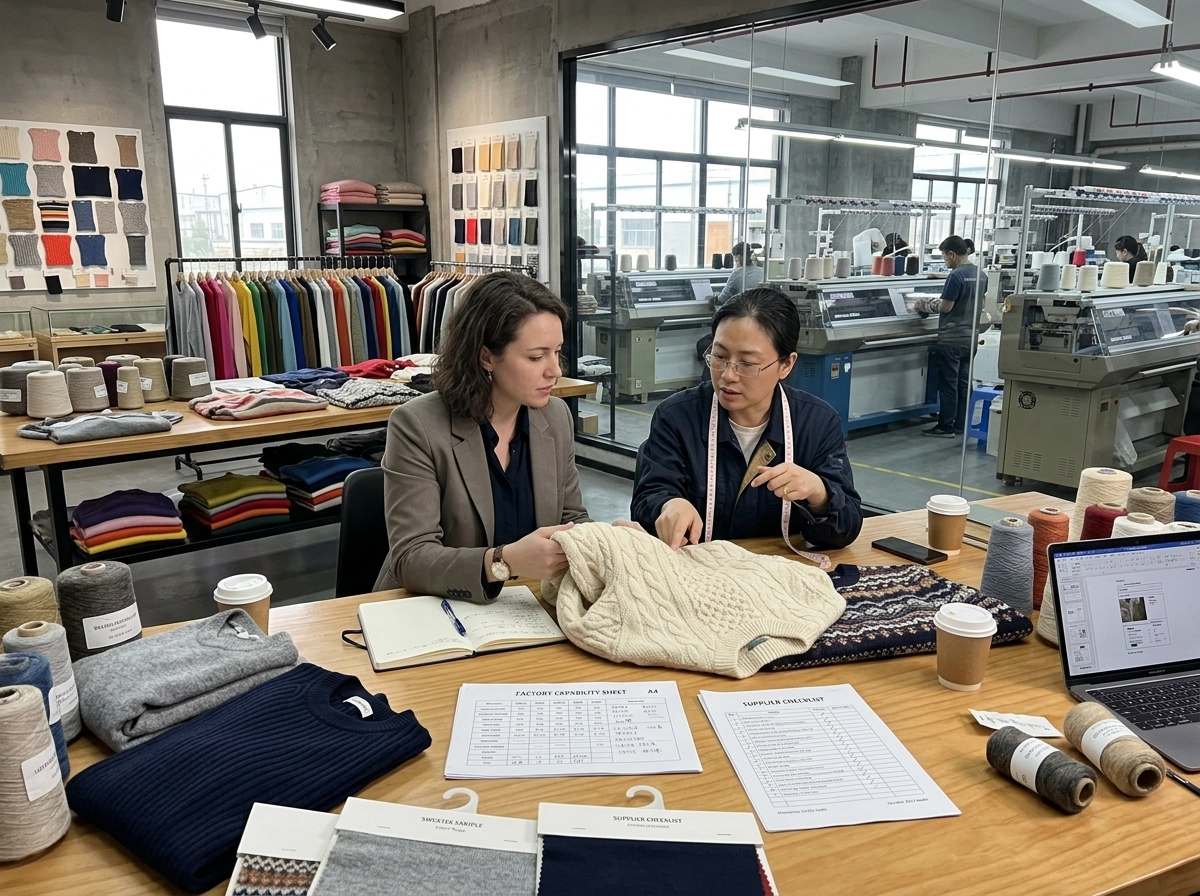
Finding the right sweater factory in China is one of the highest-stakes sourcing decisions a brand can make. Get it right, and you have a partner who can translate your designs into consistent, saleable product season after season. Get it wrong, and you’re managing shrinkage complaints, delayed shipments, and reorders that look nothing like your approved sample.
Most evaluation mistakes don’t happen during final inspection. They happen much earlier—when a brand selects a factory based on price alone, or skips the hard questions during sampling. This guide gives procurement managers, brand owners, and product developers a practical framework for evaluating a China sweater factory before committing: covering machine capability, sampling reliability, MOQ logic, QC infrastructure, and the communication patterns that separate long-term partners from one-order suppliers.
Why the Evaluation Stage Determines Everything
Before the first bulk piece is knitted, the quality of your partnership is already being set. Many brands rush this stage because they’re eager to move fast. But in knitwear—a category built on yarn engineering, machine gauge, and skilled hand-finishing—a mismatch between your product requirements and a factory’s actual capability can’t be corrected after the fact.
The Real Cost of a Wrong Supplier
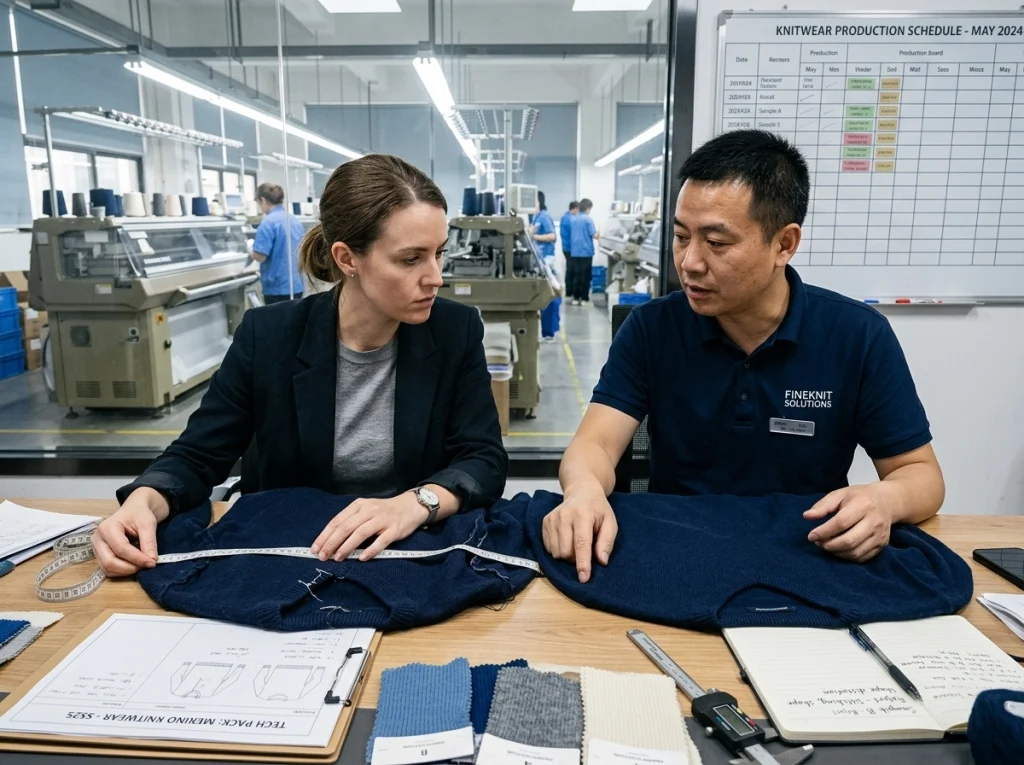
A factory that can’t hold dimensional stability will deliver sweaters that shrink out of tolerance after one wash. A factory without in-house washing and blocking equipment will struggle to control final measurements consistently. A factory that lacks the right gauge machines for your yarn and stitch structure will either push you toward a design compromise or deliver inconsistent results across colorways and sizes.
The downstream cost isn’t just one failed order. It’s customer returns, emergency re-sampling, missed launch windows, and the time spent finding a replacement supplier while your season moves forward without product on the shelf.
What “Capable” Actually Means in Knitwear
In woven apparel, factory capability is relatively straightforward to assess: review the sewing lines, the cutting room, the trim management. In knitwear, the picture is more layered. Capability depends on gauge range (which determines which product types a factory can produce), linking skill (the most labor-intensive and defect-prone assembly step), washing and finishing control (which governs final dimensions and hand-feel), and QC systems that run at the panel level—not just at the end of the line.
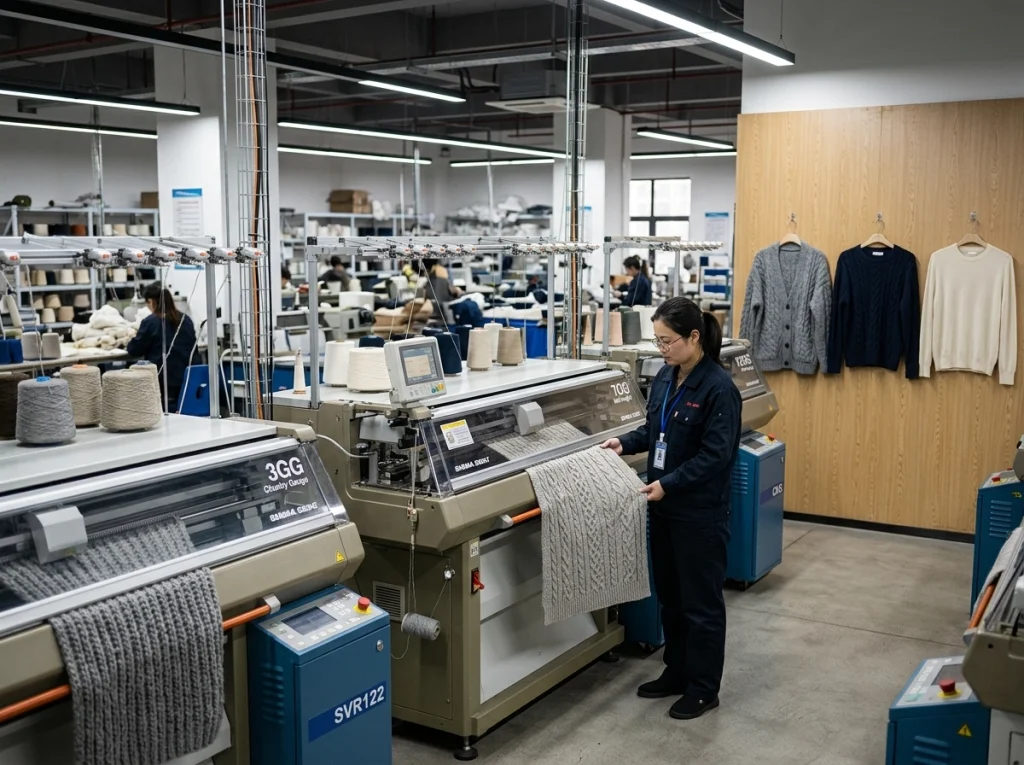
A factory running mostly 7G and 12G machines is not the right partner for a chunky 3G cable sweater, regardless of how competitive their pricing looks. Matching capability to your product category is the first filter, and it’s non-negotiable.
Machine Capability and Gauge Range
This is where many first-time buyers make their earliest mistake: they don’t ask. Gauge refers to the number of needles per inch on a flat knitting machine, and it directly determines which yarn counts, fabric densities, and stitch structures a factory can produce reliably. A factory with the wrong gauge range cannot make your product to spec—full stop.
Matching Gauge to Your Product Category
The table below provides a working reference. If your product category falls outside a factory’s machine range, the sample may look acceptable, but bulk will drift in tension, weight, or stitch definition.
| Gauge | Product Type | Typical Yarn |
|---|---|---|
| 1.5G – 3G | Chunky hand-knit look, oversized cable sweaters | Roving, bulky wool, thick acrylic |
| 5G – 7G | Mid-weight sweaters, textured knits | Wool blends, acrylic, cotton blends |
| 9G – 12G | Standard-weight cardigans, structured knits | Merino, lambswool, acrylic/nylon |
| 14G – 16G | Fine-gauge lightweight sweaters, knit dresses | Fine merino, cotton, viscose blends |
When reviewing a factory’s capability, ask specifically: which gauges do you run in-house, how many machines at each gauge level, and what machine brands are in use (Shima Seiki, STOLL, Cixing)? Machine brand matters less than maintenance discipline, but it does signal production tier and programming sophistication.
What to Ask About Equipment and Maintenance
Computerized flat knitting machines require regular calibration to maintain consistent tension across an entire bulk run. A factory that can’t describe their needle replacement schedule or explain how they manage tension drift across machines is operating on intuition rather than documented process. That gap shows up as size inconsistency across colors or SKUs—a problem that’s painful to identify and difficult to resolve after goods have shipped.
From a factory perspective, the question we get asked less often than we should is: how do you verify tension consistency between machine batches within the same PO? The answer tells you more about a factory’s operational discipline than any certification document.
How the Sampling Process Reveals Factory Quality
Sampling is the single most informative stage of your evaluation. It tells you not just whether the factory can produce your product, but how they handle ambiguity, communicate problems, and align their bulk to their sample. Treat every sample exchange as a test of the relationship, not just the garment.
Reading a Factory’s Sampling Timeline Honestly
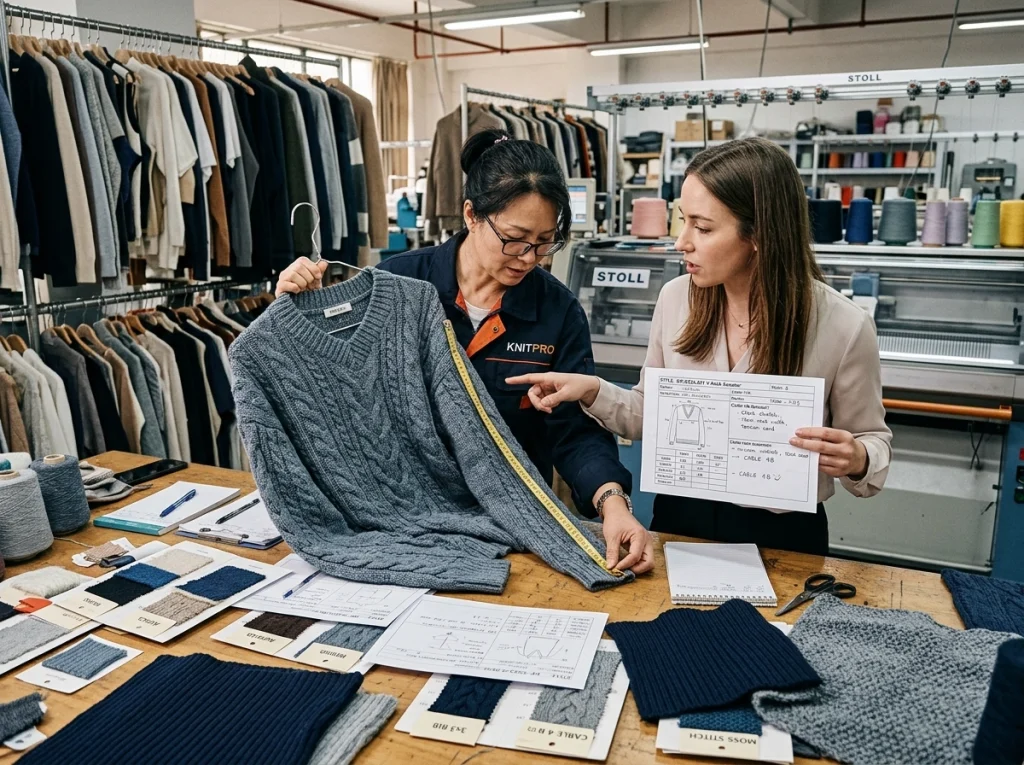
A well-organized knitwear factory should be able to turn around a proto sample in 3–5 working days for a standard style using stock yarn, with the sample reaching you within a week of completion. For styles requiring custom yarn dyeing or complex stitch structures, expect the development timeline to extend by 2–3 weeks—sometimes longer, depending on dye lot scheduling and yarn mill availability.
When a factory quotes a sampling lead time, push for specifics: is the yarn already in stock, or does it need to be sourced? Is the stitch structure something they’ve run before, or is it new to their programming team? Are any linking or finishing steps being subcontracted? Each of these adds time and introduces handoff risk that won’t always be visible to you.
Pre-production samples (PPS) matter as much as proto samples. A factory that moves from proto approval directly to bulk production without a confirmed PPS is cutting a process step that often surfaces later as measurement drift, color inconsistency, or finish variation across a run.
Red Flags That Appear Before Bulk, Not After
These are patterns worth noting during sampling:
- Unexplained measurement variation between rounds. If chest width changes by 3cm between PP1 and PP2 with no explanation, the factory is not controlling wash tension systematically.
- Material substitution without notification. A factory that swaps your specified yarn for a similar but cheaper alternative without informing you is not operating as a partner.
- Vague answers on shrinkage testing. Ask directly: was this sample pre-washed? What was the shrinkage delta? A factory that can’t answer hasn’t tested it.
- Sample quality that exceeds what photos suggest. If the physical sample looks worse than the product photography they send, finishing and linking are being managed for presentation, not for production consistency.
MOQ, Pricing Transparency, and Cost Logic
MOQ is often the first question brands ask and the last thing they fully understand. In knitwear, MOQ operates differently from woven garments, and treating them the same creates either unnecessary overstocking or an inability to get orders placed at all.
Why Sweater MOQ Works Differently
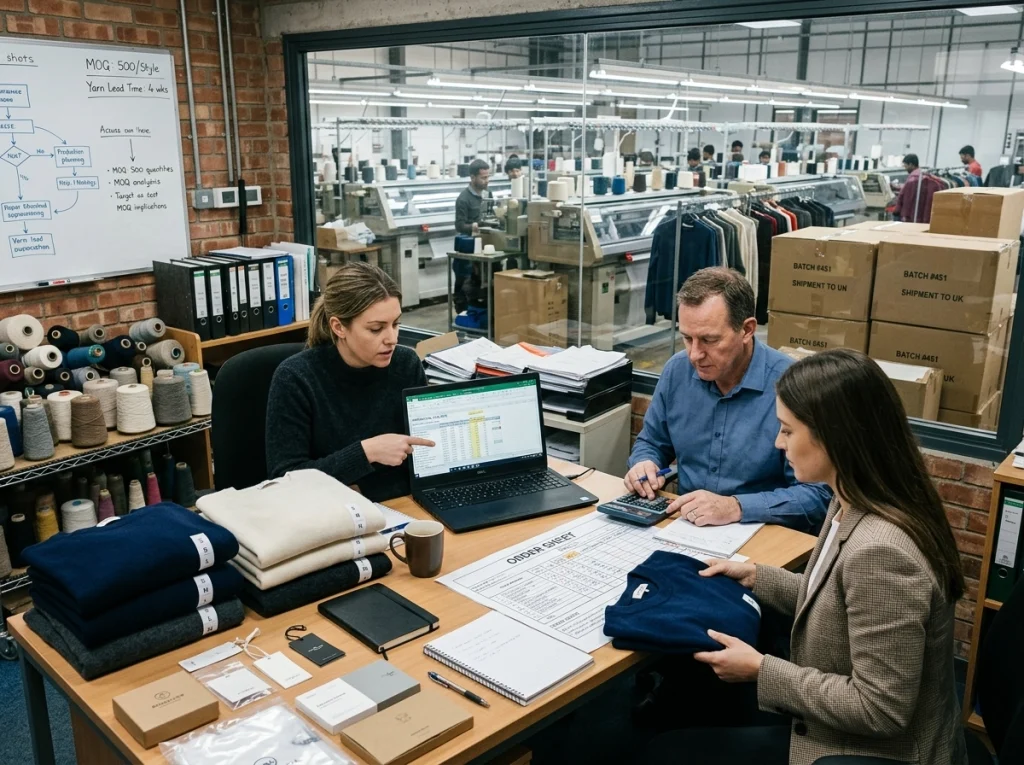
In woven production, MOQ is typically driven by fabric minimums—the minimum yardage a mill will commit to cutting and dyeing for a given fabric. In knitwear, MOQ is governed primarily by machine efficiency and yarn lot economics. A single colorway in a single style needs enough units to justify loading the machine, programming the pattern, and absorbing the yarn dye lot commitment without running at a loss.
Typical working bands for wholesale knitted sweaters run from 50 to 300 units per style per color. Factories that accept lower MOQs—in the 50–100 unit range—are often using stock-service yarn to offset the dye lot constraint. If your design requires custom yarn colors, MOQ will almost always be higher, because the dye lot itself has minimum volume requirements that set the economic floor.
For a brand running 2 colors across 5 sizes, a common structure is 10–20 units per size per color. Confirm upfront whether the factory applies minimums per color or per size—those are different calculations with different total commitments.
How to Evaluate a Quote Without Getting Misled
A unit price quote with no cost breakdown is a negotiating tactic, not a cost disclosure. Ask for the quote to be itemized by yarn cost, knitting cost, linking and finishing, and packaging. This serves two purposes: it tells you where the cost actually lives, and it gives you a basis for future cost engineering if you want to adjust materials, construction, or volume.
Two common issues to watch for: a factory quoting unusually low MOQ at a suspiciously low price will often either inflate the sample charge to compensate, or quietly adjust the bulk price at PO confirmation stage. And a factory that can’t explain the logic behind their pricing usually can’t explain why it shifts between seasons, either.
Quality Control Systems Worth Verifying
A factory that says “we have strict QC” without being able to describe what that means operationally hasn’t earned the claim. Quality control in knitwear is a multi-stage process, and each stage addresses a different failure mode. The key question isn’t whether QC exists—it’s whether it runs inline during production, or only at the end of the line.
What Inline QC Looks Like in a Real Knit Factory
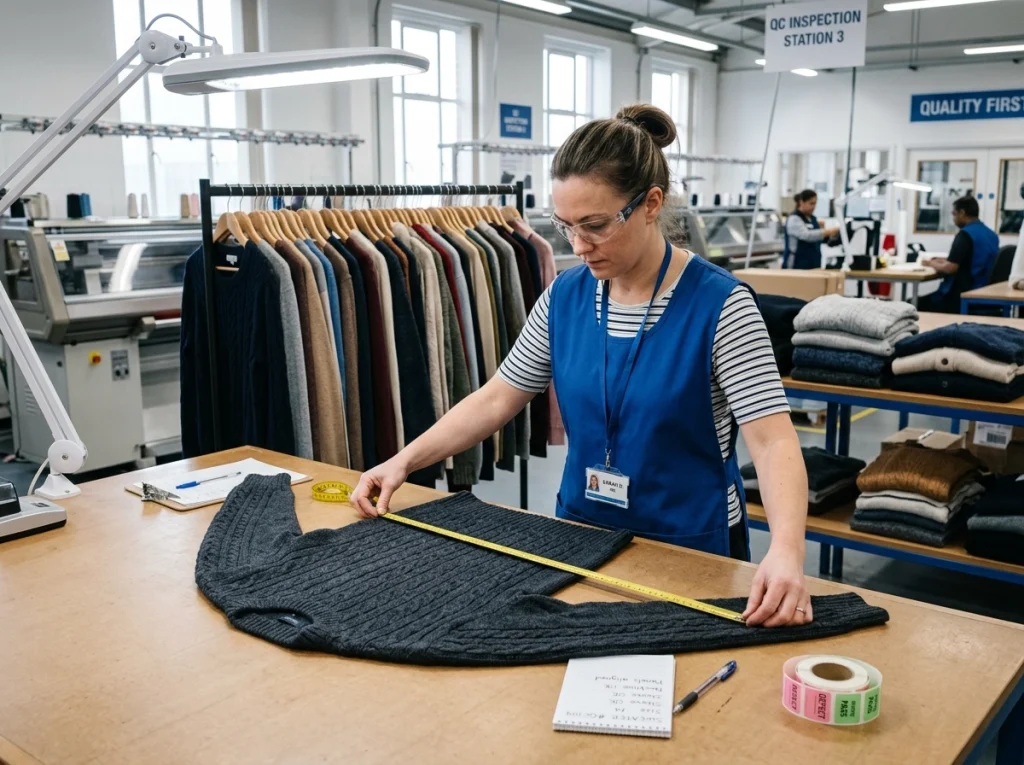
Professional knitwear factories run QC at four levels: yarn testing before production begins, machine-level tension checks during knitting, panel-level measurement and wash testing after knitting but before linking, and final garment inspection after washing and finishing.
Yarn-level QC matters because yarn lots vary—between dye batches, between spinning runs, sometimes between deliveries from the same mill. A factory that verifies yarn count, twist, and colorfastness before loading the machine is catching problems that would otherwise appear as size inconsistency or color drift across the bulk run.
Panel-level QC is where less rigorous factories cut corners most often. After knitting, each panel—front body, back body, sleeves—should be measured before linking begins. If panel dimensions are already outside specification, linking them together doesn’t fix the problem; it locks it in. Ask whether the factory measures and wash-tests panels before committing to bulk linking.
AQL, Measurement Tolerance, and What to Actually Verify
Most reputable knitwear factories operate to AQL 2.5 for standard commercial production, with AQL 1.5 available for higher-tier requirements. AQL governs the inspection sample size relative to total output and the acceptable defect rate per inspection lot. A factory that can’t state their working AQL level has a process gap worth clarifying before you place a PO.
Measurement tolerance for sweaters typically runs ±1 to ±1.5 cm depending on the spec point and the brand’s own standard. The primary dimensions to verify are chest, body length, sleeve length, and neckline width. A factory that can provide actual wash-test shrinkage data from their pre-production samples—rather than stated allowances—is giving you verifiable evidence instead of a promise.
For custom knit projects with complex stitch structures, also request pilling test results (ISO 12945-2 Martindale method) and colorfastness data. These aren’t standard in every initial quote, but any factory operating at a commercial level should be able to provide them on request.
Communication, Capacity, and Reorder Reliability
Technical capability matters. So does the ability to work with your team across an entire season. Communication quality—how a factory handles ambiguity, flags problems early, and manages expectations—is what separates a dependable manufacturing partner from a one-order supplier.
Testing Responsiveness Before You Commit
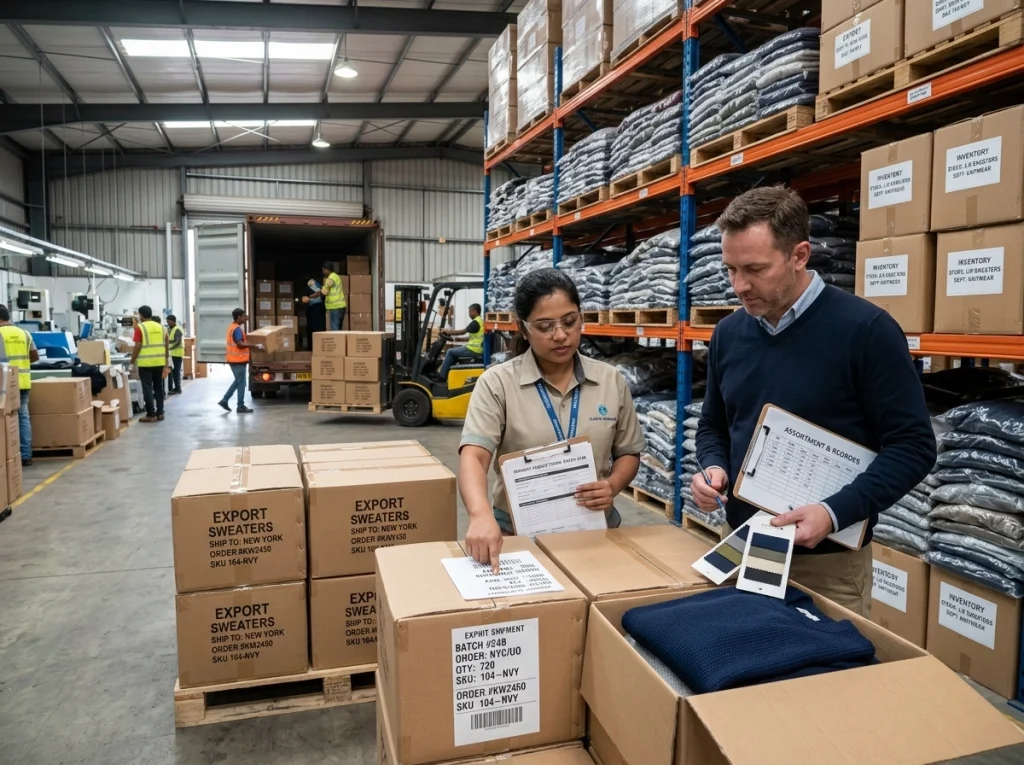
The sampling stage is your lowest-cost test of how a factory will behave during bulk production. Pay attention to how quickly they respond to revision requests. Note whether they ask clarifying questions when your specs are incomplete, or simply proceed and deliver something that may or may not match your intent. Note whether they proactively flag risks—material availability, timeline constraints, stitch feasibility issues—or surface them only after the sample has already been affected.
A factory with a well-run OEM/ODM knitwear service will treat the sampling stage as the first chapter of a production relationship, not a formality before the real work starts. If communication is slow or vague during sampling, it will be slower and more evasive when a bulk issue emerges mid-production.
Planning Refill Orders and Navigating Peak Season Capacity
Knitwear production has a pronounced seasonal rhythm. For most China sweater factories, the off-season runs from roughly February through July; the peak production window runs August through January. If your reorder falls inside peak season, lead times will be longer and raw material and labor costs will be higher. Planning orders ahead of August—particularly for Q4 assortments—gives you meaningfully more scheduling control and typically better cost stability.
Bulk production lead times, when yarn is confirmed and specs are locked, typically run 3–4 weeks for standard styles. More complex constructions—such as cardigan sourcing involving fully fashioned shaping or intarsia patterning—will add time on the knitting and linking side. Build this into your T&A calendar from the start, not as a buffer at the end.
For brands managing a mixed product range that includes multiple sweater styles alongside hoodies and zip knitwear, confirm whether your factory carries dedicated capacity for each product type, or whether different categories compete for the same machines. A factory without clear production segmentation will have scheduling conflicts when your product mix is varied and your delivery windows are tight.
Conclusion
Evaluating a sweater factory in China is a calibration process, not a checklist. The goal is to determine whether a factory’s real capability, sampling discipline, QC infrastructure, and communication approach genuinely align with what your brand needs at its current stage. Price is relevant—but it’s the last dimension to evaluate, not the first.
The brands that build reliable China knitwear relationships share a consistent pattern: they invest real time in the sampling stage, ask specific operational questions rather than accepting quality assurances at face value, and treat early communication as a signal worth reading carefully. They also plan ahead—placing orders before peak season, confirming yarn availability before locking timelines, and building refill logic into their buying calendar from day one.
If you’re evaluating a knitwear manufacturing partner or looking to scale your existing line, reach out to us at cnsweaters.com—share your tech pack, target price range, and delivery window, and we’ll give you a direct answer on capability, timeline, and MOQ.
FAQ
What is a realistic MOQ when working with a China sweater factory?
Most factories apply MOQ per style per color, with a typical working band of 50–300 units per color. For straightforward styles using stock-service yarn, some factories will accept 50–100 units per color, often with a modest price premium. For custom yarn colors, MOQ will generally be higher because the dye lot minimum sets the economic floor—not the factory’s preference.
How long does sampling take, and what’s actually included in that timeline?
For a standard style with yarn in stock, a proto sample typically takes 3–5 working days in-factory. Shipping adds 5–7 days depending on your location. For custom yarn colors or complex stitch structures, add 2–3 weeks for yarn development. Always confirm whether the timeline quoted assumes stock yarn or requires sourcing first—these are very different starting points.
How do I verify that a factory’s QC is reliable?
Ask them to walk you through QC at four specific stages: yarn testing before production, panel measurement before linking, wash and shrinkage testing, and final garment inspection. Request their working AQL level and ask for measurement data from their most recent pre-production samples. A factory that can provide actual test data—not just stated tolerances—is demonstrating process, not just claiming it.
Does peak season in China really affect my order?
Yes, meaningfully. For most China knitwear factories, August through January is peak season—lead times extend, and both raw material and labor costs increase. If your collection needs to ship by October or November, aim to confirm your order before August and lock yarn availability at the same time. Off-season ordering (February–July) typically offers more scheduling flexibility and more stable costing.
What is the practical difference between OEM and ODM for sweaters?
In OEM production, you provide the design, tech pack, and full specifications—the factory manufactures to your brief. In ODM, the factory offers existing designs or construction options that you can adapt and brand. ODM moves faster and requires less technical input on your side, but the differentiation is limited. Most established knitwear factories offer both modes, and many brands use a combination: ODM for basics, OEM for hero styles.