 CN Sweaters

Quarter-zips and zip necks are not a passing moment — they are the most consistently reordered zip knitwear silhouettes in men’s wholesale right now, and 2026 has only strengthened that position. If you are a brand buyer, distributor, or wholesale account manager deciding what to commit to for your next season, this article covers what the demand signals actually look like, how sourcing these styles works from a factory perspective, and where the real risks sit between sampling and bulk delivery.
This is not a trend piece. It is a sourcing guide for buyers who need to make decisions with money behind them.
The Quarter-Zip Moment Is Real — and It’s Bigger Than TikTok
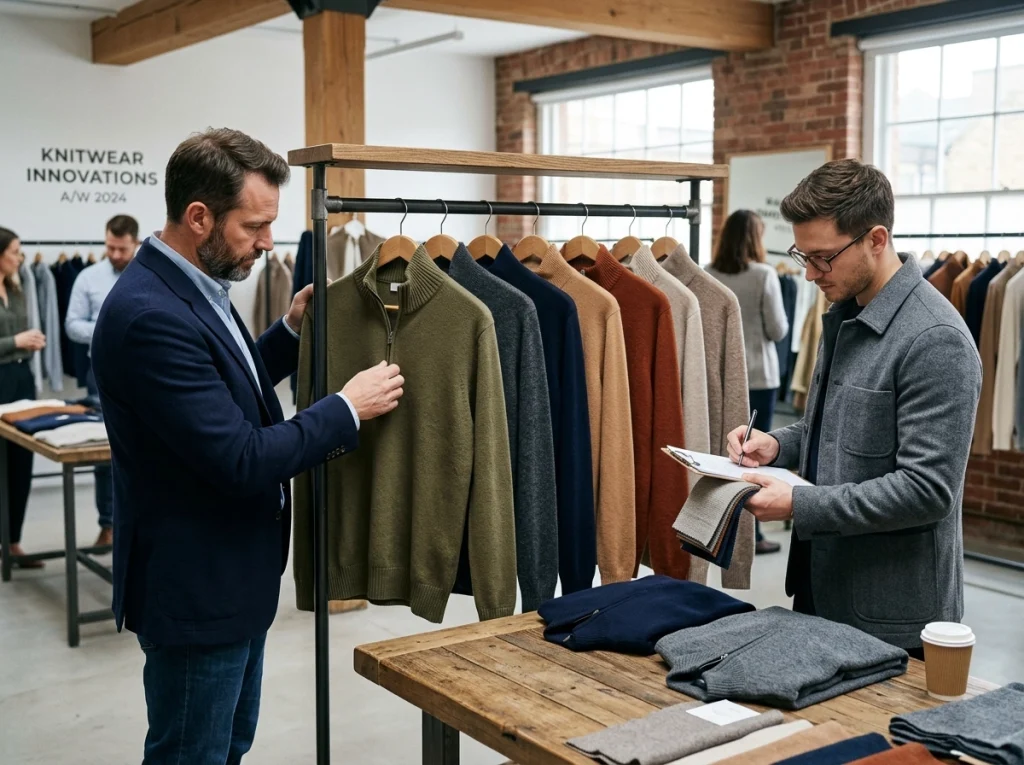
The quarter-zip has had cultural momentum before. What makes 2026 different is the convergence of signals: street-level virality, runway endorsement, and sustained retail sell-through all happening at the same time. For wholesale buyers, that convergence matters. It is the difference between a product that moves one season and one that builds into a repeatable category.
From Finance Bro to Fashion Week Validation
For years the quarter-zip occupied an awkward middle ground — too casual for the office, not casual enough for the weekend, permanently associated with hedge fund managers and Ivy League alumni. That changed quickly in late 2024 and accelerated through 2025. A viral TikTok moment, driven by a 21-year-old creator pairing a navy quarter-zip with matcha and deadpan confidence, rewrote the cultural script practically overnight. Suddenly a garment that used to signal “safe and sensible” was being read as aspirational.
What followed was measurable. According to The Times, Google searches for the quarter-zip surged by 2,250% over 12 months, with retail sales climbing roughly 25% in the same period. That is not trend noise — that is a fundamental demand shift with real wholesale implications.
The runway confirmed it from the other direction. Matthieu Blazy opened Chanel’s Métiers d’Art show with a deep oatmeal quarter-zip — not tweed, not a jacket, a quarter-zip sweater, worn by the show’s opening model. Miu Miu sent it down the runway with signature subversion. Tory Burch offered it in saturated red. Brands like J.Crew and Sandy Liang grounded it with an off-duty, street-leaning energy. When Chanel and a TikTok creator are pointing in the same direction at the same time, the wholesale implication is clear: this silhouette has crossed from micro-trend to broad-market product, and the demand pool is bigger than it was 18 months ago.
Why Zip Necks Are Gaining Alongside Quarter-Zips
The zip neck — sometimes called a funnel-neck zip or mock-neck zip — is gaining momentum as a companion style rather than a competitor. Where the quarter-zip sits at roughly mid-chest with a longer zip pull and a more relaxed neckline, the zip neck features a closer-fitting ribbed or funnel neck with a shorter zip, giving a slightly more structured and elevated look while sharing the same functional, easy-to-wear appeal.
From a sourcing standpoint, these two styles address slightly different retail needs. Quarter-zips skew more relaxed and universal — they work across lifestyle, sportswear-adjacent, and smart-casual positioning, and they are easier to sell across a broad size and age range. Zip necks tend to attract buyers targeting a more premium or fashion-forward customer, and they sit more comfortably alongside tailored separates or elevated casual pieces. Both are seeing strong repeat order activity this season. If you are building out a wholesale mens knitwear range for 2026, carrying both rather than picking one is the more defensible commercial decision.
What This Means for Wholesale Buyers in 2026
Trend validation is useful context, but it does not by itself answer the buying question. The more practical question is which specific configurations are moving, through which channels, and what the margin and reorder picture actually looks like.
Which Styles Are Moving
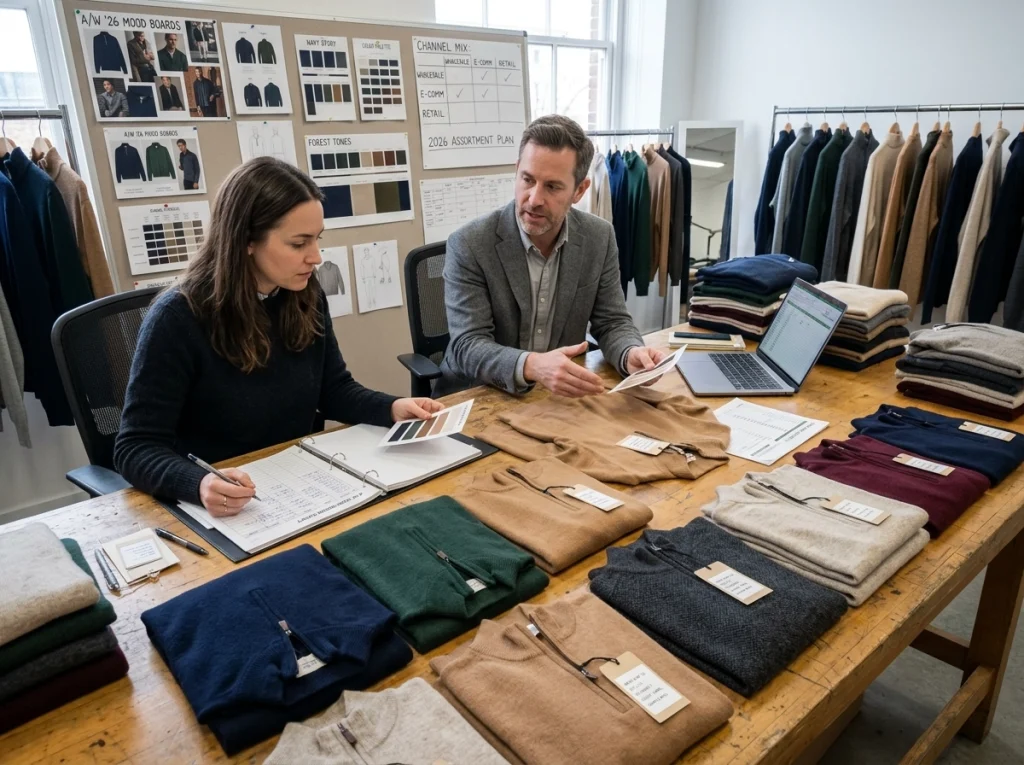
Not every quarter-zip performs equally. From inbound development requests we receive, mid-weight constructions in merino wool blends, cotton-acrylic mixes, and 100% wool are the most consistently ordered. Fine-gauge constructions — typically 7GG to 12GG — dominate for brands targeting smart-casual or business-casual positioning, where the product needs to sit cleanly under a jacket or translate into office-appropriate styling. Chunky constructions (5GG and below) work well for lifestyle brands and winter-focused collections, but they carry more inventory risk outside of colder markets and are harder to sell into transitional seasons.
Color-wise, the market is split between two distinct demand signals. Neutrals — oatmeal, navy, dark khaki, slate grey — remain the safest entry point for first-order buyers and wholesale basics programs. There is also a visible shift toward bolder colorways, particularly saturated reds, forest greens, and warm earth tones, driven by the fashion-forward end of the market. Buyers targeting trend-led boutiques or DTC brands will find color is increasingly a differentiator; buyers targeting department stores or large wholesale accounts may find neutrals still make up the bulk of sell-through.
| Zip Style | Gauge Range | Key Market | Buyer Profile |
|---|---|---|---|
| Quarter-Zip Pullover | 7GG–12GG | Lifestyle, smart-casual, men’s basics | Distributors, mid-market wholesale |
| Quarter-Zip Chunky | 3GG–5GG | Winter lifestyle, fashion-forward | Boutique brands, seasonal buyers |
| Zip Neck / Funnel Zip | 7GG–12GG | Premium casual, fashion-adjacent | Private label brands, EU/US buyers |
| Full-Zip Knit (cardigan-style) | 5GG–10GG | Layering, transitional season | Multi-channel wholesale accounts |
Seasonal Windows and Channel Trade-offs
One trade-off worth naming clearly: if you are placing first orders for zip knitwear in Q1 or Q2, you are not late, but you are approaching the practical limit for comfortable development. Chinese knitwear factories — including ours — see a significant volume ramp from August onward as peak season begins. Raw material costs and lead times both tend to rise during this period, and production bandwidth tightens. Buyers who lock in orders and yarn commitments before Q3 generally have more flexibility on pricing, colorway options, and the number of sampling rounds available before bulk.
For buyers on a DTC or e-commerce model, a later delivery window is often manageable — you can absorb the shift and adjust your launch date. For wholesale accounts with confirmed retail floor dates or pre-season sell-in commitments, placing late means compressing the development timeline and potentially taking fewer sampling iterations, which increases bulk risk. If autumn delivery matters to your business, the time to act is now rather than after summer.
Sourcing Quarter-Zips from a Mens Knitwear Manufacturer
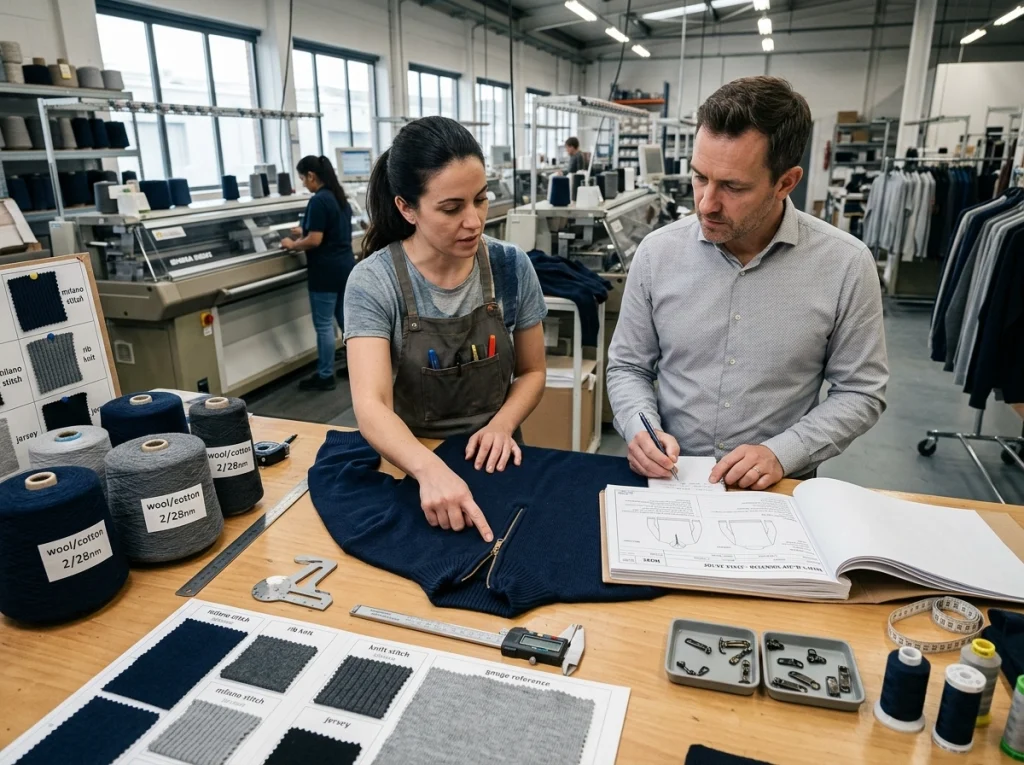
The knitting itself is rarely where problems originate with zip knitwear. The complexity sits at the intersection of the zip hardware and the knit construction — and getting that interface right before bulk is where most downstream problems either get resolved or get locked in.
Yarn, Gauge, and Zip Hardware
The yarn and gauge decision determines everything downstream: drape, hand-feel, weight range, the price point the product can reach, and which segment of buyers it is viable for. For quarter-zips targeting the smart-casual or premium basics positioning, merino wool blends and fine-gauge constructions are the most commercially versatile. They photograph well, hold their structure across a range of body types, wash reliably, and translate cleanly into both lifestyle and work-adjacent styling.
The zip hardware is a separate decision that buyers consistently underestimate. Zip type (metal versus nylon coil versus invisible zip), zip weight, chain width, and puller style all need to be matched to the yarn weight and gauge. A zip that is too heavy for a fine-gauge body distorts the neck band and creates visual imbalance; a zip that is too light for a chunky construction looks cheap and wears poorly. From a factory perspective, we recommend confirming zip specification with a physical swatch review before approving the first sample. Changing zip type after sample sign-off costs time and sometimes requires a re-knit of the neck band construction — which adds days to the sampling cycle and costs.
Gauge-matching the zip opening is also worth explicit attention. The rib or neck band surrounding the zip needs to be knitted to a specific tension to accept the zip tape cleanly without puckering or gaping. This is one of the most common finishing quality issues in zip knitwear production, and it is something buyers sourcing from a new mens sweater supplier should review explicitly during sample sign-off rather than assuming it will be resolved in bulk.
MOQ, Sampling, and Lead Time Reality
MOQ expectations for zip knitwear from China vary significantly by factory scale and positioning. Smaller specialty factories typically work from 100–300 pieces per style per color; larger more integrated manufacturers often require higher minimums. Our hoodies and zip knitwear programs at cnsweaters.com start from 30 pieces per size per color, which makes genuine test orders viable and range-building accessible without forcing premature depth commitment.
Sampling takes 3–5 business days for an initial sample, with courier shipping to Europe or North America adding roughly 5–7 days. One thing worth emphasizing: the sample round is not just a fit check. It is where zip alignment, neck band tension, puller placement, and color match between the zip tape and the body yarn all get physically confirmed. Approving by photograph rather than reviewing a physical sample is one of the most consistent causes of bulk quality deviations for zip styles specifically.
For bulk production, standard lead times after sample approval run 25–45 days depending on order volume and whether the yarn is a stock color or requires custom dyeing. Non-stock yarn adds 7–14 days to the timeline. Off-season production windows (February through July) typically offer faster turnaround and more available capacity. Peak season (August onward) requires a buffer, particularly for complex constructions or custom colorways.
Private Label and Custom Mens Knitwear
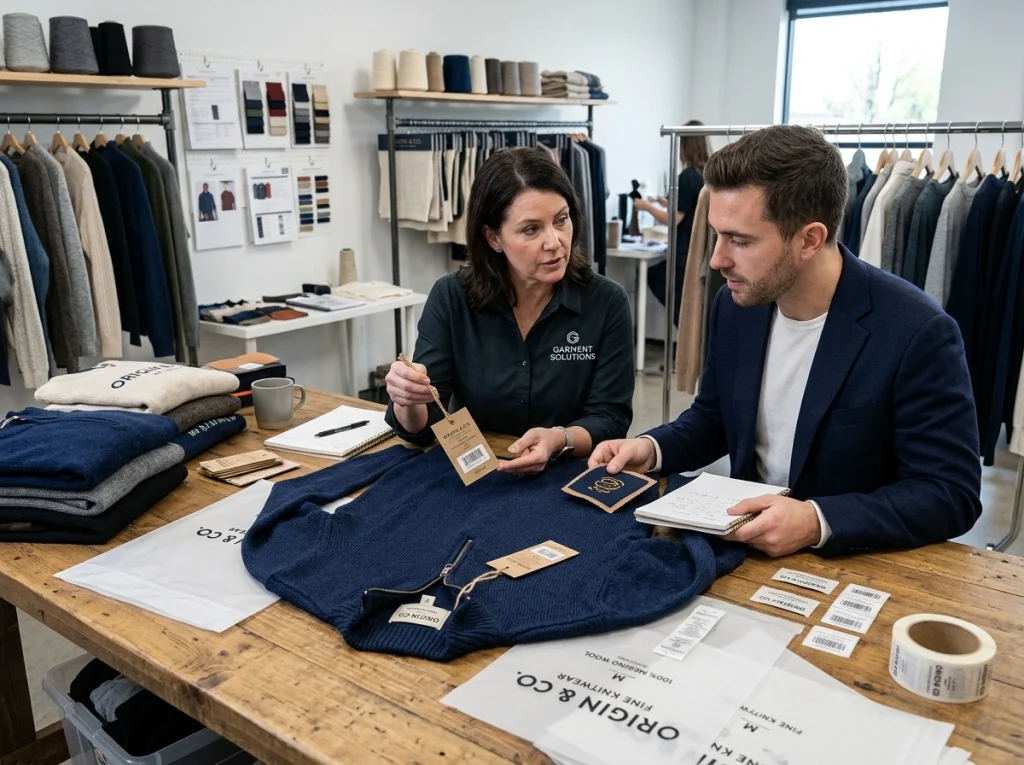
Not every buyer needs a bespoke product. But for brands competing in a market where wholesale mens sweaters are widely available from multiple sources, private label and custom development are the most reliable ways to build margin separation and reduce direct price comparison.
When Custom Makes Sense
Full custom development — meaning a design built from a proprietary yarn specification, original stitch structure, or bespoke gauge construction — makes commercial sense when you are placing consistent volumes across multiple seasons and have a clear brand identity that warrants protecting. The development investment is real: sampling, yarn testing, wash testing, and fit iterations all take time and cost money. That investment only pays off if you are buying deeply enough to amortize it across a genuine selling program.
For buyers earlier in that journey, private label is the more practical entry point. You are working from existing constructions with your own branding applied — labels, hangtags, packaging — which compresses development time and removes most of the technical risk. This is where most mid-tier wholesale buyers start before moving to custom programs once volumes are established and reorder patterns are proven.
For genuinely differentiated product — unusual gauges, intarsia panels, engineered colorwork, or hybrid constructions that combine zip hardware with atypical stitch structures — our custom knit projects service covers that development path. It requires more lead time in the early stages, but it produces a product your competitors cannot directly copy from an existing mens knitwear factory catalog.
Labels, Packaging, and Brand Setup
Private label execution involves more than a woven brand label. For retail-ready delivery, most buyers need care labels with fiber content and wash instructions, main brand labels, hangtags, size stickers, poly bags per unit, and outer carton labeling aligned to their retail or distribution requirements. Some markets also require specific compliance documentation — country of origin labeling, fiber content certification, or chemical compliance statements depending on destination.
The setup is straightforward for a factory with established private label workflows, but it requires complete and correct specifications at order placement. The most common delays in first-time private label orders come from incomplete label artwork files, missing UPC or EAN barcode data, and packaging spec changes made during production. Providing full documentation upfront — not mid-production — is what keeps the timeline clean.
Our OEM/ODM service covers the complete flow from yarn sourcing and matching through finished packaging, with private label setup included as standard across all programs. For buyers developing private label mens knitwear for the first time, we walk through the documentation requirements early so nothing becomes a last-minute bottleneck.
Quality Control for Zip Knitwear
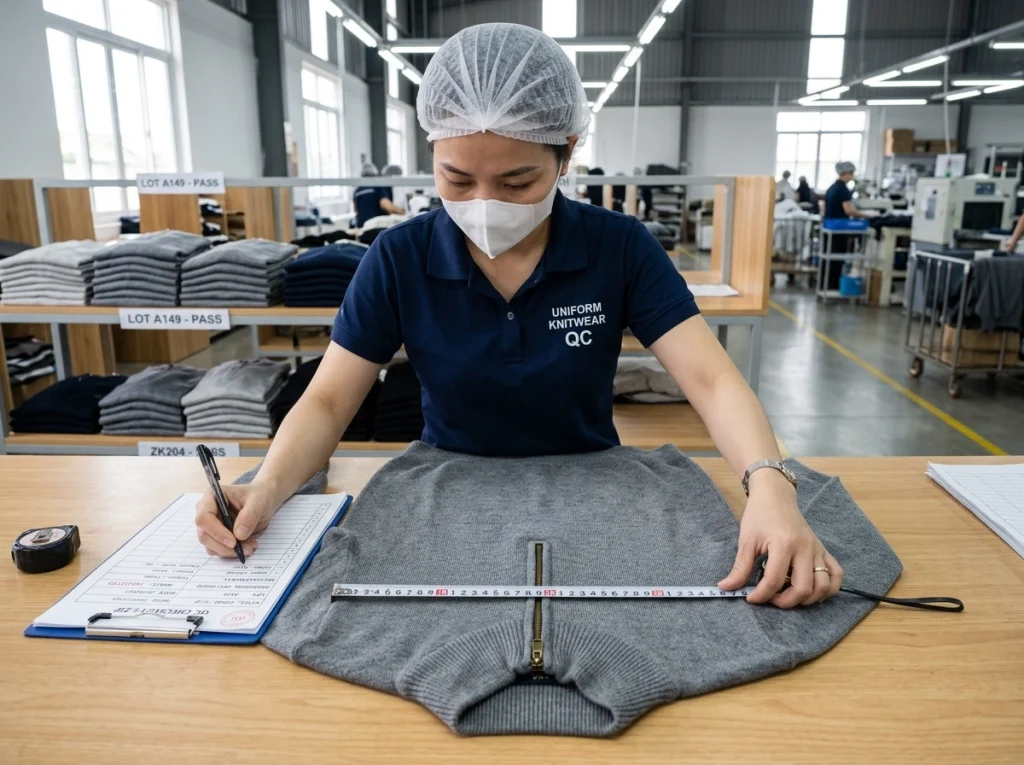
Zip knitwear has a slightly larger QC surface area than standard pullovers. There are more components, more assembly steps, and more opportunities for specification drift between sample and bulk. Understanding where the failure points typically sit lets buyers build better pre-production and pre-shipment protocols.
Common Production Issues with Zipped Knits
From our production experience across zip knitwear programs, four issues come up most consistently:
Zip alignment and puckering. When zip tape is attached under incorrect tension during linking or finishing, the neck band puckers or the zip track pulls off-center. This is almost always a finishing process issue rather than a knitting issue, and it shows up clearly in measurement and appearance checks when done correctly against an approved sample.
Zip puller movement during wear. Pullers that slide open under normal use generate retail returns and brand complaints. The fix is specifying a locking puller or a stopper mechanism at the order stage, not as a correction after bulk. It is a hardware specification decision, not a production quality issue.
Color matching between zip tape and body yarn. Zip tapes are produced in a finite range of standard colors. When the body yarn uses a custom dye color, confirming the zip tape match requires physical swatch comparison under consistent lighting before production starts. Metamerism — where two colors appear matched under one light source but diverge under another — is a real and underappreciated risk in garment QC, and it is impossible to assess accurately from product photos.
Pilling at the zip placket. High-friction zones around the zip opening are inherently more prone to pilling, particularly in acrylic or acrylic-blend constructions. If product durability is important to your end customer, specifying an anti-pill treatment or selecting a more pill-resistant yarn at the development stage is worth the incremental cost.
How to De-risk Before Bulk
The most effective single risk reduction step is a proper pre-production sample (PPS) approval — not a rushed approval based on the first sample, but a deliberate sign-off that confirms final yarn, gauge, zip hardware, sizing, and finishing as a binding benchmark for bulk production. Cutting this step short to save a week of lead time is a trade-off that regularly costs more than a week in bulk rework, re-shipping, or commercial disputes.
For higher-volume orders, a pre-shipment inspection (PSI) is a practical investment. An independent inspector — or your own QC representative — checks a statistically representative sample of finished goods against AQL acceptance criteria before the shipment is packed and leaves the factory. Standard checks cover measurements against approved spec, appearance, zip function, label accuracy, and packaging compliance. Problems found at PSI are almost always cheaper and faster to resolve than problems found after delivery.
Our inline QC process runs throughout production — at knitting, linking, finishing, and final check stages — rather than only at the end. Defect mapping at each stage means systemic issues are caught before they propagate across the full run. Buyers working with us across our sweaters or zip knitwear programs receive AQL-standard final inspection documentation as a standard part of each delivery package.
Conclusion
Quarter-zips and zip necks have earned their position in wholesale mens knitwear for 2026 — not because a single trend cycle said so, but because demand is broad-based, multi-channel, and backed by sustained sell-through rather than speculative forward buying. The runway validated what streetwear already knew, and the wholesale numbers are following. The silhouette works across price points, channels, and customer profiles in a way that genuinely versatile products do.
For buyers who do not yet carry zip knitwear, the development window for Q3–Q4 delivery is still open — but it is not indefinite. For buyers who are already in the category, the question is whether your current supplier can support the next step: colorway expansion, gauge range extension, or private label development that separates your product from the wholesale catalog.
Either way, the details matter more here than they do with a basic crew neck or V-neck pullover. Zip hardware specification, gauge selection, sample approval discipline, and pre-shipment QC protocols are all places where the difference between a clean reorder and a problem order gets made. Getting them right from the first development cycle is how a seasonal buy becomes a repeatable program.
If you are ready to explore what is possible for your timeline and volume, contact us at cnsweaters.com with your tech pack, target price point, and delivery window. We will respond with yarn options, a realistic production timetable, and a transparent quote.
FAQ
What MOQ do I need to place a quarter-zip knitwear order? It depends on the factory. Smaller specialty manufacturers typically work from 100–300 pieces per style per color. At cnsweaters.com, the minimum is 30 pieces per size per color, which is accessible for brands in a testing or range-building phase. The trade-off at lower volumes is reduced flexibility on custom yarn dyeing and slightly higher per-unit cost relative to larger runs.
How long does sampling take for a zip knitwear style? An initial sample takes 3–5 business days in production, plus 5–7 days for courier delivery to Europe or North America. If your style requires a custom yarn color, add 7–10 days for yarn procurement. Budget for at least one revision round — most zip styles require at least one adjustment to zip placement, neck band tension, or puller specification before sample approval.
Is it better to develop a custom quarter-zip or work from an existing factory construction? For buyers in their first few seasons, working from an existing base construction is faster, lower-risk, and easier to manage on a tight timeline. Full custom development makes sense once you have established reorder patterns and a brand identity that warrants proprietary construction. Private label — your branding applied to an existing construction — is usually the right starting point, with custom development as a natural progression.
What are the main quality risks in zip knitwear versus standard pullovers? The primary risks are zip alignment and puckering, puller movement during wear, color mismatch between the zip tape and the body yarn, and pilling at the zip placket. All four are manageable if specified correctly at the development stage and confirmed through a physical PPS approval before bulk production begins.
When is the right time to place wholesale zip knitwear orders for autumn delivery? For autumn delivery with comfortable lead time and full development flexibility, placing orders before the end of Q2 — ideally by June or July — gives the most room. Chinese knitwear factories enter peak production season from August onward, which typically brings higher raw material costs and tighter timelines. Off-season placement (February through July) offers faster turnaround, more capacity, and more room for sampling iterations.
External References
- Vogue Arabia — The Quarter-Zip’s Quiet Takeover — https://www.voguearabia.com/article/the-quarter-zip-trend
- The Times — Why the quarter-zip is the coolest knitwear of 2026 — https://www.thetimes.com/life-style/fashion/article/quarter-zip-fleece-jumper-coolest-knitwear-2026-fvnk00nlg
- Red Online — The quarter zip will dominate 2026 — https://www.redonline.co.uk/fashion/buyers-guide/a69808467/quarter-zip-trend/