 CN Sweaters
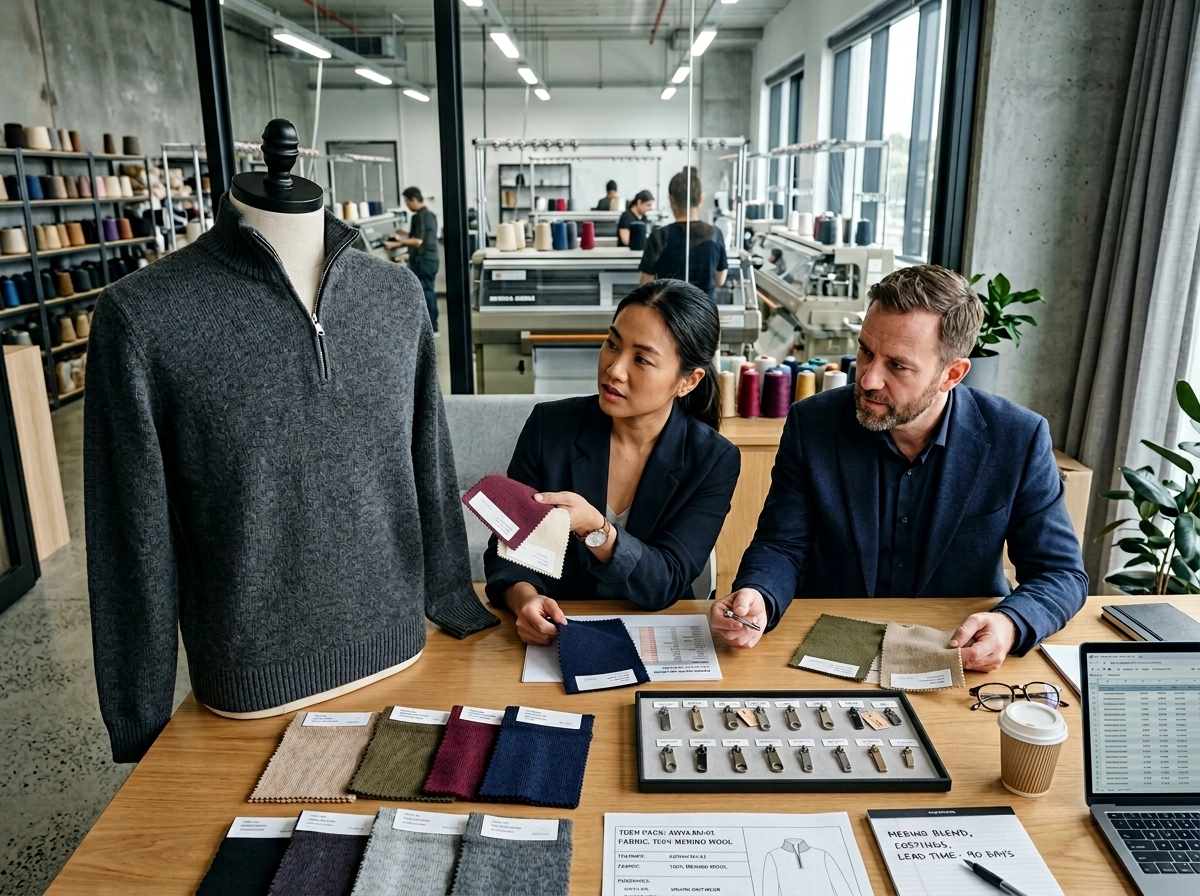
If you’re building a men’s knitwear program and considering adding a half zip jumper, the timing makes sense. The silhouette has moved well past trend status—it now sits comfortably as a staple category across casualwear, smart casual, and premium basics. This guide is written for wholesale buyers, brand managers, and product developers who want to source a mens half zip jumper with confidence, not guesswork.
The decisions that matter most—fabric, gauge, zipper hardware, collar construction, MOQ—happen before sampling, not after. Getting clear on those decisions early is what separates a smooth production run from a costly rework cycle.
Why Half Zip Jumpers Belong in Your Next Wholesale Order
The category is commercially solid, and the demand base is broader than it’s been in years.
The Demand Signal Is Real and It’s Not Going Away
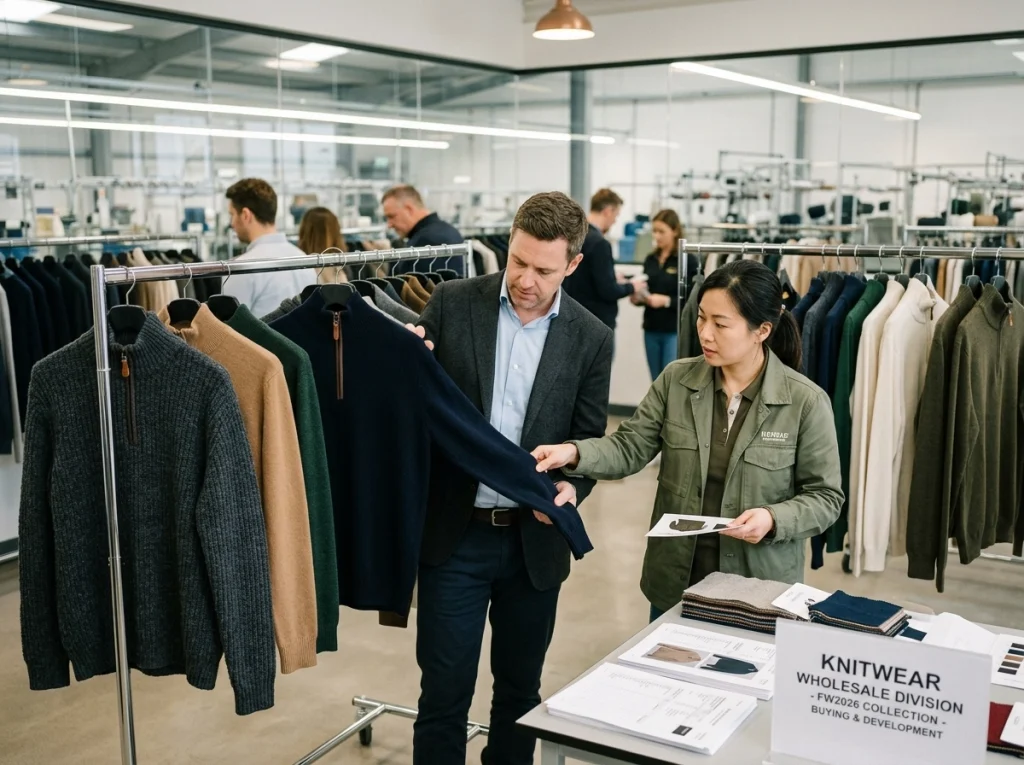
Half-zip and quarter-zip knitwear has been gaining genuine commercial traction since late 2025, when a viral TikTok clip turned the silhouette into a cultural shorthand for aspirational, no-fuss dressing. What followed wasn’t just a social media moment—it was a category shift. Chanel opened its Pre-Fall 2026 Métiers d’Art show with a deep oatmeal-hued zip-neck sweater. Miu Miu sent zip-neck knitwear down its Autumn 2025 runway. The silhouette, long anchored in menswear through brands like Loro Piana and Ralph Lauren, has now broken into mainstream fashion buying across price tiers.
For wholesale programs, this matters because demand is now broad-based rather than niche. Buyers sourcing half zip jumpers for men are entering a high-visibility category with genuine reorder potential—not chasing a microtrend.
Where the Opportunity Sits for Wholesale Programs
The commercial opportunity sits at the intersection of performance heritage and everyday wearability. Men’s buyers are looking for pieces that work across multiple contexts: office-adjacent, travel-ready, weekend-casual. A well-constructed mens half zip jumper in a mid-gauge merino or wool blend serves all three without asking the wearer to think too hard.
From a wholesale perspective, the silhouette supports a clean size run and relatively predictable sell-through compared to fashion-heavy items. It doesn’t shift dramatically season to season, which means refill orders are realistic and the investment in fit development pays off across multiple seasons. That kind of commercial stability is worth something in a category that’s otherwise prone to fast trend turnover.
Silhouette Decisions That Happen Before Sampling
The two most common sources of sample rework on zip-neck knitwear are underspecified collar construction and ambiguous zip length. Both are avoidable.
Half Zip vs Quarter Zip at the Factory Level
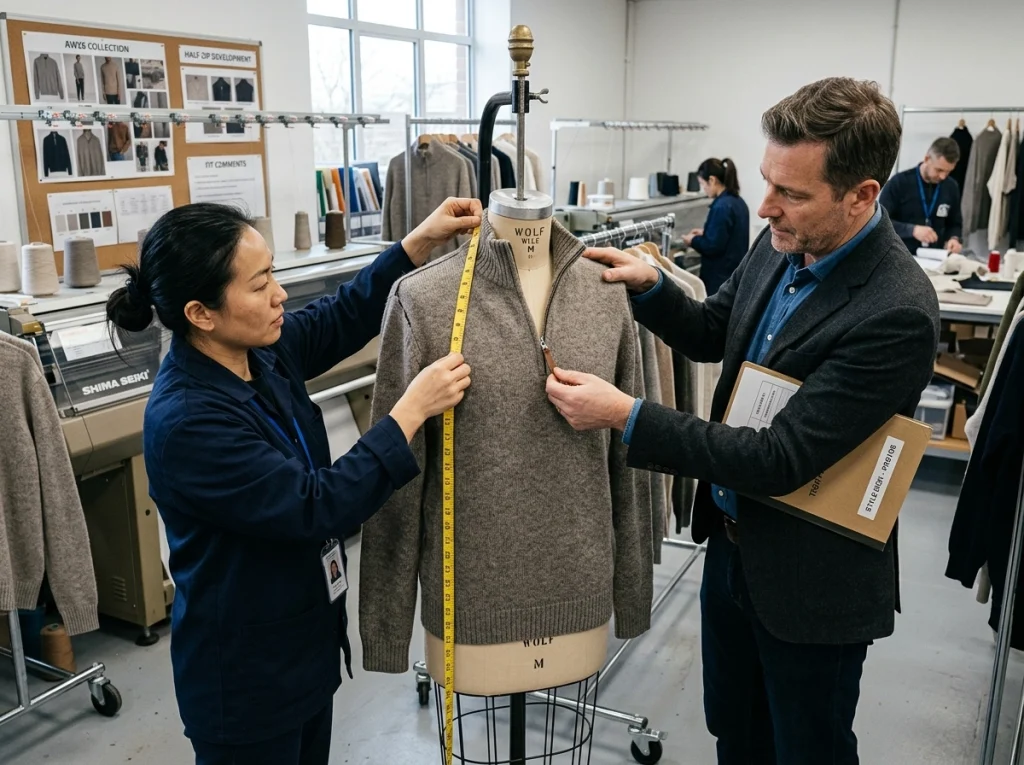
These terms are often used interchangeably in retail, but at the factory level they represent different constructions. A quarter zip opens to roughly chest height—enough for ventilation but not enough to open the garment fully. A half zip extends further, typically to mid-chest or just below the collarbone. The longer zip run means more placket fabric, more hardware cost, and a more dramatic open silhouette.
For B2B buyers, the distinction matters when confirming your tech pack. Stating “half zip” without specifying zip length in centimeters—or as a proportion of body length—creates ambiguity at sampling. Specify zip length measured from the collar base, and flag whether the open-zip state matters aesthetically. Some brands want a relaxed drape when open; others want a structured placket that holds its shape. Both are achievable, but they require different construction approaches.
From a cost standpoint, half zips run slightly higher than quarter zips for the same fabric and gauge—mostly due to the longer zipper tape and additional placket work. It’s not a large delta, but it should be reflected in initial costing.
Collar Height, Zip Length, and Fit Variables
The collar on a half zip jumper is a design decision with real downstream impact. A low stand collar (roughly 3–4cm finished height) reads sportswear-adjacent. A taller collar (5–7cm) reads more premium and suits brands positioning in smart casual or elevated basics. Collar height also affects how the zipper interacts with the neckline when fully closed—tall collars with metal zippers can press against the chin if the lining isn’t properly managed.
On fit: wholesale programs need to commit to a primary fit direction—slim, regular, or relaxed—before sampling. Each generates different fabric consumption and different cost. A relaxed fit half zip also behaves differently at the placket; more ease in the chest can cause the placket to gap or pucker if not accounted for in pattern making. Confirm this at first sample stage before moving to pre-production approval.
Fabric and Gauge Choices and What They Actually Cost You
Fiber and gauge are the two variables with the most direct impact on landed cost, and they need to be decided together—not sequentially.
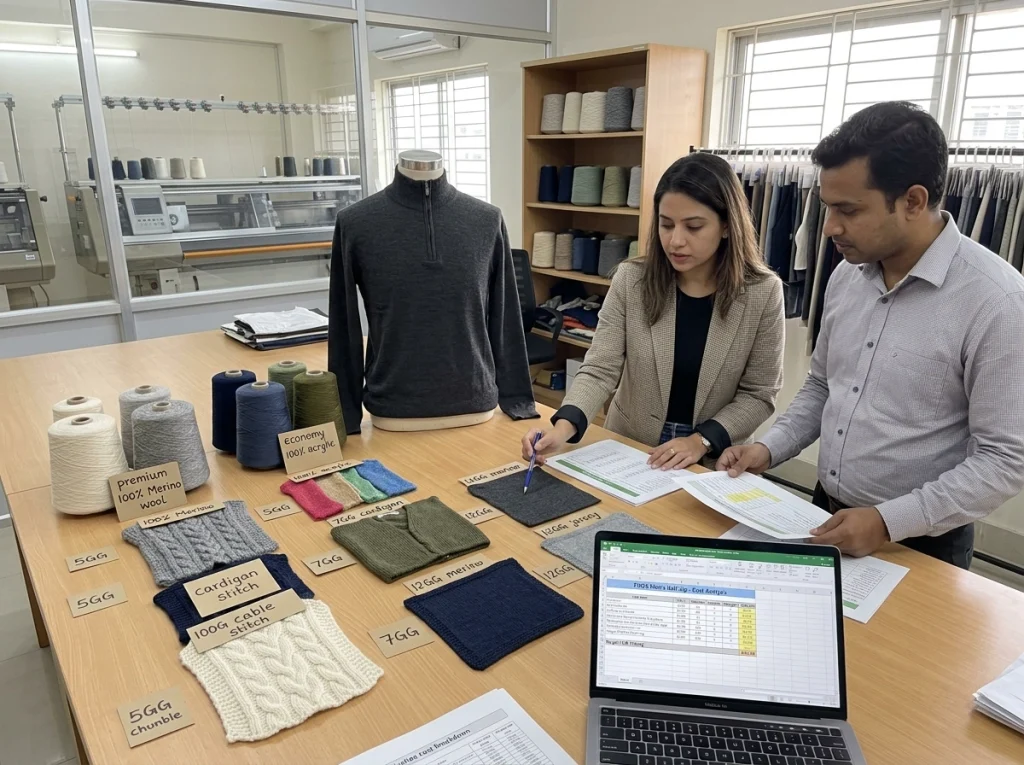
Merino Wool, Wool Blends, and Acrylic: The Real Trade-offs
Fabric selection for a wholesale mens zip neck sweater program is a cost-versus-positioning decision. There’s no universally right answer, but the trade-offs are consistent enough across programs to be worth mapping clearly before you lock in a yarn spec.
| Fiber | Hand-feel & Performance | Cost Position | Washing Risk | Best-fit Market |
|---|---|---|---|---|
| 100% Merino Wool | Soft, breathable, temperature-regulating, natural odor resistance | Higher | Hand wash or dry clean unless treated for machine wash | Premium basics, travel collections, smart casual |
| Wool-Acrylic Blend (70/30 or 50/50) | Good warmth, improved durability vs pure wool, slight synthetic feel | Mid | Usually machine washable | Mid-market menswear, wholesale programs with broad distribution |
| 100% Acrylic | Affordable, color-consistent, pilling risk over time, less breathable | Lower | Machine washable | Entry-level wholesale, price-competitive programs |
For a program targeting brands in Europe or North America, a wool-acrylic blend is often the practical default. It offers the warmth and hand-feel cues of natural fiber at a cost that works across a full size run, and machine-washability reduces end-consumer care friction. Pure merino makes sense when your price point supports it and your retail channel can communicate the fiber benefit clearly. Full acrylic works for promotional or price-competitive distribution—but pilling is a real quality risk on a zip-neck style, where friction around the collar is higher than on a standard pullover.
Gauge Selection and How It Affects Weight, Drape, and Margin
Gauge is the number of stitches per inch across the knitting bed, and it determines how a garment looks, wears, and prices out. For a mens half zip jumper in a wholesale context, the decision usually comes down to three zones.
A 3G–5G construction produces a chunky, textured hand-feel with strong visual presence. It’s well-suited to autumn-winter programs where warmth and visual weight are intentional, and it’s the most forgiving for zipper installation because the heavier fabric provides more stability at the placket.
A 7G–9G mid-gauge is the most commercially versatile range for this category. It balances warmth and wearability, suits merino and wool-blend yarns well, and produces a finished garment that photographs clearly and sits naturally on the body. Most high-volume wholesale half zip programs live here.
A 12G–14G fine-gauge construction gives a lightweight, fluid drape better suited to transitional seasons or layering. It’s technically more demanding—fine-gauge knitting is slower and carries higher defect rates—so it typically commands a cost premium over equivalent mid-gauge styles.
Gauge and yarn selection interact directly: a fine-gauge construction with a coarse or hairy yarn produces an uneven surface, while a chunky gauge with a premium fine merino wastes the fiber’s hand-feel advantage. Align both at the RFQ stage rather than deciding them separately.
Zipper Hardware and Placket Construction
The zipper is the most handled component on the garment. Getting the hardware spec right before sampling avoids the most disruptive type of mid-production change request.
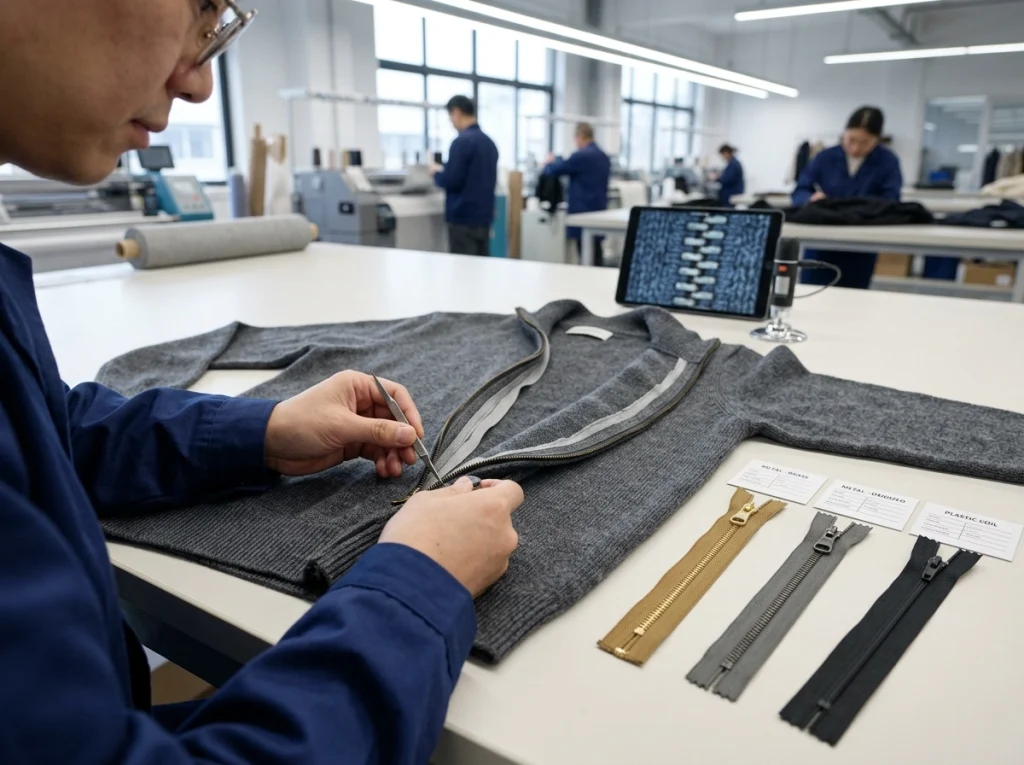
Metal, Resin, or Nylon: Choosing by End Use
Metal zippers—typically brass or zinc alloy—communicate premium quality immediately. The weight and tactile closure signal value in a way that reads clearly at retail. The trade-off is cost: metal zippers are the most expensive option and add weight to the finished garment. For a half zip jumper targeting a retail price above $80–100, metal hardware is worth the investment.
Resin zippers offer a practical middle ground. They’re lighter than metal, available across a wide range of colors and finishes (matte, gloss, brushed), and can be color-matched to the body of the garment for a clean tonal look. This makes them a common choice for private label half zip knitwear programs where brand differentiation matters but cost targets are firm.
Nylon coil zippers are the lightest and most affordable option, but they’re not well-suited to a premium half zip jumper. The tape can feel insubstantial in the hand, and slider movement typically lacks the smooth, controlled feel buyers expect in knitwear. Nylon coil works better in technical or performance-adjacent styles where weight reduction is the primary brief.
One spec detail worth confirming: whether you want a self-locking slider (holds position when you stop pulling) or a non-locking version. For a mens half zip jumper in everyday use, a self-locking slider reduces warranty claims and returns without adding meaningful cost.
Placket Finish and Lining Details That Affect Quality Perception
Zipper waviness—where the placket fabric buckles or ripples along the zip tape—is one of the most visible and most common quality issues in zip knitwear. It happens when tension between the knit fabric and the zipper tape isn’t controlled during sewing, or when the garment is laundered without proper tension management.
A well-constructed half zip placket requires controlled stitch tension throughout installation, an inner placket (knitted or woven) sitting between the zip tape and the wearer’s skin for comfort, and a finished face that lies flat whether the zipper is open or closed. During sampling, lay the garment flat and run the zip open and closed slowly. Any pucker or wave at this stage will worsen in bulk, not improve.
Some brands specify a knitted placket cover rather than a woven one—a legitimate premium detail that creates a softer, more integrated look. It’s more technically demanding and typically requires at least one additional sample round to resolve. Factor that into your development schedule if you’re going this route.
MOQ, Sampling, and Lead Time Planning
Timeline and minimum order planning are where most wholesale programs run into trouble, usually because the factory’s actual schedule wasn’t accounted for at the brief stage.
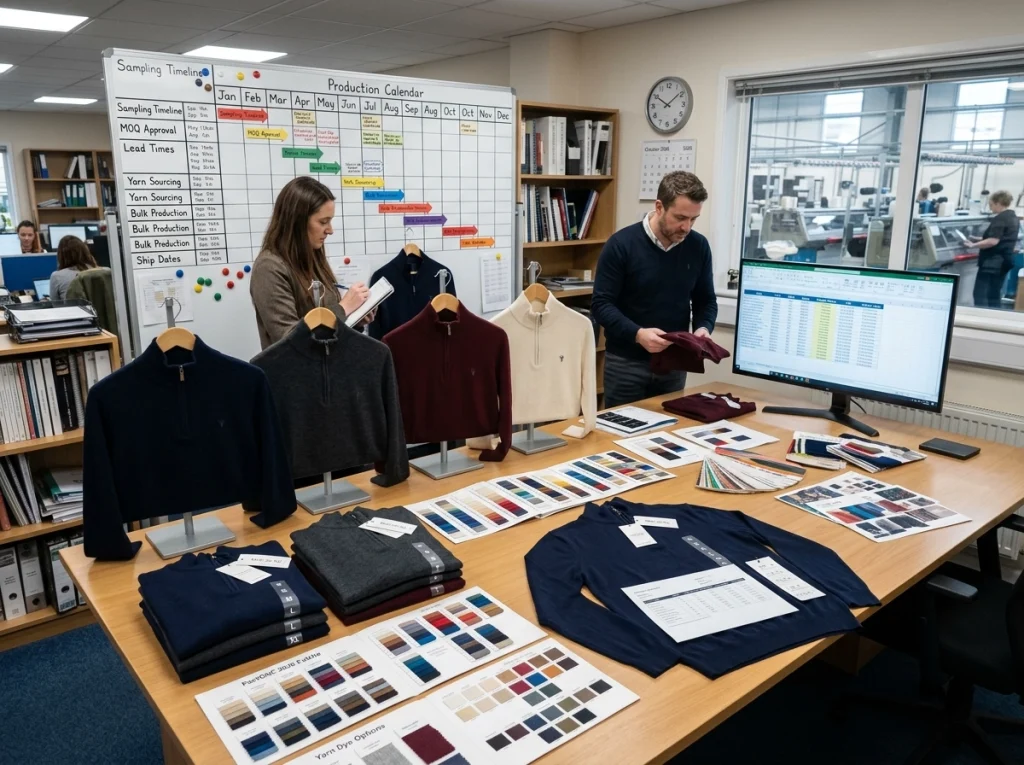
Realistic Timelines from Sample Request to Bulk Delivery
For a mens half zip jumper sourced through a dedicated OEM knitwear manufacturer, the timeline from first contact to delivery typically breaks down as follows:
Sampling takes 7–14 days for standard constructions using stock-service yarns. Complex stitch patterns or custom dye routes push this to 10–20 days. A clear tech pack or well-annotated reference sample compresses sampling time; a vague brief extends it.
PP approval adds another review round—typically 5–10 days—depending on how quickly your team can respond and whether fit corrections are needed. Budget a minimum of two sample rounds for any new style.
Bulk production from PP sign-off runs approximately 20–35 days for a program in the 1,000-piece range. Larger volumes, more complex stitches, or peak-season timing will extend this.
Shipping adds 3–5 business days by air or 25–35 days by sea, depending on destination.
Plan for 12–16 weeks from RFQ to delivery on a first-time style. Replenishment of an approved style with pre-booked yarn can compress to 6–8 weeks. MOQ for a wholesale half zip program typically starts at 200–300 pieces per style and 50–100 pieces per colorway, with flexibility depending on yarn type and construction.
Off-Season vs Peak Season: Why Timing Your PO Matters
Knitwear production follows a predictable seasonal rhythm. The off-season—roughly February through July—is when yarn prices are more favorable and factory capacity is accessible. The peak season—August through January—is when factories are managing the bulk of autumn-winter production, raw material costs tend to rise, and lead times extend across the board.
For wholesale buyers planning an autumn-winter mens half zip jumper program, the implication is direct: placing your PO before September gives you better cost, better timeline control, and more flexibility in color and material selection. Buyers who wait until October or November are often competing for capacity and may see lead times run 20–30% longer as a result.
If you’re running a spring-summer program with lightweight half zip styles in fine-gauge cotton or compact wool, Q1 ordering gives you meaningful leverage on both price and scheduling.
Working with a Factory on Private Label and Custom Development
The accuracy of a factory quote is almost entirely a function of the information quality you provide. A vague brief produces a vague quote—and a vague quote produces cost surprises at bulk.
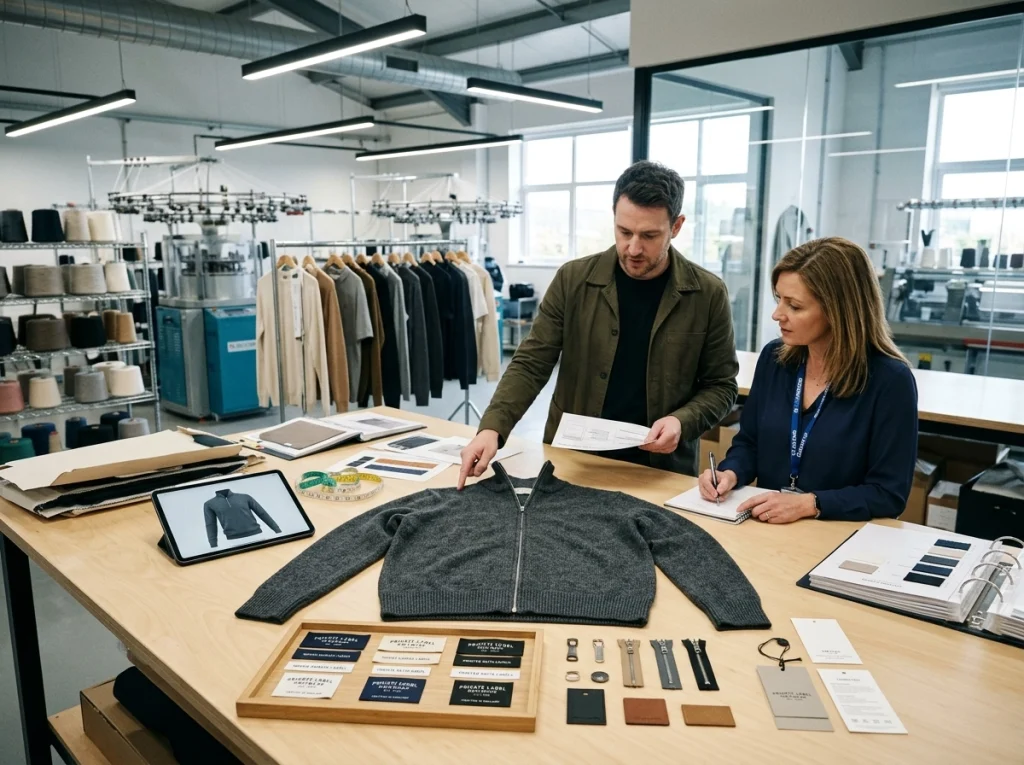
What to Prepare Before Requesting a Quote
For a custom half zip jumper program, a factory needs the following to give you a meaningful response:
- Tech pack or annotated reference garment: including finished measurements, zipper length from collar base, collar height, and fit direction
- Yarn specification or hand-feel reference: e.g., “7-gauge wool-acrylic blend, matte finish” or a physical swatch
- Target quantities by style and colorway
- Delivery window and destination port: for accurate shipping cost and production scheduling
- Label and packaging requirements: neck labels, care labels, hangtags, polybags, barcode format
- Compliance or testing requirements: any certification or inspection your retail channel demands
If you don’t have a full tech pack, a clear reference garment plus detailed annotated photos is a workable starting point with a factory that has ODM capability. Expect one or two additional sampling rounds to confirm the spec compared to a fully documented brief—build that into your timeline.
QC Checkpoints Specific to Zip Knitwear
Zip knitwear carries quality risks that don’t apply to standard pullovers, and these are worth confirming your factory checks explicitly before bulk sign-off.
Zipper function: Open and close the zipper 20–30 times on the PP sample. The slider should run without catching, and a self-locking mechanism should hold at any point along the track.
Placket flatness: Check the placket open and closed on a flat surface. Any wave or pucker at the PP sample stage should be resolved before bulk production begins—it will not self-correct in a production run.
Collar-to-zip transition: The junction where zipper tape meets the collar facing is a stress point. Check for puckering or twisting; this area is also where seam stress concentrates during wash testing.
Shade continuity across colors: In multi-colorway programs, sign off all lab dips before bulk cutting. Shade variation across a size run is one of the most common drivers of knitwear returns.
Wash and pill testing: If your retail channel has specific requirements—Martindale pilling, OEKO-TEX, or CE compliance—confirm these before sampling starts, not after bulk is cut and the cost is already committed.
A pre-shipment AQL inspection at AQL 2.5 is standard for most apparel programs and worth building into your PO terms from the outset.
Conclusion
A mens half zip jumper program done well is one of the more straightforward wholesale investments in knitwear. The silhouette is established, end-consumer demand is genuine and growing, and the manufacturing process is well understood. The decisions that make or break the program happen early—fiber and gauge selection, zipper hardware spec, placket construction, and PO timing relative to the production calendar.
From a factory perspective, the buyers who achieve the most consistent results are those who arrive with clear specs, realistic timelines, and an understanding of where the real cost drivers sit. The zipper placket is an unforgiving detail. Get it right in sampling, and bulk will hold.
If you’re planning a mens half zip jumper or a broader knit hoodie and zip knitwear program, start with a clear brief and an open conversation about gauge, fiber, and seasonal timing before locking in your first sample request. Get in touch with the team at CNSweaters—we support programs from initial development through to private label shipment.
FAQ
What is the realistic MOQ for a wholesale half zip jumper program?
Most dedicated knitwear factories start at 200–300 pieces per style, with a minimum of 50–100 pieces per colorway. Smaller entry MOQs may be available for simpler constructions, but expect unit costs to be higher. If you need a smaller first order to test the market, ask your factory about pre-booking yarn to avoid delays when your first refill order comes in.
How long does development take from first sample to delivery?
Budget 12–16 weeks for a first-time style, covering sampling, PP approval, bulk production, and sea freight. Replenishment of a confirmed style with pre-booked yarn can run 6–8 weeks. Air freight compresses shipping to 3–5 days but increases landed cost meaningfully—factor that into your margin before committing to it as a standard mode.
What’s the difference between OEM and ODM for a half zip program?
In OEM, you provide the complete specification and the factory executes it. In ODM, the factory contributes development input based on a brief or direction you provide. For a half zip jumper where you already have a clear reference or existing style, OEM is typically faster and lower-risk. ODM makes more sense when you’re developing a new silhouette or want the factory’s input on gauge, fiber, and construction before committing to a spec.
Which fiber works best for a mens half zip jumper at wholesale scale?
A wool-acrylic blend—typically 70/30 or 50/50—is the practical default for most mid-market wholesale programs. It delivers good warmth and hand-feel, is generally machine washable, and supports a wider retail price range than pure merino. Pure merino is worth the premium when your channel can support the retail price and communicate the fiber benefit clearly. Full acrylic works for price-competitive distribution but carries a real pilling risk around the collar on a zip-neck style.
Can I add private label branding to a wholesale half zip jumper order?
Yes. Most OEM knitwear factories support full private label setup: neck labels, care labels, woven or printed hangtags, polybag packing, and export cartons. Confirm your brand standards—label dimensions, care instruction language, barcode format—at the RFQ stage so they’re costed and scheduled into production from the start, not treated as an afterthought.
External References
- Vogue Arabia — The Quarter-Zip’s Quiet Takeover: Seen Through Street Style (and a Chanel Show) — https://www.voguearabia.com/article/the-quarter-zip-trend
- NPR — Gen Z turns the quarter-zip into TikTok’s coolest menswear staple — https://www.npr.org/2025/12/05/nx-s1-5628995/gen-z-turns-the-quarter-zip-into-tiktoks-coolest-menswear-staple