 CN Sweaters
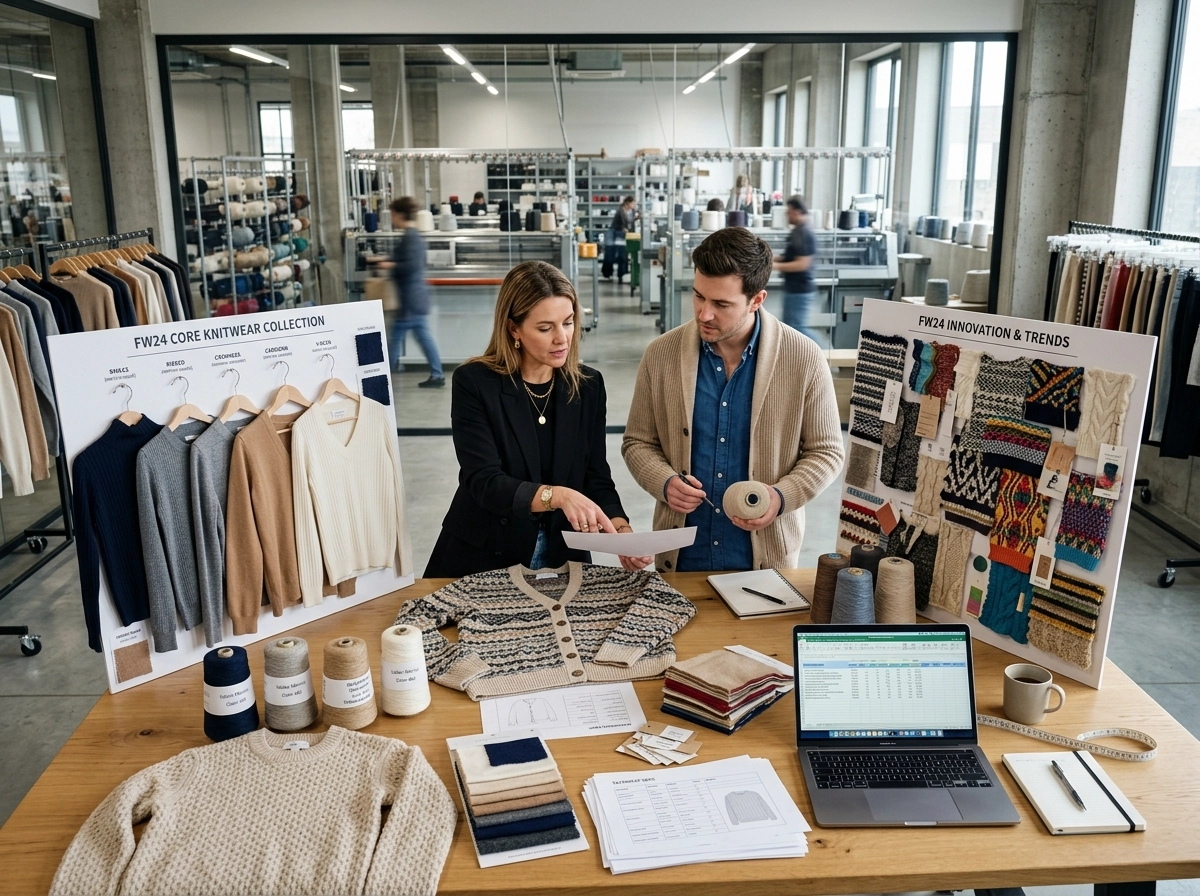
If you’re a wholesale knitwear buyer or a brand structuring its range for 2026, the pressure to simplify isn’t a trend—it’s a structural shift backed by market data. Buyers who build around a small set of reliable, repeatable core styles are holding margins better, reordering more successfully, and carrying less dead stock than those who entered the year with broad, trend-driven lineups.
McKinsey’s State of Fashion 2026 puts the broader context plainly: inventory days on hand hit an all-time high in 2024, sitting 14% above pre-2020 averages, while 80% of consumers are now actively showing value-seeking behavior. Brands across the industry are trimming assortments to control working capital and reduce exposure. In knitwear, that logic plays out in very specific production and sourcing terms.
This article is for wholesale buyers, brand owners, private label operators, and procurement managers deciding how to structure their knitwear range—whether you’re sourcing wholesale sweaters for the first time or re-evaluating a collection that’s grown too wide. We’ll cover what’s driving the shift, what it looks like on the production side, and how to apply a tighter range logic without losing commercial viability.
The Market Is Pushing Buyers Toward Fewer Styles
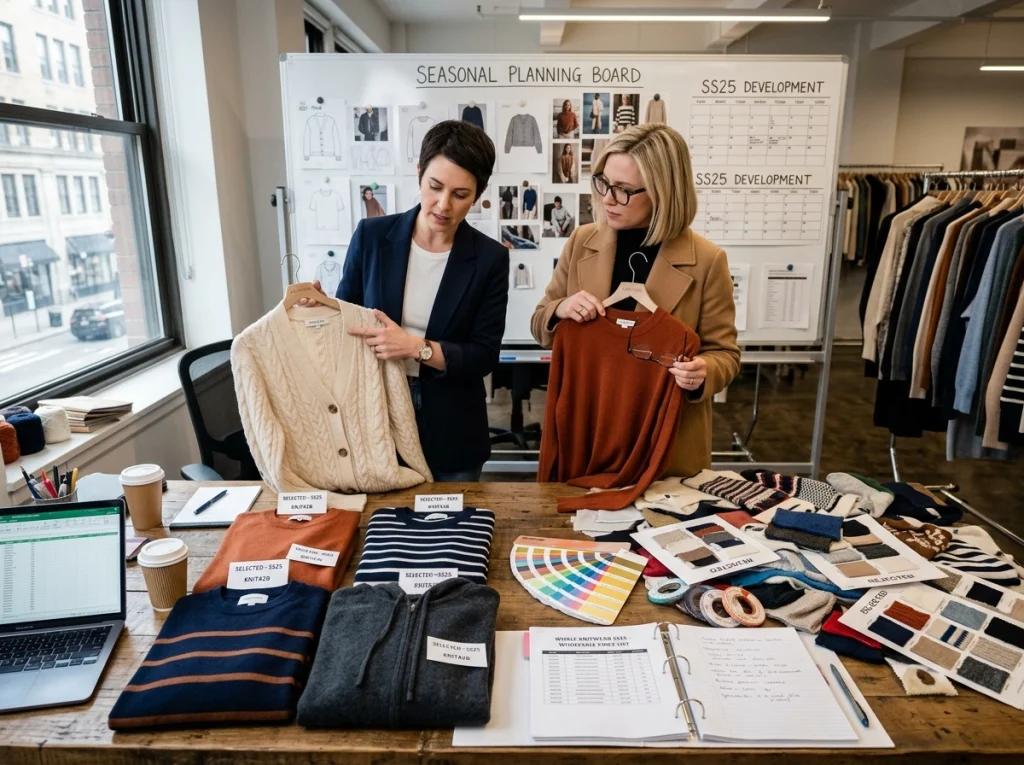
What the buying data says about 2026
The 2026 wholesale environment has a clear signature: caution. According to McKinsey’s State of Fashion 2026, 46% of fashion executives expect industry conditions to worsen this year—up 8 percentage points from 2025. Tariffs have raised apparel prices by roughly 35% from a first-cost perspective, and consumers are responding by waiting for sales, switching retailers, and delaying discretionary purchases.
That shift in consumer behavior flows directly into wholesale buying decisions. Retailers are reluctant to place early commitments when landed costs change month to month—a dynamic that Vogue Business confirmed in its analysis of 2026 supply chain forces. For buyers, this means less certainty around sell-through, which in turn means less appetite for styles that haven’t already proven themselves.
How this is reshaping knitwear order patterns
From a factory perspective, the change is visible in how purchase orders are being structured. JOOR’s 2026 wholesale trend data confirms the pattern: the share of brands producing a full new collection each season has steadily declined from 2023 to 2025, while the number developing smaller capsule collections has risen sharply. Evergreen styles—those that carry across seasons without major redesign—have moved from fallback category to primary business driver.
In practical terms, this means fewer new development requests per season and more “same construction, new colorway” orders. It also means buyers are approaching sampling with more scrutiny, asking whether a style justifies its development cost before committing to the process.
Why Overbuilt Collections Create Problems That Compound
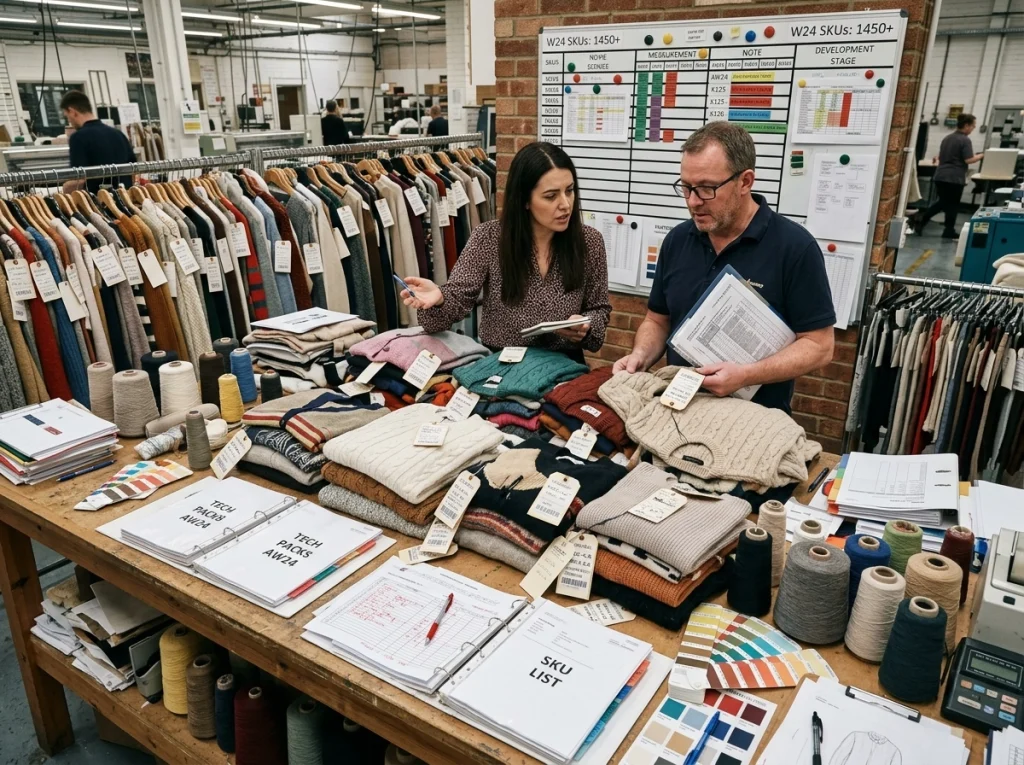
Every new style adds cost and lead time
The relationship between style count and total production risk is direct, and it’s regularly underestimated until the second or third season. Each style in a knitwear collection isn’t just a different design—it requires its own yarn sourcing confirmation, gauge selection, tension calibration, and at least one sample round before it’s ready for bulk production.
A 20-style collection and a 6-style collection don’t just differ in SKU count. They differ in sample cost, revision cycles, QC scope, and total lead time exposure. The table below shows how style count affects the key production variables wholesale buyers actually care about:
| Factor | Focused Range (5–7 Styles) | Broad Collection (15–20 Styles) |
|---|---|---|
| Sampling cost per season | Lower; fewer spec packages to manage | Higher; more yarn matching, more sample rounds |
| Lead time risk | Predictable; factory knows the construction | Higher variation; each new style needs setup time |
| QC consistency | Easier to hold standards on familiar builds | More variables per inspection lot |
| MOQ efficiency | Units concentrated on proven styles | MOQ spread thin; harder to hit minimums cleanly |
| Refill capability | High; factory can repeat with minimal re-setup | Low; new styles rarely reach stable repeat status |
| Inventory exposure | Lower; sell-through is more predictable | Higher; slow movers tie up capital across seasons |
This isn’t an argument against all complexity. It’s an argument for making sure complexity earns its place.
MOQ traps and the real cost of dead inventory
The MOQ reality in knitwear wholesale is worth being specific about. Most China knitwear factories set minimums per style, per color, per size run—not per order total. A 30pcs-per-color-per-size minimum sounds manageable for a core crewneck in three colorways, but it scales quickly when you’re also trying to hit MOQ on a textured stitch pattern, a different yarn weight, and a new silhouette all in the same purchase order.
Buyers who spread a fixed budget across too many styles often end up failing to hit MOQ efficiently on any of them—or they meet MOQ on styles that don’t sell, resulting in leftover stock. In 2026, that outcome carries a higher cost: new legislation in Europe and California is tightening rules around unsold inventory and take-back requirements, adding financial consequences to dead stock that didn’t exist at the same level in prior seasons.
What Makes a Core Knitwear Style Worth Building Around
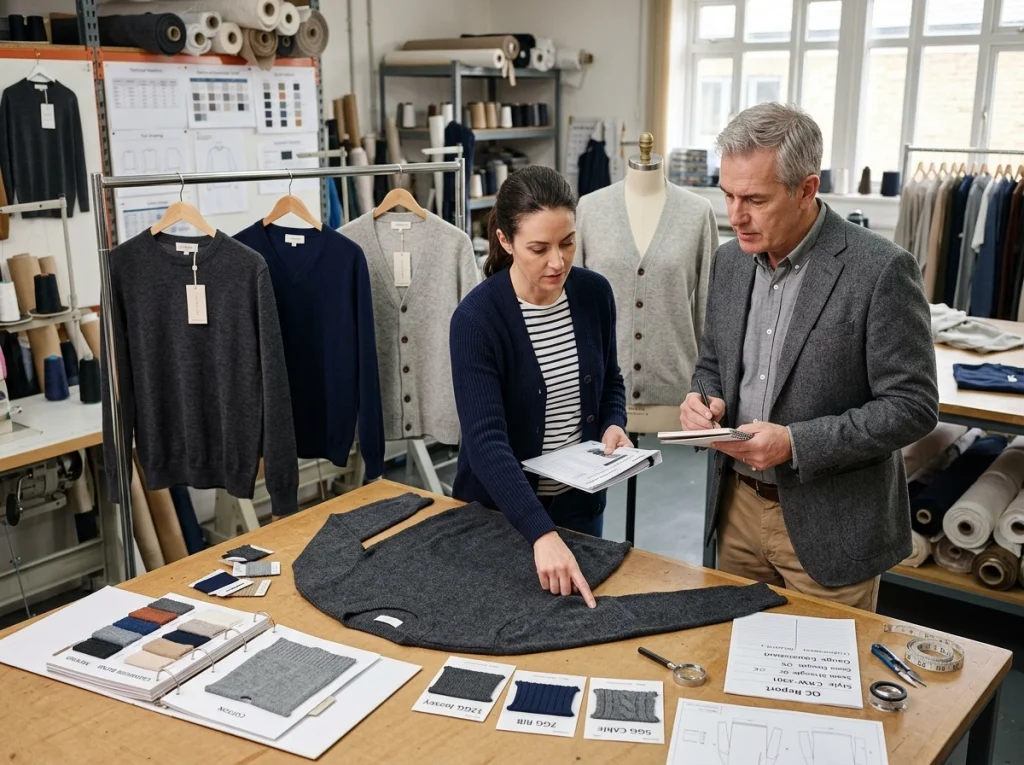
Construction and material decisions that stay repeatable
Not every style can be a core, and knowing which ones qualify is a genuine sourcing skill. From a factory perspective, the styles that reorder most reliably tend to share a few characteristics.
Standard gauge constructions—5GG for chunky builds, 7GG for mid-weight, 12GG for fine-gauge—are easier to reproduce consistently than novelty or specialty gauges. They’re also faster to troubleshoot if a quality issue appears in bulk, because the machines, linkers, and QC benchmarks are already calibrated from prior runs. Proven yarn blends—merino/acrylic, cotton/nylon, or established wool blends—carry less risk of hand-feel variation between seasons, especially when you’re ordering from the same factory across multiple POs.
Silhouette matters too. A classic crewneck pullover, a V-neck with a clean rib finish, or a longline open-front cardigan—these constructions don’t need a trend moment to justify their place in a wholesale catalog. That independence from trend cycles is exactly what makes them worth anchoring a range around.
Private label execution on stable constructions
One practical advantage of a stable core style is that private label setup becomes repeatable. When the construction is consistent across orders, label placement, packaging specs, and compliance documentation can all be standardized. Getting private label details wrong on a new construction is one of the most common causes of final inspection delays—it’s not a small operational detail.
With a repeating core construction, the factory already knows where the woven label sits, how the hangtag attaches, and what the approved measurement spec looks like. This reduces first-shipment risk and makes onboarding a new retail partner significantly more straightforward. For buyers building a private label knitwear program, a stable construction base is often the difference between a smooth launch and a season of corrections.
How to Build a Range That Stays Lean Without Losing Commercial Appeal
A practical framework for deciding what makes the cut
A workable structure is to think of your range in two tiers. Tier one is core: styles that have sold through cleanly, have been reordered at least once, and can be offered in multiple colorways without major spec changes. Tier two is seasonal: two or three styles that introduce freshness each season without displacing the foundation.
Before adding any new style to tier two, it helps to ask a few honest questions. Can this style be reordered if it sells well? If the answer requires re-sampling, re-confirming yarn availability, and recalibrating machine settings, it’s effectively a one-season commitment—and it should be budgeted and risk-assessed as one. Will this construction work in three colorways? A style that only performs in a single specific color is harder to hit MOQ on across a full size run. Can the spec be written clearly enough to pass QC inspection consistently? Vague spec packages produce inconsistent results, and inconsistent results on a low-volume style cost disproportionately more to resolve.
When a statement style is worth developing—and when it isn’t
There’s a reasonable case for one statement piece per season, particularly when targeting boutiques or specialty retailers who expect some seasonal distinction in your range. The trade-off is known: a statement style costs more to develop, carries more inventory risk, and rarely transitions into a repeat. That’s an acceptable risk if the style serves a specific commercial purpose—opening a new account, testing a silhouette before committing to it as a potential core, or responding to a specific retail request.
What’s harder to defend is a collection where most styles fall into the statement category by default. That’s not range-building; it’s sample accumulation with a shipping address. For buyers who want to explore technically complex designs, working with a factory that has dedicated custom knitwear development capability at least ensures the process is structured—with scoped sampling costs and clear decision points before bulk is committed.
Working with a China Knitwear Supplier on a Lean, Repeat-Friendly Range

Why focused collections are easier to execute with consistent quality
A smaller, more focused range isn’t just better for inventory management—it’s also easier for the factory to execute with stable quality across multiple production runs. When the same construction is repeated season after season, machine settings, yarn lots, and QC benchmarks stay aligned. There are fewer variables per inspection lot, and when defects appear, they’re faster to trace and resolve because the production baseline is well understood.
This is particularly relevant in knitwear, where quality is sensitive to small variations. Gauge drift, tension inconsistency, and linking quality are all harder to control on a first-run construction than on a familiar one. From a factory perspective, a buyer who returns with the same five or six styles each season is a buyer whose quality expectations can be met reliably—because both sides have the same reference point.
Lead time, refill orders, and the off-season timing advantage
For core styles, a bulk reorder moves faster than a new development. The sampling phase is either eliminated or reduced to a pre-production sample (PPS) for color approval, which saves weeks of calendar time. Yarn sourcing is faster when the mill relationship is established and the blend specification hasn’t changed. If the factory holds your spec on file, the efficiency gain on reorders is measurable.
Timing also affects cost and capacity access. In knitwear manufacturing, the off-season—broadly February through July—is when factories carry more scheduling flexibility, raw material pricing is more stable, and production capacity is easier to confirm. Buyers who place core reorders during this window consistently secure better pricing and more reliable lead time commitments than those ordering in the peak season from August onward, when machine allocation fills quickly.
For buyers managing a repeat-heavy range, this creates a clear planning window: lock in core reorders in Q1 or early Q2, confirm yarn and capacity, and use the peak season for delivery rather than development scrambles. New style development, if it’s part of the season plan, can be scoped during the same off-season period so it doesn’t compress production time when demand is highest.
The Trade-offs Worth Being Honest About
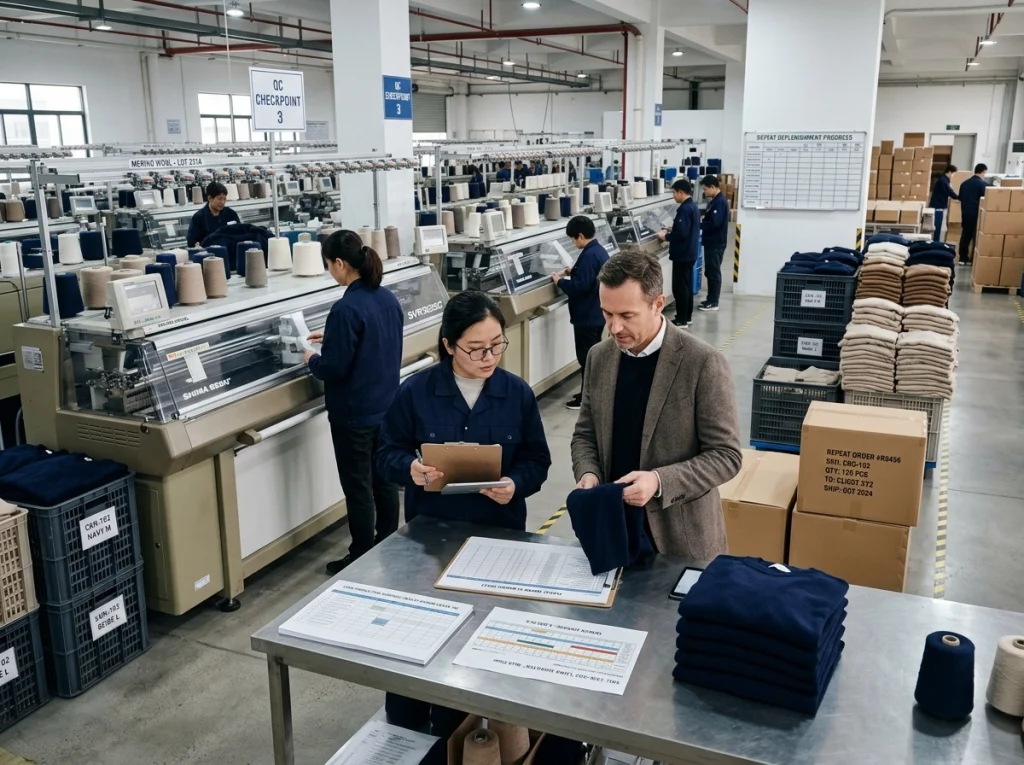
A lean, core-focused range is not the right structure for every situation.
If you’re entering a wholesale knitwear category for the first time, some breadth in your early sampling makes sense. You can’t identify which styles will become your core until you’ve tested a few against real retail environments. The risk is acceptable at the sampling stage; it becomes expensive at bulk. First-season buyers should think of their initial range as a learning investment, not a permanent structure.
If you supply retailers who have a contractual expectation of seasonal freshness—fashion department stores being the clearest example—a purely core-style approach may not meet their range requirements. The practical response is a structured rotation: keeping your core in place while introducing one or two new styles each season through a deliberate development process. That’s different from replacing the whole collection, and it’s sustainable.
The focused-range approach also has limits when your target markets have materially different fit or fiber requirements by geography—EU and US sizing standards, or yarn preferences that vary by climate region. These are manageable variables, but they need to be planned at the spec stage, not discovered at final inspection.
Conclusion
The direction in wholesale knitwear for 2026 is toward concentration rather than expansion. Consumer caution, rising inventory costs, tightening unsold-stock regulations, and a market environment that rewards efficiency over novelty all point the same way: a tighter range, built around styles that earn their place through proven sell-through and refill performance, is a more defensible commercial position than a broad collection built to cover all possibilities.
For practical next steps: audit your current range and identify which styles have been genuinely reordered, which have sold through cleanly without markdown pressure, and which are sitting as slow-moving stock. The styles that have earned their place are your core. Build the structure around them, apply discipline to what gets added, and use off-season timing to secure production capacity before it becomes expensive.
If you’re making sourcing decisions for 2026—building a private label range from scratch, streamlining an existing one, or planning bulk reorders for core styles—Cainan Knitwear works directly with brands on both new development and repeat production, with clear MOQ structures, in-house sampling, and AQL-standard QC that scales with your order size.
FAQ
What’s the typical MOQ for core wholesale knitwear styles from a China factory?
MOQ in China knitwear manufacturing is generally set per style, per color, per size run—not as a total order minimum. A common starting point is 30 pieces per color per size. For a core style offered in three colors across four sizes, that means planning for a minimum of 360 pieces before factory economics work cleanly in your favor. Concentrating your units on fewer styles rather than spreading across many is one of the most reliable ways to keep per-unit cost down and MOQ compliance manageable.
How does lead time differ for a repeat core style versus a newly developed one?
A new style requires full sampling—yarn confirmation, gauge setup, linking calibration, and at least one revision round—before it’s ready for bulk. Depending on revision cycles, that adds three to six weeks to your total timeline. A core style on repeat may only require a pre-production sample for color confirmation, cutting lead time significantly. If the factory already holds your approved spec on file, repeat orders can move faster still.
Can I include trend-driven styles if my range is built around core pieces?
Yes—and for most wholesale knitwear ranges, that structure is right. The core provides stability and reorder efficiency; one or two seasonal additions provide freshness without replacing the foundation. The problem arises when most of a collection consists of untested, first-season styles with no sell-through track record. At that point, sampling costs, MOQ inefficiency, and inventory risk all compound at once, rather than being isolated to a contained portion of the range.
What makes a knitwear construction more likely to become a reliable repeat style?
Standard gauge (5GG, 7GG, or 12GG), proven yarn blends with consistent supplier availability, clean silhouettes that don’t depend on a specific seasonal trend, and specs that can be written precisely enough to pass QC inspection consistently across multiple runs. Novelty constructions—unusual stitch patterns, mixed materials, atypical gauge ranges—introduce more variables and are harder to reproduce precisely. They can contribute to a range, but they rarely develop into core repeaters.
When is the best time to place core knitwear reorders to get better pricing and capacity?
In China knitwear manufacturing, the off-season runs broadly from February through July. During this window, raw material pricing is more stable, factory scheduling has more flexibility, and production capacity is easier to confirm well in advance. Buyers who place core reorders in Q1 or early Q2—even for delivery in Q4—consistently get better pricing and more reliable lead time commitments than those ordering during the August-to-January peak. Locking in off-season capacity is one of the most straightforward cost controls available for buyers managing a repeat-heavy range.
External References
- McKinsey & Company — The State of Fashion 2026: When the Rules Change
- JOOR — Top 5 Wholesale Trends for 2026
- Vogue Business — The Forces That Will Shape Fashion’s Supply Chains in 2026