 CN Sweaters
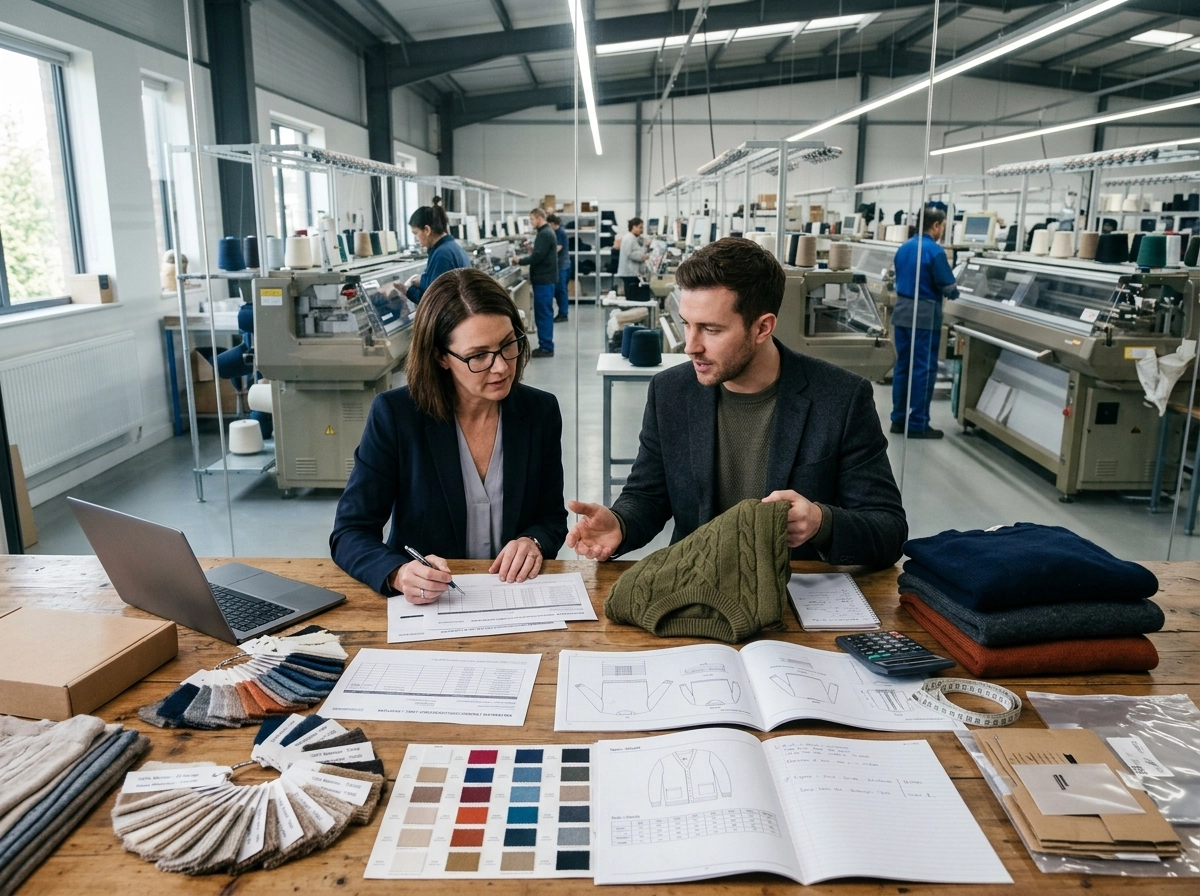
Most sourcing problems don’t begin at production — they begin at the inquiry stage. Brands and buyers who send generic quote requests to wholesale knitwear suppliers often get vague price ranges back, wait weeks for clarification, and still end up with samples that miss the mark. This article is for procurement managers, brand owners, and wholesale buyers who want to walk into a supplier conversation with the right information already in hand.
The nine checks below aren’t a certification process. They’re a practical framework for making sure you and a potential factory are aligned on the fundamentals before anyone spends time on a formal quote.
Why Most Knitwear Inquiries Fall Apart Before They Start
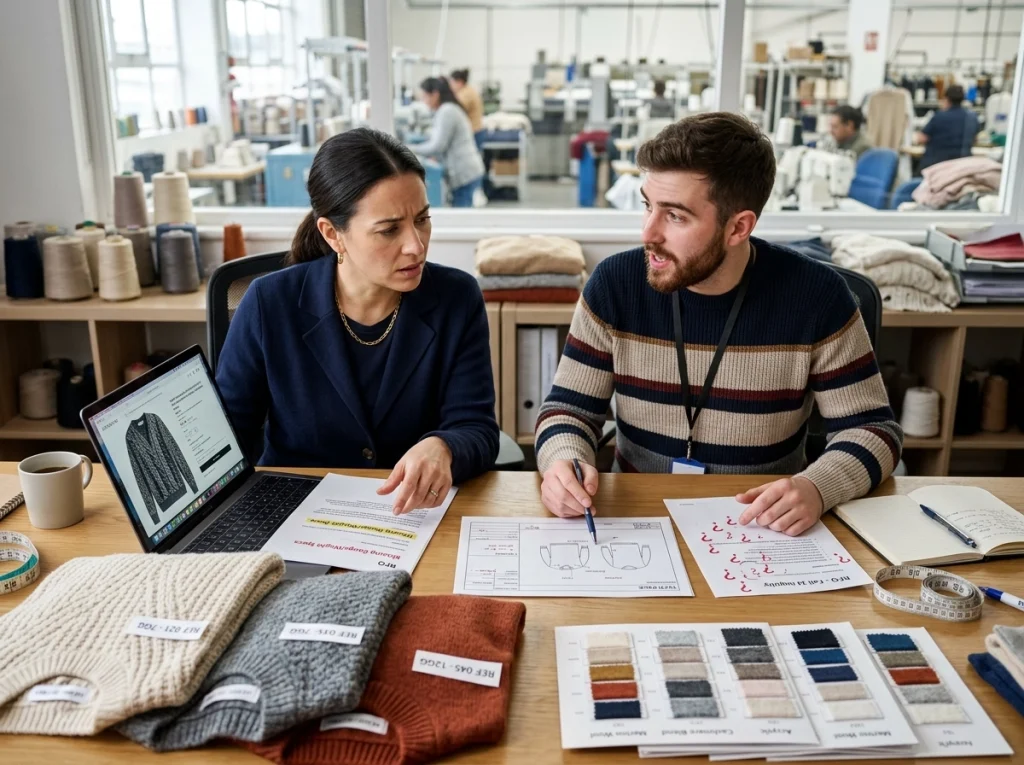
Sending a quote request without preparation rarely saves time. In practice, it creates a longer feedback loop — the factory asks follow-up questions, you chase internal approvals for answers, the initial timeline slips, and the quote that comes back is hedged with assumptions that may not match your actual requirements.
What a Factory Needs to Quote You Accurately
A useful knitwear quote requires more than a product category and a target price. Factories need to know yarn type and composition, gauge preference, construction method (fully fashioned vs. cut-and-sew vs. seamless), target markets (which drives labeling and compliance requirements), expected order quantity per style, and whether you’re starting from a tech pack or need design development support.
Without these inputs, a quote is essentially a guess. It may come back low to win your attention, only to be revised upward once sampling begins and the real complexity becomes clear. That’s a waste of everyone’s time and a common source of broken supplier relationships.
How Being Unprepared Inflates Costs and Delays Timelines
From a factory perspective, a half-specified inquiry creates rework from day one. If a buyer requests a sample without confirming yarn composition, the factory either makes an assumption — which may require a re-sample — or pauses to ask, which adds days or weeks before physical development begins. Multiply this across two or three revision rounds, and what should be a four-week sampling process becomes ten.
Being prepared doesn’t mean having every technical detail locked in. It means knowing what you know and being honest about what still needs factory input. That clarity alone speeds everything up.
Check Production Scope and Category Fit First
Check 1 — Gauge Range, Construction Method, and Product Category
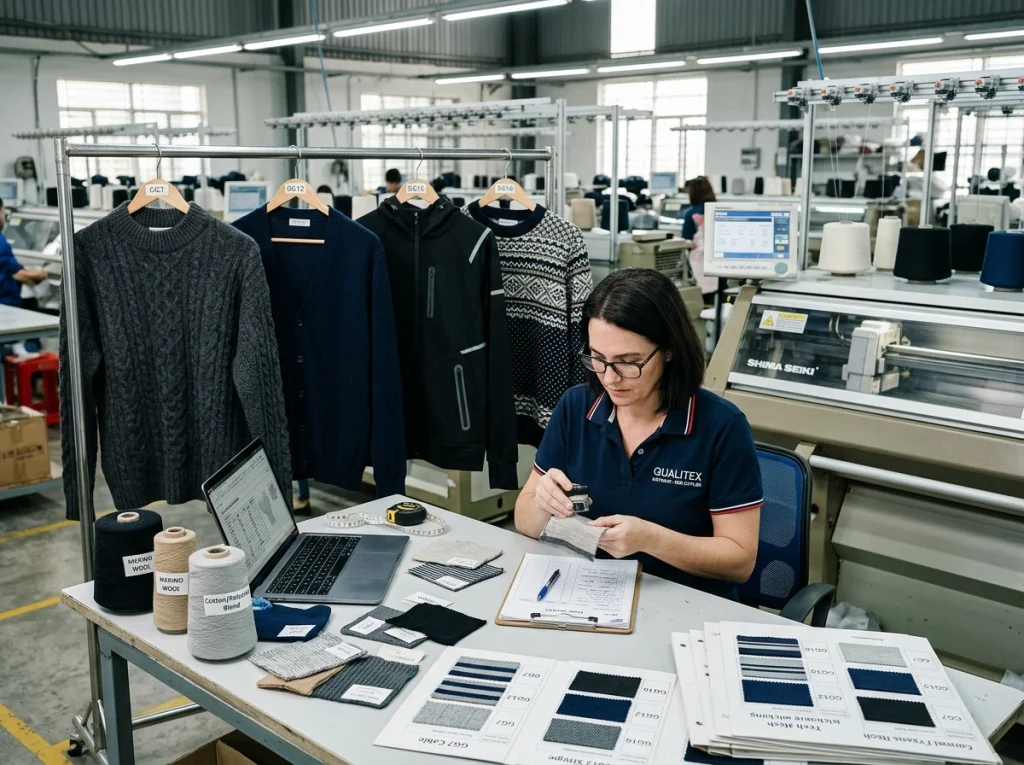
Not all knitwear factories produce the same range of products, and a mismatch here is the most common cause of early-stage supplier failure. A factory specializing in fine-gauge merino knitwear may not have the machine setup or skill base for chunky cable constructions. One focused on cut-and-sew won’t give you the shaping precision of a fully fashioned factory for structured cardigans.
Before reaching out, identify your product category clearly. Are you sourcing classic pullovers and crew necks, tailored button-up cardigans, or more complex pieces with mixed construction? Then verify whether the factory lists that category as a core capability — not just something they’ve done before.
Gauge is a practical filter. Standard knitwear gauges run from 3GG (chunky, bulky texture) up to 14GG or finer (lightweight, smooth, close-to-skin). A factory optimized for mid-gauge production isn’t automatically equipped for either extreme. Ask directly about their machine range and where they do their best work.
Check 2 — OEM or ODM: Which Model Matches Where You Are
This distinction matters more than most buyers realize, and getting it wrong sets up misaligned expectations from the first email.
| OEM (Original Equipment Manufacturing) | ODM (Original Design Manufacturing) | |
|---|---|---|
| What you bring | Complete or near-complete tech pack | A concept, reference image, or brief |
| What the factory does | Executes your specifications | Develops design and construction with you |
| Best for | Brands with in-house design capability | Brands earlier in product development |
| Sample process | Follows your specs closely | Requires collaborative development rounds |
| Key risk | Output quality depends on spec accuracy | More factory influence over final design |
| Development cost | Generally lower | May involve design or development fees |
If you have a detailed tech pack and confirmed yarn selection, you’re following an OEM/ODM service path that’s well-defined and fast to quote. If you’re starting from a mood board or a competitor reference, you’re asking for collaborative development — which is a different scope entirely, and factories that don’t support it will either decline or deliver misaligned results. For more complex construction briefs, reviewing a factory’s custom knit project capabilities is worth doing before you assume standard OEM applies.
Understand MOQ and How Volume Shapes the Quote
Check 3 — What MOQ Actually Means at a Knitwear Factory
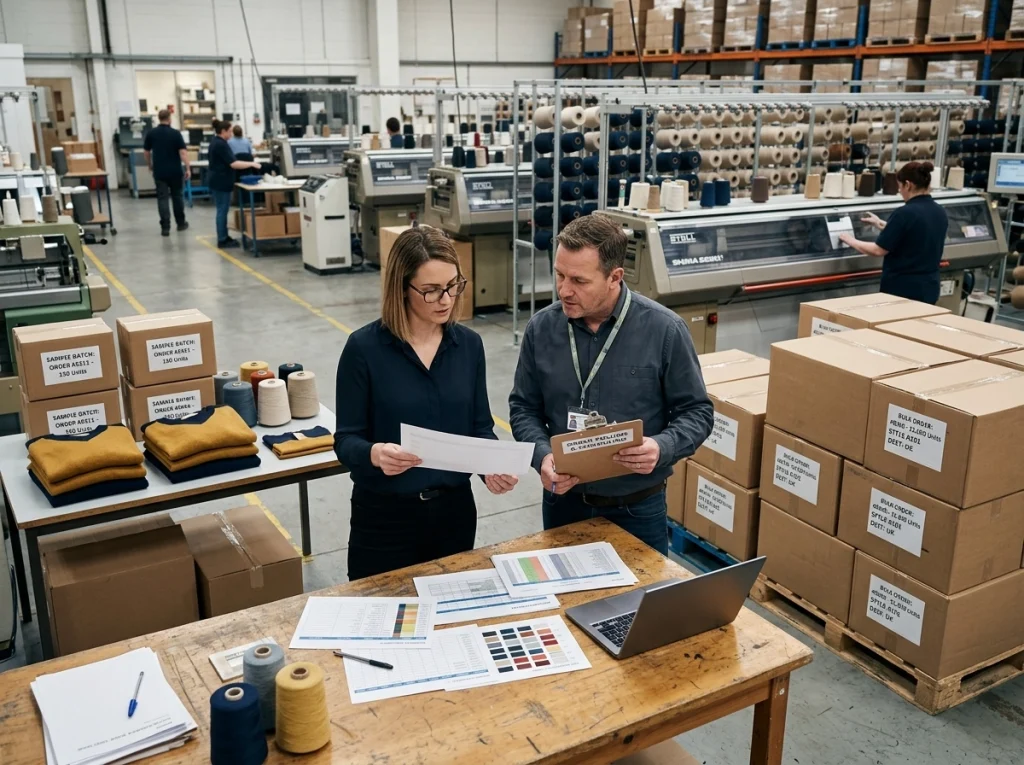
MOQ in knitwear is not an arbitrary number — it reflects real production constraints around machine setup, yarn purchasing minimums, and labor allocation. At most knitwear factories, MOQ is quoted per color per size, not per style total. That distinction matters significantly when you’re planning a multi-color, multi-size run.
A factory may quote 30 pieces per color per size as its minimum. That sounds manageable until you do the math: three colors across four sizes puts you at 360 pieces minimum for a single style. Buyers who assume MOQ means “units per style” often find themselves either over-ordering or locked out of the production schedule.
Clarify the MOQ structure before requesting a price. Ask whether the minimum applies per size, per color, or per style — and ask what happens to pricing when you’re near the minimum versus three to five times over it.
Check 4 — How Volume Affects Machine Allocation and Unit Cost
Here’s a factory-side dynamic that rarely appears in supplier brochures: in knitwear production, a small order and a large order don’t just differ in total output — they differ in how machines are allocated. A small run of a given yarn and gauge occupies one or two machines. A significantly larger run of the same can be spread across multiple machines simultaneously, compressing production time and reducing per-unit cost through better resource utilization.
This means that for small orders, you’re not just paying more per unit because of lower economies of scale — you’re also occupying capacity in a way that limits how the factory can schedule other work. Many factories will accept smaller orders during the off-season, when capacity is available. Fewer will during the August–January peak, when every machine slot is allocated.
Understanding this dynamic helps you negotiate more realistically and set internal margin expectations before a quote arrives.
Clarify the Sampling Process Before You Commit
Check 5 — Sample Fees, Paid Samples, and Refund Conditions
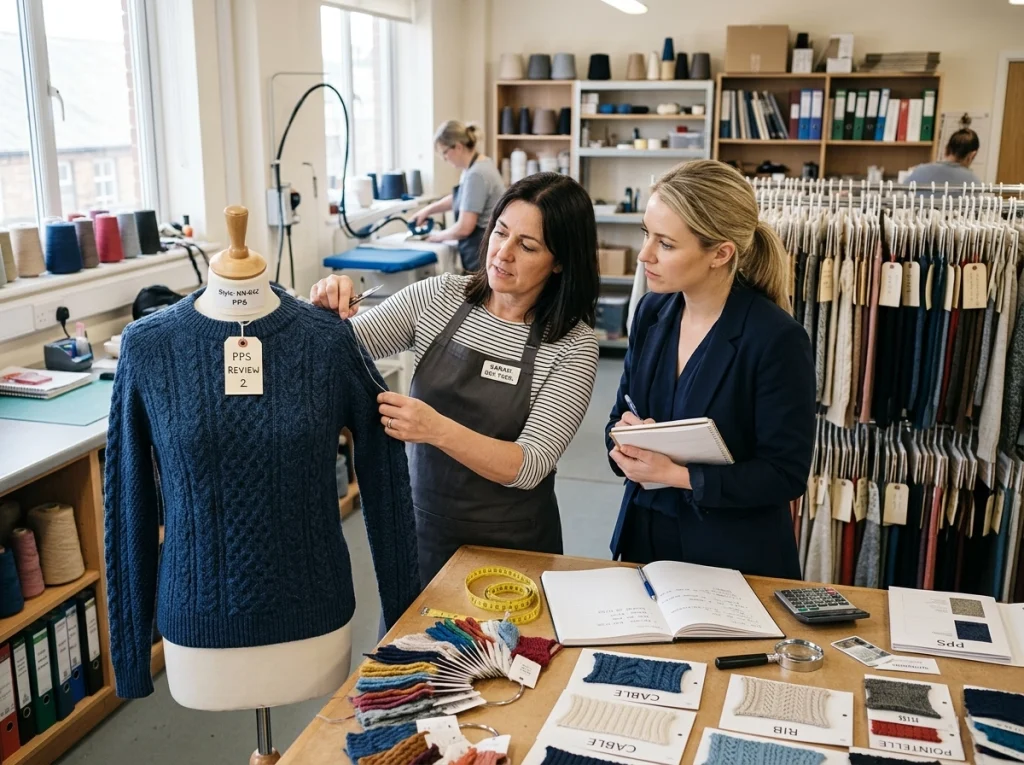
Most knitwear factories charge for samples. This is standard practice and not a red flag. What varies is whether the sample fee is refundable against a confirmed bulk order — and at what minimum quantity the refund kicks in.
A common structure: sample fees are charged upfront and refunded when the buyer places a qualifying bulk order above a threshold. The threshold varies by factory. Knowing this in advance helps you evaluate whether the sampling cost is a sunk expense or effectively a deposit against production.
Free samples are sometimes available, but usually for returning buyers with established order histories, or where the style is close to the factory’s existing catalog. For a custom development — new yarn, new construction, new branding specs — expect to pay. A factory offering free development samples on a complex brief is either absorbing significant cost or cutting corners somewhere. Ask what happens if the first sample misses your spec: Is there a re-sample fee? How many revision rounds are included before additional charges apply? Factories with clear answers to these questions are generally better organized than those that respond vaguely.
Check 6 — PPS Approval and Managing Spec Deviation
Pre-production sample (PPS) approval is the checkpoint between confirmed sampling and bulk production. It’s the stage at which both buyer and factory agree that the construction, yarn, color, measurements, and finish are correct — and authorize the move to bulk.
Skipping or rushing PPS approval is the single most common cause of bulk quality disputes. From a factory perspective, once bulk begins, changes are expensive and disruptive. A buyer who approves PPS without a thorough review and then raises measurement issues after delivery has limited commercial recourse.
Before requesting a quote, ask how the factory handles PPS. Do they send a physical sample for sign-off or manage it digitally? What documentation is generated at this stage? Who is the point of contact for spec queries during sampling? These questions tell you a great deal about how structured and reliable the development process actually is.
Confirm Lead Times and Seasonal Timing
Check 7 — Sample Lead Time vs Bulk Production Lead Time
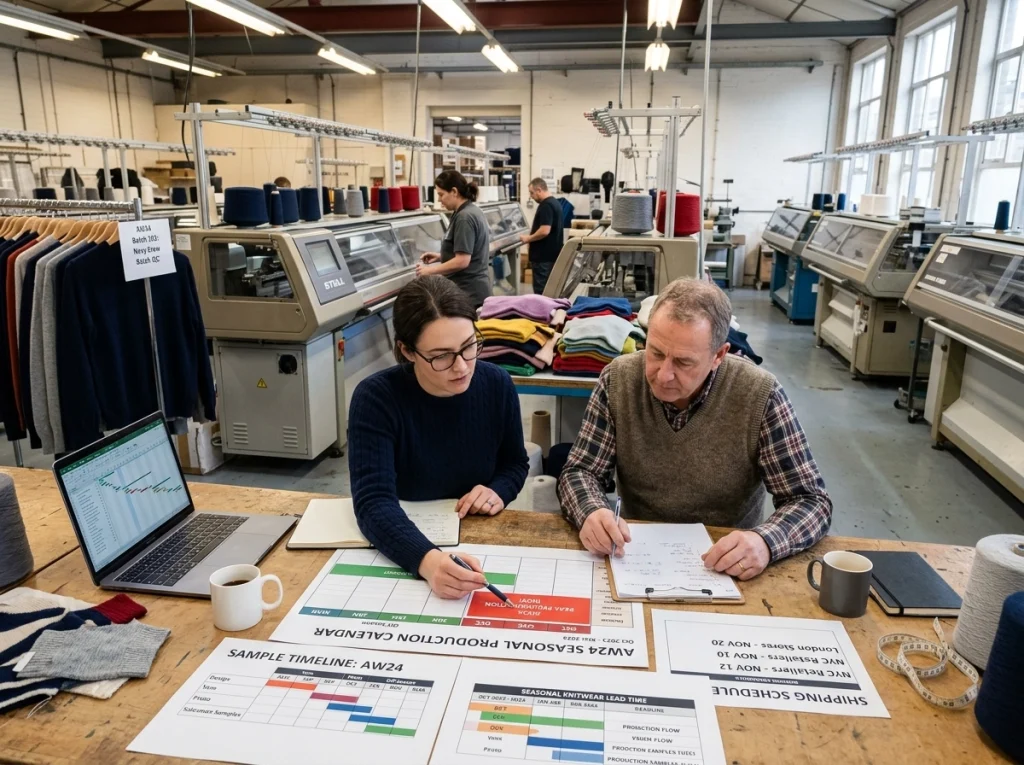
These are two separate timelines and they’re frequently confused. Sample lead time is typically shorter — usually three to seven working days for a standard construction once all materials are confirmed, plus shipping to your location. Bulk lead time depends on order size, construction complexity, and factory capacity at the time of booking.
A common planning error is adding sample lead time and bulk lead time together and treating the sum as total time to delivery. It isn’t. There’s also PPS review time, potential re-sampling rounds, bulk material procurement (which can add two to four weeks if yarn needs to be sourced), and shipping transit. Map each stage separately and build in realistic buffers at each one.
Bulk production lead time for knitwear generally runs longer than for woven or cut-and-sew garments because machine programming, linking, and finishing are all more time-intensive per unit. When asking a supplier for a lead time estimate, specify your confirmed quantity — not a rough range — and ask for the timeline based on current capacity, not theoretical best case.
Check 8 — Off-Season vs Peak Season: How Timing Shifts Costs and Capacity
Knitwear production follows a consistent seasonal pattern. February through July is typically the off-season: factories carry more available capacity, raw material prices tend to be more stable, and they’re generally more willing to accommodate smaller orders or onboard new buyers.
From August onward, demand climbs steadily. Raw material costs rise. Machine capacity fills quickly as domestic and export orders accumulate. Lead times lengthen. Buyers placing orders late in the year often compete for capacity with buyers who committed months earlier.
| Period | Factory Capacity | MOQ Flexibility | Pricing Pressure | Production Lead Time |
|---|---|---|---|---|
| Feb–Jul (off-season) | High | More flexible | Lower | Shorter |
| Aug–Jan (peak season) | Tight | Less flexible | Higher | Longer |
If your target is a fall or winter retail launch, placing orders before late summer is not simply good advice — it’s often the difference between working with your preferred factory and settling for whoever still has slots open.
Verify QC Standards, Documentation, and Supply Chain Stability
Check 9a — AQL Inspection, Inline QC, and What to Request
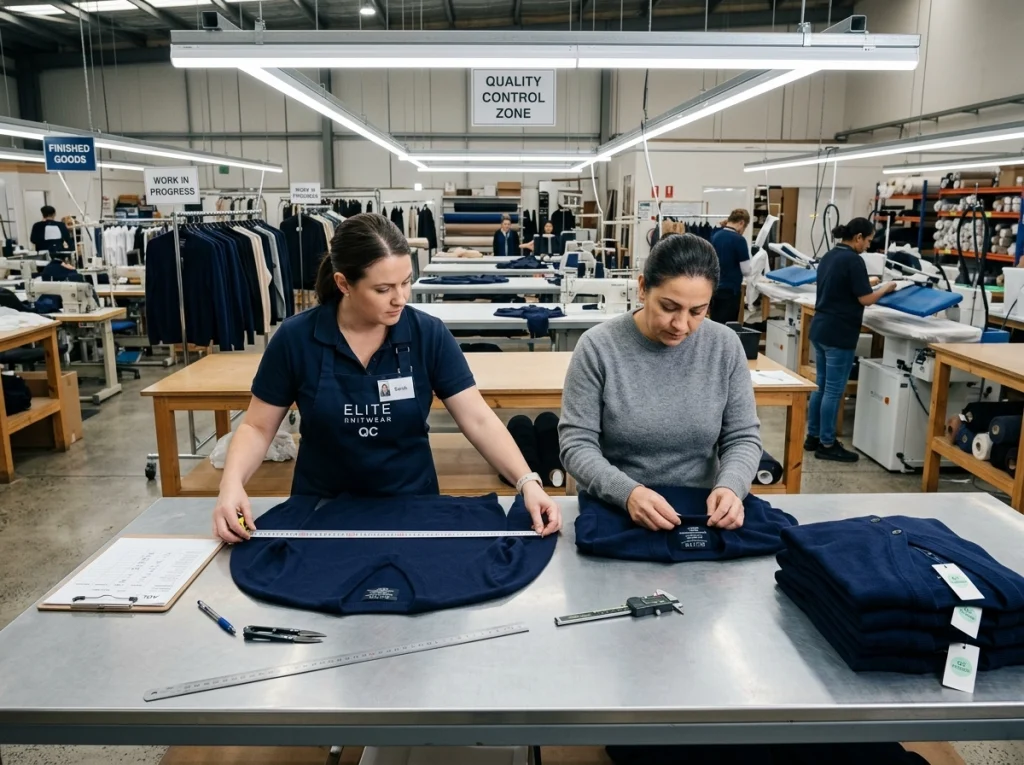
Quality control in knitwear happens at multiple stages: during knitting (tension consistency, stitch uniformity, machine calibration), during linking and finishing (seam integrity, measurement conformance), and at final inspection before packing.
A reliable knitwear manufacturer should be able to describe both their inline and final inspection process clearly. The standard framework for final inspection is AQL (Acceptable Quality Limit) sampling, in which a statistically defined number of units are checked against agreed defect categories. AQL 2.5 at normal inspection level II is a widely used benchmark in apparel sourcing — ask whether the factory works to this or a comparable standard, and what their defect classification categories are.
Documentation worth requesting before or alongside your first bulk order includes: factory certification (specifying which standard it covers), recent AQL inspection records from comparable production runs, and material compliance documents confirming yarn composition and labeling accuracy. Reputable factories keep these on file and provide them on request. If a supplier is reluctant or vague about quality documentation, treat that as a substantive risk, not an administrative detail.
Check 9b — Trade Policy Risk and Supplier Stability in 2026
This check is newer as a practical pre-quote consideration, but it carries more weight today than it did even two years ago.
According to McKinsey’s State of Fashion 2026 report, as reported by Supply Chain Dive, 76% of fashion executives believe higher tariffs and trade disruptions will shape sourcing conditions in 2026. Forty percent named disruptive U.S. trade policy as one of their top three sourcing risks, up from 25% the year prior. In that environment, a supplier’s exposure to tariff risk, their yarn sourcing geography, and their capacity to adapt to shifting trade conditions are legitimate due diligence questions — not premature ones.
From a buyer’s standpoint, asking a potential wholesale knitwear supplier about their raw material sourcing origins, their export history across different markets, and how they’ve responded to tariff-driven cost pressure in recent seasons is reasonable procurement diligence. Suppliers with diversified input sourcing and transparent cost structures are better positioned to offer pricing stability when trade conditions shift unexpectedly. Supplier resilience isn’t visible in a product catalog. It comes out in conversation — in how clearly they explain their cost structure, and in whether they proactively flag risks or wait to be asked.
Conclusion
Wholesale knitwear sourcing rewards preparation. Buyers who arrive at a supplier conversation with a clear product scope, realistic volume expectations, and a working understanding of how knitwear sampling and production actually operate get better quotes, faster timelines, and fewer surprises in bulk. The nine checks in this article aren’t meant to slow down your sourcing — they’re designed to front-load the clarification that would otherwise surface through weeks of back-and-forth emails after an inquiry has already gone sideways.
Use this list as a pre-inquiry checkpoint, not a formal audit. The goal is alignment before commitment, not perfection before contact.
When you’re ready to move forward, share your brief with us at Cainan — tech pack or concept, target price, and delivery window. We’ll come back with yarn options, a realistic production timetable, and a quote that reflects your actual requirements.
FAQ
How many wholesale knitwear suppliers should I contact before choosing one?
Three to five is a reasonable range for a first sourcing round. Contacting fewer limits your benchmarking data; contacting significantly more creates coordination overhead without proportional benefit. Prioritize suppliers whose stated capabilities match your product category, and use the checks in this article to filter before you reach out.
Can I request a knitwear quote without a tech pack?
Yes, but the quote will be less accurate. A rough brief — product type, yarn preference, target silhouette, approximate quantity — is enough to get a ballpark range. A full tech pack with measurements, construction spec, and yarn composition produces a quote you can actually build a margin model on. If you don’t have a tech pack yet, ask whether the factory offers development support, or review their custom knit project services to understand what design input they can provide.
What’s a realistic timeline from sample approval to bulk delivery?
Under normal conditions and assuming no significant spec changes after PPS approval, most knitwear bulk orders deliver 60 to 90 days after production is confirmed. Add four to six weeks for initial sampling and review before that, plus additional buffer if you’re developing a new construction or sourcing a non-standard yarn. Map each stage backward from your target in-store or warehouse date, not forward from when you send the first inquiry.
What’s the practical difference between a private label sweater supplier and an OEM manufacturer?
The terms overlap significantly in practice. A private label sweater supplier typically offers finished or near-finished styles that you customize with your branding — labels, hangtags, and packaging. An OEM manufacturer produces to your specifications from a tech pack. Many factories support both models. When evaluating a supplier, ask specifically whether they handle full spec-driven OEM production, catalog-based private label programs, or both — and which represents the majority of their work.
How do I evaluate a reliable knitwear manufacturer I’ve never worked with?
Start with documentation: ask for factory certifications, recent AQL inspection records, and material compliance files. Then assess communication quality — how quickly they respond, how precisely they answer technical questions, and whether they proactively flag constraints or wait to be asked. For higher-value initial orders, a third-party pre-shipment inspection is worth building into your sourcing budget before you’ve established a track record with that factory.
External References
- Supply Chain Dive — 4 fashion supply chain trends to watch in 2026 https://www.supplychaindive.com/news/fashion-supply-chains-2026-risks-and-trends/812006/
- McKinsey & Company / Business of Fashion — State of Fashion 2026 https://www.mckinsey.com/industries/retail/our-insights/state-of-fashion