 CN Sweaters
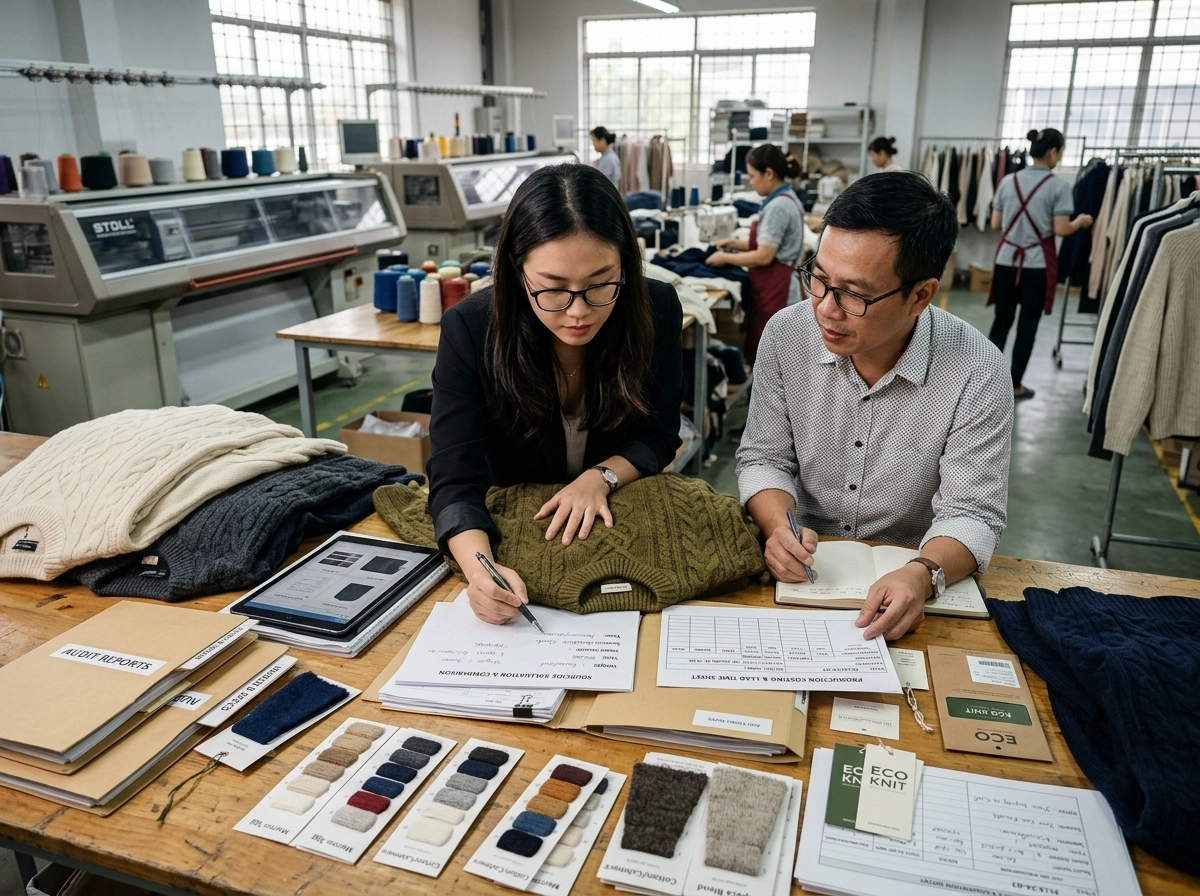
Compare knitwear manufacturers on the same decision file, not on a headline unit price. Before choosing a supplier, a private-label team should be able to compare the quoted assumptions, sample response, technical records, inspection plan, communication protocol, and repeat-order controls.
Use the first quotation and sample to expose what is unknown. Require each supplier to name the input versions, open decisions, change process, acceptance rule, and documents available for the actual order. This is a buyer comparison framework, not a claim about a supplier’s MOQ, lead time, capacity, certification, or finished-goods result. Create a comparison matrix before the call: each row should identify the evidence, its date, the supplier response, the buyer owner, and the next release or hold decision. Do not replace a missing record with a general verbal assurance; flag it as an unresolved material condition in the supplier comparison.
Which quote assumptions must be compared with price?
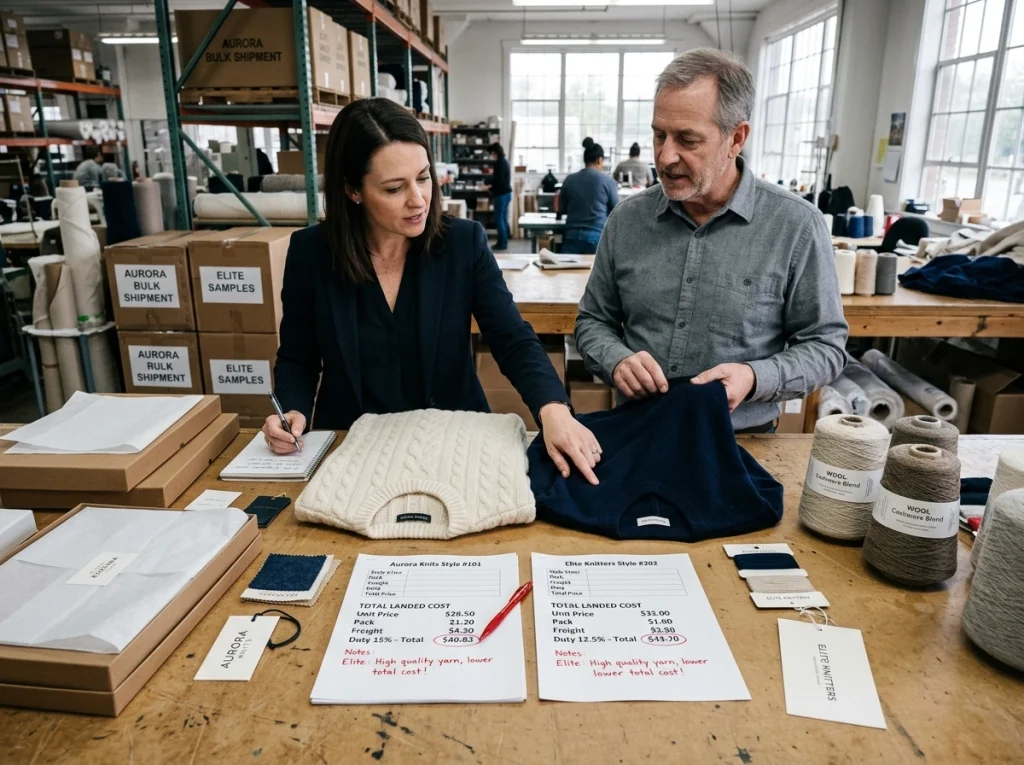
Price shopping across knitwear manufacturers is a reasonable starting point, but a poor
finishing line. The factory with the lowest per-unit quote doesn’t always deliver the
lowest landed cost — and for private label buyers managing tight seasonal margins, that
distinction matters.
Which cost inputs should be made visible?
Landed cost includes production price, but it also includes freight, duties, packaging
materials, rework, delays, and the internal labor your team spends managing a difficult
supplier. A factory that quotes 15% less per piece but requires three rounds of sampling
corrections, ships late, and delivers inconsistent measurements across colorways will cost
you more in practice than one that priced the job fairly from the start.
From a factory perspective, low quotes often reflect one of a few realities: thinner yarn,
faster but less controlled linking, or a lead time that assumes zero complications. None
of those assumptions hold under real production conditions — especially on private label
knitwear where gauge, weight, and hand-feel are part of your brand positioning.
Which evidence should sit beside the quote?
Most buyers open with price, MOQ, and lead time. Experienced buyers add a longer list:
Comparison item
Quote assumptions, MOQ unit, technical inputs and delivery dependencies.
Evidence to request
Sample/POM record, dated plan, inspection method, change log and order-scoped documents.
Decision rule
Compare only like-for-like inputs; hold bulk approval while an important condition is unknown.
Price will always be in that table. It just shouldn’t dominate it.
Which sample records reveal supplier control?
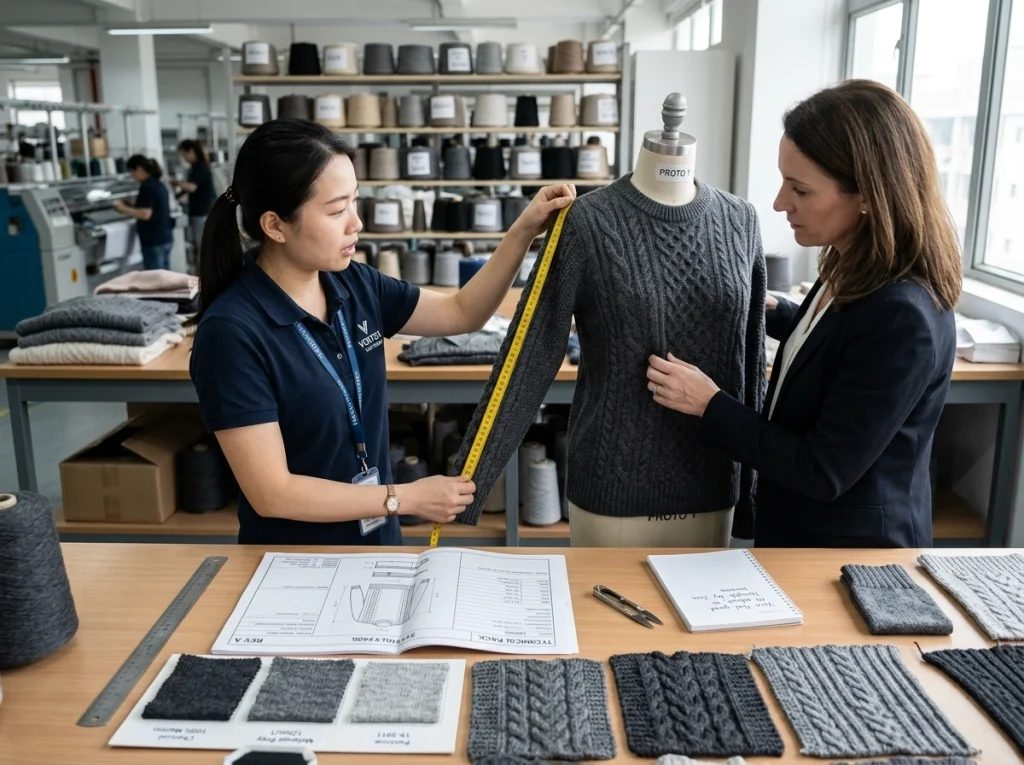
If there’s one part of the supplier evaluation process that gets consistently
underestimated, it’s sampling. A well-handled sampling round tells you almost everything
you need to know about how a factory will perform at scale. A poorly handled one tells
you even more.
Which sample handoffs should be documented?
A factory that takes sampling seriously will confirm your yarn specification before
cutting anything. They’ll flag potential issues — gauge conflicts, color availability,
structural constraints on a particular construction — before the sample arrives, not
after. When the sample ships, it comes with measurement data and a note explaining any
substitutions made.
That process sounds basic. In practice, it’s what separates factories that treat sampling
as a service from those that treat it as an obstacle to collecting a deposit. For
custom knitwear development, where the
construction itself may be novel, this back-and-forth is where most development risk
either gets managed or accumulates.
The number of rounds required to reach approval is a meaningful signal. One to two rounds
on a straightforward custom sweater production project
suggests the factory reads tech packs carefully. Three or more rounds on a basic style
suggests something is off — in their process, their machinery calibration, or their
willingness to invest time in pre-production alignment.
Which findings should hold bulk approval?
Watch for factories that rush toward a deposit after the first sample, even when fit or
construction isn’t fully confirmed. Watch for sample approvals that include undisclosed
yarn substitutions. And pay close attention to measurement tolerances: if the sample is
2cm off spec and the factory describes it as “acceptable,” that gap will not close in
bulk — it will widen.
For private label knitwear, where the product carries your brand’s name, a sample that’s
“close enough” is not a green light.
Which communication rules reduce production risk?
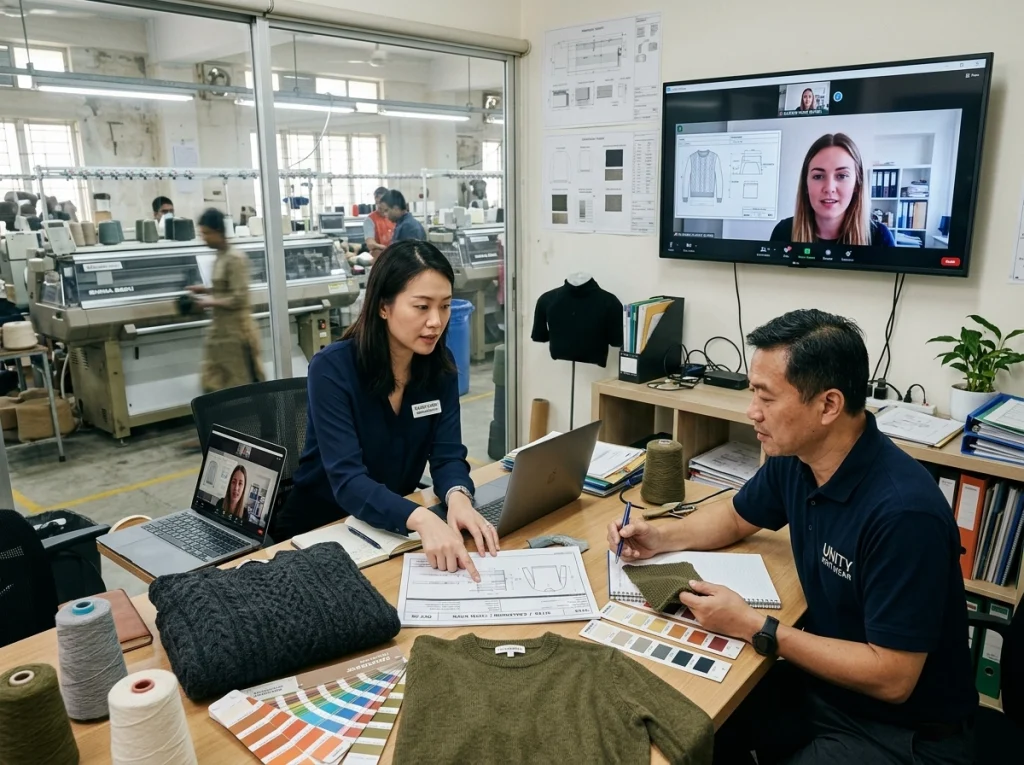
Communication is often treated as a soft criterion — a nice-to-have rather than a
supplier requirement. That framing is wrong. Poor communication between brand and factory
is one of the most consistent causes of delayed shipments, spec deviations, and defects
that only surface at pre-shipment inspection.
What should an accountable response contain?
Responsive doesn’t just mean fast. It means the factory acknowledges your message,
confirms what they understood, and flags anything ambiguous before it becomes a
production decision made without your input. A reliable OEM/ODM knitwear service
partner will proactively update you on production milestones — yarn arrival, knitting
completion, finishing start — without you having to chase.
Accountability means that when something goes wrong, the factory tells you before you
discover it at inspection. Delays happen. Yarn lots run short. Machines go down. What
separates a production partner from a transactional vendor is whether problems surface
early enough for you to make decisions, or late enough that your options have already
closed.
How should a buyer close an ambiguous requirement?
Specification errors that originate in a miscommunication during development tend to
replicate cleanly into bulk. A color reference not confirmed against a physical swatch.
A measurement discussed verbally but never updated in the tech pack. A label placement
“agreed” over email but never verified on the pre-production sample.
Every one of those gaps is recoverable before bulk starts. After bulk starts, recovery
means rework, delay, or a decision to accept the deviation — none of which are free.
The brand typically absorbs most of that cost, even when the miscommunication was shared.
How should MOQ and timing assumptions be compared?
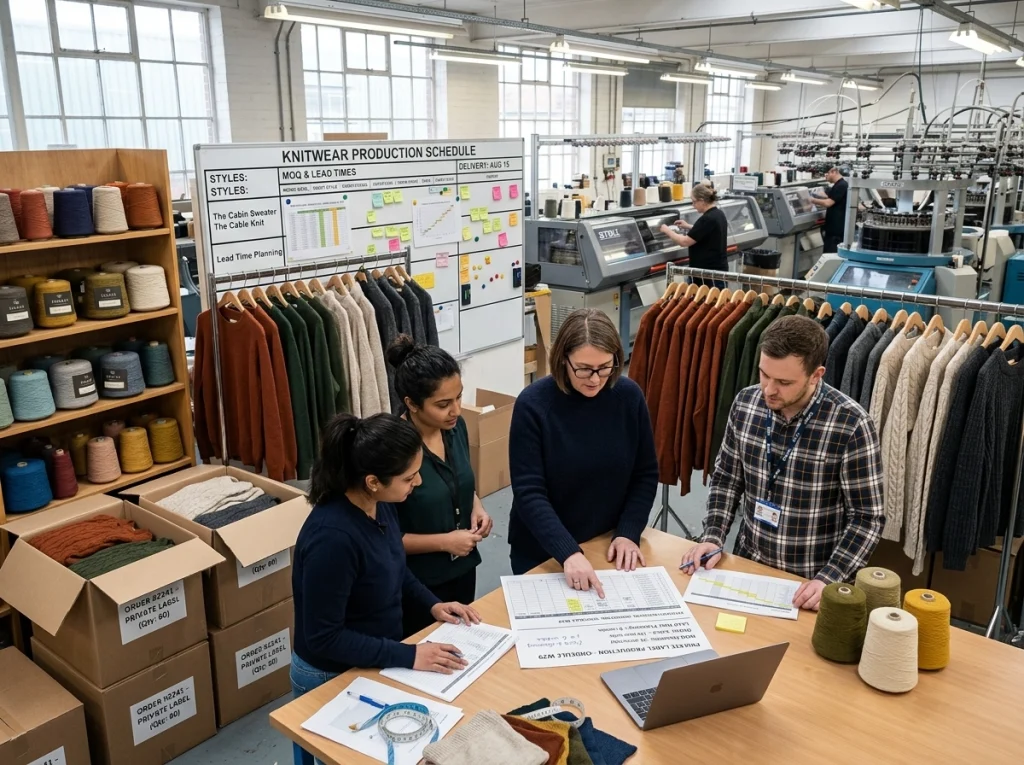
MOQ and lead time are the two numbers most buyers ask for first. They’re also two of
the numbers most likely to be quoted optimistically during the inquiry phase.
Understanding what they actually mean requires a bit more digging.
What a Factory’s MOQ Tells You About Its Setup
In knitwear, MOQ is typically set at the style-color-size level, not just the style
level. A factory that works from 30 pieces per color per size has a different production
setup than one requiring 300 units per SKU. The former suits smaller brand launches and
test runs; the latter is built for buyers who already know what’s selling.
Neither is wrong — but they serve different profiles. A
low MOQ knitwear manufacturer that accommodates
smaller brand orders has typically invested in flexible machine scheduling and is
comfortable running shorter production lots. That flexibility has trade-offs: unit
pricing is naturally higher than on a 1,000-piece order, and capacity may tighten during
peak season, which in knitwear typically runs August through January.
Which critical-path steps require dates and owners?
A quoted lead time of 30–45 days from bulk order to ex-factory is common. Whether it’s
achievable depends on variables worth asking about directly: Does the factory carry
your yarn in stock, or does it source after order confirmation? Is there a current queue
for machine time? What’s the season workload at the point you’re placing?
A factory that breaks down its lead time into stages — yarn sourcing, knitting, linking,
finishing, QC, packing — is giving you information you can actually work with. A factory
that hands you a single number without breakdown is giving you a target, not a plan. For
brands with fixed retail delivery windows, that distinction can determine whether you
make your season.
Which controls make bulk and repeat orders comparable?
Getting the first bulk order right is one test. Getting the second and third right —
with the same yarn, same measurements, same hand-feel — is a different and harder test.
This is where supplier relationships that started well often begin to show strain.
Which inspection points must be specified?
Factories that inspect only at the end of production are catching defects after they’ve
already been made. Factories with inline quality control — checking measurements, seam
quality, linking tension, and finishing at multiple production stages — are managing the
process itself. The difference shows up in defect rates, rework volumes, and measurement
consistency across a full run.
For private label cardigans and other knitwear
where construction detail is part of your brand positioning, inline QC isn’t a premium
feature — it’s the baseline you should expect from a serious production partner. AQL
final inspection remains necessary, but it shouldn’t be the only checkpoint.
Which retained records protect a repeat order?
First orders get attention. The factory is motivated to make a strong impression, the
team is closely involved, and deviations are caught early because everyone is paying
close attention. Repeat orders are where complacency tends to enter.
The risk isn’t a factory suddenly becoming careless. It’s more subtle: a yarn lot
variation that wasn’t flagged, a machine recalibrated slightly between seasons, a
linking team change that shifted seam tension. None of those individually look
significant — but if you’re selling the same sweater across two seasons and the
hand-feel has shifted, your customers will notice even if your factory didn’t.
Ask directly: how does your factory manage continuity across repeat POs? Do they retain
yarn lot records? Do they keep a confirmed bulk sample from the original order as a
reference standard?
Which refill process should be tested before commitment?
The decision to refill a product that’s selling well should be one of the simpler
decisions in private label sourcing. In practice, it’s often more complicated than the
original order — because you’re now asking a factory to reproduce something exactly,
under production conditions that may have changed.
Which changes must be disclosed for a refill?
Some factories handle first orders well but struggle with refills because their systems
don’t support continuity. Yarn from the original lot may no longer be available. The
machine that ran your gauge may have been reallocated. The linking team may have changed.
None of those problems are unique to any one factory — they’re operational realities of
knitwear production. What matters is whether the factory has processes to manage them,
and whether they’re upfront about constraints when a repeat order is being discussed. For
knit hoodies and zip knitwear and other
construction-intensive styles, small changes in linking or finishing tension are
particularly visible, making continuity management even more important.
Which questions should decide the supplier?
Before placing a first bulk order, have a direct conversation about repeat order protocol:
- How far in advance do they need notification for a refill?
- Do they retain reference samples and yarn records from approved bulk?
- If the original yarn is discontinued, do they propose alternatives proactively or wait
for the buyer to raise it? - Is there an off-season window where capacity and pricing are more favorable for
planning ahead?
These aren’t adversarial questions. A factory that welcomes them is demonstrating
operational maturity. A factory that deflects them is telling you something about how
they handle the parts of the relationship that don’t involve getting a new order.
McKinsey’s State of Fashion research notes that brands accelerating supply chain
reconfiguration are prioritizing partners that support agility and reduce excess
inventory risk — not just those offering the most competitive per-unit cost. The
knitwear manufacturer you choose either supports that kind of responsiveness or limits
it.
Which evidence supports the final comparison?
For a documented buyer review, use the OECD garment due-diligence guidance to frame supplier-risk records, ISO 2859-1 for acceptance-sampling concepts, FTC textile and wool labeling guidance for US label checks, and CBP UFLPA guidance where the import-evidence boundary applies. These references define checks and limits; they do not validate a specific supplier.
Which published buying guides can complete the file?
Use tech-pack essentials, manufacturer evaluation, MOQ controls, low-MOQ checks, OEM and ODM selection, bulk consistency, zipper and fit controls, cable-knit development, and sourcing-model comparison.
Conclusion
Private label knitwear brands that build reliable product lines don’t do it by finding
the cheapest factory. They do it by finding a factory whose sampling process is honest,
whose communication is proactive, whose MOQ structure fits their order profile, whose
QC runs through production rather than just at the end, and whose repeat order management
keeps the product consistent across seasons.
Unit price belongs in your evaluation — it’s not irrelevant. But it should be the last
thing you finalize, not the first thing you compare. The criteria that actually determine
whether a factory works for your brand are the ones that show up in process and behavior,
not in a quote sheet.
If you’re evaluating production partners for an upcoming season, we’re happy to walk
through your specs, lead time requirements, and MOQ needs in detail.
Reach out to our team and we’ll provide yarn options,
a realistic timetable, and a transparent quote.
FAQ
Is unit price the most important factor when choosing a knitwear manufacturer?
No — it’s a necessary input, but not the decisive one. Unit price affects margin, but
sampling accuracy, communication quality, QC methodology, and refill reliability
determine whether your product line actually performs season to season. Brands that
over-optimize on price tend to absorb the difference in rework, delays, and
inconsistency.
How many sample rounds should I expect before approving a bulk order?
For a standard style with a clear tech pack, one to two rounds is reasonable. More than
three rounds on a straightforward design typically signals a process issue at the factory
— either in how they read specs or how they invest time in pre-production alignment.
What MOQ is realistic for private label knitwear from a China factory?
It varies by factory setup and style complexity. Factories oriented toward smaller brands
often work from 30 pieces per color per size, which fits test runs and new launches.
Factories optimized for volume buyers often require 200–500 pieces per SKU. The right
MOQ is the one that matches your actual order profile, not whichever number sounds
lowest.
How do I verify a factory’s quality control process before committing?
Ask specifically whether they use inline QC checkpoints during production, or only
final inspection at the end. Request to see an AQL inspection report from a previous
order. Pay attention to how they answer QC questions during the inquiry phase — factories
with genuine QC processes describe them in concrete operational terms, not in
generalities.
What’s the biggest consistency risk in a knitwear refill order?
Yarn lot variation. Color shade, hand-feel, and gauge can shift when a factory moves to
a new batch — even from the same yarn supplier. Ask whether the factory retains yarn
lot records and keeps a confirmed bulk sample from the original order as a reference
standard for the next production run.