 CN Sweaters
Quarter zip knitwear has moved from a reliable wardrobe basic to one of the most talked-about silhouettes of 2026 — and if you’re a retail buyer or brand building out your knitwear range, the timing actually matters. This article is for brand owners, wholesale buyers, and product development managers who want a clear, grounded read on which fabrics and fits are gaining real commercial traction, not just runway attention, and what you need to know before committing to samples and production.
The short answer: merino wool in fine and mid gauge leads for volume, cotton fills the accessible price tier, and the fits moving fastest are relaxed-but-considered rather than oversized for its own sake. The rest of this article explains why, where the trade-offs sit, and how to think about sampling and ordering before the production window gets tight.
Why Quarter Zip Knitwear Is Worth Building Into Your 2026 Range
From Niche to Mainstream, Faster Than Most Buyers Expected
The quarter zip’s cultural climb has been unusually fast. According to The Times, Google searches for the style increased by approximately 2,250 percent over the past twelve months, and sales have climbed by roughly 25 percent. That kind of search acceleration tends to translate into real buying intent within one to two seasons.
What accelerated it was a convergence of forces. Preppy has overtaken streetwear and athleisure as the dominant fashion vernacular. The Guardian’s Jess Cartner-Morley described the quarter-zip as “the breakout main character of the 2026 wardrobe,” citing appearances at Chanel’s New York catwalk, on Jonathan Bailey in Dior, and as a near-uniform for Arsenal’s Mikel Arteta — each a different signal to a different consumer, but all pointing in the same direction. A viral TikTok “Quarter-Zip Winter” trend among Gen Z men pulled in tens of millions of views and pulled a younger buyer into the category.
For retailers, this isn’t about chasing the exact same trend moment. It’s about the underlying shift: consumers want garments that are comfortable, considered, and versatile across contexts. The quarter zip delivers all three when it’s built right.
What This Means for Price Architecture
The quarter zip knitwear category now runs a wider price range than it did three years ago. At the accessible end, cotton and cotton-blend styles retail comfortably under £60–80. Mid-tier merino wool pieces sit in the £90–180 range. At the premium end, fine-gauge or cashmere-blend options can push past £200 without resistance from the right customer.
That spread is useful for buyers. It means a single silhouette can anchor multiple positions across a range, provided the material, gauge, and finish are genuinely differentiated — not just repriced. A merino piece that’s been properly developed and fits cleanly feels worth considerably more than a cotton version at the same gauge, and consumers can tell.
From a production standpoint, this price architecture means different decisions at sampling and at bulk. We’ll cover those specifics further down.
Which Fabrics Are Actually Worth Committing To
The yarn choice is the most consequential decision in a quarter zip development. It defines handle, retail price, care requirements, seasonal placement, and how much risk sits in your stock. Here’s how the main options compare in practice.
Merino Wool — The Commercially Reliable Core
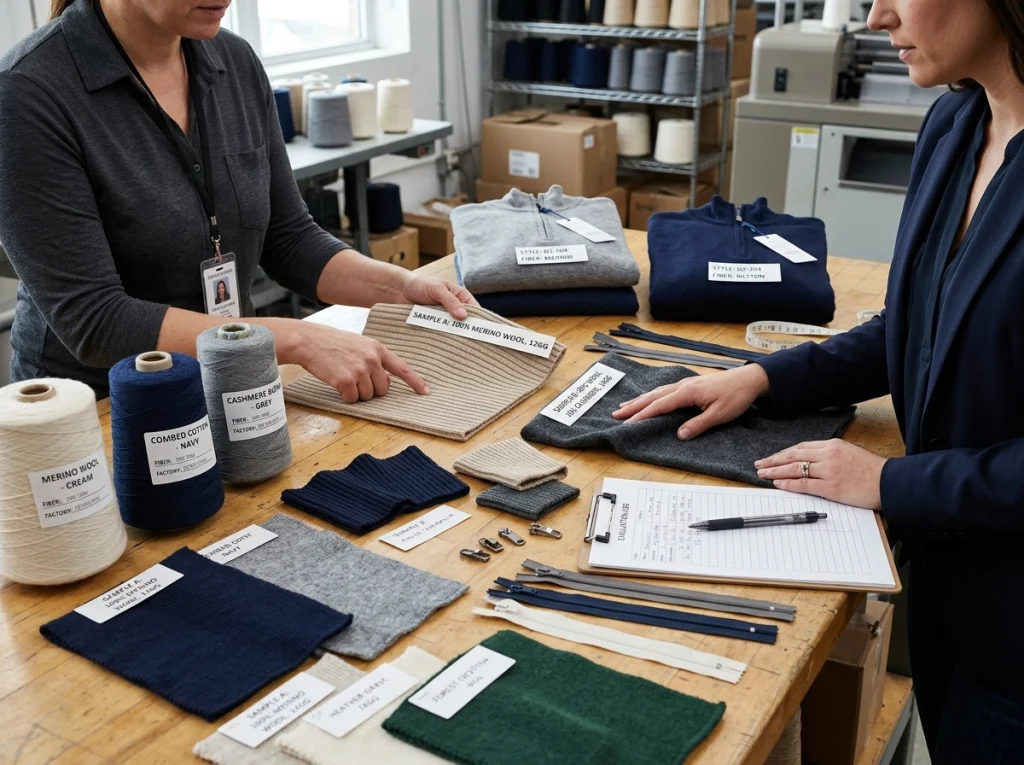
Merino is the safest and most commercially durable choice for wholesale quarter zip sweaters going into 2026. It’s naturally temperature-regulating, which extends its selling season into transitional weather — a real advantage for buyers trying to avoid heavily seasonal inventory risk. Fine merino at 12–14 gauge reads clean against the skin, drapes well without bulk, and photographs clearly for e-commerce.
From a factory perspective, merino is also one of the more manageable yarns to produce consistently. Gauge, tension, and linking are all more predictable than hairy or novelty fibers. That said, it does require proper wash testing before bulk sign-off, particularly if your target customer will machine wash — the shrink and pill behavior varies meaningfully between yarns, and not all merino is Woolmark-certified or treated the same way by different mills. If you’re planning to make a care claim, verify it at the pre-production sample stage.
The color direction for merino in 2026 trends toward earth neutrals — coal, camel, oat, tobacco — with small doses of muted mineral tones like washed olive or dusty teal as accent options. High-saturation colors are slower in this category unless your brand actively targets that segment.
Cashmere and Cashmere Blends — When Positioning Supports the Cost
Pure cashmere makes sense when your retail price point and brand positioning can genuinely support it. At the luxury end, a fine-gauge cashmere quarter zip can retail well above £200 — Esquire’s recent roundup included styles from Naadam, Brunello Cucinelli, and Loro Piana’s cashmere-silk blend in this tier. Mongolian cashmere at the more accessible premium end (think direct-to-consumer brands like Quince) has also demonstrated that the category isn’t exclusively luxury territory.
For retailers ordering from a knitwear factory in China, cashmere or cashmere-blend options add complexity at yarn sourcing and require tighter QC at linking and finishing. A cashmere piece that pills visibly in the first wash is a returns and brand risk, not just a production issue. Blends — cashmere with merino, or cashmere with a silk component — can reduce cost while preserving hand-feel, but they require careful specification so the blend ratio matches what ends up on the care label.
The trade-off: cashmere is high-reward when it’s right, but requires more attention at the development stage. Don’t rush to bulk off a first sample.
Cotton and Organic Cotton — Accessible Price Point, Real Demand
Cotton quarter zips occupy a different commercial lane, and it’s a real one. They retail at an accessible price point, care is simple, and their seasonality is broader than pure wool — particularly for spring or year-round programs. Ribbed cotton construction, as seen in Banana Republic’s oversized polo-zip style, delivers visible texture and a ’90s-referencing feel that’s been selling consistently. Heavyweight terry cotton, as seen in Todd Snyder’s Portuguese terry quarter-zip, leans more casual-to-smart and is particularly suited to buyers targeting the weekend-to-office crossover customer.
For brands that want to make a credible sustainability claim, organic cotton is a useful option. It adds a modest cost premium but provides legitimate story support for brands that communicate sustainability positioning to their customers. From a factory standpoint, organic cotton is not difficult to source or produce — but certification traceability needs to be confirmed at yarn sourcing if your brand plans to make it a label claim.
The limitation with cotton: hand-feel and perceived quality don’t scale up the way wool does. A well-developed cotton quarter zip can be excellent in its price tier, but it won’t compete with a fine merino on drape or feel, and trying to price it at parity won’t work.
Fabric Comparison at a Glance
| Yarn | Common Gauge | Retail Positioning | Seasonal Range | Key Trade-offs |
|---|---|---|---|---|
| Fine Merino Wool | 12–14GG | Mid to premium (£90–180+) | Autumn through spring | Requires wash test; varies by mill |
| Mid-gauge Merino / Wool | 7–10GG | Mid-market (£70–140) | Autumn/winter-led | Bulkier; best in relaxed or structured fits |
| Pure Cashmere | 12–14GG | Premium to luxury (£180+) | Autumn through spring | Higher QC risk; blend options reduce cost |
| Cashmere-Merino Blend | 12–14GG | Premium (£130–200) | Autumn through spring | Good hand-feel balance; check blend ratio |
| Cotton (ribbed / plain) | 10–12GG | Accessible (£40–90) | Year-round / spring | Lower perceived value; straightforward care |
| Organic Cotton | 10–12GG | Accessible to mid (£50–100) | Year-round / spring | Certification needed for label claims |
Gauge and Collar Decisions That Define the Product
Fine Gauge vs Mid-Gauge — Different Product, Different Buyer
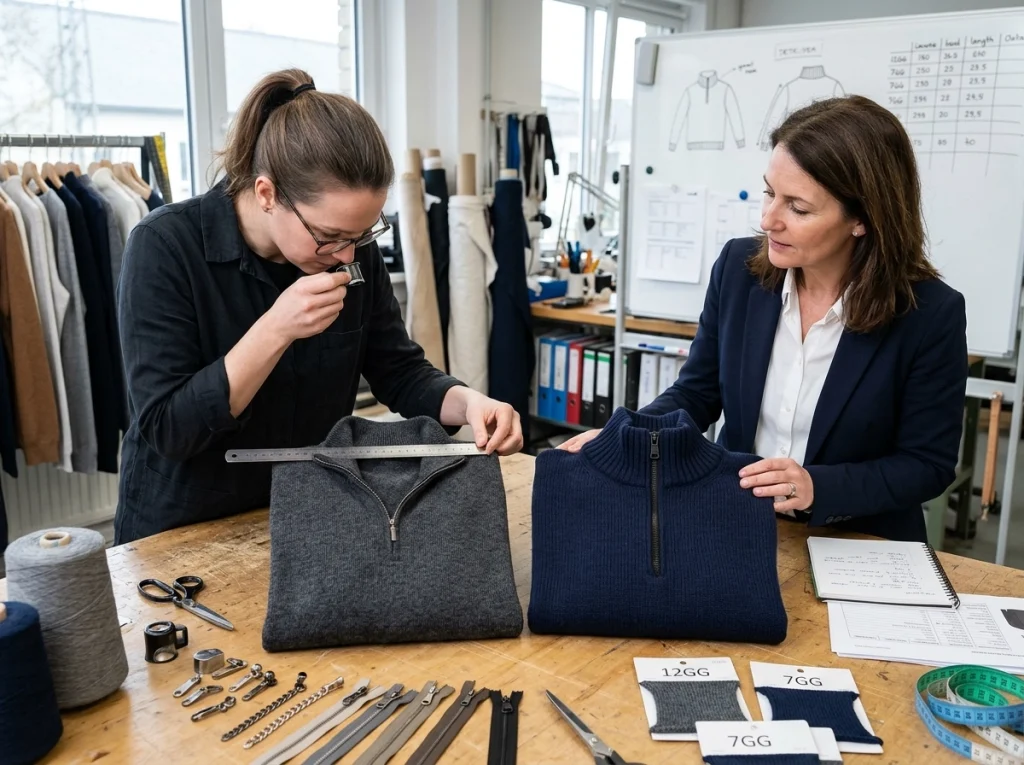
Gauge isn’t just a technical spec — it changes what the garment is and who buys it. Fine-gauge (12–14GG) knits sit closer to tailoring in how they read and wear. They’re smooth, lightweight, and easy to layer under a coat or jacket without adding bulk. They photograph well and sell well in smart-casual and premium market positions. The limitation is that fine-gauge production is slower and any tension inconsistency is more visible, so it requires tighter machine calibration and more skilled finishing.
Mid-gauge (7–10GG) gives a more textured, visible stitch and works well for a relaxed or chunky positioning. Cable-knit constructions — like Ralph Lauren’s classic cotton cable quarter-zip — sit in this range and read clearly as a design statement. Mid-gauge is more forgiving in production but adds physical weight, which affects shipping cost and wearability in transitional seasons.
From our experience, buyers choosing between the two should decide based on retail price and customer lifestyle, not just aesthetics. A fine-gauge merino quarter zip will carry a £150 price tag more credibly than a mid-gauge cotton version. Match the gauge to the position you’re trying to hold.
Collar Treatment and Zip Hardware — The Detail Buyers Underestimate
The collar and zip are what a customer touches first and what they see when the garment is folded on a shelf or photographed flat. In 2026, the direction is moving away from the basic mock-neck toward a slightly more considered collar — either a cleaner funnel neck with ribbed facing, or a structured stand collar that sits well when zipped up and collapses neatly when open.
Zip hardware quality matters more than most buyers budget for at the development stage. A cheap zip on an otherwise well-made garment is noticed, and it ages faster than the knit body. For wholesale quarter zip sweaters going into premium-leaning retail, specify a YKK or equivalent grade zip from the outset — it adds a modest cost but changes the perceived quality of the finished product. Zip pull size and finish (matte vs. polished metal) also reads differently depending on brand positioning.
One practical note: the placket stitching around the zip needs to be checked at pre-production sample stage. It’s one of the more common points of inconsistency in knitwear production, and a poorly finished placket is very hard to fix after bulk is cut.
Fit Directions That Feel Current in 2026
The Relaxed and Slightly Oversized Shift
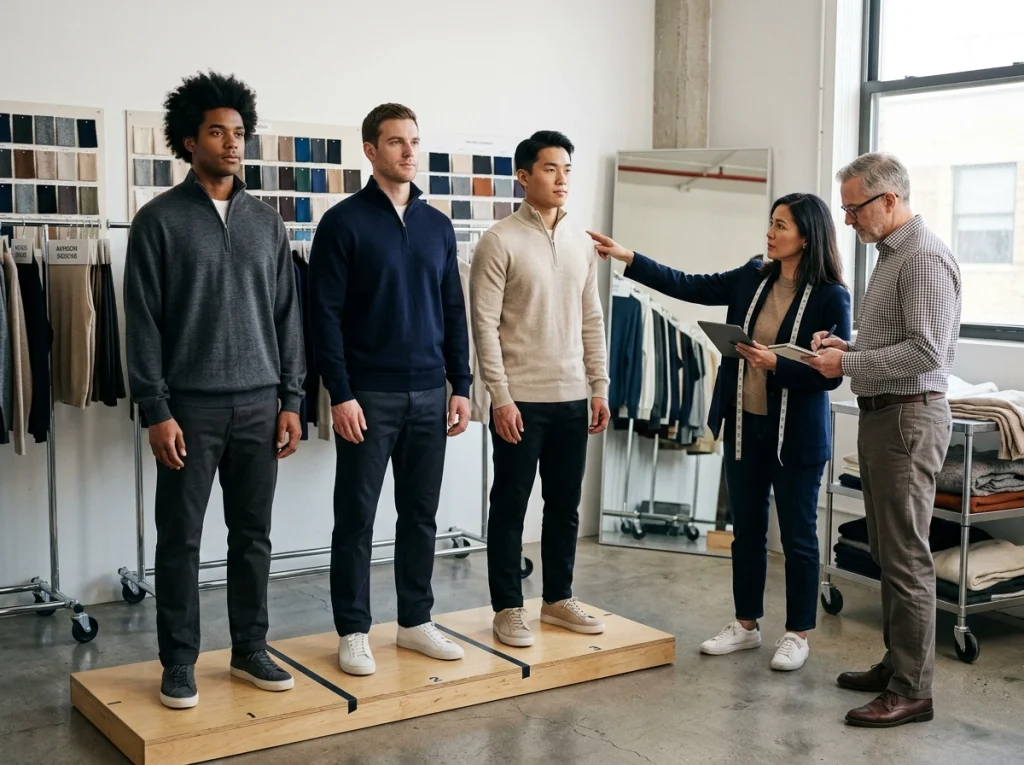
The dominant fit shift in quarter zip knitwear for 2026 is toward relaxed — but relaxed with structure, not relaxed as a proxy for imprecision. Drop-shoulder, slightly wider body, clean rib at hem and cuff: this reads current without being aggressively oversized. Esquire highlighted mfpen’s organic cotton zip-up as a benchmark in this category — “polished enough to complement a button-up yet hangs off the body like a well-loved hoodie.”
For buyers, this fit works well in cotton and mid-gauge wool. It’s the most commercially accessible quarter zip fit direction because it covers a wider size range with fewer SKUs. The trade-off is that it requires a well-judged pattern — a relaxed fit that’s too wide in the body reads cheap, not relaxed, and a dropped shoulder that doesn’t sit cleanly looks like a development error rather than a style choice. Pre-production fit confirmation is essential.
Tailored-Relaxed — Structured but Wearable
Above the accessible tier, tailored-relaxed is gaining ground. Rag & Bone’s Melrose wool zip-up cardigan — tailored through the torso with a relaxed drop, and featuring subtle windowpane texture — is a good commercial reference for this position. It reads smart enough for a professional context but has none of the stiffness of formal tailoring.
This fit is harder to execute than it sounds. Getting the shoulder to sit cleanly, the chest to hang without pulling, and the hem to track level requires more sampling rounds than a basic relaxed fit. From a factory standpoint, we’d always recommend two sample rounds before committing to pre-production approval on a tailored-relaxed construction — the first round surfaces fit and proportion issues, the second confirms corrections.
It also tends to be better in fine yarn at higher gauge. A tailored-relaxed quarter zip in chunky cotton usually reads confused rather than considered.
Slim Fit Still Works, but Only in the Right Context
Slim fit quarter zips haven’t disappeared — Ralph Lauren’s cable-knit slim fit continues to sell consistently, and fine merino in a clean, close-to-body cut works well for buyers targeting office-casual or smart-casual segments. But slim fit in 2026 is a supporting position rather than the lead direction.
The risk for buyers is that a slim-fit quarter zip at the wrong gauge or in the wrong yarn reads as dated rather than classic. Fine-gauge merino in a clean neutral is the safest vehicle for this fit. Avoid mid-gauge cotton in a slim cut — it tends to pull at the seams and doesn’t wear well over a day. If your brand’s customer is older, more corporate, or specifically values a polished silhouette, slim fit is still valid. If you’re aiming at a broader or younger customer, relaxed is the safer bet.
What to Know Before You Sample and Order
MOQ, Lead Time, and the Timing Window That Matters
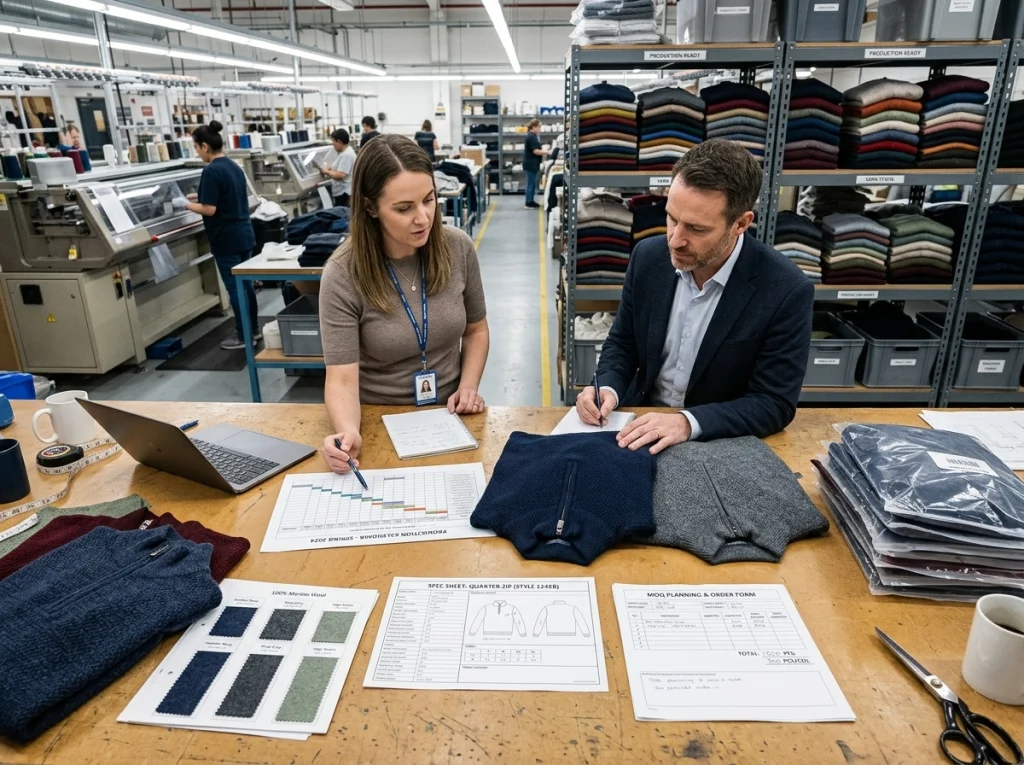
Knitwear production has seasonal dynamics that matter more than most buyers account for when planning. The off-season for knitwear factories typically runs from February through July — this is the period when capacity is more available, lead times are shorter, and it’s possible to get more attention on development details. From August onward, peak season demand compresses capacity, raw material costs can shift, and delivery timelines extend.
For buyers planning a 2026 autumn/winter range or a Q4 program, the practical implication is clear: if you haven’t started sampling by mid-year, you’re competing for production capacity in the peak window. That creates pressure on timelines and sometimes on quality if you’re rushing bulk sign-off.
Our MOQ starts at 30 pieces per size per color — that’s relatively accessible for brands testing a new SKU or colorway, and it allows a buyer to trial a style at reasonable volume before committing to a deeper run. Larger quantities distribute production across more machines simultaneously, which compresses timeline and can improve pricing. Samples typically take 3–5 business days in production, with shipping time on top depending on your destination.
For refill orders, the same timing logic applies. If a style performs in its first season and you want to reorder, get the refill order in early. Back-to-back orders on the same spec are usually faster than new developments, but capacity is still capacity.
If you’re planning a broader custom quarter zip knitwear development — something that involves a new construction, a new stitch, or a more complex collar — build in at least two sample rounds before pre-production approval. That’s not caution for caution’s sake; it’s what reliably avoids bulk corrections that cost far more than an extra sample.
Private Label Setup and What It Takes to Get Right
Private label setup for zip knitwear covers labels, hangtags, care labels, and packaging. For a first order, it’s worth getting the label specification right before production — not as an afterthought. A well-executed label pack reads as a finished retail product; a misaligned or off-spec label on an otherwise good garment undermines the whole product.
For brands using our OEM/ODM knitwear service, the label setup process is straightforward: provide your brand artwork, care content, and size spec, and we’ll confirm placement and attachment method at the pre-production sample stage. Main labels, neck labels, hangtags, and polybag branding can all be aligned to your requirements.
One area buyers sometimes underestimate: care content accuracy. The care label must match the actual yarn composition and construction. If a garment is promoted as merino but the blend isn’t verified, or if the wash instruction doesn’t reflect actual behavior, that’s a returns and compliance risk. Confirm yarn composition at sampling, not at bulk.
Packaging — polybag, folding method, barcode sticker placement — is worth specifying clearly if your product is going directly to retail floor or third-party warehouse. Retail-ready packing reduces handling at your end and avoids rework on arrival.
Conclusion
Quarter zip knitwear is not a trend to chase because it’s trending. It’s worth building into a 2026 range because the underlying demand signals — from media attention to search behavior to runway validation — are pointing in a consistent direction, and the category has enough price tier flexibility to work across different retail positions.
The practical hierarchy: merino wool in fine gauge is the most commercially reliable core yarn for this silhouette. Cotton fills the accessible tier with genuine demand. Cashmere blends are worth developing if your positioning supports a premium price. On fit, relaxed-but-structured is leading; tailored-relaxed is gaining ground at the mid-to-premium level; slim fit remains valid for a more specific customer profile.
The biggest risk isn’t choosing the wrong fabric — it’s mistiming development and production. Knitwear factory capacity tightens from August onward. If you’re building an autumn/winter program, the development window is now.
If you’re working out which styles and yarn directions fit your range for 2026, we’re here to work through it with you. Share your tech pack, target retail price, and delivery window, and we’ll provide yarn options, a timetable, and a realistic quote.
FAQ
Q: What’s the minimum order quantity for wholesale quarter zip sweaters?
Our MOQ is 30 pieces per size per color. This is accessible enough for brand owners testing a new style before committing to volume. For deeper runs, pricing improves as production can be distributed across more machines simultaneously, which also compresses lead time.
Q: How long does sampling take for a custom quarter zip knitwear style?
Sample production typically takes 3–5 business days. Shipping time to your location adds 5–7 days on top. For styles involving new constructions, special gauge settings, or non-standard collar treatments, build in at least two sample rounds before pre-production approval — the first round identifies fit and proportion issues, the second confirms corrections. Rushing to bulk on a single sample is the most common source of costly corrections.
Q: What yarn options are available for a mens quarter zip supplier program?
We work with merino wool (fine and mid gauge), cashmere and cashmere blends, cotton (plain, ribbed, terry), organic cotton, and wool-acrylic blends for cost-managed programs. Yarn sourcing includes verified mills with material traceability. If you have a specific yarn in mind or a hand-feel reference, send it with your inquiry and we’ll match it or propose an equivalent.
Q: What’s the best time of year to place an order?
For autumn/winter programs, placing orders by mid-year gives you better access to production capacity and more stable raw material pricing. From August onward, peak season demand compresses capacity and lead times extend. If you’re planning a spring or transitional program, the February–July window is when capacity is most available and development attention is most focused.
Q: Can you handle private label zip knitwear including labels, hangtags, and retail packaging?
Yes. Our private label knitwear setup covers main labels, neck labels, care labels, hangtags, polybag branding, and carton packing. Provide your brand artwork, care content, and size spec at the sampling stage, and placement and attachment method will be confirmed before production starts. For retail-ready delivery, specify your packing requirements clearly in the brief — it avoids rework on arrival.
External References
- Jess Cartner-Morley, The Guardian — “The quarter-zip is the breakout star of the 2026 wardrobe”, February 2026
- The Times — “Why the quarter-zip is the coolest knitwear of 2026”, January 2026
- Esquire — “The Best Men’s Zip-Up Sweaters”, 2026 edition
- HD Merino — “2026 Sweater Trends: Key Styles in Men’s Knitwear, Cardigans & Polos”