 CN Sweaters
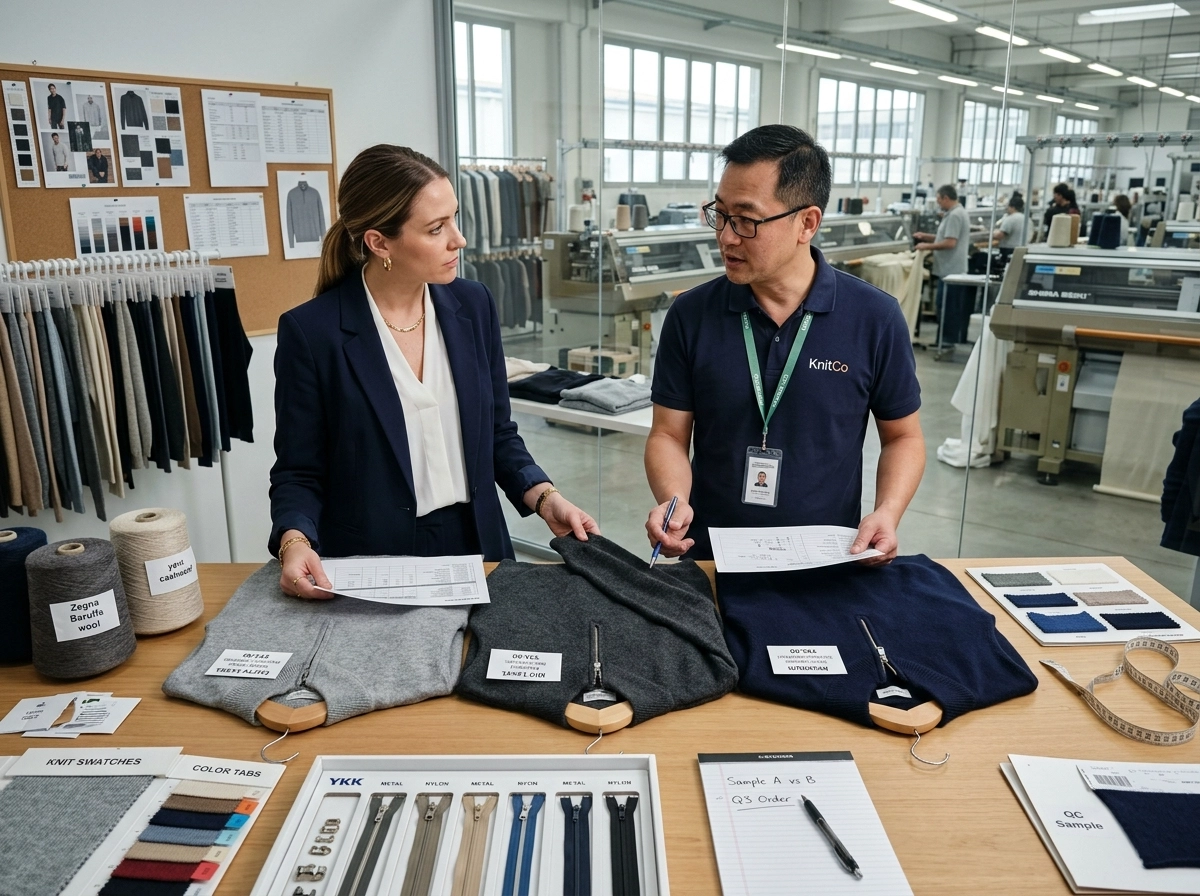
If you’re placing a B2B order for men’s half zip sweaters, the most consequential decision you’ll make isn’t the color or the size run — it’s which tier you’re building for. Good, Better, and Best aren’t just retail marketing labels. From a factory perspective, they represent genuinely different material specifications, construction standards, sampling timelines, and supply chain realities.
This article is for brand buyers, wholesale teams, and procurement managers who need to structure a men’s half zip knitwear range — whether that’s a single opening price point or a three-tier private label program. We’ll walk through what each tier actually looks like on the factory floor, what trade-offs come with each, and how to decide where to start.
Why Price Tiering Matters When You Source Half Zip Sweaters
How the retail market defines the three tiers
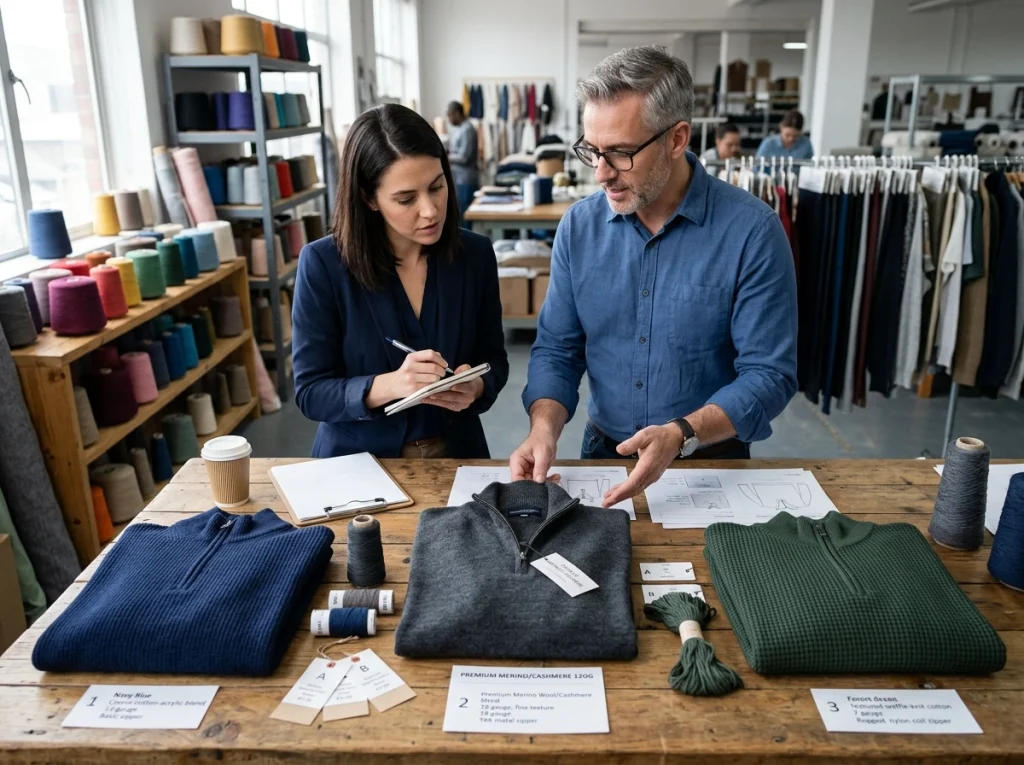
The retail market gives useful signals. Esquire’s 2026 roundup of the best men’s zip-up sweaters spans everything from under-$100 cotton options to Italian cashmere pieces well over $1,000. That range isn’t arbitrary — it maps closely to real differences in yarn quality, gauge, construction method, and zip hardware. For wholesale buyers, understanding what separates these retail tiers is the starting point for translating consumer expectations into factory specifications.
At the entry level, cotton, acrylic, and basic blended yarns dominate. At the mid-range, merino wool, lambswool, and refined blends take over. At the top end, cashmere and cashmere-silk blends define the product. These aren’t interchangeable — each comes with a distinct cost structure, a different minimum order logic, and different expectations around sampling and fit development.
Why unclear tier boundaries cost buyers money
The problem we see most often isn’t that buyers don’t know their tiers exist. It’s that they don’t define them clearly enough before placing orders. A brief that says “mid-range merino-feel sweater” without specifying yarn grade, gauge, or linking quality leaves too much room for interpretation. You end up approving a sample that looks right but doesn’t match your margin model — or, worse, a bulk production that shifts below the sample standard because the materials weren’t locked in writing.
Tier clarity isn’t about being inflexible. It’s about creating a specification baseline that both the buyer and the factory agree on before sampling starts. Without that, you’re paying for iterations that should have been avoided.
The Good Tier — What Entry-Level B2B Half Zips Actually Look Like
The Good tier isn’t a compromise. It’s a deliberate positioning. Entry-level men’s half zip sweaters serve fast fashion, value retail, promotional gifting, and brands building a wide distribution strategy where margin matters more than material story. The challenge is knowing what “good enough” actually means in production terms.
Yarn and gauge choices at this level
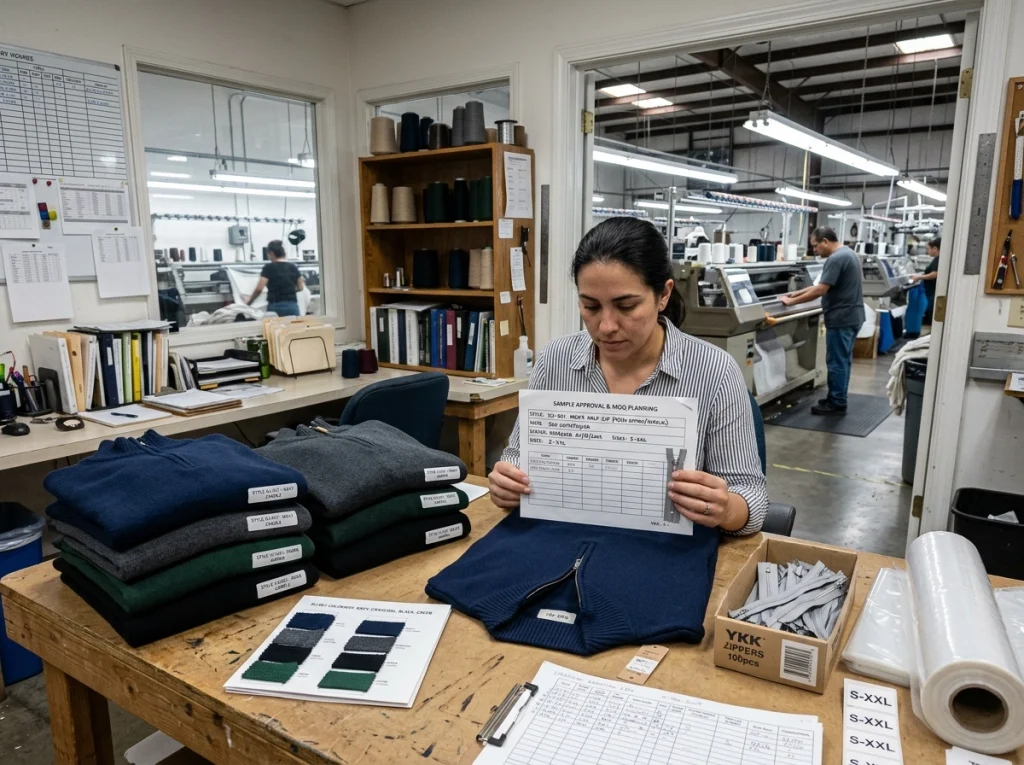
At the Good tier, the most common yarn choices are 100% acrylic, cotton-acrylic blends, or basic wool blends with wool content typically below 30%. These yarns are widely available in standard colors, have predictable wash behavior, and cost significantly less than natural fiber alternatives. Gauge typically runs 7GG to 12GG depending on the weight target.
Cotton is a common choice for Good-tier half zip sweater men’s styles aimed at the North American casual market — it’s breathable, washes easily, and consumers recognize the fiber. Acrylic-dominant blends work well where price sensitivity is highest and durability matters more than hand-feel. The zip hardware at this level is usually a standard metal or resin zipper — functional and consistent, but not something you’d highlight in a product story.
Customization scope and realistic expectations
Good-tier half zip sweaters can absolutely be private labeled. Custom branding, neck labels, and hangtags can all be applied through standard OEM/ODM service without requiring complex development. Color customization within standard yarn ranges is straightforward.
Where limitations appear is in construction detail. Requesting full-fashioned construction, specialty stitch patterns, or unusual zip placements at a Good-tier price point usually pushes the cost into Better-tier territory before the first sample is confirmed. Be honest about what your customer will see and feel. If it’s going into a branded polybag for e-commerce, presentation quality matters more than the yarn story. If it’s going onto a retail floor next to merino alternatives, you need to be prepared for the comparison.
MOQ, sampling, and lead time at the entry tier
For a standard Good-tier men’s half zip knitwear style, sampling typically takes 3–5 working days once yarn and specifications are confirmed. Bulk MOQ starts at around 30 pieces per size per color — a genuine entry point for new brands testing a style before committing to larger volumes.
Lead time from pre-production sample approval to shipment is typically 45–60 days for standard cotton or acrylic styles, assuming yarn is in stock. If you’re ordering during the August–January peak season, add buffer time for both material costs and production capacity.
The Better Tier — Where Most Wholesale Brands Find the Sweet Spot
For most B2B buyers building a sustained men’s knitwear range, the Better tier is where the real commercial logic sits. It supports a believable product story, commands a retail price that works for independent boutiques and mid-market department stores, and still offers enough margin flexibility to manage markdowns. The trade-off is that it requires more precise specification and slightly more development time.
How upgrading yarn changes the product and the price
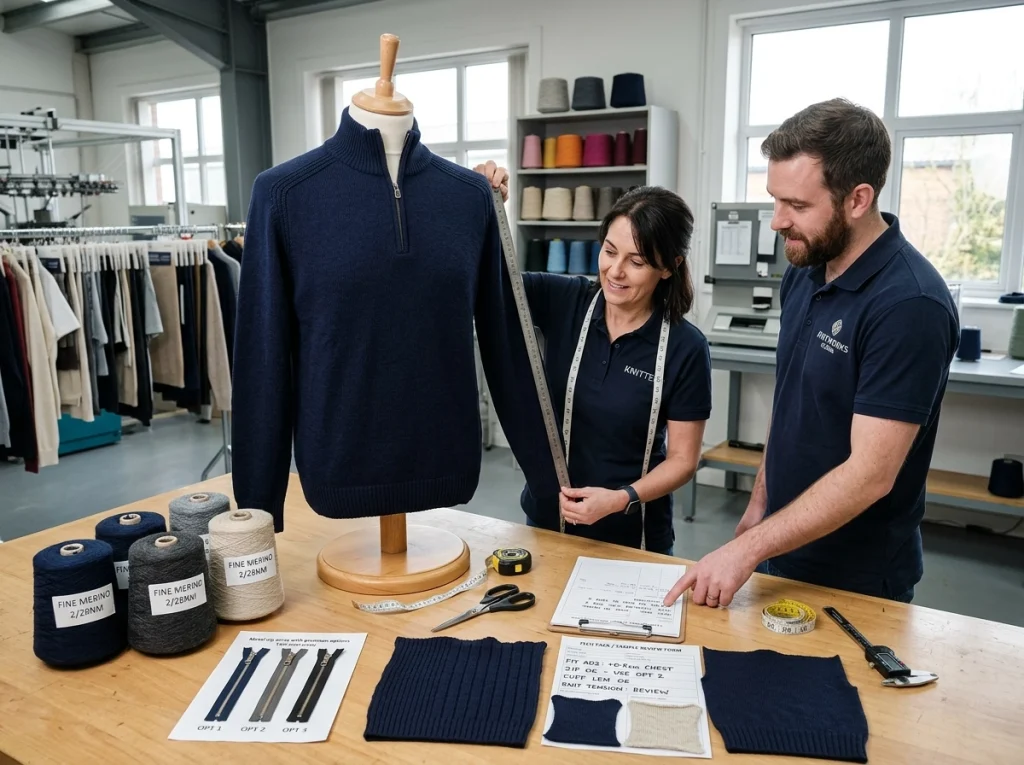
The defining material move in the Better tier is the shift to pure merino wool, lambswool, or high-quality wool blends — typically 80–100% natural fiber content. From a production perspective, merino wool behaves differently from acrylic or cotton. It requires more careful tension control during knitting, more precise wash protocols during finishing, and more attention to shrinkage management across a size run.
The hand-feel difference is immediately apparent to anyone who picks up the garment. Merino’s temperature-regulating properties are real and communicable to retail staff and end consumers. Brooks Brothers’ fine merino half-zip — recognized in the Esquire 2026 roundup as a standout mid-range option under $200 at retail — illustrates the point well: it’s a conventional silhouette, but the material quality justifies the price step clearly.
Yarn grade matters within merino. There’s a meaningful difference between 17.5-micron superfine merino and a standard 21-micron grade in both hand-feel and cost. If you’re spec’ing merino, specify the micron range — not just the fiber name.
Construction details that justify the step up
The Better tier is also where construction differences become visible and worth paying for. Full-fashioned panels — shaped during knitting rather than cut from flat fabric — reduce bulk at seams and improve fit. This is a meaningful upgrade from cut-and-sew construction that end consumers may not name, but will feel.
Linking quality matters more here, too. Tight, even linking at shoulder and sleeve seams is a strong indicator of overall production standard. Loose or uneven linking is one of the first things that shows at retail. Zip hardware at the Better tier typically upgrades to a YKK or equivalent branded zipper. The zip pull weight and movement quality are things end consumers notice, even if they don’t identify the brand name behind it. A half zip sweater that opens and closes smoothly signals quality in a way that product photography alone cannot convey.
For buyers who want to understand how natural fiber constructions translate across product types, our broader sweaters range is a useful reference point.
The Best Tier — Premium Wholesale Half Zip Sweaters
The Best tier is not for everyone, and that’s precisely the point. It’s for brands whose retail positioning depends on a material story — cashmere, cashmere-silk blends, or fine-gauge wool — and who are selling through channels where the customer is comparing against Brunello Cucinelli or Loro Piana, not an entry-level wholesale competitor. The commercial case for Best-tier sourcing is narrow but real.
Materials and standards at the top end
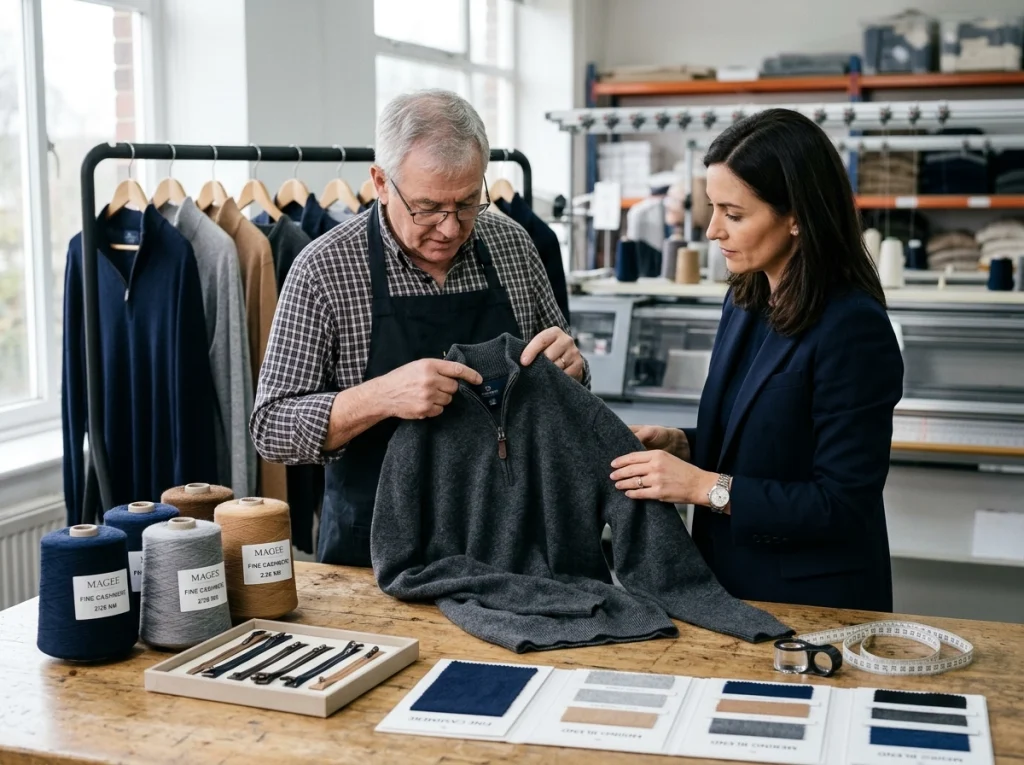
Cashmere dominates the Best tier. The Esquire 2026 list names Brunello Cucinelli’s Italian cashmere half-zip and Loro Piana’s cashmere-silk blend as the defining retail references at the top end of the market. From a factory sourcing perspective, the relevant questions aren’t just about fiber — they’re about grade, origin, and processing standards.
Grade A Mongolian cashmere remains the most commercially viable top-end material for volume production. It’s softer and finer than lower grades, but still producible at quantities that make wholesale economics work. Cashmere-silk blends add drape and a slight sheen that photographs well — a practical advantage for e-commerce at this price point.
Gauge at the Best tier typically runs 14GG to 16GG, producing a lightweight, refined hand-feel. This requires well-calibrated machinery and experienced operators. Not every factory can execute fine-gauge cashmere consistently at scale — it’s a legitimate point to assess before committing to development.
Custom development timelines and investment logic
Best-tier projects require a different development mentality. Sampling typically runs three to four rounds rather than one or two — not because the factory is less capable, but because the specification precision required at this price point is genuinely higher. Fit, drape, hand-feel, and finishing all need to be locked before bulk, and that takes time.
For complex constructions — intarsia patterns, unusual zip placements, double-layer collar treatments — custom knit development is the right starting point. These projects benefit from early factory involvement in spec review, rather than submitting a finished tech pack and expecting a clean first sample.
MOQ for cashmere is typically higher than for cotton or synthetic tiers, driven primarily by yarn purchasing minimums. If a Best-tier program represents a small share of your overall buy, it’s worth an honest conversation with your supplier about whether the economics make sense before sampling begins. Lead time from pre-production sample approval to bulk shipment is 75–90 days or more, accounting for yarn sourcing, sampling iterations, and the more controlled production pace fine-gauge construction requires.
Trade-Off Summary Across All Three Tiers
Understanding each tier individually is useful. Comparing them side by side is more useful.
| Specification | Good | Better | Best |
|---|---|---|---|
| Primary Yarn | Cotton, acrylic, basic blends | Merino wool, lambswool, 80%+ natural blends | Cashmere, cashmere-silk, fine-grade wool |
| Typical Gauge | 7GG–12GG | 7GG–14GG | 14GG–16GG |
| Construction | Cut-and-sew or basic linking | Full-fashioned preferred | Full-fashioned, precision linking required |
| Zip Hardware | Standard metal or resin | YKK or equivalent | YKK premium or custom pull specified |
| MOQ (per color/size) | ~30 pcs | ~50–100 pcs | ~100–200 pcs (cashmere yarn minimum) |
| Sampling Lead Time | 3–5 working days | 5–10 working days | 10–20 working days (multiple rounds) |
| Bulk Lead Time | 45–60 days | 60–75 days | 75–90+ days |
| Customization Scope | Label, color, basic branding | Label, color, construction detail | Full spec development, special construction |
| Best Suited For | Value retail, promo, e-commerce | Mid-market boutiques, wholesale, DTC | Premium boutiques, brand flagships, luxury DTC |
Refill orders and in-season replenishment risk
Refill behavior differs meaningfully across tiers — and it’s something buyers consistently underestimate at the planning stage.
Good-tier styles using standard acrylic or cotton yarns are the easiest to replenish. Yarn is typically available in stock lots, and a factory can usually turn around a refill order in 30–40 days if production capacity allows. Color matching to the original bulk is still a risk, but it’s manageable with proper color standards on file.
Better-tier merino styles carry more refill risk. Natural fiber dye lots vary, and there’s no guarantee the same lot will still be available mid-season. If you’re planning in-season refills for a merino style, communicate that plan upfront so your supplier can reserve yarn from the same dyeing run. A six-week advance notice window is a realistic minimum.
Best-tier cashmere carries the highest refill risk of the three. Cashmere yarn supply is seasonal, and in-season replenishment orders may face both availability constraints and price volatility — particularly if your delivery window falls in the August–January peak period. Best-tier programs generally work better as pre-season buys with limited refill expectation, unless you’re prepared to carry safety stock.
How to Decide Which Tier (or Tiers) to Start With
Single-tier focus vs. multi-tier range
The instinct to build all three tiers simultaneously is understandable. In practice, it spreads sampling investment, factory attention, and buying budget across three separate development tracks at once. For most brands placing their first substantial men’s knitwear order, starting with a single well-defined tier is more likely to produce a commercially ready product than attempting a full range.
The right tier depends on your channel. If you’re entering mid-market wholesale or DTC at an accessible price point, the Better tier is usually the most forgiving starting position — material quality supports a credible product story, and the construction standards are achievable without extreme development complexity. If you’re launching into value retail or promotional contexts, Good tier is faster and cleaner to execute. Best tier should only be your starting point if your distribution channel already commands — and sustains — a luxury retail price.
Working with a manufacturer on tier structure
When briefing a knitwear manufacturer on a tiered range, the most useful input you can provide is a clear target retail price for each tier, not a general quality descriptor. A factory can reverse-engineer a material and construction specification from a target FOB cost far more efficiently than it can interpret “premium feel at a reasonable price.”
Provide your tier definitions in writing. Specify the fiber, the gauge range, the preferred construction method, and any non-negotiable hardware or trim requirements. Where you don’t have strong opinions, say so explicitly — factories can and will make sensible default decisions, but only when they know which decisions are theirs to make. Ambiguity at the brief stage is what creates misalignment at the sampling stage.
Conclusion
Building a Good-Better-Best range for men’s half zip sweaters is a supply chain decision as much as it is a product design decision. Each tier has its own coherent logic: entry-level styles built on accessible materials and fast lead times; mid-market styles where natural fiber quality earns the price step; premium styles that require genuine development investment and careful pre-season planning.
The common mistake isn’t choosing the wrong tier. It’s entering a tier without clear specification, then discovering the cost reality mid-sampling. Start with the tier that matches your channel, lock your materials before sampling begins, and treat refill planning as part of the initial buy decision — not an afterthought addressed after the season has started.
If you’re ready to develop a half zip program — whether that’s a single style or a structured range across tiers — contact us at cnsweaters.com to discuss yarn options, sampling lead times, and a transparent quote based on your target price.
FAQ
What is the minimum order quantity for a men’s half zip sweater?
For standard styles, MOQ starts at 30 pieces per size per color. This applies across Good and Better tier programs. Best-tier cashmere styles typically require higher quantities due to yarn purchasing minimums — confirm with your supplier before committing to sampling so the economics are clear from the start.
How many sampling rounds should I budget for?
Good-tier styles with standard construction usually require one to two rounds. Better-tier programs with fit-critical details typically need two to three. Best-tier cashmere or complex custom styles should budget for three to four rounds. That expectation needs to be reflected in your development calendar and not just your sample cost estimate.
Can I use the same factory for all three tiers?
Yes, if the factory has multi-gauge capability and consistent experience with both synthetic and natural fiber production. The practical question to ask is whether the factory runs cashmere or fine merino regularly — not just occasionally as a one-off project. Consistent production experience with fine-gauge natural fibers is a meaningful quality indicator.
When is the best time to place a bulk order?
From a cost and lead time standpoint, February through July — the industry off-season — generally offers better material pricing and faster production turnaround than August through January. If your delivery window is autumn or winter, placing orders in spring typically avoids peak-season capacity constraints and material cost increases.
Does upgrading the zip hardware meaningfully affect retail perception?
Yes. The zip pull is the most physically interacted-with element on a half zip sweater. A heavy, smooth YKK-branded zipper reads as quality to end consumers before they even assess the fabric. Specifying premium zip hardware is one of the lowest-cost upgrades available in the Better and Best tiers — and one of the most consistently noticed by end customers.
External References
- Esquire — The 12 Best Men’s Zip-Up Sweaters of 2026: https://www.esquire.com/style/mens-fashion/g70732822/best-mens-zip-up-sweaters/