 CN Sweaters
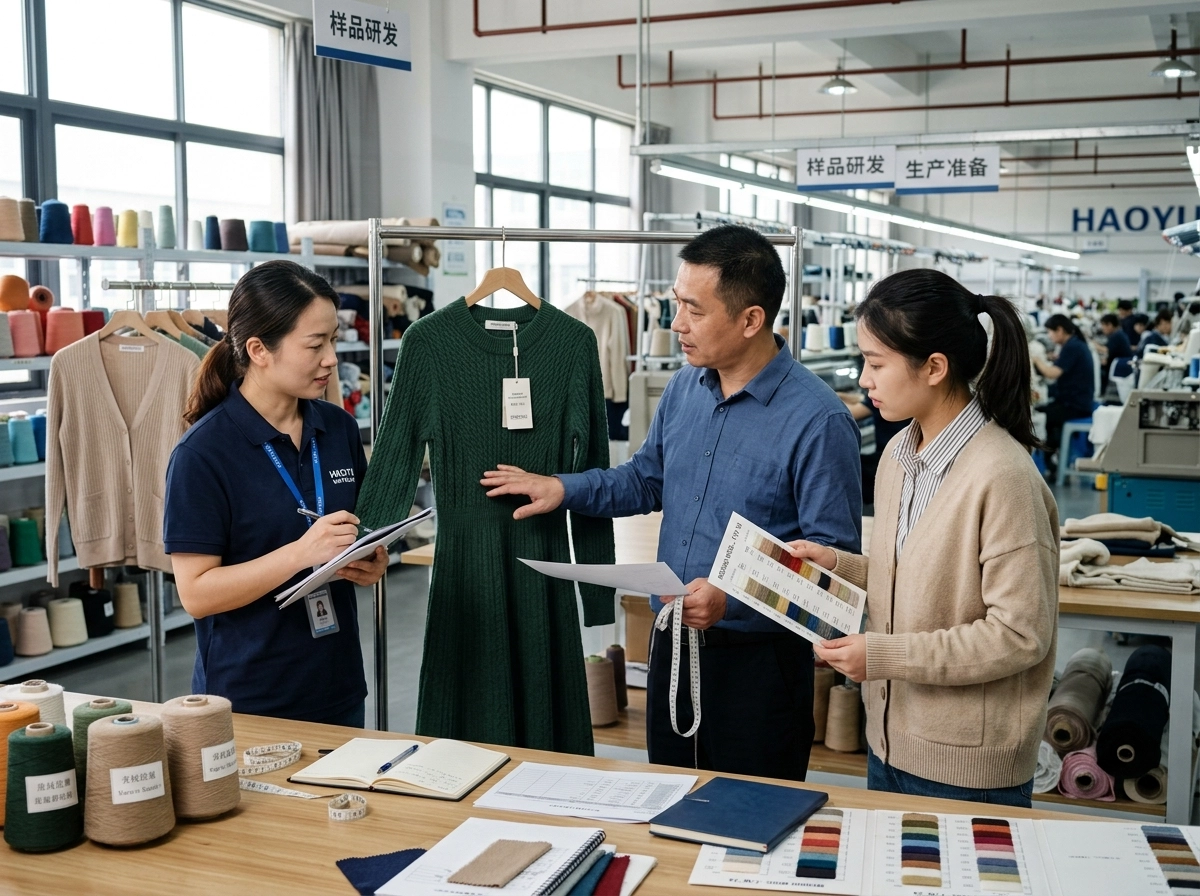
Approve a knitted dress for women size range only after the buyer can compare the fit block, finished-garment POM, ease, stretch and recovery, care result, and grade rules on the same dated record. Knit construction can alter the way a garment hangs and recovers, so a body chart alone is not a bulk-release standard.
Start by naming the silhouette, target customer, size range, key measurement points, yarn and stitch, care path, and sample decision owner. Ask the supplier to show the proposed garment measurements separately from body measurements and to record each change through proto, fit and PP samples. This page does not set universal measurements, tolerances, MOQ, timing, or factory fit results.
Which size inputs must be fixed before sampling?
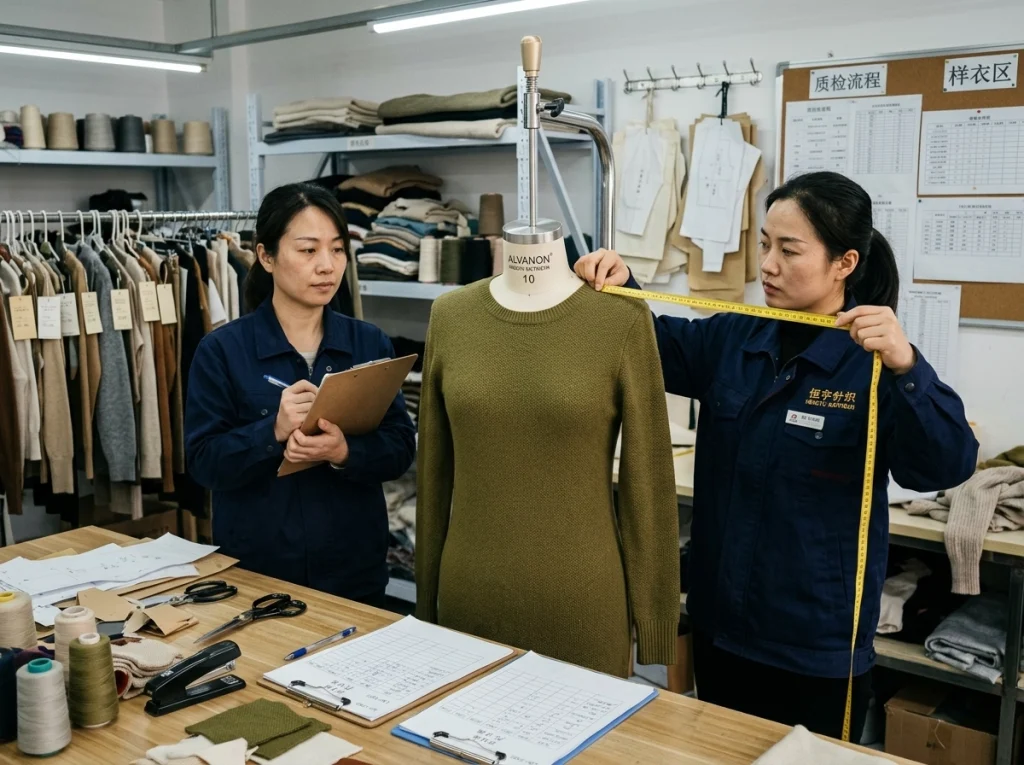
The main sizing risk in knit dresses is not whether the garment can technically stretch onto the body. The real issue is whether the dress keeps the intended silhouette, recovers after wear, and stays consistent across sizes and colorways in bulk.
How should stretch and recovery be recorded?
Many buyers assume knitwear is more forgiving because it stretches. In practice, that can create more risk, not less. A knit dress may fit in a fitting room but still become longer, looser at the hip, or less balanced after hanging, steaming, packing, and repeat wear. This is especially true in fitted styles, rib structures, and softer yarn systems such as viscose blends.
That is why a supplier should not discuss sizing without also discussing recovery, density, and construction route. On the knit dresses page, the emphasis on stitch architecture, drape control, elasticity management, and vertical stability reflects a practical reality: a knit dress that “fits” at sample stage can still fail commercially if it grows or twists too easily in production.
Which silhouette decisions change the size system?
Not every knitted dress should be sized with the same logic. A bodycon style depends on controlled elasticity and recovery. A straight dress depends more on clean vertical hang and hip balance. An A-line shape needs a stable transition from upper body fit to hem movement. A long dress introduces more risk because length, weight, and gravity start to affect the final look more noticeably.
For buyers, this means the measurement priorities must change by silhouette. If the style is close-fitting, bust, waist, hip, and recovery behavior may matter most. If it is a long sleeve knit dress with a straighter line, cross back, armhole depth, sleeve drag, and total length stability become more important. Using one grading mindset for all silhouettes usually leads to avoidable sample rounds.
Which fit conditions need a repeatable check?
A fitting session tells you only part of the story. Knit dresses often reveal their real issues after hanging, steaming, and time under their own weight. Common problems include vertical elongation, spirality, localized bulging, sleeve drag, and hem distortion.
This is why factory-side checkpoints matter. The knit dresses program specifically highlights hanging tests, spirality checks, and elongation control. For a buyer, those are not small technical details. They are part of the sizing strategy because they determine whether the approved sample can actually hold the intended fit in bulk and during retail use.
Which garment measurements define the approved size chart?
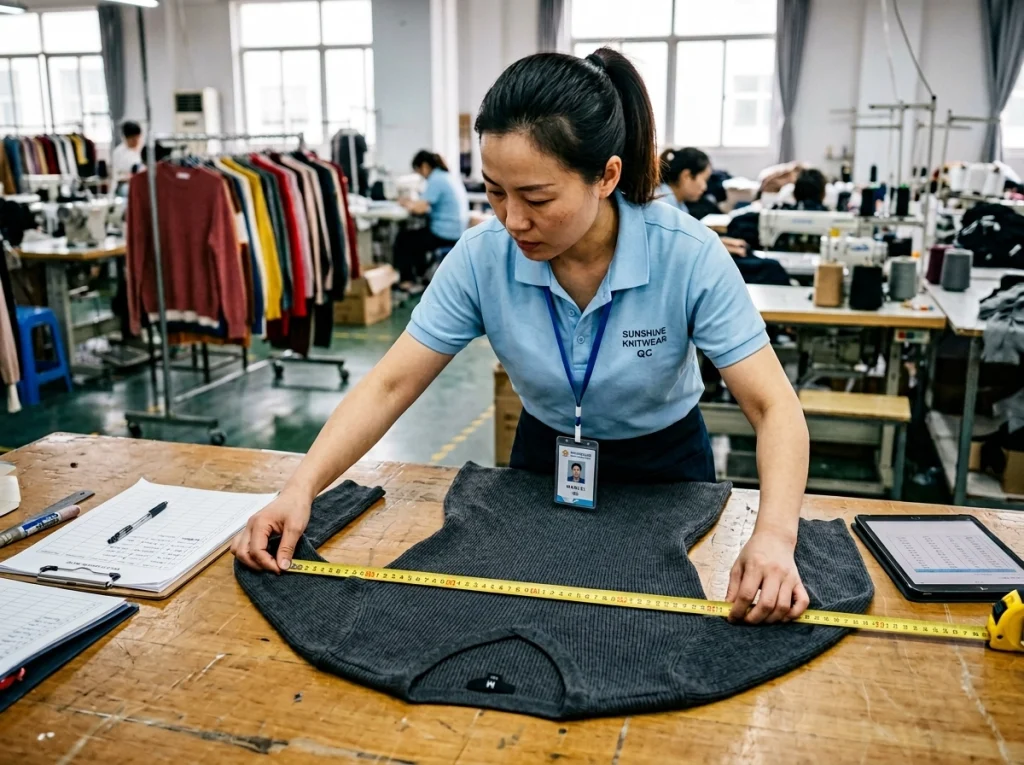
Bust, waist, and hip are only the starting point. For a commercial ladies knitted dress program, especially one with sleeves or a more structured silhouette, the internal size chart needs more depth.
How should body and garment measurements be separated?
A common mistake is to mix body measurements and garment measurements as if they were the same tool. They are not. As the Craft Yarn Council body sizing guidance explains, body measurements are the reference for sizing, while ease determines how the final garment relates to the body. The Points of Measure explanation of size charts makes a similar point: a size chart should define the target customer body first, and garment specs should then be built from that logic.
For B2B development, the supplier and buyer should align on an internal size chart before discussing final garment tolerances. That chart should represent the target wearer, not a random fit model and not a competitor garment copied without analysis. If this step is weak, the grading discussion will stay reactive all the way through sampling.
Which sleeve and length points need explicit POMs?
For a long sleeve knit dress, several measurements are often under-specified even when bust, waist, and hip are clear. These include back waist length, cross back, armhole depth, sleeve length, and upper arm. Those points affect how the dress sits on the shoulder, whether the sleeve pulls the bodice, and whether the silhouette stays balanced once the garment is worn and hangs under its own weight.
This matters because knit sleeves can change the way the whole dress behaves. If the armhole is too shallow, movement becomes restricted and the upper body may lift. If the sleeve is too heavy for the bodice structure, it can drag the shoulder line. If the cross back is too narrow, the dress may look correct on a static mannequin but fail in real movement. The Craft Yarn Council body sizing guidance is useful here because it shows that a good fit system for knitwear should consider more than the basic three circumference points.
How should ease be decided before the fit sample?
Ease should never be treated as an afterthought. The Craft Yarn Council body sizing guidance outlines the difference between negative ease, zero ease, and positive ease, and that distinction is highly relevant in knit dresses.
For fitted bodycon styles, controlled negative ease may be appropriate, but only if the yarn and stitch combination has reliable recovery. For a classic long sleeve knit dress meant for broader wearability, zero to light positive ease is often safer. For relaxed or straight silhouettes, too much ease can create drag, length growth, and a less premium look. From a factory perspective, it is much easier to engineer the correct ease at proto stage than to keep revising measurements later after stitch and yarn decisions are already locked.
Locked input
Silhouette, target customer, POM, size range, yarn, stitch and care path.
Evidence
Approved fit sample, dated measurement sheet, grade rules, stretch/recovery check and comments.
Gate
Hold bulk when the sample result or an approved change is not traceable to the size record.
Which construction inputs can change fit?
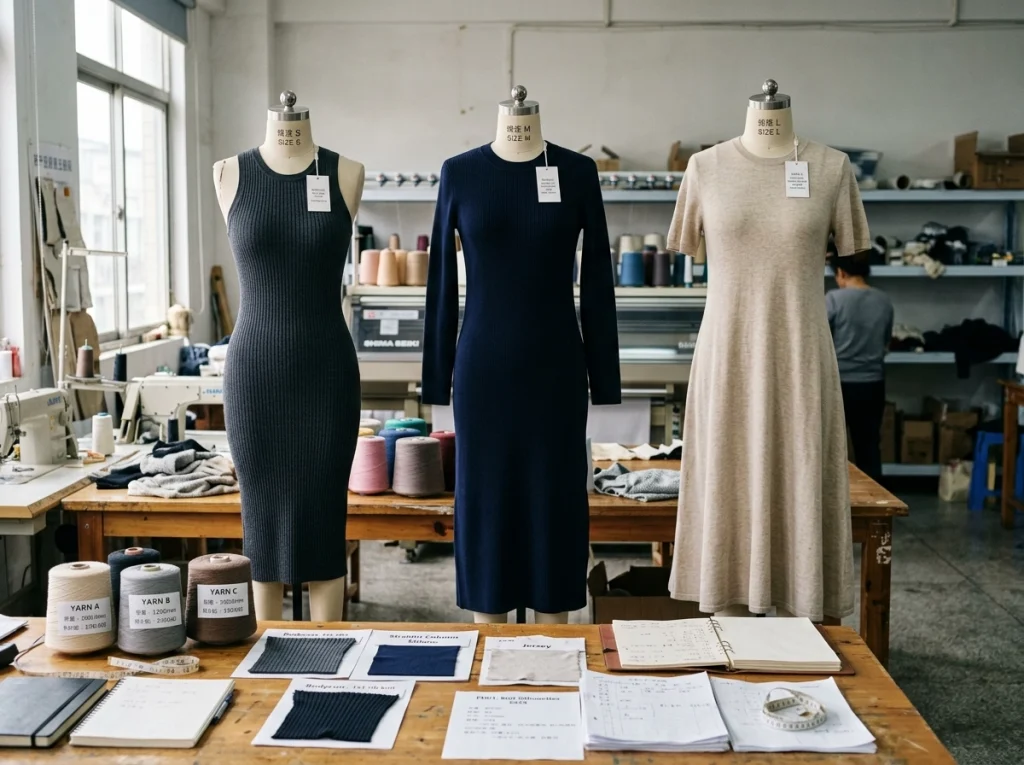
The right size chart alone is not enough. In knit dresses, silhouette, stitch system, and yarn choice can change the sizing outcome even when the nominal measurements stay the same.
How should the buyer adapt sizing by silhouette?
A bodycon dress needs controlled elasticity and strong recovery. If the stitch is too loose or the yarn is too fluid, the dress may start with the right fit but lose shape after wear. A straight dress is less demanding in terms of compression, but more sensitive to vertical balance, spirality, and clean side seams. An A-line dress needs stable shaping from torso to hem, or the flare may become uneven across sizes.
This is why brands should define the fit objective first, not only the look reference. The knit dresses page separates bodycon, A-line, straight, and long dress programs for a reason. Each silhouette has a different production logic, and sizing decisions should follow that logic rather than trying to simplify everything into one grading sheet.
Which stitch behaviour must be checked on the sample?
Stitch structure changes both fit perception and production stability. Rib offers controlled stretch, which can work well for close-fitting dresses, but it also makes recovery and elongation more important. Milano rib is firmer and helps reduce distortion, making it useful when a brand wants more structure. Double-knit can support cleaner surfaces and more formal silhouettes, especially when a straighter line and better shape retention are needed.
From a buyer’s perspective, stitch selection is not only a design decision. It is part of the sizing strategy because it affects how much tolerance the style can absorb before the fit starts to look wrong. When evaluating a ladies knitted dress, it is often better to ask how the stitch behaves after hanging and steaming than to focus only on the flat sample measurements.
How should yarn and care be connected to the fit decision?
Yarn choice is one of the biggest reasons two dresses with the same pattern can fit differently. Viscose and nylon blends often give fluid drape and a smoother surface, but they can also make length control more difficult if density and structure are not adjusted carefully. Strong-twist cotton can help shape retention. Merino adds natural elasticity and warmth. Linen blends can support seasonal texture but may require a different fit expectation because they behave differently from softer, more elastic yarn systems.
This is why a buyer should not approve size and yarn in separate conversations. On the OEM / ODM knitwear service page, the workflow connects yarn options, sampling, approval, and bulk planning. That structure is commercially sound because sizing only becomes reliable when yarn, gauge, stitch, and fit notes are reviewed together.
Which sample records support bulk approval?
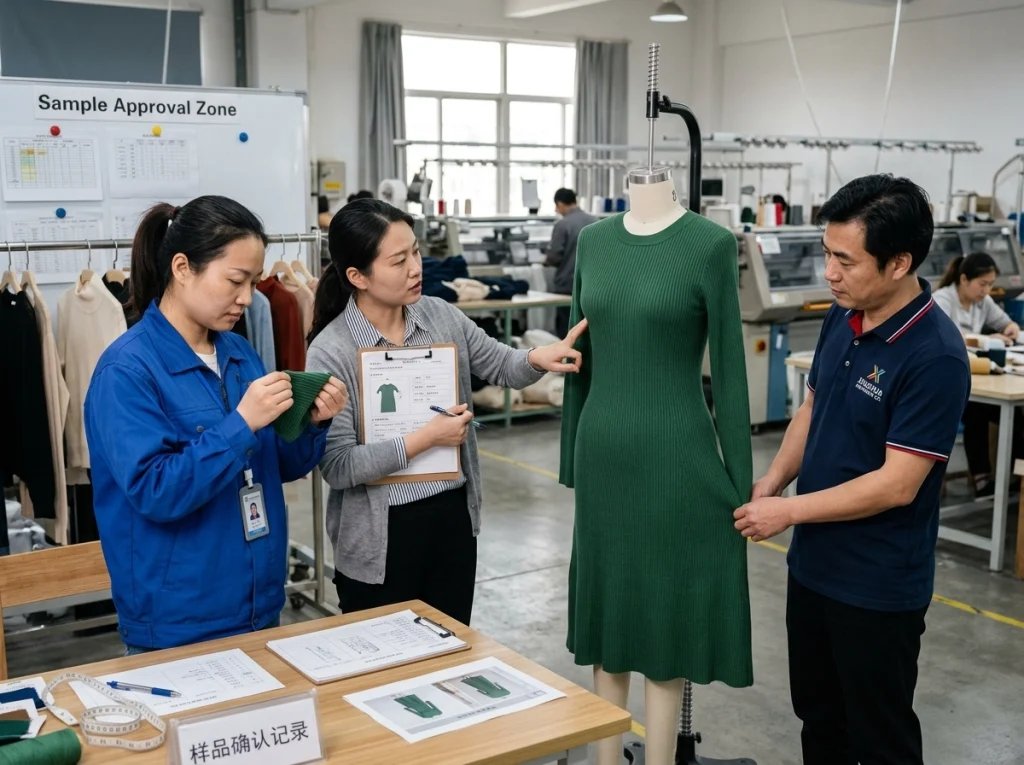
The most effective way to reduce fit disputes is to design the sample workflow properly. A good sizing strategy becomes real only when it is tested through the right approval stages.
What must be decided at each sample gate?
At proto stage, the main goal is to confirm direction: silhouette, stitch behavior, yarn suitability, and whether the chosen ease makes sense. At fit sample stage, the focus should narrow to measurements, wearing balance, sleeve behavior, recovery, and how the dress sits after movement and hanging. At PP sample stage, the buyer should confirm what will be frozen for production: approved measurements, colorway execution, finishing standards, and the bulk plan.
The OEM / ODM knitwear service page presents a clear process from RFQ to sampling, PP approval, bulk and QC, then shipment. That sequence is especially important for knit dresses because PP approval is not just a formal step. It is the point where fit logic, production feasibility, and commercial timing need to align.
When should a size set be checked?
A sample in one core size is not enough to prove that a size strategy works. Size sets help reveal whether grade rules are functioning properly across the range. This is particularly important in dresses with sleeves, fitted waists, longer lengths, or structures that react strongly to weight and stretch.
The Points of Measure explanation of size charts is useful here because it distinguishes between the customer-facing chart and the internal technical chart used for development consistency. From a factory perspective, size sets translate that internal logic into something testable. They reduce the risk of approving one good-looking sample size while other sizes become commercially weaker.
Which inspection points protect the size system?
For knit dresses, QC should cover more than visual defects. Buyers should ask how measurements are taken after finishing, whether hanging or elongation checks are used, how shade continuity is controlled, whether yarn lots are traceable, and whether inline plus final inspections are part of the system. If the program includes replenishment, consistency in future repeats matters as much as first-shipment appearance.
The OEM / ODM knitwear service page highlights PP sealing, inline inspection, final AQL checks on request, and yarn and color lot records. Those are good signs because they support not only quality control, but also size consistency over time.
Which order assumptions can change the size plan?
Sizing strategy is not separate from commercial planning. MOQ, yarn booking, launch timing, and repeat-order logic all affect how ambitious or conservative a size range should be.
When should the initial size range be limited?
For a first order, a narrower size range is often the smarter move. It reduces development complexity, lowers the risk of grading errors, and makes it easier to evaluate real sell-through before expanding the size architecture. This is especially true if the style uses more technical stitches, a fluid yarn, or a fitted silhouette.
From a factory perspective, simplified size planning can also improve sampling speed and reduce bulk risk. If the buyer wants to test market response first, it is usually better to build a cleaner core size offer than to launch too many sizes before the fit logic is proven.
Which timing changes require re-approval?
Lead time affects fit more than many buyers expect. If yarn is booked late, substitutions or continuity issues may appear. If PP approval is delayed, the factory may lose valuable production planning room in peak season. The OEM / ODM knitwear service page notes that capacity planning and early PP lock are important, and the homepage also stresses that peak season can affect both price and delivery timing.
For knit dresses, timing matters because late changes often force technical compromises. A small adjustment in yarn, gauge, or finishing timing can change how the dress hangs. If a brand cares about repeatable fit, it should treat calendar planning as part of the sizing strategy, not as a separate logistics issue.
Which retained records make a repeat size set comparable?
Replenishment is smoother when the first order creates a stable technical baseline. That means the approved size chart, yarn specification, stitch structure, finishing method, and inspection logic should be documented clearly and changed only for a reason.
This is one reason many buyers prefer working with a professional knitwear manufacturer in China that can connect development and production in one workflow. If the first order is handled with clear fit notes and disciplined PP approval, repeat orders usually become faster, more predictable, and easier to cost.
Which records should decide the size release?
Keep the dated POM and grade rules beside the approved sample, fit comments and care result. Use the ISO 2859-1 overview for an agreed sampling framework, FTC textile and wool guidance for US label checks, Woolmark care guidance where relevant, and the AATCC method-change index to identify method/version questions. They do not prove the result for a specific order.
Related published controls: tech-pack essentials, manufacturer evaluation, MOQ controls, low-MOQ checks, OEM/ODM selection, bulk consistency, cable-knit development, zipper and fit controls, and supplier comparison.
Conclusion
A strong knit dress fit is built, not guessed. For knitted dress women programs, the best results usually come from three things working together: a clear measurement logic, the right stitch and yarn decisions for the intended silhouette, and disciplined sample validation before bulk.
For buyers and product teams, the practical takeaway is simple. Define the target body, lock the ease direction early, test the style after hanging rather than only during fitting, and use size sets and PP approval to confirm that the fit can repeat in production. That approach is usually more effective than trying to fix problems after the bulk order is already underway.
If you are planning a ladies knitted dress or long sleeve knit dress line and want to review fit, yarn options, development timing, or bulk feasibility, working with our knitwear manufacturing team early in the process can help reduce avoidable sample rounds and improve production consistency.
FAQ
How should buyers size a bodycon knit dress differently from an A-line knit dress?
Bodycon styles usually need controlled negative ease and stronger recovery discipline, while A-line dresses need a more balanced upper-body fit with controlled flare through the hem. The sizing logic should reflect how the silhouette is supposed to hold shape, not just how the dress looks on a hanger.
What measurements matter most for a long sleeve knit dress?
Bust, waist, and hip still matter, but long sleeve styles also depend heavily on armhole depth, upper arm, sleeve length, cross back, and back waist length. These points affect shoulder balance, sleeve drag, and how the dress hangs after wear.
Should brands use body measurements or garment measurements in supplier communication?
Both are needed, but they serve different purposes. Body measurements define the target customer, while garment measurements define the physical spec to be produced. Mixing them without clear ease rules often creates confusion during development.
How many sample rounds are usually needed before bulk?
That depends on complexity, but knit dresses often need at least a proto review and a fit-focused round before PP approval. More complex stitches, fluid yarns, or fitted silhouettes may need additional correction rounds if the technical direction is not clear early enough.
How does MOQ affect size range decisions for a new knit dress program?
MOQ affects how wide a range is realistic in the first launch. If quantity is limited, a tighter size architecture is often safer because it reduces grading risk, simplifies production, and gives the brand cleaner market feedback before expanding the range.