 CN Sweaters
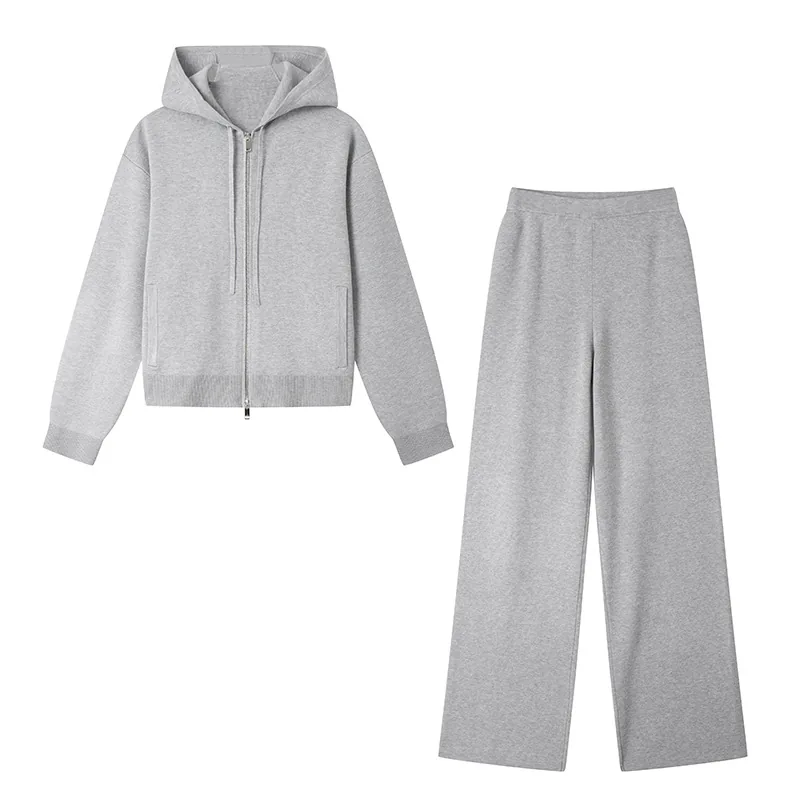
A knit hoodie is not a cut-and-sew hoodie made from sweater fabric. It is a different garment category that requires fully-fashioned panels or whole-garment knitting, hood-weight engineering, and shoulder-line support that French terry or fleece hoodies never need. Treating the two as interchangeable is the most common reason knit hoodie development goes wrong in bulk.
When a buyer sends a French terry hoodie reference and asks a sweater factory to “make it in knit,” the result is rarely usable. The hood droops because nobody calculated its grams. The shoulder stretches out after one wash because the seam was not reinforced for a heavy knitted panel. The body grows two centimeters in length because the knit construction has natural shrinkage that cotton fleece does not. These are not quality defects in the traditional sense. They are development failures caused by applying cut-and-sew logic to a knitted product.
This guide explains how a hooded knit sweater is actually built, where the costs and risks sit, and what brands developing a cable knit hoodie, cotton knit hoodie, or heavier knitwear hoodie need to clarify before committing to bulk. The goal is to help buyers ask the right questions during sampling and avoid surprises after shipment.
What Makes a Knit Hoodie Structurally Different
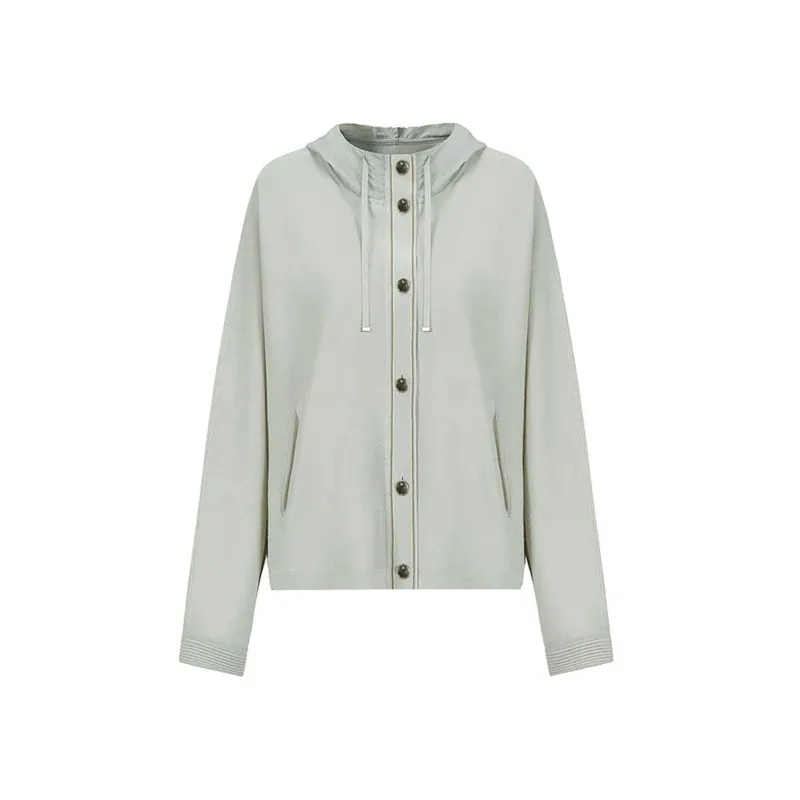
A knit hoodie is built loop by loop on a flat-bed or circular knitting machine, not cut from a roll of fabric. This single fact changes almost every downstream decision. In cut-and-sew hoodie production, a factory orders French terry or fleece by the meter, lays it on a cutting table, cuts panels with a die or laser, and sews them together. The fabric exists before the garment does.
In knit hoodie production, the fabric and the garment are created at the same time. Panels are knitted to shape on a flat-bed machine, usually at a gauge between 3GG and 14GG depending on the look you want. A chunky cable knit hoodie typically lives at 3GG to 7GG. A finer cotton knit hoodie sits at 7GG to 12GG. The yarn, the stitch density, and the panel shape are all decided before a single piece of fabric exists.
This matters for buyers because it means you cannot send a reference photo and expect the factory to “match the feel” without specifying gauge, yarn count, and stitch structure. Production is gated by machine availability at the chosen gauge, and switching gauges mid-development means rebuilding the program. From a factory perspective, a hooded knit sweater is closer to engineering than to sewing. For B2B buyers, the practical consequence is longer development cycles and tighter front-end specification work, but also a more stable bulk outcome once the program is locked.
How Knit and Cut-and-Sew Hoodies Compare Side by Side
Before discussing individual production stages, it helps to see the differences in one view. The table below summarizes how the two construction methods diverge across the dimensions buyers actually care about during development.
| Dimension | Knit Hoodie (Fully-Fashioned) | Cut and Sew Hoodie (French Terry / Fleece) |
|---|---|---|
| Fabric source | Knitted to shape per panel | Roll goods cut into panels |
| Typical gauge / weight | 3GG–14GG, 350–900g garment | 280–450 GSM fabric, 400–700g garment |
| Hood behavior | Tends to droop if not engineered | Holds shape from woven-like stability |
| Shoulder stability | Needs linking and reinforcement | Standard overlock seam is sufficient |
| Sampling lead time | 18–30 days typical | 7–15 days typical |
| MOQ driver | Yarn dye lot (often 50–100 kg) | Fabric roll minimum and color |
| Per-unit cost | Higher, yarn-driven | Lower, fabric-driven |
| Bulk consistency risk | Yarn batch and tension variation | Cutting accuracy and shrinkage |
The table makes one point clear: a knit hoodie carries more front-end risk and cost, but it delivers a different product category entirely. Buyers should not pick between them based on price alone. The choice depends on what the end consumer expects when they pick the garment up off the rack.
Why a Knit Hoodie Needs Engineered Hood Weight and Shape
The single most common defect in a poorly developed knit hoodie is a hood that droops, collapses against the back, or pulls the neckline down. This is a weight and structure issue, not a styling issue, and it has to be solved before sampling begins.
A fleece hoodie hood weighs roughly 60 to 90 grams. A knitted hood at 5GG in cotton blend can easily weigh 150 to 220 grams. That extra mass hangs from the neckline and pulls on the upper back panel. If the body is knitted in a soft jersey without enough density at the shoulder yoke, the whole garment distorts after the first wear.
Three levers control this. The first is hood gauge selection. Many factories knit the hood one or two gauges tighter than the body, or use a double-layer hood construction to add structure without adding too much weight. The second is yarn choice. Cotton-acrylic blends and merino blends behave differently here because cotton absorbs more moisture and gets heavier when washed, which compounds the droop problem over time. The third is neckline reinforcement, usually a linked rib or a tape inside the hood-to-body join.
For buyers, the practical takeaway is to weigh the reference hoodie hood on a kitchen scale and share that target with the factory. A weight target gives the development team something concrete to engineer against. Without it, you are relying on the factory’s interpretation, which varies widely. We have seen the same hood pattern produced with a 90-gram weight difference between two suppliers, both technically correct against the spec sheet.
Shoulder, Sleeve, and Hem Construction in Knit Hoodies
The shoulder line is where cut-and-sew habits cause the most damage in knit hoodie development. A French terry hoodie uses a standard overlock or flatlock seam at the shoulder, and the fabric itself is stable enough to hold the line. A knitted panel is not. It stretches under its own weight, especially in heavier gauges and longer body lengths.
Proper knit hoodie shoulders are linked, not overlocked. Linking joins two knitted panels loop-by-loop, creating a flat, low-stretch seam that does not break under tension. It is slower and costs more per piece, but it is the difference between a garment that holds its shape for 30 wash cycles and one that sags after five. For heavier styles in our Zip-Up & Hooded Knitwear range, we link the shoulders by default and reinforce the neckline tape.
Sleeve attachment follows similar logic. Set-in sleeves on knit hoodies require either linking or a carefully tensioned overlock with stretch tape inside the seam. Drop-shoulder constructions are more forgiving because gravity pulls the seam straight down rather than across, but they still need attention at the armhole curve, where the stitch count changes most rapidly.
Hems and cuffs almost always use a 1×1 or 2×2 rib, knitted continuously with the panel rather than sewn on afterward. This is one of the structural advantages of fully-fashioned knitting and a visible quality marker. If a sample arrives with a separately cut and sewn rib hem, the factory is treating the project as cut-and-sew, which usually predicts other problems downstream. Buyers reviewing samples should always check whether the rib transitions smoothly into the body or shows a cut-and-attached seam line.
Yarn Selection and Stitch Structure for Knit Hoodies
Yarn drives both cost and behavior in a knit hoodie, more directly than fabric drives a fleece hoodie. According to CottonWorks design guidance, fabric cost typically accounts for around 60% of total garment price in knitwear, and the lever is yarn, not labor.
For a cotton knit hoodie aimed at year-round retail, the common spec is a 2/28Nm or 2/24Nm cotton-acrylic blend, often 60/40 or 50/50. This gives enough weight for a hood without making the garment uncomfortably warm. For a cable knit hoodie in heavier outerwear positioning, buyers more often request 2/16Nm to 2/8Nm wool blends or chunky cotton, knitted at 3GG to 5GG. The thicker the yarn, the more visible the cable, but also the heavier the hood and the higher the risk of distortion.
Stitch structure interacts with yarn choice in ways that affect dimensional stability. Pure jersey shrinks more in length and curls at the edges. Half-cardigan and full-cardigan structures hold shape better but use more yarn per square meter, increasing weight and cost. Cable patterns pull the fabric inward, which can make the chest measurement smaller than the flat measurement suggests, requiring pattern compensation.
The buyer decisions that matter here are: target garment weight in grams, gauge in GG, and yarn composition in percentages. Send these three numbers with your tech pack and most of the ambiguity disappears.
Sampling, MOQ, and Lead Time Realities
Knit hoodie sampling takes longer than cut-and-sew sampling for a structural reason. Each panel program has to be written, tested on a swatch, knitted, washed for shrinkage measurement, then adjusted. A first proto sample on a new style typically takes 18 to 25 working days at our factory, and a confirmed PP sample adds another 10 to 15 days. For a fleece hoodie, the same process runs 7 to 12 days because the factory is cutting from existing fabric.
MOQ in knitwear is driven by yarn dye lots, not by stitching capacity. A single color in a custom yarn typically requires a minimum dye lot of 50 to 100 kilograms. For a mid-weight knit hoodie using roughly 600 grams of yarn per piece, that translates to 80 to 160 pieces per color before the yarn mill will accept the order. Stock yarn colors lower this threshold significantly, often to 30 to 50 pieces per color, which is why we encourage new buyers to start with stock-color development and move to custom dye after the first season. The same principle applies across our broader knitwear product range, where yarn availability often defines what is achievable at small volumes.
Lead time for bulk production typically runs 45 to 70 days after PP sample approval, depending on yarn lead time, gauge, and order size. Heavier gauges produce more meters of fabric per machine hour but take longer per piece on the linking and finishing lines. For buyers building a launch calendar, the practical rule is to budget 90 to 120 days from tech pack to shipment-ready goods. Compressing below this is possible only when working with familiar stock yarns and proven base patterns.
How to Control Knit Hoodie Quality in Bulk
Quality control for knit hoodies is heavier on dimensional testing than for cut-and-sew hoodies, because knitted fabric moves more between production stages. The areas that need formal testing before bulk approval are dimensional stability after wash, pilling resistance, color fastness to washing and rubbing, and seam strength at linked shoulders and armholes. International testing programs such as Intertek apparel testing provide standardized methods for these, and most serious brands require third-party reports before shipment.
In-house, the controls that matter most are tension monitoring on the knitting machines, post-knit wash and measure on every size, and full size-set inspection before bulk linking begins. We measure body length, chest, hood height, hood width, sleeve length, and armhole drop on every size, comparing against the approved PP sample with a tolerance of typically ±1 cm to ±1.5 cm depending on the dimension. Anything outside tolerance triggers a program adjustment, not a discount.
Bulk risk in knit hoodies concentrates in two places. The first is yarn batch variation across larger orders. A 1,000-piece order may pull from two or three yarn dye lots, and if the lots vary in shade, the only fix is to group pieces by lot for shipment. The second is hand-feel drift between sampling and bulk, caused by differences in finishing equipment loads. We address this by running a top-of-production sample alongside the first bulk batch and comparing it to the original PP sample under the same wash conditions.
Conclusion
A knit hoodie is a different garment from a cut-and-sew hoodie at every stage, from yarn selection through hood engineering, shoulder construction, sampling, and bulk QC. Treating it as a sweater fabric version of a fleece hoodie is what produces drooping hoods, sagging shoulders, and inconsistent bulk. Treating it as a fully-fashioned knit product, with weight targets, gauge specifications, and linked seam requirements, is what produces a garment that holds up across a full retail season.
For brands developing a hooded knit sweater, cable knit hoodie, or cotton knit hoodie program, the value of working with a dedicated knitwear factory comes from this engineering perspective rather than from sewing capacity alone. Share your hoodie reference style, target yarn, gauge, and fit requirements with our knit hoodie development team to confirm knit hoodie production feasibility and lock the specifications that will keep your bulk consistent.
FAQ
What is the MOQ for a custom knit hoodie in a new color?
For custom-dyed yarn, expect 80 to 160 pieces per color depending on yarn weight, because the yarn mill’s minimum dye lot is typically 50 to 100 kilograms. Stock yarn colors usually allow MOQs of 30 to 50 pieces per color per size set, which is the more practical starting point for new programs or first seasons.
How long does it take to develop a knit hoodie from tech pack to bulk-ready PP sample?
Plan on 30 to 40 working days for a new style. The first proto sample takes 18 to 25 days, and the PP sample adds another 10 to 15 days for adjustments, washed measurements, and final approval. Bulk production then runs 45 to 70 days after PP confirmation.
Can I send a French terry hoodie as my reference for a knit hoodie?
You can send it for silhouette and fit reference, but the construction will be re-engineered. We will ask for separate inputs on target gauge, yarn composition, garment weight, and hood weight, because these cannot be derived from a fleece reference. Without these inputs, sampling risk increases significantly.
What testing should I require before approving bulk knit hoodie shipment?
At minimum, dimensional stability after three wash cycles, pilling resistance to a Martindale or random tumble standard, color fastness to washing and rubbing, and seam strength at the shoulder linking. Third-party reports from recognized labs cover these and reduce dispute risk on arrival.
Why does my knit hoodie sample feel different from the bulk garments?
The most common cause is finishing equipment load. Sampling is done in small batches, while bulk runs through larger washers and tumblers, which changes hand-feel. We run a top-of-production sample against the PP sample under matched conditions to catch this before full shipment.